instrument cluster MITSUBISHI OUTLANDER PHEV 2018 (in English) User Guide
[x] Cancel search | Manufacturer: MITSUBISHI, Model Year: 2018, Model line: OUTLANDER PHEV, Model: MITSUBISHI OUTLANDER PHEV 2018Pages: 538, PDF Size: 25.01 MB
Page 250 of 538
Emergency stop signal
system E00626001259
This is a device that reduces the possibility of rear end collisions by the rapid and automatic blinking of the hazard warning lamps to alert
vehicles approaching from behind during sudden braking. When the emergency stop
signal system operates, the hazard warning indication lamp in the instrument cluster
blinks rapidly at the same time.CAUTIONl If the ABS warning or ASC warning is dis-
played, the emergency stop signal system may not operate. Refer to “ABS warning
lamp/display” on page 7-37.
Refer to “ASC warning lamp/display” on page 7-42.NOTEl [Activating condition for the emergency stop
signal system]
It activates when all of the following condi-
tions are met.
• The vehicle speed is approximately
55 km/h (34 mph) or higher.NOTE• The brake pedal has been depressed, and
the system judges that it was sudden brak- ing from the vehicle deceleration and theoperating condition of the anti-lock brake
system (ABS).
[Deactivating condition for the emergency
stop signal system]
It deactivates when one of the following conditions is met.
• The brake pedal is released.
• The hazard warning flasher switch is
pressed.
• The system judges that it was not sudden
braking from the vehicle deceleration and
the operating condition of the anti-lock
brake system (ABS).Anti-lock brake system
(ABS) E00607102489
Environmental conditions can have an effect
on braking. During sudden braking when there is snow, ice, oil, water etc. on the road
surface, a skid may occur. In this situation, steering control and braking effectiveness is
reduced and the stopping distance is in-
creased. The vehicle may also go into an un- controlled spin.
The ABS helps prevent the wheels from lock-
ing during braking, thus maintaining direc-
tional stability, ensuring controllability and
providing optimum braking force.
Operating hints
l Always maintain the same distance from
the vehicle in front of you as you would for a vehicle not equipped with ABS.
Compared with vehicles not fitted with ABS, your vehicle may require a longer
stopping distance in the following cases: • Driving on gravel or snow-covered
roads.
• Driving with snow traction device
(tyre chains) installed.
• Driving on roads where the road sur-
face is pitted or has other differences in surface height.
• Driving on bumpy roads or other poor
driving surfaces.
l Operation of ABS is not restricted to sit-
uations where brakes are applied sud-
denly. This system may also operate to
prevent wheel lock when you are driving over manholes, steel road-work plates,
or the vehicle is driven over steps or lev-
el differences in the road, road markings, or other surfaces which are difficult for
the wheels to grip.
Emergency stop signal system
7-36OGGE18E1Starting and driving7
Page 295 of 538
WARNING•When a vehicle is travelling alongside
of your vehicle at nearly the same speed
for prolonged periods of time.
• When the heights of the next lane and
your lane are different.
• Immediately after the BSW has been
turned on.
• Immediately after the power switch is
turned on.
• Under adverse weather conditions,
such as rain, snow, strong winds or
sand storms.
• When your vehicle comes too close to
another vehicle.
• While multiple vehicles are overtaking
your vehicle.
• When driving near a pot hole and
tramline.
• When a surrounding vehicle or an on-
coming vehicle is splashing water, snow or dirt.
• When driving on a curve including the
beginning and the end of the curve.
• When driving on a road with alternat-
ing up and down steep slopes.
• When driving on a bumpy or rough
road.
• When the rear of your vehicle is weigh-
ed down or your vehicle is leaning to
the right or left due to the weight of passengers and luggage or the improp-
er adjustment of tyre pressure.
• When the bumper surface around the
sensor is covered with dirt, snow and
ice, etc.WARNING• When the sensor is extremely hot or
cold (while the vehicle is parked for a
long period of time under a blazing sun or in cold weather).
• When a bicycle carrier or accessory is
installed to the rear of the vehicle.CAUTIONl To maintain proper performance of the
BSW, follow the instructions below.
• Always clean the bumper surface around
the sensor.
• Avoid impacting the sensor or its sur-
rounding area.
• Do not put a sticker on the sensor or its
surrounding bumper surface.
• Do not paint the sensor or its surrounding
bumper surface.
• Do not modify the sensor or its surround-
ing area.
l If the bumper has experienced an impact, the
sensor may have been damaged and the
BSW may not function properly. Have the
vehicle inspected at a MITSUBISHI
MOTORS Authorized Service Point.To operate
E00652300126
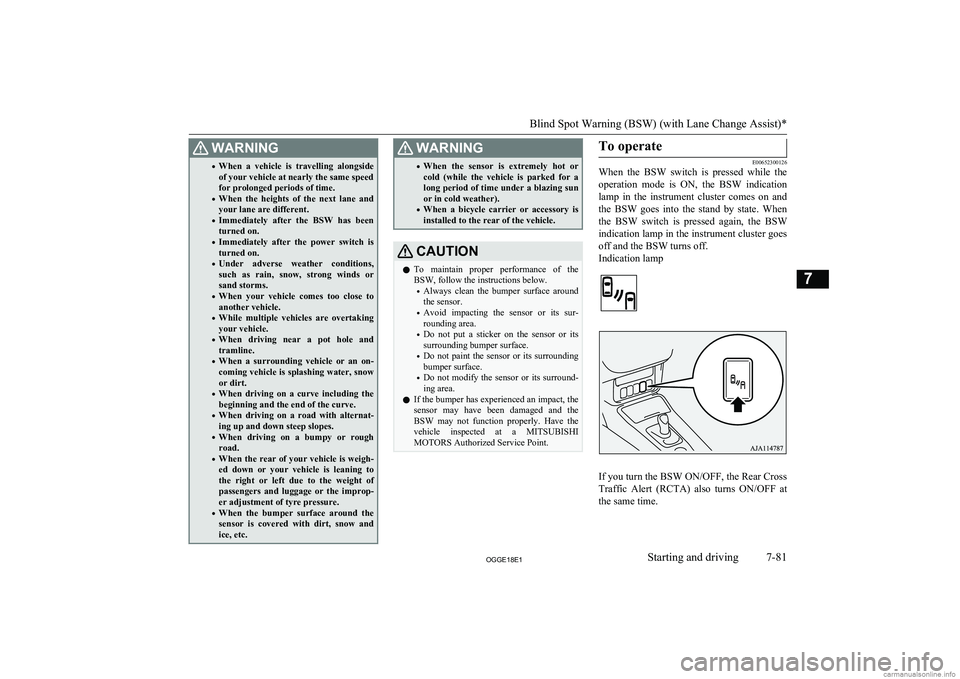
When the BSW switch is pressed while the
operation mode is ON, the BSW indication
lamp in the instrument cluster comes on and the BSW goes into the stand by state. When the BSW switch is pressed again, the BSW
indication lamp in the instrument cluster goes
off and the BSW turns off.
Indication lamp
If you turn the BSW ON/OFF, the Rear Cross Traffic Alert (RCTA) also turns ON/OFF at the same time.
Blind Spot Warning (BSW) (with Lane Change Assist)*
7-81OGGE18E1Starting and driving7