oil type MITSUBISHI OUTLANDER SPORT 2015 3.G Owners Manual
[x] Cancel search | Manufacturer: MITSUBISHI, Model Year: 2015, Model line: OUTLANDER SPORT, Model: MITSUBISHI OUTLANDER SPORT 2015 3.GPages: 384, PDF Size: 61.37 MB
Page 66 of 384
Break-in recommendations
Features and controls 5-3
5
N00508700330
Advanced automobile manufacturing tech- niques permit you to operate your new vehi-cle without requiring a long break-in period of low-speed driving. However, you can add to the future perfor-mance and economy of your vehicle by observing the following precautions during the first 300 miles (500 km).Drive your vehicle at moderate speeds duringthe break-in period. Avoid revving the engine. Avoid rough driving such as sudden starts, sudden acceleration, prolonged high-speed driving and sudden braking. These would have a detrimental effect on the engine and also cause increased fuel andoil consumption, which could result in malfunction of the engine components. Be particularly careful to avoid full accelera-tion while in low shift position (low gears). Do not overload the vehicle. Stay within the seating capacity. (Refer to “Cargo load precautions” on page 6-10.) Do not use this vehicle for trailer towing.
N00508800562
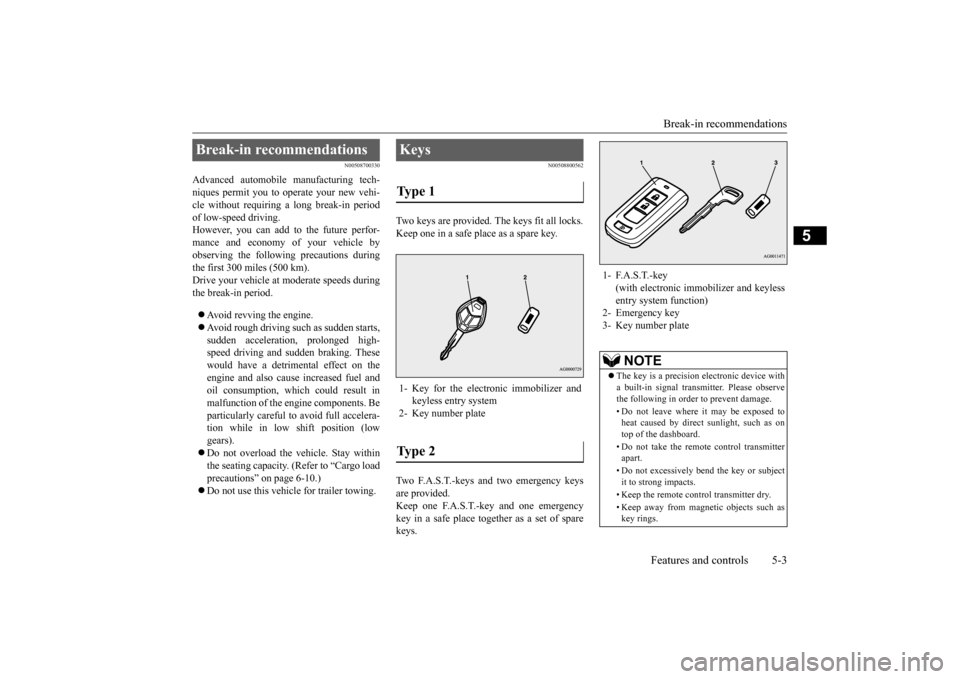
Two keys are provided. The keys fit all locks. Keep one in a safe place as a spare key. Two F.A.S.T.-keys and two emergency keys are provided. Keep one F.A.S.T.-key and one emergencykey in a safe place together as a set of spare keys.
Break-in recommendations
Keys Type 1 1- Key for the electronic immobilizer and
keyless entry system
2- Key number plateType 2
1- F.A.S.T.-key
(with electronic immob
ilizer and keyless
entry system function)
2- Emergency key 3- Key number plate
NOTE
The key is a precision electronic device with a built-in signal transmitter. Please observe the following in order to prevent damage. • Do not leave where it may be exposed to heat caused by direct sunlight, such as ontop of the dashboard. • Do not take the remote control transmitter apart. • Do not excessively bend the key or subject it to strong impacts. • Keep the remote control transmitter dry.• Keep away from magnetic objects such as key rings.
BK0206700US.bo
ok 3 ページ 2014年3月25日 火曜日 午後4時42分
Page 124 of 384
Inspection and maintenance fo
llowing rough road operation Features and controls 5-61
5
N00530700098
After operating the vehicle in rough road con- ditions, be sure to perform the following inspection and maintenance procedures: Check that the vehicle has not been dam- aged by rocks, gravel, etc. Carefully wash the vehicle with water. Drive the vehicle slowly while lightlydepressing the brake pedal in order to dry out the brakes. If the brakes still do not function properly, co
ntact an authorized
Mitsubishi Motors dealer or a repair facil- ity of your choice as soon as possible to have the brakes checked. Remove the insects, dried grass, etc. clog- ging the radiator core.
After driving through water, check the engine, transaxle and differential oil. If the oil or grease is milky or cloudy because of water contamination, it mustbe replaced with new oil. Check the inside of the vehicle. If water entry is found, dry the carpet etc. Inspect the headlights. If water is in the headlight housing, have it drained at an authorized Mitsubishi Motors dealer or arepair facility of your choice. Have an authorized Mitsubishi Motors dealer replace grease in the wheel bear- ings.
N00530800187
Since the driving torque can be applied to thefour wheels, the driving performance of thevehicle when operating in 4-wheel drive is greatly affected by the condition of the tires. Pay close attention to the tires. Install only the specified tires on all wheels. Refer to “Tires and wheels” onpage 11-5.
Be sure all four tires and wheels are the same size and type. When it is necessary to replace any of the tires or wheels, replace all four. All tires should be rotated before the wear difference between the front and rear tires is recognizable.
Good vehicle performance cannot be expected if there is a difference in wear between tires. Refer to “Tire rotation” on page 9-19. Check the tire inflation pressure regularly.
After driving through water, apply the brakes to be sure they are functioning properly. If the brakes are wet and not functioning prop- erly, dry them out by driving slowly while lightly depressing the brake pedal. Inspecteach part of the vehicle carefully.
Inspection and maintenance following rough road opera-tion
CAUTION
Cautions on the handling of 4-wheel drive vehicles Tires and wheels
CAUTION Always use tires of the same size, type, and brand that have no wear differences. Usingtires of different size, type, brands or degree of wear, will increase the differential oil tem- perature and result in possible damage to thedriving system. Further, the drive train will be subject to excessive loading, possibly leading to oil leakage, component seizure, orother serious failures.
BK0206700US.bo
ok 61 ページ 2014年3月25日 火曜日 午後4時42分
Page 176 of 384
Indicator light, warning light, an
d information screen display list Features and controls 5-113
5
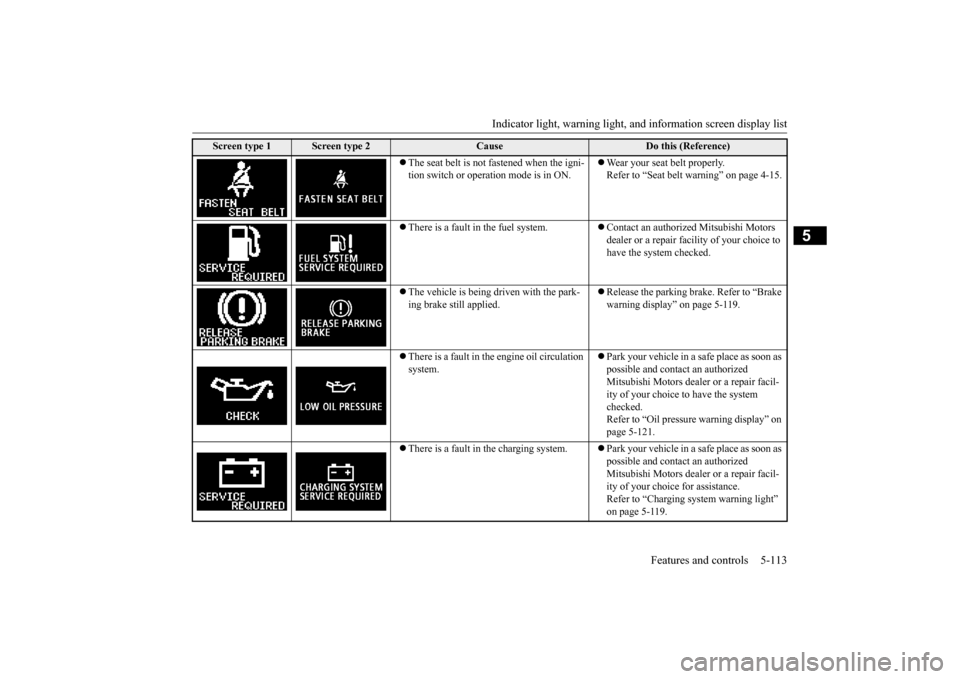
The seat belt is not fastened when the igni- tion switch or operation mode is in ON.
Wear your seat belt properly. Refer to “Seat belt warning” on page 4-15.
There is a fault in the fuel system.
Contact an authorized Mitsubishi Motors dealer or a repair facility of your choice to have the system checked.
The vehicle is being driven with the park- ing brake still applied.
Release the parking brake. Refer to “Brake warning display” on page 5-119.
There is a fault in the engine oil circulation system.
Park your vehicle in a safe place as soon as possible and contact an authorized Mitsubishi Motors dealer or a repair facil- ity of your choice to have the system checked. Refer to “Oil pressure warning display” on page 5-121.
There is a fault in the charging system.
Park your vehicle in a safe place as soon as possible and contact an authorized Mitsubishi Motors dealer or a repair facil- ity of your choice for assistance.Refer to “Charging system warning light” on page 5-119.
Screen type 1
Screen type 2
Cause
Do this (Reference)
BK0206700US.book
113 ページ 2014年3月25日 火曜日 午後4時42分
Page 184 of 384
Combination headlights and dimmer switch
Features and controls 5-121
5
N00558700090
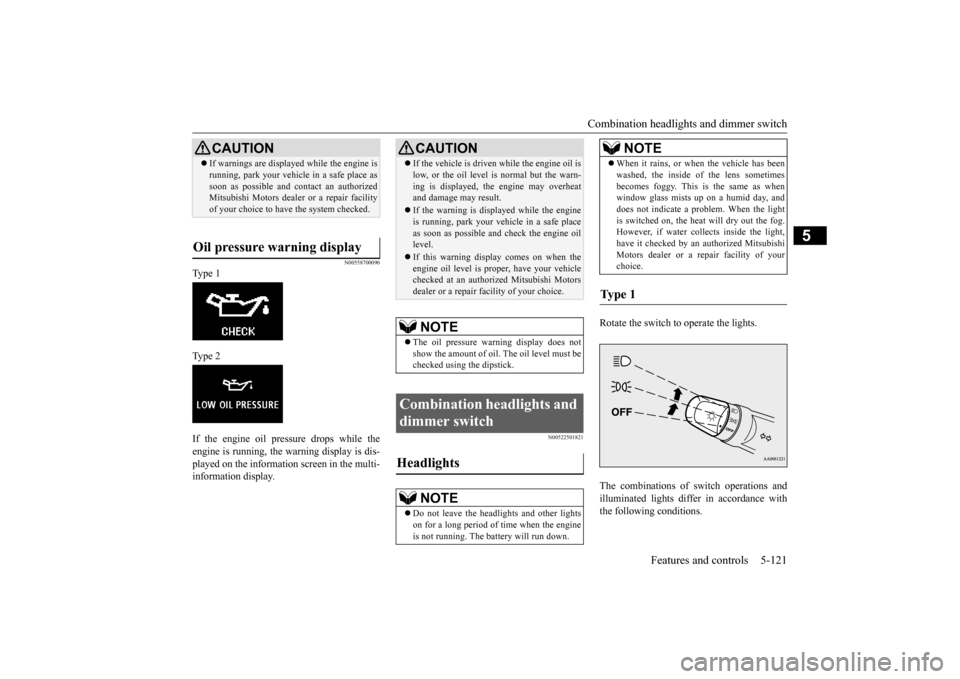
Type 1 Type 2 If the engine oil pressure drops while the engine is running, the warning display is dis-played on the information screen in the multi- information display.
N00522501821
Rotate the switch to operate the lights. The combinations of switch operations and illuminated lights differ in accordance with the following conditions.
CAUTION If warnings are displayed while the engine is running, park your vehicle in a safe place as soon as possible and contact an authorized Mitsubishi Motors dealer or a repair facility of your choice to have the system checked.
Oil pressure warning display
CAUTION If the vehicle is driven while the engine oil is low, or the oil level is normal but the warn- ing is displayed, the engine may overheat and damage may result. If the warning is displayed while the engine is running, park your vehicle in a safe place as soon as possible and check the engine oillevel. If this warning display comes on when the engine oil level is proper, have your vehicle checked at an authorized Mitsubishi Motors dealer or a repair facility of your choice.NOTE
The oil pressure warning display does not show the amount of oil. The oil level must be checked using the dipstick.
Combination headlights and dimmer switch Headlights
NOTE
Do not leave the headlights and other lights on for a long period of time when the engineis not running. The battery will run down.
When it rains, or when the vehicle has been washed, the inside of the lens sometimes becomes foggy. This is the same as when window glass mists up on a humid day, and does not indicate a problem. When the lightis switched on, the heat will dry out the fog. However, if water collects inside the light, have it checked by an authorized MitsubishiMotors dealer or a repair facility of your choice.
Ty p e 1
NOTE
BK0206700US.book
121 ページ 2014年3月25日 火曜日 午後4時42分
Page 331 of 384
Air cleaner filter 9-8 Vehicle care and maintenance
9
Do not overfill the reserve tank. Your vehicle uses a special radiator cap that stays sealed and lets the coolant flow from the reserve tank back to the radiatorwhen the engine cools down. If you need to change the cap, use the exact same kind. Check the coolant freeze point in the radi- ator with the proper gauge, and only when it is safe. If you add antifreeze, the con-tents of the reserve tank must be protected against freezing. Keep the front of the radiator and con- denser clean. If the engine coolant temperature does not rise after the engine is warmed-up, takeyour vehicle to an authorized Mitsubishi Motors dealer or a repair facility of your choice to have the thermostat checked,and replaced if necessary.
N00937901465
The air cleaner filter w
ill get dirty and dusty
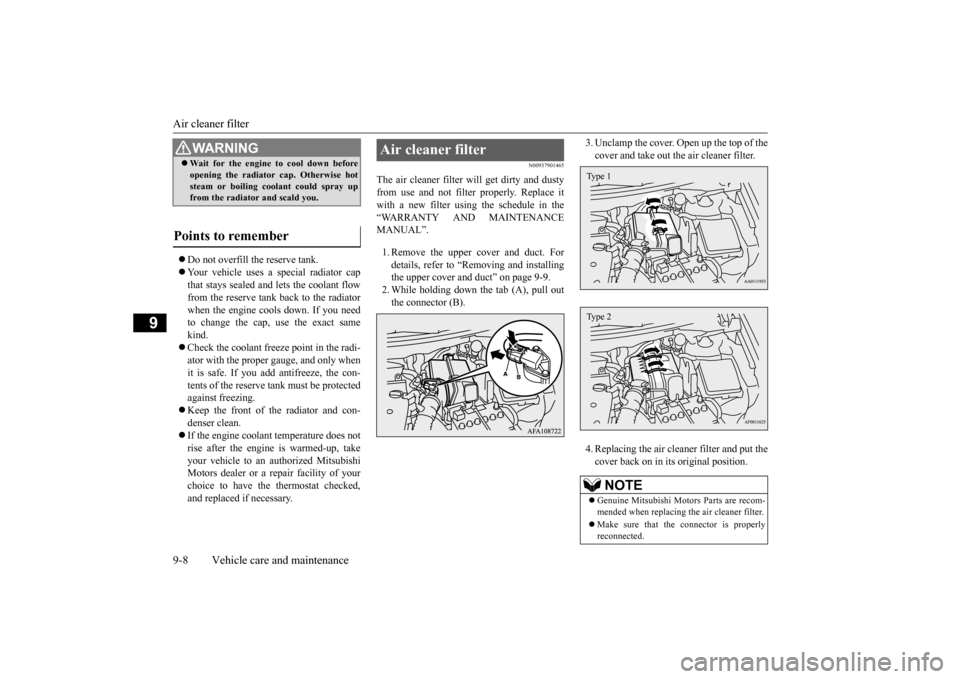
from use and not filter properly. Replace itwith a new filter using the schedule in the “WARRANTY AND MAINTENANCE MANUAL”. 1. Remove the upper cover and duct. For details, refer to “Removing and installingthe upper cover and duct” on page 9-9. 2. While holding down
the tab (A), pull out
the connector (B).
3. Unclamp the cover. Open up the top of the cover and take out the air cleaner filter. 4. Replacing the air cleaner filter and put the cover back on in its original position.
WA R N I N G Wait for the engine to cool down before opening the radiator cap. Otherwise hot steam or boiling coolant could spray up from the radiator and scald you.
Points to remember
Air cleaner filter
NOTE
Genuine Mitsubishi Moto
rs Parts are recom-
mended when replacing the air cleaner filter. Make sure that the connector is properly reconnected.Type 1Type 2
BK0206700US.bo
ok 8 ページ 2014年3月25日 火曜日 午後4時42分
Page 333 of 384
Manual transaxle oil (if so equipped) 9-10 Vehicle care and maintenance
9
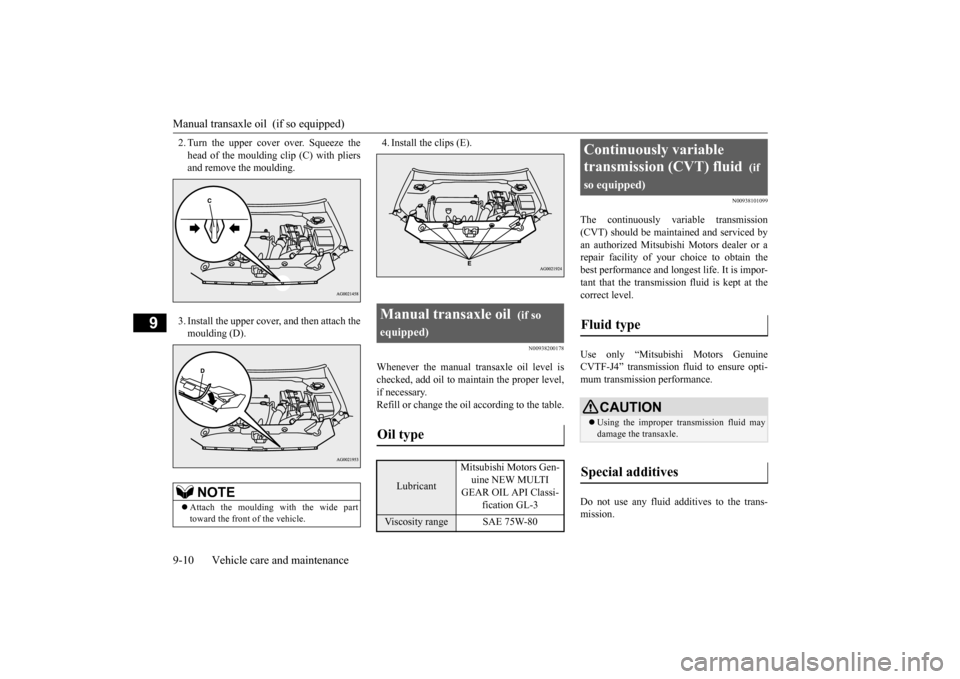
2. Turn the upper cover over. Squeeze the head of the moulding clip (C) with pliers and remove the moulding. 3. Install the upper cover, and then attach the moulding (D).
4. Install the clips (E).
N00938200178
Whenever the manual transaxle oil level is checked, add oil to maintain the proper level, if necessary.Refill or change the oil according to the table.
N00938101099
The continuously variable transmission(CVT) should be maintained and serviced by an authorized Mitsubishi Motors dealer or a repair facility of your choice to obtain thebest performance and longest life. It is impor-tant that the transmission fluid is kept at the correct level. Use only “Mitsubishi Motors Genuine CVTF-J4” transmission fluid to ensure opti- mum transmission performance. Do not use any fluid additives to the trans- mission.
NOTE
Attach the moulding with the wide part toward the front of the vehicle.
Manual transaxle oil
(if so
equipped)Oil type
Lubricant
Mitsubishi Motors Gen- uine NEW MULTI GEAR OIL API Classi-
fication GL-3
Viscosity range SAE 75W-80
Continuously variable transmission (CVT) fluid
(if
so equipped)Fluid type
CAUTION Using the improper transmission fluid may damage the transaxle.
Special additives
BK0206700US.bo
ok 10 ページ 2014年3月25日 火曜日 午後4時42分
Page 334 of 384
Transfer oil (All-wheel drive models) Vehicle care and maintenance 9-11
9
N00938400271
Whenever the transfer oil level is checked, add oil as necessary to maintain the properlevel. Fill or change the oil according to the table.
N00915200269
Whenever the oil level is checked, add oil asnecessary to maintain the proper level. Fill or change oil according to the table.
N00938600299
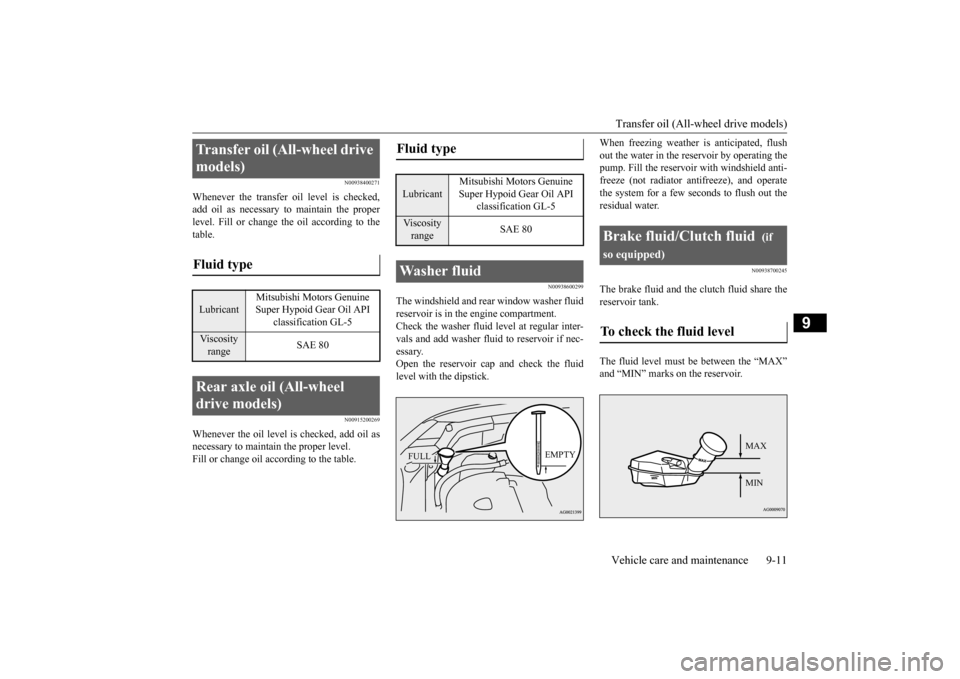
The windshield and rear window washer fluidreservoir is in the engine compartment.Check the washer fluid level at regular inter- vals and add washer fluid to reservoir if nec- essary.Open the reservoir cap and check the fluid level with the dipstick.
When freezing weather is anticipated, flush out the water in the reservoir by operating the pump. Fill the reservoir with windshield anti- freeze (not radiator antifreeze), and operatethe system for a few seconds to flush out the residual water.
N00938700245
The brake fluid and the clutch fluid share thereservoir tank. The fluid level must be between the “MAX” and “MIN” marks on the reservoir.
Transfer oil (All-wheel drive models) Fluid type Lubricant
Mitsubishi Motors Genuine Super Hypoid Gear Oil API
classification GL-5
Viscosity range
SAE 80
Rear axle oil (All-wheel drive models)
Fluid type Lubricant
Mitsubishi Motors Genuine Super Hypoid Gear Oil API
classification GL-5
Viscosity range
SAE 80
Washer fluid FULL
EMPTY
Brake fluid/Clutch fluid
(if
so equipped)To check the fluid level
MAX MIN
BK0206700US.bo
ok 11 ページ 2014年3月25日 火曜日 午後4時42分
Page 341 of 384
Tires 9-18 Vehicle care and maintenance
9
Cold inflation pressure must not go above the maximum values molded into the tire side- wall. After driving several miles, your tire inflation pressure may increase 2 to 6 psi (14to 41 kPa) from the cold inflation pressure. Do not let air out of the tires to get back to the specified cold pressure, or your tires will betoo low. Check your tires each time you refuel. If one tire looks lower than the others, check thepressure for all of them.You should also take the following safety pre- cautions: Keep your tires inflated to the recom- mended pressures. (See the tire and load-ing information placard attached to the driver’s door sill.) Stay within the recommended load limits. Make sure that the weight of any load in your vehicle is evenly distributed. Drive at safe speeds. After filling your tires to the correct pres- sure, check them for damage and air leaks. Be sure to reinstall the caps on thevalve stems.
N00939600241 N00939700141
The following maintenance steps are recom- mended:
Check tire pressures regularly. Have regular maintenance done on the wheel balance and front and rear suspen- sion alignment. Rotate your tires regularly as described in the “Tire rotation” section on page 9-19.
N00939800184
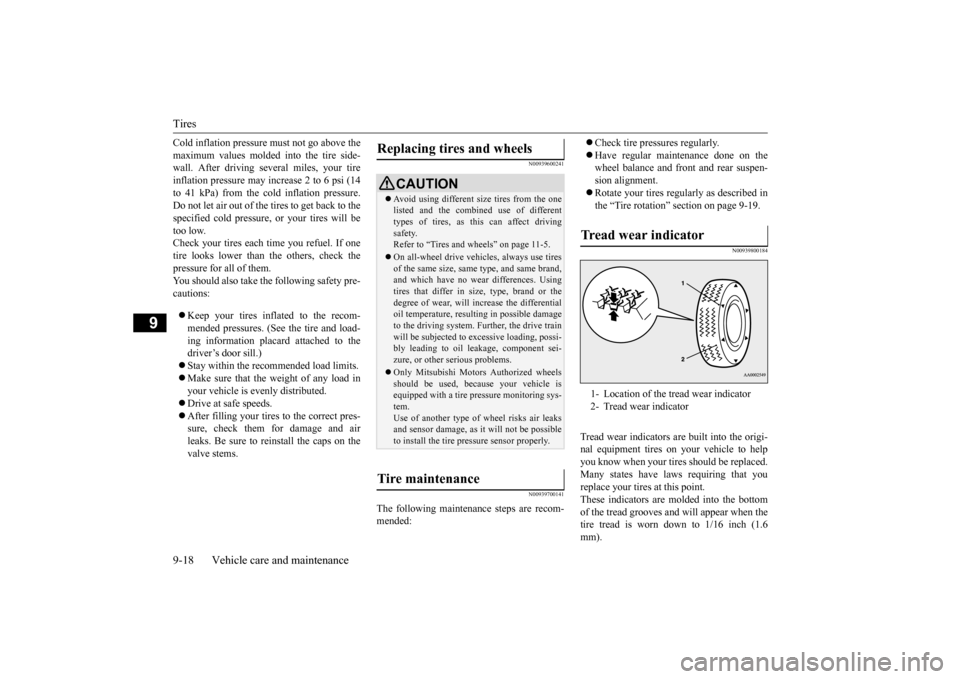
Tread wear indicators are built into the origi- nal equipment tires on your vehicle to helpyou know when your tires should be replaced. Many states have laws requiring that you replace your tires at this point.These indicators are molded into the bottom of the tread grooves and will appear when the tire tread is worn down to 1/16 inch (1.6mm).
Replacing tires and wheels
CAUTION Avoid using different
size tires from the one
listed and the combined use of different types of tires, as this can affect driving safety.Refer to “Tires and wheels” on page 11-5. On all-wheel drive vehicles, always use tires of the same size, same type, and same brand, and which have no wear differences. Using tires that differ in size, type, brand or thedegree of wear, will increase the differential oil temperature, resulting in possible damage to the driving system. Further, the drive trainwill be subjected to excessive loading, possi- bly leading to oil leakage, component sei- zure, or other serious problems. Only Mitsubishi Motors Authorized wheels should be used, because your vehicle isequipped with a tire pressure monitoring sys- tem. Use of another type of wheel risks air leaksand sensor damage, as it will not be possible to install the tire pressure sensor properly.
Tire maintenance
Tr e a d w e a r i n d i c a t o r 1- Location of the tread wear indicator 2- Tread wear indicator
BK0206700US.bo
ok 18 ページ 2014年3月25日 火曜日 午後4時42分
Page 346 of 384
General maintenance
Vehicle care and maintenance 9-23
9
there are other parts which do not usually need regular maintenance. But, if any of these parts stops working prop- erly, your vehicle performance could suffer.Have these items checked if you notice a problem with them. See your authorized Mitsubishi Motors dealer for assistance, if you have any questions.
N00941600059
Good brakes are essential for safe driving. Check the brake pads for wear. For good braking performance, replace the brake padswith the same type pads as the originals.
N00941700076
Brake hoses and tubing should be checkedfor: Severe surface cracking, scuffing or worn spots. If the fabric casing of the hose is showing through any cracks or worn spotsin the rubber hose cover, the hose should be replaced. The brakes can fail if the hose wears through. Improper installation may cause twisting, or wheel, tire or chassis interference.
N00941800077
Check the following parts for damage and grease leaks: Ball joint boots of the front suspension and steering linkage Bellows on both ends of the drive shaft
N00942200094
The best way to keep carbon monoxide gas from entering inside your vehicle is to have the engine exhaust system properly serviced. Have a competent mechanic inspect the com-plete exhaust system and nearby body areas for broken, damaged, deteriorated, or mispo- sitioned parts if you notice any of the follow-ing: A change in the sound of the exhaust sys- tem The smell of exhaust fumes inside the vehicle
The underside or rear of the vehicle is damaged
Also check the exhaust system each time the vehicle is raised for lubrication, oil changes, or required service. Any open seams or looseconnections could let dangerous exhaust fumes seep into the luggage compartment and passenger compartments. Check for holes or exhaust gas leaks caused by corrosion or damage. Check the joints and connections for looseness or exhaust gas leaks. Check the rubber hangers and brackets for damage.
N00942500101
The hood lock release mechanism and hood safety catch should be checked, cleaned, and oiled when needed for easy movement and tostop rust and wear. Use Multipurpose Grease NLGI Grade 2 sparingly for all sliding parts of the hood latch and release lever. Work thegrease into the hood lock mechanism until all the movable surfaces are covered.
Disc brake pads Brake hoses
Ball joint, steering linkage seals and drive shaft boots Exhaust system
WA R N I N G Carbon monoxide gas from your vehicle’s exhaust is poisonous. Breathing these fumes can cause unconsciousness or death.
Check for any of the following conditions: Hood lock release mechanism and safety catch
BK0206700US.bo
ok 23 ページ 2014年3月25日 火曜日 午後4時42分
Page 351 of 384
Fuses 9-28 Vehicle care and maintenance
9
N00954900128
1. Before replacing a fuse, always turn off the electrical item concerned to the fuse and turn the ignition switch to the “OFF”position or put the operation mode in OFF.
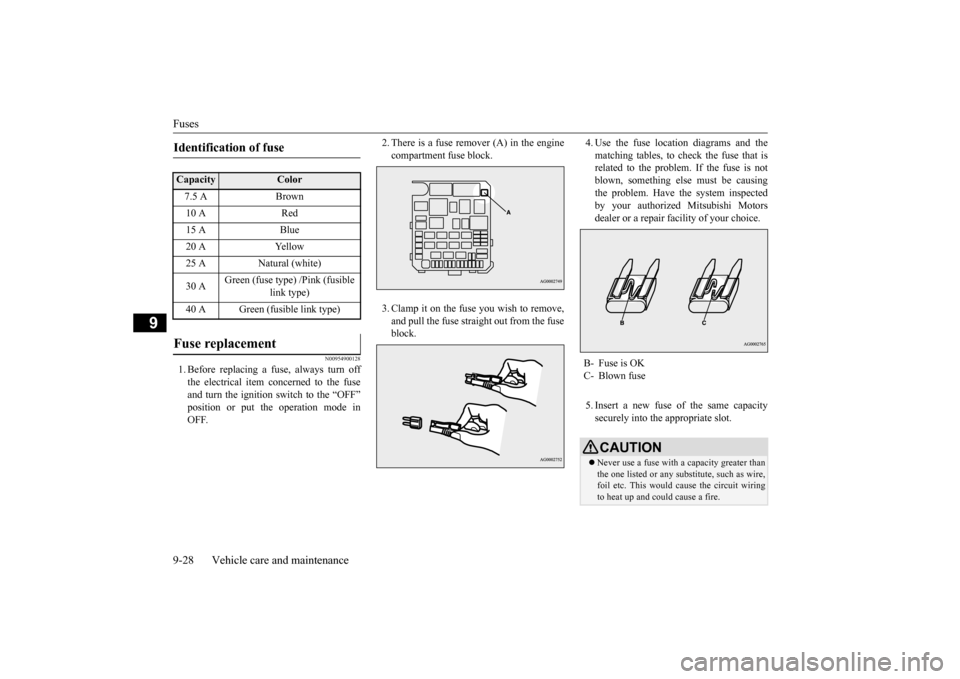
2. There is a fuse remover (A) in the engine compartment fuse block. 3. Clamp it on the fuse you wish to remove, and pull the fuse straight out from the fuse block.
4. Use the fuse location diagrams and the matching tables, to check the fuse that is related to the problem. If the fuse is not blown, something else must be causingthe problem. Have the system inspected by your authorized Mitsubishi Motors dealer or a repair facility of your choice. 5. Insert a new fuse of the same capacity securely into the appropriate slot.
Identification of fuse Capacity
Color
7.5 A Brown10 A Red15 A Blue20 A Yellow25 A Natural (white) 30 A
Green (fuse type) /Pink (fusible
link type)
40 A Green (fusible link type)
Fuse replacement
B- Fuse is OK C- Blown fuse
CAUTION Never use a fuse with a capacity greater than the one listed or any substitute, such as wire,foil etc. This would cause the circuit wiring to heat up and could cause a fire.
BK0206700US.bo
ok 28 ページ 2014年3月25日 火曜日 午後4時42分