wheel MITSUBISHI OUTLANDER SPORT 2016 3.G Repair Manual
[x] Cancel search | Manufacturer: MITSUBISHI, Model Year: 2016, Model line: OUTLANDER SPORT, Model: MITSUBISHI OUTLANDER SPORT 2016 3.GPages: 398, PDF Size: 14.63 MB
Page 353 of 398

Tires
Vehicle care and maintenance 9-17
9
EXAMPLE: DOT MA L9 ABCD 1504
The treadwear grade is a comparative rating based on the wear rate of the tire when tested under controlledconditions on a specified government test course. For example, a tire graded 150 would wear one and one- half (1
1/2) times as well on the gov-
ernment course as a tire graded 100. The relative performance of tiresdepends upon the actual conditions of their use, however, and may depart significantly from the norm due tovariations in driving habits, service practices and differences in road characteristics and climate. The traction grades, from highest to lowest, are AA, A, B and C. Thosegrades represent the tire’s ability to stop on wet pavement as measured
under controlled conditions on speci- fied government test surfaces of asphalt and concrete. A tire marked C may have poor traction perfor- mance. The temperature grades are A (the highest), B and C, representing the tire’s resistance to the generation ofheat and its ability to dissipate heat when tested under controlled condi- tions on a specified indoor laboratorytest wheel. Sustained high tempera- ture can cause the material of the tire to degenerate and reduce tire life, andexcessive temperature can lead to sudden tire failure. The grade C cor- responds to a level of performancewhich all passenger car tires must meet under the Federal Motor Vehi- cle Safety Standard No. 109. Grades B and A represent higher levels of performance on the laboratory testwheel than the minimum required by law.
DOT
Department of Transporta- tion This symbol certifies that the tire is in compliance with the U.S. Department of Trans- portation tire safety stan-dards, and is approved for highway use.
MA
Code representing the tire manufacturing location. (2 digits)
L9 ABC D
Code representing the tire size. (2 digits)Code used by tire manufac- turer. (1 to 4 digits)
15
Number representing the week in which the tire was manufactured. (2 digits)
04
Number representing the year in which the tire was manufactured. (2 digits)
Treadwear, Traction and Temper- ature Grades Treadwear Tr a c t i o n
Temperature
BK0229600US.bo
ok 17 ページ 2015年10月1日 木曜日 午後2時29分
Page 354 of 398
Tires 9-18 Vehicle care and maintenance
9
N00939301955
Proper tire inflation pressure is essential for the safe and satisfactory operation of yourvehicle. The wrong tire pressure will cause problems in three major areas: Safety Too little pressure increases flexing in thetire and can cause tire failure. Too muchpressure can cause a tire to lose its ability to cushion shock. Objects on the road and potholes could then cause tire damage thatmay result in tire failure. Economy The wrong tire pressure can cause unevenwear patterns in the tire tread. These abnormal wear patterns will reduce the tread life, and the tire will have to bereplaced sooner. Too little pressure also makes it harder for the tire to roll, and this uses up more fuel. Ride comfort and vehicle stability The superior riding experience built into your vehicle partly depends on the correcttire pressure. Too much pressure gives an uncomfortable and jarring ride. Too little pressure feels as if your vehicle is slow torespond. Unequal tire pressures can make steering your vehicle uneven and unpredictable.
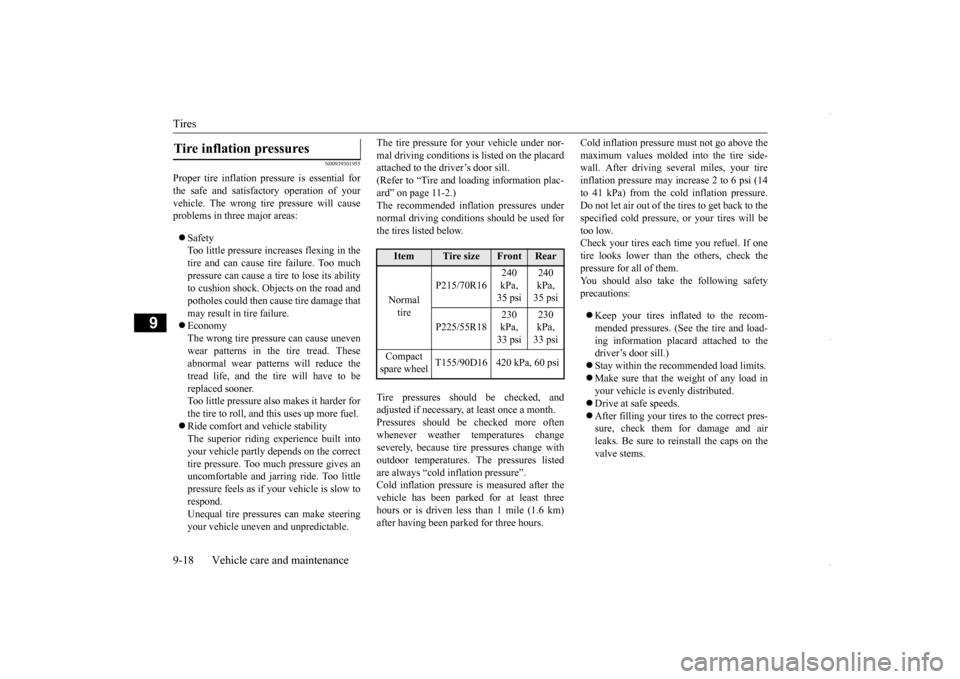
The tire pressure for your vehicle under nor- mal driving conditions is listed on the placard attached to the driver’s door sill. (Refer to “Tire and loading information plac-ard” on page 11-2.) The recommended infl
ation pressures under
normal driving conditions should be used forthe tires listed below. Tire pressures should be checked, and adjusted if necessary, at least once a month. Pressures should be checked more oftenwhenever weather temperatures change severely, because tire pressures change with outdoor temperatures. The pressures listedare always “cold inflation pressure”. Cold inflation pressure is measured after the vehicle has been parked for at least threehours or is driven less than 1 mile (1.6 km) after having been parked for three hours.
Cold inflation pressure must not go above the maximum values molded into the tire side- wall. After driving several miles, your tire inflation pressure may increase 2 to 6 psi (14to 41 kPa) from the cold inflation pressure. Do not let air out of the tires to get back to the specified cold pressure, or your tires will betoo low. Check your tires each time you refuel. If one tire looks lower than the others, check thepressure for all of them.You should also take the following safety precautions: Keep your tires inflated to the recom- mended pressures. (See the tire and load-ing information placard attached to the driver’s door sill.) Stay within the recommended load limits. Make sure that the weight of any load in your vehicle is evenly distributed. Drive at safe speeds. After filling your tires to the correct pres- sure, check them for damage and air leaks. Be sure to reinstall the caps on thevalve stems.
Tire inflation pressures
Item
Tire size
Front
Rear
Normal tire
P215/70R16
240 kPa, 35 psi
240 kPa, 35 psi
P225/55R18
230 kPa, 33 psi
230 kPa, 33 psi
Compact spare wheel
T155/90D16 420 kPa, 60 psi
BK0229600US.bo
ok 18 ページ 2015年10月1日 木曜日 午後2時29分
Page 355 of 398
Tires
Vehicle care and maintenance 9-19
9
N00939600241 N00939700141
The following maintenance steps are recom- mended:
Check tire pressures regularly. Have regular maintenance done on the wheel balance and front and rear suspen- sion alignment. Rotate your tires regularly as described in the “Tire rotation” section on page 9-19.
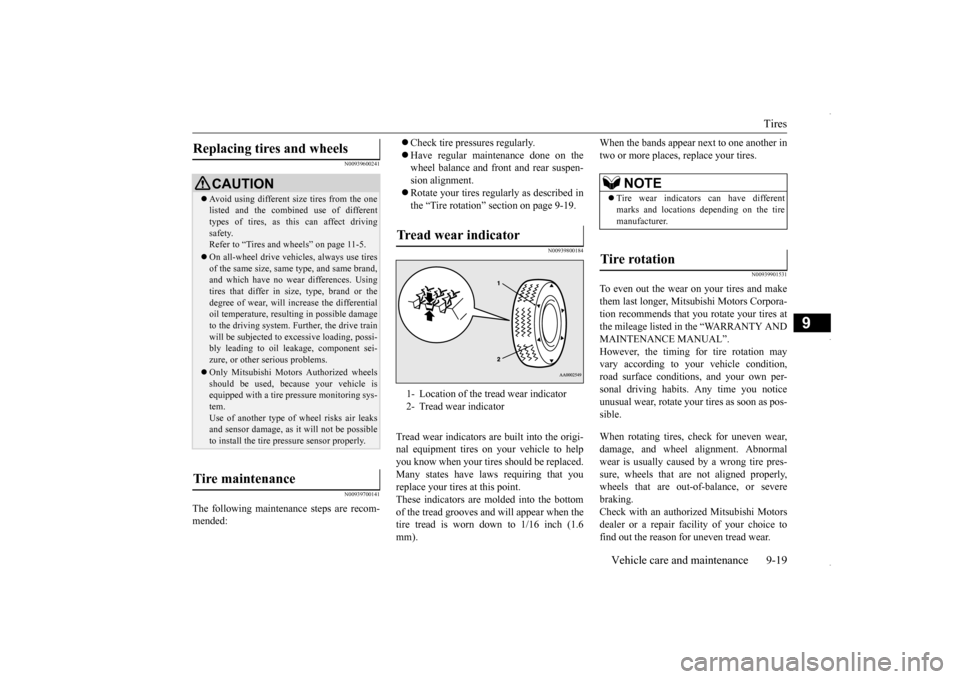
N00939800184
Tread wear indicators are built into the origi- nal equipment tires on your vehicle to helpyou know when your tires should be replaced. Many states have laws requiring that you replace your tires at this point.These indicators are molded into the bottom of the tread grooves and will appear when the tire tread is worn down to 1/16 inch (1.6mm).
When the bands appear next to one another in two or more places, replace your tires.
N00939901531
To even out the wear on your tires and makethem last longer, Mitsubishi Motors Corpora- tion recommends that you rotate your tires at the mileage listed in the “WARRANTY ANDMAINTENANCE MANUAL”. However, the timing for tire rotation may vary according to your vehicle condition,road surface conditions, and your own per- sonal driving habits. Any time you notice unusual wear, rotate your tires as soon as pos-sible. When rotating tires, check for uneven wear, damage, and wheel alignment. Abnormal wear is usually caused by a wrong tire pres-sure, wheels that are not aligned properly, wheels that are out-of-balance, or severe braking.Check with an authorized Mitsubishi Motors dealer or a repair faci
lity of your choice to
find out the reason for uneven tread wear.
Replacing tires and wheels
CAUTION Avoid using different size tires from the one listed and the combined use of different types of tires, as this can affect driving safety.Refer to “Tires and wheels” on page 11-5. On all-wheel drive vehicles, always use tires of the same size, same type, and same brand, and which have no wear differences. Using tires that differ in size, type, brand or thedegree of wear, will increase the differential oil temperature, resulting in possible damage to the driving system. Further, the drive trainwill be subjected to excessive loading, possi- bly leading to oil leakage, component sei- zure, or other serious problems. Only Mitsubishi Motors Authorized wheels should be used, because your vehicle isequipped with a tire pressure monitoring sys- tem. Use of another type of wheel risks air leaksand sensor damage, as it will not be possible to install the tire pressure sensor properly.
Tire maintenance
Tread wear indicator 1- Location of the tread wear indicator 2- Tread wear indicator
NOTE
Tire wear indicators can have different marks and locations depending on the tire manufacturer.
Tire rotation
BK0229600US.bo
ok 19 ページ 2015年10月1日 木曜日 午後2時29分
Page 356 of 398
Tires 9-20 Vehicle care and maintenance
9
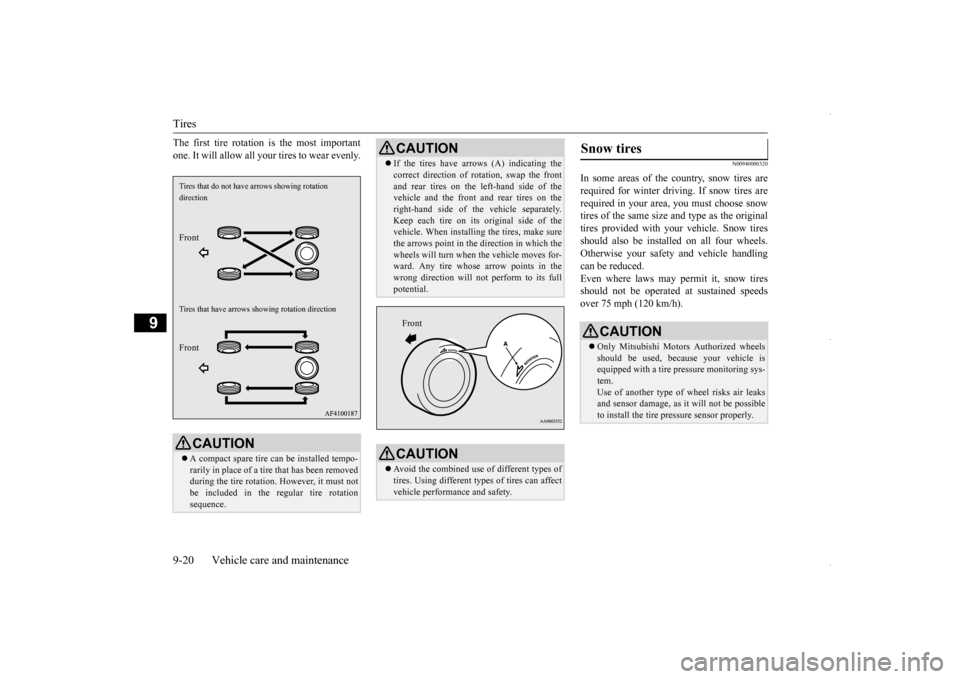
The first tire rotation is the most important one. It will allow all your
tires to wear evenly.
N00940000320
In some areas of the country, snow tires are required for winter driving. If snow tires arerequired in your area, you must choose snow tires of the same size and type as the original tires provided with your vehicle. Snow tiresshould also be installed on all four wheels. Otherwise your safety and vehicle handling can be reduced.Even where laws may permit it, snow tiresshould not be operated at sustained speeds over 75 mph (120 km/h).
CAUTION A compact spare tire can be installed tempo- rarily in place of a tire that has been removed during the tire rotation. However, it must not be included in the regular tire rotationsequence.Tires that do not have
arrows showing rotation
directionFrontTires that have arrows
showing rotation direction
Front
If the tires have arrows (A) indicating the correct direction of rotation, swap the front and rear tires on the left-hand side of the vehicle and the front and rear tires on the right-hand side of the vehicle separately.Keep each tire on its original side of the vehicle. When installing the tires, make sure the arrows point in the direction in which thewheels will turn when the vehicle moves for- ward. Any tire whose arrow points in the wrong direction will not perform to its fullpotential.CAUTION Avoid the combined use of different types of tires. Using different types of tires can affect vehicle performance and safety.CAUTIONFront
Snow tires
CAUTION Only Mitsubishi Motors Authorized wheels should be used, because your vehicle isequipped with a tire pressure monitoring sys- tem. Use of another type of wheel risks air leaksand sensor damage, as it will not be possible to install the tire pressure sensor properly.
BK0229600US.bo
ok 20 ページ 2015年10月1日 木曜日 午後2時29分
Page 359 of 398
General maintenance
Vehicle care and maintenance 9-23
9
N00941000040
Check the hose surfaces for any heat and mechanical damage, hard and brittle rubber,cracking, tears, cuts and abrasions. Pay spe- cial attention to the hoses closest to high heat sources such as the exhaust manifold. Checkall the hose connections, such as clamps and couplings, to make sure they are secure and that there are no leaks. If you see any wear ordamage, replace the hoses immediately.
N00950100050
Have the valve clearance checked at anauthorized Mitsubishi Motors dealer at themileage specified in the “WARRANTY AND MAINTENANCE MANUAL”. If the engine sounds abnormally loud, haveadjustments made by an authorized Mitsubishi Motors dealer.
N00941300173
Check these regularly for damage or leaks in the fuel lines and connections. Check the fuel tank filler cap for damage or looseness. Pay special attention to the fuel lines closest to
high heat sources such as the exhaust mani- fold.
N00941400187
If the fuel-vapor vent line is clogged or dam- aged, the fuel-vapor mixture will escape, pol- luting the air.Have the system checked at an authorized Mitsubishi Motors dealer at the mileage spec- ified in the “WARRANTY AND MAINTE-NANCE MANUAL”.
N00941500247
The next pages list the maintenance servicerecommended by Mitsubishi Motors Corpo- ration. In addition to the general maintenance that needs to be perfor
med at the times listed,
there are other parts which do not usually need regular maintenance. But, if any of these parts stops working prop- erly, your vehicle performance could suffer.Have these items checked if you notice a problem with them. See your authorized Mitsubishi Motors dealer for assistance, if you have any questions.
N00941600059
Good brakes are essential for safe driving. Check the brake pads for wear. For good braking performance, replace the brake padswith the same type pads as the originals.
N00941700076
Brake hoses and tubing should be checkedfor: Severe surface cracking, scuffing or worn spots. If the fabric casing of the hose is showing through any cracks or worn spotsin the rubber hose cover, the hose should be replaced. The brakes can fail if the hose wears through. Improper installation may cause twisting, or wheel, tire or chassis interference.
Fuel hoses Intake valve clearance Fuel system (tank, pipe line and connection, and fuel tank filler cap)
WA R N I N G If you see a fuel leak or if you smell fuel, do not run the engine. Any spark (includ- ing from the ignition), flame or smokingmaterial could cause an explosion or fire. Call an authorized Mitsubishi Motors dealer or a repair facility of your choicefor assistance.
Evaporative emission control system (except evaporative emission canister) General maintenance
Disc brake pads Brake hoses
BK0229600US.bo
ok 23 ページ 2015年10月1日 木曜日 午後2時29分
Page 362 of 398
Fuses 9-26 Vehicle care and maintenance
9
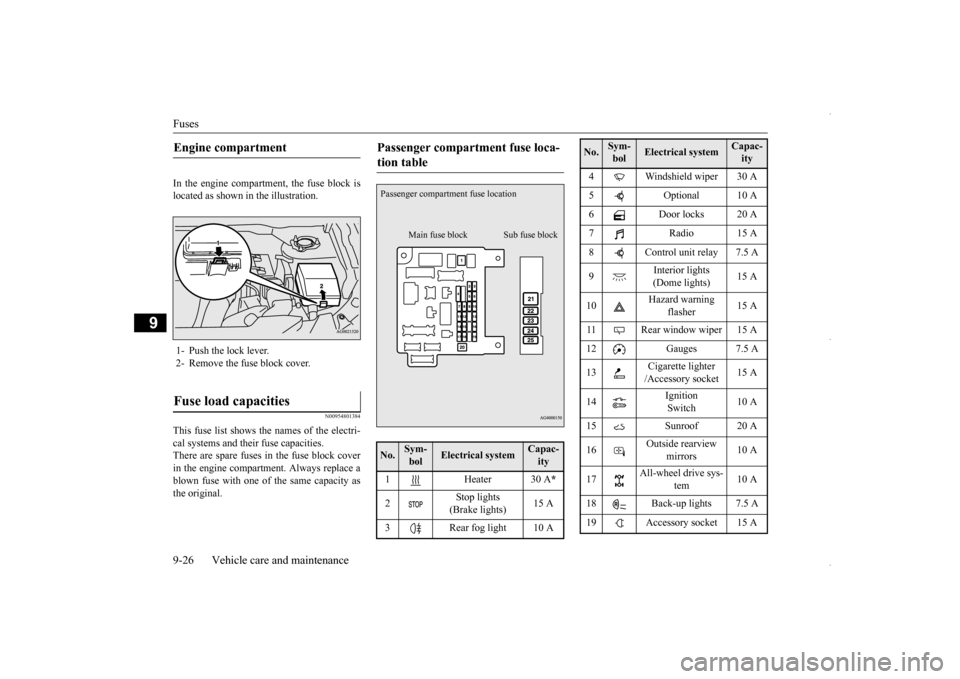
In the engine compartment, the fuse block is located as shown in the illustration.
N00954801384
This fuse list shows the names of the electri-cal systems and their fuse capacities. There are spare fuses in the fuse block cover in the engine compartment. Always replace ablown fuse with one of the same capacity as the original.Engine compartment 1- Push the lock lever. 2- Remove the fuse block cover.Fuse load capacities
Passenger compartment fuse loca- tion table No.
Sym- bol
Electrical system
Capac-ity
1 Heater 30 A
*
2
Stop lights (Brake lights)
15 A
3 Rear fog light 10 APassenger compartment fuse location
Main fuse block Sub fuse block
4 Windshield wiper 30 A 5 Optional 10 A 6 Door locks 20 A 7 Radio 15 A8 Control unit relay 7.5 A 9
Interior lights (Dome lights)
15 A
10
Hazard warning
flasher
15 A
11 Rear window wiper 15 A 12 Gauges 7.5 A 13
Cigarette lighter /Accessory socket
15 A
14
Ignition Switch
10 A
15 Sunroof 20 A16
Outside rearview
mirrors
10 A
17
All-wheel drive sys-
tem
10 A
18 Back-up lights 7.5 A 19 Accessory socket 15 ANo.
Sym- bol
Electrical system
Capac-ity
BK0229600US.bo
ok 26 ページ 2015年10月1日 木曜日 午後2時29分
Page 378 of 398
Cleaning the outside of your vehicle 9-42 Vehicle care and maintenance
9
Salt and other chemicals spread on winter roads in some geographical areas can have a detrimental effect on the vehicle underbody. You should flush the underbody with a highpressure hose every time you wash the out- side of your vehicle. Take special care to remove mud or otherdebris which could trap and hold salt and moisture. After washing your vehicle, wipe off allwaterdrops from the rubber parts around the doors to prevent the doors from freezing.
N00946000234
Wax your vehicle once or twice a year, or when water does not bead up on the paint. Use a soft cloth to put a small amount of wax on the painted surfaces. After the wax hasdried, polish with a dry soft cloth. Do not wax your vehicle in direct sunlight. You should wax when the painted surfacesare cool.
CAUTION When washing the underside of your vehicle or the wheels, wear a pair of gloves to pro- tect your hands. If your vehicle has rain sensor wipers, place the wiper switch lever in the “OFF” position to deactivate the rain sensor before washing the vehicle. Otherwise, the wipers will oper-ate in the presence of water spray on the windshield and may get damaged as a result. Never spray or splash water on the electrical parts in the engine compartment. This may damage them. Be careful also when washingthe underbody to ensure that water does not enter the engine compartment. Avoid automatic car washers that use rotat- ing brushes. These brushes may scratch the paint surface and make it dull.Scratches are more noticeable on darker col- ored vehicles. Some hot water washing equipment uses high pressure and heat to clean your vehicle. Because hot water can damage plastics partsand seep inside your vehicle, make sure you do the following when using such equip- ment:• Keep the washing nozzle at least 28 inches(70 cm) away from the vehicle body.• When washing around the door glass, holdthe nozzle at a distance of more than 28 inches (70 cm) and at a right angle to the glass surface.
Make sure to do the following when using an automatic car wash, with help from either this manual or the car wash operator, to avoid damaging your vehicle:• Fold the outside rearview mirrors.• Remove the antenna.• Tape the wiper arm assembly.• If your vehicle is equipped with a rearspoiler or roof rails, check with the car wash operator before using the car wash.• If your vehicle is equipped with the rainsensor wipers, place the wiper switch leverin the “OFF” position to deactivate the rain sensor.
During cold weather
CAUTION
NOTE
When the door is frozen, opening it by force may tear off or crack the rubber gasket installed around the door. Pour warm water to melt the ice. Be sure to thoroughly wipe off the water after opening the door. To pre-vent freezing of the weatherstripping on the doors, hood, etc., treat with silicone lubri- cant.
Waxing
CAUTION Waxes containing high abrasive compounds should not be used. These waxes remove rust and stain effectively from the paintwork, butare harmful to the finish of the paint, because they also remove paint/clearcoat. They are also harmful to other glossy sur-faces such as the grill
e, trim, moldings, etc.
BK0229600US.bo
ok 42 ページ 2015年10月1日 木曜日 午後2時29分
Page 379 of 398
Cleaning the outside of your vehicle Vehicle care and maintenance 9-43
9
N00946100046
If painted surfaces have been severely dam- aged and lost their original luster and color tone, polish the surface lightly with a finepolishing compound. Avoid limiting your polishing to the damaged surface only; polish a somewhat wider area, moving the polishingcloth in one direction. After polishing, flush the compound from the surface and apply a coat of wax to regain a beautiful luster.
N00946200047
Small cracks and scratches in the paint coatshould be touched up as soon as possible withtouch-up paint to prevent corrosion. Check body areas facing the road or the tires carefully for damage to the paint caused byflying stones, etc. The paint code number for your vehicle can be found on the vehicle
information code plate in the engine compart- ment.
N00946300194
Use a sponge or chamois to clean these parts.If a vehicle wax sticks to a gray or black rough surface of the bumper, molding or lights, the surface may appear white in color.In this case, wipe it
off using lukewarm water
and a soft cloth or chamois.
N00946400052
To prevent spots and corrosion of chromeparts, wash with water, dry thoroughly, andapply a nonabrasive automotive wax. If the chrome is severely damaged or pitted, use a commercially available chrome polish.
N00946500183
1. Remove dirt using a wet sponge. 2. Use a mild detergent on any dirt that can- not be removed easily with water.Rinse off the detergent after washing the wheel. 3. Dry the wheel thoroug
hly using a chamois
leather or a soft cloth.
Do not use gasoline, benzine, kerosene or paint thinners to remove road tar or other dirt from the vehicle surface. Do not put wax on the areas having black matte coating because it can cause uneven discoloration, patches, blurs, etc. If these get wax on them, wipe the wax off right awaywith a soft cloth and warm water.
Polishing Damaged paint
CAUTION
Cleaning plastic parts
CAUTION Do not use a scrubbing brush or other rough scrubber as these may damage the plastic surface. Do not use wax containing compounds (pol- ishing powder) which may damage the plas- tic surface. Do not let plastic parts get soiled with gaso- line, oil, brake fluids
, engine oils, greases,
paint thinner, and sulfuric acid (battery elec- trolyte), as such substances will cause stains, cracks, or discoloration.If any of these get on a plastic part, wipe them up with a soft cloth or chamois and a mild solution of soap and water. Then rinse them immediately with water.
Chrome parts Aluminum wheels
(if so equipped)
CAUTION Do not use a brush or other hard implement on the wheels. Do not use any cleaner that contains an abra- sive substance or is acidic or alkaline. Doing so could cause the coating on the wheels to peel or become discolored or stained. Do not directly apply hot water using a steam cleaner or by any other means. Contact with seawater or road salt used for de-icing can cause corrosion. Rinse off such substances as soon as possible.
BK0229600US.bo
ok 43 ページ 2015年10月1日 木曜日 午後2時29分
Page 382 of 398
Consumer information (For vehicles sold in U.S.A.) 10-2 Customer assistance/Reporting Safety Defects
10
N01047100171
This information is provided in compliance with the requirements of the National High-way Traffic Safety Administration, Depart- ment of Transportation. It provides the purchasers and/or prospective purchaserswith information on reporting safety defects. DOT quality grades - All passenger vehicle tires must conform to Federal Safety Require-ments in addition to these grades. The spe- cific grade rating in each grade category is shown on the side wall of the tires on yourvehicle. The treadwear grade is a comparative rating based on the wear rate of the tire when tested under controlled conditions on a specified government test course. For example, a tiregraded 150 would wear one and one-half (11/2) times as well on the government course
as a tire graded 100. The relative performance of tires depends upon the actual conditions of
their use, however, and may depart signifi- cantly from the norm due to variations in driving habits, service practices and differ- ences in road characteristics and climate. The traction grades, from highest to lowest, are AA, A, B and C. Those grades representthe tire’s ability to stop on wet pavement asmeasured under controlled conditions on specified government test surfaces of asphalt and concrete. A tire marked C may have poortraction performance. The temperature grades are A (the highest), B and C, representing the tire’s resistance to thegeneration of heat and its ability to dissipate heat when tested under controlled conditions on a specified indoor laboratory test wheel.Sustained high temperature can cause the
material of the tire to degenerate and reduce tire life, and excessive temperature can lead to sudden tire failure. The grade C corre- sponds to a level of performance which allpassenger car tires must meet under the Fed- eral Motor Vehicle Safety Standard No. 109. Grades B and A represent higher levels ofperformance on the laboratory test wheel than the minimum required by law.
N01047201531
If you believe that your vehicle has a defect which could cause a crash or could cause injury or death, you should immediately inform the National Highway Traffic SafetyAdministration (NHTSA) in addi- tion to notifying Mitsubishi Motors Corporation.
Consumer information (For vehicles sold in U.S.A.) Uniform tire quality grading Treadwear
Traction AA, A, B, C
WA R N I N G The traction grade assigned to this tire is based on straight-ahead braking traction tests, and does not include acceleration, cornering, hydroplaning, or peak tractioncharacteristics.
Temperature A, B, C
WA R N I N G The temperature grade for this tire is established for a tire that is properly inflated and not overloaded. Excessive speed, underinflation, or excessive load-ing, either separately or in combination, can cause heat buildup and possible tire failure.
Reporting Safety Defects
BK0229600US.bo
ok 2 ページ 2015年10月1日 木曜日 午後2時29分
Page 387 of 398

11
SpecificationsVehicle labeling ....
.................................................
........................ 11-2
Vehicle dimensions
................................................
........................ 11-3
Vehicle weights ...............
............................................................... 11-3
Engine specifications
.............................................
........................ 11-4
Battery .......................................
..................................................... 11-4
Tires and wheels .............
............................................................... 11-5
Capacity ....................................
..................................................... 11-5
BK0229600US.bo
ok 1 ページ 2015年10月1日 木曜日 午後2時29分