airbag MITSUBISHI OUTLANDER SPORT 2016 3.G Owners Manual
[x] Cancel search | Manufacturer: MITSUBISHI, Model Year: 2016, Model line: OUTLANDER SPORT, Model: MITSUBISHI OUTLANDER SPORT 2016 3.GPages: 398, PDF Size: 14.63 MB
Page 2 of 398
Instruments and controls 1-1
1
Overview
N00100202560
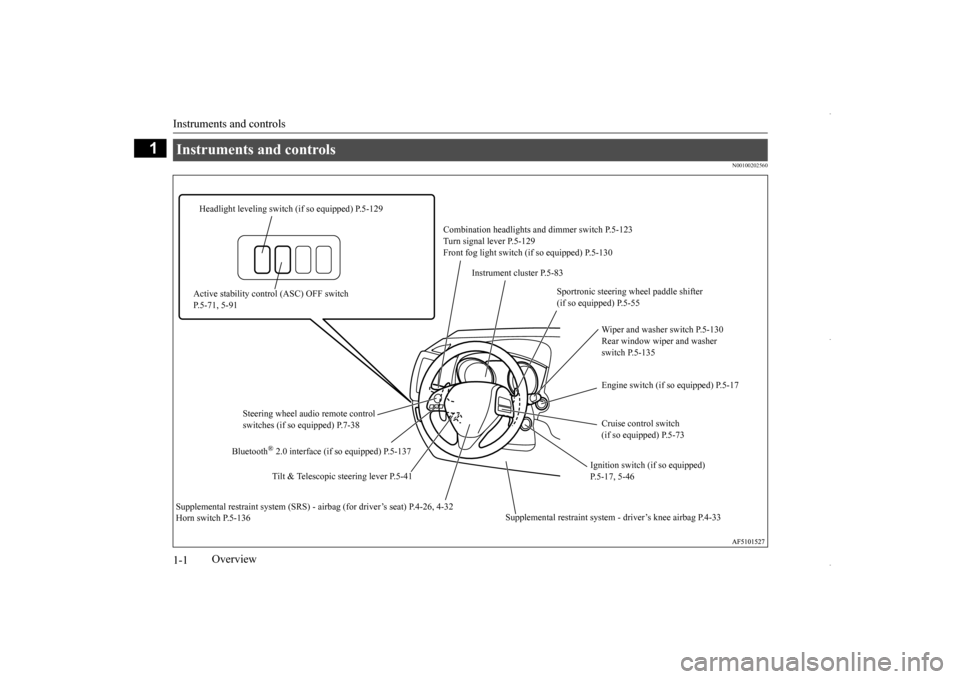
Instruments and controls
Combination headlights
and dimmer switch P.5-123
Turn signal lever P.5-129 Front fog light switch (if so equipped) P.5-130
Headlight leveling switch (if so equipped) P.5-129
Instrument cluster P.5-83
Active stability control (ASC) OFF switch P.5-71, 5-91
Sportronic steering wheel paddle shifter (if so equipped) P.5-55
Wiper and washer switch P.5-130 Rear window wiper and washer switch P.5-135 Engine switch (if so equipped) P.5-17
Steering wheel audio remote control switches (if so equipped) P.7-38
Cruise control switch (if so equipped) P.5-73
Tilt & Telescopic steering lever P.5-41
Ignition switch (if so equipped) P.5-17, 5-46
Bluetooth
® 2.0 interface (if so
equipped) P.5-137
Supplemental restraint system
- driver’s knee airbag P.4-33
Supplemental restraint system (SRS) - ai
rbag (for driver’s seat) P.4-26, 4-32
Horn switch P.5-136BK0229600US.bo
ok 1 ページ 2015年10月1日 木曜日 午後2時29分
Page 5 of 398
Interior
Overview 1-4
1
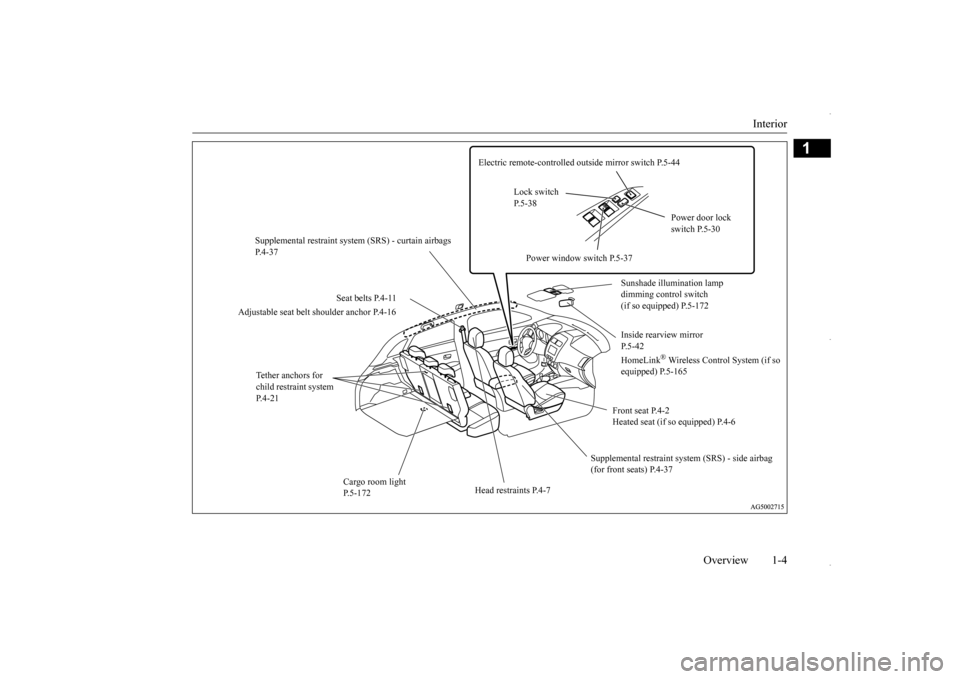
Electric remote-controlled outside mirror switch P.5-44
Lock switch P.5-38
Power door lock switch P.5-30
Supplemental restraint system (SRS) - curtain airbags P.4-37
Power window switch P.5-37
Sunshade illumination lamp dimming control switch (if so equipped) P.5-172
Seat belts P.4-11
Adjustable seat belt shoulder anchor P.4-16
Inside rearview mirror P.5-42 HomeLink
® Wireless Control System (if so
equipped) P.5-165
Tether anchors for child restraint system P.4-21
Front seat P.4-2 Heated seat (if so equipped) P.4-6
Supplemental restraint system (SRS) - side airbag (for front seats) P.4-37
Cargo room light P.5-172
Head restraints P.4-7
BK0229600US.bo
ok 4 ページ 2015年10月1日 木曜日 午後2時29分
Page 10 of 398
If this warning light comes on or
flashes while you’re driving...
2-2 Quick index
2
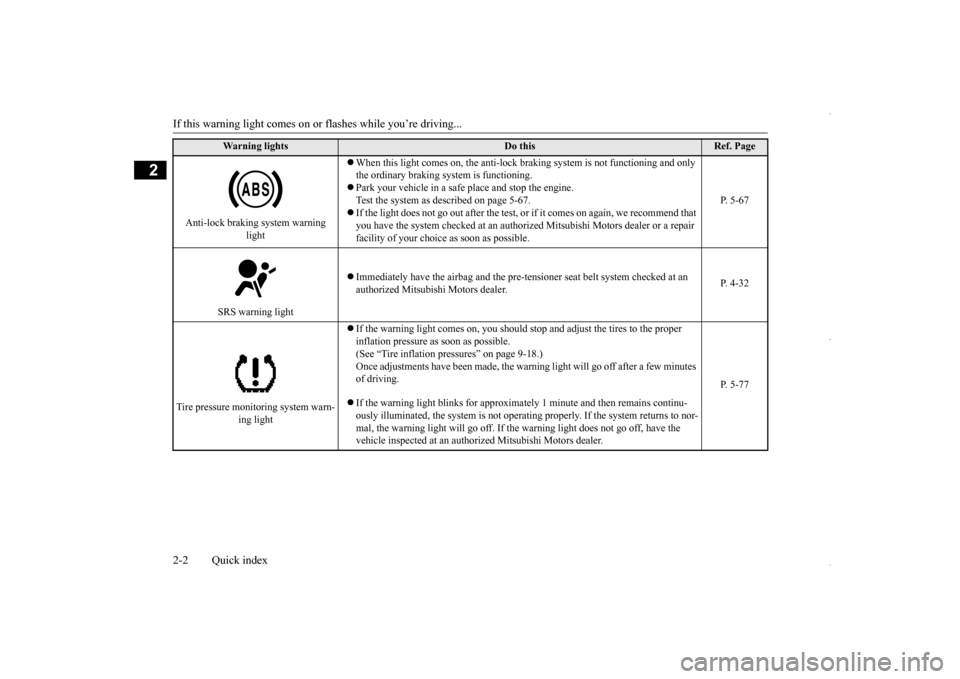
Anti-lock braking system warning
light
When this light comes on, the anti-lock braking system is not functioning and only the ordinary braking system is functioning. Park your vehicle in a safe place and stop the engine. Test the system as described on page 5-67. If the light does not go out after the test, or if it comes on again, we recommend that you have the system checked at an authorized Mitsubishi Motors dealer or a repair facility of your choice as soon as possible.
P. 5-67
SRS warning light
Immediately have the airbag and the pre-te
nsioner seat belt system checked at an
authorized Mitsubishi Motors dealer.
P. 4-32
Tire pressure monitoring system warn-
ing light
If the warning light comes on, you should stop and adjust the tires to the proper inflation pressure as soon as possible. (See “Tire inflation pressures” on page 9-18.)Once adjustments have been made, the warnin
g light will go off after a few minutes
of driving. If the warning light blinks for approxim
ately 1 minute and then remains continu-
ously illuminated, the system is not operatin
g properly. If the system returns to nor-
mal, the warning light will go off. If the warning light does not go off, have the vehicle inspected at an authori
zed Mitsubishi Motors dealer.
P. 5-77
Warning lights
Do this
Ref. Page
BK0229600US.bo
ok 2 ページ 2015年10月1日 木曜日 午後2時29分
Page 20 of 398
Genuine Mitsubishi Motors parts 3-6 General information
3
Using a cellular phone or radio set inside the vehicle without an external antenna may cause electrical system interference, which could lead to unsafe vehicle opera-tion. Tires and wheels which do not meet spec- ifications must not be used.Refer to the “Specifications” section for information regarding wheel and tire sizes.
Due to the large number of accessory and replacement parts provided by different man-ufacturers in the market, it is not always pos- sible for an authorized Mitsubishi Motors dealer to check whether the attachment orinstallation of non-Mitsubishi Motors genu-
ine parts affects the driving safety of your Mitsubishi-vehicle.
N00301800138
Mitsubishi Motors ma
nufactures high quality
vehicles with an emphasis on safety. It is important to consult an authorized MitsubishiMotors dealer before installation of anyaccessory which may involve modification of the electrical or fuel systems.
N00301400219
Mitsubishi Motors Genuine Parts are designed and manufactured to meet high stan- dards of performance, and are recommended for all of your maintenance needs. Also avail-
able from your Mitsubishi Motors dealer are a wide variety of accessories to personalize your new vehicle. Each Mitsubishi Motors vehicle has a selection of Mitsubishi Motorsauthorized accessories to choose from to tai- lor your new vehicle to your own personal preference. Your Mitsubishi Motors dealer’sParts Manager has information on various audio systems, protection items, as well as interior and exterior accessories available foryour specific model.
N00300100017
Certain components of this vehicle, such asairbag modules, seat belt pretensioners, andbutton cell batteries, may contain perchlorate materials. Special handling may apply. For additionalinformation, see www.dtsc.ca.gov/hazardous- waste/perchlorate.
WA R N I N G While driving, do not use a cellular phone in a way that hinders safe driving. Any-thing, including cellular phone usage, that distracts you from the safe operation of your vehicle increases your risk of an acci-dent. Refer to and follow all state and local laws in your area regarding cellular phoneusage while driving.
Important point!
Modification/alterations to the electrical or fuel systems
CAUTION Please consult an authorized Mitsubishi Motors dealer concerning any such acces-sory fitment or modification. If the wires interfere with the vehicle body or improper installation methods are used (pro-tective fuses not included, etc.), electronic devices may be adversely affected, resulting in a fire, vehicle damage, or other accident.
Genuine Mitsubishi Motors parts
California Perchlorate Materials Requirements
BK0229600US.bo
ok 6 ページ 2015年10月1日 木曜日 午後2時29分
Page 21 of 398
4
Seat and restraint systemsSeats ..........................................
.......................................................4-2
Seats and restraint syst
ems ..............................................................4-2
Front seats .......................
.................................................................4-3
Rear seats ........................
.................................................................4-7
Head restraints ......
.................................................
..........................4-7
Extending a luggage comp
artment ..................................................4-9
Seat belts .........................
............................................................... 4-11
Seat belt use during preg
nancy ......................................................4-17
Seat belt pre-tensioner and fo
rce limiter systems ..........................4-17
Child restraint system
s ...........................................
........................4-18
Maintenance and inspection of seat belts ......................................4-25 Supplemental Restraint System (SRS) - airbag .............................4-26
BK0229600US.bo
ok 1 ページ 2015年10月1日 木曜日 午後2時29分
Page 22 of 398
Seats 4-2 Seat and restraint systems
4
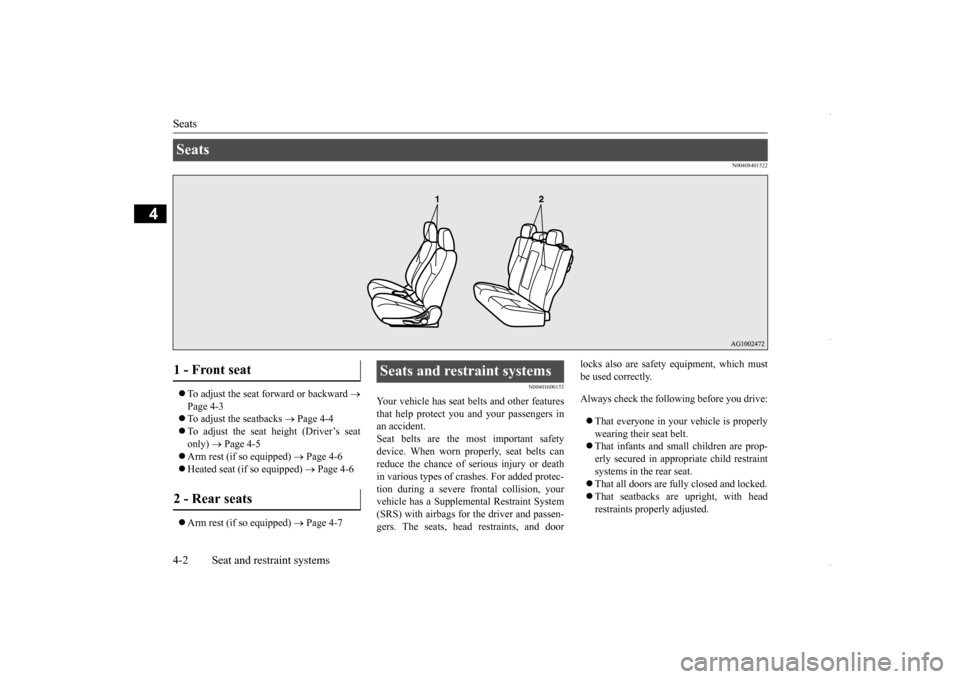
N00408401522
To adjust the seat forward or backward
Page 4-3 To adjust the seatbacks
Page 4-4
To adjust the seat height (Driver’s seat only)
Page 4-5
Arm rest (if so equipped)
Page 4-6
Heated seat (if so equipped)
Page 4-6
Arm rest (if so equipped)
Page 4-7
N00401600153
Your vehicle has seat belts and other features that help protect you and your passengers in an accident. Seat belts are the most important safetydevice. When worn properly, seat belts can reduce the chance of serious injury or death in various types of crashes. For added protec-tion during a severe frontal collision, your vehicle has a Supplemental Restraint System (SRS) with airbags for the driver and passen-gers. The seats, head restraints, and door
locks also are safety equipment, which must be used correctly. Always check the following before you drive: That everyone in your vehicle is properly wearing their seat belt. That infants and small children are prop- erly secured in appropriate child restraint systems in the rear seat. That all doors are fully closed and locked. That seatbacks are upright, with head restraints properly adjusted.
Seats 1 - Front seat 2 - Rear seats
Seats and restraint systems
BK0229600US.bo
ok 2 ページ 2015年10月1日 木曜日 午後2時29分
Page 23 of 398
Front seats
Seat and restraint systems 4-3
4
Safety equipment cannot prevent injury or death in all motor vehicle accidents. You can help reduce the risk of injury or death, how- ever, by following the
instructions in this
manual.
N00401800399
Position the driver’s seat
as far back as possi-
ble while maintaining a position that stillenables you to fully apply the pedals, easily control the steering wheel and safely operate the vehicle.
N00401900228
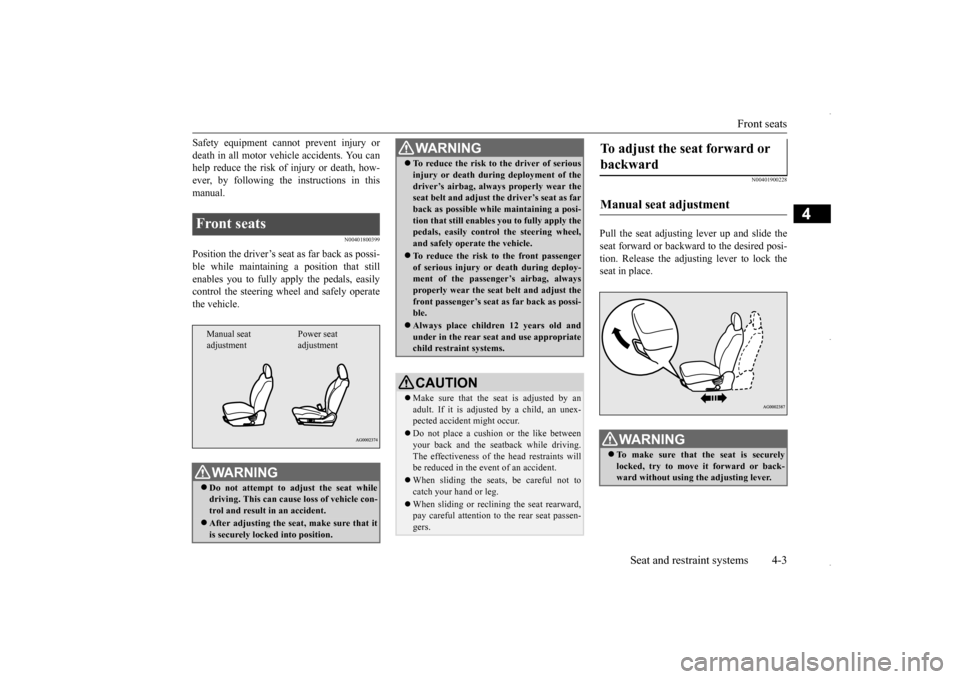
Pull the seat adjusting lever up and slide theseat forward or backward to the desired posi- tion. Release the adjusting lever to lock the seat in place.
Front seats
WA R N I N G Do not attempt to adjust the seat while driving. This can cause loss of vehicle con- trol and result in an accident. After adjusting the seat, make sure that it is securely locked into position.Manual seat adjustment
Power seat adjustment
To reduce the risk to the driver of serious injury or death during deployment of the driver’s airbag, always properly wear the seat belt and adjust th
e driver’s seat as far
back as possible while maintaining a posi-tion that still enables
you to fully apply the
pedals, easily control the steering wheel, and safely operate the vehicle. To reduce the risk to the front passenger of serious injury or death during deploy-ment of the passenger’s airbag, always properly wear the seat belt and adjust the front passenger’s seat as far back as possi-ble. Always place children 12 years old and under in the rear seat and use appropriate child restraint systems.CAUTION Make sure that the seat is adjusted by an adult. If it is adjusted by a child, an unex-pected accident might occur. Do not place a cushion or the like between your back and the seatback while driving. The effectiveness of the head restraints will be reduced in the event of an accident. When sliding the seats, be careful not to catch your hand or leg. When sliding or reclining the seat rearward, pay careful attention to the rear seat passen- gers.WA R N I N G
To adjust the seat forward or backward Manual seat adjustment
WA R N I N G To make sure that the seat is securely locked, try to move it forward or back- ward without using the adjusting lever.
BK0229600US.bo
ok 3 ページ 2015年10月1日 木曜日 午後2時29分
Page 29 of 398
Extending a luggage compartment Seat and restraint systems 4-9
4
N00405500105
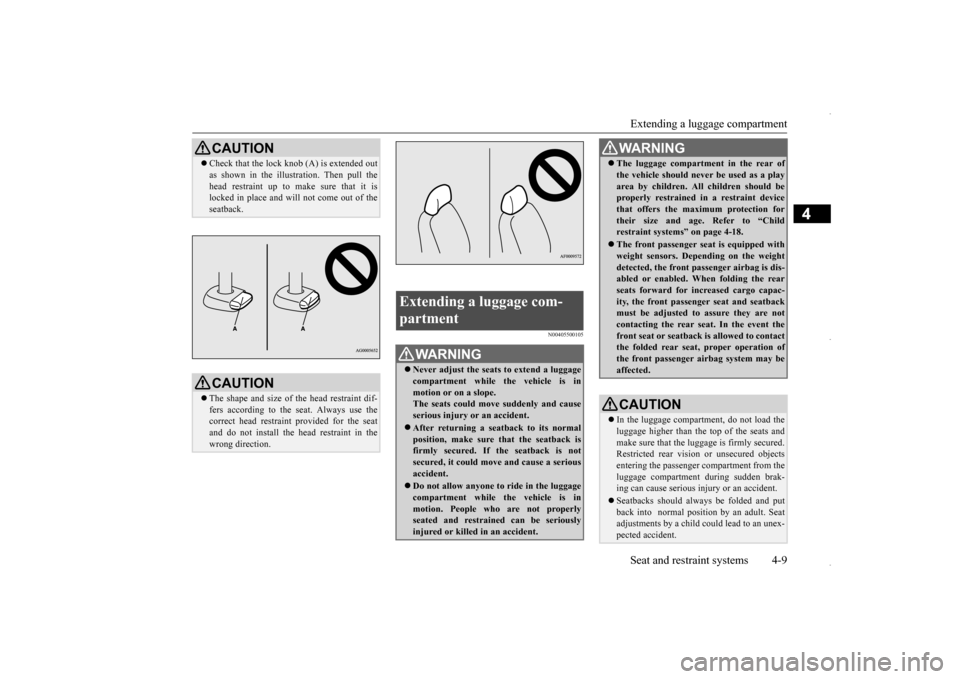
CAUTION Check that the lock knob (A) is extended out as shown in the illustration. Then pull the head restraint up to make sure that it is locked in place and will not come out of the seatback.CAUTION The shape and size of the head restraint dif- fers according to the seat. Always use the correct head restraint provided for the seatand do not install the head restraint in the wrong direction.
Extending a luggage com- partment
WA R N I N G Never adjust the seats to extend a luggage compartment while the vehicle is inmotion or on a slope. The seats could move suddenly and cause serious injury or an accident. After returning a seatback to its normal position, make sure that the seatback isfirmly secured. If the seatback is not secured, it could move and cause a serious accident. Do not allow anyone to
ride in the luggage
compartment while the vehicle is inmotion. People who are not properly seated and restrained can be seriously injured or killed in an accident.
The luggage compartment in the rear of the vehicle should never be used as a play area by children. All children should be properly restrained in a restraint device that offers the maximum protection fortheir size and age. Refer to “Child restraint systems” on page 4-18. The front passenger seat is equipped with weight sensors. Depending on the weight detected, the front passenger airbag is dis-abled or enabled. When folding the rear seats forward for increased cargo capac- ity, the front passenger seat and seatbackmust be adjusted to assure they are not contacting the rear seat. In the event the front seat or seatback is allowed to contactthe folded rear seat, proper operation of the front passenger airbag system may be affected.CAUTION In the luggage compartment, do not load the luggage higher than the top of the seats and make sure that the luggage is firmly secured. Restricted rear vision or unsecured objects entering the passenger compartment from the luggage compartment during sudden brak-ing can cause serious injury or an accident. Seatbacks should always be folded and put back into normal position by an adult. Seat adjustments by a child could lead to an unex- pected accident.WA R N I N G
BK0229600US.bo
ok 9 ページ 2015年10月1日 木曜日 午後2時29分
Page 32 of 398
Seat belts 4-12 Seat and restraint systems
4
N00406201496
All seats are equipped with a seat belt which uses one combined lap-and-shoulder belt with an emergency locking retractor. This system is designed to provide both com- fort and safety. It permits full extension and automatic retraction of the belts during nor- mal vehicle operation. A sensing device
inside the belt retractor is designed to lock the retractor in the event of a sudden change in the vehicle’s motion. 1. Occupants should always sit back in their seats with their backs against the uprightseatback. To reduce the risk of serious injury or death during deployment of the airbag, adjust the driver’s seat as far backas possible while maintaining a position that still enables you to fully apply the pedals, easily control the steering wheel,and safely operate the vehicle. The front passenger seat should also be moved as far back as possible. Refer to “Supple-mental Restraint System (SRS) - airbag” on page 4-26. Also refer to “To adjust the seat forward or backward” on page 4-3.
To reduce the risk to the driver of serious injury or death during deployment of the driver’s airbag, always properly wear the seat belt and adjust the driver’s seat as far back as possible while maintaining a posi-tion that still enables you to fully apply the pedals, easily control the steering wheel, and safely operate the vehicle. To reduce the risk to a front seat passen- ger of serious injury or death from adeploying airbag, make sure the passenger always wears the seat belt properly, remains seated all the way back andupright in their seat, and moves the seat as far back as possible. Refer to “Supplemen- tal Restraint System (SRS) - airbag” onpage 4-26 for additional information. Never hold an infant or child in your arms or on your lap when riding in this vehicle even when you are wearing your seat belt. Never place any part of the seat belt youare wearing around an infant or child. Failure to follow these simple instructions creates a risk of serious injury or death toyour child in the event of an accident or sudden stop.WA R N I N G
Children 12 years old and under should always ride in the rear seat and be prop- erly restrained. This reduces their risk of serious injury or death in an accident, especially due to a deploying front passen-ger airbag. Refer to “Child restraint sys- tems” on page 4-18 for additional information. Any child who is too small to properly wear a seat belt must be properlyrestrained in an appropriate child restraint system. Infants MUST be placed in a rear-facing child safety seat and positioned in the rear seat. In the event of an accident, all seat belt assemblies, including retractors andattachment hardware, should be inspected by an authorized Mitsubishi Motors dealer to determine whether replacementis necessary.
Seat belt instructions
WA R N I N G
NOTE
For instructions on installing a child restraint system using a seat belt, refer to “Installing a child restraint system using the seat belt” on page 4-23.
BK0229600US.bo
ok 12 ページ 2015年10月1日 木曜日 午後2時29分
Page 37 of 398
Seat belt use during pregnancy
Seat and restraint systems 4-17
4
N00406701228
When your seat belt, even fully extended, is not long enough, a seat belt extender must be obtained. The extender may be used for either of the front seats.
N00406800134
Seat belts work for ev
eryone, including preg-
nant women. Like all occupants, pregnantwomen are more likely to be seriously injured or killed in an accident if they do not wear seat belts.
N00417700641
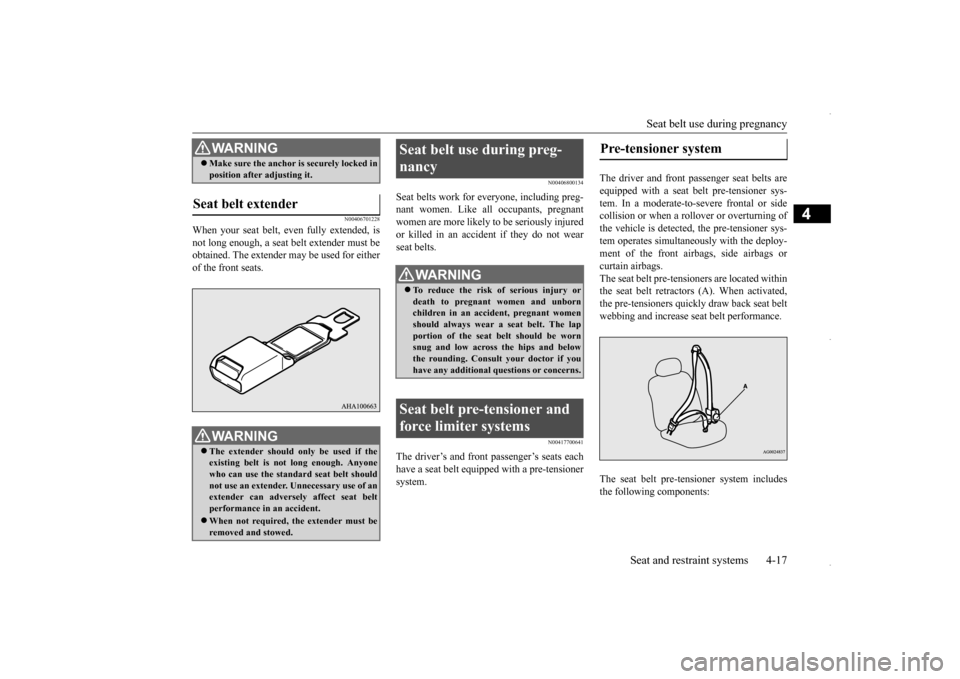
The driver’s and front passenger’s seats eachhave a seat belt equipped with a pre-tensioner system.
The driver and front passenger seat belts are equipped with a seat belt pre-tensioner sys-tem. In a moderate-to-severe frontal or side collision or when a rollover or overturning of the vehicle is detected, the pre-tensioner sys-tem operates simultaneously with the deploy- ment of the front airbags, side airbags or curtain airbags.The seat belt pre-tensioners are located withinthe seat belt retractors (A). When activated, the pre-tensioners quickly draw back seat belt webbing and increase seat belt performance. The seat belt pre-tensioner system includes the following components:
Make sure the anchor is securely locked in position after adjusting it.
Seat belt extender
WA R N I N G The extender should only be used if the existing belt is not long enough. Anyone who can use the standard seat belt shouldnot use an extender. Unnecessary use of an extender can adversely affect seat belt performance in an accident. When not required, the extender must be removed and stowed.WA R N I N G
Seat belt use during preg- nancy
WA R N I N G To reduce the risk of serious injury or death to pregnant women and unbornchildren in an accident, pregnant women should always wear a seat belt. The lap portion of the seat belt should be wornsnug and low across the hips and below the rounding. Consult your doctor if you have any additional questions or concerns.
Seat belt pre-tensioner and force limiter systems
Pre-tensioner system
BK0229600US.bo
ok 17 ページ 2015年10月1日 木曜日 午後2時29分