tire pressure MITSUBISHI OUTLANDER SPORT 2017 3.G Owner's Manual
[x] Cancel search | Manufacturer: MITSUBISHI, Model Year: 2017, Model line: OUTLANDER SPORT, Model: MITSUBISHI OUTLANDER SPORT 2017 3.GPages: 399, PDF Size: 14.61 MB
Page 353 of 399
Tires 9-16 Vehicle care and maintenance
9
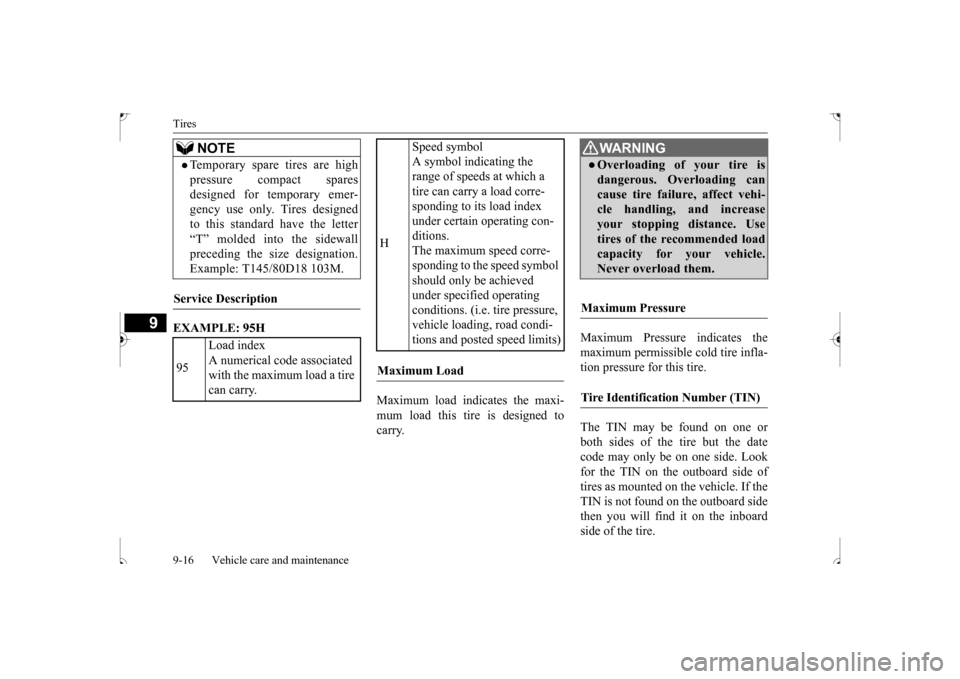
EXAMPLE: 95H
Maximum load indicates the maxi- mum load this tire is designed to carry.
Maximum Pressure indicates the maximum permissible cold tire infla- tion pressure for this tire. The TIN may be found on one or both sides of the tire but the date code may only be on one side. Look for the TIN on the outboard side of tires as mounted on the vehicle. If the TIN is not found on the outboard sidethen you will find it on the inboard side of the tire.
Temporary spare tires are highpressure compact spares designed for temporary emer-gency use only. Tires designed to this standard have the letter “T” molded into the sidewallpreceding the size designation. Example: T145/80D18 103M.
Service Description 95
Load index A numerical code associated with the maximum load a tire can carry.NOTE
H
Speed symbol A symbol indicating the range of speeds at which a tire can carry a load corre-sponding to its load index under certain operating con- ditions.The maximum speed corre- sponding to the speed symbol should only be achieved under specified operating conditions. (i.e. tire pressure, vehicle loading, road condi-tions and posted speed limits)
Maximum Load
WA R N I N GOverloading of your tire is dangerous. Overloading can cause tire failure, affect vehi-cle handling, and increase your stopping distance. Use tires of the recommended loadcapacity for your vehicle. Never overload them.
Maximum Pressure Tire Identification Number (TIN)
BK0239500US.bo
ok 16 ページ 2016年5月13日 金曜日 午前8時53分
Page 355 of 399
Tires 9-18 Vehicle care and maintenance
9
N00939301955
Proper tire inflation pressure is essential for the safe and satisfactory operation of yourvehicle. The wrong tire pressure will cause problems in three major areas: Safety Too little pressure increases flexing in thetire and can cause tire failure. Too muchpressure can cause a tire to lose its ability to cushion shock. Objects on the road and potholes could then cause tire damage thatmay result in tire failure. Economy The wrong tire pressure can cause unevenwear patterns in the tire tread. These abnormal wear patterns will reduce the tread life, and the tire will have to bereplaced sooner. Too little pressure also makes it harder for the tire to roll, and this uses up more fuel. Ride comfort and vehicle stability The superior riding experience built into your vehicle partly depends on the correcttire pressure. Too much pressure gives an uncomfortable and jarring ride. Too little pressure feels as if your vehicle is slow torespond. Unequal tire pressures can make steering your vehicle uneven and unpredictable.
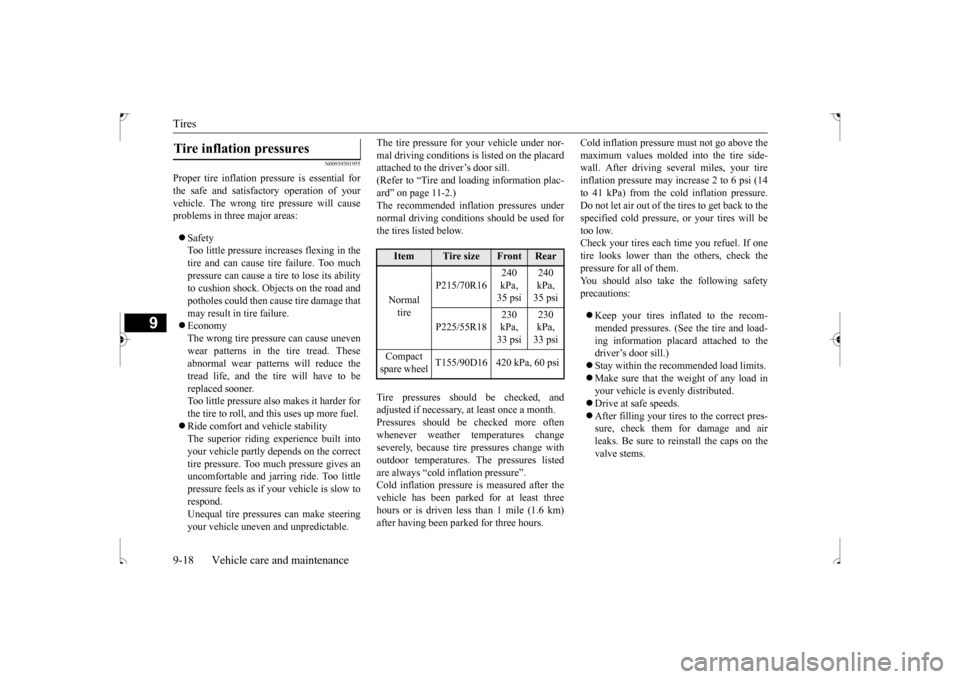
The tire pressure for your vehicle under nor- mal driving conditions is listed on the placard attached to the driver’s door sill. (Refer to “Tire and loading information plac-ard” on page 11-2.) The recommended infl
ation pressures under
normal driving conditions should be used forthe tires listed below. Tire pressures should be checked, and adjusted if necessary, at least once a month. Pressures should be checked more oftenwhenever weather temperatures change severely, because tire pressures change with outdoor temperatures. The pressures listedare always “cold inflation pressure”. Cold inflation pressure is measured after the vehicle has been parked for at least threehours or is driven less than 1 mile (1.6 km) after having been parked for three hours.
Cold inflation pressure must not go above the maximum values molded into the tire side- wall. After driving several miles, your tire inflation pressure may increase 2 to 6 psi (14to 41 kPa) from the cold inflation pressure. Do not let air out of the tires to get back to the specified cold pressure, or your tires will betoo low. Check your tires each time you refuel. If one tire looks lower than the others, check thepressure for all of them.You should also take the following safety precautions: Keep your tires inflated to the recom- mended pressures. (See the tire and load-ing information placard attached to the driver’s door sill.) Stay within the recommended load limits. Make sure that the weight of any load in your vehicle is evenly distributed. Drive at safe speeds. After filling your tires to the correct pres- sure, check them for damage and air leaks. Be sure to reinstall the caps on thevalve stems.
Tire inflation pressures
Item
Tire size
Front
Rear
Normal tire
P215/70R16
240 kPa, 35 psi
240 kPa, 35 psi
P225/55R18
230 kPa, 33 psi
230 kPa, 33 psi
Compact spare wheel
T155/90D16 420 kPa, 60 psi
BK0239500US.bo
ok 18 ページ 2016年5月13日 金曜日 午前8時53分
Page 356 of 399
Tires
Vehicle care and maintenance 9-19
9
N00939600241 N00939700141
The following maintenance steps are recom- mended:
Check tire pressures regularly. Have regular maintenance done on the wheel balance and front and rear suspen- sion alignment. Rotate your tires regularly as described in the “Tire rotation” section on page 9-19.
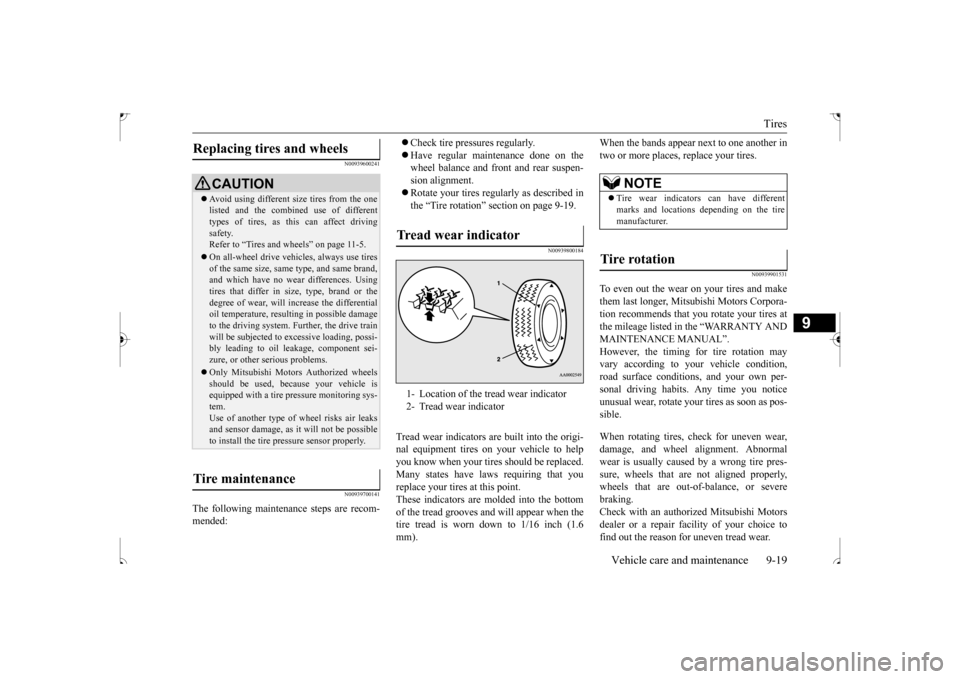
N00939800184
Tread wear indicators are built into the origi- nal equipment tires on your vehicle to helpyou know when your tires should be replaced. Many states have laws requiring that you replace your tires at this point.These indicators are molded into the bottom of the tread grooves and will appear when the tire tread is worn down to 1/16 inch (1.6mm).
When the bands appear next to one another in two or more places, replace your tires.
N00939901531
To even out the wear on your tires and makethem last longer, Mitsubishi Motors Corpora- tion recommends that you rotate your tires at the mileage listed in the “WARRANTY ANDMAINTENANCE MANUAL”. However, the timing for tire rotation may vary according to your vehicle condition,road surface conditions, and your own per- sonal driving habits. Any time you notice unusual wear, rotate your tires as soon as pos-sible. When rotating tires, check for uneven wear, damage, and wheel alignment. Abnormal wear is usually caused by a wrong tire pres-sure, wheels that are not aligned properly, wheels that are out-of-balance, or severe braking.Check with an authorized Mitsubishi Motors dealer or a repair faci
lity of your choice to
find out the reason for uneven tread wear.
Replacing tires and wheels
CAUTION Avoid using different size tires from the one listed and the combined use of different types of tires, as this can affect driving safety.Refer to “Tires and wheels” on page 11-5. On all-wheel drive vehicles, always use tires of the same size, same type, and same brand, and which have no wear differences. Using tires that differ in size, type, brand or thedegree of wear, will increase the differential oil temperature, resulting in possible damage to the driving system. Further, the drive trainwill be subjected to excessive loading, possi- bly leading to oil leakage, component sei- zure, or other serious problems. Only Mitsubishi Motors Authorized wheels should be used, because your vehicle isequipped with a tire pressure monitoring sys- tem. Use of another type of wheel risks air leaksand sensor damage, as it will not be possible to install the tire pressure sensor properly.
Tire maintenance
Tread wear indicator 1- Location of the tread wear indicator 2- Tread wear indicator
NOTE
Tire wear indicators can have different marks and locations depending on the tire manufacturer.
Tire rotation
BK0239500US.bo
ok 19 ページ 2016年5月13日 金曜日 午前8時53分
Page 357 of 399
Tires 9-20 Vehicle care and maintenance
9
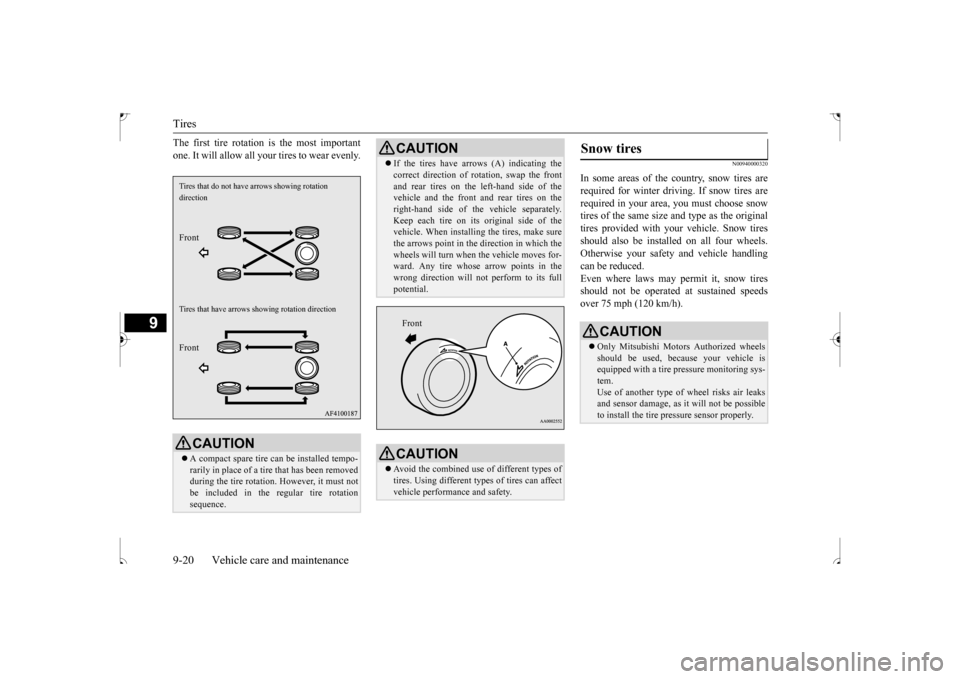
The first tire rotation is the most important one. It will allow all your
tires to wear evenly.
N00940000320
In some areas of the country, snow tires are required for winter driving. If snow tires arerequired in your area, you must choose snow tires of the same size and type as the original tires provided with your vehicle. Snow tiresshould also be installed on all four wheels. Otherwise your safety and vehicle handling can be reduced.Even where laws may permit it, snow tiresshould not be operated at sustained speeds over 75 mph (120 km/h).
CAUTION A compact spare tire can be installed tempo- rarily in place of a tire that has been removed during the tire rotation. However, it must not be included in the regular tire rotationsequence.Tires that do not have
arrows showing rotation
directionFrontTires that have arrows
showing rotation direction
Front
If the tires have arrows (A) indicating the correct direction of rotation, swap the front and rear tires on the left-hand side of the vehicle and the front and rear tires on the right-hand side of the vehicle separately.Keep each tire on its original side of the vehicle. When installing the tires, make sure the arrows point in the direction in which thewheels will turn when the vehicle moves for- ward. Any tire whose arrow points in the wrong direction will not perform to its fullpotential.CAUTION Avoid the combined use of different types of tires. Using different types of tires can affect vehicle performance and safety.CAUTIONFront
Snow tires
CAUTION Only Mitsubishi Motors Authorized wheels should be used, because your vehicle isequipped with a tire pressure monitoring sys- tem. Use of another type of wheel risks air leaksand sensor damage, as it will not be possible to install the tire pressure sensor properly.
BK0239500US.bo
ok 20 ページ 2016年5月13日 金曜日 午前8時53分
Page 398 of 399
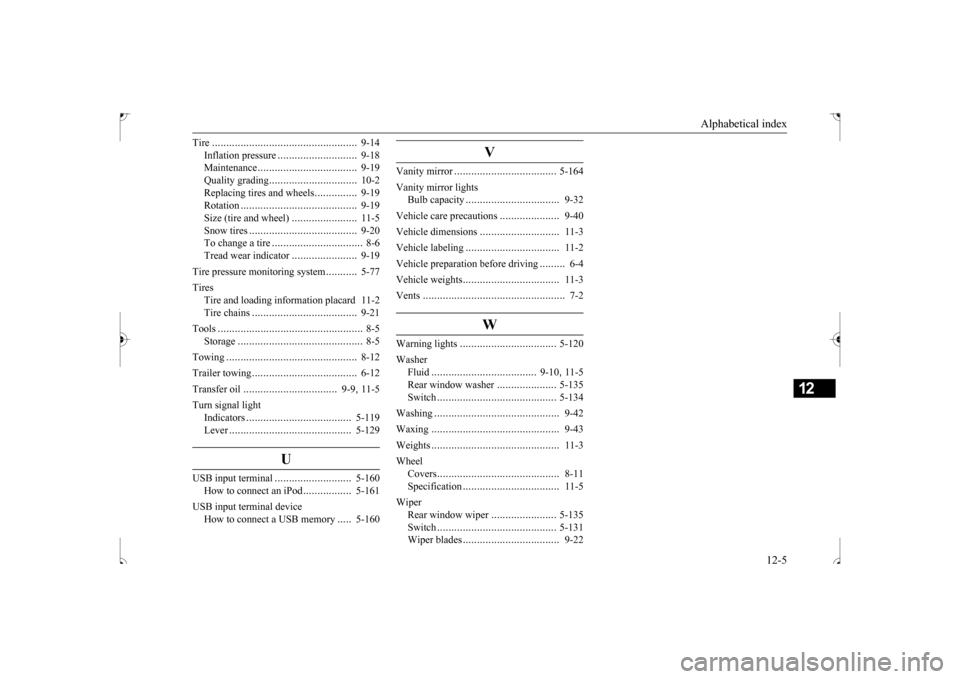
Alphabetical index
12-5
12
Tire
...........................
........................
9-14
Inflation pressure
............................
9-18
Maintenance
..................
.................
9-19
Quality grading
...............................
10-2
Replacing tires and wheels
...............
9-19
Rotation
....................
.....................
9-19
Size (tire and wheel)
.......................
11-5
Snow tires
.....................
.................
9-20
To change a tire
................
................
8-6
Tread wear indicator
.......................
9-19
Tire pressure monitoring system
...........
5-77
Tires
Tire and loading information placard 11-2 Tire chains
....................
.................
9-21
Tools
.........................
..........................
8-5
Storage
.........................
...................
8-5
Towing
......................
........................
8-12
Trailer towing
....................
.................
6-12
Transfer oil
................
.................
9-9
, 11-5
Turn signal light
Indicators
..................
...................
5-119
Lever
........................
...................
5-129
U
USB input terminal
...........................
5-160
How to connect an iPod
.................
5-161
USB input terminal device
How to connect a USB memory
.....
5-160
V
Vanity mirror
...................
.................
5-164
Vanity mirror lights
Bulb capacity
..................
...............
9-32
Vehicle care precautions
.....................
9-40
Vehicle dimensions
............................
11-3
Vehicle labeling
..................
...............
11-2
Vehicle preparation before driving
.........
6-4
Vehicle weights
...................
...............
11-3
Vents
..........................
........................
7-2
W
Warning lights
.................
.................
5-120
Washer
Fluid
....................
.................
9-10
, 11-5
Rear window washer
.....................
5-135
Switch
.....................
.....................
5-134
Washing
......................
......................
9-42
Waxing
.......................
......................
9-43
Weights
.......................
......................
11-3
Wheel
Covers
.........................
..................
8-11
Specification
...................
...............
11-5
Wiper
Rear window wiper
.......................
5-135
Switch
.....................
.....................
5-131
Wiper blades
...................
...............
9-22
BK0239500US.bo
ok 5 ページ 2016年5月13日 金曜日 午前8時53分