battery MITSUBISHI OUTLANDER SPORT 2017 3.G Workshop Manual
[x] Cancel search | Manufacturer: MITSUBISHI, Model Year: 2017, Model line: OUTLANDER SPORT, Model: MITSUBISHI OUTLANDER SPORT 2017 3.GPages: 399, PDF Size: 14.61 MB
Page 351 of 399
Tires 9-14 Vehicle care and maintenance
9
N00939201592
It is important to familiarize yourself with the following terms: Cold tire pressure: • The measured pressure after the vehicle has been parked for at least three hours,or • The measured pressure when the vehicle is driven less than 1 mile (1.6 km) afterhaving been parked for three hours.
Maximum pressure:the maximum permis- sible cold tire inflat
ion pressure for this
tire. Recommended inflation pressure: the inflation pressure for optimum tire perfor-mance. Intended outboard sidewall: • The sidewall that contains a whitewall,bears white lettering or bears manufac- turer, brand, and/or model name molding that is higher or deeper than the samemolding on the other sidewall of the tire, or
• The outward facing sidewall of an asym- metrical tire that has a particular side that must always face outward when mounted on a vehicle.
Passenger car tire: a tire intended for use on passenger cars,
multipurpose passen-
ger vehicles, and trucks, that have a grossvehicle weight rating (GVWR) of 10,000 pounds or less. Light truck (LT) tire: a tire designated by its manufacturer as primarily intended foruse on lightweight trucks or multipurpose passenger vehicles. Tread: portion of a tire that comes into contact with the road. Tread rib: a tread section running circum- ferentially around a tire. Tread separation: pulling away of the tread from the tire carcass. Carcass: the tire structure, except tread and sidewall rubber which, when inflated, bears the load. Sidewall: portion of a tire between the tread and bead. Section width: the linear distance between the exteriors of the sidewalls of aninflated tire, excluding elevations due to labeling, decoration, or protective bands. Bead: the part of the tire that is made of steel wires, wrapped or reinforced by ply cords and that is shaped to fit the rim.
NOTE
Check each battery terminal for corrosion. You can stop more corrosion by washing with a solution of baking soda and water. Grease the posts and clamps after cleaning or tightening them. Check to see that the battery is securely installed and cannot be moved. Also checkeach terminal for tightness. If you will not be driv
ing your vehicle for a
long period of time, remove the battery and store it in a place where the battery fluid will not freeze. The battery only should be storedwith a full charge. Before cleaning the battery, tighten all the filler port caps to keep dirt and moisture out.
Tires
WA R N I N G Driving with tires that are worn, damaged or improperly inflated is dangerous.These type tire conditions will adversely affect vehicle performance. These type tire conditions can also cause a tread separation or blowout which may result in an accident causing seriousinjury or death.
Tires, including spare tire, degrade over time with age even when they are not being used. It is recommended that tires over 6 years generally be replaced even if damage isnot obvious.WA R N I N G
BK0239500US.bo
ok 14 ページ 2016年5月13日 金曜日 午前8時53分
Page 359 of 399
Wiper blades 9-22 Vehicle care and maintenance
9
N00940700138
Check the wiper blades occasionally. Clean them regularly to remove deposits of salt androad film. Use a sponge or cloth and a mild detergent or non-abrasive cleaner to clean the blades and glass areas.Replace the blades if they continue to streak or smear. If the blades are frozen to the windshield or rear window, do not operate the wipers until the ice has melted and the blades are freed,otherwise the wiper motor may be damaged.
N00940800328
Your vehicle is equipped with an emission-control system that meets all the requirements of the U.S. Environmental Protection Agency
and Environment Canada. The emission-con- trol system is made of: a positive crankcase ventilation system an evaporative emission-control system an exhaust emission-control system
To be sure the emission-control system works properly, have your vehicle inspected and maintained by an authorized Mitsubishi Motors dealer or a repair facility of yourchoice. This should be done at the time ormileage specified in the “WARRANTY AND MAINTENANCE MANUAL”. These, and all the other “general” mainte-nance services listed in this manual, need to be performed to keep your vehicle running properly and reliably.You should also have an inspection and ser- vice any time you suspect a malfunction.
N00940900228
Spark plugs must fire properly for good engine performance and emission-control.Do not reuse them by cleaning or regapping. Change them at the mileage listed in the “WARRANTY AND MAINTENANCEMANUAL”.
Wiper blades
NOTE
Do not run the wipers on dry glass for a long time. This wears out the rubber and can scratch the glass.
During cold weather Emission-control system maintenance
NOTE
To meet government regulations and pro- mote cleaner air, your vehicle is equipped with an onboard diagnostic system (OBD). The engine electronic control module that controls OBD functions stores various data(especially about the exhaust emissions). This data will be erased if the battery cable is disconnected, which could make a rapiddiagnosis difficult. Do not disconnect the battery cable when the engine malfunction indicator (“SERVICE ENGINE SOON” or“Check engine light”) is ON.
Spark plugs
NOTE
Use the spark plugs listed under “Engine specifications” on page 11-4 or plugs that are exactly the same. Other plugs could causeengine damage, performance problems or radio noise.
BK0239500US.bo
ok 22 ページ 2016年5月13日 金曜日 午前8時53分
Page 380 of 399
Cleaning the outside of your vehicle Vehicle care and maintenance 9-43
9
N00946000234
Wax your vehicle once or twice a year, or when water does not bead up on the paint. Use a soft cloth to put a small amount of wax on the painted surfaces. After the wax hasdried, polish with a dry soft cloth. Do not wax your vehicle in direct sunlight. You should wax when the painted surfacesare cool.
N00946100046
If painted surfaces have been severely dam- aged and lost their original luster and color tone, polish the surface lightly with a finepolishing compound. Avoid limiting your polishing to the damaged surface only; polish a somewhat wider area, moving the polishingcloth in one direction. After polishing, flush the compound from the surface and apply a coat of wax to regain a beautiful luster.
N00946200047
Small cracks and scratches in the paint coatshould be touched up as soon as possible withtouch-up paint to prevent corrosion. Check body areas facing the road or the tires carefully for damage to the paint caused byflying stones, etc. The paint code number for your vehicle can be found on the vehicle
information code plate in the engine compart- ment.
N00946300194
Use a sponge or chamois to clean these parts.If a vehicle wax sticks to a gray or black rough surface of the bumper, molding or lights, the surface may appear white in color.In this case, wipe it
off using lukewarm water
and a soft cloth or chamois.
NOTE
When the door is frozen, opening it by force may tear off or crack the rubber gasket installed around the door. Pour warm water to melt the ice. Be sure to thoroughly wipe off the water after opening the door. To pre-vent freezing of the weatherstripping on the doors, hood, etc., treat
with silicone lubri-
cant.
Waxing
CAUTION Waxes containing high abrasive compounds should not be used. These waxes remove rust and stain effectively from the paintwork, butare harmful to the finish of the paint, because they also remove paint/clearcoat. They are also harmful to other glossy sur-faces such as the grill
e, trim, moldings, etc.
Do not use gasoline, benzine, kerosene or paint thinners to remove road tar or other dirt from the vehicle surface. Do not put wax on the areas having black matte coating because it can cause uneven discoloration, patches, blurs, etc. If these get wax on them, wipe the wax off right awaywith a soft cloth and warm water.
Polishing Damaged paint
CAUTION
Cleaning plastic parts
CAUTION Do not use a scrubbing brush or other rough scrubber as these may damage the plastic surface. Do not use wax containing compounds (pol- ishing powder) which may damage the plas- tic surface. Do not let plastic parts get soiled with gaso- line, oil, brake fluids
, engine oils, greases,
paint thinner, and sulfuric acid (battery elec- trolyte), as such substances will cause stains, cracks, or discoloration.If any of these get on a plastic part, wipe them up with a soft cloth or chamois and a mild solution of soap and water. Then rinse them immediately with water.
BK0239500US.bo
ok 43 ページ 2016年5月13日 金曜日 午前8時53分
Page 381 of 399
Cleaning the outside of your vehicle 9-44 Vehicle care and maintenance
9
N00946400052
To prevent spots and corrosion of chrome parts, wash with water, dry thoroughly, andapply a nonabrasive automotive wax. If the chrome is severely damaged or pitted, use a commercially available chrome polish.
N00946500183
1. Remove dirt using a wet sponge. 2. Use a mild detergent on any dirt that can- not be removed easily with water.Rinse off the detergent after washing the wheel. 3. Dry the wheel thoroug
hly using a chamois
leather or a soft cloth.
N00946600054
The window glass can usually be cleanedusing only a sponge and water. Glass cleanercan be used to remove
wax, oil, grease, dead
insects, etc. After washing the glass, wipe it dry with a clean, dry, soft cloth.
N00946700068
Use a soft cloth and glass cleaner to remove grease, dead insects, etc., from the wiper blades.Replace the wiper blades when they no longer clean the windshield and rear window prop- erly.
N00947000071
Never spray or splash water on the electricalaccessories in the engine compartment. Thisputs the engine at risk of being damaged. Do not bring the circumferential parts, the plastic parts and so on into contact with sulfu-ric acid (battery electrolyte) which may crack, stain or discolor them. If they are in contact, wipe off with soft cloth,chamois or the like and an aqueous solution of neutral detergent then immediately rinse the affected parts with plenty of water.
Chrome parts Aluminum wheels
(if so equipped)
CAUTION Do not use a brush or other hard implement on the wheels. Do not use any cleaner that contains an abra- sive substance or is acidic or alkaline. Doing so could cause the coating on the wheels to peel or become discolored or stained. Do not directly apply hot water using a steam cleaner or by any other means. Contact with seawater or road salt used for de-icing can cause corrosion. Rinse off such substances as soon as possible.
Window glass Wiper blades Engine compartment
BK0239500US.bo
ok 44 ページ 2016年5月13日 金曜日 午前8時53分
Page 388 of 399
11
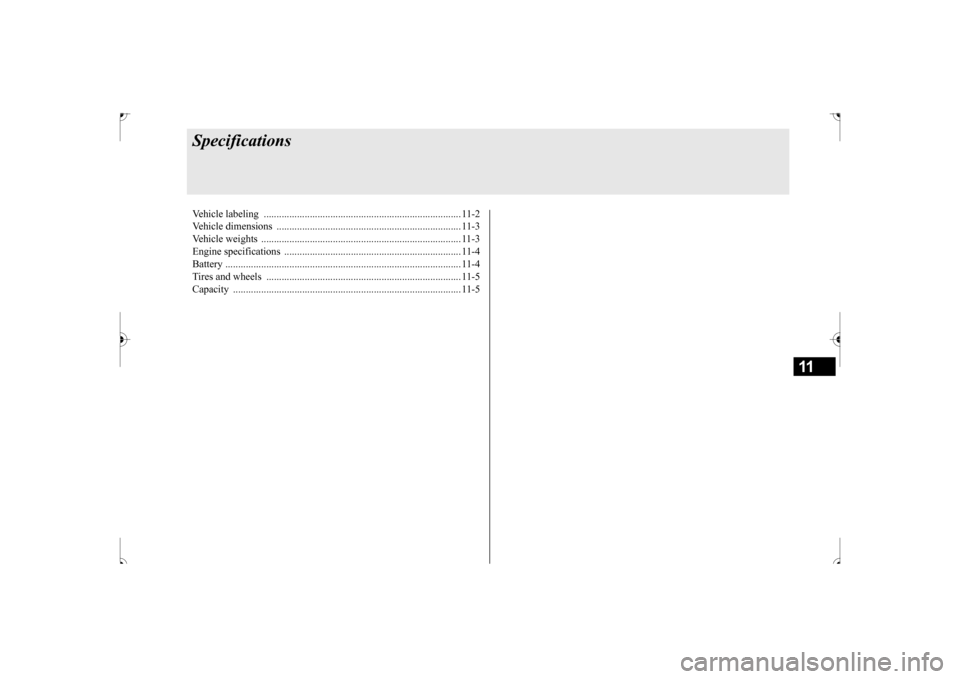
SpecificationsVehicle labeling ....
.................................................
........................ 11-2
Vehicle dimensions
................................................
........................ 11-3
Vehicle weights ...............
............................................................... 11-3
Engine specifications
.............................................
........................ 11-4
Battery .......................................
..................................................... 11-4
Tires and wheels .............
............................................................... 11-5
Capacity ....................................
..................................................... 11-5
BK0239500US.bo
ok 1 ページ 2016年5月13日 金曜日 午前8時53分
Page 391 of 399
Engine specifications 11-4 Specifications
11
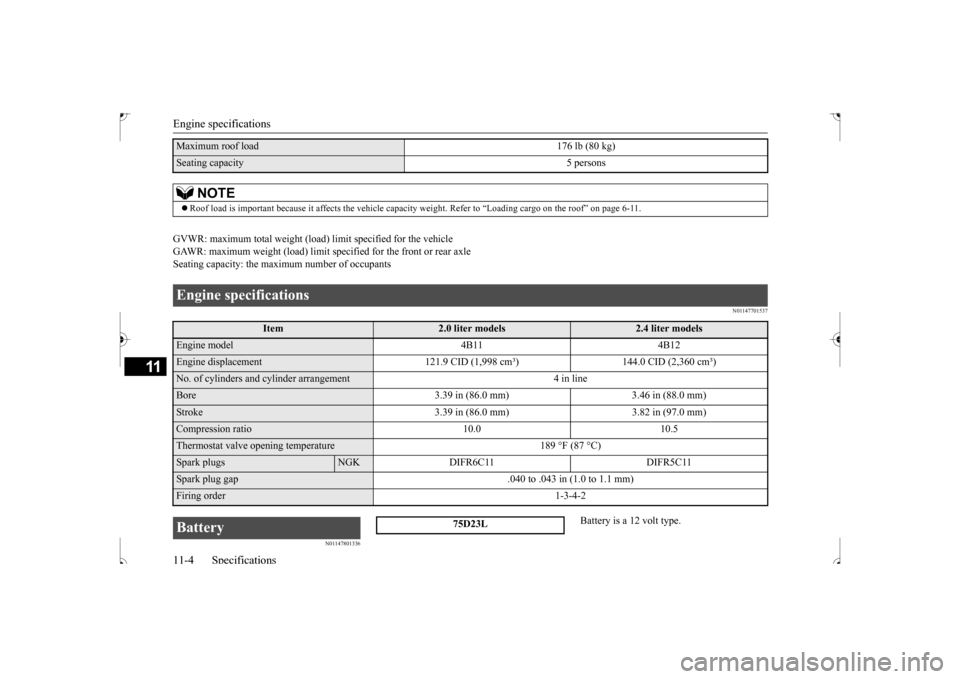
GVWR: maximum total weight (load) limit specified for the vehicle GAWR: maximum weight (load) limit sp
ecified for the front or rear axle
Seating capacity: the maximum number of occupants
N01147701537
N01147801336
Battery is a 12 volt type.
Maximum roof load 176 lb (80 kg)Seating capacity 5 persons
NOTE
Roof load is important because it affects the vehicle capacity
weight. Refer to “Loading cargo on the roof” on page 6-11.
Engine specifications
Item
2.0 liter models
2.4 liter models
Engine model 4B11 4B12Engine displacement 121.9 CID (1,998 cm³) 144.0 CID (2,360 cm³)No. of cylinders and cylinder arrangement 4 in lineBore 3.39 in (86.0 mm) 3.46 in (88.0 mm)Stroke 3.39 in (86.0 mm) 3.82 in (97.0 mm)Compression ratio 10.0 10.5Thermostat valve opening temperature 189 °F (87 °C)Spark plugs
NGK DIFR6C11 DIFR5C11
Spark plug gap .040 to .043 in (1.0 to 1.1 mm)Firing order
1-3-4-2
Battery
75D23L
BK0239500US.bo
ok 4 ページ 2016年5月13日 金曜日 午前8時53分
Page 394 of 399
Alphabetical index
12-1
12
Numerics
4-wheel drive operation
.......................
5-60
A
Accessory (installation)
.........................
3-6
Active stability control (ASC)
..............
5-70
Air bag
......................
........................
4-26
Air cleaner filter
...................
................
9-8
Air conditioning
Automatic air conditioning
.....
7-14
, 7-19
Important air conditioning operating tips
..
7-24Manual air conditioning
.............
7-4
, 7-9
Air purifier
....................
.....................
7-25
Aluminum wheels
...............................
9-44
AM/FM radio
....................
.................
7-25
Anti-lock braking system
.....................
5-67
Arm rest
........................
.......................
4-7
Assist grip
.....................
...................
5-178
Audio
AM/FM radio
................
.................
7-25
CD player
.....................
.................
7-25
Troubleshooting
.............................
7-60
Automatic air conditioning
.........
7-14
, 7-19
Automatic transaxle
Fluid
......................
........................
11-5
B
Back-up light
Bulb capacity
..................
...............
9-30
Replacement
...................
...............
9-38
Ball joint, steering linkage seals and drive shaft boots
.....................
..................
9-24
Battery
........................
......................
9-11
Charging system warning light
.......
5-121
Disconnection and connection
.........
9-13
During cold weather
.......................
9-13
Specification
...................
...............
11-4
Bluetooth 2.0 interface
.......................
5-137
Bottle holders
...................
.................
5-177
Brake
Fluid
.......................
......................
11-5
Brake assist system
.............................
5-66
Braking
.......................
........................
6-5
Anti-lock braking system
................
5-67
Hose
.......................
......................
9-23
Pad wear alarm
...............
...............
5-65
Parking brake
..................
...............
5-40
Pedal
.......................
......................
5-64
Pedal free play
................
...............
9-21
Power brakes
..................
...............
5-64
Service brake
..................
...............
5-64
Warning lights
..............................
5-120
Break-in recommendations
....................
5-3
Bulb capacity
...................
..................
9-30
C
California Perchlorate Materials Requirements
.....................
................
3-6
Capacities
.....................
.....................
11-5
Card holder
...................
...................
5-164
Cargo area cover
................
...............
5-177
Cargo loads
...................
.....................
6-10
Cargo room light
Bulb capacity
................
.................
9-32
Catalytic converter
................
................
9-2
Cautions on the handling of all-wheel drive vehicles
.......................
.....................
5-63
CD player
......................
.....................
7-25
Certification label
...............................
11-3
Charging system warning light
...........
5-121
Child restraint systems
........................
4-19
Child safety locks for rear door
............
5-31
Cleaning
Inside of your vehicle
......................
9-40
Outside of your vehicle
...................
9-41
Clutch
Pedal free play
...............
.................
9-21
Coat hook
......................
...................
5-178
Consumer information
.........................
10-2
Continuously variable transmission (CVT)
...
5-51
BK0239500US.bo
ok 1 ページ 2016年5月13日 金曜日 午前8時53分