wheel MITSUBISHI SPYDER 1990 Service Service Manual
[x] Cancel search | Manufacturer: MITSUBISHI, Model Year: 1990, Model line: SPYDER, Model: MITSUBISHI SPYDER 1990Pages: 2103, PDF Size: 68.98 MB
Page 580 of 2103
ENGINE (TURBO)
AND Troubleshooting
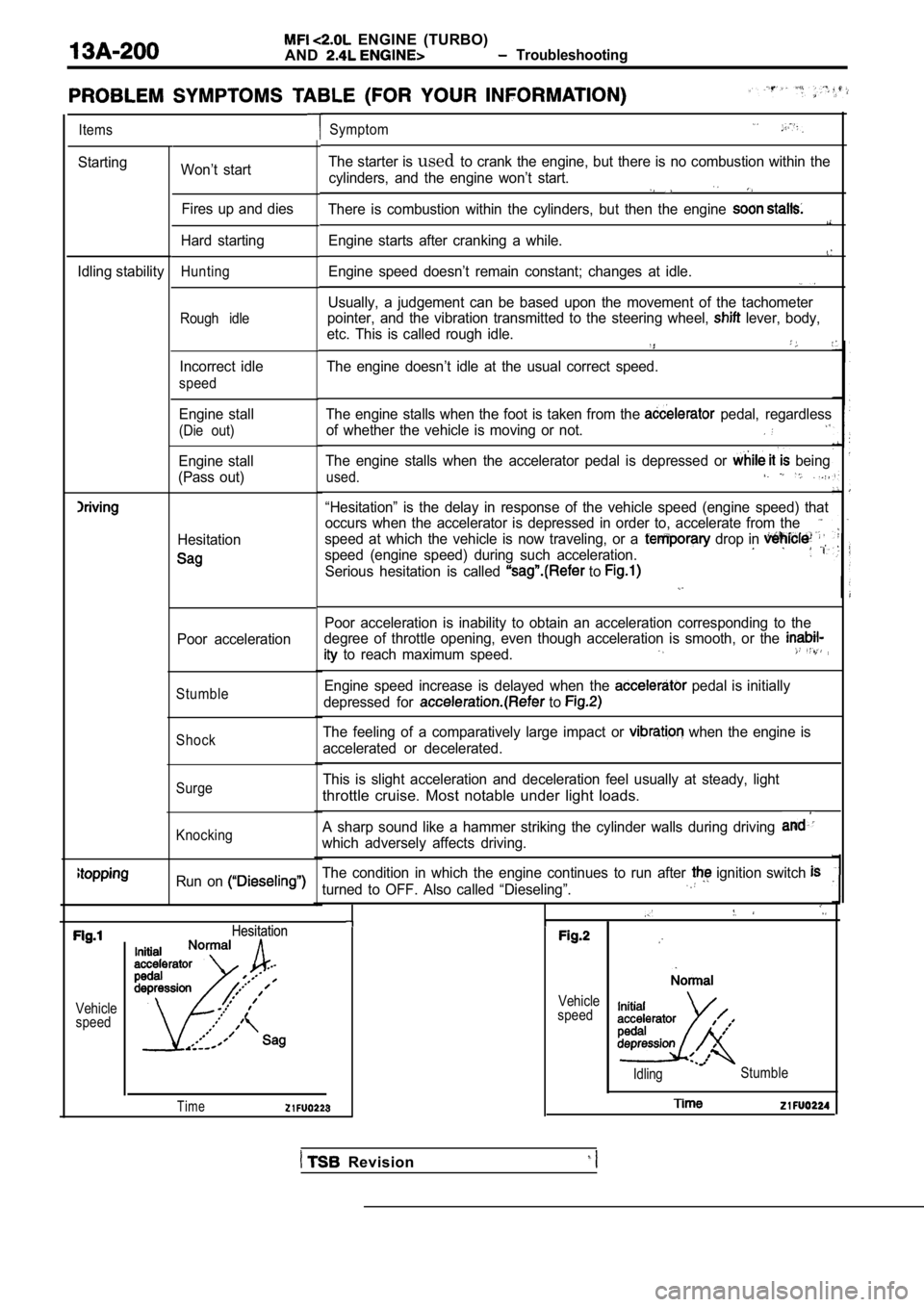
Items
Starting
Idling stabilityWon’t start Fires up and dies
Hard starting
Hunting
Rough idle
Incorrect idle
speed
Engine stall
(Die out)
Engine stall
(Pass out)
Hesitation
Poor acceleration
Stumble
Shock
Surge
Knocking
Run on
Symptom
The starter is usedto crank the engine, but there is no combustion wit hin the
cylinders, and the engine won’t start.
There is combustion within the cylinders, but then the engine
Engine starts after cranking a while.
Engine speed doesn’t remain constant; changes at id le.
Usually, a judgement can be based upon the movement of the tachometer
pointer, and the vibration transmitted to the steer ing wheel,
lever, body,
etc. This is called rough idle.
The engine doesn’t idle at the usual correct speed.
The engine stalls when the foot is taken from the
pedal, regardless
of whether the vehicle is moving or not.
The engine stalls when the accelerator pedal is dep ressed or being
used.
“Hesitation” is the delay in response of the vehicle speed (engine speed) that
occurs when the accelerator is depressed in order t o, accelerate from the
speed at which the vehicle is now traveling, or a drop in
speed (engine speed) during such acceleration.
Serious hesitation is called to
Poor acceleration is inability to obtain an acceleration corresponding to the
degree of throttle opening, even though acceleratio n is smooth, or the
to reach maximum speed.
Engine speed increase is delayed when the pedal is initially
depressed for
to
The feeling of a comparatively large impact or when the engine is
accelerated or decelerated.
This is slight acceleration and deceleration feel u sually at steady, light
throttle cruise. Most notable under light loads.
A sharp sound like a hammer striking the cylinder w alls during driving
which adversely affects driving.
The condition in which the engine continues to run after
ignition switch
turned to OFF. Also called “Dieseling”.
Vehicle
speedHesitation
Hesitation
Time
Vehicle
speed
Idling Stumble
Revision
Page 592 of 2103
![MITSUBISHI SPYDER 1990 Service Service Manual ENGINE (TURBO)
AND ENGINE> T r o u b l e s h o o t i n g
INSPECTION PROCEDURE 15
Hesitation, sag or stumbleProbable
[Comment]Malfunction of the ignition system
In cases such as the a](/img/19/57345/w960_57345-591.png "MITSUBISHI SPYDER 1990 Service Service Manual ENGINE (TURBO)
AND ENGINE> T r o u b l e s h o o t i n g
INSPECTION PROCEDURE 15
Hesitation, sag or stumbleProbable
[Comment]Malfunction of the ignition system
In cases such as the a")
ENGINE (TURBO)
AND ENGINE> T r o u b l e s h o o t i n g
INSPECTION PROCEDURE 15
Hesitation, sag or stumbleProbable
[Comment]Malfunction of the ignition system
In cases such as the above, the cause is probably t hat ignition system, air/fuel or l of pressure is defective. of the fuel l Malfunction of the system Poor compression Malfunction of the turbocharger,
Arediagnostic trouble codesoutput
Check the injectors for operationsound.(Refer to
OK
Refer to INSPECTION FOR DIAGNOSTICTROUBLE CODES.. .
Check the injector circuit malfunction PROCEDURE FOR DIAGNOSTIC
Check the ignition timing. Engine (Turbo)>
(Refer to GROUP On-vehicle Service.)
Check the ignition timing.
(Refer to GROUP 11 On-vehicle Service.)
Check that the crankshaft position and cover installed properly.
OK
Scan Tool: Inspection when hesitation, sag, stumble or pooracceleration occurs. (Refer to INSPECTION
PROCEDURE 42.)
IOK
Check the fuel pressure. (Refer to
O K
Check the following items.
l Check the ignition coil, spark plugs, spark plug ca bles.
l Check supercharging pressure.
l Check intake charge pressure control system.
l Check rotating resistance of turbocharger turbine w heel. (Does the wheel rotate smoothly?)
Check the EGR system.l Check the compression pressure.lCheck the fuel filter or fuel line for clogging.
INSPECTION PROCEDURE 16
Acceleration shock
[Comment]
In cases such as the above, the cause is probably t hat there is an ignition leak accompanying
the increase in the spark plug demand voltage durin g acceleration.
Probable cause
M a l f u n c t i o n system
SCAN TOOL DTC
Are diagnostic trouble codes output
NORefer to
INSPECTION CHART FOR DIAGNOSTIC
T R O U B L E C O D E S .
,
Check the following items.
l Check the ignition coil, spark plugs, spark plug ca bles.
l Check for occurrence of ignition leak.
TSB Revision
Page 593 of 2103
![MITSUBISHI SPYDER 1990 Service Service Manual ENGINE (TURBO)
AND
ENGINE> Troubleshooting
INSPECTION PROCEDURE 17
Probable causeI
[Comment]l Malfunction of the system
Malfunction of the system is suspected.
Are diagnostic troubl](/img/19/57345/w960_57345-592.png "MITSUBISHI SPYDER 1990 Service Service Manual ENGINE (TURBO)
AND
ENGINE> Troubleshooting
INSPECTION PROCEDURE 17
Probable causeI
[Comment]l Malfunction of the system
Malfunction of the system is suspected.
Are diagnostic troubl")
ENGINE (TURBO)
AND
ENGINE> Troubleshooting
INSPECTION PROCEDURE 17
Probable causeI
[Comment]l Malfunction of the system
Malfunction of the system is suspected.
Are diagnostic trouble codes output
YESRefer to INSPECTION FOR DIAGNOSTICTROUBLE CODES.
Check theidle air control motor for operation sound Engine (Refer to Check the idle air control motor for operation soun d Engine>. (Refer to
SCAN TOOL Data list
14 Throttle position sensor (Refer to
OK
Check the idle control system malfunction (Refer t o INSPECTION PROCEDURE FOR DIAGNOSTIC TROUBLE CODE
Check the throttle position circuit malfunction (Refer to PROCEDURE FOR DIAGNOSTIC TROUBLE 20.)
NG,
SCAN TOOL Data list Check closed position switch system.
26 Closed throttle position switch (Refer to (Refer to INSPECTION PROCEDURE FOR DIAGNOSTICTROUBLE CODE .
. .
Clean the throttle valve area. (Refer to
INSPECTION PROCEDURE 18
Poor acceleration Probable cause I
[Comment]
Defective ignition system, abnormal air-fuel ratio, poor compression pressure, etc. are l Malfunction of the Ignition system Malfunction of air-fuel ratio control l Malfunction of the fuel supply system Poor acceleration
l C l o g g e d e x h a u s t s y s t e m
l Malfunction ‘of turbocharger system .
SCAN TOOL DTC
Are diagnostic trouble codes output
YESRefer to INSPECTION CHART FOR DIAGNOSTICTROUBLE CODES.
Check the injectors for opNG
(Refer to PROCEDURE FOR DIAGNOSTIC TROUBLE
OK
Check the ignition timing. Engine (Turbo)>
(Refer to GROUP A On-vehicle Service.)
Check the ignition timing. Engine>
Check that the crankshaft position sensor and timi ng belt cover are
installed
(Refer to GROUP On-vehicle Service.)
OK
Scan tool: Inspection when hesitation. stumble or poor acceleration occur. (Refer to INSPECTIONPROCEDURE 42.)I
OK
Check the fuel pressure. (Refer to
OK
Check the following items.
l Check the ignition coil, spark plugs, spark plug ca bles.
l Check supercharging pressure.
l Check intake charge pressure control system.
l Check rotating resistance of turbocharger turbine w heel. (Does the wheel rotate smoothly?)
l Check the compression pressure.
lCheck the fuel filter or fuel for clogging.
l Broken air intake hose
Clogged air cleaner
l Clogged exhaust system
Revision
Page 621 of 2103
ENGINE (TURBO)
AND
ENGINE>
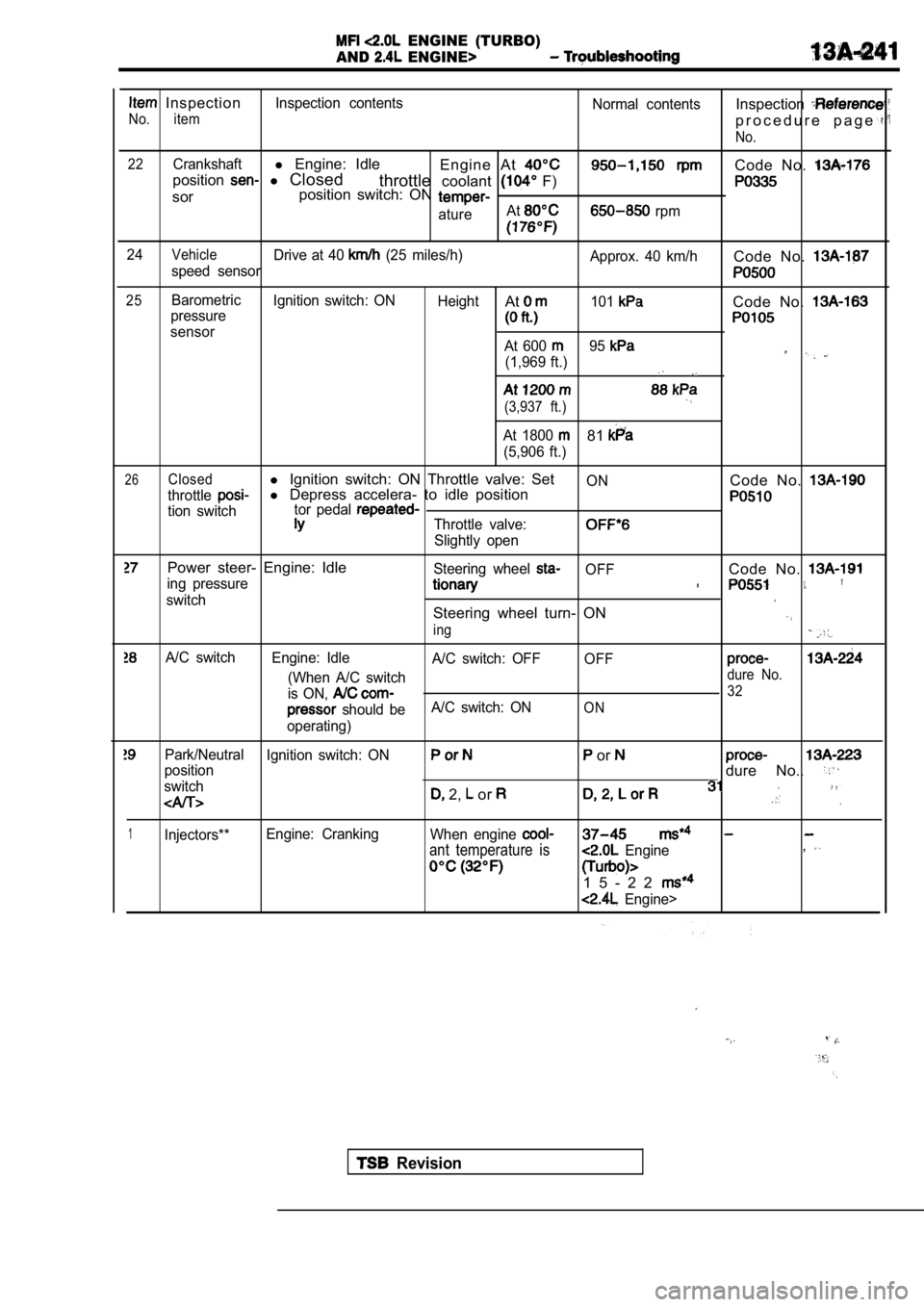
Inspection
No. item
Inspection contents Normal contentsInspection
p r o c e d u r e p a g e
No.
22
Crankshaftl Engine: Idle
Engine At Code No. position l Closed
throttlecoolant F)
sor position switch: ON
atureAt rpm
24VehicleDrive at 40 (25 miles/h)
Approx. 40 km/hCode No. speed sensor
25BarometricIgnition switch: ON
HeightAt101Code No. pressure
sensor
At 600 95
(1,969 ft.)
(3,937 ft.)
At 1800 81
(5,906 ft.)
26Closedl Ignition switch: ON Throttle valve: SetONCode No. throttlel Depress accelera- to idle position
tion switch tor pedal Throttle valve:
Slightly open
Power steer- Engine: IdleSteering wheel OFFCode No. ing pressure
switchSteering wheel turn- ON
ing
A/C switch
Engine: Idle
A/C switch: OFFOFF
(When A/C switchdure No.
is ON, 32
should beA/C switch: ONON
operating)
Park/Neutral
Ignition switch: ON or positiondure No..
switch 2, or
1Injectors**Engine: Cranking
When engine
ant temperature is Engine,
1 5 - 2 2
Engine>
Revision
Page 627 of 2103
ENGINE (TURBO)
AND ENGINE>
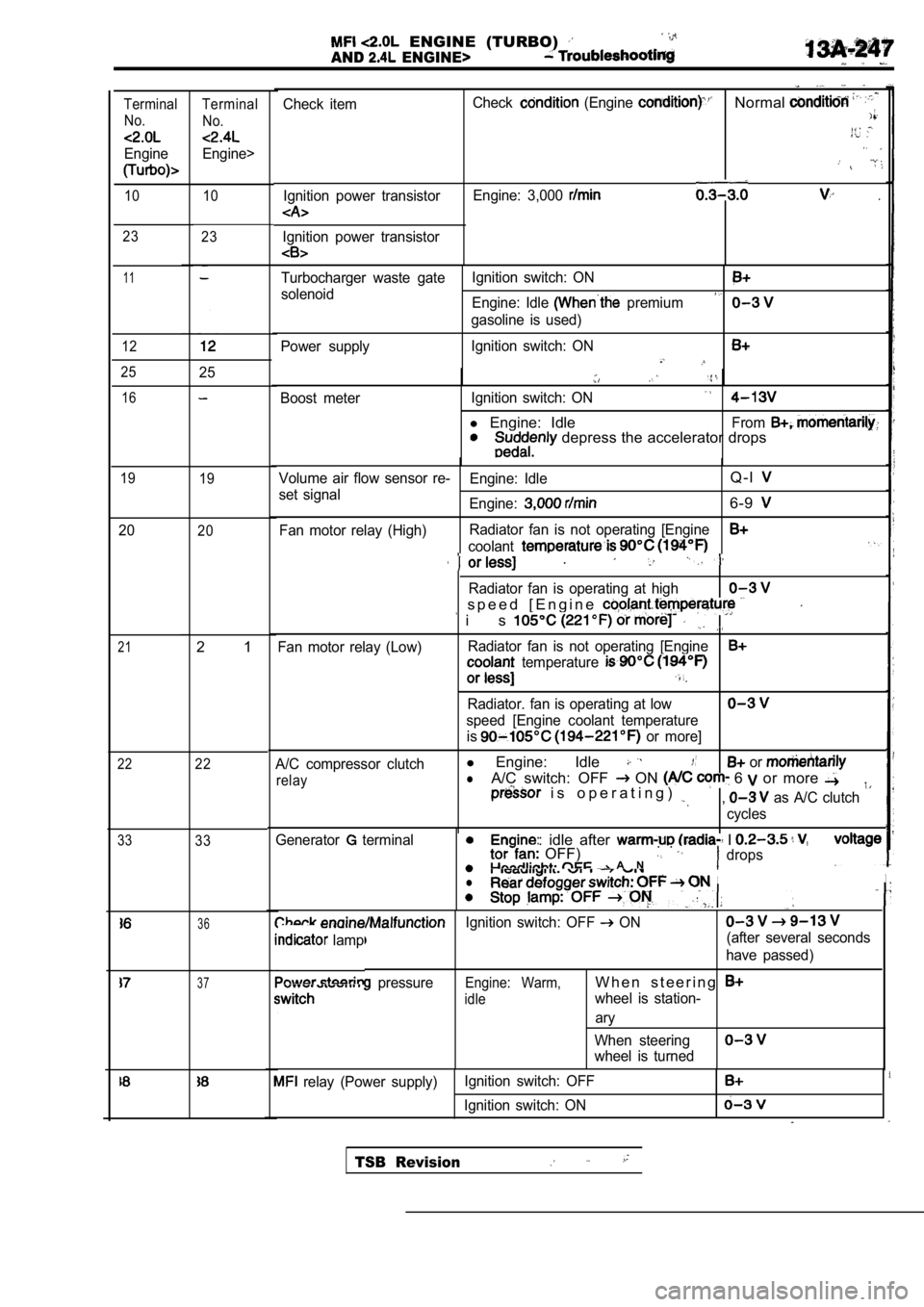
Check itemIgnition power transistorCheck (Engine Normal
Engine: 3,000 .
Ignition power transistor
Terminal No.
Engine
Terminal
No.
Engine>
10 10
23 23
11
12
Turbocharger waste gate Ignition switch: ON
solenoid
Engine: Idle premium
gasoline is used)
Power supply Ignition switch: ON
2525
Boost meter
Ignition switch: ON
l Engine: IdleFrom depress the accelerator drops
16
19
19Volume air flow sensor re- Engine: IdleQ - l
set signal
Engine:6-9
Fan motor relay (High)Radiator fan is not operating [Engine
coolant
2020
21
22
33
.
Radiator fan is operating at high
s p e e d [ E n g i n e
i s
Fan motor relay (Low)Radiator fan is not operating [Engine temperature
Radiator. fan is operating at low
speed [Engine coolant temperature
is
or more]
A/C compressor clutch
l Engine: Idle or
relaylA/C switch: OFF ON 6 or more i s o p e r a t i n g ) , as A/C clutch
cycles
2 1
22
33
ine: idle after I OFF) . . A Ndrops
II. .
Generator terminal
l
36Ignition switch: OFF ON
lamp(after several seconds
have passed)
pressureEngine: Warm,W h e n s t e e r i n g
idlewheel is station-
ary
When steering
wheel is turned
37
relay (Power supply) Ignition switch: OFF
Ignition switch: ON
TSB Revision
Page 734 of 2103
INTAKE AND EXHAUST Exhaust Manifold ENGINE (Turbo)>
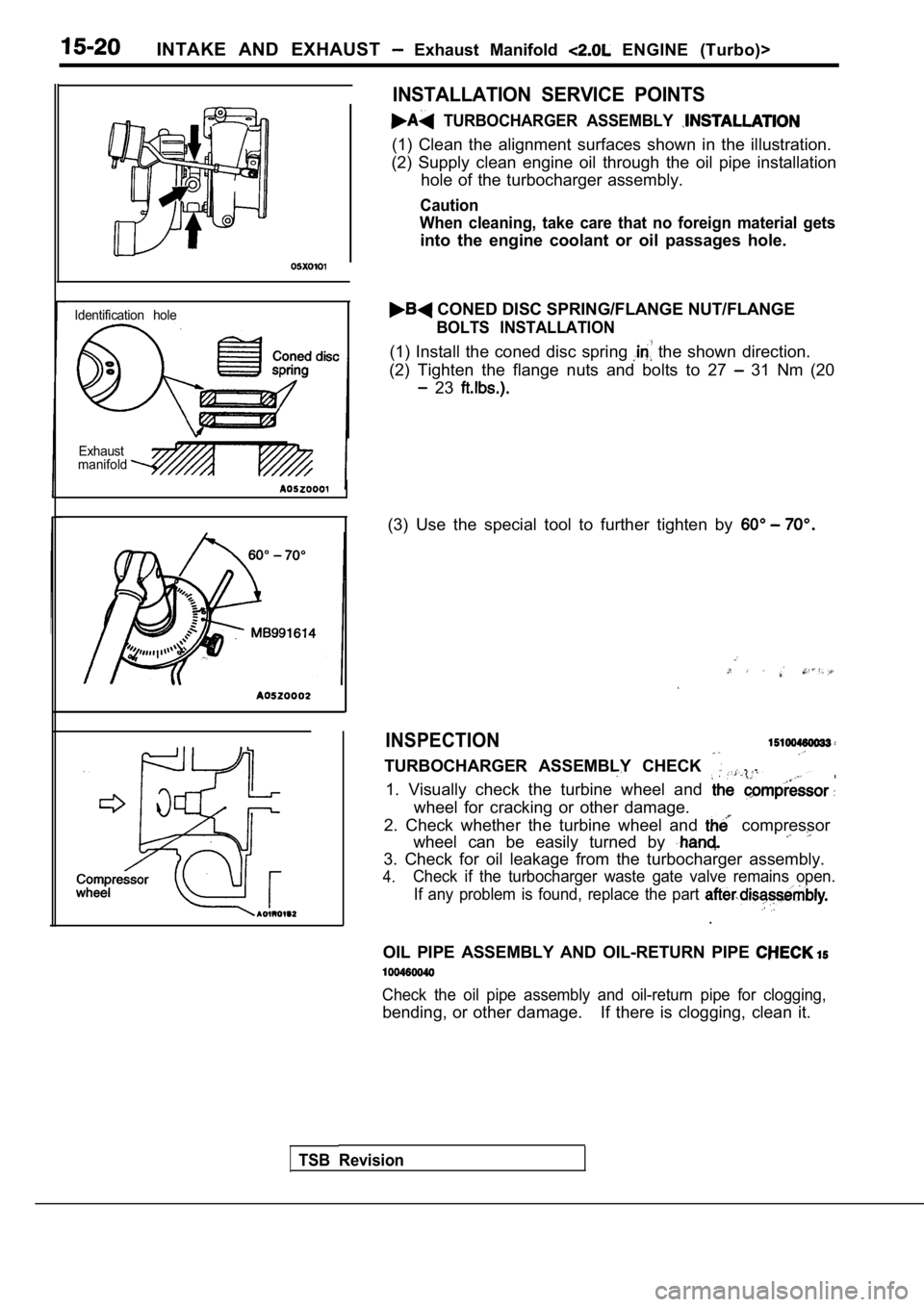
Identification holeExhaust
manifold
INSTALLATION SERVICE POINTS
TURBOCHARGER ASSEMBLY
(1) Clean the alignment surfaces shown in the illus tration.
(2) Supply clean engine oil through the oil pipe in stallation
hole of the turbocharger assembly.
Caution
When cleaning, take care that no foreign material g ets
into the engine coolant or oil passages hole.
CONED DISC SPRING/FLANGE NUT/FLANGE
BOLTS INSTALLATION
(1) Install the coned disc spring the shown direction.
(2) Tighten the flange nuts and bolts to 27
31 Nm (20
23
(3) Use the special tool to further tighten by
INSPECTION
TURBOCHARGER ASSEMBLY CHECK . .
1. Visually check the turbine wheel and
wheel for cracking or other damage.
2. Check whether the turbine wheel and
compressor
wheel can be easily turned by
3. Check for oil leakage from the turbocharger asse mbly.
4.Check if the turbocharger waste gate valve remains open.
If any problem is found, replace the part
.
OIL PIPE ASSEMBLY AND OIL-RETURN PIPE
Check the oil pipe assembly and oil-return pipe for clogging,
bending, or other damage. If there is clogging, clea n it.
TSB Revision
Page 782 of 2103
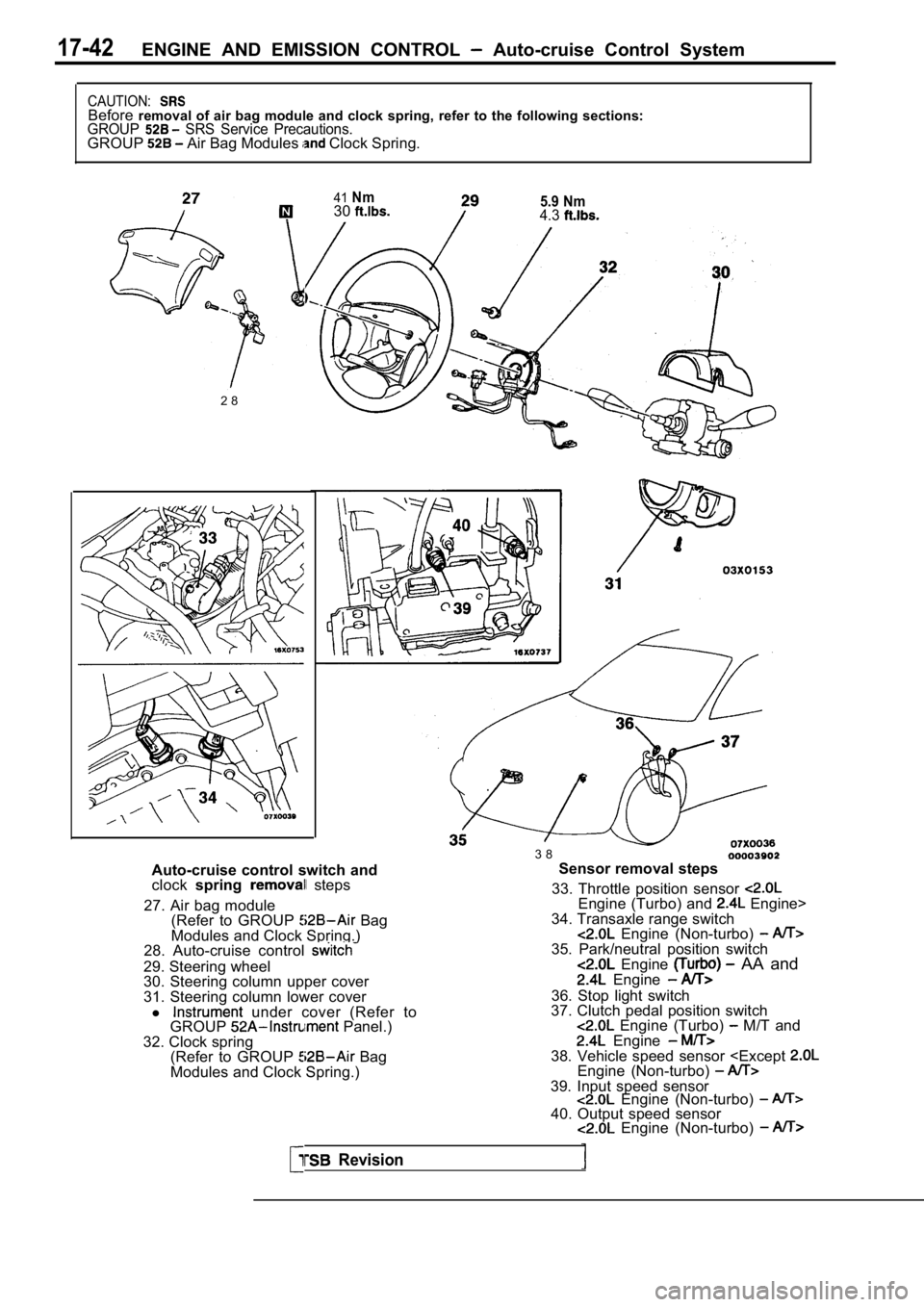
17-42ENGINE AND EMISSION CONTROL Auto-cruise Control System
CAUTION:Beforeremoval of air bag module and clock spring, refer t o the following sections:GROUP SRS Service Precautions.GROUP Air Bag Modules Clock Spring.
5.9 Nm4.3
41Nm30
2 8
Auto-cruise control switch and
clock spring
steps
27. Air bag module (Refer to GROUP
Bag
Modules and Clock Spring.)
28. Auto-cruise control
29. Steering wheel
30. Steering column upper cover
31. Steering column lower cover
l
under cover (Refer to
GROUP Panel.)
32. Clock spring (Refer to GROUP
Bag
Modules and Clock Spring.) 3 8
Sensor removal steps
33. Throttle position sensor
Engine (Turbo) and Engine>
34. Transaxle range switch
Engine (Non-turbo) 35. Park/neutral position switch Engine AA and Engine
36. Stop light switch
37. Clutch pedal position switch
Engine (Turbo) M/T and Engine 38. Vehicle speed sensor
Page 834 of 2103
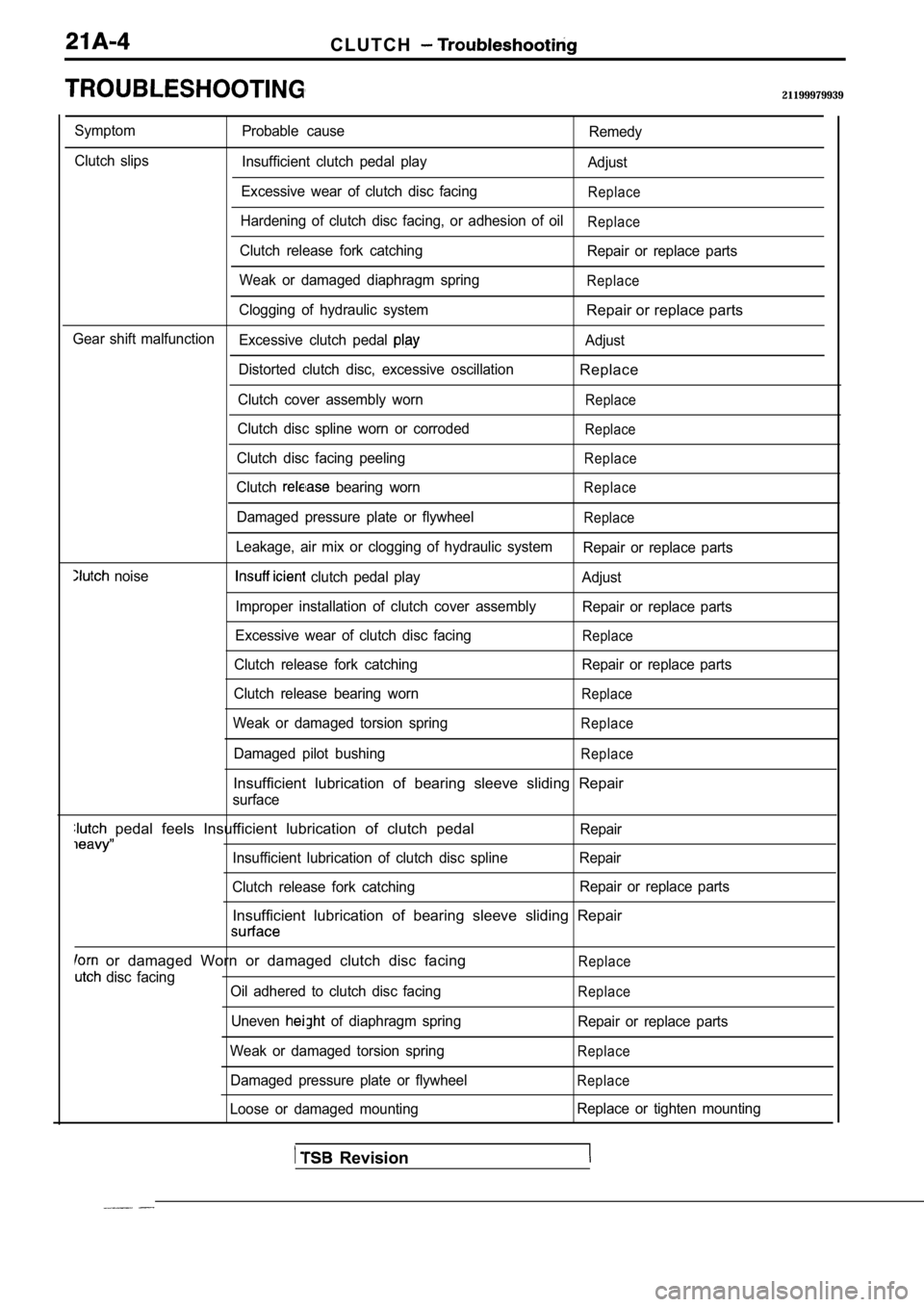
C L U T C H
21199979939
SymptomProbable cause
Remedy
Clutch slips Insufficient clutch pedal play Adjust
Excessive wear of clutch disc facing
Replace
Hardening of clutch disc facing, or adhesion of oilReplace
Clutch release fork catching Repair or replace parts
Weak or damaged diaphragm spring
Replace
Clogging of hydraulic systemRepair or replace parts
Gear shift malfunction Excessive clutch pedal Adjust
Distorted clutch disc, excessive oscillation
Replace
Clutch cover assembly wornReplace
Clutch disc spline worn or corrodedReplace
Clutch disc facing peelingReplace
Clutch bearing wornReplace
Damaged pressure plate or flywheelReplace
Leakage, air mix or clogging of hydraulic system Repair or replace parts
noise clutch pedal playAdjust
Improper installation of clutch cover assembly Repair or replace parts
Excessive wear of clutch disc facing
Replace
Clutch release fork catching Repair or replace parts
Clutch release bearing worn
Replace
Weak or damaged torsion springReplace
Damaged pilot bushingReplace
Insufficient lubrication of bearing sleeve sliding Repair
surface
pedal feels Insufficient lubrication of clutch ped alRepair
Insufficient lubrication of clutch disc spline Repai r
Clutch release fork catching Repair or replace parts
Insufficient lubrication of bearing sleeve sliding
Repair
or damaged Worn or damaged clutch disc facing
disc facing
Oil adhered to clutch disc facing
Uneven
of diaphragm spring
Weak or damaged torsion spring Damaged pressure plate or flywheel
Loose or damaged mounting
Replace
Replace
Repair or replace parts
Replace
Replace
Replace or tighten mounting
Revision
Page 836 of 2103
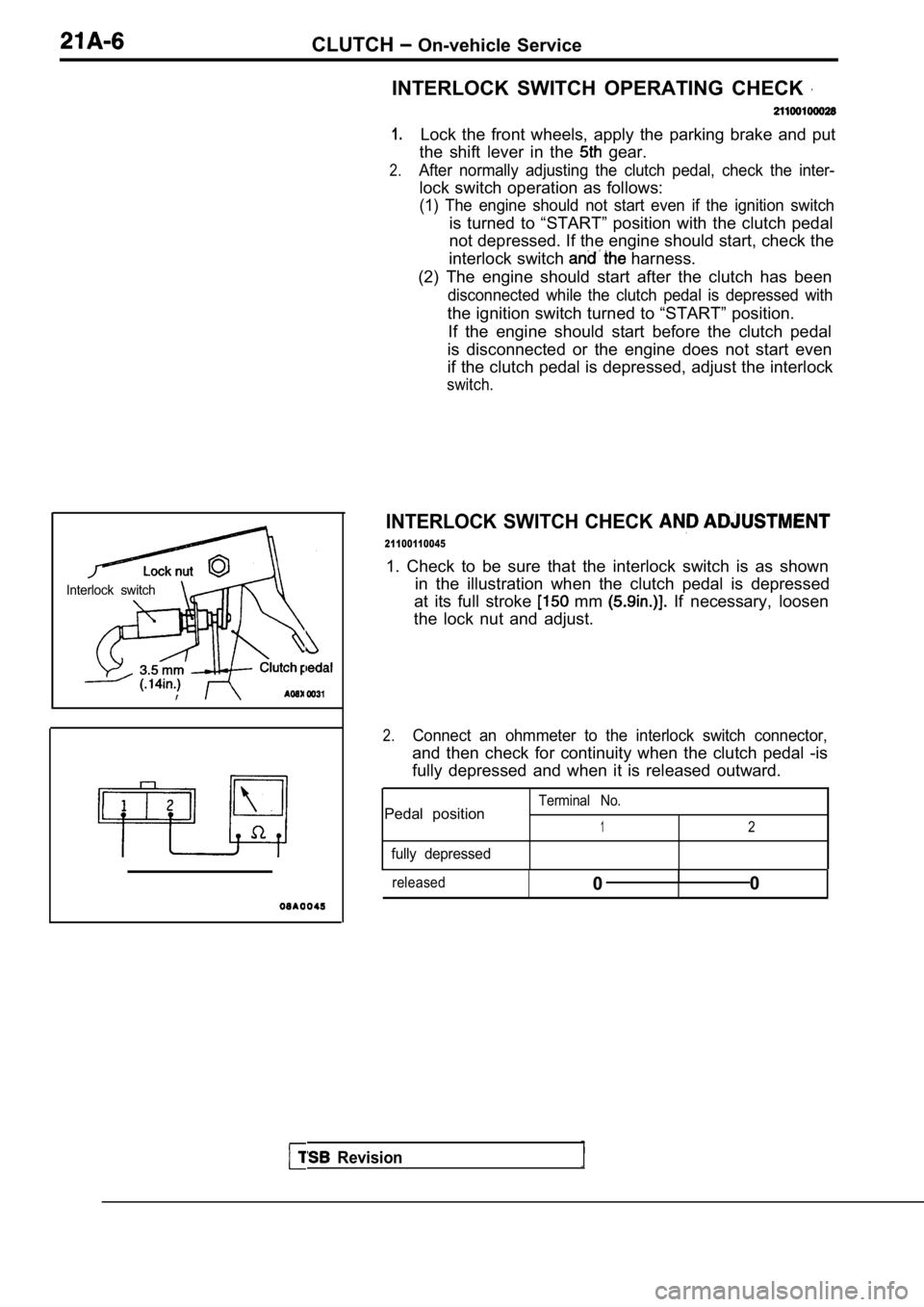
CLUTCH On-vehicle Service
Interlock switch
Revision
INTERLOCK SWITCH OPERATING CHECK
1.
2.
Lock the front wheels, apply the parking brake and put
the shift lever in the
gear.
After normally adjusting the clutch pedal, check th e inter-
lock switch operation as follows:
(1) The engine should not start even if the ignition switch
is turned to “START” position with the clutch pedal
not depressed. If the engine should start, check th e
interlock switch
harness.
(2) The engine should start after the clutch has be en
disconnected while the clutch pedal is depressed with
the ignition switch turned to “START” position.
If the engine should start before the clutch pedal
is disconnected or the engine does not start even
if the clutch pedal is depressed, adjust the interl ock
switch.
INTERLOCK SWITCH CHECK
21100110045
1. Check to be sure that the interlock switch is as shown
in the illustration when the clutch pedal is depres sed
at its full stroke
mm If necessary, loosen
the lock nut and adjust.
2.Connect an ohmmeter to the interlock switch connect or,
and then check for continuity when the clutch pedal -is
fully depressed and when it is released outward.
Terminal No.Pedal position12
fully depressed
released0I0
Page 846 of 2103
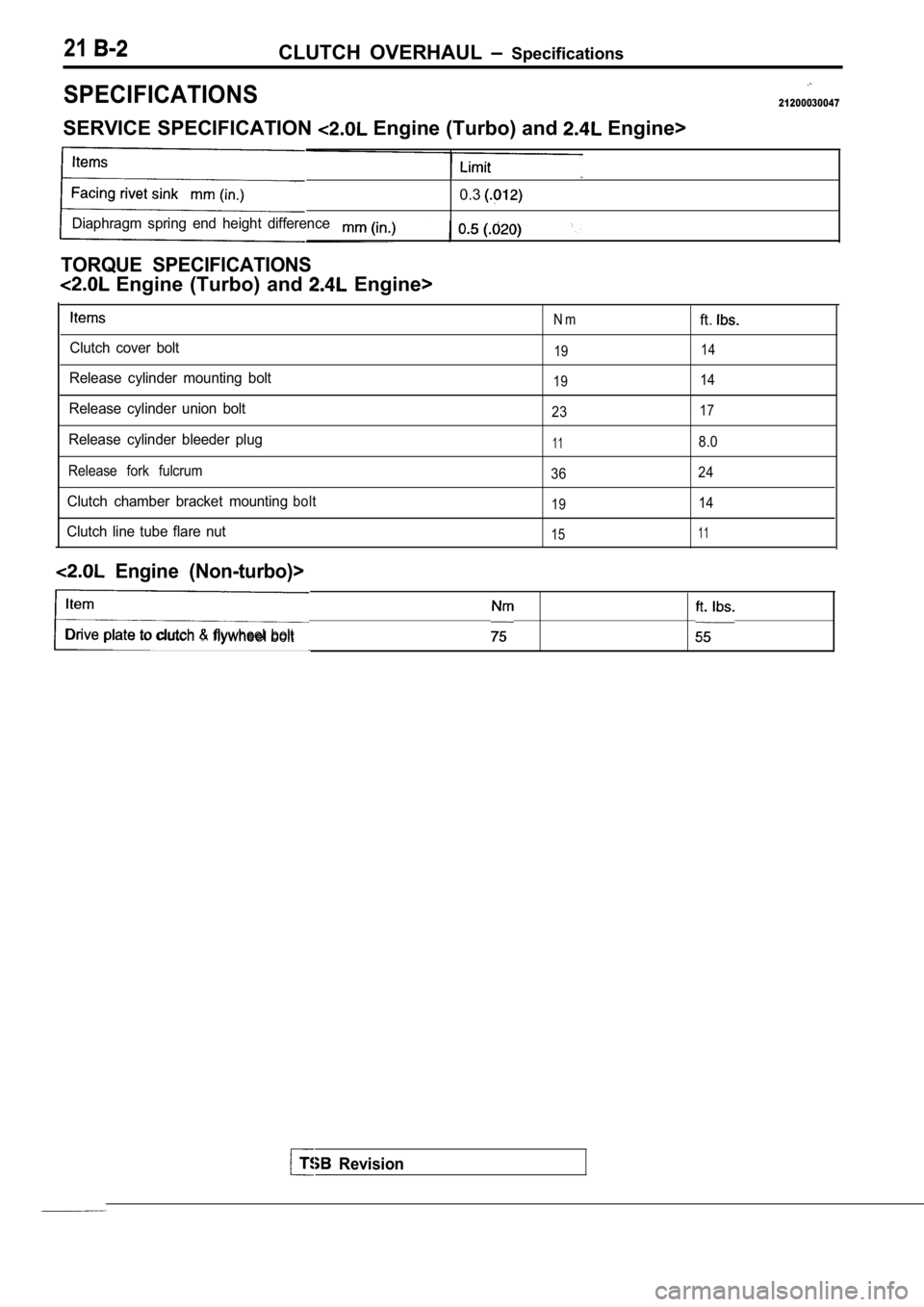
21CLUTCH OVERHAUL Specifications
SPECIFICATIONS21200030047
SERVICE SPECIFICATION Engine (Turbo) and Engine>
0.3
Diaphragm spring end height difference
TORQUE SPECIFICATIONS
Engine (Turbo) and Engine>
Clutch cover bolt
Release cylinder mounting bolt
Release cylinder union bolt
Release cylinder bleeder plug
Release fork fulcrum
Clutch chamber bracket mountingbolt
Clutch line tube flare nut
N mft.
19 14
19
14
23
17
118.0
36 24
1914
1511
Engine (Non-turbo)>
Drive plate to clutch flywheel bolt
Revision