brake NISSAN 300ZX 1984 Z31 Automatic Transmission User Guide
[x] Cancel search | Manufacturer: NISSAN, Model Year: 1984, Model line: 300ZX, Model: NISSAN 300ZX 1984 Z31Pages: 99, PDF Size: 3.09 MB
Page 55 of 99
![NISSAN 300ZX 1984 Z31 Automatic Transmission User Guide ASSEMBLY ~
Total
end play
Totql end play = [B - 0 1 mm (0.004 in)] - C
Specified total end play:
0 25 - 0.50 mm
(0.0098 - 0.0197 in)
Total end play can be adjusted with bearing race
Avail](/img/5/563/w960_563-54.png "NISSAN 300ZX 1984 Z31 Automatic Transmission User Guide ASSEMBLY ~
Total
end play
Totql end play = [B - 0 1 mm (0.004 in)] - C
Specified total end play:
0 25 - 0.50 mm
(0.0098 - 0.0197 in)
Total end play can be adjusted with bearing race
Avail")
ASSEMBLY ~
Total
end play
Totql end play = [B - 0 1 mm (0.004 in)] - C
Specified total end play:
0 25 - 0.50 mm
(0.0098 - 0.0197 in)
Total end play can be adjusted with bearing race
Available oil pump cover bearing race
Thickness rnm (in)
1 2 (0 0471
1
4 (0055)
16 (0.0631
18 (0071)
20
(0 079)
22
(00871
Pan number
31556-X0100 31556-XOlO1
31 556-X0102
31 556-XO103
31 556-XO104
31 556-XO105
17 Install brake band, band strut, and band servo.
Lubricate servo O-rings before installing
SAT066
18 Install and torque the retainer bolts. Loosen
piston stem.
,GG91060000
19 Finger tighten brake band servo piston stem
enough to prevent brake band and
strut from
falling out
Do not adjust brake band at this time.
SAT068
20 Apply vaseline to bearing race and thrust
washer, then mount them
on drum support
e- Bearing race
SA1573
AT-55
Page 58 of 99
ASSEMBLY
15 (0 059)
17 (0 067)
19 (0 075)
2 1 (0 083)
2.3 (0 091)
25 (0098)
2 7 (0 106)
Available 0 D thrust washer
3 1528-XO106
31 528-XO105
31528-X0100
31 528-X0101
31 528-XO102
31528-XO103
31 528-XO104
Thickness mm (in) I Part number
Thickness mm (in) Part number
1 2 (0.047)
14 (0 055)
16 (0063)
18
(0071)
20 (0079)
22 (0087)
31556-X0100
3 1556-X0101
31556-X0102
31 556-XO103
31 556.X0104
31 556-XOlO5
26. Adjust 2nd brake band. Tighten piston stem to
the specified value Back off two full turns and
secure with lock nut
SAT580
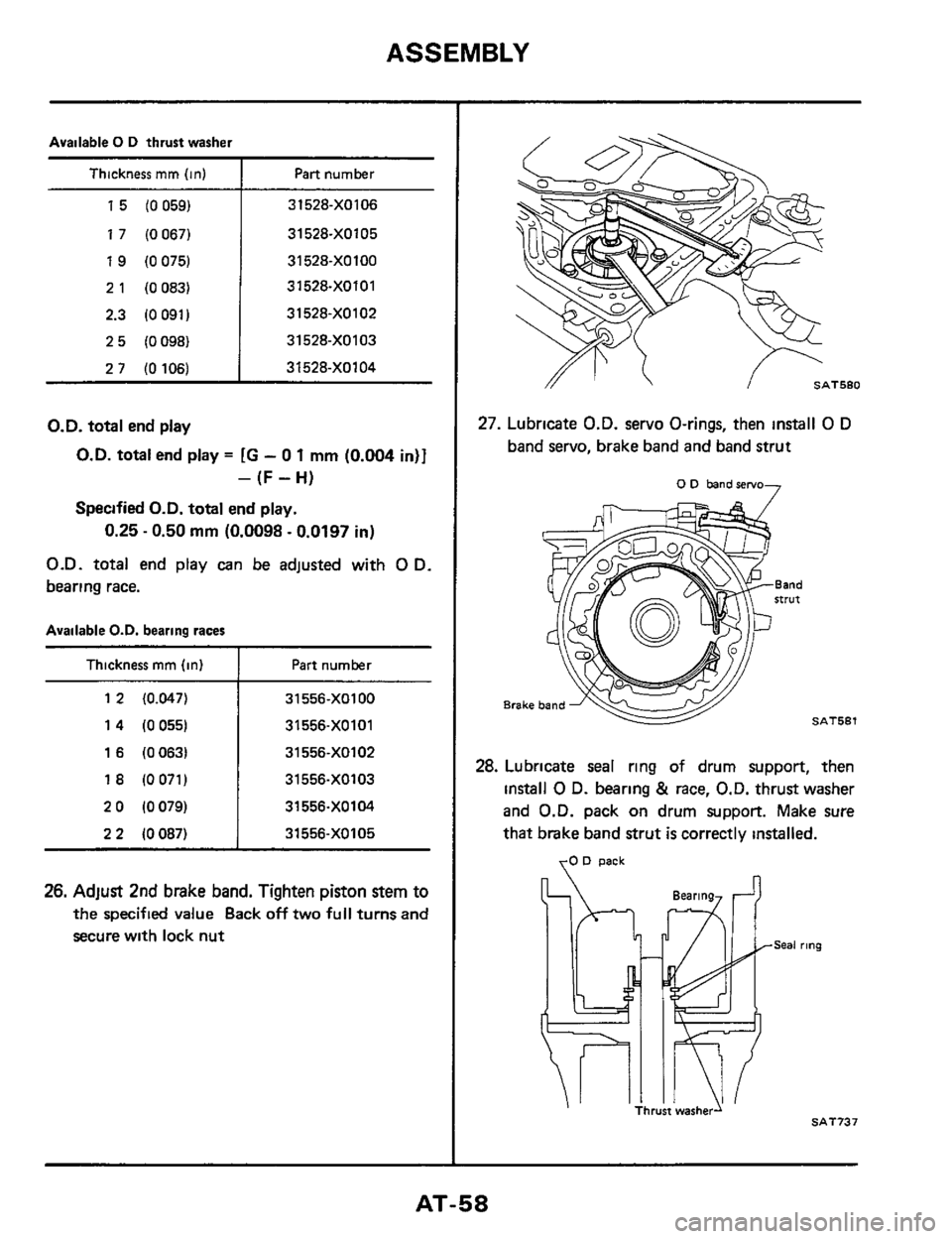
27. Lubricate O.D. servo O-rings, then install 0 D
band servo, brake band and band strut
7 0 D band %NO
SAT581
28. Lubricate seal ring of drum support, then
install
0 D. bearing & race, O.D. thrust washer
and
O.D. pack on drum support. Make sure
that brake band strut
is correctly installed.
70 D pack
AT-58
Page 60 of 99
ASSEMBLY
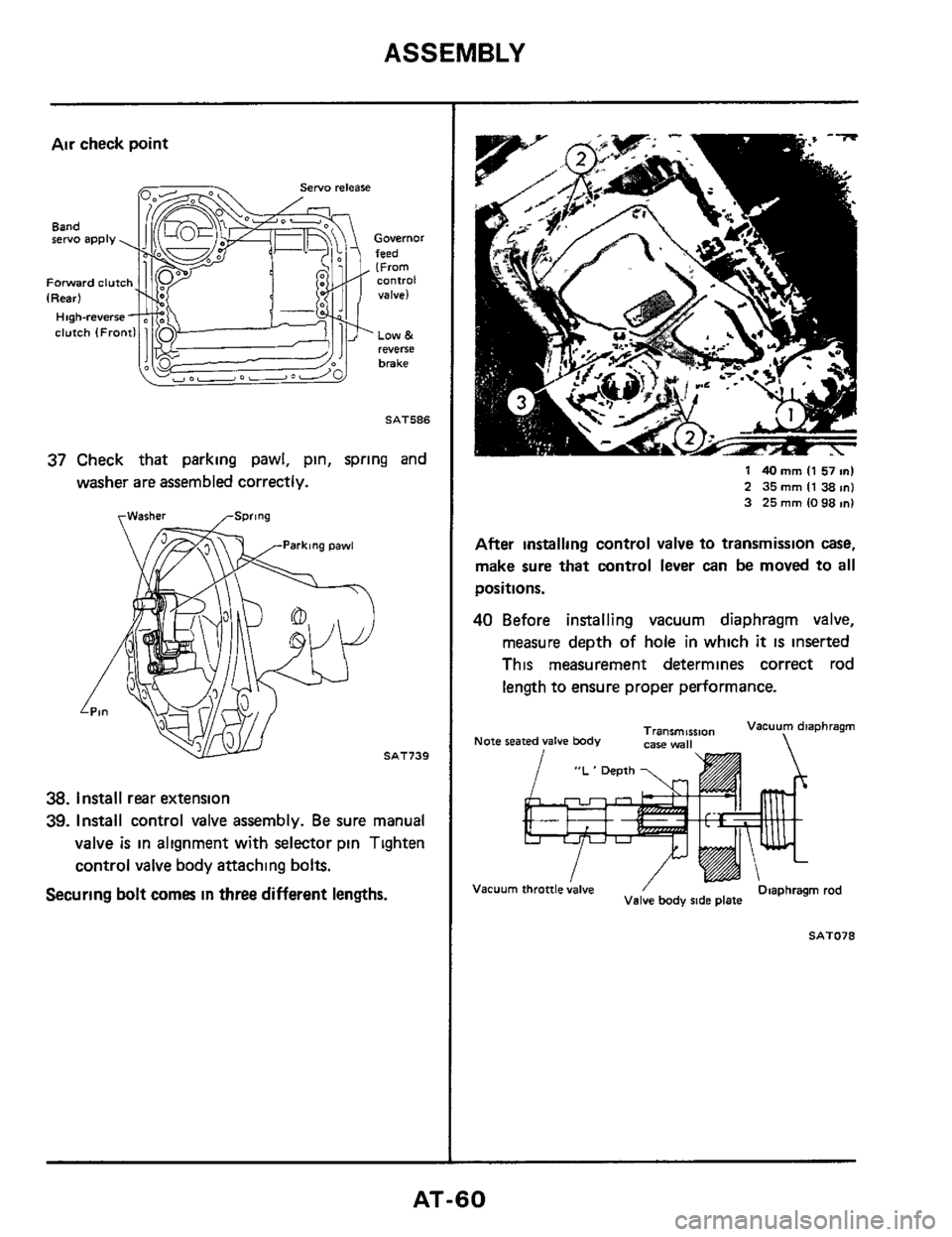
Air check point
Governor feed (From
valve) Forward clutch Control
LOW & reverse
brake
SAT586
37 Check that parking pawl, pin, spring and
washer are assembled correctly.
rWasher
SAT739
38. Install rear extension
39. Install control valve assembly. Be sure manual
valve
is in alignment with selector pin Tighten
control valve
body attaching bolts.
Securing bolt comes in three different lengths.
1 40 mm I1 57 ml
2 35 mm I1 38 m) 3 25 mm IO 98 1n1
After installing control valve to transmission case,
make sure that control lever can be moved to all
positions.
40 Before installing vacuum diaphragm valve,
measure depth of hole in which
it is inserted
This measurement determines correct rod
length to ensure proper performance.
"L ' Depth
Vacuum Diaphragm rod , throttle;alve / Valve body ride plate
AT-60
Page 63 of 99
TROUBLE-SHOOTING AND DIAGNOSES
Preliminary Checks
(Prior to Road Testing)
FLUID LEAKAGE
To detect a fluid leak
1) Raise vehicle
2) Clean area suspected of leaking
3) Start engine, apply foot brake, place control
lever in drive, and wait a few minutes
4) Stop engine
5) Check for fresh leakage
FLUID CONDITION
Examine the AT F and note its color, texture,
and odor
1) Dark of Black Fluid
With a burned odor
- Worn friction material
2) Milky Pink Fluid Water Contamination
- Road water entering through filler
tube or breather
3) Varnished Fluid, light to dark brown and
tacky Oxidation
- Over or Underfilling
- Overheating
- Road Testing
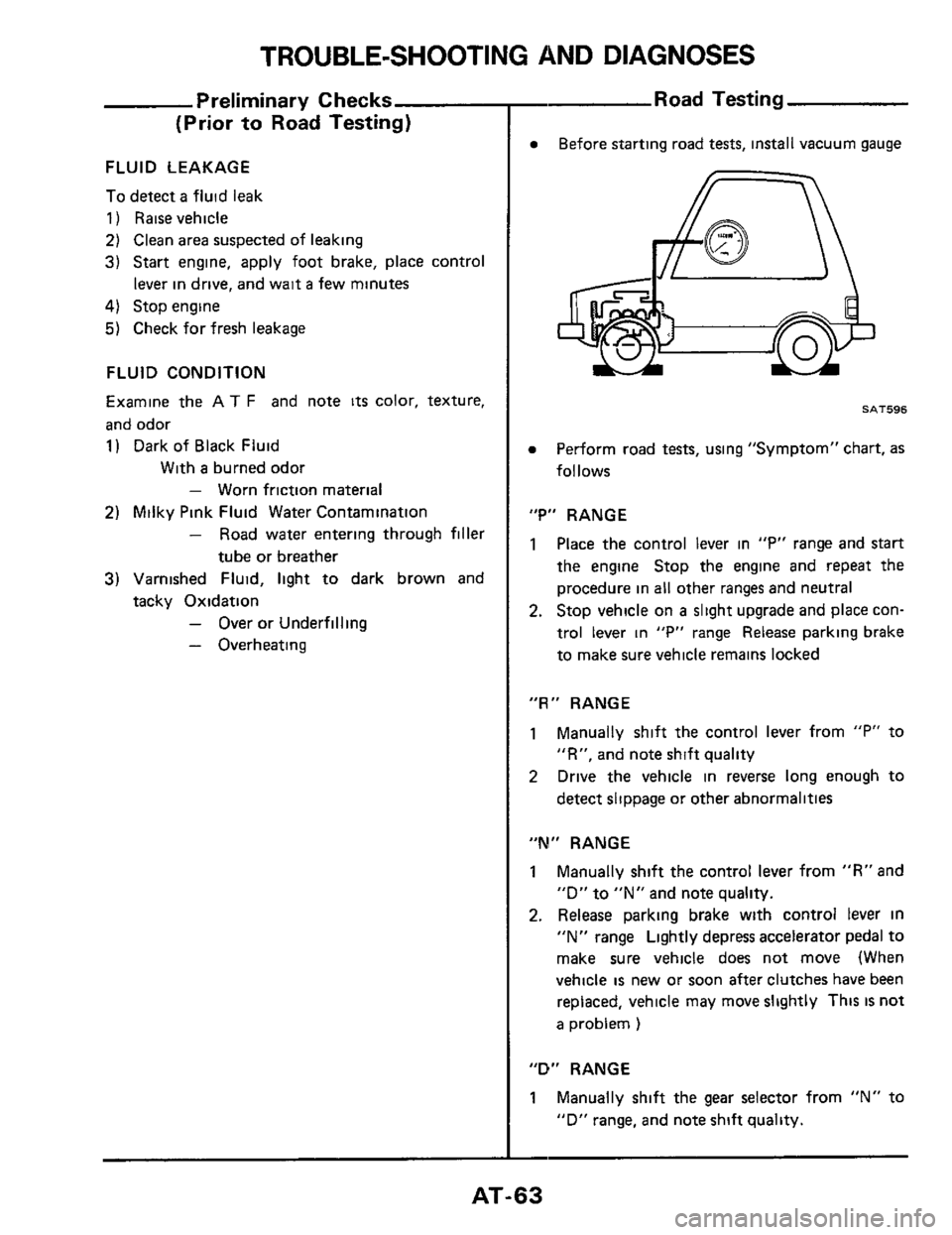
Before starting road tests, install vacuum gauge
SAT596
Perform road tests, using "Symptom" chart, as
follows
"P" RANGE
1 Place the control lever in "P" range and start
the engine Stop the engine and repeat the
procedure in all other ranges and neutral
2. Stop vehicle on a slight upgrade and place con-
trol lever
in "P" range Release parking brake
to make sure vehicle remains locked
"R" RANGE
1 Manually shift the control lever from "P" to
"R", and note shift quality
2 Drive the vehicle in reverse long enough to
detect slippage or other abnormalities
"M" RANGE
1 Manually shift the control lever from "R" and
"D"
to "N" and note quality.
2. Release parking brake with control lever in
"N" range Lightly depress accelerator pedal to
make sure vehicle does not move (When
vehicle
is new or soon after clutches have been
replaced, vehicle may move slightly This
IS not
a problem )
"D" RANGE
1 Manually shift the gear selector from "N" to
"D" range, and note shift quality.
-
AT-63
Page 64 of 99
TROUBLE-SHOOTING AND DIAGNOSES
Road Test
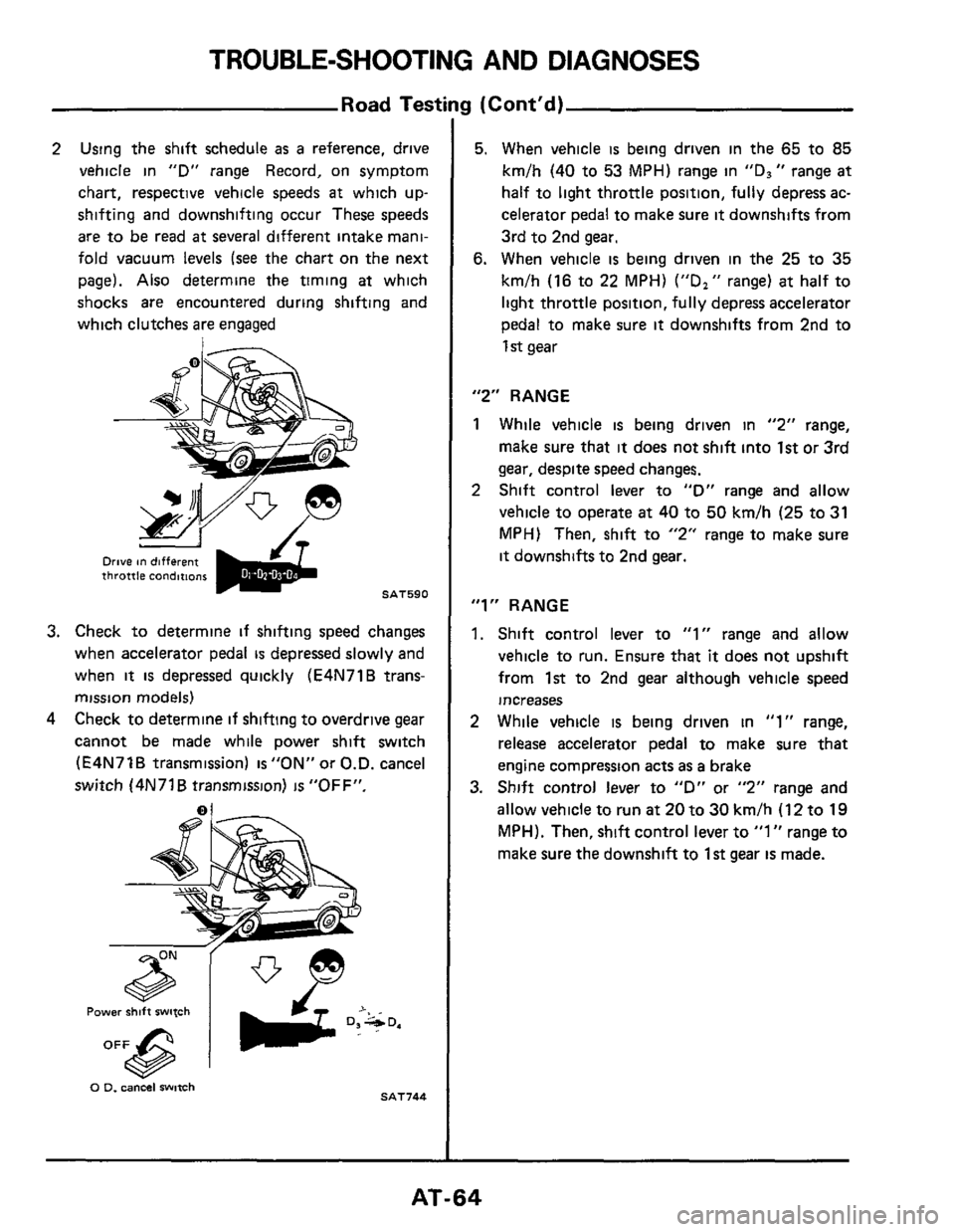
2 Using the shift schedule as a reference, drive
vehicle in
"D" range Record, on symptom
chart, respective vehicle speeds
at which up-
shifting and downshifting occur These speeds
are to be read at several different intake mani-
fold vacuum levels
(see the chart on the next
page). Also determine the timing
at which
shocks are encountered during shifting and
which clutches
are engaged
Drive on different throttle condirtom
SAT590
3. Check to determine if shifting speed changes
when accelerator pedal
is depressed slowly and
when
it is depressed quickly (E4N71B trans-
mission models)
4 Check to determine if shifting to overdrive gear
cannot be made while power shift switch
(E4N71B transmission) is"0N" or
O.D. cancel
switch (4N71
B transmission) is "OFF".
0 0. cancel witch SAT744
3 (Cont'd)
5. When vehicle is being driven in the 65 to 85
km/h (40 to 53 MPH) range in "Ds" range at
half to light throttle position, fully depress ac-
celerator pedal to make sure
it downshifts from
3rd to 2nd
gear.
6. When vehicle is being driven in the 25 to 35
km/h (16 to 22 MPH) ("D," range) at half to
light throttle position, fully depress accelerator
pedal to make sure
it downshifts from 2nd to
1 st gear
"2" RANGE
1 While vehicle is being driven in "2" range,
make sure that
it does not shift into 1st or 3rd
gear, despite speed changes.
2 Shift control lever to "D" range and allow
vehicle to operate
at 40 to 50 km/h (25 to 31
MPH) Then, shift to "2" range to make sure
it downshifts to 2nd gear.
"1" RANGE
1. Shift control lever to "1" range and allow
vehicle to run. Ensure
that it does not upshift
from 1st to 2nd gear although vehicle speed
increases
2 While vehicle is being driven in "1" range,
release accelerator pedal
to make sure that
engine compression acts
as a brake
3. Shift control lever to "D" or "2" range and
allow vehicle to run
at 20 to 30 km/h (12 to 19
MPH). Then, shift control lever to "1" range to
make sure the downshift to 1st gear is made.
AT-64
Page 76 of 99
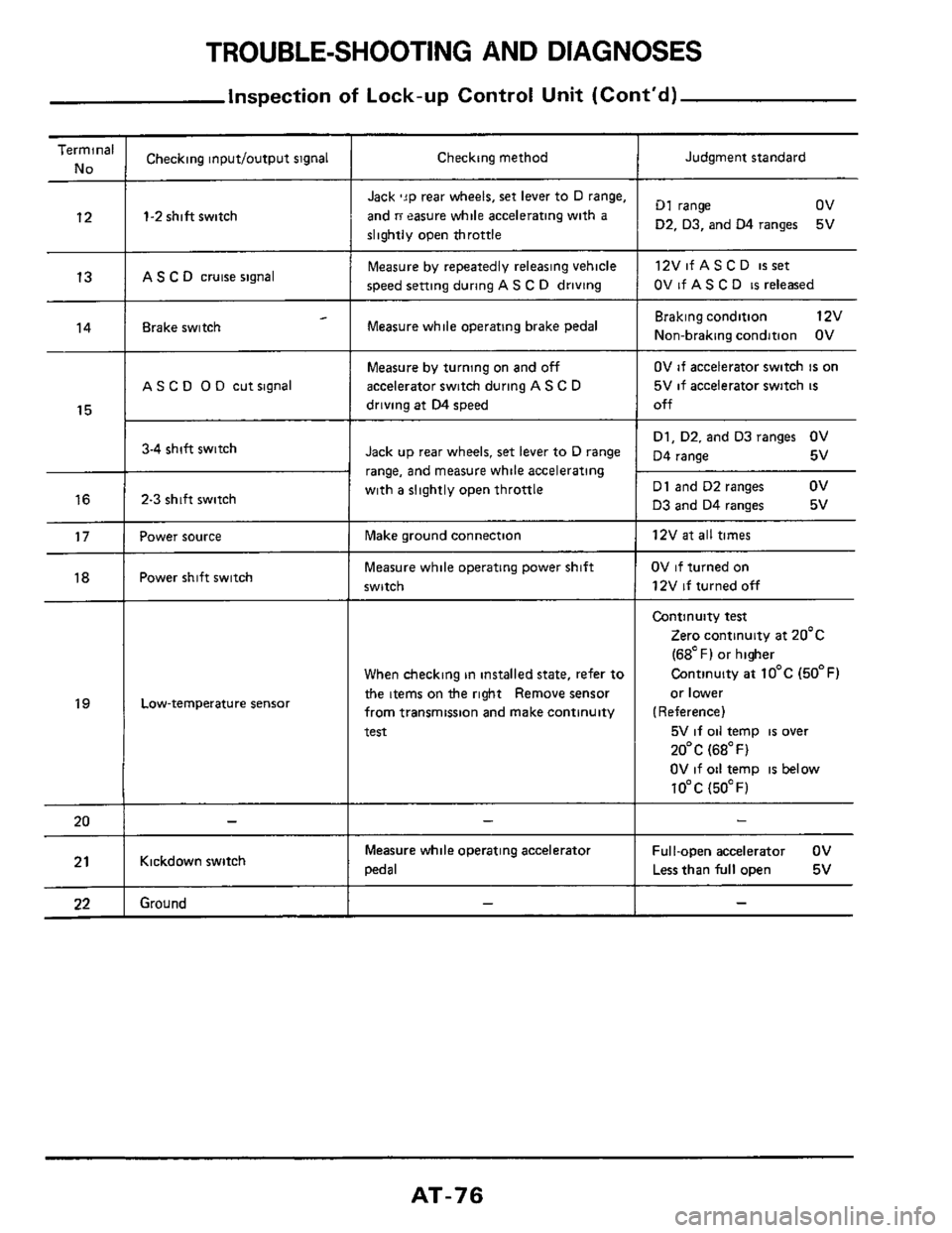
TROUBLE-SHOOTING AND DIAGNOSES
Inspection of Lock-up Control Unit (Cont'd)
Terminal
No
12
13
14
15
16
17
18
19
20
21
22
___
Checking inputloutput signal
1-2 shift switch
AS C D cruise signal
- Brake switch
A S C 0 0 D cut signal
3-4 shift switch
2-3 shift switch
Power source
Power shift switch
Low-temperature sensor
Kickdown switch
Ground
Checking method
Jack 'JP rear wheels, set lever to D range,
and
ri easure while accelerating with a
slightly open throttle
Measure by repeatedly releasing vehicle
speed setting during
AS C D driving
Measure while operating brake pedal
Measure by turning on and off
accelerator switch during A S C D
driving at D4 speed
Jack up rear wheels, set lever to D range
range,
and measure while accelerating
with
a slightly open throttle
Make ground connection
Measure while operating power shift
switch
When checking in installed state, refer to
the items on the right Remove sensor
from transmission and make continuity
test
Measure while operating acceleratoi
pedal
Judgment standard
D1 range ov
D2. D3, and 04 ranges
12VifASCD
isset
OV if AS C D is released
5V
Braking condition 12v
Non-braking condition OV
OV if accelerator switch is on
5V
if accelerator switch is
off
D1, D2. and D3 ranges OV
D4 range 5v
D1 and D2 ranges
ov
D3 and D4 ranges 5v
12V
at all times
OV if turned on
12V
if turned off
Continuity test
Zero continuity at 20'c
(68OF) or higher
Continuity
at 10°C (50°F)
or lower
(Reference)
5V
if oil temp is over
20°C (68°F)
OV if oil temp
is below
10°C (5OOF)
Ful I-open accelerator OV
Less than
full open 5v
AT-76
Page 80 of 99
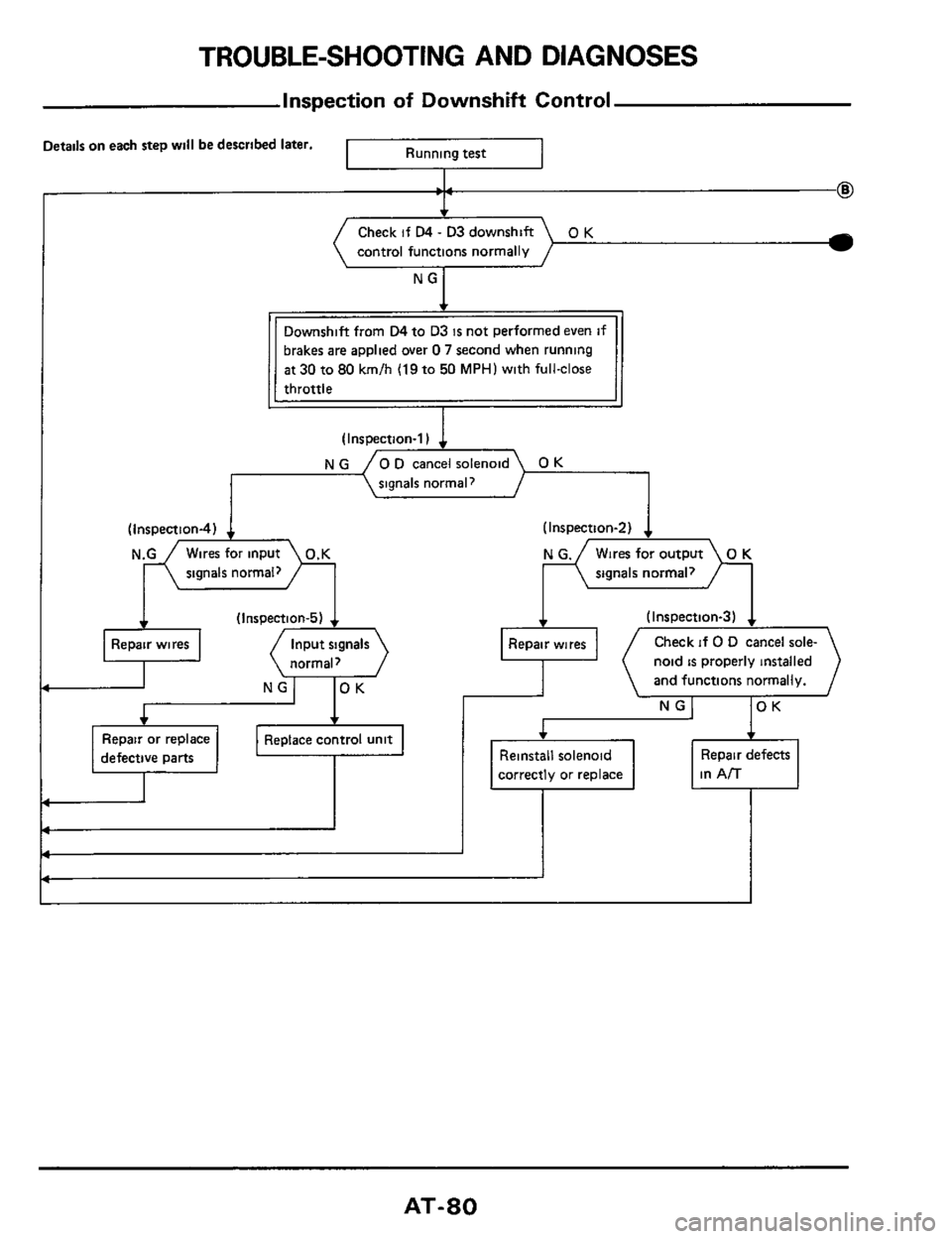
TROUBLE-SHOOTING AND DIAGNOSES
Inspection of Downshift Control
Details on each step will be described later.
I Running test
Check if D4 - D3 downshift
control functions normally 0 K
brakes are applied over 0 7 second when running
at 30 to 80 kmlh (19 to 50 MPH) with full-close
throttle
(Inspection-1) 1.
N G 0 D cancel solenoid 0 K
signals normal7
(Inspection-4)
P I
signals normal?
(~nspection-3) 4
Repair wires Check if 0 D cancel sole-
noid
is properly installed
and functions normally.
NG OK
Repair defects
AT-80
Page 81 of 99
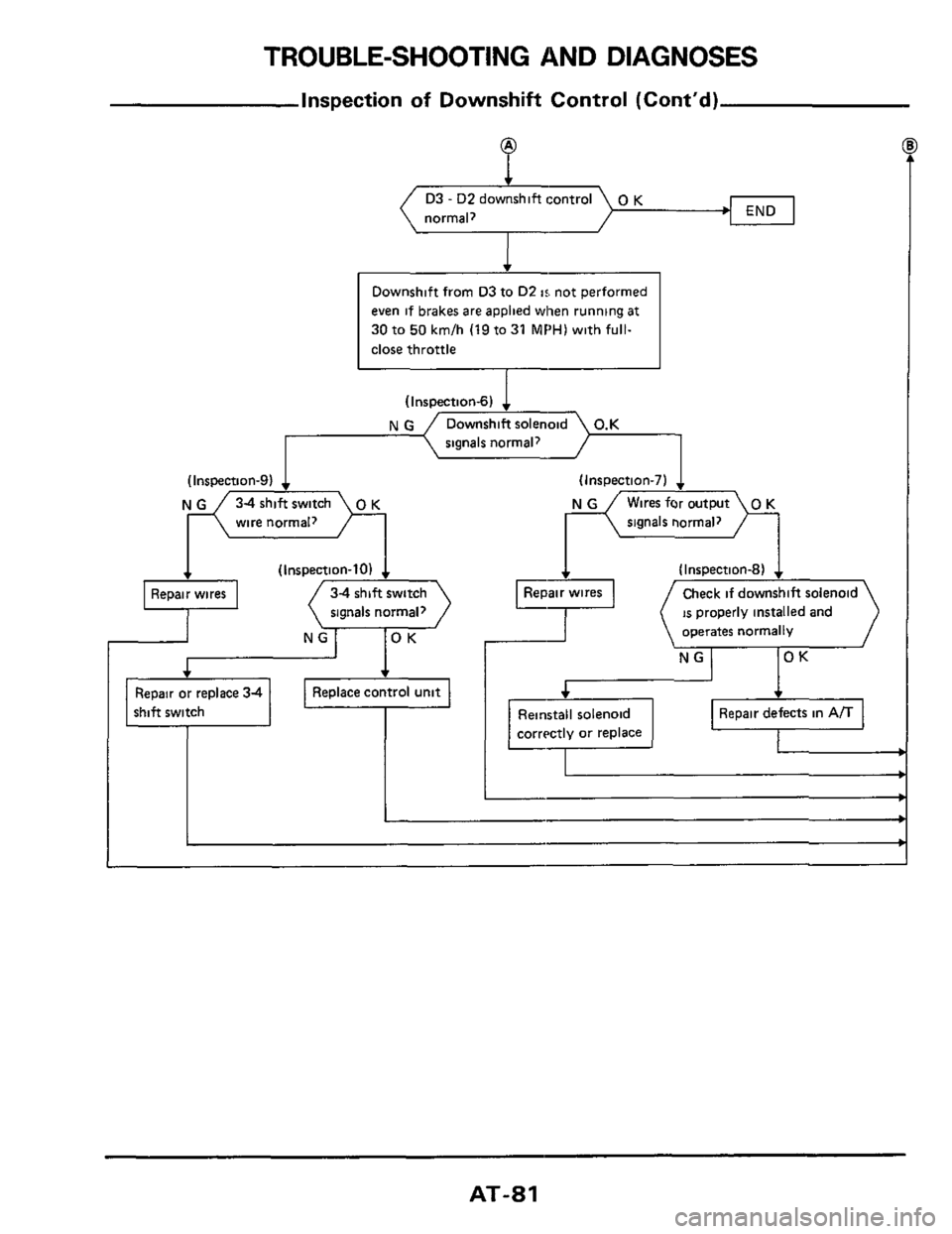
TROUBLE-SHOOTING AND DIAGNOSES
Inspection of Downshift Control (Cont‘d)
D3 - D2 downshift control
normal, 0 K END
Downshift from D3 to D2 is, not performed
even
if brakes are applied when running at
30 to 50 km/h (19 to 31 MPH) with full-
close throttle
(Inspection-6) 1
, NG(-G*
signals normal?
(Inspection-9) 4
N G 34 shift switch
wire normal?
1 Inspection-10)
signals normal7
~~nspection-7) 1
signals normal)
‘1
Repair or replace 34
shift switch
Check if downshift solenoid
IS properly installed and
operates normally
corrrctly or replace
AT-81
Page 82 of 99
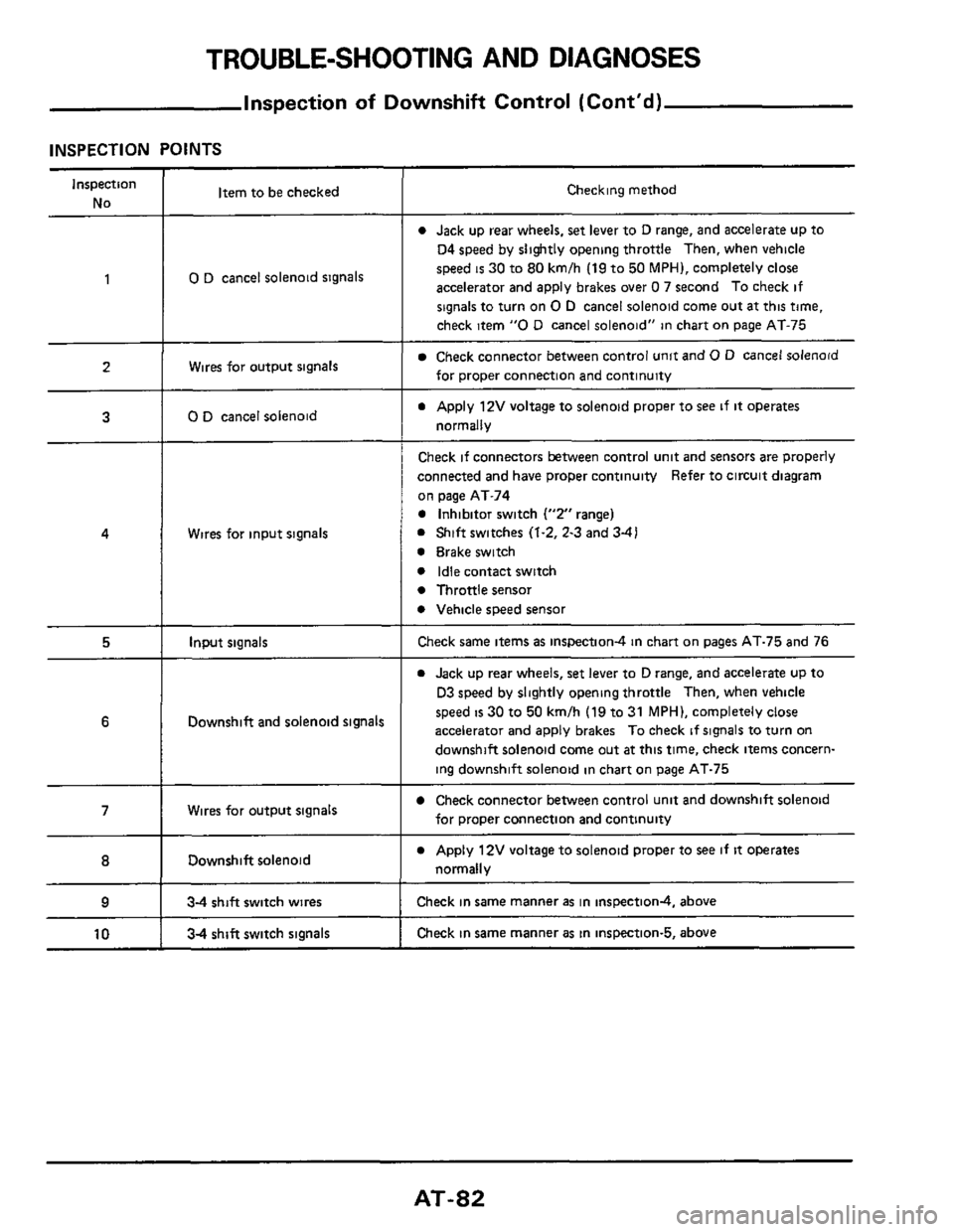
TROUBLE-SHOOTING AND DIAGNOSES
Inspection of Downshift Control (Cont'd)
INSPECTION POINTS
Inspection
No Item to be checked Checking method
0 Jack up rear wheels, set lever to D range, and accelerate up to
04 speed by slightly opening throttle Then, when vehicle
speed
is 30 to 80 kmlh (19 to 50 MPH), completely close
accelerator and apply brakes over
0 7 second To check if
signals to turn on
0 D cancel solenoid come out at this time,
check item
"0 D cancel solenoid" in chart on page AT-75
1 0 D cancel solenoid signals
Wires for output signals Check connector between control unit and 0 D cancel solenoid
for proper connection and continuity
a Apply 12V voltage to solenoid proper to see if it operates
normally
2
3 0 D cancel solenoid
Wires for input signals
Check if connectors between control unit and sensors are properly
connected and have proper continuity Refer to circuit diagram
on page AT-74
0 Inhibitor switch ("2" range)
0 Shift switches (1.2, 2-3 and 3-41
0 Brake switch
0 Idle contact switch
0 Throttle sensor
0 Vehicle speed sensor
4
5 Input signals Check same items as inspection4 in chart on pages AT-75 and 76
0 Jack up rear wheels, set lever to D range, and accelerate up to
D3 speed by slightly opening throttle Then, when vehicle
speed
is 30 to 50 kmlh (19 to 31 MPH), completely close
accelerator and apply brakes To check
if signals to turn on
downshift solenoid come out
at this time, check items concern-
ing downshift solenoid in chart on page AT-75
6 Downshift and solenoid signals
Check connector between control unit and downshift solenoid
for proper connection and continuity 7 Wires for output signals
Downshift solenoid
___ ~~ ~~~
0 Apply 12V voltage to solenoid proper to see if it operates
normally 8
9 34 shift switch wires Check in same manner as in inspectiond, above
Check in same manner
as in inspection-5, above 10 34 shift switch signals
AT-82
Page 88 of 99
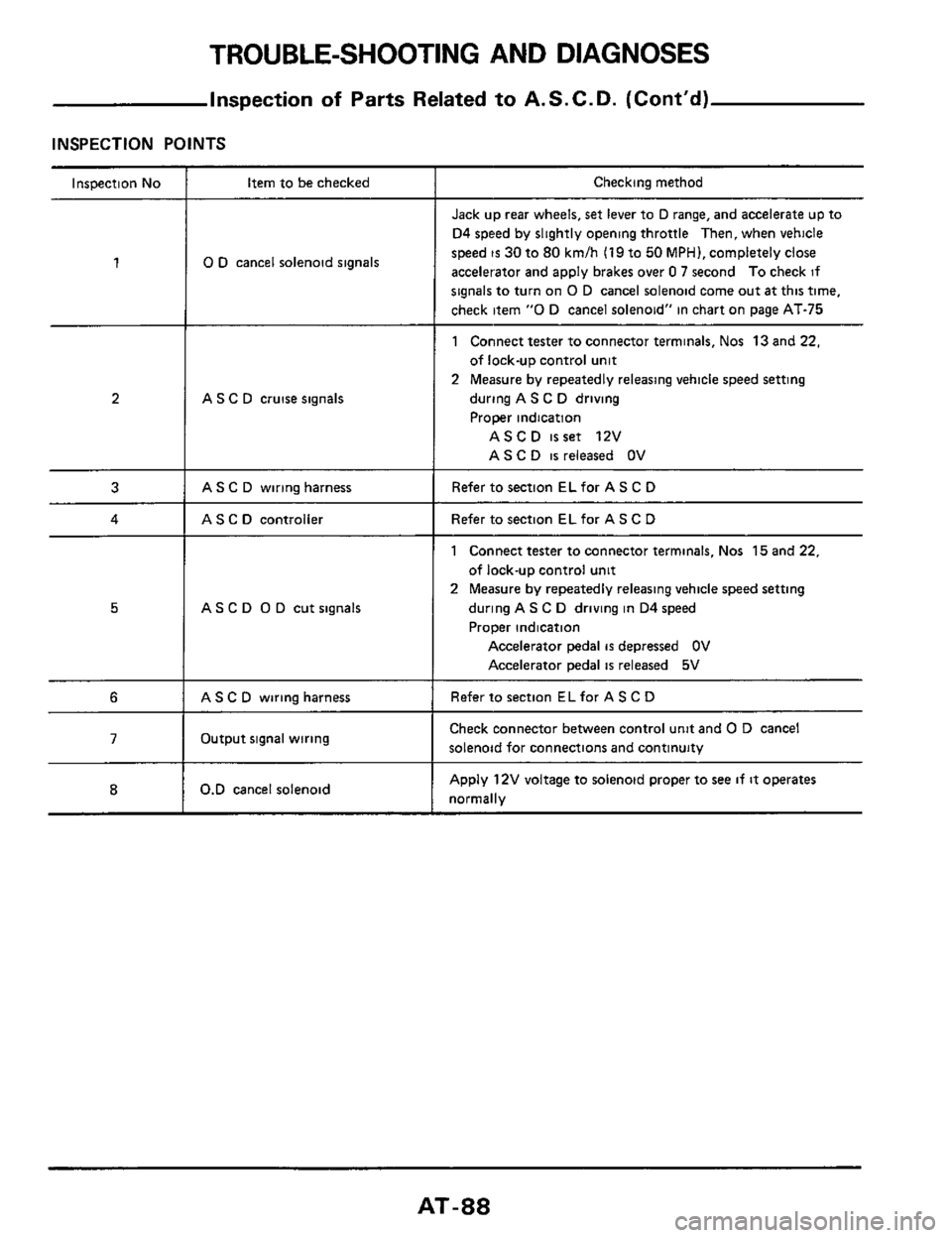
TROUBLE-SHOOTING AND DIAGNOSES
Inspection of Parts Related to A. S. C. D. (Cont’d)
INSPECTION POINTS
Inspection No
1
2
3
4
5
6
7
8
Item to be checked
0 D cancel solenoid signals
A S C D cruise signals
AS C D wiring harness
AS C D controller
AS C D 0 D cut signals
AS C D wiring harness
Output signal wiring
0.D cancel solenoid
Checking method
Jack up rear wheels, set lever to D range, and accelerate up to
D4 speed by slightly opening throttle
Then, when vehicle
speed
is 30 to 80 kmlh (19 to 50 MPH), completely close
accelerator and apply brakes over
0 7 second To check if
signals to turn on 0 D cancel solenoid come out at this time,
check item
“0 D cancel solenoid” in chart on page AT-75
1 Connect tester to connector terminals, Nos 13 and 22,
of lock-up control unit
2 Measure by repeatedly releasing vehicle speed setting
during A S C D driving
Proper indication
ASCD isset 12V
AS C
D is released OV
Refer to section EL for A S C D
Refer to section EL for AS C D
1 Connect tester to connector terminals, Nos 15 and 22,
of lock-up control
unit
2 Measure by repeatedly releasing vehicle speed setting
during AS C
D driving in D4 speed
Proper indication
Accelerator pedal is depressed OV
Accelerator pedal
is released 5V
Refer to section ELfor A S C D
Check connector between control unit and 0 D cancel
solenoid for connections and continuity
Apply 12V voltage to solenoid proper to see if it operates
normally
AT-88