fuel cap NISSAN 370Z COUPE 2010 Owners Manual
[x] Cancel search | Manufacturer: NISSAN, Model Year: 2010, Model line: 370Z COUPE, Model: NISSAN 370Z COUPE 2010Pages: 409, PDF Size: 3.56 MB
Page 75 of 409
Black plate (73,1)
Model "Z34-D" EDITED: 2009/ 9/ 10
Front passenger air bag status
light
The front passenger air bag status light (
),
located on the center of the instrument panel,
will be lit and the passenger front air bag will be
OFF depending on how the front passenger
seat is being used.
For front passenger air bag status light opera-
tion,see“NISSANADVANCEDAIRBAG
SYSTEM (front seats)” in the “1. Safety —
Seats, seat belts and supplemental restraint
system” section of this manual.
High beam indicator light
This light comes on when the headlight high
beam is on and goes out when the low beam is
selected.
Malfunction Indicator Light (MIL)
If the malfunction indicator light comes on
steady or blinks while the engine is running, it
may indicate a potential emission control mal-
function.
The malfunction indicator light may also come on
steady if the fuel-filler cap is loose or missing, or
if the vehicle runs out of fuel. Check to make
sure the fuel-filler cap is installed and closed tightly, and that the vehicle has at least 3 US
gallons (14 liters) of fuel in the fuel tank.
After a few driving trips, the
light should
turn off if no other potential emission control
system malfunction exists.
If this indicator light remains on for 20 seconds
and then blinks for 10 seconds when the engine
is not running, it indicates that the vehicle is not
ready for an emission control system inspection/
maintenance test. (See “READINESS FOR
INSPECTION/MAINTENANCE (I/M) TEST (US
only)” in the “9. Technical and consumer
information” section.)
Operation:
The malfunction indicator light will come on in
one of two ways:
. Malfunction indicator light on steady — An
emission control system malfunction has
been detected. Check the fuel-filler cap. If
the fuel-filler cap is loose or missing, tighten
or install the cap and continue to drive the
vehicle. The
light should turn off after a
few driving trips. If the
light does not
turn off after a few driving trips, have the
vehicle inspected by a NISSAN dealer. You
do not need to have your vehicle towed to
the dealer.
. Malfunction indicator light blinking — An
engine misfire has been detected which may damage the emission control system.
To reduce or avoid emission control system
damage:
a) Do not drive at speeds above 45 MPH (72 km/h) .
b) Avoid hard acceleration or deceleration.
c) Avoid steep uphill grades.
d) If possible, reduce the amount of cargo being hauled or towed.
The malfunction indicator light may stop
blinking and remain on.
Have the vehicle inspected by a NISSAN
dealer. You do not need to have your vehicle
towed to the dealer.
CAUTION
Continued vehicle operation without
having the emission control system
checked and repaired as necessary
could lead to poor driveability, reduced
fuel economy, and possible damage to
the emission control system.
Instruments and controls
2-13
Page 113 of 409
Black plate (10,1)
3 Pre-driving checks and adjustments
Model "Z34-D" EDITED: 2009/ 9/ 10
Keys ............................................................... 3-2Intelligent Key ................................................ 3-2
Valet hand-off ................................................ 3-3
Doors .............................................................. 3-4
Locking with mechanical key ............................. 3-4
Opening and closing windows with the
mechanical key .............................................. 3-4
Locking with inside lock knob ........................... 3-5
Locking with power door lock switch .................. 3-5
Automatic door locks ...................................... 3-5
Intelligent Key system .......................................... 3-6
Intelligent Key operating range .......................... 3-8
Door locks/unlocks precaution .......................... 3-8
Intelligent Key operation ................................... 3-9
Battery saver system ..................................... 3-11
Warning signals ........................................... 3-11
Troubleshooting guide ................................... 3-12
Remote keyless entry system .............................. 3-13
How to use remote keyless entry system ........... 3-13
Hood ............................................................ 3-16
Rear hatch (Coupe models) ................................ 3-17
Rear hatch opener switch .............................. 3-17
Secondary rear hatch release .......................... 3-18
Trunk lid (Roadster models) ................................ 3-19
Trunk lid opener switch .................................. 3-19 Trunk release power cancel switch
................... 3-19
Interior trunk lid release ................................. 3-20
Secondary trunk lid release ............................ 3-21
Soft top (Roadster models) ................................ 3-21
Before operating the top ................................ 3-21
When operating the top ................................. 3-23
Opening the top .......................................... 3-25
Closing the top ............................................ 3-26
Opening the top using the Intelligent Key ........... 3-26
Troubleshooting guide ................................... 3-27
If the top does not open or close electrically . . .... 3-28
Care of the soft top and the vehicle body .......... 3-32
Front, side and rear unique parts
(NISMO models) .............................................. 3-32
Fuel-filler door ................................................. 3-34
Opening the fuel-filler door ............................. 3-34
Fuel-filler cap .............................................. 3-34
Tilt steering ..................................................... 3-35
Manual operation ......................................... 3-36
Sun visors ...................................................... 3-36
Mirrors ........................................................... 3-36
Inside mirror ................................................ 3-36
Outside mirrors ............................................ 3-38
Vanity mirror ................................................ 3-39
Page 146 of 409
Black plate (146,1)
Model "Z34-D" EDITED: 2009/ 9/ 10
SPA2581
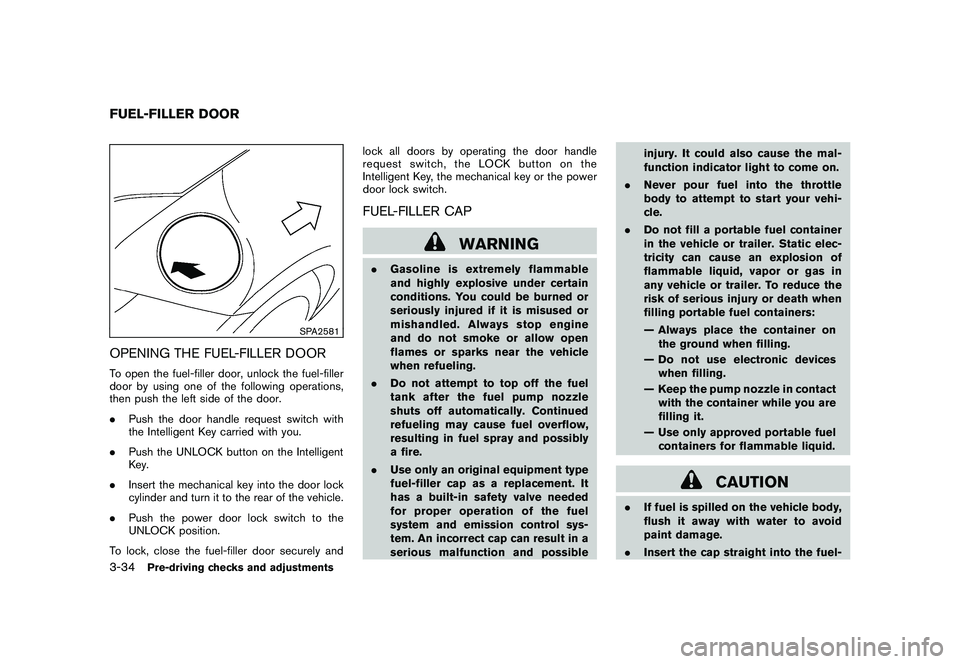
OPENING THE FUEL-FILLER DOORTo open the fuel-filler door, unlock the fuel-filler
door by using one of the following operations,
then push the left side of the door.
.Push the door handle request switch with
the Intelligent Key carried with you.
. Push the UNLOCK button on the Intelligent
Key.
. Insert the mechanical key into the door lock
cylinder and turn it to the rear of the vehicle.
. Push the power door lock switch to the
UNLOCK position.
To lock, close the fuel-filler door securely and lock all doors by operating the door handle
request switch, the LOCK button on the
Intelligent Key, the mechanical key or the power
door lock switch.
FUEL-FILLER CAP
WARNING
.
Gasoline is extremely flammable
and highly explosive under certain
conditions. You could be burned or
seriously injured if it is misused or
mishandled. Always stop engine
and do not smoke or allow open
flames or sparks near the vehicle
when refueling.
. Do not attempt to top off the fuel
tank after the fuel pump nozzle
shuts off automatically. Continued
refueling may cause fuel overflow,
resulting in fuel spray and possibly
a fire.
. Use only an original equipment type
fuel-filler cap as a replacement. It
has a built-in safety valve needed
for proper operation of the fuel
system and emission control sys-
tem. An incorrect cap can result in a
serious malfunction and possible injury. It could also cause the mal-
function indicator light to come on.
. Never pour fuel into the throttle
body to attempt to start your vehi-
cle.
. Do not fill a portable fuel container
in the vehicle or trailer. Static elec-
tricity can cause an explosion of
flammable liquid, vapor or gas in
any vehicle or trailer. To reduce the
risk of serious injury or death when
filling portable fuel containers:
— Always place the container on
the ground when filling.
— Do not use electronic devices when filling.
— Keep the pump nozzle in contact with the container while you are
filling it.
— Use only approved portable fuel containers for flammable liquid.
CAUTION
. If fuel is spilled on the vehicle body,
flush it away with water to avoid
paint damage.
. Insert the cap straight into the fuel-
FUEL-FILLER DOOR3-34
Pre-driving checks and adjustments
Page 147 of 409
Black plate (147,1)
Model "Z34-D" EDITED: 2009/ 9/ 10
filler tube, then tighten until the
fuel-filler cap clicks. Failure to tight-
en the fuel-filler cap properly may
cause the
malfunction indicator
light (MIL) to illuminate. If the
light illuminates because the fuel-
filler cap is loose or missing, tighten
or install the cap and continue to
drive the vehicle. The
light
should turn off after a few driving
trips. If the
light does not turn
off after a few driving trips, have the
vehicle inspected by a NISSAN deal-
er.
SPA2582
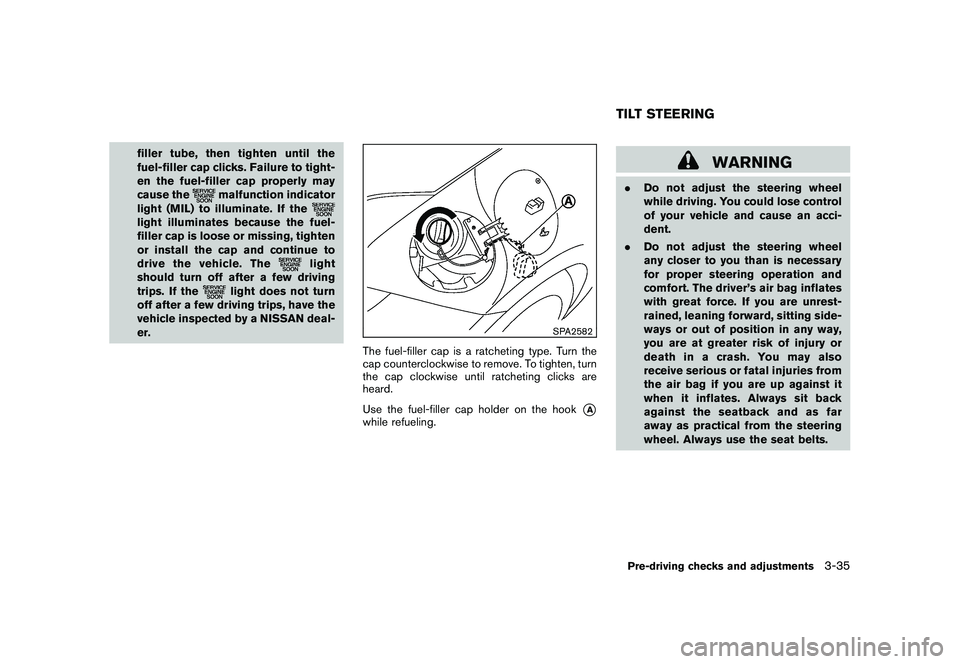
The fuel-filler cap is a ratcheting type. Turn the
cap counterclockwise to remove. To tighten, turn
the cap clockwise until ratcheting clicks are
heard.
Use the fuel-filler cap holder on the hook
*A
while refueling.
WARNING
. Do not adjust the steering wheel
while driving. You could lose control
of your vehicle and cause an acci-
dent.
. Do not adjust the steering wheel
any closer to you than is necessary
for proper steering operation and
comfort. The driver’s air bag inflates
with great force. If you are unrest-
rained, leaning forward, sitting side-
ways or out of position in any way,
you are at greater risk of injury or
death in a crash. You may also
receive serious or fatal injuries from
the air bag if you are up against it
when it inflates. Always sit back
against the seatback and as far
away as practical from the steering
wheel. Always use the seat belts.TILT STEERINGPre-driving checks and adjustments
3-35
Page 176 of 409
Black plate (176,1)
Model "Z34-D" EDITED: 2009/ 9/ 10
SERVICING AIR CONDITIONERThe air conditioning system in your NISSAN is
charged with a refrigerant designed with the
environment in mind.This refrigerant will not
harm the earth’s ozone layer. However,
special charging equipment and lubricant are
required when servicing your NISSAN air con-
ditioner. Using improper refrigerants or lubri-
cants will cause severe damage to your air
conditioning system. (See “CAPACITIES AND
RECOMMENDED FUEL/LUBRICANTS” in the
“9. Technical and consumer information” section
for air conditioning system refrigerant and
lubricant recommendations.)
Your NISSAN dealer will be able to service your
environmentally friendly air conditioning system.
WARNING
The system contains refrigerant under
high pressure. To avoid personal injury,
any air conditioner service should be
done only by an experienced technician
with the proper equipment.
AUDIO OPERATION PRECAUTIONS
RadioPush the ignition switch to the ACC or ON
position and push the radio band select button
to turn on the radio. If you listen to the radio with
the engine not running, the ignition switch
should be pushed to the ACC position.
Radio reception is affected by station signal
strength, distance from radio transmitter, build-
ings, bridges, mountains and other external
influences. Intermittent changes in reception
quality normally are caused by these external
influences.
Using a cellular phone in or near the
vehicle may influence radio reception
quality.
Radio reception:
Your NISSAN radio system is equipped with
state-of-the-art electronic circuits to enhance
radio reception. These circuits are designed to
extend reception range, and to enhance the
quality of that reception.
However there are some general characteristics
of both FM and AM radio signals that can affect
radio reception quality in a moving vehicle, even
when the finest equipment is used. These
characteristics are completely normal in a given
reception area, and do not indicate any mal- function in your NISSAN radio system.
Reception conditions will constantly change
because of vehicle movement. Buildings, terrain,
signal distance and interference from other
vehicles can work against ideal reception.
Described below are some of the factors that
can affect your radio reception.
Some cellular phones or other devices may
cause interference or a buzzing noise to come
from the audio system speakers. Storing the
device in a different location may reduce or
eliminate the noise.AUDIO SYSTEM
4-24
Center display, heater, air conditioner, audio, phone and voice recognition systems
Page 343 of 409
Black plate (345,1)
Model "Z34-D" EDITED: 2009/ 9/ 10
When performing any inspection or mainte-
nance work on your vehicle, always take care
to prevent serious accidental injury to yourself or
damage to the vehicle. The following are general
precautions which should be closely observed.
WARNING
.Park the vehicle on a level surface,
apply the parking brake securely
and block the wheels to prevent
the vehicle from moving. For man-
ual transmission models, move the
shift lever to N (Neutral) . For auto-
matic transmission models, move
the selector lever to P (Park) .
. Be sure the ignition switch is in the
OFF or LOCK position when per-
forming any parts replacement or
repairs.
. Never connect or disconnect the
battery or any transistorized com-
ponent while the ignition switch is
in the ON position.
. Never leave the engine or automatic
transmission related component
harnesses disconnected while the
ignition switch is in the ON position.
. If you must work with the engine running, keep your hands, clothing,
hair and tools away from moving
fans, belts and any other moving
parts.
. It is advisable to secure or remove
any loose clothing and remove any
jewelry, such as rings, watches, etc.
before working on your vehicle.
. Always wear eye protection when-
ever you work on your vehicle.
. If you must run the engine in an
enclosed space such as a garage, be
sure there is proper ventilation for
exhaust gases to escape.
. Never get under the vehicle while it
is supported only by a jack. If it is
necessary to work under the vehicle,
support it with safety stands.
. Keep smoking materials, flame and
sparks away from fuel tank and the
battery.
. Your vehicle is equipped with an
automatic engine cooling fan. It may
come on at any time without warn-
ing, even if the ignition key is in the
OFF position and the engine is not
running. To avoid injury, always
disconnect the negative battery cable before working near the fan.
. The fuel filter or fuel lines should be
serviced by a NISSAN dealer be-
cause the fuel lines are under high
pressure even when the engine is
off.
CAUTION
.Do not work under the hood while
the engine is hot. Turn the engine
off and wait until it cools down.
. Avoid direct contact with used en-
gine oil and coolant. Improperly
disposed engine oil, coolant, and/
or other vehicle fluids can damage
the environment. Always conform to
local regulations for disposal of
vehicle fluid.
This “8. Maintenance and do-it-yourself” section
gives instructions regarding only those items
which are relatively easy for an owner to perform.
A genuine NISSAN Service Manual is also
available. (See “OWNER’S MANUAL/SERVICE
MANUAL ORDER INFORMATION” in the “9.
Technical and consumer information” section.)
Youshouldbeawarethatincompleteor
MAINTENANCE PRECAUTIONS
Maintenance and do-it-yourself
8-5
Page 349 of 409
Black plate (351,1)
Model "Z34-D" EDITED: 2009/ 9/ 10
Do not use excessive force.
9. Refill engine with recommended oil through the oil filler opening, and install the oil filler
cap securely.
See “CAPACITIES AND RECOMMENDED
FUEL/LUBRICANTS” in the “9. Technical
and consumer information” section for drain
and refill capacity. The drain and refill
capacity depends on the oil temperature
and drain time. Use these specifications for
reference only. Always use the dipstick to
determine the proper amount of oil in the
engine.
10. Start the engine and check for leakage around the drain plug and the oil filter.
Correct as required.
11. Turn the engine off and wait more than 15 minutes. Check the oil level with the dipstick.
Add engine oil if necessary.
After the operation1. Install the engine undercover into position as
the following steps.
a. Pull the center of the small plastic clipout.
b. Hold the engine undercover into posi- tion. c. Insert the clip through the undercover
into the hole in the frame, then push the
center of the clip in to lock the clip in
place.
d. Install the bolts that hold the undercover in place. Be careful not to strip the bolts
or over-tighten them.
2. Lower the vehicle carefully to the ground.
3. Dispose of waste oil and filter properly.
WARNING
. Prolonged and repeated contact
with used engine oil may cause skin
cancer.
. Try to avoid direct skin contact with
used oil. If skin contact is made,
wash thoroughly with soap or hand
cleaner as soon as possible.
. Keep used engine oil out of reach of
children. When checking or replacement is required, we
recommend a NISSAN dealer for servicing.
CAUTION
.
Use only Genuine NISSAN Matic S
ATF. Do not mix with other fluids.
. Using automatic transmission fluid
other than Genuine NISSAN Matic S
ATF will cause deterioration in dri-
veability and automatic transmis-
sion durability, and may damage
the automatic transmission, which
is not covered by the NISSAN new
vehicle limited warranty.AUTOMATIC TRANSMISSION FLUID
Maintenance and do-it-yourself
8-11
Page 350 of 409
Black plate (352,1)
Model "Z34-D" EDITED: 2009/ 9/ 10
SDI1765A
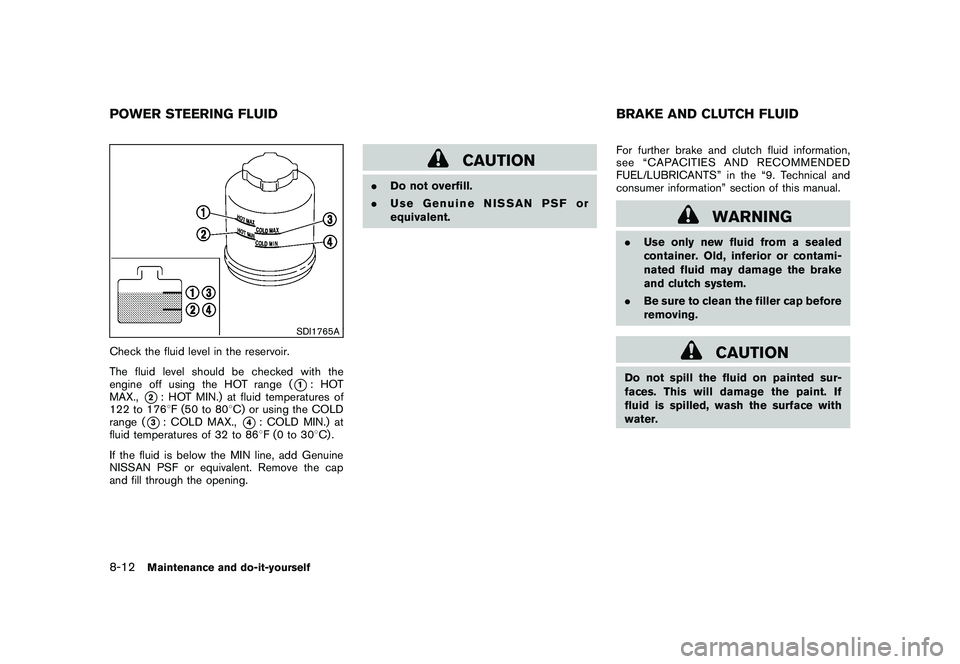
Check the fluid level in the reservoir.
The fluid level should be checked with the
engine off using the HOT range (
*1:HOT
MAX.,
*2: HOT MIN.) at fluid temperatures of
122 to 176 8F (50 to 80 8C) or using the COLD
range (
*3: COLD MAX.,
*4: COLD MIN.) at
fluid temperatures of 32 to 86 8F(0to30 8C) .
If the fluid is below the MIN line, add Genuine
NISSAN PSF or equivalent. Remove the cap
and fill through the opening.
CAUTION
. Do not overfill.
. Use Genuine NISSAN PSF or
equivalent. For further brake and clutch fluid information,
see “CAPACITIES AND RECOMMENDED
FUEL/LUBRICANTS” in the “9. Technical and
consumer information” section of this manual.
WARNING
.
Use only new fluid from a sealed
container. Old, inferior or contami-
nated fluid may damage the brake
and clutch system.
. Be sure to clean the filler cap before
removing.
CAUTION
Do not spill the fluid on painted sur-
faces. This will damage the paint. If
fluid is spilled, wash the surface with
water.
POWER STEERING FLUID BRAKE AND CLUTCH FLUID8-12
Maintenance and do-it-yourself
Page 377 of 409
Black plate (28,1)
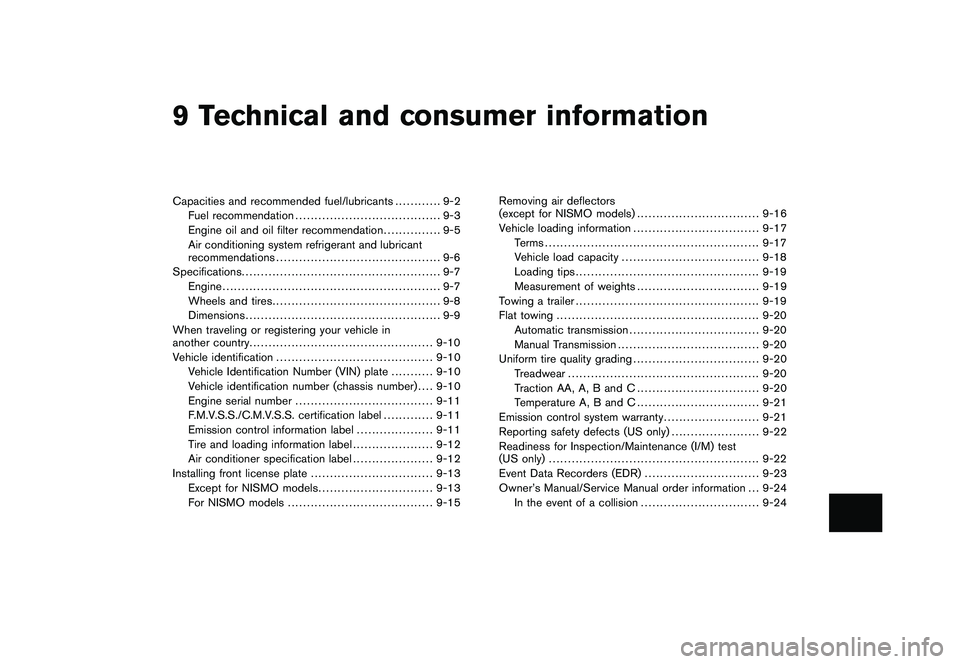
9 Technical and consumer information
Model "Z34-D" EDITED: 2009/ 9/ 10
Capacities and recommended fuel/lubricants............ 9-2
Fuel recommendation ...................................... 9-3
Engine oil and oil filter recommendation ............... 9-5
Air conditioning system refrigerant and lubricant
recommendations ........................................... 9-6
Specifications. ................................................... 9-7
Engine ......................................................... 9-7
Wheels and tires ............................................ 9-8
Dimensions ................................................... 9-9
When traveling or registering your vehicle in
another country ................................................ 9-10
Vehicle identification ......................................... 9-10
Vehicle Identification Number (VIN) plate ........... 9-10
Vehicle identification number (chassis number) .... 9-10
Engine serial number .................................... 9-11
F.M.V.S.S./C.M.V.S.S. certification label ............. 9-11
Emission control information label .................... 9-11
Tire and loading information label ..................... 9-12
Air conditioner specification label ..................... 9-12
Installing front license plate ................................ 9-13
Except for NISMO models .............................. 9-13
For NISMO models ...................................... 9-15 Removing air deflectors
(except for NISMO models)
................................ 9-16
Vehicle loading information ................................. 9-17
Terms ........................................................ 9-17
Vehicle load capacity .................................... 9-18
Loading tips ................................................ 9-19
Measurement of weights ................................ 9-19
Towing a trailer ................................................ 9-19
Flat towing ..................................................... 9-20
Automatic transmission .................................. 9-20
Manual Transmission ..................................... 9-20
Uniform tire quality grading ................................. 9-20
Treadwear .................................................. 9-20
Traction AA, A, B and C ................................ 9-20
Temperature A, B and C ................................ 9-21
Emission control system warranty ......................... 9-21
Reporting safety defects (US only) ....................... 9-22
Readiness for Inspection/Maintenance (I/M) test
(US only) ....................................................... 9-22
Event Data Recorders (EDR) .............................. 9-23
Owner’s Manual/Service Manual order information . . . 9-24 In the event of a collision ............................... 9-24
Page 378 of 409

Black plate (380,1)
Model "Z34-D" EDITED: 2009/ 9/ 10
The following are approximate capacities. The actual refill capacities may be a little different. When refilling, follow the procedure
instructed in the “8. Maintenance and do-it-yourself” section to determine the proper refill capacity.
Capacity (Approximate)Recommended specifications
US measure Imp measure Liter
Fuel 19 gal 15-7/8 gal 71.9 See “FUEL RECOMMENDATION” later in this section.
Engine oil*1
Drain and refill With oil filter change 5-1/8 qt 4-3/8 qt 4.9 .Engine oil with API Certification Mark*2, *3
. Viscosity SAE 5W-30*2, *3
Without oil filter change 4-7/8 qt 4 qt 4.6
Cooling system
Automatic transmission model With reservoir 9 qt 7-1/2 qt 8.5
50% Genuine NISSAN Long Life Antifreeze/Coolant or equivalent
50% Demineralized or distilled water
Reservoir 7/8 qt 3/4 qt 0.8
Manual transmission model With reservoir 9-1/8 qt 7-5/8 qt 8.6
Reservoir 7/8 qt 3/4 qt 0.8
Automatic transmission fluid —— —Genuine NISSAN Matic S ATF*4
Manual transmission gear oil —— —Genuine NISSAN Manual Transmission Fluid (MTF)
HQ Multi 75W-85 or API GL-4, Viscosity SAE 75W-85
Differential gear oil —— —Genuine NISSAN Differential Oil Synthetic 75W-90 or API GL-5 synthetic
gear oil, Viscosity SAE 75W-90*5
Power steering fluid (PSF) Refill to the proper oil level according to the instructions in the “8.
Maintenance and do-it-yourself” section.Genuine NISSAN PSF or equivalent*6
Brake and clutch fluid Genuine NISSAN Super Heavy Duty Brake Fluid*7 or equivalent DOT 3
Multi-purpose grease NLGI No. 2 (Lithium soap base)
Air conditioning system refrigerant —— —HFC-134a (R-134a)*8
Air conditioning system lubricants —— —NISSAN UV Luminous Oil Type S or exact equivalent
Window washer fluid 4-3/444.5Genuine NISSAN Windshield Washer Concentrate Cleaner & Antifreeze or
equivalent
*1: For additional information, see “ENGINE OIL” in the “8. Maintenance and do-it-yourself” section for changing engine oil.
*2: For additional information, see “ENGINE OIL AND OIL FILTER RECOMMENDATION” later in this section.
*3: NISSAN recommends Genuine NISSAN Ester Engine Oil, which is available at a NISSAN dealer.
*4: Using automatic transmission fluid other than Genuine NISSAN Matic S ATF will cause deterioration in driveability and automatic transmission durability, and may damage the automatic
transmission, which is not covered by the NISSAN new vehicle limited warranty.
*5: See a NISSAN dealer for service for synthetic oil.
*6: DEXRON
TMVI type ATF may also be used.
*7: Available in mainland US through a NISSAN dealer.
*8: For additional information, see “VEHICLE IDENTIFICATION” later in this section for air conditioner specification label.
CAPACITIES AND RECOMMENDED
FUEL/LUBRICANTS9-2
Technical and consumer information