belt NISSAN GT-R 2013 R35 Owner's Guide
[x] Cancel search | Manufacturer: NISSAN, Model Year: 2013, Model line: GT-R, Model: NISSAN GT-R 2013 R35Pages: 346, PDF Size: 4.19 MB
Page 75 of 346
1-26Safety — Seats, seat belts and supplemental restraint system
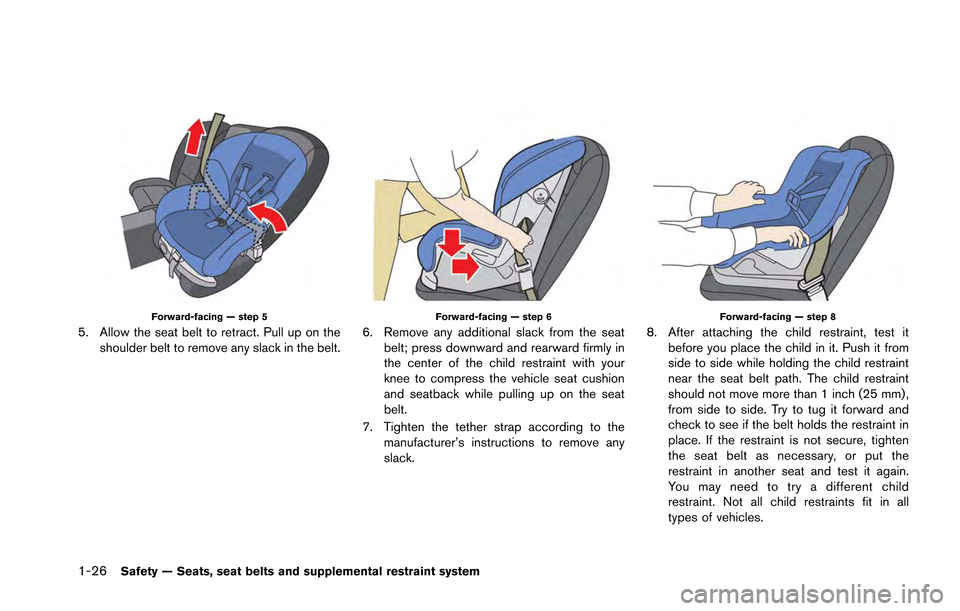
Forward-facing — step 5
5. Allow the seat belt to retract. Pull up on theshoulder belt to remove any slack in the belt.
Forward-facing — step 6
6. Remove any additional slack from the seatbelt; press downward and rearward firmly in
the center of the child restraint with your
knee to compress the vehicle seat cushion
and seatback while pulling up on the seat
belt.
7. Tighten the tether strap according to the manufacturer’s instructions to remove any
slack.
Forward-facing — step 8
8. After attaching the child restraint, test itbefore you place the child in it. Push it from
side to side while holding the child restraint
near the seat belt path. The child restraint
should not move more than 1 inch (25 mm) ,
from side to side. Try to tug it forward and
check to see if the belt holds the restraint in
place. If the restraint is not secure, tighten
the seat belt as necessary, or put the
restraint in another seat and test it again.
You may need to try a different child
restraint. Not all child restraints fit in all
types of vehicles.
Page 76 of 346
9. Check to make sure the child restraint isproperly secured prior to each use. If the
seat belt is not locked, repeat steps 2
through 8.
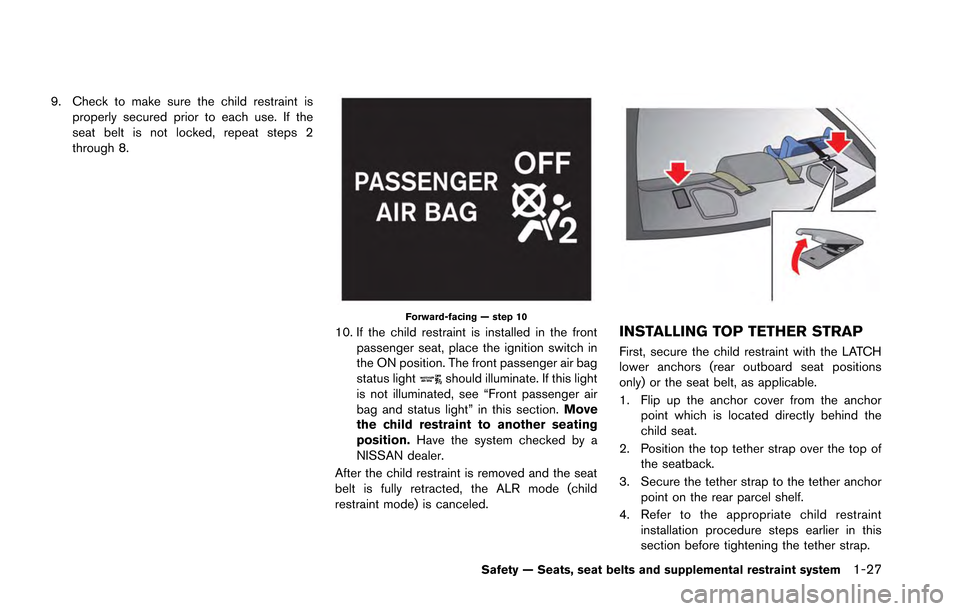
Forward-facing — step 10
10. If the child restraint is installed in the frontpassenger seat, place the ignition switch in
the ON position. The front passenger air bag
status light
should illuminate. If this light
is not illuminated, see “Front passenger air
bag and status light” in this section. Move
the child restraint to another seating
position. Have the system checked by a
NISSAN dealer.
After the child restraint is removed and the seat
belt is fully retracted, the ALR mode (child
restraint mode) is canceled.
INSTALLING TOP TETHER STRAP
First, secure the child restraint with the LATCH
lower anchors (rear outboard seat positions
only) or the seat belt, as applicable.
1. Flip up the anchor cover from the anchor point which is located directly behind the
child seat.
2. Position the top tether strap over the top of the seatback.
3. Secure the tether strap to the tether anchor point on the rear parcel shelf.
4. Refer to the appropriate child restraint installation procedure steps earlier in this
section before tightening the tether strap.
Safety — Seats, seat belts and supplemental restraint system1-27
Page 77 of 346
1-28Safety — Seats, seat belts and supplemental restraint system
If you have any questions when installing a
top tether strap, consult a GT-R certified
NISSAN dealer for details.
BOOSTER SEATS
Precautions on booster seats
WARNING
If a booster seat and seat belt are not
used properly, the risk of a child being
injured in a sudden stop or collision
greatly increases:
.Make sure the shoulder portion of
the belt is away from the child’s face
and neck and the lap portion of the
belt does not cross the stomach.
. Make sure the shoulder belt is not
behind the child or under the child’s
arm.
. A booster seat must only be in-
stalled in a seating position that has
a lap/shoulder belt.
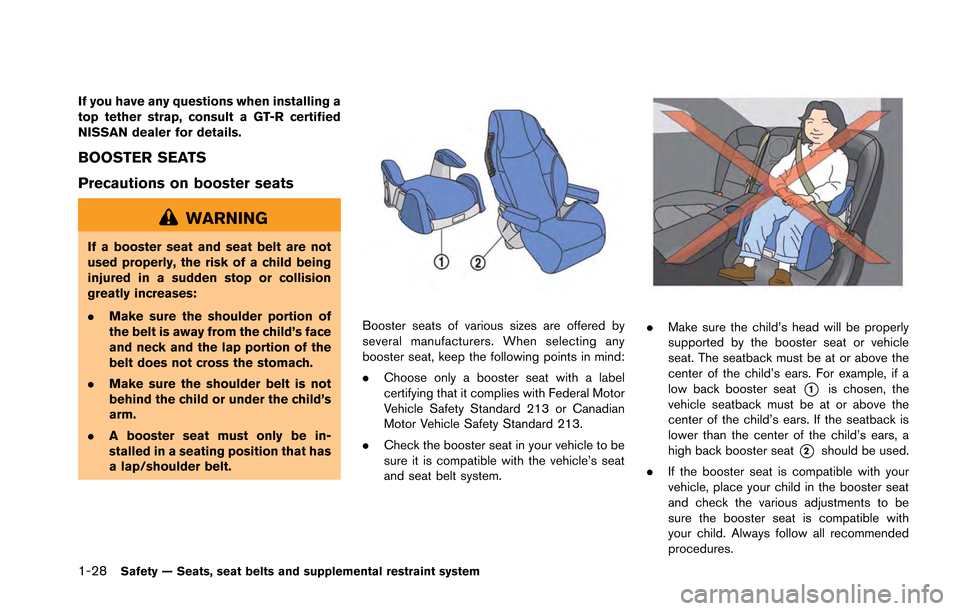
Booster seats of various sizes are offered by
several manufacturers. When selecting any
booster seat, keep the following points in mind:
.Choose only a booster seat with a label
certifying that it complies with Federal Motor
Vehicle Safety Standard 213 or Canadian
Motor Vehicle Safety Standard 213.
. Check the booster seat in your vehicle to be
sure it is compatible with the vehicle’s seat
and seat belt system..Make sure the child’s head will be properly
supported by the booster seat or vehicle
seat. The seatback must be at or above the
center of the child’s ears. For example, if a
low back booster seat
*1is chosen, the
vehicle seatback must be at or above the
center of the child’s ears. If the seatback is
lower than the center of the child’s ears, a
high back booster seat
*2should be used.
. If the booster seat is compatible with your
vehicle, place your child in the booster seat
and check the various adjustments to be
sure the booster seat is compatible with
your child. Always follow all recommended
procedures.
Page 78 of 346
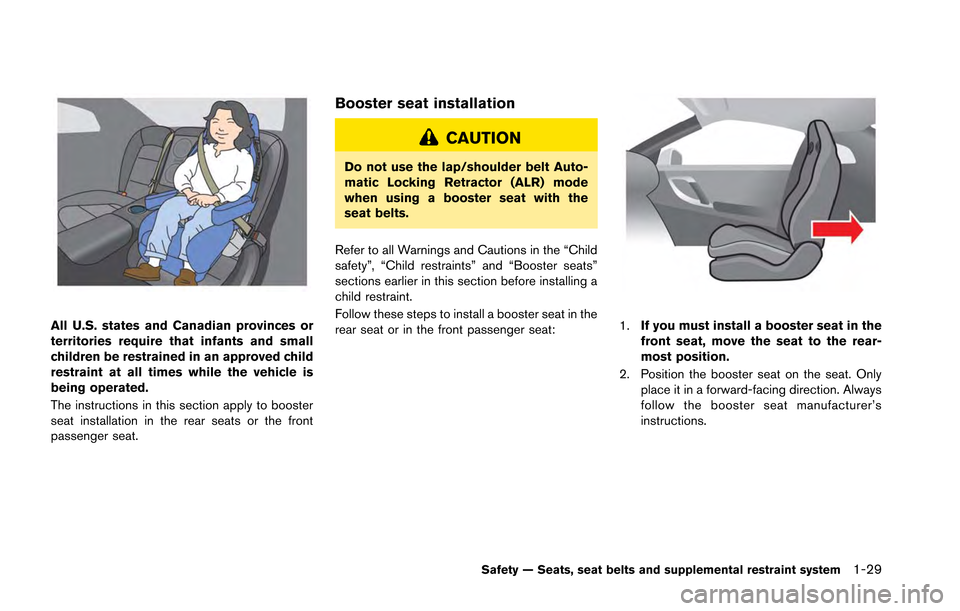
All U.S. states and Canadian provinces or
territories require that infants and small
children be restrained in an approved child
restraint at all times while the vehicle is
being operated.
The instructions in this section apply to booster
seat installation in the rear seats or the front
passenger seat.
Booster seat installation
CAUTION
Do not use the lap/shoulder belt Auto-
matic Locking Retractor (ALR) mode
when using a booster seat with the
seat belts.
Refer to all Warnings and Cautions in the “Child
safety”, “Child restraints” and “Booster seats”
sections earlier in this section before installing a
child restraint.
Follow these steps to install a booster seat in the
rear seat or in the front passenger seat:
1. If you must install a booster seat in the
front seat, move the seat to the rear-
most position.
2. Position the booster seat on the seat. Only place it in a forward-facing direction. Always
follow the booster seat manufacturer’s
instructions.
Safety — Seats, seat belts and supplemental restraint system1-29
Page 79 of 346
1-30Safety — Seats, seat belts and supplemental restraint system
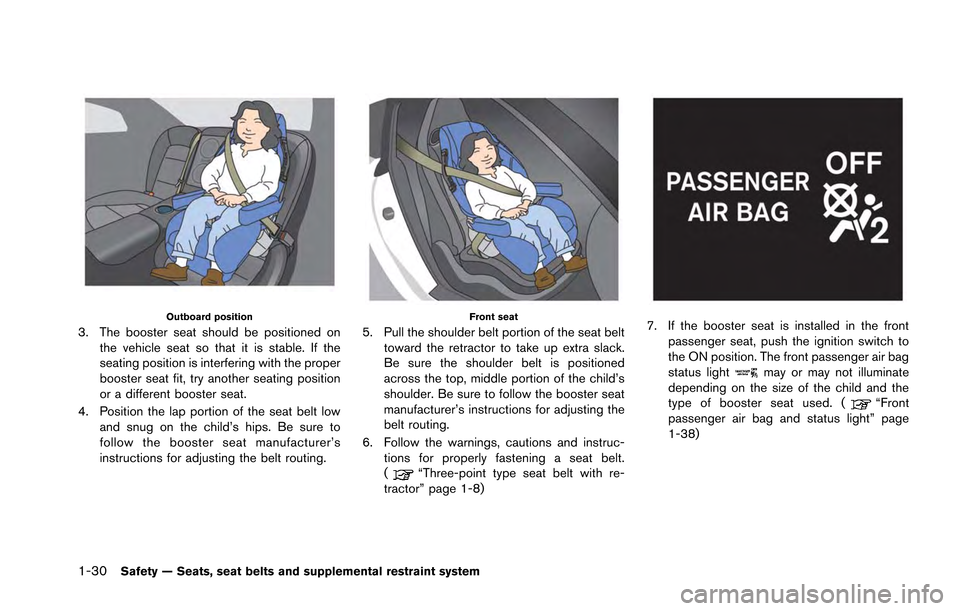
Outboard position
3. The booster seat should be positioned onthe vehicle seat so that it is stable. If the
seating position is interfering with the proper
booster seat fit, try another seating position
or a different booster seat.
4. Position the lap portion of the seat belt low and snug on the child’s hips. Be sure to
follow the booster seat manufacturer’s
instructions for adjusting the belt routing.
Front seat
5. Pull the shoulder belt portion of the seat belttoward the retractor to take up extra slack.
Be sure the shoulder belt is positioned
across the top, middle portion of the child’s
shoulder. Be sure to follow the booster seat
manufacturer’s instructions for adjusting the
belt routing.
6. Follow the warnings, cautions and instruc- tions for properly fastening a seat belt.
(
“Three-point type seat belt with re-
tractor” page 1-8)
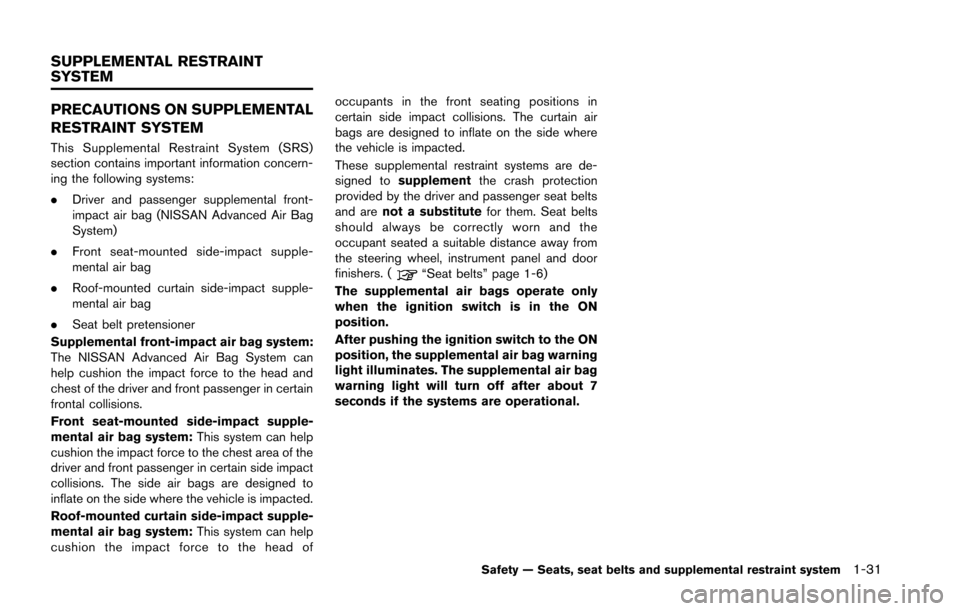
7. If the booster seat is installed in the front passenger seat, push the ignition switch to
the ON position. The front passenger air bag
status light
may or may not illuminate
depending on the size of the child and the
type of booster seat used. (
“Front
passenger air bag and status light” page
1-38)
Page 80 of 346
PRECAUTIONS ON SUPPLEMENTAL
RESTRAINT SYSTEM
This Supplemental Restraint System (SRS)
section contains important information concern-
ing the following systems:
.Driver and passenger supplemental front-
impact air bag (NISSAN Advanced Air Bag
System)
. Front seat-mounted side-impact supple-
mental air bag
. Roof-mounted curtain side-impact supple-
mental air bag
. Seat belt pretensioner
Supplemental front-impact air bag system:
The NISSAN Advanced Air Bag System can
help cushion the impact force to the head and
chest of the driver and front passenger in certain
frontal collisions.
Front seat-mounted side-impact supple-
mental air bag system: This system can help
cushion the impact force to the chest area of the
driver and front passenger in certain side impact
collisions. The side air bags are designed to
inflate on the side where the vehicle is impacted.
Roof-mounted curtain side-impact supple-
mental air bag system: This system can help
cushion the impact force to the head of occupants in the front seating positions in
certain side impact collisions. The curtain air
bags are designed to inflate on the side where
the vehicle is impacted.
These supplemental restraint systems are de-
signed to
supplement the crash protection
provided by the driver and passenger seat belts
and are not a substitute for them. Seat belts
should always be correctly worn and the
occupant seated a suitable distance away from
the steering wheel, instrument panel and door
finishers. (
“Seat belts” page 1-6)
The supplemental air bags operate only
when the ignition switch is in the ON
position.
After pushing the ignition switch to the ON
position, the supplemental air bag warning
light illuminates. The supplemental air bag
warning light will turn off after about 7
seconds if the systems are operational.
Safety — Seats, seat belts and supplemental restraint system1-31
SUPPLEMENTAL RESTRAINT
SYSTEM
Page 81 of 346
1-32Safety — Seats, seat belts and supplemental restraint system
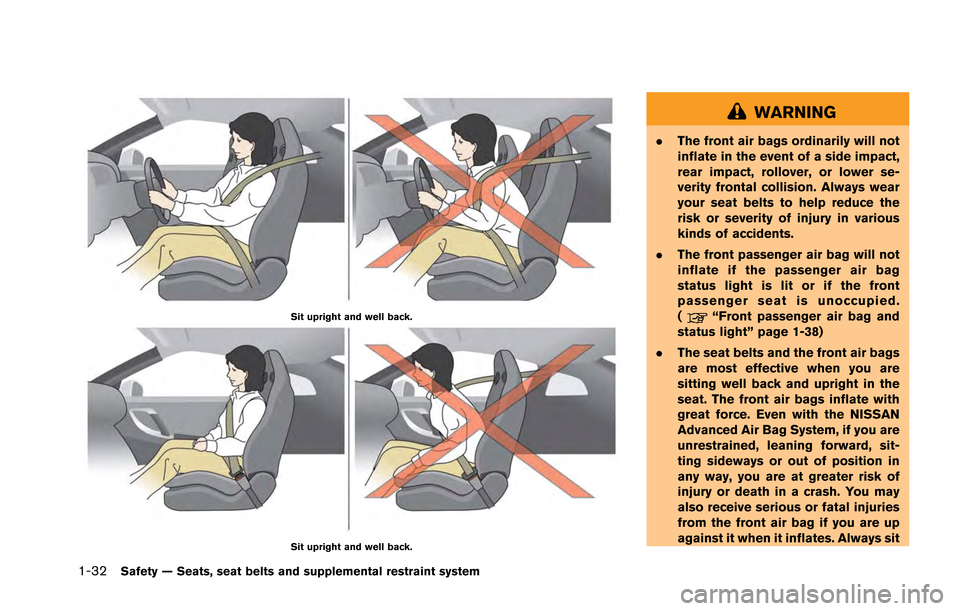
Sit upright and well back.
Sit upright and well back.
WARNING
.The front air bags ordinarily will not
inflate in the event of a side impact,
rear impact, rollover, or lower se-
verity frontal collision. Always wear
your seat belts to help reduce the
risk or severity of injury in various
kinds of accidents.
. The front passenger air bag will not
inflate if the passenger air bag
status light is lit or if the front
passenger seat is unoccupied.
(
“Front passenger air bag and
status light” page 1-38)
. The seat belts and the front air bags
are most effective when you are
sitting well back and upright in the
seat. The front air bags inflate with
great force. Even with the NISSAN
Advanced Air Bag System, if you are
unrestrained, leaning forward, sit-
ting sideways or out of position in
any way, you are at greater risk of
injury or death in a crash. You may
also receive serious or fatal injuries
from the front air bag if you are up
against it when it inflates. Always sit
Page 82 of 346
back against the seatback and as
far-away as practical from the steer-
ing wheel or instrument panel. Al-
ways use the seat belts.
. The driver and front passenger seat
belt buckles are equipped with
sensors that detect if the seat belts
are fastened. The Advanced Air Bag
System monitors the severity of a
collision and seat belt usage then
inflates the air bags as needed.
Failure to properly wear seat belts
can increase the risk or severity of
injury in an accident.
. The front passenger seat is
equipped with an occupant classifi-
cation sensor (pattern sensor) that
turns the front passenger air bag
OFF under some conditions. This
sensor is only used in this seat.
Failure to be properly seated and
wearing the seat belt can increase
the risk or severity of injury in an
accident. (
“Front passenger air
bag and status light” page 1-38)
. Keep hands on the outside of the
steering wheel. Placing them inside
the steering wheel rim could in- crease the risk of hand injury if the
supplemental front air bag inflates.
Safety — Seats, seat belts and supplemental restraint system1-33
Page 83 of 346
1-34Safety — Seats, seat belts and supplemental restraint system
WARNING
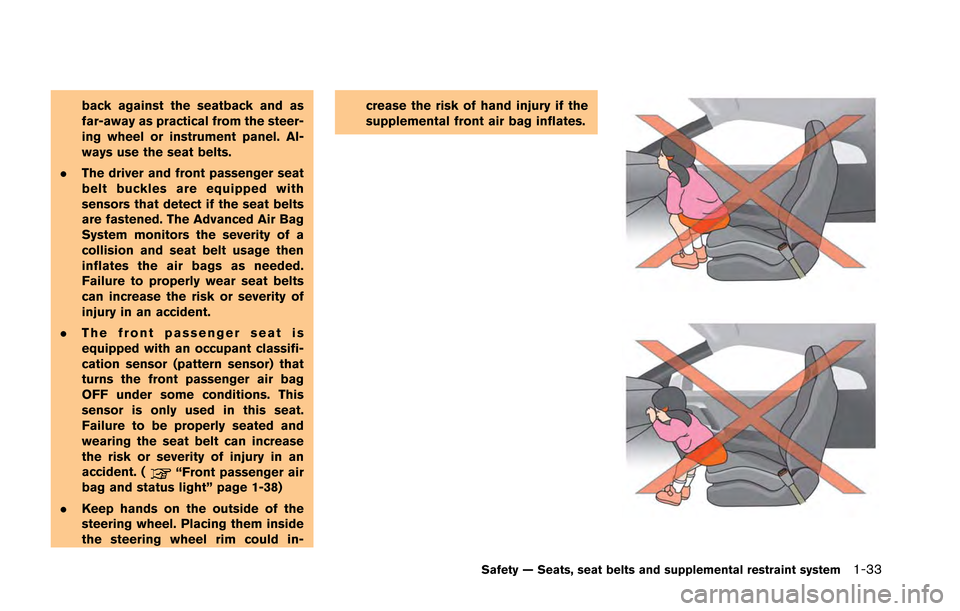
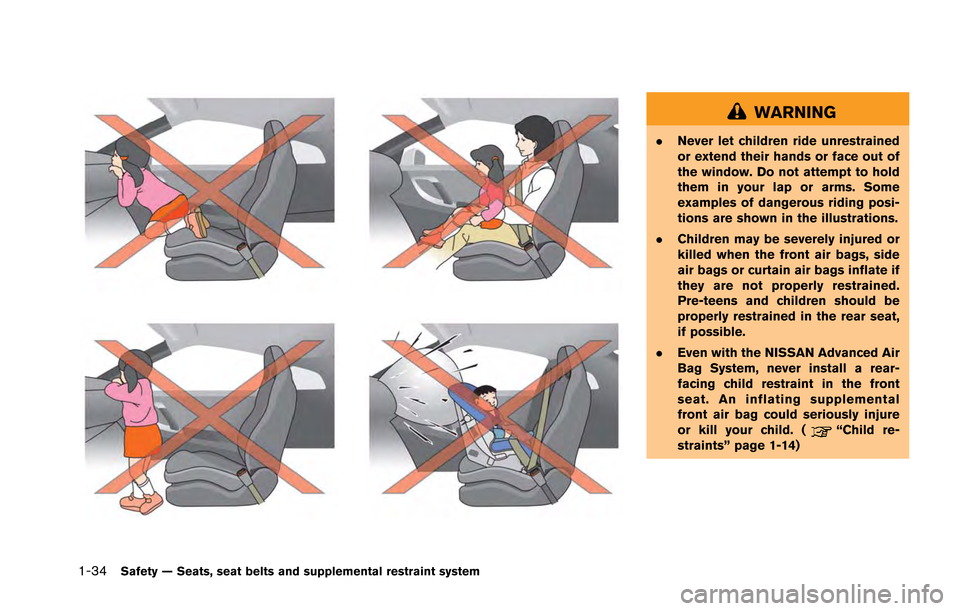
.Never let children ride unrestrained
or extend their hands or face out of
the window. Do not attempt to hold
them in your lap or arms. Some
examples of dangerous riding posi-
tions are shown in the illustrations.
. Children may be severely injured or
killed when the front air bags, side
air bags or curtain air bags inflate if
they are not properly restrained.
Pre-teens and children should be
properly restrained in the rear seat,
if possible.
. Even with the NISSAN Advanced Air
Bag System, never install a rear-
facing child restraint in the front
seat. An inflating supplemental
front air bag could seriously injure
or kill your child. (
“Child re-
straints” page 1-14)
Page 84 of 346
Do not lean against doors or windows.Do not lean against doors or windows.
WARNING
Front seat-mounted side-impact sup-
plemental air bag and roof-mounted
curtain side-impact supplemental air
bag:
.The side air bags and curtain air
bags ordinarily will not inflate in the
event of a frontal impact, rear im-
pact, rollover or lower severity side
collision. Always wear your seat
belts to help reduce the risk or
severity of injury in various kinds
of accidents.
. The seat belts, side air bags and
curtain air bags are most effective
when you are sitting well back and
upright in the seat. The side air bags
and curtain air bags inflate with
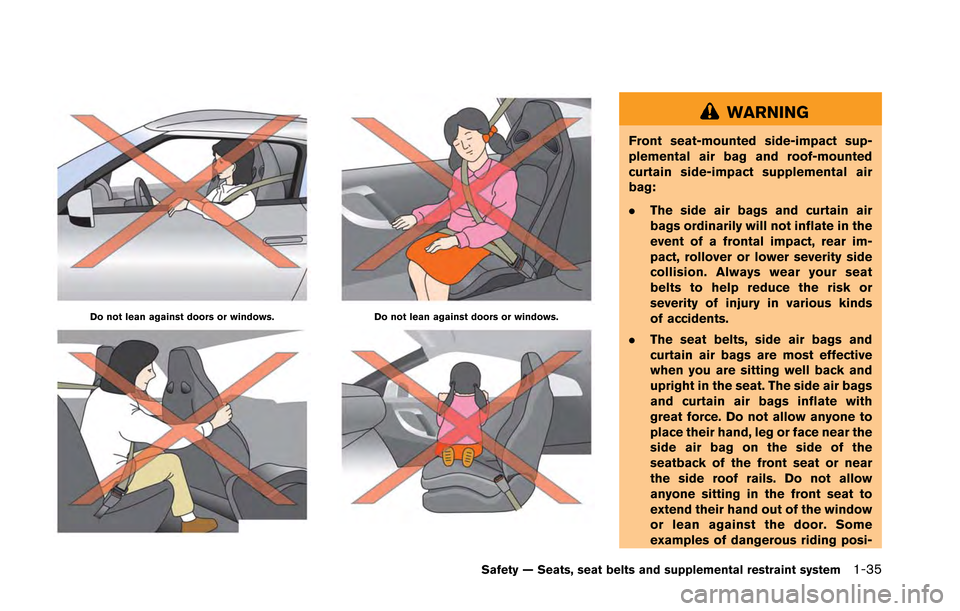
great force. Do not allow anyone to
place their hand, leg or face near the
side air bag on the side of the
seatback of the front seat or near
the side roof rails. Do not allow
anyone sitting in the front seat to
extend their hand out of the window
or lean against the door. Some
examples of dangerous riding posi-
Safety — Seats, seat belts and supplemental restraint system1-35