belt NISSAN GT-R 2013 R35 Repair Manual
[x] Cancel search | Manufacturer: NISSAN, Model Year: 2013, Model line: GT-R, Model: NISSAN GT-R 2013 R35Pages: 346, PDF Size: 4.19 MB
Page 260 of 346

7 Appearance and care
Cleaning exterior ...................................................................... 7-2Washing ........................................................................\
........ 7-2
Waxing ........................................................................\
.......... 7-3
Removing spots .................................................................. 7-3Underbody ........................................................................\
.... 7-3
Glass ........................................................................\
............. 7-3
Wheels ........................................................................\
.......... 7-3
Chrome parts ...................................................................... 7-4
Outside door handles ....................................................... 7-4
Tire dressing ........................................................................\
7-4
Dry carbon fiber rear spoiler (if so equipped) ............ 7-4 Cleaning interior ...................................................................... 7-5
Air fresheners .................................................................... 7-5Floor mats ........................................................................\
.. 7-6
Seat belts ........................................................................\
... 7-7
Corrosion protection ............................................................... 7-8 Most common factors contributing to
vehicle corrosion .............................................................. 7-8
Environmental factors influence the rate
of corrosion ....................................................................... 7-8
To protect your vehicle from corrosion ...................... 7-8
Page 266 of 346
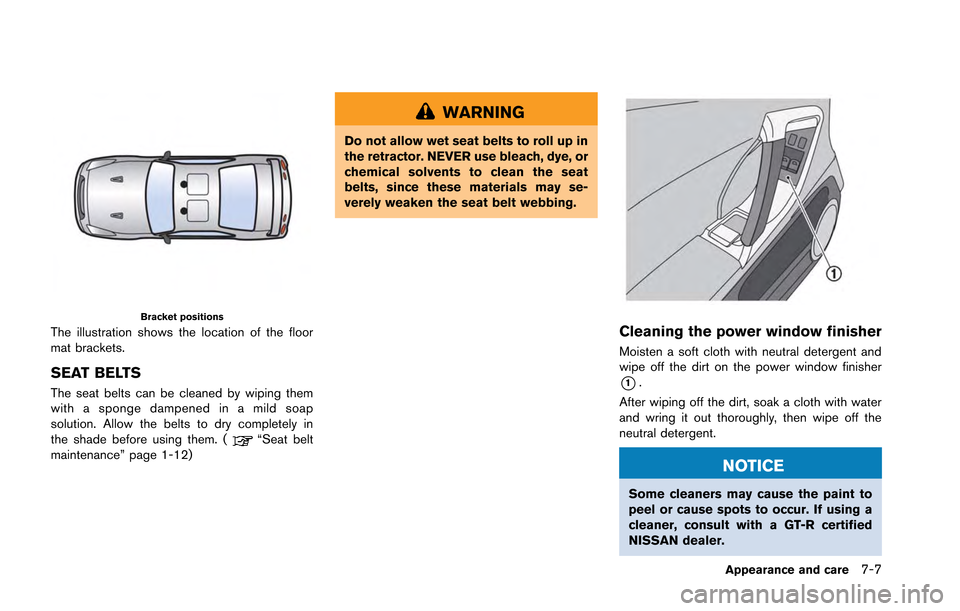
Bracket positions
The illustration shows the location of the floor
mat brackets.
SEAT BELTS
The seat belts can be cleaned by wiping them
with a sponge dampened in a mild soap
solution. Allow the belts to dry completely in
the shade before using them. (
“Seat belt
maintenance” page 1-12)
WARNING
Do not allow wet seat belts to roll up in
the retractor. NEVER use bleach, dye, or
chemical solvents to clean the seat
belts, since these materials may se-
verely weaken the seat belt webbing.
Cleaning the power window finisher
Moisten a soft cloth with neutral detergent and
wipe off the dirt on the power window finisher
*1.
After wiping off the dirt, soak a cloth with water
and wring it out thoroughly, then wipe off the
neutral detergent.
NOTICE
Some cleaners may cause the paint to
peel or cause spots to occur. If using a
cleaner, consult with a GT-R certified
NISSAN dealer.
Appearance and care7-7
Page 268 of 346
8 Maintenance and do-it-yourself
Maintenance requirement ....................................................... 8-3Scheduled maintenance ................................................... 8-3
General maintenance ........................................................ 8-3
Where to go for service ................................................... 8-3
General maintenance .............................................................. 8-4 Explanation of maintenance items ................................. 8-4
Maintenance precautions ....................................................... 8-6
Engine compartment check locations ................................. 8-8 Removing the cowl top cover ......................................... 8-9
Engine cooling system ......................................................... 8-10
Checking engine coolant level ..................................... 8-11
Changing engine coolant .............................................. 8-12
Engine oil ........................................................................\
........ 8-12
Checking engine oil level .............................................. 8-12
Changing engine oil and filter ...................................... 8-13
Transmission oil ..................................................................... 8-14
Power steering fluid .............................................................. 8-14
Brake fluid ........................................................................\
....... 8-15
Window washer fluid ........................................................... 8-16
Battery ........................................................................\
.............. 8-17
Precautions ....................................................................... 8-17
Fluid level check .............................................................. 8-17
Jump starting .................................................................... 8-18 Drive belts ........................................................................\
...... 8-19
Spark plugs ........................................................................\
.... 8-19
Replacing spark plugs ................................................. 8-20
Air cleaner ........................................................................\
...... 8-20
Windshield wiper blades .................................................... 8-21 Cleaning ........................................................................\
.. 8-21
Replacing the wiper blades ....................................... 8-21
Brakes ........................................................................\
............. 8-22 Self-adjusting brakes ................................................... 8-22
Brake pad wear warning ............................................. 8-22
High performance brake system ............................... 8-22
Replacing the brake pads ........................................... 8-23
Fuses ........................................................................\
............... 8-23
Engine compartment .................................................... 8-23
Passenger compartment ............................................. 8-24
Intelligent Key battery replacement .................................. 8-26
Lights ........................................................................\
............... 8-28 Headlights ....................................................................... 8-29Exterior and interior lights ........................................... 8-29
Wheels and tires .................................................................. 8-31
Tire pressure .................................................................. 8-31
Tire and loading information label ............................ 8-33
Checking the tire pressure ......................................... 8-34
Page 272 of 346
Inside the vehicle
The maintenance items listed here should be
checked on a regular basis, such as when
performing scheduled maintenance, cleaning
the vehicle, etc.
Accelerator pedal:Check the pedal for
smooth operation and make sure the pedal
does not catch or require uneven effort. Keep
the floor mat away from the pedal.
Transmission
&Pmechanism: On a fairly
steep hill, check that your vehicle is held
securely with the shift lever in the
&Pposition
without applying any brakes.
Brake pedal: Check the pedal for smooth
operation. If the brake pedal suddenly goes
down further than normal, the pedal feels
spongy or the vehicle seems to take longer to
stop, see a GT-R certified NISSAN dealer
immediately. Keep the floor mat away from the
pedal.
Brakes: Check that the brakes do not pull the
vehicle to one side when applied.
Parking brake: Check the parking brake
operation regularly. The vehicle should be
securely held on a fairly steep hill with only the
parking brake applied. If the parking brake needs
to be adjusted, see a GT-R certified NISSAN
dealer. Seat belts:
Check that all parts of the seat belt
system (for example, buckles, anchors, adjuster
and retractors) operate properly and smoothly,
and are installed securely. Check the belt
webbing for cuts, fraying, wear or damage.
Seats: Check seat position controls such as
seat adjusters, seatback recliner, etc. to ensure
they operate smoothly and that all latches lock
securely in every position.
Steering wheel: Check for changes in the
steering conditions, such as excessive free play,
hard steering or strange noises.
Warning lights and chimes: Make sure that
all warning lights and chimes are operating
properly.
Windshield defroster: Check that the air
comes out of the defroster outlets properly and
in sufficient quantity when operating the heater
or air conditioner.
Windshield wiper and washer*: Check that
the wipers and washer operate properly and that
the wipers do not streak.
Under the hood and vehicle
The maintenance items listed here should be
checked periodically (for example, each time you
check the engine oil or refuel) .
Battery*: Check the fluid level in each cell. It should be between the MAX and MIN lines.
Vehicles operated in high temperatures or under
severe condition require frequent checks of the
battery fluid level.
Brake fluid level*:
Make sure that the brake
fluid level is between the MAX and MIN lines on
the reservoir.
Engine coolant level*: Check the coolant level
when the engine is cold.
Engine drive belts*: Make sure that no belt is
frayed, worn, cracked or oily.
Engine oil level*: Check the level after parking
the vehicle on a level spot and turning off the
engine. Wait at least 5 minutes for the oil to
drain back into the oil pan before checking the
oil.
Exhaust system: Make sure there are no loose
supports, cracks or holes. If the sound of the
exhaust seems unusual or there is a smell of
exhaust fumes in the engine compartment,
immediately have the exhaust system inspected
by a GT-R certified NISSAN dealer.
(
“Exhaust gas (carbon monoxide)” page
5-3)
Fluid leaks: Check under the vehicle for fuel,
oil, water or other fluid leaks after the vehicle has
been parked for a while. Water dripping from the
air conditioner after use is normal. If you should
Maintenance and do-it-yourself8-5
Page 273 of 346
8-6Maintenance and do-it-yourself
notice any leaks or if gasoline fumes are evident,
check for the cause and have it corrected
immediately.
Power steering fluid level* and lines:Check
the level when the fluid is cold, with the engine
off. Check the lines for proper attachment, leaks,
cracks, etc.
Radiator and hoses: Check the front of the
radiator and clean off any dirt, insects, leaves,
etc., that may have accumulated. Make sure the
hoses have no cracks, deformation, rot or loose
connections.
Underbody: The underbody is frequently ex-
posed to corrosive substances such as those
used on icy roads or to control dust. It is very
important to remove these substances, other-
wise rust will form on the floor pan, frame, fuel
lines and around the exhaust system. At the end
of winter, the underbody should be thoroughly
flushed with plain water, being careful to clean
those areas where mud and dirt may accumu-
late. (
“Underbody” page 7-3)
Windshield washer fluid*: Check that there is
adequate fluid in the reservoir.
When performing any inspection or mainte-
nance work on your vehicle, always take care
to prevent serious accidental injury to yourself or
damage to the vehicle. The following are general
precautions which should be closely observed.
WARNING
. Park the vehicle on a level surface,
apply the parking brake securely
and block the wheels to prevent
the vehicle from moving. Move the
shift lever to the
&Pposition.
. Be sure the ignition switch is in the
OFF or LOCK position when per-
forming any parts replacement or
repairs.
. If you must work with the engine
running, keep your hands, clothing,
hair and tools away from moving
fans, belts and any other moving
parts.
. It is advisable to secure or remove
any loose clothing and remove any
jewelry, such as rings, watches, etc.
before working on your vehicle.
. Always wear eye protection when-
ever you work on your vehicle. .
If you must run the engine in an
enclosed space such as a garage, be
sure there is proper ventilation for
exhaust gases to escape.
. Never get under the vehicle while it
is supported only by a jack. If it is
necessary to work under the vehicle,
support it with safety stands.
. Keep smoking materials, flame and
sparks away from fuel tank and the
battery.
. Your vehicle is equipped with an
automatic engine cooling fan. It may
come on at any time without warn-
ing, even if the ignition key is in the
OFF position and the engine is not
running. To avoid injury, always
disconnect the negative battery
cable before working near the fan.
. The fuel filter or fuel lines should be
serviced by a GT-R certified NISSAN
dealer because the fuel lines are
under high pressure even when the
engine is off.
MAINTENANCE PRECAUTIONS
Page 286 of 346
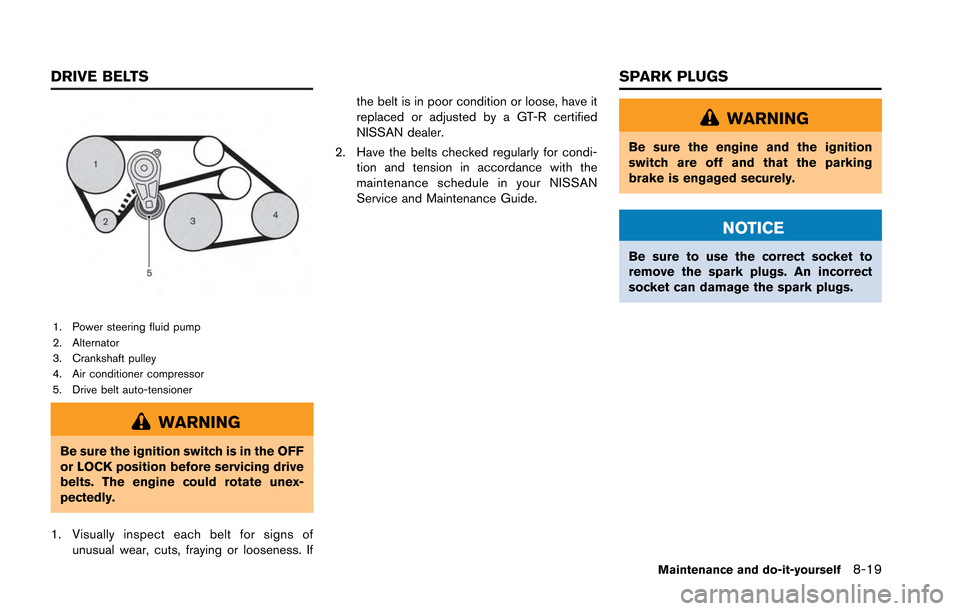
1. Power steering fluid pump
2. Alternator
3. Crankshaft pulley
4. Air conditioner compressor
5. Drive belt auto-tensioner
WARNING
Be sure the ignition switch is in the OFF
or LOCK position before servicing drive
belts. The engine could rotate unex-
pectedly.
1. Visually inspect each belt for signs of unusual wear, cuts, fraying or looseness. If the belt is in poor condition or loose, have it
replaced or adjusted by a GT-R certified
NISSAN dealer.
2. Have the belts checked regularly for condi- tion and tension in accordance with the
maintenance schedule in your NISSAN
Service and Maintenance Guide.
WARNING
Be sure the engine and the ignition
switch are off and that the parking
brake is engaged securely.
NOTICE
Be sure to use the correct socket to
remove the spark plugs. An incorrect
socket can damage the spark plugs.
Maintenance and do-it-yourself8-19
DRIVE BELTS SPARK PLUGS
Page 308 of 346
changer, cracks and deformation
may occur on the bead portion of
the tires meaning that the tires
cannot be reused.
. Make sure the tire valve stem cap is
installed and that the valve stem is
tight. When installing the cap, make
sure to tighten the cap by hand. If a
tool is used to tighten the cap, the
cap may be damaged.
WARNING
.The use of tires other than those
specified or the mixed use of tires of
different brands, construction (bias,
bias-belted, radial or run-flat) , or
tread patterns can adversely affect
the ride, braking, VDC system, hand-
ling, ground clearance, body-to-tire
clearance, tire chain clearance,
speedometer calibration, headlight
aim and bumper height. Some of
these effects may lead to accidents
and could result in serious personal
injury.
. If the wheels are changed for any
reason, always replace with wheels which have the same off-set dimen-
sion. Wheels of a different off-set
could cause premature tire wear,
degrade vehicle handling character-
istics, affect the VDC system and/or
cause interference with the brake
discs. Such interference can lead to
decreased braking efficiency and/or
early brake pad wear. (
“Wheels
and tires” page 9-9)
. When a wheel is replaced, tire
pressure will not be indicated, the
TPMS will not function and the low
tire pressure warning light will flash
for approximately 1 minute and
remain on after the 1 minute. Con-
tact a GT-R certified NISSAN dealer
as soon as possible for tire replace-
ment and/or system resetting.
. Replacing tires with those not ori-
ginally specified by NISSAN could
affect the proper operation of the
TPMS.
. Do not install a damaged or de-
formed wheel or tire even if it has
been repaired. Such wheels or tires
could have structural damage and
could fail without warning. .
Never use retread tires.
. For additional information regard-
ing tires, refer to “Important Tire
Safety Information” (US) or “Tire
Safety Information” (Canada) in the
Warranty Information Booklet.
. Always use tires of the specified
type, size, brand, construction (bias,
bias-belted, radial or run-flat) , and
tread pattern on all four wheels.
Failure to do so may result in a
circumference difference between
tires on the front and rear axles
which will cause excessive tire wear
and may damage the transmission,
transfer case and differential gears.
Wheel balance
Unbalanced wheels may affect vehicle handling
and tire life. Even with regular use, wheels can
get out of balance. Therefore, they should be
balanced as required.
Wheel balance service should be performed
with the wheels off the vehicle. Spin balancing
the rear wheels on the vehicle could lead to
mechanical damage.
For additional information regarding tires, refer
Maintenance and do-it-yourself8-41
Page 327 of 346
9-14Technical and consumer information
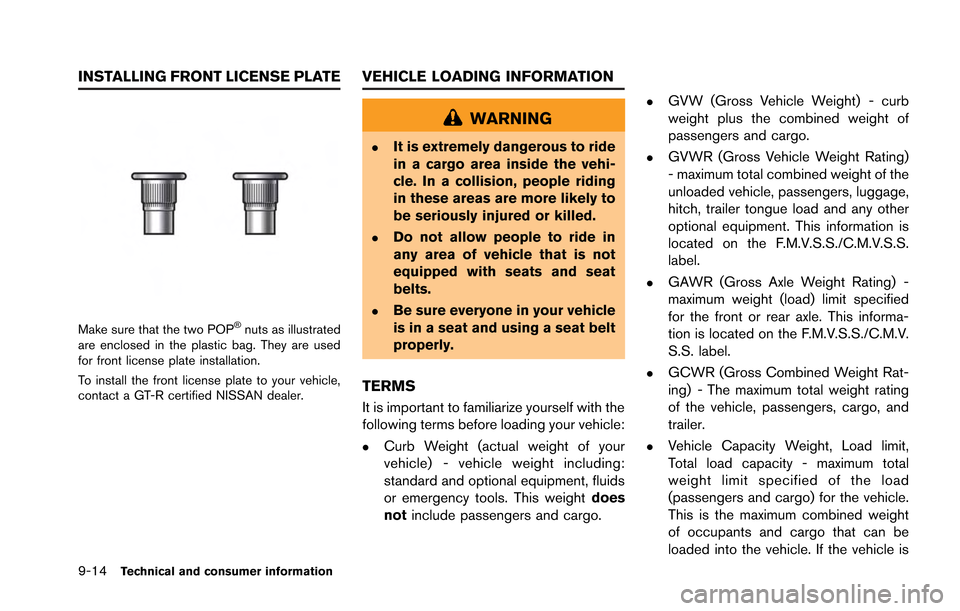
Make sure that the two POP®nuts as illustrated
are enclosed in the plastic bag. They are used
for front license plate installation.
To install the front license plate to your vehicle,
contact a GT-R certified NISSAN dealer.
WARNING
.It is extremely dangerous to ride
in a cargo area inside the vehi-
cle. In a collision, people riding
in these areas are more likely to
be seriously injured or killed.
.Do not allow people to ride in
any area of vehicle that is not
equipped with seats and seat
belts.
.Be sure everyone in your vehicle
is in a seat and using a seat belt
properly.
TERMS
It is important to familiarize yourself with the
following terms before loading your vehicle:
.Curb Weight (actual weight of your
vehicle) - vehicle weight including:
standard and optional equipment, fluids
or emergency tools. This weight does
not include passengers and cargo.
.GVW (Gross Vehicle Weight) - curb
weight plus the combined weight of
passengers and cargo.
.GVWR (Gross Vehicle Weight Rating)
- maximum total combined weight of the
unloaded vehicle, passengers, luggage,
hitch, trailer tongue load and any other
optional equipment. This information is
located on the F.M.V.S.S./C.M.V.S.S.
label.
.GAWR (Gross Axle Weight Rating) -
maximum weight (load) limit specified
for the front or rear axle. This informa-
tion is located on the F.M.V.S.S./C.M.V.
S.S. label.
.GCWR (Gross Combined Weight Rat-
ing) - The maximum total weight rating
of the vehicle, passengers, cargo, and
trailer.
.Vehicle Capacity Weight, Load limit,
Total load capacity - maximum total
weight limit specified of the load
(passengers and cargo) for the vehicle.
This is the maximum combined weight
of occupants and cargo that can be
loaded into the vehicle. If the vehicle is
INSTALLING FRONT LICENSE PLATE VEHICLE LOADING INFORMATION
Page 334 of 346
This vehicle is equipped with an Event Data
Recorder (EDR) . The main purpose of an EDR is
to record, in certain crash or near crash-like
situations, such as an air bag deployment or
hitting a road obstacle, data that will assist in
understanding how a vehicle’s systems per-
formed. The EDR is designed to record data
related to vehicle dynamics and safety systems
for a short period of time, typically 30 seconds
or less. The EDR in this vehicle is designed to
record such data as:
.How various systems in your vehicle were
operating;
. Whether or not the driver and passenger
safety belts were buckled/fastened;
. How far (if at all) the driver was depressing
the accelerator and/or brake pedal; and,
. How fast the vehicle was traveling.
. Sounds are not recorded.
These data can help provide a better under-
standing of the circumstances in which crashes
and injuries occur. NOTE: EDR data are
recorded by your vehicle only if a nontrivial
crash situation occurs; no data are recorded by
the EDR under normal driving conditions and no
personal data (e.g. name, gender, age and crash
location) are recorded. However, other parties,
such as law enforcement, could combine the EDR data with the type of personally identifying
data routinely acquired during a crash investiga-
tion.
To read data recorded by an EDR, special
equipment is required and access to the vehicle
or the EDR is needed. In addition to the vehicle
manufacturer and NISSAN dealer, other parties,
such as law enforcement, that have the special
equipment, can read the information if they have
access to the vehicle or the EDR. EDR data will
only be accessed with the consent of the vehicle
owner or lessee or as otherwise required or
permitted by law.The Vehicle Status Data Recorder (VSDR) is
different from the Event Data Recorder de-
scribed in “Event Data Recorder” in this section.
The VSDR is not a crash-activated device, but it
records and accumulates vehicle data while
driving.
Examples are:
.
Vehicle operating information such as the
wheel speeds of the front and rear wheels
. Engine control information such as the
engine speed and boost pressure
The VSDR always records and stores vehicle
operating data between periodic inspections,
which can assist and be used for servicing,
diagnosing and performing warranty repairs.
The VSDR does not record sounds, conversa-
tions or images.
To read data recorded by the VSDR, special
equipment is required and access to the vehicle
or the VSDR is needed.
HANDLING OF DATA
NISSAN and third parties affiliated with NISSAN
can acquire and use the data recorded by the
VSDR in order to confirm the part replacement
history to improve the quality of NISSAN
vehicles.
With the exception of the following cases,
Technical and consumer information9-21
EVENT DATA RECORDERS (EDR) VEHICLE STATUS DATA RECORDER
(VSDR)
Page 337 of 346
10-2
Cruise control................................................... 2-15, 5-34
Cruise control operations.......................................... 5-36
Cruise control system warning................................ 2-39
Cup holders.................................................................. 2-55
Current fuel consumption ......................................... 2-15
D
Differential oil............................................................ GTR-4
Dimensions ................................................................... 9-11
Distance to empty....................................................... 2-17
Distortion of rear spoiler...................................... GTR-25
Door pocket.................................................................. 2-57
Door/trunk open warning .......................................... 2-40
Doors................................................................................ 3-4
Draining of coolant water.......................................... 5-51
Drinking alcohol/drugs and driving........................... 5-8
Drive belts..................................................................... 8-19
Drive computer ............................................................ 2-14
DrivingAll-Wheel Drive driving safety precautions ...... 5-9
Cold weather driving........................................... 5-51
Drinking alcohol/drugs and driving..................... 5-8
Driving on snow or ice........................................ 5-52
Driving the vehicle................................................ 5-15
Driving tips............................................................. 5-21
Precautions when starting and driving .............. 5-3
Driving after replacing tires ................................ GTR-12
Dry carbon fiber rear spoiler ..... GTR-7, GTR-27, 7-4
Dual clutch transmission ......................... GTR-28, 5-15
E
Elapsed time and trip odometer.............................. 2-16
Emergency engine shut off.............................. 5-11, 6-2
Emergency trunk lid release..................................... 3-22
Emission control information label.......................... 9-13
Emission control system warranty........................... 9-19
Engine.............................................................................. 9-8 Before starting the engine................................. 5-13
Changing engine coolant................................... 8-12
Changing engine oil and filter........................... 8-13
Checking engine coolant level.......................... 8-11
Checking engine oil level................................... 8-12
Emergency engine shut off....................... 5-11, 6-2
Engine block heater............................................. 5-53
Engine compartment ........................................... 8-23
Engine compartment check locations................ 8-8
Engine coolant temperature gauge .................... 2-7
Engine cooling system........................................ 8-10
Engine oil................................................. GTR-3, 8-12
Engine oil and oil filter recommendation........... 9-6
Engine oil level display........................................ 2-12
Engine oil low pressure warning...................... 2-33
Engine serial number........................................... 9-12
Engine start operation indicator ....................... 2-41
Engine system warning....................................... 2-33
Operating range for engine start ..................... 5-10
Starting the engine .............................................. 5-13
Engine and powertrain....................... GTR-15, GTR-23
Engine oil maintenance.......................................... GTR-3
Engine output......................................................... GTR-24 Engine output according to the
coolant temperature.............................................. GTR-24
Engine settings (balancing right and left
air flow)...................................................................... GTR-8
Engine speed is restricted.................................. GTR-24
Environmental factors influence the rate
of corrosion..................................................................... 7-8
Event Data Recorders................................................ 9-21
Exhaust gas .................................................................... 5-3
Exhaust muffler and trunk carpet ........................ GTR-6
Explanation of maintenance items ............................ 8-4
Extended storage switch........................................... 8-25
Exterior and interior lights ......................................... 8-29
Exterior parts (spoiler, etc.) .................................. GTR-6
F
F.M.V.S.S./C.M.V.S.S. certification label ............... 9-12
Features of each mode.............................................. 5-27
Flat tire............................................................................. 6-2
Flat towing .................................................................... 9-17
Floor mats ....................................................................... 7-6
Fluid
Brake fluid............................................... GTR-4, 8-15
Fluid level check................................................... 8-17
Low brake fluid warning ..................................... 2-35
Low washer fluid warning.................................. 2-40
Power steering fluid............................................. 8-14
Window washer fluid .......................................... 8-16
Fluids...................................................... GTR-14, GTR-19