tire pressure NISSAN GT-R 2022 User Guide
[x] Cancel search | Manufacturer: NISSAN, Model Year: 2022, Model line: GT-R, Model: NISSAN GT-R 2022Pages: 1808, PDF Size: 4.88 MB
Page 289 of 1808
Intelligent Key warning light
After the ignition switch is pushed to the
ON position, this light comes on for about
2 seconds and then turns off.
This light warns of a malfunction with the
electrical steering lock system or the
Intelligent Key system.
If the light comes on while the engine is
stopped, it may be impossible to free the
steering lock or to start the engine. If the
light comes on while the engine is run-
ning, you can drive the vehicle. However
in these cases, it is recommended you
contact a GT-R certified NISSAN dealer for
repair as soon as possible.
“Tire
Pressure Monitoring System (TPMS)”
page 5-4) (
“Tire Pressure Monitor-
ing System (TPMS)” page 6-3)
Run-flat tire warning:
“Run-flat tires” page 8-36)
TPMS malfunction:
If the TPMS is not functioning properly,
the low tire pressure warning light will
flash for approximately 1 minute when the
ignition switch is pushed to the ON
position. The light will remain on after
the 1 minute. It is recommended you have
the system checked by a GT-R certified
NISSAN dealer. (
“Tire Pressure Mon-
itoring System (TPMS)” page 5-4)
(
“Tire pressure” page 8-30)
Page 291 of 1808

NOTE:
.If the vehicle is being driven at
speeds of less than 16 MPH (25
km/h), the TPMS may not operate
correctly.
. The tires of this vehicle are filled
with nitrogen gas. When the tire
pressure is low, fill the tires with
nitrogen gas. It is recommended you
contact a GT-R certified NISSAN
dealer for information on filling the
tires with nitrogen gas.
light
should turn off if no other potential
emission control system malfunction ex-
ists. If this indicator light remains on for 20
seconds and then blinks for 10 seconds
when the engine is not running, it indi-
cates that the vehicle is not ready for an
emission control system inspection/
maintenance test. (
“Readiness for
Inspection/Maintenance (I/M) test (US
only)” page 10-22)
Operation:
The malfunction indicator light will come
on in one of two ways:
. Malfunction indicator light on steady
— An emission control system mal-
function has been detected. Check
the fuel-filler cap. If the fuel-filler cap
is loose or missing, tighten or install
the cap and continue to drive the
vehicle. The
light should turn off
after a few driving trips. If the
light
does not turn off after a few driving
trips, it is recommended you have the
vehicle inspected by a GT-R certified
NISSAN dealer. You do not need to
have your vehicle towed to the dealer.
. Malfunction indicator light blinking —
An engine misfire has been detected
which may damage the emission
control system.
To reduce or avoid emission control
system damage: 1) Do not drive at speeds above 45
MPH (72 km/h).
2) Avoid hard acceleration or decel- eration.
3) Avoid steep uphill grades.
4) If possible, reduce the amount of cargo being hauled or towed.
The malfunction indicator light may
stop blinking and remain on.
It is recommended you have the
vehicle inspected by a GT-R certified
NISSAN dealer. You do not need to
have your vehicle towed to the dealer.
NOTICE
Continued vehicle operation without
having the emission control system
checked and repaired as necessary
could lead to poor driveability, re-
duced fuel economy, and possible
damage to the emission control sys-
tem.
Master warning light
When the ignition switch is in the ON
position, the master warning light illumi-
nates if any of the warning displays
appear on the vehicle information display.
(
“Warning display” page 2-36)
Page 301 of 1808

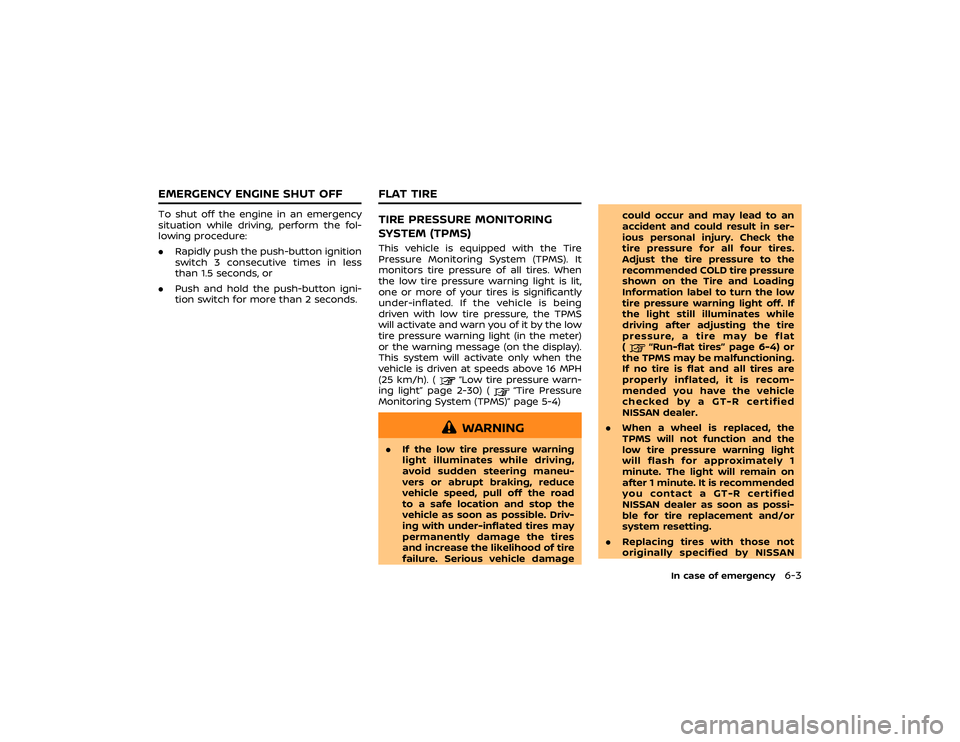
LOW TIRE PRESSURE WARNINGThis will appear if the vehicle is being
driven with low tire pressure. (
“Low
tire pressure warning light” page 2-30)
“Low tire pressure
warning light” page 2-30)
“Low tire pressure
warning light” page 2-30)
Page 387 of 1808
.You can also check the pressure of all
tires on the touch screen display.
Refer to the separate Multi Function
Display Owner’s Manual.
. The tire pressure sensor should be
reset anytime the wheels or tires are
removed or replaced.
. If the tire is removed in order to
replace the tire pressure sensor bat-
tery, it may not be possible to reuse
the removed tire from the wheel. To
replace the tire pressure sensor bat-
tery, it is recommended you contact a
GT-R certified NISSAN dealer.
WARNING
.If the low tire pressure warning
light illuminates while driving,
avoid sudden steering maneu-
vers or abrupt braking, reduce
vehicle speed, pull off the road
to a safe location and stop the
vehicle as soon as possible. Driv-
ing with under-inflated tires may
permanently damage the tires
and increase the likelihood of tire
failure. Serious vehicle damage
could occur and may lead to an
accident and could result in ser-
ious personal injury. Check the tire pressure for all four tires.
Adjust the tire pressure to the
recommended COLD tire pressure
shown on the Tire and Loading
Information label to turn the low
tire pressure warning light off. If
the light still illuminates while
driving after adjusting the tire
pressure, a tire may be flat
(
“Run-flat tires” page 6-4) or
the TPMS may be malfunctioning.
If no tire is flat and all tires are
properly inflated, have the vehicle
checked. It is recommended you
have the vehicle checked by a
GT-R certified NISSAN dealer.
. Although you can continue driv-
ing with a punctured run-flat tire,
remember that vehicle handling
stability is reduced, which could
lead to an accident and personal
injury. Also, driving a long dis-
tance at high speeds may da-
mage the tires.
. Do not drive at speeds above 50
MPH (80 km/h) and do not drive
more than 50 miles (80 km) with a
punctured run-flat tire. The actual
distance the vehicle can be driven
on a flat tire depends on outside
temperature, vehicle load, road conditions and other factors.
. When a wheel is replaced, the
TPMS will not function and the
low tire pressure warning light
will flash for approximately 1
minute. The light will remain on
after 1 minute. It is recommended
you contact your GT-R certified
NISSAN dealer as soon as possi-
ble for tire replacement and/or
system resetting.
. Replacing tires with those not
originally specified by NISSAN
could affect the proper operation
of the TPMS.
. Do not inject any tire liquid or
aerosol tire sealant into the tires,
as this may cause a malfunction
of the tire pressure sensors.
NOTICE
.The TPMS may not function prop-
erly when the wheels are
equipped with tire chains or the
wheels are buried in snow.
. The TPMS may not function prop-
erly if the TPMS sensor is not
reset and when wheels/tires from
Page 388 of 1808

another GT-R are installed on
your vehicle.
. The TPMS will not function prop-
erly if non-GT-R wheels are in-
stalled on the vehicle.
. Do not place metalized film or
any metal parts (antenna, etc.) on
the windows. This may cause
poor reception of the signals
from the tire pressure sensors,
and the TPMS will not function
properly.
Some devices and transmitters may tem-
porarily interfere with the operation of
the TPMS and cause the low tire pressure
warning light to illuminate. Some exam-
ples are:
. Facilities or electric devices using
similar radio frequencies are near the
vehicle.
. If a transmitter set to similar frequen-
cies is being used in or near the
vehicle.
. If a computer (or similar equipment) or
a DC/AC converter is being used in or
near the vehicle.
Low tire pressure warning light may
illuminate in the following cases. .
If the vehicle is equipped with a wheel
and tire without TPMS.
. If the TPMS has been replaced and the
ID has not been registered.
. If the wheel is not originally specified
by NISSAN.
FCC Notice:
For USA:
This device complies with Part 15 of the
FCC Rules. Operation is subject to the
following two conditions: (1) This device
may not cause harmful interference,
and (2) this device must accept any
interference received, including inter-
ference that may cause undesired op-
eration.
Note: Changes or modifications not
expressly approved by the party re-
sponsible for compliance could void
the user’s authority to operate the
equipment.
For Canada:
This device complies with Industry Ca-
nada licence-exempt RSS standard(s).
Operation is subject to the following
two conditions: (1) this device may not
cause interference, and (2) this device
must accept any interference, including
interference that may cause undesired
operation of the device.
WARNING
Failure to operate this vehicle in a
safe and prudent manner may result
in loss of control or an accident.
Be alert and drive defensively at all times.
Obey all traffic regulations. Avoid exces-
sive speed, high speed cornering, or
sudden steering maneuvers, because
these driving practices could cause you
to lose control of your vehicle. As with
any vehicle, a loss of control could
result in a collision with other vehicles
or objects, or cause the vehicle to roll-
over, particularly if the loss of control
causes the vehicle to slide sideways. Be
attentive at all times, and avoid driving
when tired. Never drive when under the
influence of alcohol or drugs (including
prescription or over-the-counter drugs
which may cause drowsiness). Always
wear your seat belt as outlined in this
manual, and also instruct your passen-
gers to do so. (
Page 424 of 1808

is started.
If any malfunction occurs in the AWD
system while the engine is running, the
warning light will come on.
The warning light may blink rapidly
(about twice per second) while trying to
free a stuck vehicle due to high AWD
clutch temperature. The driving mode
may change to two-wheel drive. If the
warning light blinks rapidly during opera-
tion, stop the vehicle with the engine
idling in a safe place immediately. Then if
the light goes off after a while, you can
continue driving.
A large difference between the diameters
of front and rear wheels will make the
warning light blink slowly (about once per
two seconds). Pull off the road in a safe
area, and idle the engine. Check that all
tire sizes are the same, tire pressure is
correct and tires are not worn and winter
tires are not installed on the front or rear
wheels only.
If the warning light is blinking after the
above operation, it is recommended you
have your vehicle checked by a GT-R
certified NISSAN dealer as soon as possi-
ble.
If non-genuine GT-R tires are used, the
warning light may illuminate. (
Page 445 of 1808
could affect the proper operation
of the TPMS.
. Do not inject any tire liquid or
aerosol tire sealant into the tires,
as this may cause a malfunction
of the tire pressure sensors.
NOTE:
. You can check the pressure of all
four tires on the touch screen dis-
play. See the separate Multi Func-
tion Display Owner’s Manual.
. The tires of this vehicle are filled
with nitrogen gas. When the tire
pressure is low, fill the tires with
nitrogen. It is recommended you
contact a GT-R certified NISSAN
dealer for information on filling the
tires with nitrogen.
. If nitrogen is not available, com-
pressed air may be safely used
under normal driving conditions.
However, NISSAN recommends re-
filling with nitrogen for maximum
tire performance.
RUN-FLAT TIRESRun-flat tires are those tires that can be
used temporarily if they are punctured.
(
“Run-flat tires” page 8-36)
Also, see the tire safety information in the
Warranty Information Booklet.
position.
4. Turn off the engine.
5. Raise the hood to warn other traffic,
Page 457 of 1808

NOTICE
When cleaning the inside of the
windows, do not use sharp-edged
tools, abrasive cleaners or chlorine-
based disinfectant cleaners. They
could damage the electrical conduc-
tors, radio antenna elements or rear
window defroster elements.WHEELSWash the wheels when washing the
vehicle to maintain their appearance.
.Clean the inner side of the wheels
when the wheel is changed or the
underside of the vehicle is washed.
. Inspect wheel rims regularly for dents
or corrosion. Such damage may cause
loss of pressure or poor seal at the tire
bead.
. NISSAN recommends that the road
wheels be waxed to protect against
road salt in areas where it is used
during winter.
Page 493 of 1808

NOTICE
Make sure the tire valve stem cap is
installed and that the valve stem is
tight. When installing the cap, make
sure to tighten the cap by hand. If a
tool is used to tighten the cap, the
cap may be damaged.TIRE PRESSURE
Tire Pressure Monitoring System
(TPMS)This vehicle is equipped with the Tire
Pressure Monitoring System (TPMS). It
monitors tire pressure of all tires. When
the low tire pressure warning light is lit,
one or more of your tires is significantly
under-inflated. The system also displays
pressure of all tires on the touch screen
display by sending a signal from a sensor
that is installed in each wheel.
The TPMS will activate only when the
vehicle is driven at speeds above 16 MPH
(25 km/h). Also, this system may not
detect a sudden drop in tire pressure.
(
“Low tire pressure warning light”
page 2-30) (
“Tire Pressure Monitoring
System (TPMS)” page 5-4) (
“Flat tire”
page 6-3)
Tire inflation pressure
Check the tire pressure often and
always prior to long distance trips.
The recommended tire pressure
specifications are shown on the F.
M.V.S.S./C.M.V.S.S. label or the Tire
and Loading Information label (if so
equipped) under the “Cold Tire
Pressure” heading. The Tire and
Loading Information label is affixed
to the driver side door end. Tire
pressures should be checked reg-
ularly because:.
Most tires naturally lose air over
time.
.
Tires can lose air suddenly when
driven over potholes or other
objects or if the vehicle strikes
a curb while parking.
NOTE:
. You can check the pressure of all
four tires on the touch screen dis-
play. See the separate Multi Func-
tion Display Owner’s Manual.
. The tires of this vehicle are filled
with nitrogen gas. When the tire
pressure is low, fill the tires with nitrogen. It is recommended you
contact a GT-R certified NISSAN
dealer for information on filling the
tires with nitrogen.
. If nitrogen is not available, com-
pressed air may be safely used
under normal driving conditions.
However, NISSAN recommends re-
filling with nitrogen for maximum
tire performance.
The tire pressures should be
checked when the tires are cold.
The tires are considered COLD after
the vehicle has been parked for 3 or
more hours, or driven less than 1
mile (1.6 km) at moderate speeds.
Incorrect tire pressure, including
under inflation, may adversely
affect tire life and vehicle hand-
ling.
WARNING
.
Improperly inflated tires can
fail suddenly and cause an
accident.
.
The Gross Vehicle Weight
rating (GVWR) is located on
Page 494 of 1808

the F.M.V.S.S./C.M.V.S.S. cer-
tification label. The vehicle
weight capacity is indicated
on the Tire and Loading In-
formation label (if so
equipped). Do not load your
vehicle beyond this capacity.
Overloading your vehicle
may result in reduced tire
life, unsafe operating condi-
tions due to premature tire
failure, or unfavorable hand-
ling characteristics and
could also lead to a serious
accident. Loading beyond
the specified capacity may
also result in failure of other
vehicle components.
.
Before taking a long trip, or
whenever you heavily load
your vehicle, use a tire pres-
sure gauge to ensure that
the tire pressures are at the
specified level.
.
For additional information
regarding tires, refer to “Im-
portant Tire Safety Informa-tion” (US) or “Tire Safety
Information” (Canada) in the
Warranty Information Book-
let.
NOTE:
.
Use only genuine GT-R tires and
road wheels.
The GT-R uses specially designed
run-flat tires and matching road
wheels. Use of these specially devel-
oped tires and wheels provides the
greatest potential for maximum
performance.
—Genuine GT-R tires and road
wheels help achieve maximum
cornering and braking perfor-
mance.
— Genuine GT-R tires and road
wheels help achieve maximum
tire durability during acceleration.
— Genuine GT-R tires and road
wheels help achieve maximum
handling capability during perfor-
mance driving.
— Genuine GT-R tires and road
wheels help provide road holding
in the event of decreasing tire
pressure and punctures. —
Genuine GT-R tires and road
wheels help prevent the decrease
of straight-running stability
caused by uneven tire wear due
to high rigidity wheels and wide
tires.
. The GT-R uses specially designed
run-flat tires which feature an ex-
tremely rigid side wall. Special tech-
niques and equipment are therefore
required when replacing these tires.
NISSAN recommends that tire repla-
cement be performed at a GT-R
certified NISSAN dealer.
. Specific tire changing equipment
must be used to remove the GT-R
tires from the wheel and to install
the GT-R tires onto the wheel. It is
only possible to reuse the tires when
they have no cracks and/or defor-
mations on the bead portion of the
tire. If the incorrect equipment is
used to remove the GT-R tires from
the wheel and to install the GT-R
tires onto the wheel, cracks and
deformation may occur on the bead
portion of the tires meaning that the
tires cannot be reused. It is recom-
mended you contact a GT-R certified
NISSAN dealer if the tires need to be
removed from the wheels.
Do-it-yourself
8-31