child restraint NISSAN MAXIMA 1998 A32 / 4.G User Guide
[x] Cancel search | Manufacturer: NISSAN, Model Year: 1998, Model line: MAXIMA, Model: NISSAN MAXIMA 1998 A32 / 4.GPages: 231, PDF Size: 1.94 MB
Page 33 of 231

According to accident statistics, chil-
dren are safer when properly re-
strained in the rear seat than in the
front seat.
IAn improperly installed child re-
straint could lead to serious injury or
death in an accident.
In general, child restraints are designed to be
installed with a lap belt or the lap portion of a
three-point type seat belt.
Child restraints for infants and children of
various sizes are offered by several manufac-
turers. When selecting any child restraint,
keep the following points in mind:
Ichoose only a restraint with a label certify-
ing that it complies with Federal Motor
Vehicle Safety Standard 213 or Canadian
Motor Vehicle Safety Standard 213.
Icheck that child restraint in your vehicle to
be sure it is compatible with the vehicle's
seat and seat belt system. Choose a child
restraint that meets the guidelines of the
Society of Automotive Engineers recom-
mended practice J1819 for child restraint
installation.
Iif the child restraint is compatible with your
vehicle, place your child in the child re-straint and check the various adjustments
to be sure the child restraint is compatible
with your child. Always follow all recom-
mended procedures.
All US states and provinces of Canada
require that infants and small children be
restrained in approved child restraints at
all times while the vehicle is being oper-
ated.
IImproper use of a child restraint can
result in increased injuries for both
the infant or child and other occu-
pants in the vehicle.
IFollow all of the child restraint manu-
facturer's instructions for installation
and use. When purchasing a child
restraint, be sure to select one which
will fit your child and vehicle. It may
not be possible to properly install
some types of child restraints in your
vehicle.
IIf the child restraint is not anchored
properly, the risk of a child beinginjured in a collision or a sudden stop
greatly increases.
IAdjustable seatbacks should be posi-
tioned to fit the child restraint, but as
upright as possible.
IAfter attaching the child restraint,
test it before you place the child in it.
Tilt it from side to side. Try to tug it
forward and check to see if the belt
holds the restraint in place. If the
restraint is not secure, tighten the
belt as necessary, or put the restraint
in another seat and test it again.
IFor a front facing child restraint, if the
seat position where it is installed has
a three-point type lap/shoulder belt,
check to make sure the shoulder belt
does not go in front of the child's face
or neck. If it does, put the shoulder
belt behind the child restraint. If you
must install a front facing child re-
straint in the front seat, see later in
ªChild restraintsº for installation on
front passenger seat.
IWhen your child restraint is not in
use, store it in the trunk or keep it
1-26
Seats, restraints and supplemental air bag systems
Z
01.1.31/A32-D
X
Page 34 of 231

secured with a seat belt to prevent it
from being thrown around in case of
a sudden stop or accident.
Remember that a child restraint left in a
closed vehicle can become very hot.
Check the seating surface and buckles
before placing your child in the child
restraint.
INSTALLATION ON REAR SEAT
CENTER POSITION
Front facingWhen you install a child restraint in a rear
center seat, follow these steps:
1. Position the child restraint on the seat as
illustrated. It can be placed in a front facing
or rear facing direction, depending on the
size of the child. Always follow the restraint
manufacturer's instructions.2. Route the seat belt tongue through the child
restraint and insert it into the buckle until
you hear and feel the latch engage. Be sure
to follow the child restraint manufacturer's
instructions for belt routing.
SSS0104
SSS0029
Seats, restraints and supplemental air bag systems
1-27
Z
01.1.31/A32-D
X
Page 35 of 231

3. Remove all slack in the lap belt for a very
tight fit by pulling forcefully on the lap belt
adjustment.4. Before placing the child in the child re-
straint, use force to tilt the child restraint
from side to side, and tug it forward to make
sure that it is securely held in place.
5. If it is not secure, try to tighten the belt
again, or put the restraint in another seat.
6. Check to make sure the child restraint is
properly secured prior to each use.
Rear facingWhen you install a child restraint in a rear
center seat, follow these steps:
1. Position the child restraint on the seat as
illustrated. The direction of the child re-
straint depends on the type of the child
restraint and the size of the child. Always
follow the restraint manufacturer's instruc-
tions.
SSS0105
SSS0031
SSS0033
1-28
Seats, restraints and supplemental air bag systems
Z
01.1.31/A32-D
X
Page 36 of 231

2. Route the seat belt tongue through the child
restraint and insert it into the buckle until
you hear and feel the latch engage. Be sure
to follow the child restraint manufacturer's
instructions for belt routing.3. Remove all slack in the lap belt for a very
tight fit by pulling forcefully on the lap belt
adjustment.4. Before placing the child in the child re-
straint, use force to tilt the child restraint
from side to side, and tug it forward to make
sure that it is securely held in place.
5. If it is not secure, try to tighten the belt
again, or put the restraint in another seat.
6. Check to make sure the child restraint is
properly secured prior to each use.
SSS0035
SSS0036
SSS0106
Seats, restraints and supplemental air bag systems
1-29
Z
01.1.31/A32-D
X
Page 37 of 231

INSTALLATION ON REAR SEAT
OUTBOARD POSITIONSIThe three-point belt on your vehicle is
equipped with a locking mode retrac-
tor which must be used when install-
ing a child restraint.
IFailure to do so will result in the child
restraint not being properly secured.
It could tip over or otherwise be un-
secured and cause injury to the child
in a sudden stop or collision.
Front facingWhen you install a child restraint in a rear
outboard seat, follow these steps:
1. Position the child restraint on the seat. It
can be placed in a front facing direction,
depending on the size of the child. Always
follow the restraint manufacturer's instruc-
tions.2. Route the seat belt tongue through the child
restraint and insert it into the buckle until
you hear and feel the latch engage.
Be sure to follow the child restraint manu-
facturer's instructions for belt routing.
SSS0041
SSS0043
1-30
Seats, restraints and supplemental air bag systems
Z
01.1.31/A32-D
X
Page 38 of 231

3. Pull on the shoulder belt until all of the belt
is fully extended. At this time, the belt
retractor is in the automatic locking mode
(child restraint mode). It reverts back to
emergency locking mode when the belt is
fully retracted.4. Allow the belt to retract. Pull up on the belt
to remove any slack in the belt.5. Before placing the child in the child re-
straint, use force to tilt the child restraint
from side to side, and tug it forward to make
sure that it is securely held in place.
6. Check that the retractor is in the automatic
locking mode by trying to pull more belt out
of the retractor. If you cannot pull any more
belt webbing out of the retractor, the belt is
in the automatic locking mode.
7. Check to make sure that the child restraint
is properly secured prior to each use. If the
belt is not locked, repeat steps 3 through 6.
SSS0107
SSS0062
SSS0108
Seats, restraints and supplemental air bag systems
1-31
Z
01.1.31/A32-D
X
Page 39 of 231

After the child restraint is removed and the
seat belt is allowed to wind back into the
retractor, the automatic locking mode (child
restraint mode) is canceled; the seat belt only
locks during a sudden stop or impact.
Rear facingWhen you install a child restraint in a rear
outboard seat, follow these steps:
1. Position the child restraint on the seat. The
direction of the child restraint depends on
the type of the child restraint and the size of
the child. Always follow the restraint manu-
facturer's instructions.2. Route the seat belt tongue through the child
restraint and insert it into the buckle until
you hear and feel the latch engage.
Be sure to follow the child restraint manu-
facturer's instructions for belt routing.
SSS0044
SSS0046
1-32
Seats, restraints and supplemental air bag systems
Z
01.1.31/A32-D
X
Page 40 of 231

3. Pull on the shoulder belt until all of the belt
is fully extended. At this time, the belt
retractor is in the automatic locking mode
(child restraint mode). It reverts back to
emergency locking mode when the belt is
fully retracted.4. Allow the belt to retract. Pull up on the belt
to remove any slack in the belt.5. Before placing the child in the child re-
straint, use force to tilt the child restraint
from side to side, and tug it forward to make
sure that it is securely held in place.
6. Check that the retractor is in the automatic
locking mode by trying to pull more belt out
of the retractor. If you cannot pull any more
belt webbing out of the retractor, the belt is
in the automatic locking mode.
7. Check to make sure that the child restraint
is properly secured prior to each use. If the
belt is not locked, repeat steps 3 through 6.
SSS0045A
SSS0109
SSS0110
Seats, restraints and supplemental air bag systems
1-33
Z
01.1.31/A32-D
X
Page 41 of 231
After the child restraint is removed and the
seat belt is allowed to wind back into the
retractor, the automatic locking mode (child
restraint mode) is canceled; the seat belt only
locks during a sudden stop or impact.
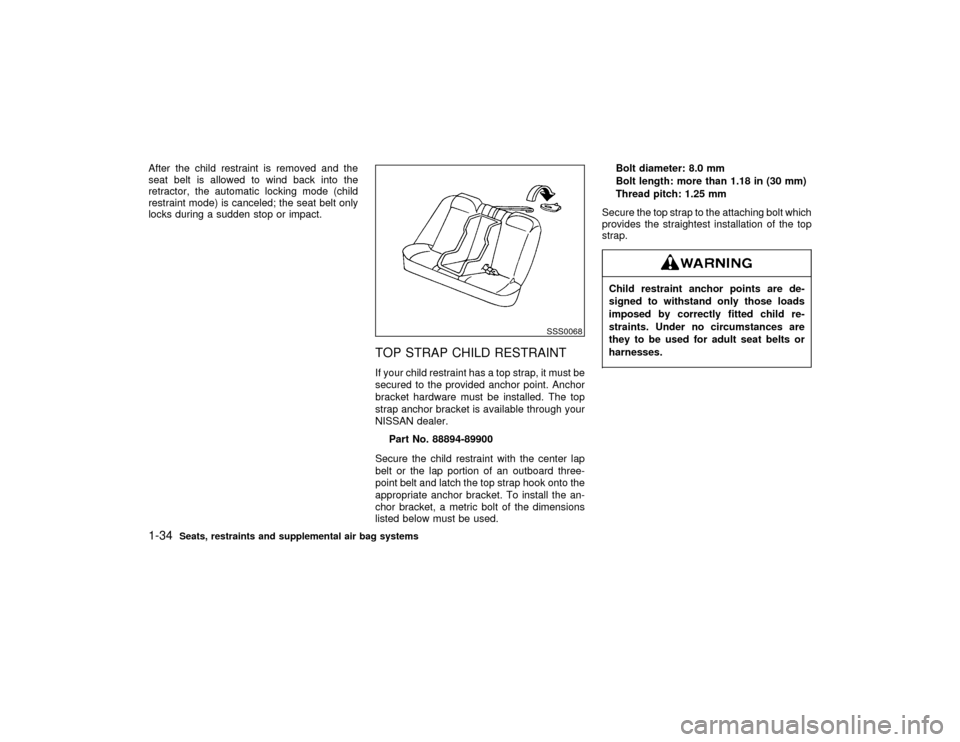
TOP STRAP CHILD RESTRAINTIf your child restraint has a top strap, it must be
secured to the provided anchor point. Anchor
bracket hardware must be installed. The top
strap anchor bracket is available through your
NISSAN dealer.
Part No. 88894-89900
Secure the child restraint with the center lap
belt or the lap portion of an outboard three-
point belt and latch the top strap hook onto the
appropriate anchor bracket. To install the an-
chor bracket, a metric bolt of the dimensions
listed below must be used.Bolt diameter: 8.0 mm
Bolt length: more than 1.18 in (30 mm)
Thread pitch: 1.25 mm
Secure the top strap to the attaching bolt which
provides the straightest installation of the top
strap.
Child restraint anchor points are de-
signed to withstand only those loads
imposed by correctly fitted child re-
straints. Under no circumstances are
they to be used for adult seat belts or
harnesses.
SSS0068
1-34
Seats, restraints and supplemental air bag systems
Z
01.1.31/A32-D
X
Page 42 of 231
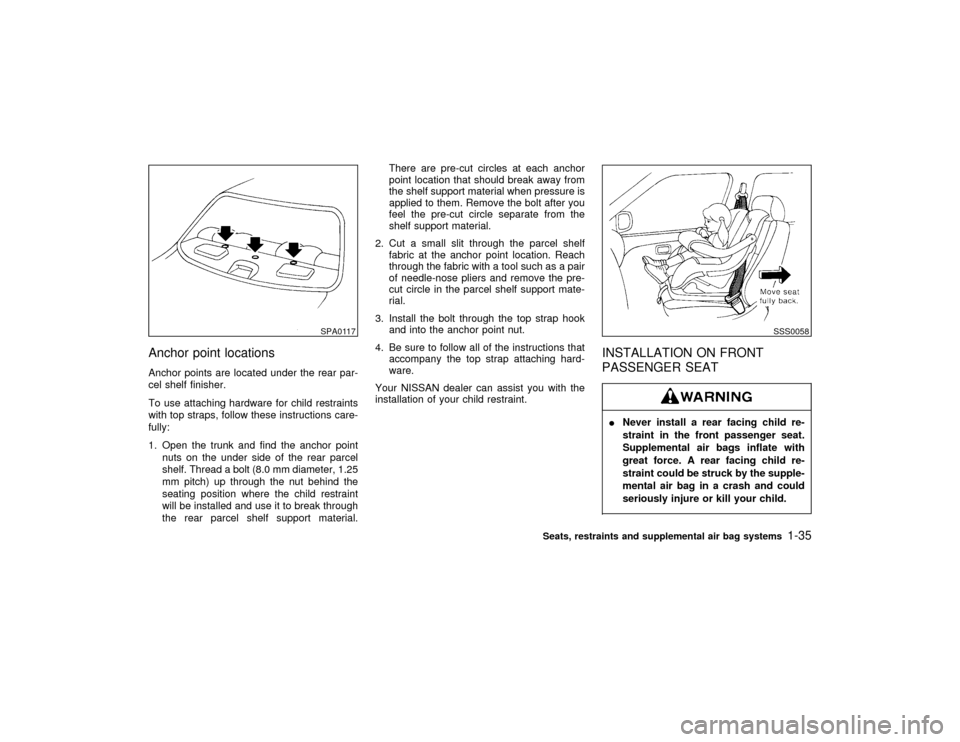
Anchor point locationsAnchor points are located under the rear par-
cel shelf finisher.
To use attaching hardware for child restraints
with top straps, follow these instructions care-
fully:
1. Open the trunk and find the anchor point
nuts on the under side of the rear parcel
shelf. Thread a bolt (8.0 mm diameter, 1.25
mm pitch) up through the nut behind the
seating position where the child restraint
will be installed and use it to break through
the rear parcel shelf support material.There are pre-cut circles at each anchor
point location that should break away from
the shelf support material when pressure is
applied to them. Remove the bolt after you
feel the pre-cut circle separate from the
shelf support material.
2. Cut a small slit through the parcel shelf
fabric at the anchor point location. Reach
through the fabric with a tool such as a pair
of needle-nose pliers and remove the pre-
cut circle in the parcel shelf support mate-
rial.
3. Install the bolt through the top strap hook
and into the anchor point nut.
4. Be sure to follow all of the instructions that
accompany the top strap attaching hard-
ware.
Your NISSAN dealer can assist you with the
installation of your child restraint.
INSTALLATION ON FRONT
PASSENGER SEATINever install a rear facing child re-
straint in the front passenger seat.
Supplemental air bags inflate with
great force. A rear facing child re-
straint could be struck by the supple-
mental air bag in a crash and could
seriously injure or kill your child.
SPA0117
SSS0058
Seats, restraints and supplemental air bag systems
1-35
Z
01.1.31/A32-D
X