child restraint NISSAN MAXIMA 1998 A32 / 4.G Owners Manual
[x] Cancel search | Manufacturer: NISSAN, Model Year: 1998, Model line: MAXIMA, Model: NISSAN MAXIMA 1998 A32 / 4.GPages: 231, PDF Size: 1.94 MB
Page 1 of 231

ForewordWelcome to the growing family of new
NISSAN owners. This vehicle is delivered to
you with confidence. It was produced using
the latest techniques and strict quality control.
This manual was prepared to help you under-
stand the operation and maintenance of your
vehicle so that you may enjoy many miles of
driving pleasure. Please read through this
manual before operating your vehicle.
A separate Warranty Information and Mainte-
nance Log Booklet explains details about the
warranties covering your vehicle and vehicle
maintenance schedules.
Your NISSAN dealer knows your vehicle best.
When you require any service or have any
questions, he will be glad to assist you with
the extensive resources available to him.
READ FIRST Ð THEN DRIVE
SAFELYBefore driving your vehicle please read
your Owner's Manual carefully. This will
ensure familiarity with controls and main-
tenance requirements, assisting you in the
safe operation of your vehicle.IMPORTANT SAFETY INFORMA-
TION
REMINDERS FOR SAFETY!Follow these important driving rules to
help ensure a safe and comfortable
trip for you and your passengers!
INever drive under the influence of
alcohol or drugs.
IAlways observe posted speed limits
and never drive too fast for condi-
tions.
IAlways use your seat belts and ap-
propriate child restraint systems.
Preteen children should be seated
in the rear seat.
IAlways provide information about
the proper use of vehicle safety fea-
tures to all occupants of the vehicle.
IAlways review this Owner's Manual
for important safety information.
MODIFICATION OF YOUR
VEHICLEThis vehicle should not be modified. Modi-
fication could affect its performance,
safety or durability, and may even violate
governmental regulations. In addition,
damage or performance problems result-
ing from modification may not be covered
under NISSAN warranties.WHEN READING THE MANUALThis manual includes information for all
options available on this model. Therefore,
you may find some information that does
not apply to your vehicle.
All information, specifications and illustrations
in this manual are those in effect at the time of
printing. NISSAN reserves the right to change
specifications or design at any time without
notice.
Z
01.1.31/A32-D
X
Page 8 of 231

1 Seats, restraints and supplemental air bag
systemsSeats ......................................................................... 1-2
Supplemental restraint system .................................. 1-7
Seat belts ................................................................ 1-17
Child restraints ........................................................ 1-25
Z
01.1.31/A32-D
X
Page 11 of 231

FRONT POWER SEAT
ADJUSTMENTIDo not adjust the driver's seat while
driving in order that full attention may
be given to the driving operations.
IDo not leave children unattended in-
side the vehicle. They could unknow-
ingly activate switches or controls.
Unattended children could become
involved in serious accidents.Operating tipsIThe motor has an auto-reset overload pro-
tection circuit. If the motor stops during
operation, wait 30 seconds, then reactivate
the switch.
IDo not operate the power support seat
for a long period of time when the engine is
off. This will discharge the battery.
Forward and backwardMoving the switch forward or backward will
slide the seat forward or backward to the
desired position.
RecliningMove the recline switch backward until the
desired angle is obtained. To bring the seat-
back forward again, move the switch forward
and move your body forward. The seatback
will move forward.
SPA0098
1-4
Seats, restraints and supplemental air bag systems
Z
01.1.31/A32-D
X
Page 17 of 231

INever let children ride unrestrained
or extend their hands or face out of
the window. Do not attempt to hold
them in your lap or arms. Some ex-
amples of dangerous riding positions
are shown in the previous illustra-
tions.
IChildren may be severely injured or
killed when the supplemental air bag
or supplemental side air bag inflates
if they are not properly restrained.
IAlso never install a rear facing child
restraint in the front seat. An inflating
supplemental air bag could seriously
injure or kill your child. For additional
information, see ªChild restraintsº
later in this section.
SSS0008SSS0009
SSS0099SSS0100
1-10
Seats, restraints and supplemental air bag systems
Z
01.1.31/A32-D
X
Page 18 of 231
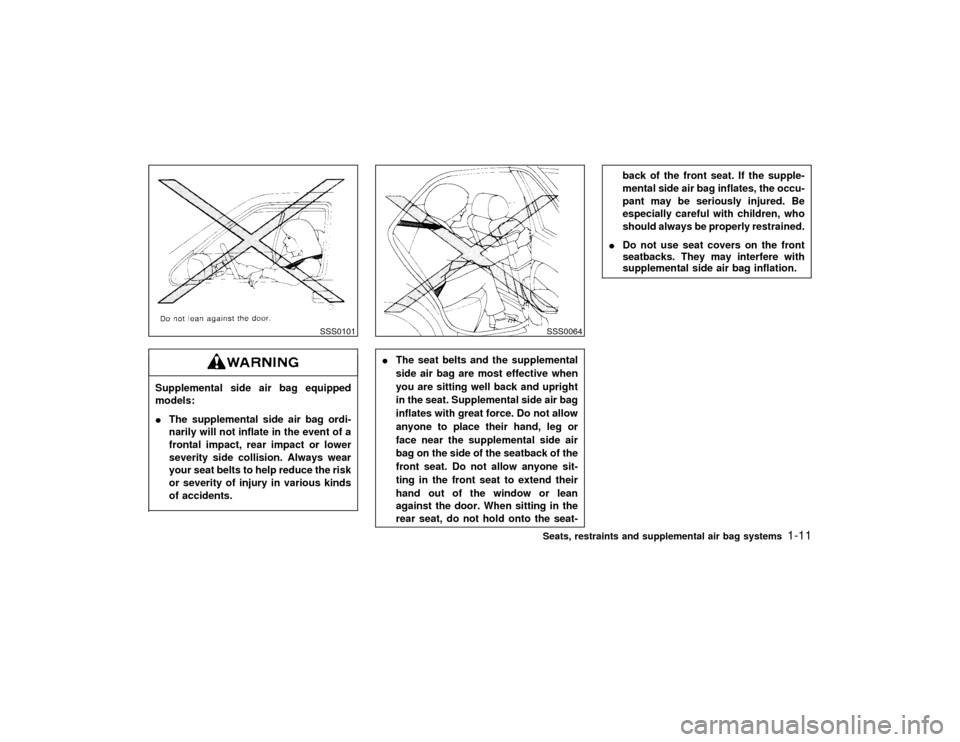
Supplemental side air bag equipped
models:
IThe supplemental side air bag ordi-
narily will not inflate in the event of a
frontal impact, rear impact or lower
severity side collision. Always wear
your seat belts to help reduce the risk
or severity of injury in various kinds
of accidents.
IThe seat belts and the supplemental
side air bag are most effective when
you are sitting well back and upright
in the seat. Supplemental side air bag
inflates with great force. Do not allow
anyone to place their hand, leg or
face near the supplemental side air
bag on the side of the seatback of the
front seat. Do not allow anyone sit-
ting in the front seat to extend their
hand out of the window or lean
against the door. When sitting in the
rear seat, do not hold onto the seat-
back of the front seat. If the supple-
mental side air bag inflates, the occu-
pant may be seriously injured. Be
especially careful with children, who
should always be properly restrained.
IDo not use seat covers on the front
seatbacks. They may interfere with
supplemental side air bag inflation.
SSS0101
SSS0064Seats, restraints and supplemental air bag systems
1-11
Z
01.1.31/A32-D
X
Page 24 of 231

PRECAUTIONS ON SEAT BELT
USAGEYour chances of being injured or killed in an
accident and/or the severity of injury may be
greatly reduced if you are wearing your seat
belt and it is properly adjusted. NISSAN
strongly encourages you and all of your pas-
sengers to buckle up every time you drive,
even if your seating position includes a supple-
mental air bag.
Most states, provinces or territories require
that seat belts be worn at all times when a
vehicle is being driven.
IEvery person who drives or rides in
this vehicle should use a seat belt at
all times. Children should be properly
restrained and, if appropriate, in a
child restraint.
IThe belt should be properly adjusted
to a snug fit. Failure to do so may
reduce the effectiveness of the entire
restraint system and increase the
chance or severity of injury in an
accident. Serious injury or death can
occur if the seat belt is not worn
properly.
IAlways route the shoulder belt over
your shoulder and across your chest.
Never run the belt behind your backs
under your arm or across your neck.
The belt should be away from your
face and neck, but not falling off your
shoulder.
IPosition the lap belt as low and snug
SSS0013
SSS0012
SEAT BELTS
Seats, restraints and supplemental air bag systems
1-17
Z
01.1.31/A32-D
X
Page 25 of 231

as possible around the hips, not the
waist. A lap belt worn too high could
increase the risk of internal injuries in
an accident.
IBe sure the seat belt tongue is se-
curely fastened to the proper buckle.
IDo not wear the belt inside out or
twisted. Doing so may reduce its ef-
fectiveness.
IDo not allow more than one person to
use the same belt.
INever carry more people in the ve-
hicle than there are seat belts.
IIf the seat belt warning light glows
continuously while the ignition is
turned ON with all doors closed and
all seat belts fastened, it may indicate
a malfunction in the system. Have the
system checked by your NISSAN
dealer.
IAll seat belt assemblies including re-
tractors and attaching hardware
should be inspected after any colli-
sion by your NISSAN dealer. NISSAN
recommends that all seat belt assem-
blies in use during a collision be
replaced unless the collision was mi-
nor and the belts show no damage
and continue to operate properly.
Seat belt assemblies not in use dur-
ing a collision should also be in-
spected and replaced if either dam-
age or improper operation is noted.
CHILD SAFETYChildren need adults to help protect them.
They need to be properly restrained.
The proper restraint depends on the child's
size. Generally, infants (up to about 1 year and
less than 20 lb (9 kg) should be placed in rear
facing child restraints. Front facing child re-
straints are available for children who outgrow
rear facing child restraints.Infants and children need special pro-
tection. The vehicle's seat belts may not
fit them properly. The shoulder belt may
come too close to the face or neck. The
lap belt may not fit over their small hip
SSS0016
SSS0014
1-18
Seats, restraints and supplemental air bag systems
Z
01.1.31/A32-D
X
Page 26 of 231

bones. In an accident, an improperly
fitting seat belt could cause serious or
fatal injury. Always use appropriate
child restraints.All US states and provinces of Canada require
the use of approved child restraints for infants
and small children. (See ªChild restraintsº later
in this section.)
In addition, there are many types of child
restraints available for larger children which
should be used for maximum protection.
NISSAN recommends that all preteens and
children be restrained in the rear seat if
possible. According to accident statistics,
children are safer when properly restrained
in the rear seat than in the front seat.
This is especially important because your
vehicle has a supplemental restraint sys-
tem (air bag system) for the front passen-
ger (see ªSupplemental Restraint Systemº
earlier in this section for precautions).Infants and small childrenNISSAN recommends that infants and small
children be placed in child restraints that com-
ply with Federal Motor Vehicle Safety Stan-
dards or Canadian Motor Vehicle Safety Stan-dards. You should choose a child restraint that
fits your vehicle and always follow the manu-
facturer's instructions for installation and use.
Larger childrenChildren who are too large for child restraint
systems should be seated and restrained by
the seat belts which are provided.
If the child's seating position has a shoulder
belt that fits close to the face or neck, the use
of a booster seat (commercially available) may
help overcome this. The booster seat should
raise the child so that the shoulder belt is
properly positioned across the top, middle
portion of the shoulder and the lap belt is low
on the hips. The booster seat should fit the
vehicle seat and have a label certifying that it
complies with Federal Motor Vehicle Safety
Standards or Canadian Motor Vehicle Safety
Standards. Once the child has grown so the
shoulder belt is no longer on or near the face
and neck, use the shoulder belt without the
booster seat.
Never let a child stand or kneel on any
seat and do not allow a child in the cargo
areas while the vehicle is moving. The
child could be seriously injured or killed
in an accident.PREGNANT WOMENNISSAN recommends that pregnant women
use seat belts. Contact your doctor for specific
recommendations. The lap belt should be
worn snug and positioned as low as possible
around the hips, not the waist.INJURED PERSONSNISSAN recommends that injured persons
use seat belts, depending on the injury. Check
with your doctor for specific recommendations.
Seats, restraints and supplemental air bag systems
1-19
Z
01.1.31/A32-D
X
Page 28 of 231

3. Position the lap belt portionlow and snug
on the hipsas shown.
4. Pull the shoulder belt portion toward the
retractor to take up extra slack.
The front passenger side seat belt and rear
three-point seat belts have a cinching mecha-
nism for child restraint installation. It is referred
to as the automatic locking mode.
When the cinching mechanism is activated the
seat belt cannot be withdrawn again until the
seat belt tongue is detached from the buckle
and fully retracted. For additional information,
see ªChild restraintsº later in this section.The automatic locking mode should be
used only for child restraint installation.
During normal seat belt use by a passen-
ger, the locking mode should not be acti-
vated. If it is activated it may cause uncom-
fortable seat belt tension.
Unfastening the seat beltsTo unfasten the belt, press the button on the
buckle. The seat belt will automatically retract.Checking seat belt operationYour seat belt retractors are designed to lock
belt movement using two separate methods:
Iwhen the belt is pulled quickly from the
retractor.
Iwhen the vehicle slows down rapidly.
You can check their operation as follows:
Igrasp the shoulder belt and pull quickly
SSS0061
SSS0021
Seats, restraints and supplemental air bag systems
1-21
Z
01.1.31/A32-D
X
Page 32 of 231

SEAT BELT EXTENDERSIf, because of body size or driving position, it is
not possible to properly fit the lap-shoulder belt
and fasten it, an extender is available which is
compatible with the installed seat belts. The
extender adds approximately 8 inches (200
mm) of length and may be used for either the
driver or front passenger seating position. See
your NISSAN dealer for assistance if the ex-
tender is required.IOnly NISSAN belt extenders, made by
the same company which made the
original equipment belts, should be
used with NISSAN belts.
IPersons who can use the standard
seat belt should not use an extender.
Such unnecessary use could result in
serious personal injury in the event of
an accident.
SEAT BELT MAINTENANCEITo clean the seat belt webbings,apply a
mild soap solution or any solution recom-
mended for cleaning upholstery or carpets.
Then brush the webbing, wipe it with a cloth
and allow it to dry in the shade. Do not allow
the seat belts to retract until they are com-
pletely dry.
IIf dirt builds up in the shoulder belt guide of
the seat belt anchors, the seat belts may
retract slowly. Wipe the shoulder belt guide
with a clean, dry cloth.
IPeriodically check to see that the seat
belt and the metal componentssuch as
buckles, tongues, retractors, flexible wires
and anchors work properly. If loose parts,
deterioration, cuts or other damage on the
webbing is found, the entire belt assembly
should be replaced.
PRECAUTIONS ON CHILD
RESTRAINTSIInfants and small children should al-
ways be placed in an appropriate
child restraint while riding in the ve-
hicle. Failure to use a child restraint
can result in serious injury or death.
IInfants and small children should
never be carried on your lap. It is not
possible for even the strongest adult
to resist the forces of a severe acci-
dent. The child could be crushed be-
tween the adult and parts of the ve-
hicle. Also, do not put the same seat
belt around both your child and your-
self.
INever install a rear facing child re-
straint in the front seat. An inflating
supplemental air bag could seriously
injure or kill your child. A rear facing
child restraint must only be used in
the rear seat.
INISSAN recommends that the child
restraint be installed in the rear seat.CHILD RESTRAINTS
Seats, restraints and supplemental air bag systems
1-25
Z
01.1.31/A32-D
X