Conditioning NISSAN NAVARA 2005 Repair User Guide
[x] Cancel search | Manufacturer: NISSAN, Model Year: 2005, Model line: NAVARA, Model: NISSAN NAVARA 2005Pages: 3171, PDF Size: 49.59 MB
Page 2392 of 3171
PRECAUTIONS
MTC-5
C
D
E
F
G
H
I
K
L
MA
B
MTC
lIf the vehicle is within the warranty period, the air conditioner warranty is void. Please contact NISSAN
Customer Affairs for further assistance.
General Refrigerant PrecautionsEJS00628
WARNING:
lDo not release refrigerant into the air. Use approved recovery/recycling equipment to capture the
refrigerant every time an air conditioning system is discharged.
lAlways wear eye and hand protection (goggles and gloves) when working with any refrigerant or
air conditioning system.
lDo not store or heat refrigerant containers above 52°C.
lDo not heat a refrigerant container with an open flame; if container warming is required, place the
bottom of the container in a warm pail of water.
lDo not intentionally drop, puncture, or incinerate refrigerant containers.
lKeep refrigerant away from open flames: poisonous gas will be produced if refrigerant burns.
lRefrigerant will displace oxygen, therefore be certain to work in well ventilated areas to prevent
suffocation.
lDo not pressure test or leak test HFC-134a (R-134a) service equipment and/or vehicle air condi-
tioning systems with compressed air during repair. Some mixtures of air and HFC-134a (R-134a)
have been shown to be combustible at elevated pressures. These mixtures, if ignited, may cause
injury or property damage. Additional health and safety information may be obtained from refriger-
ant manufacturers.
Precautions for Refrigerant ConnectionEJS005FL
A new type refrigerant connection has been introduced to all refrigerant lines except the following locations.
lExpansion valve to cooling unit
lEvaporator pipes to evaporator (inside cooling unit)
lRefrigerant pressure sensor
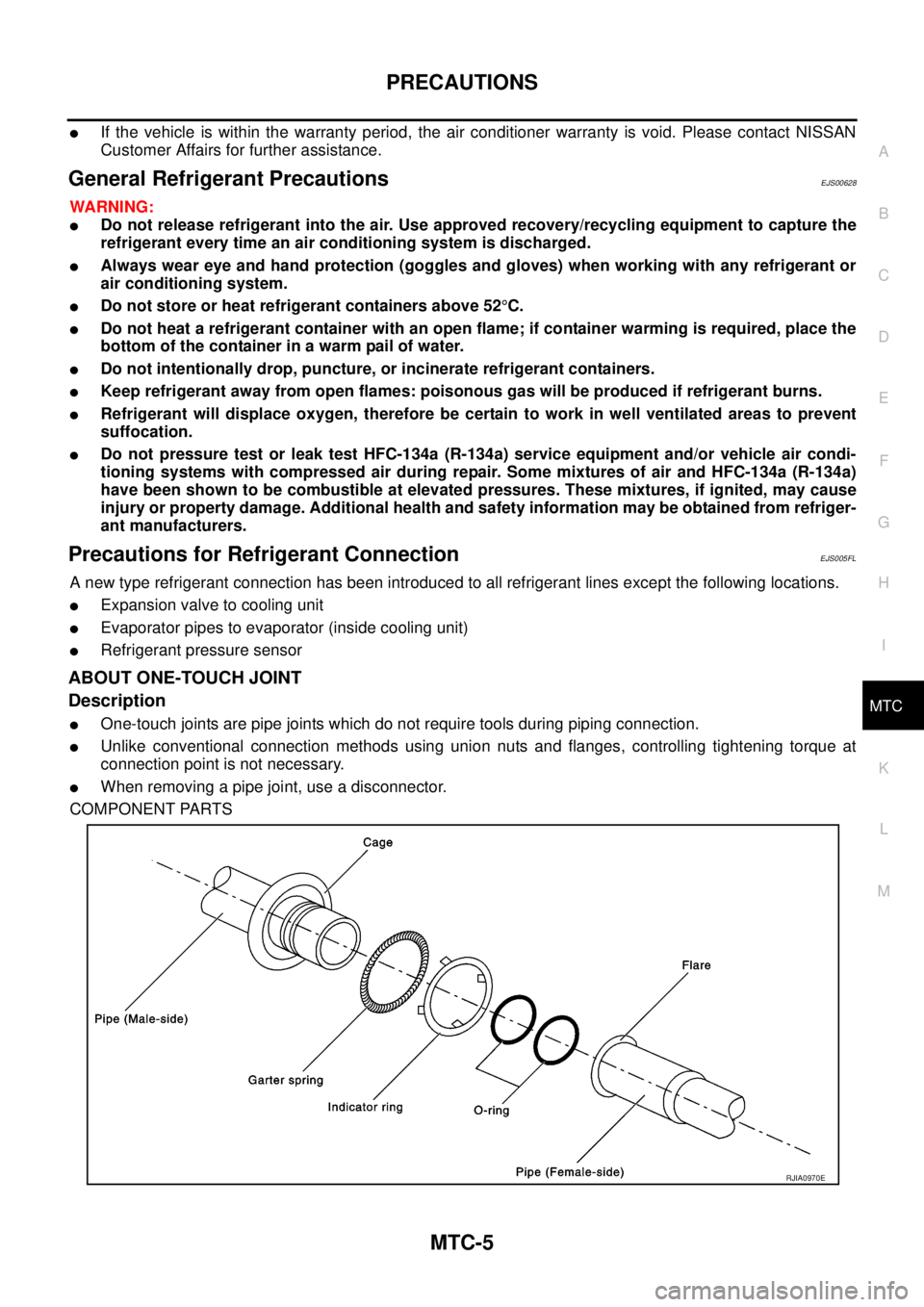
ABOUT ONE-TOUCH JOINT
Description
lOne-touch joints are pipe joints which do not require tools during piping connection.
lUnlike conventional connection methods using union nuts and flanges, controlling tightening torque at
connection point is not necessary.
lWhen removing a pipe joint, use a disconnector.
COMPONENT PARTS
RJIA0970E
Page 2476 of 3171
TROUBLE DIAGNOSIS
MTC-89
C
D
E
F
G
H
I
K
L
MA
B
MTC
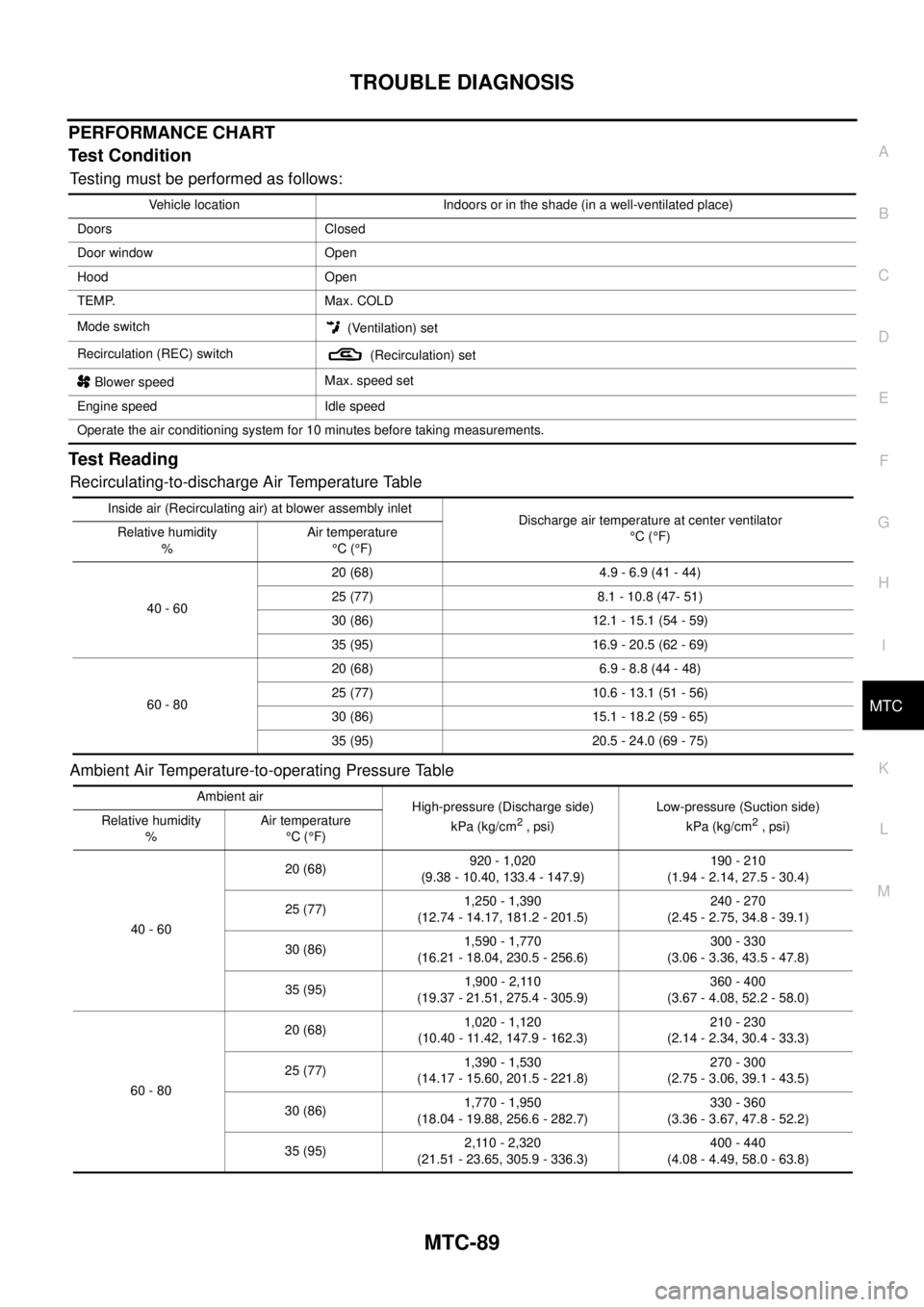
PERFORMANCE CHART
Test Condition
Testing must be performed as follows:
Test Reading
Recirculating-to-discharge Air Temperature Table
Ambient Air Temperature-to-operating Pressure Table
Vehicle location Indoors or in the shade (in a well-ventilated place)
Doors Closed
Door window Open
Hood Open
TEMP. Max. COLD
Mode switch
(Ventilation) set
Recirculation (REC) switch
(Recirculation) set
Blower speedMax. speed set
Engine speed Idle speed
Operate the air conditioning system for 10 minutes before taking measurements.
Inside air (Recirculating air) at blower assembly inlet
Discharge air temperature at center ventilator
°C(°F) Relative humidity
%Air temperature
°C(°F)
40 - 6020 (68) 4.9 - 6.9 (41 - 44)
25 (77) 8.1 - 10.8 (47- 51)
30 (86) 12.1 - 15.1 (54 - 59)
35 (95) 16.9 - 20.5 (62 - 69)
60 - 8020 (68) 6.9 - 8.8 (44 - 48)
25 (77) 10.6 - 13.1 (51 - 56)
30 (86) 15.1 - 18.2 (59 - 65)
35 (95) 20.5 - 24.0 (69 - 75)
Ambient air
High-pressure (Discharge side)
kPa (kg/cm
2,psi)Low-pressure (Suction side)
kPa (kg/cm2, psi) Relative humidity
%Air temperature
°C(°F)
40 - 6020 (68)920 - 1,020
(9.38 - 10.40, 133.4 - 147.9)190 - 210
(1.94 - 2.14, 27.5 - 30.4)
25 (77)1,250 - 1,390
(12.74 - 14.17, 181.2 - 201.5)240 - 270
(2.45 - 2.75, 34.8 - 39.1)
30 (86)1,590 - 1,770
(16.21 - 18.04, 230.5 - 256.6)300 - 330
(3.06 - 3.36, 43.5 - 47.8)
35 (95)1,900 - 2,110
(19.37 - 21.51, 275.4 - 305.9)360 - 400
(3.67 - 4.08, 52.2 - 58.0)
60 - 8020 (68)1,020 - 1,120
(10.40 - 11.42, 147.9 - 162.3)210 - 230
(2.14 - 2.34, 30.4 - 33.3)
25 (77)1,390 - 1,530
(14.17 - 15.60, 201.5 - 221.8)270 - 300
(2.75 - 3.06, 39.1 - 43.5)
30 (86)1,770 - 1,950
(18.04 - 19.88, 256.6 - 282.7)330 - 360
(3.36 - 3.67, 47.8 - 52.2)
35 (95)2,110 - 2,320
(21.51 - 23.65, 305.9 - 336.3)400 - 440
(4.08 - 4.49, 58.0 - 63.8)
Page 2479 of 3171
MTC-92
TROUBLE DIAGNOSIS
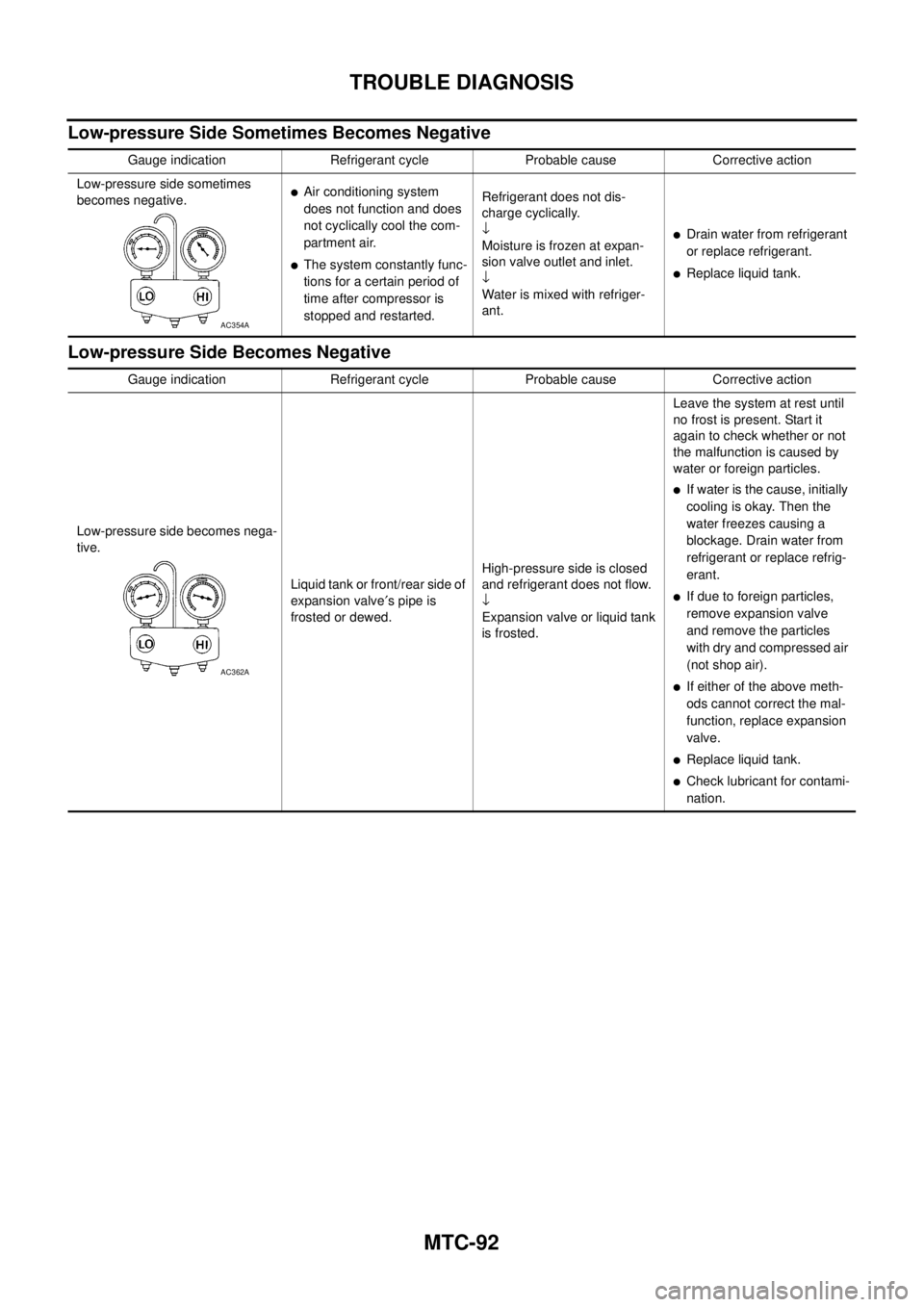
Low-pressure Side Sometimes Becomes Negative
Low-pressure Side Becomes Negative
Gauge indication Refrigerant cycle Probable cause Corrective action
Low-pressure side sometimes
becomes negative.
lAir conditioning system
does not function and does
not cyclically cool the com-
partment air.
lThe system constantly func-
tions for a certain period of
time after compressor is
stopped and restarted.Refrigerant does not dis-
charge cyclically.
¯
Moisture is frozen at expan-
sion valve outlet and inlet.
¯
Water is mixed with refriger-
ant.
lDrain water from refrigerant
or replace refrigerant.
lReplace liquid tank.
AC354A
Gauge indication Refrigerant cycle Probable cause Corrective action
Low-pressure side becomes nega-
tive.
Liquid tank or front/rear side of
expansion valve¢spipeis
frosted or dewed.High-pressure side is closed
and refrigerant does not flow.
¯
Expansion valve or liquid tank
is frosted.Leave the system at rest until
no frost is present. Start it
again to check whether or not
the malfunction is caused by
waterorforeignparticles.
lIf water is the cause, initially
cooling is okay. Then the
water freezes causing a
blockage. Drain water from
refrigerant or replace refrig-
erant.
lIf due to foreign particles,
remove expansion valve
and remove the particles
with dry and compressed air
(not shop air).
lIf either of the above meth-
ods cannot correct the mal-
function, replace expansion
valve.
lReplace liquid tank.
lCheck lubricant for contami-
nation.
AC362A