Test NISSAN PATHFINDER 2018 Owner´s Manual
[x] Cancel search | Manufacturer: NISSAN, Model Year: 2018, Model line: PATHFINDER, Model: NISSAN PATHFINDER 2018Pages: 474, PDF Size: 5.51 MB
Page 430 of 474
10 Technical and consumer information
Recommended fluids/lubricants and
capacities...................................... 10-2
Fuel recommendation ....................... 10-4
Engine oil and oil filter
recommendations .......................... 10-7
Air conditioner system refrigerant and
oil recommendations .......................10-8
Specifications .................................. 10-9
Engine ...................................... 10-9
Wheels and tires ............................ 10-10
Dimensions and weights ...................10-10
When traveling or registering in another
country ......................................... 10-11
Vehicle identification ........................... 10-11
Vehicle Identification Number (VIN)
plate ........................................ 10-11
Vehicle identification number
(chassis number) ............................ 10-11
Engine serial number ....................... 10-12
F.M.V.S.S./C.M.V.S.S. certification label ........10-12
Emission control information label .........10-12
Tire and Loading Information label .........10-13
Air conditioner specification label ...........10-13 Installing front license plate
....................10-13
Vehicle loading information ...................10-14
Terms ...................................... 10-14
Vehicle load capacity ....................... 10-15
Securing the load ........................... 10-16
Loading tips ................................ 10-17
Measurement of weights ...................10-17
Towing a trailer ................................ 10-18
Maximum load limits ....................... 10-18
Towing load/specification ..................10-21
Towing safety .............................. 10-22
Flat towing for 4–Wheel drive vehicle
(if so equipped) ............................. 10-30
Flat towing for front wheel drive vehicle
(if so equipped) ............................. 10-31
Uniform tire quality grading ....................10-32
Emission control system warranty .............10-33
R
eporting safety defects ......................10-33
Readiness for Inspection/Maintenance (I/M)
test ............................................ 10-34
Event Data Recorders (EDR) ....................10-35
Owner’s Manual/Service Manual order
information ................................... 10-36
Page 435 of 474
Af termarket fuel additives
NISSAN does not recommend the use of
any af termarket fuel additives (for ex-
ample, fuel injector cleaner, octane
booster, intake valve deposit removers,
etc.) which are sold commercially. Many of
these additives intended for gum, varnish
or deposit removal may contain active sol-
vents or similar ingredients that can be
harmful to the fuel system and engine.
Octane rating tips
Using unleaded gasoline with an octane
rating lower than recommended can
cause persistent, heavy “spark knock.”
(“Spark knock” is a metallic rapping
noise.) If severe, this can lead to engine
damage. If you detect a persistent heavy
spark knock even when using gasoline
of the stated octane rating, or if you hear
steady spark knock while holding a
steady speed on level roads, it is recom-
mended that you have a NISSAN dealer
correct the condition. Failure to correct
the condition is misuse of the vehicle, for
which NISSAN is not responsible.Incorrect ignition timing may result in
spark knock, af ter-run and/or overheating,
which may cause excessive fuel consump-
tion or engine damage. If any of the above
symptoms are encountered, have your ve-
hicle checked. It is recommended that you
visit a NISSAN dealer for servicing.
However, now and then you may notice
light spark knock for a short time while
accelerating or driving up hills. This is not
a cause for concern, because you get the
greatest fuel benefit when there is light
spark knock for a short time under heavy
engine load.
10-6Technical and consumer information
Page 455 of 474
Electric Trailer Brakes -Electric braking
systems are activated by an electronic sig-
nal sent from a trailer brake controller (spe-
cial brake-sensing module). For additional
information, refer to “Electric trailer brake
controller” in this section.
Have a professional supplier of towing
equipment make sure the trailer brakes are
properly installed and demonstrate proper
brake function testing.
WARNING
Never connect a trailer brake system di-
rectly to the vehicle brake system.
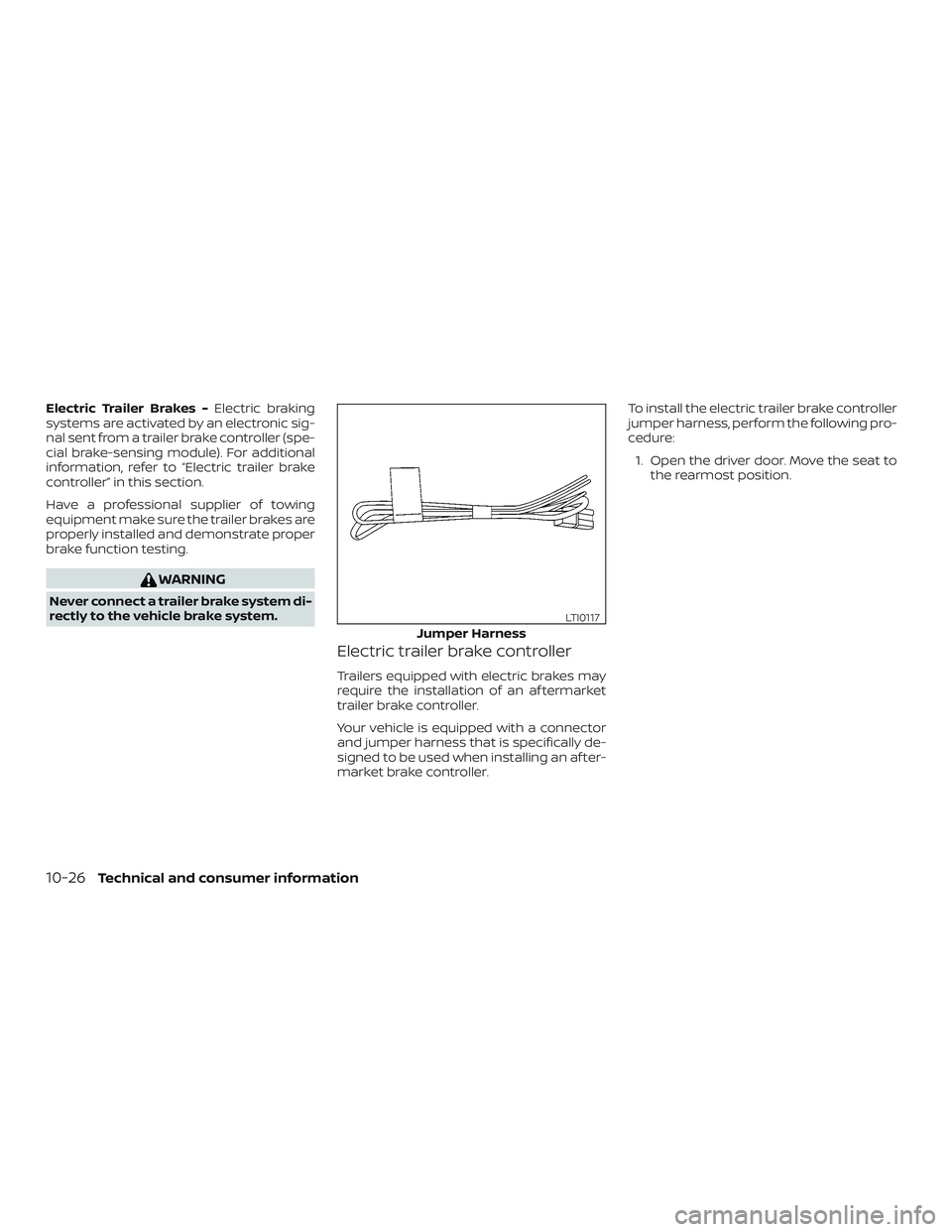
Electric trailer brake controller
Trailers equipped with electric brakes may
require the installation of an af termarket
trailer brake controller.
Your vehicle is equipped with a connector
and jumper harness that is specifically de-
signed to be used when installing an af ter-
market brake controller. To install the electric trailer brake controller
jumper harness, perform the following pro-
cedure:
1. Open the driver door. Move the seat to the rearmost position.
Jumper Harness
LTI0117
10-26Technical and consumer information
Page 461 of 474
DOT (Department of Transportation) Qual-
ity Grades: All passenger car tires must
conform to federal safety requirements in
addition to these grades.
Quality grades can be found where appli-
cable on the tire sidewall between tread
shoulder and maximum section width. For
example:
Treadwear 200 Traction AA Temperature
A
Treadwear
The treadwear grade is a comparative rat-
ing based on the wear rate of the tire when
tested under controlled conditions on a
specified government test course. For ex-
ample, a tire graded 150 would wear one
and one-half (1 1/2) times as well on the
government course as a tire graded 100.
The relative performance of tires depends
upon the actual conditions of their use,
however, and may depart significantly from
the norm due to variations in driving habits,
service practices and differences in road
characteristics and climate.
Traction AA, A, B and C
The traction grades, from highest to low-
est, are AA, A, B, and C. Those grades repre-
sent the tire’s ability to stop on wet pave-ment as measured under controlled
conditions on specified government test
surfaces of asphalt and concrete. A tire
marked C may have poor traction perfor-
mance.
WARNING
The traction grade assigned to this tire
is based on straight-ahead braking
traction tests, and does not include ac-
celeration, cornering, hydroplaning, or
peak traction characteristics.
Temperature A, B and C
The temperature grades are A (the high-
est), B, and C, representing the tire’s resis-
tance to the generation of heat, and its
ability to dissipate heat when tested under
controlled conditions on a specified indoor
laboratory test wheel. Sustained high tem-
perature can cause the material of the tire
to degenerate and reduce tire life, and ex-
cessive temperature can lead to sudden
tire failure. The grade C corresponds to a
level of performance which all passenger
car tires must meet under the Federal Mo-
tor Safety Standard No. 109. Grades B and A
represent higher levels of performance on
the laboratory test wheel than the mini-
mum required by law.
WARNING
The temperature grade for this tire is
established for a tire that is properly in-
flated and not overloaded. Excessive
speed, under-inflation, or excessive
loading, either separately or in combi-
nation, can cause heat build-up and
possible tire failure.
UNIFORM TIRE QUALITY GRADING
10-32Technical and consumer information
Page 463 of 474
You may notif y NISSAN by contact-
ing our Consumer Affairs Depart-
ment, toll-free, at 1-800-NISSAN-1.
For Canada
If you believe that your vehicle has a
defect which could cause a crash or
could cause injury or death, you
should immediately inform Trans-
port Canada in addition to notif ying
NISSAN.
If Transport Canada receives com-
plaints, it may open an investigation,
and if it finds that a safety defect
exists in a group of vehicles, it may
request that NISSAN conduct a recall
campaign. However, Transport
Canada cannot become involved in
individual problems between you,
your dealer, or NISSAN.
You may contact Transport Canada’s
Defect Investigations and Recalls Divi-
sion toll free at 1-800-333-0510. You
may also report safety defects online
at: https://wwwapps.tc.gc.ca/Saf-
Sec-Sur/7/PCDB-BDPP/fc-cp.aspx?lang=eng (English speakers)
or https://wwwapps.tc.gc.ca/Saf-
Sec-Sur/7/PCDB-BDPP/fc-
cp.aspx?lang=fra (French speakers)
Additional information concerning
motor vehicle safety may be obtained
from Transport Canada’s Road Safety
Information Centre at 1-800-333-0371
or online at www.tc.gc.ca/roadsafety
(English speakers) or
www.tc.gc.ca/securiteroutiere
(French speakers).
To notif y NISSAN of any safety con-
cerns please contact our Consumer
Information Centre toll free at 1-800-
387-0122.
WARNING
A vehicle equipped with Four-Wheel
Drive (4WD) should never be tested us-
ing a two wheel dynamometer (such as
the dynamometers used by some
states for emissions testing), or similar
equipment. Make sure you inform the
test facility personnel that your vehicle
is equipped with 4WD before it is placed
on a dynamometer. Using the wrong
test equipment may result in transmis-
sion damage or unexpected vehicle
movement which could result in serious
vehicle damage or personal injury.
Due to legal requirements in some states
and Canadian Provinces, your vehicle may
be required to be in what is called the
“ready condition” for an
Inspection/Maintenance (I/M) test of the
emission control system.
The vehicle is set to the “ready condition”
when it is driven through certain driving
patterns. Usually, the ready condition can
be obtained by ordinary usage of the ve-
hicle.
READINESS FOR INSPECTION/
MAINTENANCE (I/M) TEST
10-34Technical and consumer information
Page 464 of 474
If a powertrain system component is re-
paired or the battery is disconnected, the
vehicle may be reset to a “not ready” condi-
tion. Before taking the I/M test, check the
vehicle’s inspection/maintenance test
readiness condition. Place the ignition
switch in the ON position without starting
the engine. If the Malfunction Indicator
Light (MIL) comes on steady for 20 seconds
and then blinks for 10 seconds, the I/M test
condition is “not ready”. If the MIL does not
blink af ter 20 seconds, the I/M test condi-
tion is “ready”. It is recommended that you
visit a NISSAN dealer to set the “ready con-
dition” or to prepare the vehicle for testing.This vehicle is equipped with an Event Data
Recorder (EDR). The main purpose of an
EDR is to record, in certain crash or near
crash-like situations, such as an air bag
deployment or hitting a road obstacle, data
that will assist in understanding how a ve-
hicle’s systems performed. The EDR is de-
signed to record data related to vehicle dy-
namics and safety systems for a short
period of time, typically 30 seconds or less.
The EDR in this vehicle is designed to re-
cord such data as:
∙ How various systems in your vehicle were operating;
∙ Whether or not the driver and passen- ger safety belts were buckled/fastened;
∙ How far (if at all) the driver was depress- ing the accelerator and/or brake pedal;
and,
∙ How fast the vehicle was traveling.
∙ Sounds are not recorded. These data can help provide a better un-
derstanding of the circumstances in which
crashes and injuries occur. NOTE: EDR data
are recorded by your vehicle only if a non-
trivial crash situation occurs; no data are
recorded by the EDR under normal driving
conditions and no personal data (e.g.
name, gender, age and crash location) are
recorded. However, other parties, such as
law enforcement, could combine the EDR
data with the type of personally identif ying
data routinely acquired during a crash in-
vestigation.
To read data recorded by an EDR, special
equipment is required and access to the
vehicle or the EDR is needed. In addition to
the vehicle manufacturer and NISSAN
dealer, other parties, such as law enforce-
ment, that have the special equipment, can
read the information if they have access to
the vehicle or the EDR. EDR data will only be
accessed with the consent of the vehicle
owner or lessee or as otherwise required or
permitted by law.
EVENT DATA RECORDERS (EDR)
Technical and consumer information10-35
Page 470 of 474
OilCapacities and recommended
fuel/lubricants...............10-2
Changing engine oil ............8-7
Changing engine oil filter .........8-8
Checking engine oil level .........8-6
Engine oil ...................8-6
Engine oil and oil filter
recommendation .............10-7
Engine oil viscosity .............10-7
Outsidemirrors................3-46
Overhead sunglasses holder ........2-60
Overheat Ifyourvehicleoverheats.........6-12
Owner's manual order form ........10-36
Owner's manual/service manual order
information..................10-36
P
Parking Parking brake operation .........5-22
Parking/parkingonhills.........5-72
Parkingbrake..................5-22
Personal lights .................2-72
Power Front seat adjustment ...........1-5
Power door locks ..............3-6
Poweroutlet.............2-54,2-55
Powerrearwindows...........2-66
Powersteeringfluid............8-9
Power steering system ..........5-72
Powerwindows..............2-65
Rearpowerwindows...........2-66
Powerinverterswitch ............2-52 Poweroutlet...............2-54,2-55
Powersteering.................5-72
Powersteeringfluid..............8-9
Precautions
Maintenance precautions .........8-2
On-pavement and off-road driving
precautions .................5-7
Precautions on booster
seats............1-30, 1-37, 1-43, 1-49
Precautions on child
restraints.........1-30, 1-37, 1-43, 1-49
Precautions on seat belt usage .....1-18
Precautions on supplemental restraint
system ................... .1-53
Precautions when starting and
driving.....................5-2
Push starting ..................6-12
R
Radio Car phone or CB radio ..........4-41
Readiness for inspection maintenance
(I/M) test ....................10-34
RearCrossTrafficAlert(RCTA) .......5-32
Rear Door Alert .............2-33,2-50
Rearpowerwindows.............2-66
Rear sonar system ..............5-79
Rearviewmirror................3-44
RearViewMonitor................4-3
Rear window and outside mirror defroster
switch......................2-39
Rear window wiper and washer
switches .....................2-38
Recommended Fluids ............10-2 Recorders
EventData.................10-35
Refrigerant recommendation ........10-8
Registering a vehicle in another
country .....................10-11
Remote Engine Start ..........3-28,5-16
Reporting safety defects (US only) . . . .10-33
Roofrack....................2-64
S
Safety Child safety rear door lock ........3-7
Childseatbelts......1-30, 1-37, 1-43, 1-49
Reporting safety defects (US only) . .10-33
Seat adjustment Front manual seat adjustment ......1-3
Front power seat adjustment ......1-5
Second row bench seats .......1-7, 1-9
Seatback pockets ...............2-57
Seat belt C
hildsafety................ .1-27
Infants and small children ........1-28
InjuredPerson............... .1-21
Largerchildren.............. .1-28
Precautionsonseatbeltusage.....1-18
Pregnant women ..............1-21
Seat belt extenders ............1-26
Seat belt maintenance ..........1-27
Seatbelts................1-18, 7-6
Three-pointtypewithretractor.....1-21
Seat belt extenders ..............1-26
Seatbeltwarninglight.........1-21, 2-15
Seats 2nd row bench seat adjustment. . .1-7, 1-9
11-5