oil temperature NISSAN PRIMERA 1999 Electronic Manual PDF
[x] Cancel search | Manufacturer: NISSAN, Model Year: 1999, Model line: PRIMERA, Model: NISSAN PRIMERA 1999Pages: 2267, PDF Size: 35.74 MB
Page 2249 of 2267
Checking and Adjusting Drive Belts
Refer to section MA for Drive Belt Inspection.
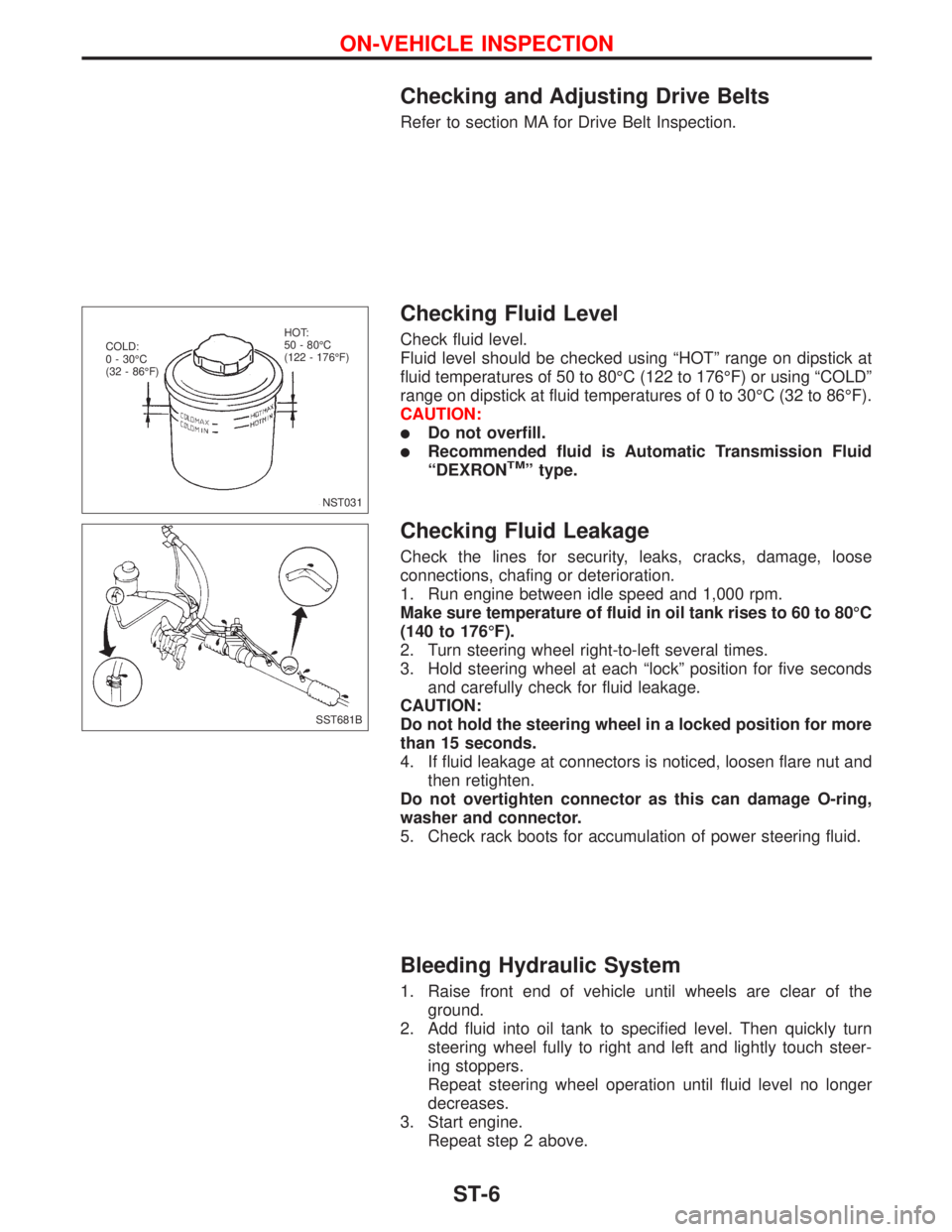
Checking Fluid Level
Check fluid level.
Fluid level should be checked using ªHOTº range on dipstick at
fluid temperatures of 50 to 80ÉC (122 to 176ÉF) or using ªCOLDº
range on dipstick at fluid temperatures of 0 to 30ÉC (32 to 86ÉF).
CAUTION:
lDo not overfill.
lRecommended fluid is Automatic Transmission Fluid
ªDEXRONTMº type.
Checking Fluid Leakage
Check the lines for security, leaks, cracks, damage, loose
connections, chafing or deterioration.
1. Run engine between idle speed and 1,000 rpm.
Make sure temperature of fluid in oil tank rises to 60 to 80ÉC
(140 to 176ÉF).
2. Turn steering wheel right-to-left several times.
3. Hold steering wheel at each ªlockº position for five seconds
and carefully check for fluid leakage.
CAUTION:
Do not hold the steering wheel in a locked position for more
than 15 seconds.
4. If fluid leakage at connectors is noticed, loosen flare nut and
then retighten.
Do not overtighten connector as this can damage O-ring,
washer and connector.
5. Check rack boots for accumulation of power steering fluid.
Bleeding Hydraulic System
1. Raise front end of vehicle until wheels are clear of the
ground.
2. Add fluid into oil tank to specified level. Then quickly turn
steering wheel fully to right and left and lightly touch steer-
ing stoppers.
Repeat steering wheel operation until fluid level no longer
decreases.
3. Start engine.
Repeat step 2 above.
NST031 COLD:
0 - 30ÉC
(32 - 86ÉF)HOT:
50 - 80ÉC
(122 - 176ÉF)
SST681B
ON-VEHICLE INSPECTION
ST-6
Page 2250 of 2267
lIncomplete air bleeding will cause the following to occur.
When this happens, bleed air again.
a. Generation of air bubbles in reservoir tank
b. Generation of clicking noise in oil pump
c. Excessive buzzing in oil pump
While the vehicle is stationary or while moving the steering wheel
slowly, fluid noise may occur in the valve or oil pump. This noise
is inherent in this steering system, and it will not affect perfor-
mance or durability of the system.
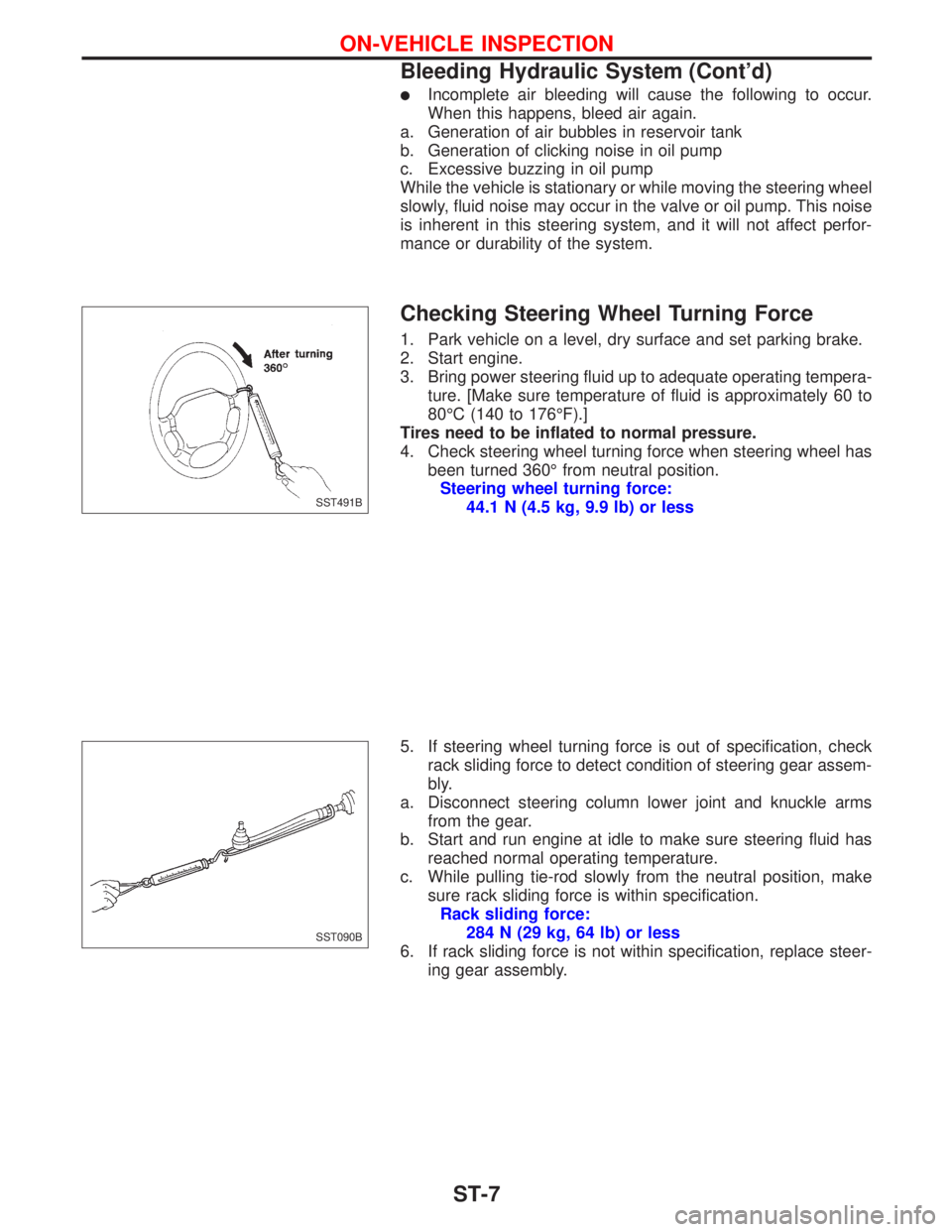
Checking Steering Wheel Turning Force
1. Park vehicle on a level, dry surface and set parking brake.
2. Start engine.
3. Bring power steering fluid up to adequate operating tempera-
ture. [Make sure temperature of fluid is approximately 60 to
80ÉC (140 to 176ÉF).]
Tires need to be inflated to normal pressure.
4. Check steering wheel turning force when steering wheel has
been turned 360É from neutral position.
Steering wheel turning force:
44.1 N (4.5 kg, 9.9 lb) or less
5. If steering wheel turning force is out of specification, check
rack sliding force to detect condition of steering gear assem-
bly.
a. Disconnect steering column lower joint and knuckle arms
from the gear.
b. Start and run engine at idle to make sure steering fluid has
reached normal operating temperature.
c. While pulling tie-rod slowly from the neutral position, make
sure rack sliding force is within specification.
Rack sliding force:
284 N (29 kg, 64 lb) or less
6. If rack sliding force is not within specification, replace steer-
ing gear assembly.
SST491B
SST090B
ON-VEHICLE INSPECTION
Bleeding Hydraulic System (Cont'd)
ST-7
Page 2251 of 2267
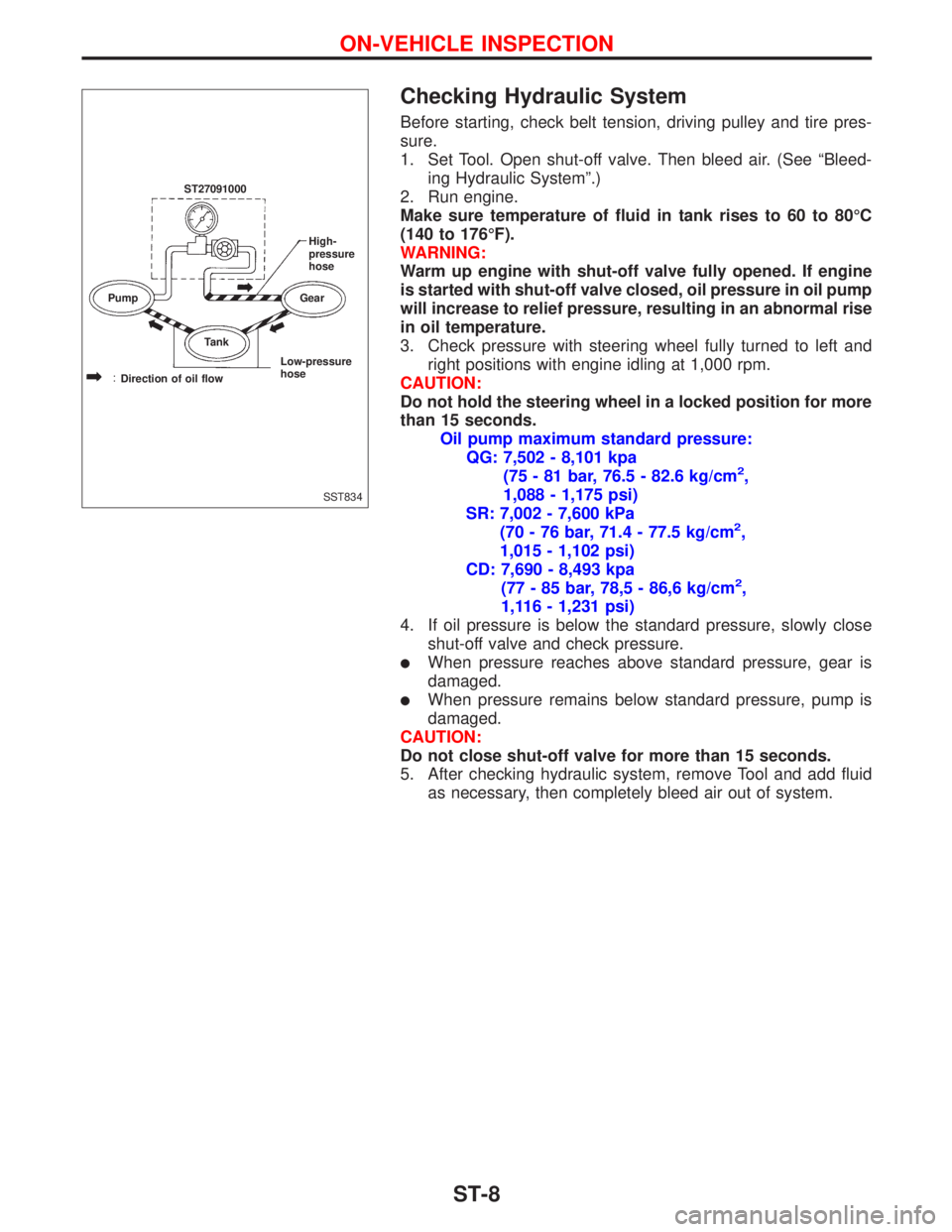
Checking Hydraulic System
Before starting, check belt tension, driving pulley and tire pres-
sure.
1. Set Tool. Open shut-off valve. Then bleed air. (See ªBleed-
ing Hydraulic Systemº.)
2. Run engine.
Make sure temperature of fluid in tank rises to 60 to 80ÉC
(140 to 176ÉF).
WARNING:
Warm up engine with shut-off valve fully opened. If engine
is started with shut-off valve closed, oil pressure in oil pump
will increase to relief pressure, resulting in an abnormal rise
in oil temperature.
3. Check pressure with steering wheel fully turned to left and
right positions with engine idling at 1,000 rpm.
CAUTION:
Do not hold the steering wheel in a locked position for more
than 15 seconds.
Oil pump maximum standard pressure:
QG: 7,502 - 8,101 kpa
(75 - 81 bar, 76.5 - 82.6 kg/cm
2,
1,088 - 1,175 psi)
SR: 7,002 - 7,600 kPa
(70 - 76 bar, 71.4 - 77.5 kg/cm
2,
1,015 - 1,102 psi)
CD: 7,690 - 8,493 kpa
(77 - 85 bar, 78,5 - 86,6 kg/cm
2,
1,116 - 1,231 psi)
4. If oil pressure is below the standard pressure, slowly close
shut-off valve and check pressure.
lWhen pressure reaches above standard pressure, gear is
damaged.
lWhen pressure remains below standard pressure, pump is
damaged.
CAUTION:
Do not close shut-off valve for more than 15 seconds.
5. After checking hydraulic system, remove Tool and add fluid
as necessary, then completely bleed air out of system.
SST834 ST27091000
Pump
TankGearHigh-
pressure
hose
Direction of oil flowLow-pressure
hose
ON-VEHICLE INSPECTION
ST-8