lights NISSAN PULSAR 1987 User Guide
[x] Cancel search | Manufacturer: NISSAN, Model Year: 1987, Model line: PULSAR, Model: NISSAN PULSAR 1987Pages: 238, PDF Size: 28.91 MB
Page 112 of 238
112 Fuel and Engine Management
If the voltage does not increase as specified, renew
the throttle position sensor.
If the voltage is as specified, proceed as follows.
(28) With the ignition switched On and the
throttle valve held fully open, measure the voltage at
control unit wiring connector terminal C13. The
voltage should be above 4 volts.
If the voltage is below 4 volts, renew the throttle
position sensor.
To Remove and Install
(1) Disconnect the negative battery terminal.
(2) On 1.6 liter engines, remove the air cleaner
assembly as previously described. (3) Disconnect the throttle position sensor wir-
ing connector. (4) Remove the throttle position sensor retain-
ing screws and remove the throttle position sensor
from the throttle body. Installation is a reversal of the removal procedure
with attention to the following points:
(1) Ensure that the throttle valve is in the fully
closed position. (2) Tighten the retaining screws securely and
install the wiring connector.
View of the throttle positi on sensor removed from the
throttle body assembly.
MANIFOLD AIR TEMPERATURE (MAT)
SENSOR - 1.8 LITRE ENGINE
To Test - Codes 23 and 25
(1) Erase the self diagnosis code memory as
previously described.
(2) Start and run the engine for 2 minutes or
until the ECM warning lamp lights. (3) Stop the engine, switch the ignition On and
connect a jumper lead between terminals A and B on
the diagnostic link connector . Note any fault codes
displayed. If codes 23 or 25 are displayed, proceed to
operation (4).
If codes 23 or 25 are not displayed but were
displayed when the self diagnosis test procedure was
originally performed, an intermittent fault is indi-
cated. Proceed as follows:
(a) Check for faulty wiri ng connections. Check
that all wiring connectors are clean and secure. (b) Check that all earth wires are secure.
(4) Disconnect the wiring connector from the
MAT sensor. (5) With the ignition switched On, measure the
voltage across the terminals on the MAT sensor wiring
connector. The voltage s hould be 4-6 volts.
If the voltage is below 4 volts, proceed to opera-
tion (9).
If the voltage is as specified, proceed as follows.
(6) Remove the MAT sensor from the engine.
(7) Connect an ohmmeter to the MAT sensor
terminals. (8) Immerse the metal end of the MAT sensor in
a container of iced water at a temperature of 4 deg C.
The resistance should be 7 500 ohms. Slowly heat the water and measure the resistance
of the MAT sensor at the following temperatures.
Compare the results with the specified values:
20 deg C .................................................. 3 400 ohms
38 deg C....................................................1 800 ohms
70 degC ...................................................... 450 ohms
100 deg C.................................................... 185 ohms
If the resistances obtained are not close to the
specified figures at any of the given temperatures,
renew the MAT sensor and retest for fault codes.
(9) Disconnect the control unit wiring connec-
tors. (10) Check the wiring harness between the MAT
sensor wiring connector and the control unit wiring
connector terminals C12 and A11 for shorts and
continuity. Also check the control unit terminals for
damage. Repair or renew the wiring harness as necessary.
If no fault is found, renew the control unit and
retest for fault codes.
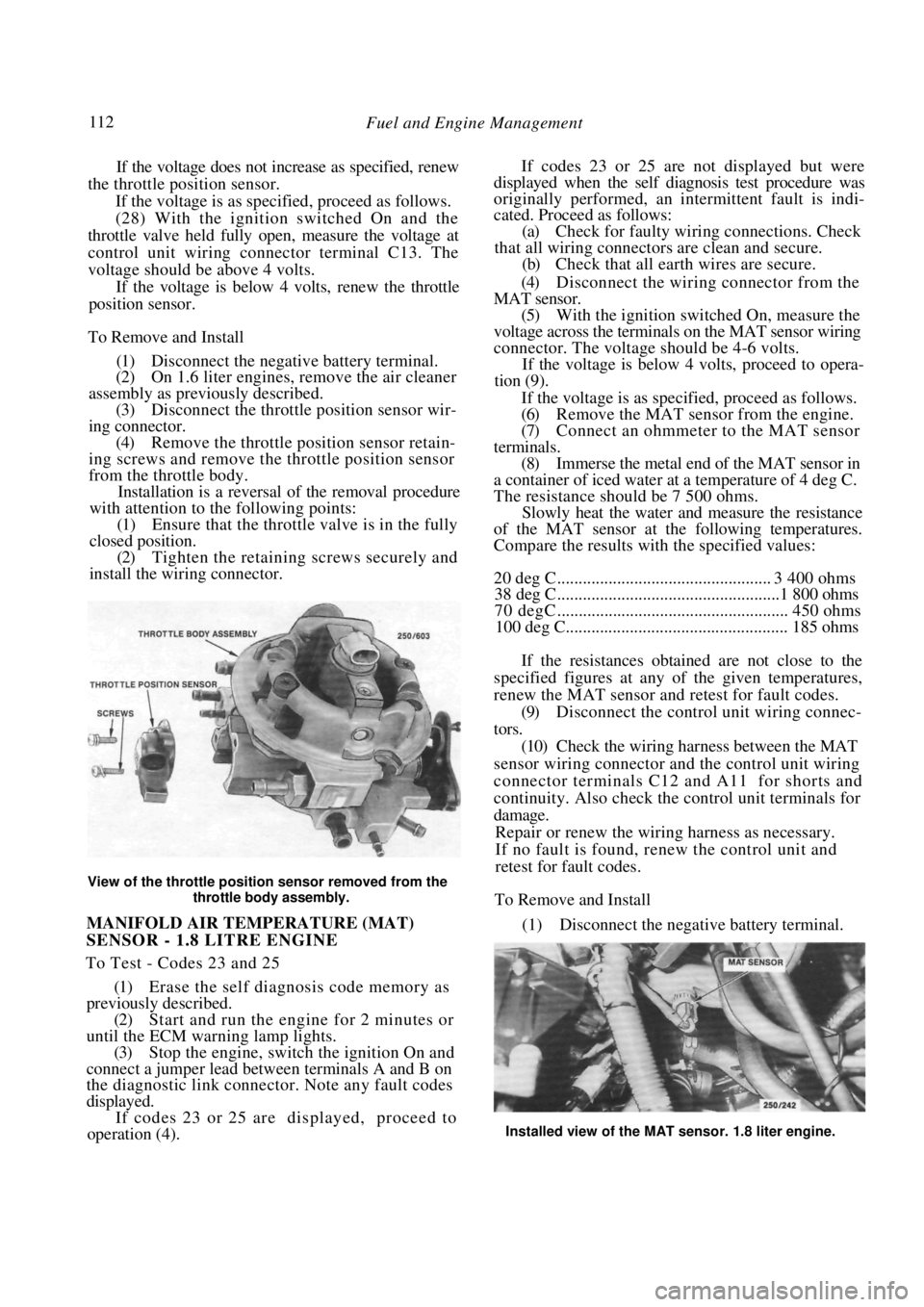
To Remove and Install
(1) Disconnect the negative battery terminal.
Installed view of the MAT sensor. 1.8 liter engine.
Page 113 of 238

Fuel and Engine Management 113
(2) Disconnect the wiring connector from the
MAT sensor.
(3) Unscrew the sensor from the inlet manifold.
Installation is a reversal of the removal procedure
with attention to the following points:
(1) Apply Loctite 567 or a similar conductive
sealer to the threads of th e sensor. Tighten the sensor
to the specified torque. (2) Ensure that the wiring connector is clean and
tight.
OXYGEN SENSOR
To Test - Code 13
(1) Run the engine until the normal operating
temperature is obtained. (2) With the ignition switched Off, connect a
jumper lead between terminals A and B on the
diagnostic link connector.
(3) Start and run the engi ne at approximately
1 600-1 800 rpm for 2 minutes and note the ECM
warning lamp.
If the ECM warning lamp flashes at the rate of
twice per second, proceed to operation (5).
If the ECM warning lamp flashes at the rate of
once per second or slower, proceed as follows.
(4) Remove the jumper lead from the diagnostic
link connector and run th e engine above 2 000 rpm
for 2 minutes, noting the ECM warning lamp.
If the ECM warning lamp lights, stop the engine,
switch the ignition On and connect a jumper lead
between terminals A and B on the diagnostic link
connector. If code 13 is displayed proceed to opera-
tion (5).
If the ECM warning lamp does not light, an
intermittent fault is indicated. Proceed as follows:
(a) Check for faulty wiri ng connections. Check
that all wiring connectors are clean and secure.
(b) Check that all earth wires are secure.
(5) Switch the ignition Off and disconnect the
oxygen sensor wiring connector. Using a jumper lead
connect the oxygen sensor wiring connector to a
suitable engine earth. (6) Start and run the engi ne at approximately
1 600-1 800 rpm and note the ECM warning lamp.
The lamp may flash for a few seconds but should then
extinguish for at least 30 seconds.
If the ECM warning lamp functions as described,
proceed to operation (7).
If the ECM warning lamp does not function as
described proceed as follows:
(a) Check the wiring harness between the oxygen
sensor wiring connector and the control unit wiring
connector D7 for open circuits. Repair or renew the
wiring harness as necessary.
{b) Check the earth circuit between the control
unit wiring connect D6 and the right rear cylinder
head bolts. Repair or renew the wiring harness as
necessary.
(c) If no fault is found in (a) and (b) renew the
control unit and retest for fault codes.
(7) Check the wiring harness earth circuit be-
tween the control unit wiring connector D6 and the
right rear cylinder head bolts. Repair or renew the
wiring harness as necessary.
If no fault is found, thoroughly check the oxygen
sensor connector. If the conne ctor is not faulty, renew
the oxygen sensor.
To Test - Code 44
(1) Run the engine until normal operating tem-
perature is attained.
(2) With the ignition switched Off, connect a
jumper lead between terminals A and B on the
diagnostic link connector. (3) Start and run the engi ne at approximately
1 600-1 800 rpm for 2 minutes and note the ECM
warning lamp. If the ECM warning lamp is off more than on or
flashes at the rate of twice per second, proceed to
operation (4).
If the ECM warning lamp flashes evenly at the
rate of once per second an intermittent fault is
indicated. Proceed as follows:
(a) Check for faulty wiri ng connections. Check
that all wiring connectors are clean and secure. (b) Check that all earth wires are secure.
(4) Switch the engine Off and disconnect the
oxygen sensor wiring connector.
(5) Start and run the engine at 1 600-1 800 rpm
for at least 30 seconds and note the ECM warning
lamp. If the ECM warning lamp flashes at the rate of
twice per second procee d to operation (6).
If the ECM warning lamp extinguishes for at least
30 seconds, check the wiring harness between the
oxygen sensor wiring connector and the control unit
wiring connector terminal D7 for shorts to earth.
Repair or renew the wiring harness as necessary.
If no fault can be found in the wiring harness, renew
the control unit.
Installed view of the oxygen sensor.