belt NISSAN PULSAR 1987 Owner's Manual
[x] Cancel search | Manufacturer: NISSAN, Model Year: 1987, Model line: PULSAR, Model: NISSAN PULSAR 1987Pages: 238, PDF Size: 28.91 MB
Page 81 of 238

Cooling and Heating Systems 81
continuous stream of bubbles indicates that the refriger-
ant charge is low.
A large number of bubbles or foam indicates that
the refrigerant charge is very low.
No bubbles or the presen ce of oil streaks in the
sight glass indicate that the system is completely
empty.
NOTE: If the outside air temperature is
high, a certain number of bubbles may be
observed in the sight gl ass, even though the
system is fully charged.
If the system requires recharging, the vehicle
should be taken to an authorized dealer for evacu-
ation, leak testing and recharging.
Do not operate the system if it is known that the
refrigerant charge is low as damage may result.
MAINTENANCE
The air conditioning system requires l i t t l e main-
tenance other than the following. Where applicable,
refer to the Lubrication an d Maintenance section for
the recommended service intervals.
(1) Check the refrigerant charge level in the
receiver/dryer sight glass. Recharge the system as
necessary. It is considered normal for the system to
require periodic recharging. (2) Inspect the air conditioner pipes and hoses
for leaks, deterioration and alignment. Evidence of oil
leakage is an indication of refrigerant leakage. Repair
or renew as necessary.
(3) Inspect the evaporator drain tube and the
condenser cooling fins for blockage. Clean as neces-
sary.
(4) Check the drive belt for deterioration and for
correct tension. Refer to the Engine Tune-up section
for the correct procedure.
(5) Operate the system at least once a week for
approximately 15 minutes to keep the compressor
seals lubricated.
Page 91 of 238
Fuel and Engine Management 91
components, erase the self diagnosis memory as
described under the following heading.
(7) Repeat the self diagnosis test procedure and
ensure that code 12 is displayed.
To Erase Memory
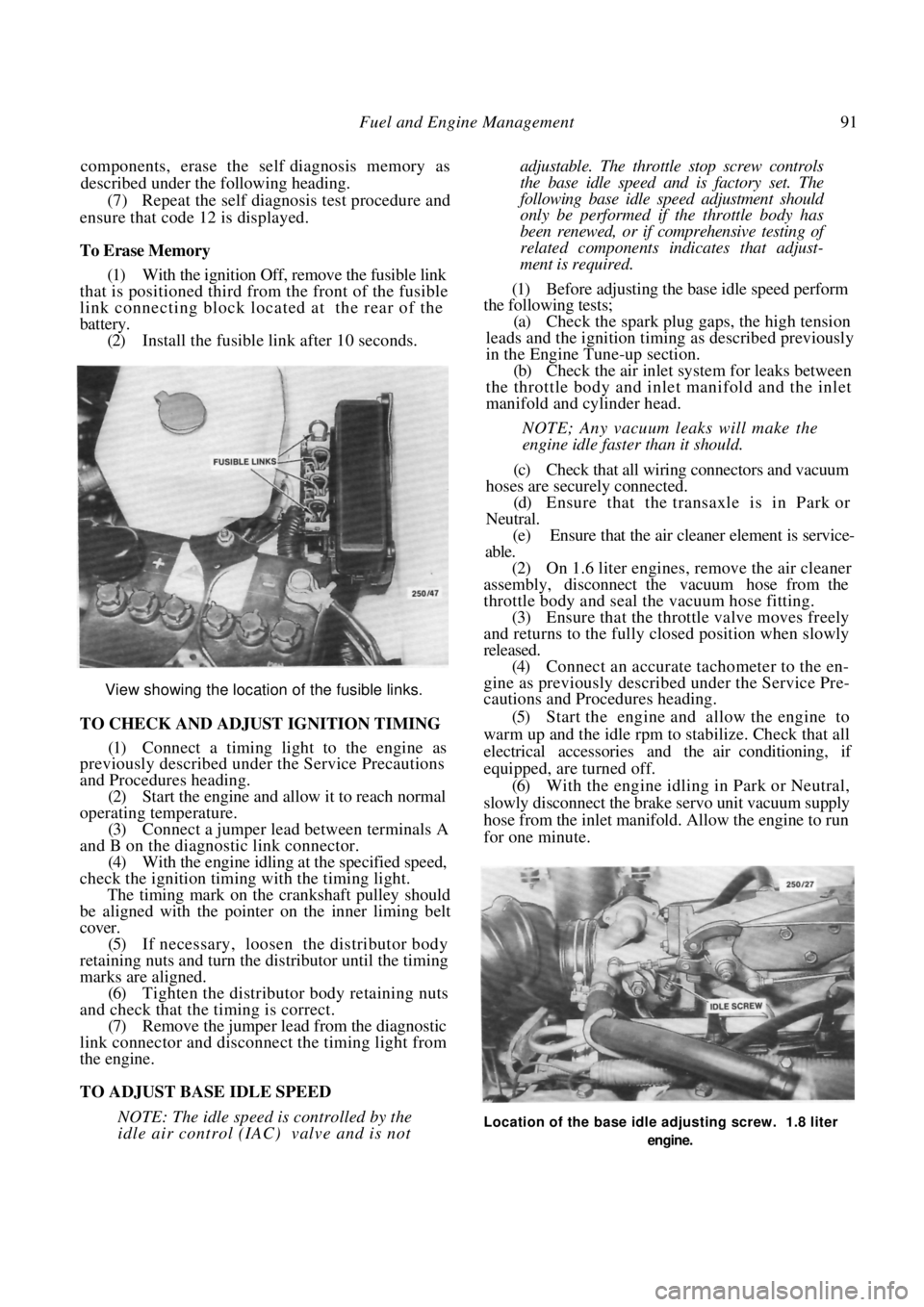
(1) With the ignition Off, remove the fusible link
that is positioned third from the front of the fusible
link connecting block located at the rear of the
battery. (2) Install the fusible link after 10 seconds.
View showing the location of the fusible links.
TO CHECK AND ADJUST IGNITION TIMING
(1) Connect a timing light to the engine as
previously described under the Service Precautions
and Procedures heading.
(2) Start the engine and allow it to reach normal
operating temperature. (3) Connect a jumper lead between terminals A
and B on the diagnostic link connector. (4) With the engine idling at the specified speed,
check the ignition timing with the timing light.
The timing mark on the crankshaft pulley should
be aligned with the pointer on the inner liming belt
cover.
(5) If necessary, loosen the distributor body
retaining nuts and turn the distributor until the timing
marks are aligned. (6) Tighten the distributor body retaining nuts
and check that the timing is correct. (7) Remove the jumper lead from the diagnostic
link connector and disconnect the timing light from
the engine.
TO ADJUST BASE IDLE SPEED
NOTE: The idle speed is controlled by the
idle air control (IAC) valve and is not
adjustable. The throttle stop screw controls
the base idle speed a nd is factory set. The
following base idle speed adjustment should
only be performed if the throttle body has
been renewed, or if comprehensive testing of
related components indicates that adjust-
ment is required.
(1) Before adjusting the base idle speed perform
the following tests;
(a) Check the spark plug gaps, the high tension
leads and the ignition timin g as described previously
in the Engine Tune-up section.
(b) Check the air inlet syst em for leaks between
the throttle body and inlet manifold and the inlet
manifold and cylinder head.
NOTE; Any vacuum leaks will make the
engine idle faster than it should.
(c) Check that all wiring connectors and vacuum
hoses are securely connected. (d) Ensure that the transaxle is in Park or
Neutral. (e) Ensure that the air cleaner element is service-
able.
(2) On 1.6 liter engines, remove the air cleaner
assembly, disconnect the vacuum hose from the
throttle body and seal the vacuum hose fitting.
(3) Ensure that the throttle valve moves freely
and returns to the fully closed position when slowly
released. (4) Connect an accurate tachometer to the en-
gine as previously descri bed under the Service Pre-
cautions and Procedures heading.
(5) Start the engine and allow the engine to
warm up and the idle rpm to stabilize. Check that all
electrical accessories and the air conditioning, if
equipped, are turned off. (6) With the engine idling in Park or Neutral,
slowly disconnect the brake servo unit vacuum supply
hose from the inlet manifold. Allow the engine to run
for one minute.
Location of the base idle adjusting screw. 1.8 liter
engine.
Page 145 of 238
145
STEERING
PART 1. STEERING TROUBLE SHOOTING
FAULTS, CAUSES AND REMEDIES
EXCESSIVE PLAY OR LOOSENESS IN
STEERING GEAR
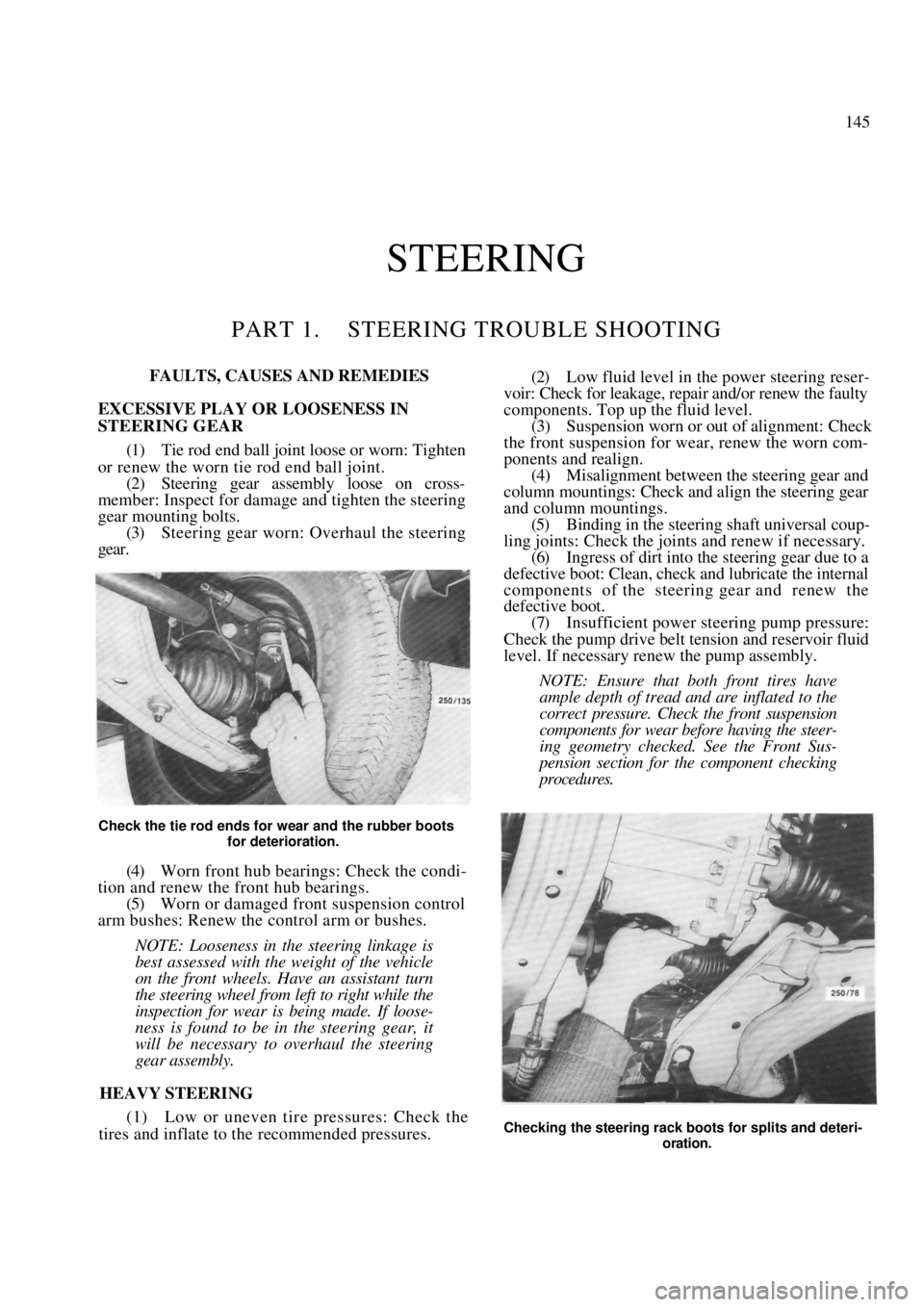
(1) Tie rod end ball joint loose or worn: Tighten
or renew the worn tie rod end ball joint. (2) Steering gear assembly loose on cross-
member: Inspect for damage and tighten the steering
gear mounting bolts. (3) Steering gear worn: Overhaul the steering
gear.
(2) Low fluid level in the power steering reser-
voir: Check for leakage, repa ir and/or renew the faulty
components. Top up the fluid level.
(3) Suspension worn or out of alignment: Check
the front suspension for wear, renew the worn com-
ponents and realign. (4) Misalignment between the steering gear and
column mountings: Check and align the steering gear
and column mountings. (5) Binding in the steering shaft universal coup-
ling joints: Check the join ts and renew if necessary.
(6) Ingress of dirt into the steering gear due to a
defective boot: Clean, check and lubricate the internal
components of the steering gear and renew the
defective boot. (7) Insufficient power steering pump pressure:
Check the pump drive belt tension and reservoir fluid
level. If necessary renew the pump assembly.
NOTE: Ensure that both front tires have
ample depth of tread and are inflated to the
correct pressure. Check the front suspension
components for wear before having the steer-
ing geometry checked. See the Front Sus-
pension section for the component checking
procedures.
Check the tie rod ends for wear and the rubber boots for deterioration.
(4) Worn front hub bearings: Check the condi-
tion and renew the front hub bearings. (5) Worn or damaged front suspension control
arm bushes: Renew the control arm or bushes.
NOTE: Looseness in th e steering linkage is
best assessed with the weight of the vehicle
on the front wheels. Have an assistant turn
the steering wheel from left to right while the
inspection for wear is being made. If loose-
ness is found to be in the steering gear, it
will be necessary to overhaul the steering
gear assembly.
HEAVY STEERING
(1) Low or uneven tir e pressures: Check the
tires and inflate to the recommended pressures.
Checking the steering rack boot s for splits and deteri-
oration.
Page 146 of 238
146 Steering — Part 1
STEERING PULLS TO ONE SIDE
(1) Uneven tire wear or pressures: Check the
condition of the tires and inflate to the recommended
pressures.
(2) Incorrect front wheel alignment: Check and
align the front end.
(3) Dragging brakes: Check each wheel for drag-
ging brakes. Overhaul the brakes as necessary. (4) Damaged suspension or crossmember: In-
spect and renew the damaged components. (5) Faulty power steering gear assembly: Re-
move the power steering gear for overhaul.
FRONT WHEEL WOBBLE OR SHIMMY
(1) Uneven tire wear or incorrect tire pressures;
Check the condition of the tires and inflate to the
recommended pressures. (2) Tire or wheel imbalance: Check and balance
as necessary (3) Worn or badly adjusted hub bearings: Check
the condition and adjust the front hub bearings.
(4) Faulty or worn suspension, units: Check and
overhaul or renew as a pair.
NOTE: Check the steering linkage as previ-
ously described. Raise the front of the vehi-
cle and check the adjustment of the hub
bearings by moving the road wheel in and
out at the top and bottom. No movement in
the bearings should be felt. Check the sus-
pension units as outlined in the Front Sus-
pension section.
STEERING ERRATIC OR WANDERING
(1) Incorrect or uneven wheel alignment setting:
Check and adjust th e steering geometry.
(2) Smooth front tires: Check and renew the
tires as necessary.
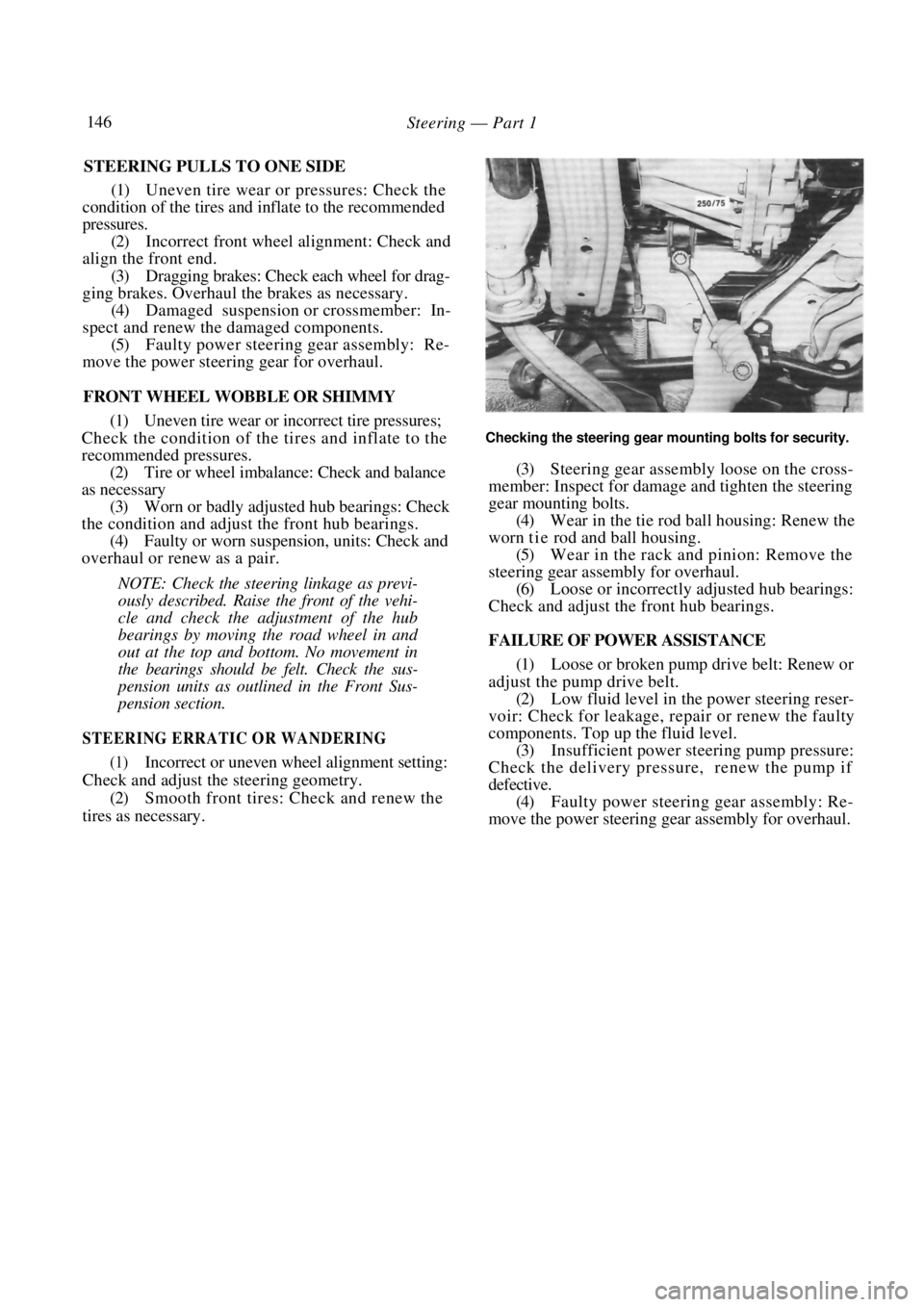
Checking the steering gear mounting bolts for security.
(3) Steering gear assembly loose on the cross-
member: Inspect for damage and tighten the steering
gear mounting bolts.
(4) Wear in the tie rod ball housing: Renew the
worn t i e rod and ball housing. (5) Wear in the rack and pinion: Remove the
steering gear assembly for overhaul. (6) Loose or incorrectly adjusted hub bearings:
Check and adjust the front hub bearings.
FAILURE OF POWER ASSISTANCE
(1) Loose or broken pump drive belt: Renew or
adjust the pump drive belt.
(2) Low fluid level in the power steering reser-
voir: Check for leakage, repair or renew the faulty
components. Top up the fluid level. (3) Insufficient power steering pump pressure:
Check the delivery pressure, renew the pump if
defective. (4) Faulty power steering gear assembly: Re-
move the power steering gear assembly for overhaul.
Page 152 of 238

152
PART 3. POWER STEERING
SPECIFICATIONS
Steering gear type ................Rack and pinion with
integral power cylinder
Steering column type .................... Energy absorbing
collapsible and lilt adjustable
Steering wheel free play ................................. 35 mm
Number of turns lock to lock:
TRW ...............................................................2.82
PR24SA ........................................................... 2.7
Linkage.....................................Direct from rack ends
to ti e rods and steering knuckles
Power steering pump
maximum pr essure.................................... 6 865 kPa
Lubricant ...................................................... Dexron II
TORQUE WRENCH SETTINGS
Steering gear to bulkhead mounting bolts... 108 Nm
Tie rod to steering knuckle nut ...................... 98 Nm
Tie rod to tie rod end locknut....................... 98 Nm
Tie rod ball housing to rack............................ 88 Nm
Power steering pump pulley nut ..................... 68 Nm
1. DESCRIPTION
The vehicles covered by this manual are equipped
with either a TRW power steering system or a
Japanese PR24SA power steering system.
Both types are similar in construction and appear-
ance.
The power steering is a rack and pinion type
which is mounted on the lower section of the engine
compartment bulkhead by rubber mountings and
brackets.
Hydraulic pressure is supplied to the power
steering gear by a pump driven by a drive belt from
the engine.
The power steering pump has a separate fluid
reservoir located on the righ t side of the bulkhead.
No lubrication of the steering gear or steering
pump is required in service and in the event of the
loss of power assistance, the steering will continue to
operate but will require a greatly increased effort.
However, as the steering gear and pump are lubricated
by the power steering fluid, the cause of the loss of
power steering or fluid loss must be determined and
repaired promptly to prevent damage to the steering
pump and to a lesser extent, the steering gear.
The t i e rod ends and rubb er boots can be renewed
without removing the steering gear from the vehicle.
To renew the integral t i e rod and tie rod ball housings,
the steering gear must be removed.
As specialist knowledge and equipment are re-
quired to overhaul the power steering gear and the
hydraulic pump, it is recommended that these op-
erations be carried out by an authorized dealer.
However, procedures for the removal and installa-
tion of the steering gear and pump are fully de-
scribed in this section.
The steering column is of the energy absorbing
type and is designed to collapse in the event of a
severe front end collision. The energy absorbing com-
ponents are the column tu bes, steering shaft and tilt
bracket breakaway capsules. All these components
should be handled with extr eme care if service opera-
tions are to be carried out on the steering column
assembly.
2. IN CAR ADJUSTMENTS, CHECKS AND
MINOR REPAIRS
If the power steering system becomes partially or
fully inoperative it is most important that the follow-
ing preliminary inspection and testing procedure be
performed prior to undertaking any trouble shooting
or repair operations.
PUMP DRIVE BELT
Inspect the pump drive belt for breakage, glazing
or wear. If any of these characteristics are evident,
renew the belt using only a genuine replacement.
If the belt is loose but still serviceable, adjust it
using the procedure outlined in the Engine Tune-up
section.
NOTE: In most cases a loose drive belt can
be heard squealing when a load is placed on
the pump as the steering wheel is turned or
as the engine speed is increased.
Checking the power steering pump drive belt for
deterioration.
Page 153 of 238

Steering — Part 3 153
TO CHECK FLUID LEVEL
Check the fluid level in the power steering reser-
voir when the fluid is cold.
If it is necessary to top up the fluid, fill to between
the arrow marks on the dipstick using the recom-
mended fluid.
NOTE: Do not overfill the reservoir.
Checking the power steering fluid level using the
dipstick incorporated in the cap.
TO CHECK FOR FLUID LEAKS
Using a suitable solvent, clean around all power
steering assemblies and hose fittings where fluid
leakage might occur and start the engine. Turn the
steering wheel from one steering lock to the other
several times and stop the engine. Check for leakage.
Where leakage is found at ho se fittings, tighten and
recheck.
If the leak remains, renew the hoses or fittings as
required.
Where leakage is found in the steering gear
assembly or pump assembly, specialist attention is
necessary.
TO CHECK STEERING WHEEL FREE PLAY
With the engine running and the steering wheel in
the straight ahead positi on, measure the free move-
ment of the steering wheel before the front wheels
move. This is specified as steering wheel free play and
if it exceeds Specifications, check for free play in the
steering linkages and the universal coupling joints. If
these components are satisfactory, it will be necessary
to remove the steering gear from the vehicle for
renewal or overhaul.
PUMP BELT TENSION
The procedure for adjusting the power steering
pump bell tension is describe d in the Engine Tune-up
section
TO PURGE THE POWER STEERING SYSTEM
OF AIR
(1) Check that the pump reservoir is filled to the
correct mark on the dipstick. (2) Raise the front of the vehicle and support it
on chassis stands. (3) Turn the steering wheel quickly from lock to
lock several times, recheck the fluid level within the
pump reservoir and top up if required. (4) Start the engine, allow it to idle and slowly
turn the steering wheel from lock to lock several times.
Do not hold the steering at full lock for more than 15
seconds. (5) Check the fluid level in the pump reservoir,
top up if necessary. (6) If the fluid is aerated within the pump
reservoir or if pump noise persists, repeat operations
(3) to (6).
3. STEERING WHEEL
The procedure for removing and installing the
steering wheel is fully covered in the Manual Steering
section under the above heading.
4. STEERING COLUMN
The procedure for removing, dismantling and
assembling the steering column is fully covered in the
Manual Steering section under the above heading.
5. POWER STEERING PUMP
TO REMOVE AND INSTAL
( 1 ) Disconnect the negative battery terminal.
View of the power steering pump removed from the
vehicle.
Page 154 of 238

154 Steering —
(2) Remove the air inlet duct from the air
cleaner and throttle body. (3) Position a container or a piece of cloth
beneath the steering pump reservoir and disconnect
the fluid return and power steering pump supply hose
from the reservoir.
(4) Loosen the steering pump drive belt as
described in the Engi ne Tune-up section.
(5) Loosen the return hose clamp and the supply
union and disconnect the hoses from the power
steering pump. Plug the hoses to prevent the loss of
fluid.
(6) Loosen the retaining bolts and withdraw the
pump. (7) Thoroughly clean the exterior of the steering
pump and inspect it for cracks, damage and signs of
leakage.
Installation is a reversal of the removal procedure
with attention to the following points:
(1) Install the pump and retaining bolts.
(2) Install the drive belt and adjust it as de-
scribed in the Engine Tune-up section. (3) Install the hoses to the power steering pump
and tighten securely. (4) Top up the pump reservoir and purge the
power steering system of air as previously described.
TO OVERHAUL
As specialist knowledge and equipment arc re-
quired to overhaul the power steering pump, it is
recommended that this operation be performed by an
authorized dealer or steering specialist.
6. POWER STEERING GEAR ASSEMBLY
Special Equipment Required:
To Renew Tie Rod Ball Housings — Large Still-
sons
TO REMOVE AND INSTAL
The procedures for removing and installing the
power steering gear are similar to those carried out in
the Manual Steering section under the Steering Gear
Assembly heading except fo r the following differences.
(1) Place a container under the pressure and
return pipes that are conn ected to the steering gear
valve housing. Remove the pipes and allow the fluid
to drain into the container. (2) Suitably seal the pipes and the steering gear
to prevent the entry of di rt whilst the pipes are
removed.
(3) Upon removal of the power steering gear,
thoroughly clean the steering gear except the tie rod
ends in a suitable solvent. Be careful not to allow the
solvent to enter the apertu res where the pressure and
return pipes were removed. (4) Check the pipes and co nnections for cracks,
damage or obstructions and renew as necessary.
Installed view of the power steering gear with the
engine removed.
Installation is a reversal of the removal procedure
with attention to the following points:
(1) Install the pressure and return pipes to the
steering gear valve housing and tighten securely. (2) Fill the power steering reservoir to the cor-
rect level and bleed the system as described previously
under the heading In Car Adjustments. Checks and
Minor Repairs. (3) Check all power steering pipe connections
for leaks and repair as necessary. (4) Check, and if necessary, adjust the front
wheel toe in as described in the Front Suspension
section. After adjustment ensure that the rubber boots
are not distorted or twisted and the rubber boot
clamps and clips are facing downward.
TO OVERHAUL
As specialist knowledge and equipment are re-
quired to overhaul the power steering gear, it is rec-
ommended that this opera tion be performed by an
authorized dealer or steering specialist.
TO RENEW TIE ROD BALL HOUSINGS
TRW Steering Gear
The renewal of the tie rod ball housings is the
same as for the manual steering gear. Refer to Part 2.
Manual Steering section.
PR24SA Steering Gear
(1) Remove the power steering gear assembly
from the vehicle as previously described.
(2) Carefully mount the power steering gear in a
vice equipped with soft jaws. Loosen the tie rod end
locknuts without disturbing the location of the tie rod
ends and unscrew the tie rod ends, taking note of the
number of turns required to remove them. Unscrew
and remove the locknuts from the tie rod. (3) Remove the clamps from the rubber boots
and remove the boots.
Page 190 of 238

190
ELECTRICAL SYSTEM
CAUTION: To prevent severe electrical shock extreme care must be taken when
working on or near the electronic ignition system as dangerous high tension voltages
are produced in both the primary and secondary circuits. See the text fo\
r
precautionary notes.
SPECIFICATIONS
BATTERY
Type ..................................................12 volt lead acid
Polarity to earth .................................... Negative ( - )
Specific gravity:
Fully charged ................................... A bove 1.250
Fully discharged ................................Below 1.130
ALTERNATOR
Make .................................................Bosch or Hitachi
Maximum output .......................................... 70 amps
Polarity to earth .................................... Negative ( - )
Stator windings ......................................... Star wound
Regulator type ................................................ Integral
Brush length minimum:
Bosch ........................................................ 5.0 mm
Hitachi ............................. 6.0 mm or limit mark
STARTER MOTOR
Make .................................................Hitach i or Bosch
Type ............................ 4 pole 4 brush reduction gear
Operation control.................................. Solenoid and
overrunning clutch
Undercut of commutator (maximum):
Hitachi ...................................................... 0.8 mm
Brush length (minimum):
Bosch ........................................................ 8.0 mm
Hitachi ........................................................11 mm
Brush spring tension;
Hitachi ............................................... 15.7-19.6 N
Hitachi:
Drive pinion stopper clearance ........ 0.3-1.5 mm
Selective fit adjuster plates ........ 0.5 and 0.8 mm
IGNITION SYSTEM
The ignition system is an integral part of the
engine management system. The Specifications, testing
and overhaul procedures are fully covered in the Fuel
and Engine Management section.
TORQUE WRENCH SETTINGS
Alternator pulley retaining nut:
Bosch ......................................................... 50 Nm
Hitachi ....................................................... 59 Nm
1. BATTERY AND CHARGING SYSTEM
TROUBLE SHOOTING
BATTERY UNDERCHARGED
3. Loose or broken drive belt: Adjust or renew
the drive belt. 4. Faulty alternator regulator; Renew the regu-
lator unit.
5. Faulty battery: Install a new battery of
the
recommended type and capacity. 6. Faulty alternator: Overhaul or renew the
alternator. 7. Fault in the charging circuit wiring: Check
and repair or renew the wiring harness. 8. Faulty connections in the charging circuit:
Check and repair the connections. 9. Fusible link blown; Rectify the fault and
renew as necessary.
NOTE: Check the state of charge (specific
gravity) of the battery- as described under
the
Battery heading in this section. If the battery
is undercharged, check the possible causes in
the order given.
BATTERY OVERCHARGED
• Faulty alternator regulator unit:
Renew the
regulator unit.
• Faulty alternator: Overhaul or
renew the
alternator. • Faulty charging circuit wiring or
connec-
tions: Check and renew or repair the faulty
compo-
nents.
NOTE: An overcharged battery is indicated
by continual loss of water through boiling.
Page 191 of 238
Electrical System 191
This is usually accompanied by discoloura-
tion of the electrolyte.
CHARGE INDICATOR LAMP REMAINS ON
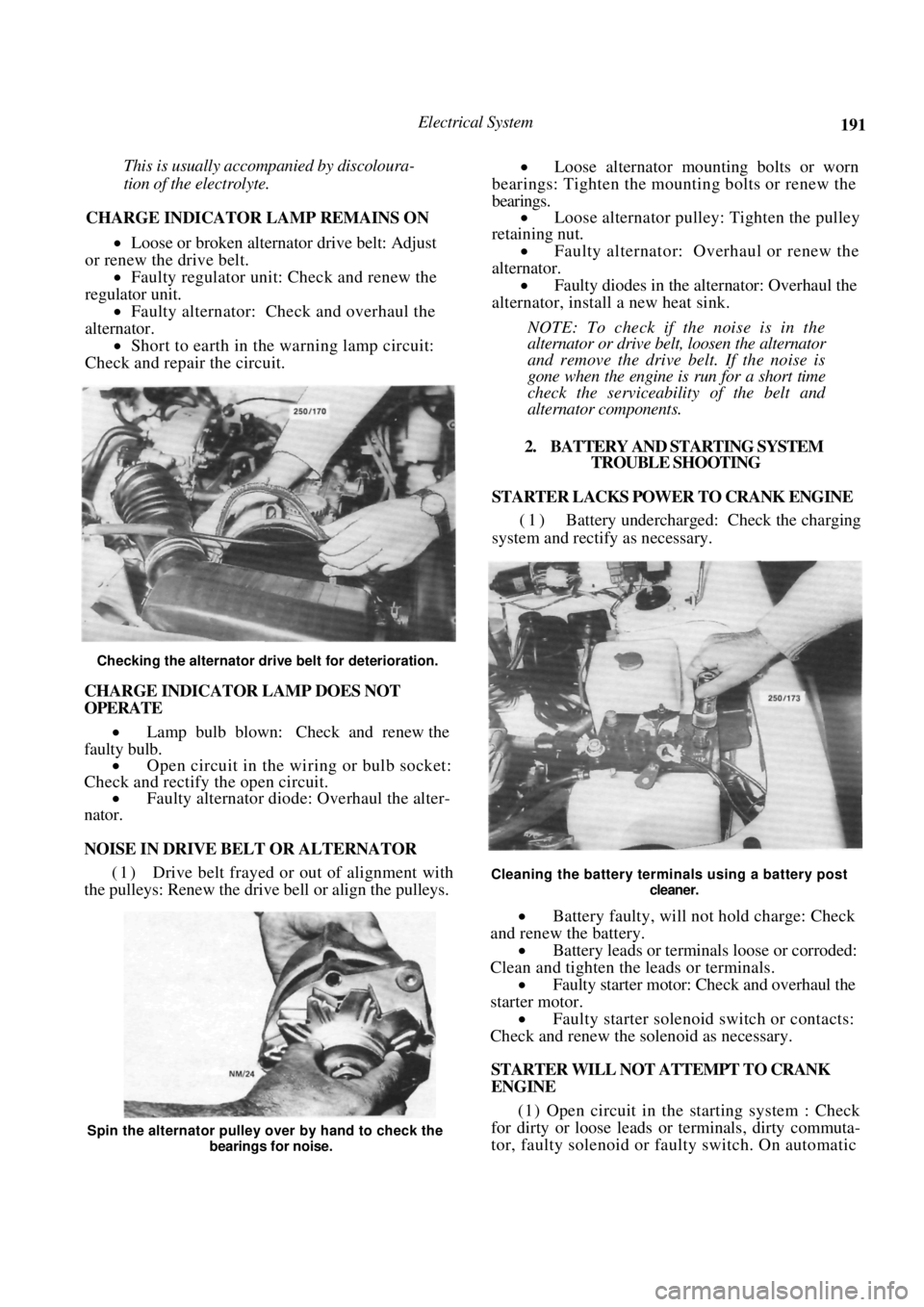
• Loose or broken alternator drive belt: Adjust
or renew the drive belt.
• Faulty regulator unit: Check and renew the
regulator unit. • Faulty alternator: Check and overhaul the
alternator. • Short to earth in the warning lamp circuit:
Check and repair the circuit.
Checking the alternator drive belt for deterioration.
CHARGE INDICATOR LAMP DOES NOT
OPERATE
• Lamp bulb blown: Check and renew the
faulty bulb. • Open circuit in the wi ring or bulb socket:
Check and rectify the open circuit. • Faulty alternator diode: Overhaul the alter-
nator.
NOISE IN DRIVE BELT OR ALTERNATOR
(1) Drive belt frayed or out of alignment with
the pulleys: Renew the drive bell or align the pulleys.
• Loose alternator moun ting bolts or worn
bearings: Tighten the mounting bolts or renew the
bearings. • Loose alternator pulley: Tighten the pulley
retaining nut.
• Faulty alternator: Overhaul or renew the
alternator. • Faulty diodes in the alternator: Overhaul the
alternator, install a new heat sink.
NOTE: To check if the noise is in the
alternator or drive belt, loosen the alternator
and remove the drive belt. If the noise is
gone when the engine is run for a short time
check the serviceability of the belt and
alternator components.
2. BATTERY AND STARTING SYSTEM TROUBLE SHOOTING
STARTER LACKS POWER TO CRANK ENGINE
(1) Battery undercharged: Check the charging
system and rectify as necessary.
Cleaning the battery terminals using a battery post
cleaner.
• Battery faulty, will not hold charge: Check
and renew the battery. • Battery leads or terminals loose or corroded:
Clean and tighten the leads or terminals.
• Faulty starter motor: Check and overhaul the
starter motor. • Faulty starter solenoid switch or contacts:
Check and renew the solenoid as necessary.
STARTER WILL NOT ATTEMPT TO CRANK
ENGINE
(1 ) Open circuit in the starting system : Check
for dirty or loose leads or terminals, dirty commuta-
tor, faulty solenoid or faulty switch. On automatic
Spin the alternator pulley over by hand to check the
bearings for noise.
Page 196 of 238
196 Electrical System
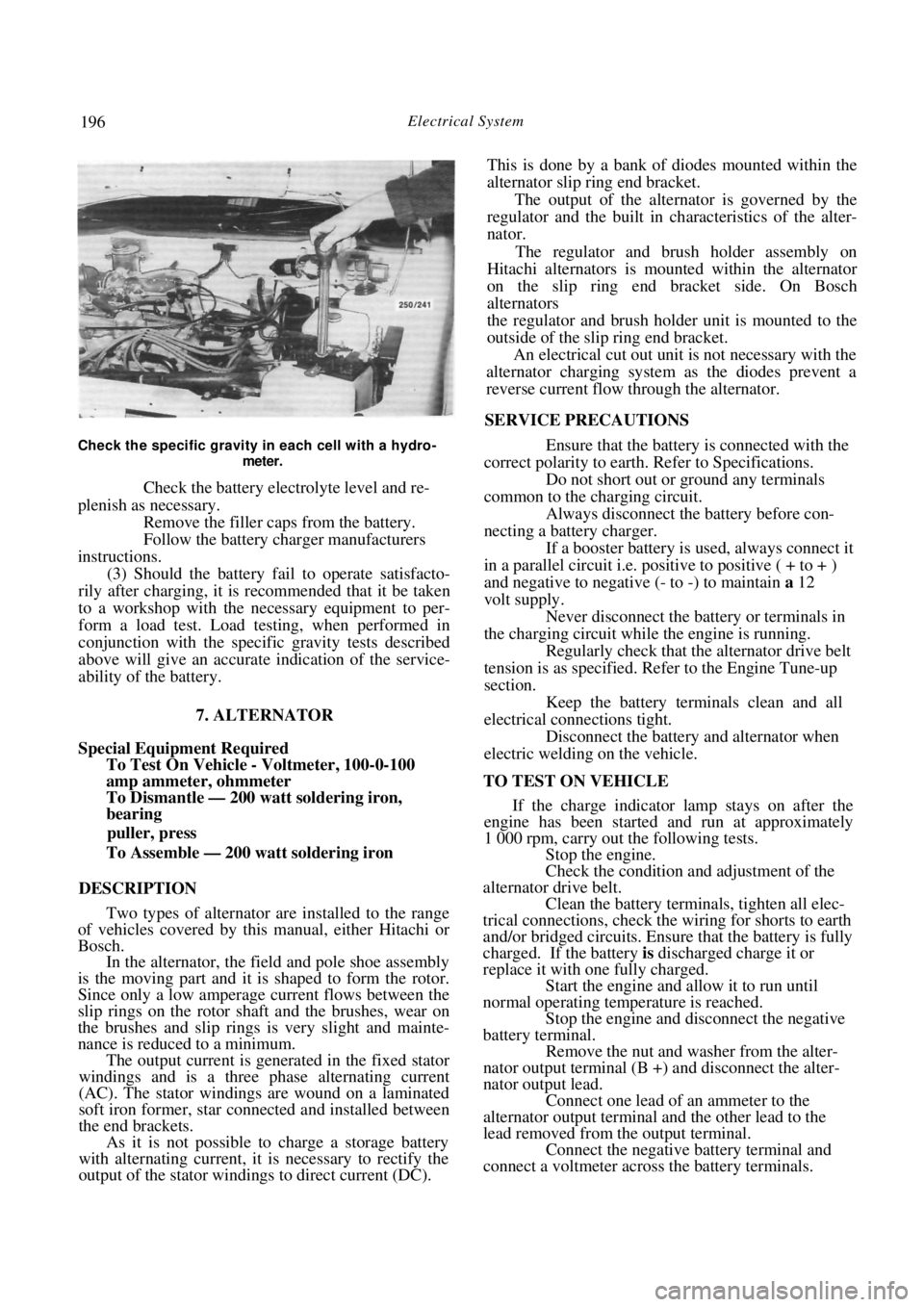
Check the specific gravity in each cell with a hydro-
meter.
Check the battery electrolyte level and re-
plenish as necessary. Remove the filler cap s from the battery.
Follow the battery charger manufacturers
instructions. (3) Should the battery fail to operate satisfacto-
rily after charging, it is recommended that it be taken
to a workshop with the necessary equipment to per-
form a load test. Load testing, when performed in
conjunction with the specific gravity tests described
above will give an accurate indication of the service-
ability of the battery.
7. ALTERNATOR
Special Equipment Required
To Test On Vehicle - Voltmeter, 100-0-100
amp ammeter, ohmmeter
To Dismantle — 200 watt soldering iron,
bearing
puller, press
To Assemble — 200 watt soldering iron
DESCRIPTION
Two types of alternator are installed to the range
of vehicles covered by this manual, either Hitachi or
Bosch. In the alternator, the field and pole shoe assembly
is the moving part and it is shaped to form the rotor.
Since only a low amperage current flows between the
slip rings on the rotor shaft and the brushes, wear on
the brushes and slip rings is very slight and mainte-
nance is reduced to a minimum. The output current is generated in the fixed stator
windings and is a three phase alternating current
(AC). The stator windings are wound on a laminated
soft iron former, star connected and installed between
the end brackets. As it is not possible to charge a storage battery
with alternating current, it is necessary to rectify the
output of the stator windings to direct current (DC). This is done by a bank of diodes mounted within the
alternator slip ring end bracket.
The output of the alternator is governed by the
regulator and the built in ch aracteristics of the alter-
nator.
The regulator and brush holder assembly on
Hitachi alternators is mounted within the alternator
on the slip ring end bracket side. On Bosch
alternators
the regulator and brush holder unit is mounted to the
outside of the slip ring end bracket. An electrical cut out unit is not necessary with the
alternator charging system as the diodes prevent a
reverse current flow through the alternator.
SERVICE PRECAUTIONS
Ensure that the battery is connected with the
correct polarity to earth. Refer to Specifications.
Do not short out or ground any terminals
common to the charging circuit. Always disconnect the battery before con-
necting a battery charger.
If a booster battery is used, always connect it
in a parallel circuit i.e. positive to positive ( + to + )
and negative to negative (- to -) to maintain a 12
volt supply. Never disconnect the battery or terminals in
the charging circuit while the engine is running. Regularly check that the alternator drive belt
tension is as specified. Refer to the Engine Tune-up
section.
Keep the battery terminals clean and all
electrical connections tight. Disconnect the battery and alternator when
electric welding on the vehicle.
TO TEST ON VEHICLE If the charge indicator lamp stays on after the
engine has been started and run at approximately
1 000 rpm, carry out the following tests. Stop the engine.
Check the condition and adjustment of the
alternator drive belt. Clean the battery terminals, tighten all elec-
trical connections, check the wiring for shorts to earth
and/or bridged circuits. Ensure that the battery is fully
charged. If the battery is discharged charge it or
replace it with one fully charged. Start the engine and allow it to run until
normal operating temperature is reached.
Stop the engine and disconnect the negative
battery terminal.
Remove the nut and washer from the alter-
nator output terminal (B +) and disconnect the alter-
nator output lead. Connect one lead of an ammeter to the
alternator output terminal and the other lead to the
lead removed from the output terminal. Connect the negative battery terminal and
connect a voltmeter across the battery terminals.