ECU NISSAN QUEST 1996 V40 / 1.G User Guide
[x] Cancel search | Manufacturer: NISSAN, Model Year: 1996, Model line: QUEST, Model: NISSAN QUEST 1996 V40 / 1.GPages: 235, PDF Size: 1.77 MB
Page 63 of 235
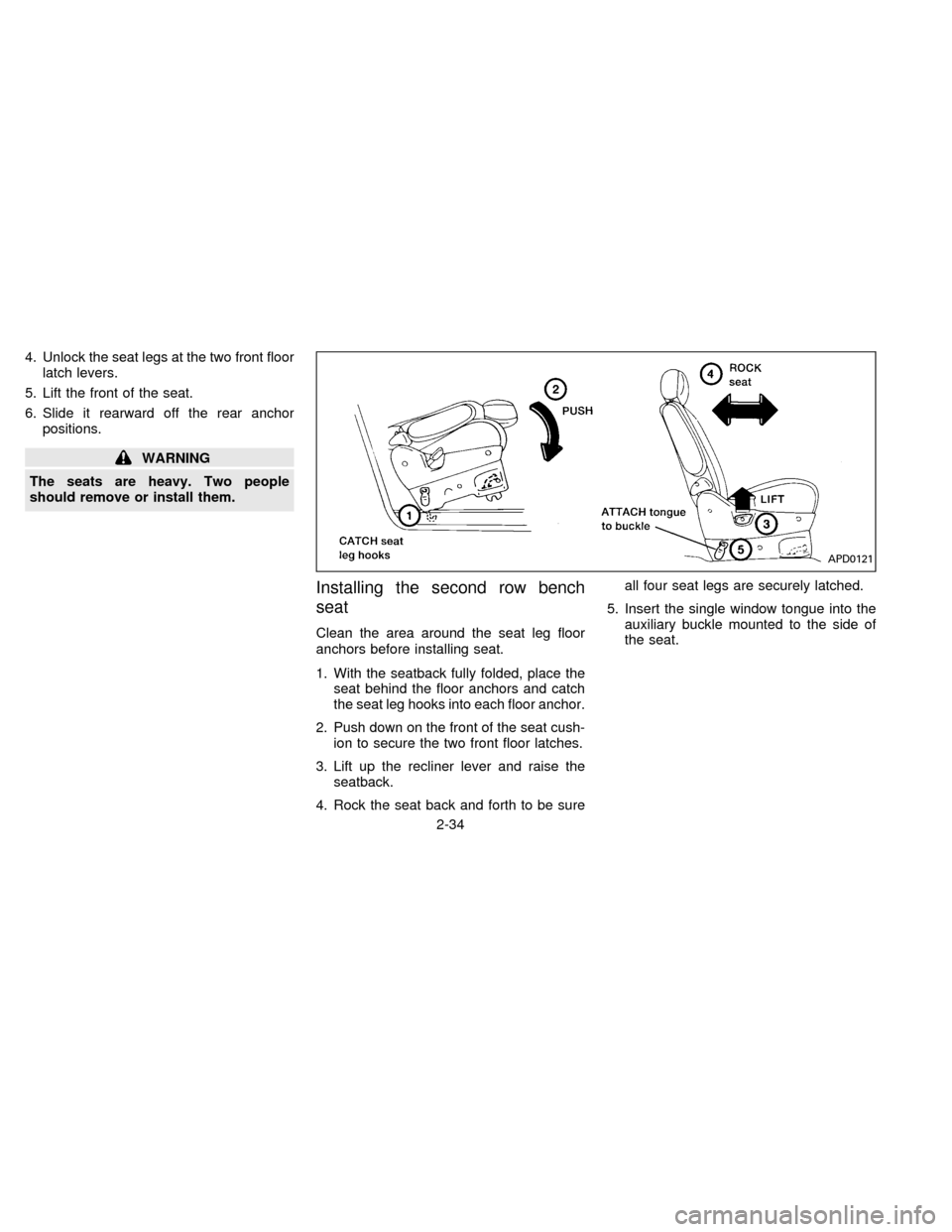
4. Unlock the seat legs at the two front floor
latch levers.
5. Lift the front of the seat.
6. Slide it rearward off the rear anchor
positions.
WARNING
The seats are heavy. Two people
should remove or install them.
Installing the second row bench
seat
Clean the area around the seat leg floor
anchors before installing seat.
1. With the seatback fully folded, place the
seat behind the floor anchors and catch
the seat leg hooks into each floor anchor.
2. Push down on the front of the seat cush-
ion to secure the two front floor latches.
3. Lift up the recliner lever and raise the
seatback.
4. Rock the seat back and forth to be sureall four seat legs are securely latched.
5. Insert the single window tongue into the
auxiliary buckle mounted to the side of
the seat.
APD0121
2-34
ZX
Page 64 of 235
Removing second row bucket seats
WARNING
cDo not remove or install seats while
the vehicle is moving.
cThe seats are heavy. Two people
should remove or install them.
cAfter adjustment, gently rock in the
seat to make sure it is securely
locked.cThe seatback should not be reclined
any more than needed for comfort
when the vehicle is moving. Seat
belts are most effective when the
passenger sits well back and
straight up in the seat. If the seat is
reclined, the risk of sliding under the
lap belt and being injured is
increased.
cWhen adjusting or moving any of the
seats in your vehicle, do not use any
of the seat belt buckles, tongues, or
webbing to carry or move the seats.
Lifting the seats by any of the seat
belts could damage them. Damaged
seat belts should be replaced at your
NISSAN dealer. Failure to follow
these instructions could increase
the chance and/or severity of injury
in an accident.
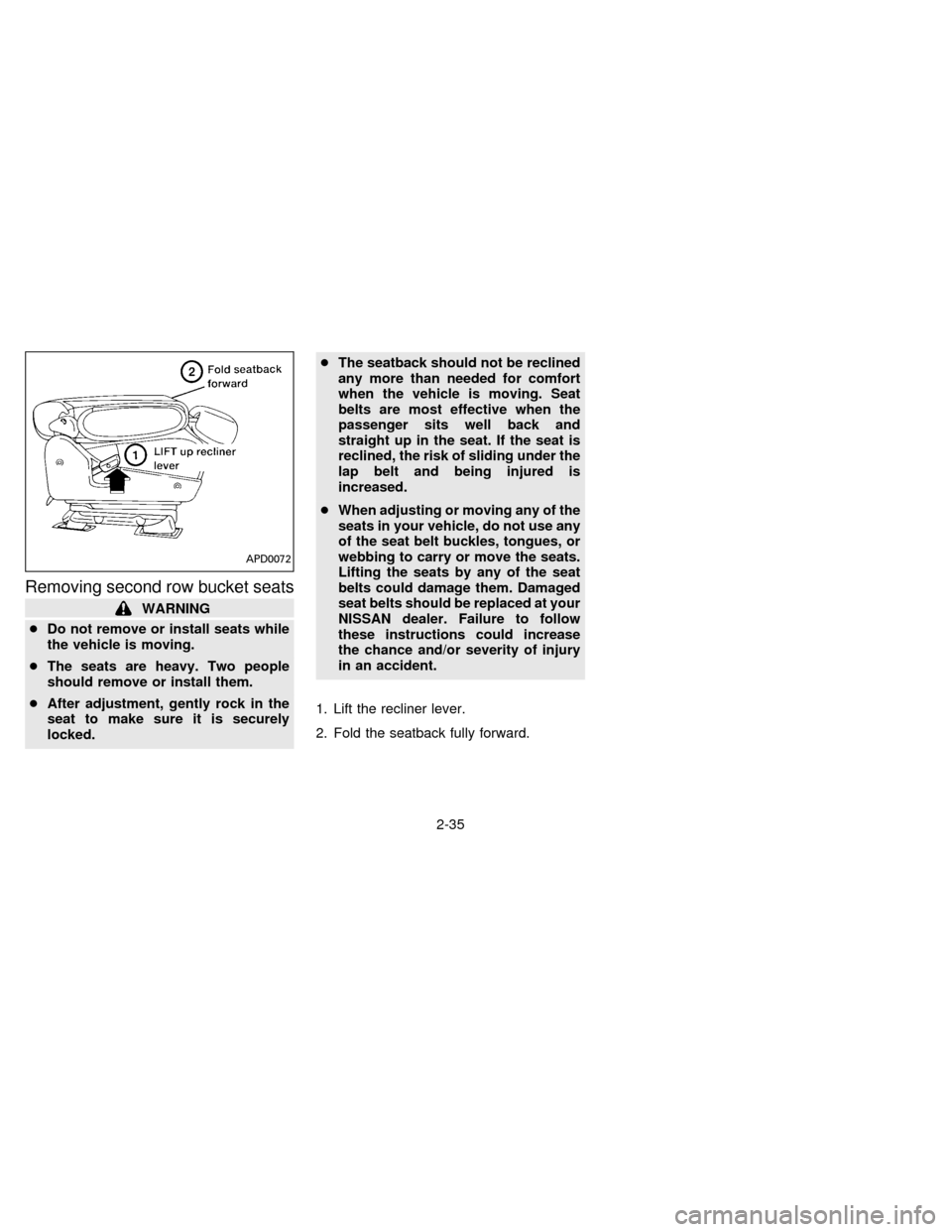
1. Lift the recliner lever.
2. Fold the seatback fully forward.
APD0072
2-35
ZX
Page 66 of 235
Installing the bucket seats
Clean the area around the seat floor attach-
ment.
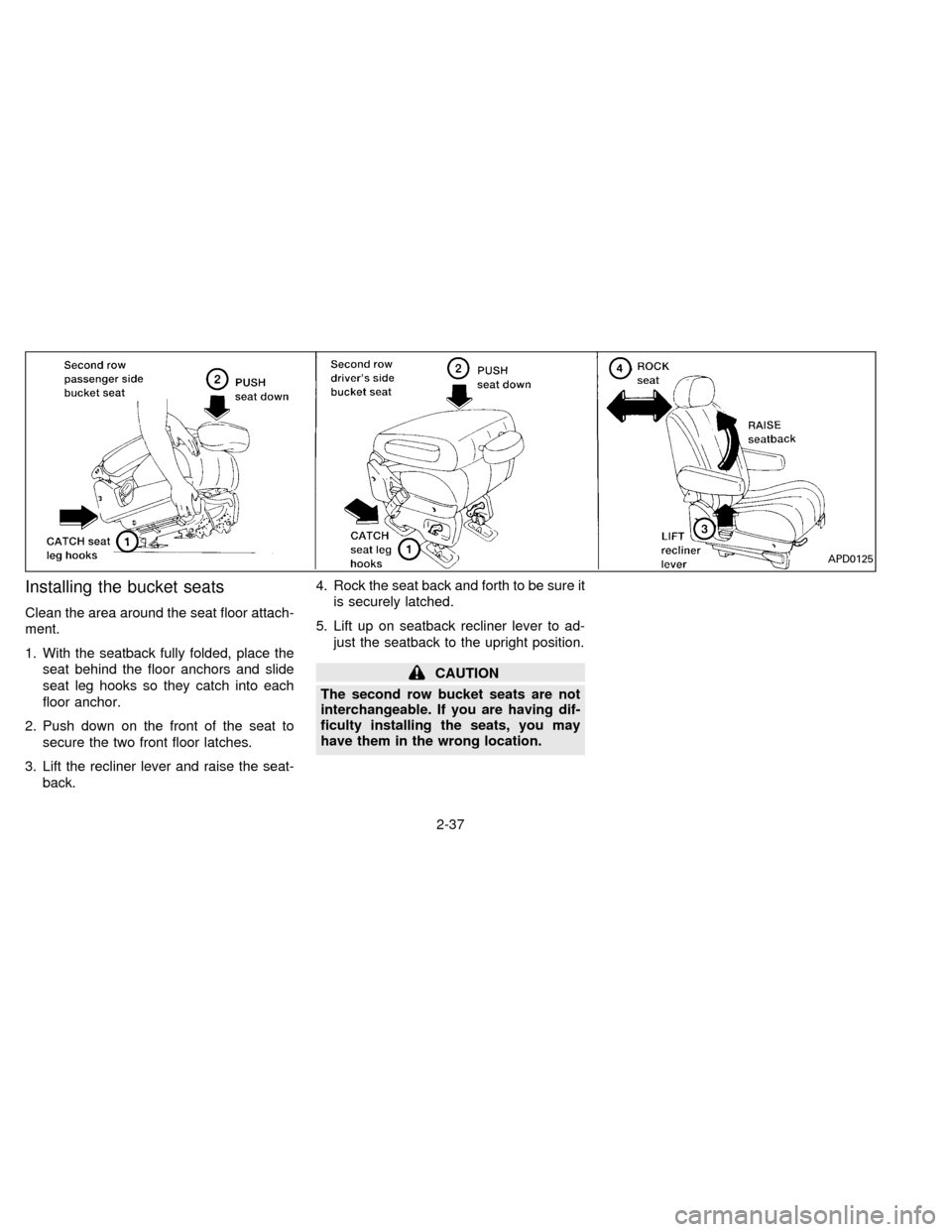
1. With the seatback fully folded, place the
seat behind the floor anchors and slide
seat leg hooks so they catch into each
floor anchor.
2. Push down on the front of the seat to
secure the two front floor latches.
3. Lift the recliner lever and raise the seat-
back.4. Rock the seat back and forth to be sure it
is securely latched.
5. Lift up on seatback recliner lever to ad-
just the seatback to the upright position.
CAUTION
The second row bucket seats are not
interchangeable. If you are having dif-
ficulty installing the seats, you may
have them in the wrong location.
APD0125
2-37
ZX
Page 70 of 235
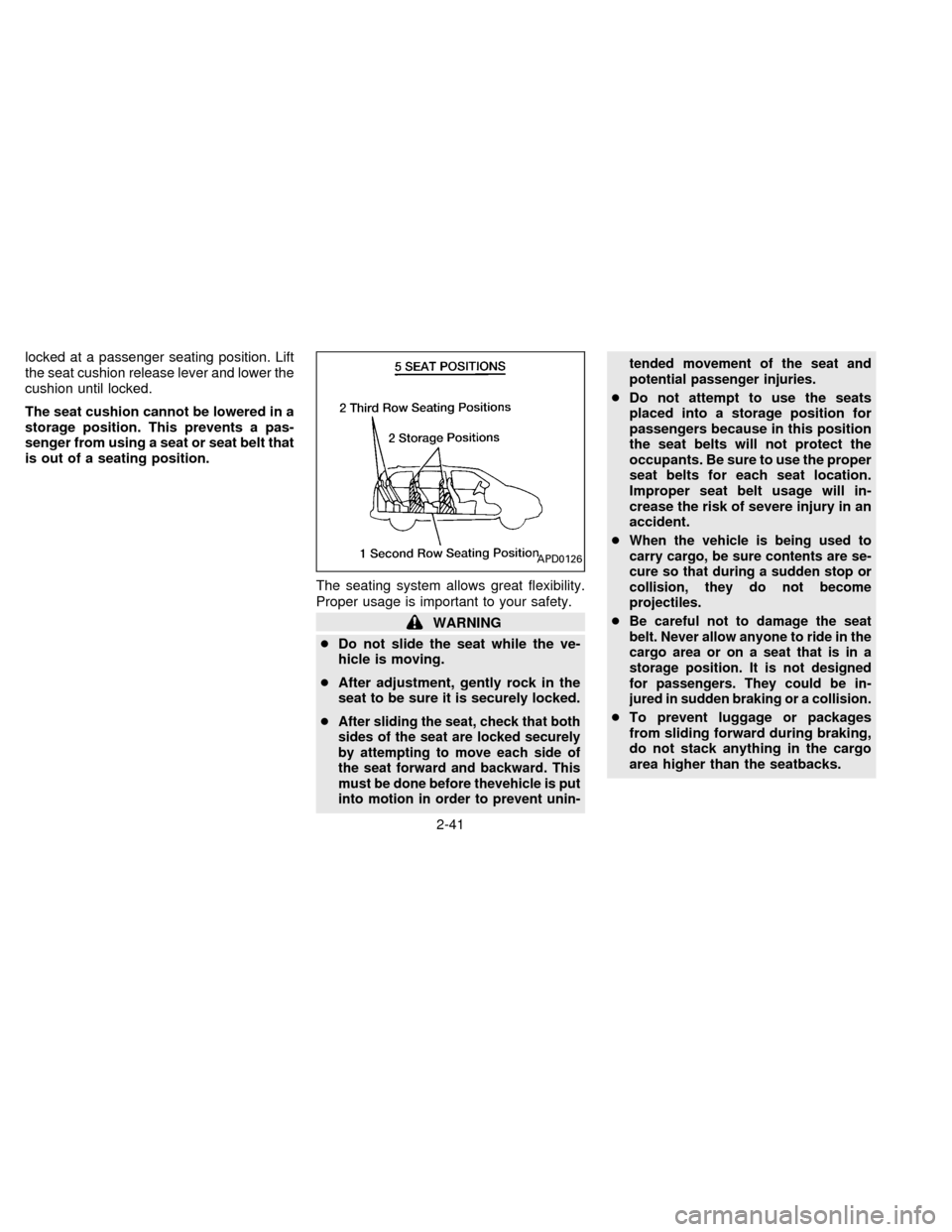
locked at a passenger seating position. Lift
the seat cushion release lever and lower the
cushion until locked.
The seat cushion cannot be lowered in a
storage position. This prevents a pas-
senger from using a seat or seat belt that
is out of a seating position.
The seating system allows great flexibility.
Proper usage is important to your safety.
WARNING
cDo not slide the seat while the ve-
hicle is moving.
cAfter adjustment, gently rock in the
seat to be sure it is securely locked.
c
After sliding the seat, check that both
sides of the seat are locked securely
by attempting to move each side of
the seat forward and backward. This
must be done before thevehicle is put
into motion in order to prevent unin-tended movement of the seat and
potential passenger injuries.
cDo not attempt to use the seats
placed into a storage position for
passengers because in this position
the seat belts will not protect the
occupants. Be sure to use the proper
seat belts for each seat location.
Improper seat belt usage will in-
crease the risk of severe injury in an
accident.
c
When the vehicle is being used to
carry cargo, be sure contents are se-
cure so that during a sudden stop or
collision, they do not become
projectiles.
cBe careful not to damage the seat
belt. Never allow anyone to ride in the
cargo area or on a seat that is in a
storage position. It is not designed
for passengers. They could be in-
jured in sudden braking or a collision.
cTo prevent luggage or packages
from sliding forward during braking,
do not stack anything in the cargo
area higher than the seatbacks.
APD0126
2-41
ZX
Page 76 of 235
PRECAUTIONS ON SEAT BELT
USAGE
Your chances of being injured or killed in an
accident and/or the severity of injury may be
greatly reduced if you are wearing your seat
belt and it is properly adjusted. NISSAN
strongly encourages you and all of your
passengers to buckle up every time you
drive, even if your seating position includes
an air bag.
Some states, provinces or territories re-
quire that seat belts be worn at all times
when a vehicle is being driven.
WARNING
cEvery person who drives or rides in
this vehicle should wear a seat belt
at all times. Children should be in
appropriate child restraints.
cThe belts should be adjusted to a
snug fit. Failure to do so will reduce
the effectiveness of the entire re-
straint system and increases the
chances or severity of injury in an
accident.cDo not wear the belts inside out or
twisted. Be sure the seat belt tongue
is securely fastened to the proper
buckle.
cDo not allow more than one person
to use the same seat belt.
cAll seat belt assemblies, including
retractors and attaching hardware,
should be inspected at your NISSAN
dealer after any collision. NISSAN
recommends that all seat belt as-
semblies in use during a collision be
replaced unless the collision was
minor and the belts show no damage
and continue to operate properly.
Seat belt assemblies not in use dur-
ing a collision should also be in-
spected and replaced if either dam-
age or improper operation is noted.
cNever carry more people in the ve-
hicle than there are seat belts.cIf the seat belt warning light glows
continuously while the ignition is
turned ON with all doors closed and
all seat belts fastened, it may indi-
cate a malfunction in the system.
Have the system checked by your
NISSAN dealer.
cBe sure to observe the following
cautions when using seat belts. Fail-
ure to do so could increase the
chance and/or severity of injury in an
accident.
cAlways route the shoulder belt over
your outer shoulder and across your
chest. Never run the belt under your
arm. Serious injury can occur if the
seat belt is not worn properly.
cPosition the lap belt as low as pos-
sible AROUND THE HIPS, NOT THE
WAIST.
cSerious injury or death can occur if
seat belts are not worn properly.
SEAT BELTS
2-47
ZX
Page 80 of 235
WARNING
After adjustment, release the button
and check that it does not move up and
down to make sure the shoulder belt
anchor is securely fixed in position.
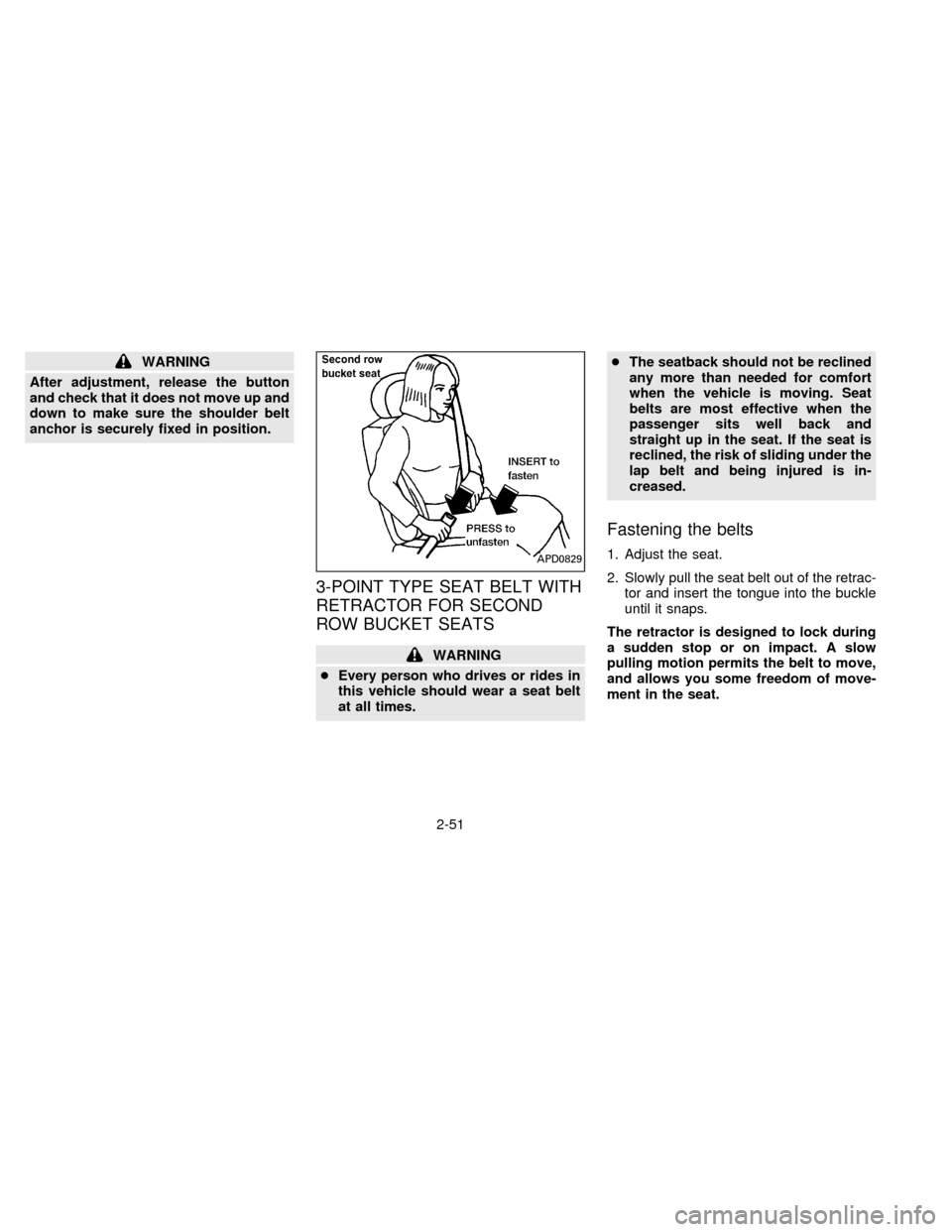
3-POINT TYPE SEAT BELT WITH
RETRACTOR FOR SECOND
ROW BUCKET SEATS
WARNING
cEvery person who drives or rides in
this vehicle should wear a seat belt
at all times.cThe seatback should not be reclined
any more than needed for comfort
when the vehicle is moving. Seat
belts are most effective when the
passenger sits well back and
straight up in the seat. If the seat is
reclined, the risk of sliding under the
lap belt and being injured is in-
creased.
Fastening the belts
1. Adjust the seat.
2. Slowly pull the seat belt out of the retrac-
tor and insert the tongue into the buckle
until it snaps.
The retractor is designed to lock during
a sudden stop or on impact. A slow
pulling motion permits the belt to move,
and allows you some freedom of move-
ment in the seat.APD0829
2-51
ZX
Page 82 of 235
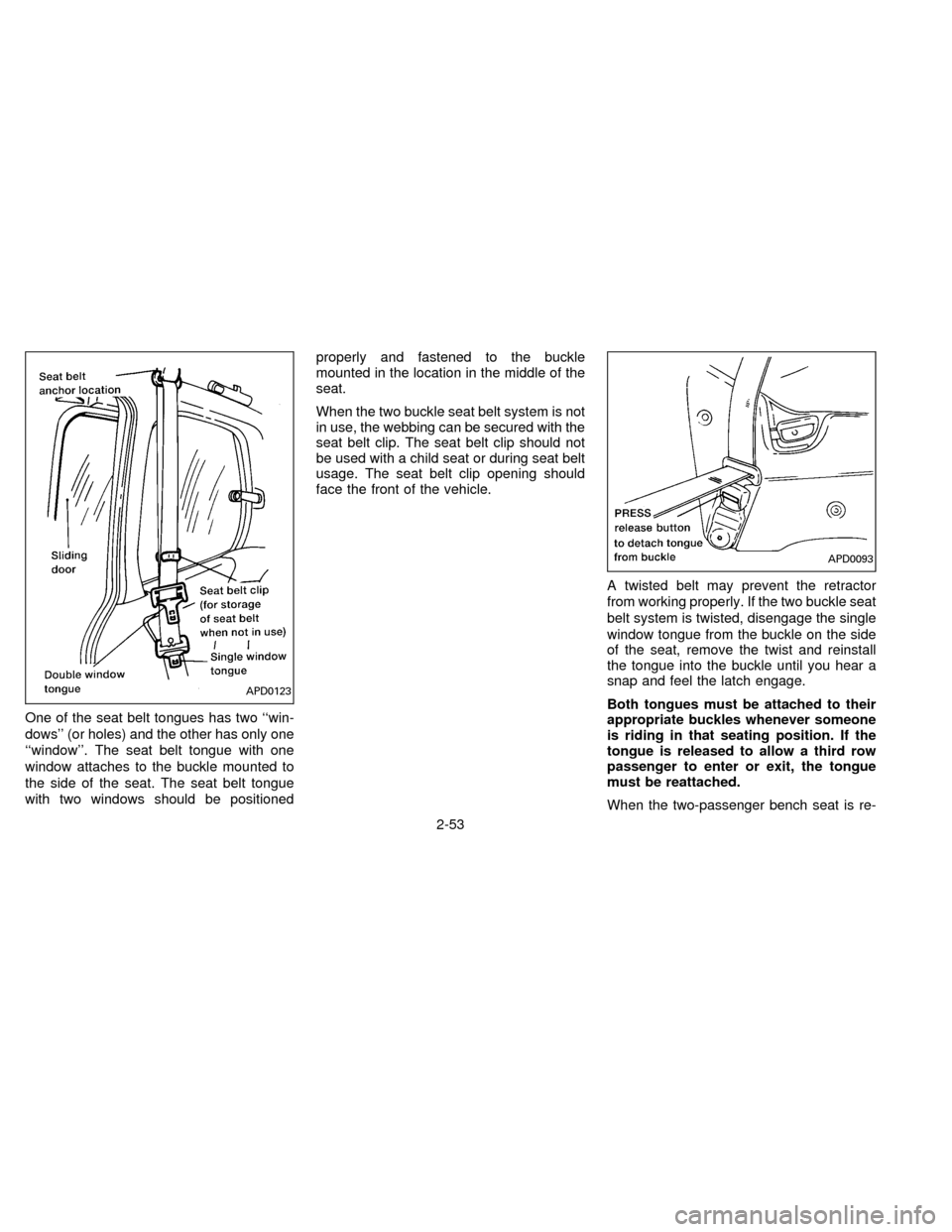
One of the seat belt tongues has two ``win-
dows'' (or holes) and the other has only one
``window''. The seat belt tongue with one
window attaches to the buckle mounted to
the side of the seat. The seat belt tongue
with two windows should be positionedproperly and fastened to the buckle
mounted in the location in the middle of the
seat.
When the two buckle seat belt system is not
in use, the webbing can be secured with the
seat belt clip. The seat belt clip should not
be used with a child seat or during seat belt
usage. The seat belt clip opening should
face the front of the vehicle.
A twisted belt may prevent the retractor
from working properly. If the two buckle seat
belt system is twisted, disengage the single
window tongue from the buckle on the side
of the seat, remove the twist and reinstall
the tongue into the buckle until you hear a
snap and feel the latch engage.
Both tongues must be attached to their
appropriate buckles whenever someone
is riding in that seating position. If the
tongue is released to allow a third row
passenger to enter or exit, the tongue
must be reattached.
When the two-passenger bench seat is re-
APD0123
APD0093
2-53
ZX
Page 88 of 235
cWhen your child restraint is not in
use, keep it secured with a seat belt
to prevent it from being thrown for-
ward in case of a sudden stop or
accident.
cRemember that a child restraint left
in a closed vehicle can become very
hot. Check the seating surface and
buckles before placing your child in
the child restraint.
cAll U.S. states and some provinces
or territories of Canada require that
infants and small children be re-
strained in approved child restraints
at all times while the vehicle is being
operated.
cAfter attaching the child restraint,
test it before you place the child in it.
Tilt it from side to side. Try to tug it
forward and check to see if the belt
holds the restraint in place. If the
restraint is not secure, tighten the
belt as necessary, or put the re-
straint in another seat and test it
again.cIf the child restraint is not anchored
properly, the risk of a child being
injured in a collision or a sudden
stop greatly increases.
cAdjustable seatbacks should be po-
sitioned to fit the child restraint, but
as upright as possible.
cFor a front facing child restraint, if
the seat position where it is installed
has a 3-point type lap/shoulder belt,
check to make sure the shoulder belt
does not go in front of the child's
face or neck. If it does, put the shoul-
der belt behind the child restraint.
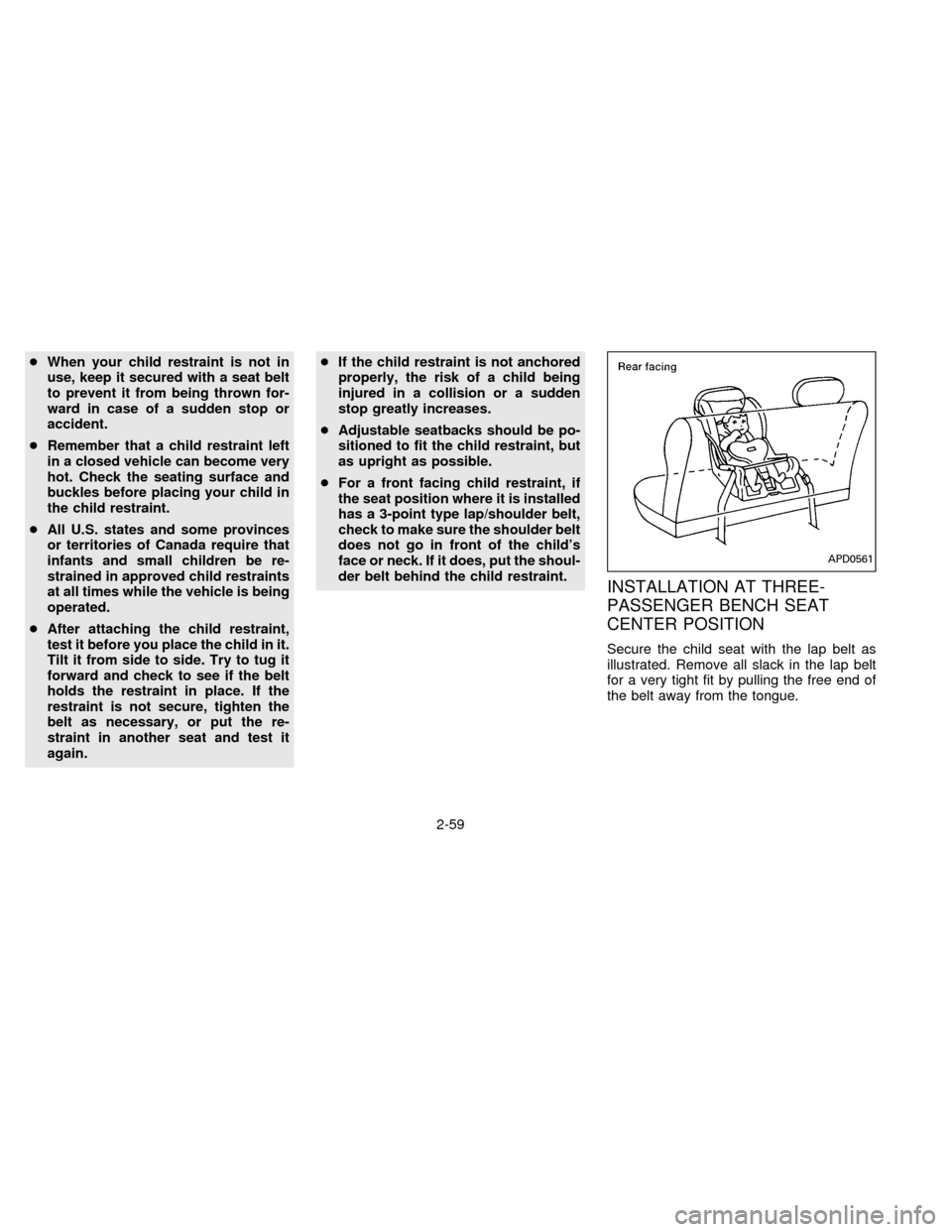
INSTALLATION AT THREE-
PASSENGER BENCH SEAT
CENTER POSITION
Secure the child seat with the lap belt as
illustrated. Remove all slack in the lap belt
for a very tight fit by pulling the free end of
the belt away from the tongue.
APD0561
2-59
ZX
Page 89 of 235
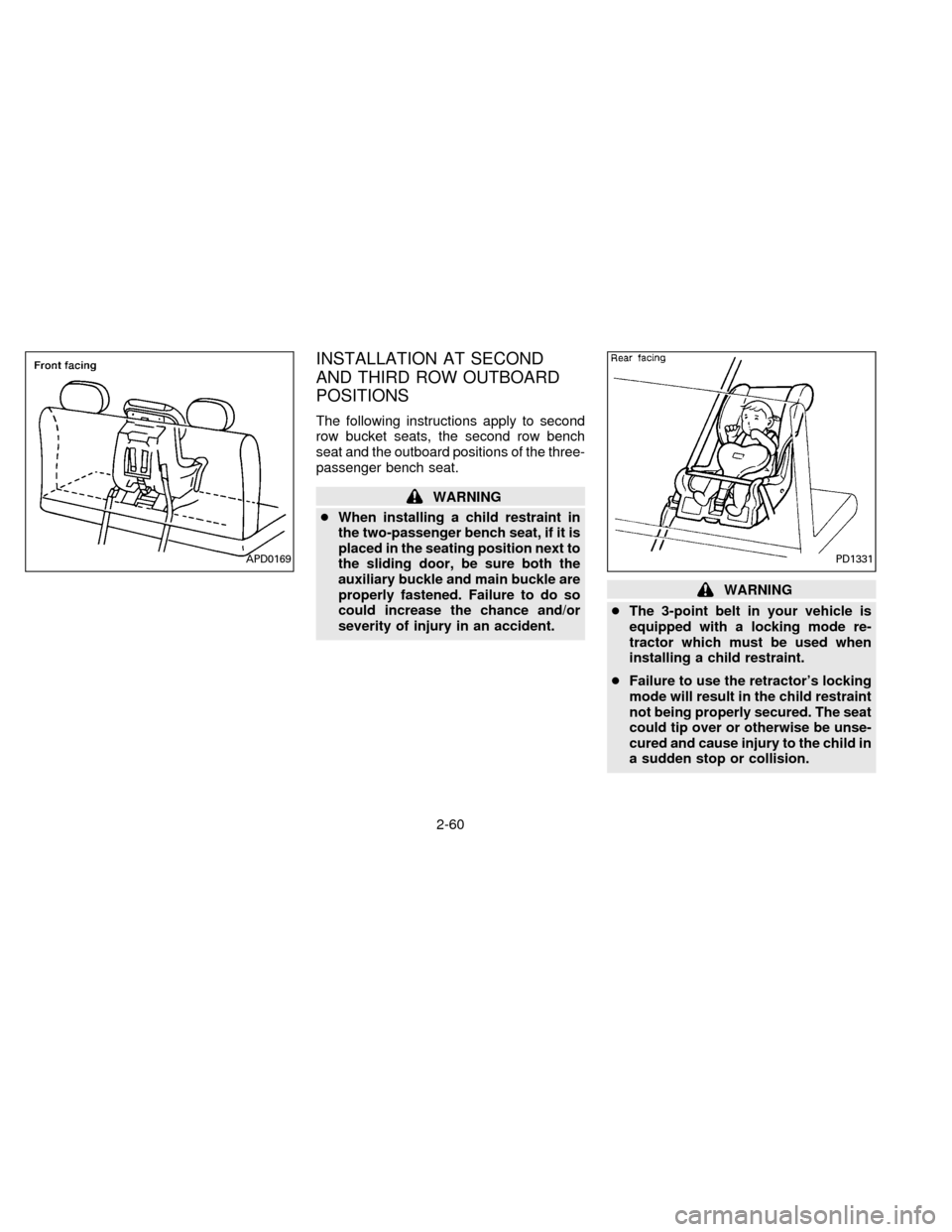
INSTALLATION AT SECOND
AND THIRD ROW OUTBOARD
POSITIONS
The following instructions apply to second
row bucket seats, the second row bench
seat and the outboard positions of the three-
passenger bench seat.
WARNING
cWhen installing a child restraint in
the two-passenger bench seat, if it is
placed in the seating position next to
the sliding door, be sure both the
auxiliary buckle and main buckle are
properly fastened. Failure to do so
could increase the chance and/or
severity of injury in an accident.
WARNING
cThe 3-point belt in your vehicle is
equipped with a locking mode re-
tractor which must be used when
installing a child restraint.
cFailure to use the retractor's locking
mode will result in the child restraint
not being properly secured. The seat
could tip over or otherwise be unse-
cured and cause injury to the child in
a sudden stop or collision.
PD1331APD0169
2-60
ZX
Page 90 of 235
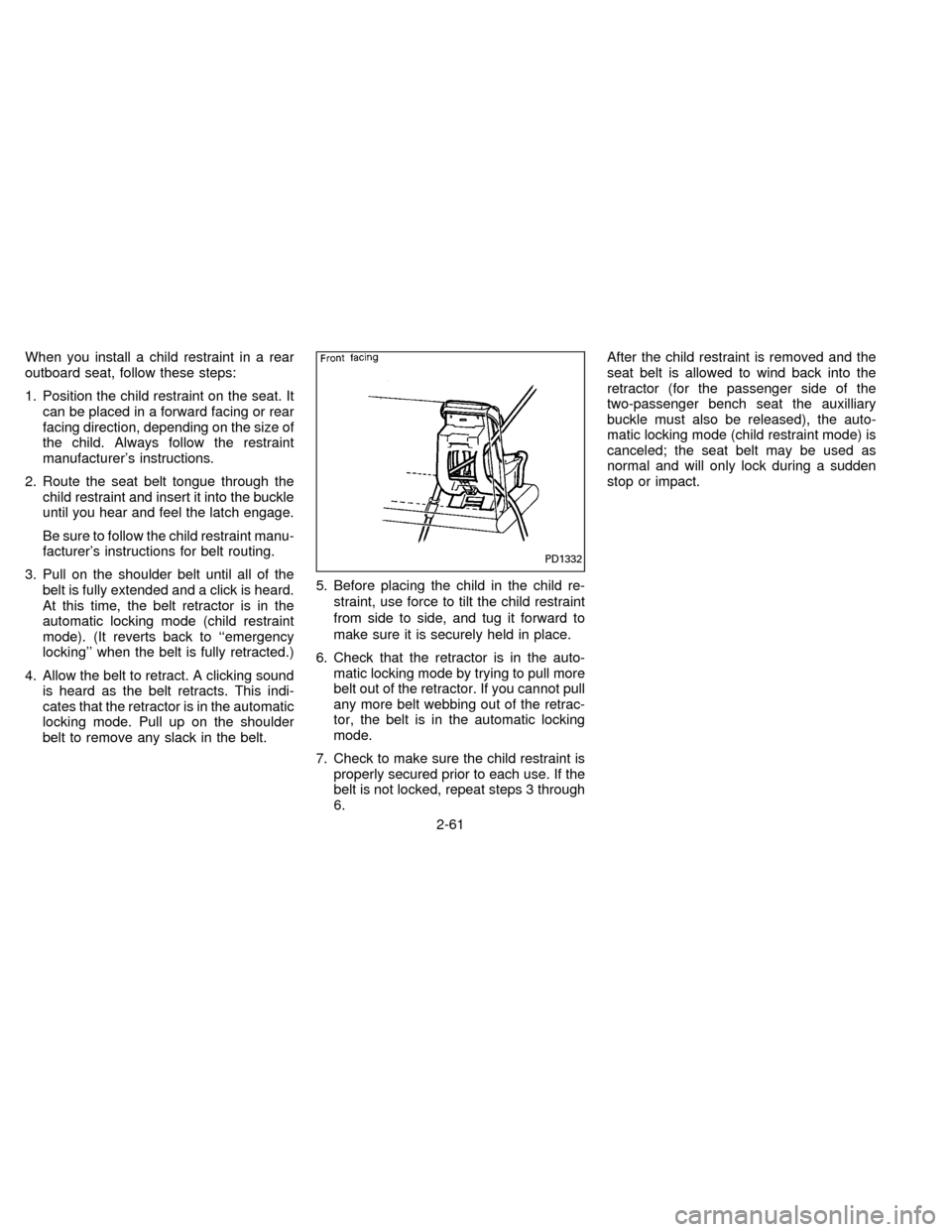
When you install a child restraint in a rear
outboard seat, follow these steps:
1. Position the child restraint on the seat. It
can be placed in a forward facing or rear
facing direction, depending on the size of
the child. Always follow the restraint
manufacturer's instructions.
2. Route the seat belt tongue through the
child restraint and insert it into the buckle
until you hear and feel the latch engage.
Be sure to follow the child restraint manu-
facturer's instructions for belt routing.
3. Pull on the shoulder belt until all of the
belt is fully extended and a click is heard.
At this time, the belt retractor is in the
automatic locking mode (child restraint
mode). (It reverts back to ``emergency
locking'' when the belt is fully retracted.)
4. Allow the belt to retract. A clicking sound
is heard as the belt retracts. This indi-
cates that the retractor is in the automatic
locking mode. Pull up on the shoulder
belt to remove any slack in the belt.5. Before placing the child in the child re-
straint, use force to tilt the child restraint
from side to side, and tug it forward to
make sure it is securely held in place.
6. Check that the retractor is in the auto-
matic locking mode by trying to pull more
belt out of the retractor. If you cannot pull
any more belt webbing out of the retrac-
tor, the belt is in the automatic locking
mode.
7. Check to make sure the child restraint is
properly secured prior to each use. If the
belt is not locked, repeat steps 3 through
6.After the child restraint is removed and the
seat belt is allowed to wind back into the
retractor (for the passenger side of the
two-passenger bench seat the auxilliary
buckle must also be released), the auto-
matic locking mode (child restraint mode) is
canceled; the seat belt may be used as
normal and will only lock during a sudden
stop or impact.
PD1332
2-61
ZX