battery NISSAN QUEST 1996 V40 / 1.G User Guide
[x] Cancel search | Manufacturer: NISSAN, Model Year: 1996, Model line: QUEST, Model: NISSAN QUEST 1996 V40 / 1.GPages: 235, PDF Size: 1.77 MB
Page 155 of 235
Always follow the instructions below.
Failure to do so could result in damage
to the charging system and cause per-
sonal injury.
1. If the booster battery is in another ve-
hicle, position the two vehicles to bring
their batteries close to each other.
Do not allow the two vehicles to touch.
2. Apply the parking brake. Move the gear-
shift lever to the P (Park) position. Switch
off all unnecessary electrical systems
(lights, heater, air conditioner, etc.).3. Remove vent caps on the battery (if so
equipped). Cover the battery with an old
cloth to reduce explosion hazard.
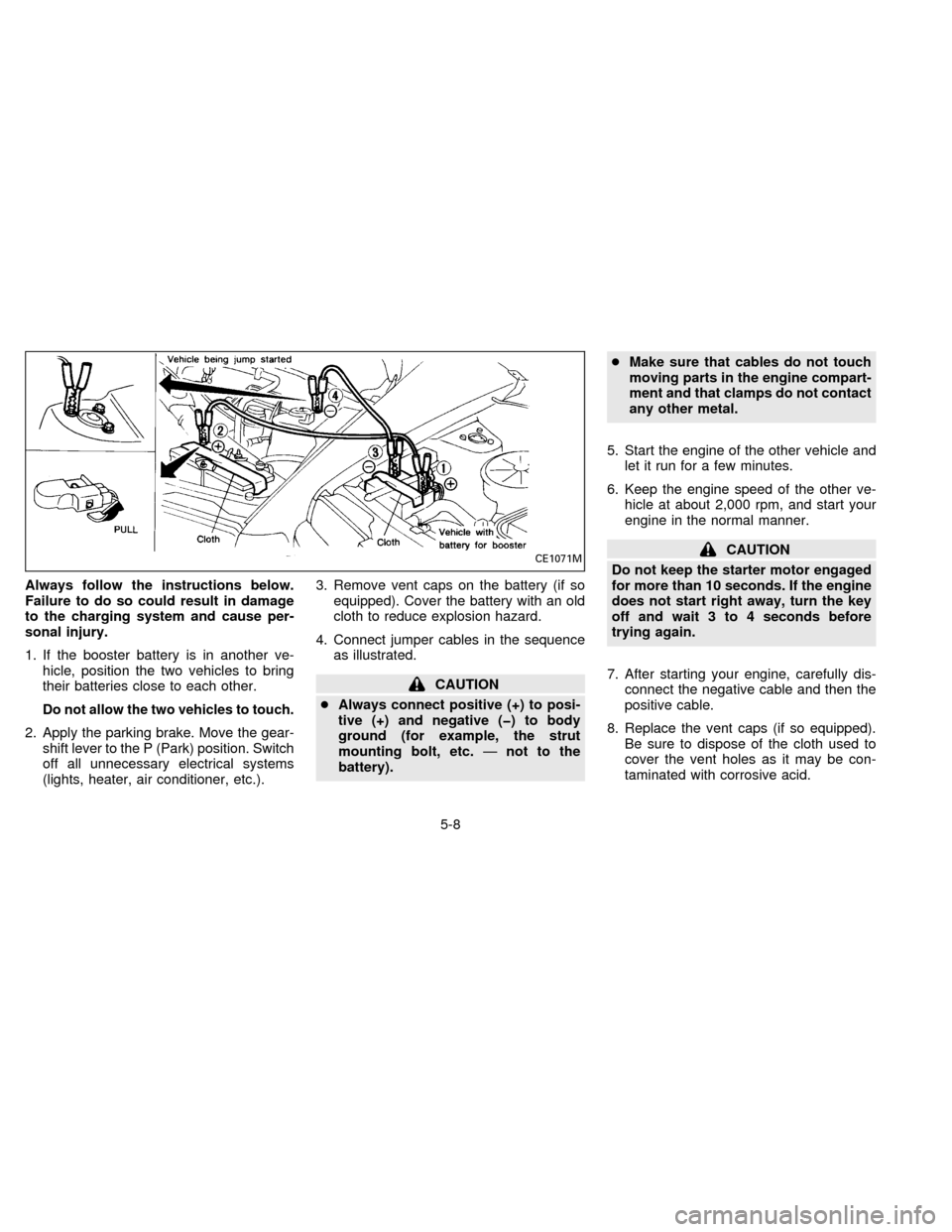
4. Connect jumper cables in the sequence
as illustrated.
CAUTION
cAlways connect positive (+) to posi-
tive (+) and negative (þ) to body
ground (for example, the strut
mounting bolt, etc.Ðnot to the
battery).cMake sure that cables do not touch
moving parts in the engine compart-
ment and that clamps do not contact
any other metal.
5. Start the engine of the other vehicle and
let it run for a few minutes.
6. Keep the engine speed of the other ve-
hicle at about 2,000 rpm, and start your
engine in the normal manner.
CAUTION
Do not keep the starter motor engaged
for more than 10 seconds. If the engine
does not start right away, turn the key
off and wait 3 to 4 seconds before
trying again.
7. After starting your engine, carefully dis-
connect the negative cable and then the
positive cable.
8. Replace the vent caps (if so equipped).
Be sure to dispose of the cloth used to
cover the vent holes as it may be con-
taminated with corrosive acid.CE1071M
5-8
ZX
Page 168 of 235

7 Do-it-yourself operations
Maintenance precautions ..................................... 7-2
Engine compartment check locations .................. 7-3
Engine cooling system ......................................... 7-4
Engine oil ............................................................ 7-5
Automatic transmission fluid ................................ 7-8
Power steering fluid.............................................. 7-9
Brake fluid .......................................................... 7-10
Window washer fluid .......................................... 7-10
Battery ................................................................ 7-11
Drive belts .......................................................... 7-12Spark plug replacement ..................................... 7-12
Air cleaner housing filter .................................... 7-13
Wiper blades ...................................................... 7-14
Parking brake check........................................... 7-16
Brake pedal ........................................................ 7-16
Brake booster ..................................................... 7-17
Fuses .................................................................. 7-17
Fusible links........................................................ 7-18
Light bulbs .......................................................... 7-19
Wheels and tires ................................................ 7-24
ZX
Page 169 of 235

When performing any inspection or mainte-
nance work on your vehicle, always take
care to prevent serious accidental injury to
yourself or damage to the vehicle. The
following are general precautions which
should be closely observed.
cPark the vehicle on a level surface,
apply the parking brake securely and
block the wheels to prevent the ve-
hicle from moving. Move the gearshift
lever to neutral (N).
cBe sure the ignition key is OFF when
performing any replacement or repair.
cDo not work under the hood while the
engine is hot. Turn off the engine and
wait until it cools down.
cBe sure to turn the ignition key to the
OFF or LOCK position. When the igni-
tion key is in the ON or ACC position,
the cooling fan may start to operate
suddenly even when the engine is not
running.
cIf you must work with the engine run-
ning, keep your hands, clothing, hair
and tools away from moving fans,
belts and any other moving parts.cIt is advisable to remove ties and any
jewelry, such as rings, watches, etc.
before working on your vehicle.
cIf you must run the engine in an en-
closed space such as a garage, be
sure there is proper ventilation for
exhaust gases.
cNever get under the vehicle while it is
supported only by a jack. If it is nec-
essary to work under the vehicle, sup-
port it with safety stands.
cKeep smoking materials, flame and
sparks away from fuel and the battery.
cNever connect or disconnect either
the battery or any transistorized com-
ponent connector while the ignition is
on.
cOn gasoline engine models with the
multiport fuel injection (MFI) system,
the fuel filter or fuel lines should be
serviced by a NISSAN dealer because
the fuel lines are under high pressure
even when the engine is off.
cFailure to follow these or other com-
mon sense guidelines may lead to
serious injury or vehicle damage.cImproperly disposed motor oil and/or
other vehicle fluids can hurt the envi-
ronment. Always conform to local
regulations for disposal of vehicle
fluid.
This ``Do-it-yourself operations'' section
gives instructions regarding only those
items which are relatively easy for an owner
to perform.
You should be aware that incomplete or
improper servicing may result in operating
difficulties or excessive emissions, and
could affect your warranty coverage.If in
doubt about any servicing, have it done
by your NISSAN dealer.
MAINTENANCE
PRECAUTIONS
7-2
ZX
Page 178 of 235
cKeep the battery surface clean and dry.
Any corrosion should be washed off with
a solution of baking soda and water.
cMake certain the terminal connections
are clean and securely tightened.
cIf the vehicle is not to be used for 30 days
or longer, disconnect the negative (þ)
battery terminal cable to prevent dis-
charge.
WARNING
Do not expose the battery to flames or
electrical sparks. Hydrogen gas gener-
ated by battery action is explosive. Do
not allow battery fluid to contact your
skin, eyes, fabrics, or painted surfaces.
After touching a battery or battery cap,
do not touch or rub your eyes. Thor-
oughly wash your hands. If the acid
contacts your eyes, skin or clothing,
immediately flush with water for at
least 15 minutes and seek medical at-
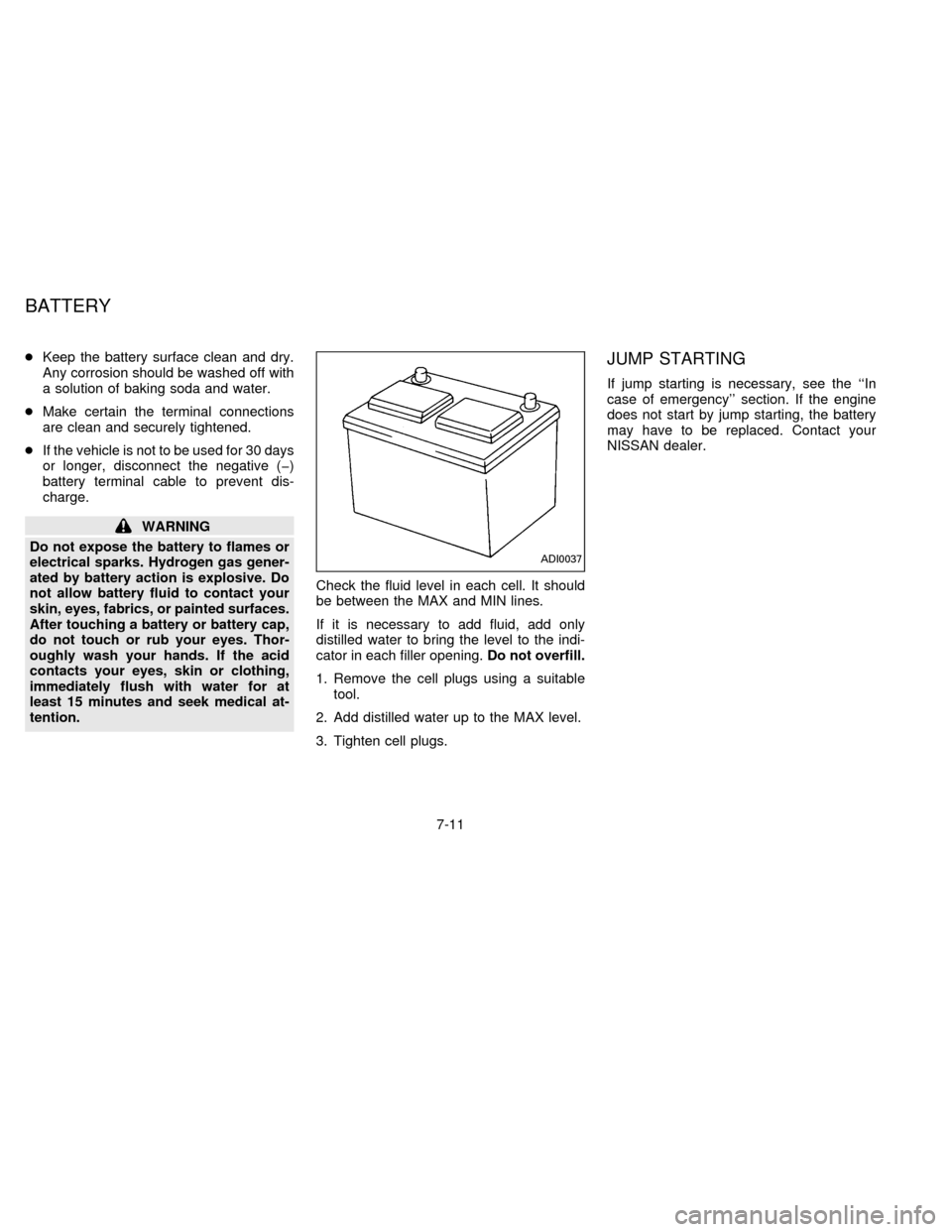
tention.Check the fluid level in each cell. It should
be between the MAX and MIN lines.
If it is necessary to add fluid, add only
distilled water to bring the level to the indi-
cator in each filler opening.Do not overfill.
1. Remove the cell plugs using a suitable
tool.
2. Add distilled water up to the MAX level.
3. Tighten cell plugs.
JUMP STARTING
If jump starting is necessary, see the ``In
case of emergency'' section. If the engine
does not start by jump starting, the battery
may have to be replaced. Contact your
NISSAN dealer.
ADI0037
BATTERY
7-11
ZB13-DX
Page 187 of 235
Hold the plastic base when handling
the bulb. Never touch the glass enve-
lope.
Removing the headlight bulb
1. Disconnect the negative battery cable.
2. Disconnect the electrical connector from
the rear end of the bulb.
3. Turn the bulb retaining ring counterclock-
wise until it is free from the headlight
reflector, then remove it.
4. Remove the headlight bulb by pulling
straight rearward. Do not shake or rotate
the bulb when removing it.
Replacing the headlight bulb
1. Insert the bulb into the headlight reflector
with the flat side of the plastic base facing
upward.
2. Install the bulb retaining ring and turn it
clockwise until it stops.
3. Push the electrical connector into the
bulb plastic base until it snaps and stops.
CAUTION
DO NOT TOUCH THE BULB.
cUse the same number and wattage
as originally installed:
Wattage 55/65
Bulb no. 9007
cAiming is not necessary after replac-
ing the bulb. When aiming adjust-
ment is necessary, contact your NIS-
SAN dealer.
cDo not leave the bulb out of the
headlight reflector for a long period
of time as dust, moisture, and smoke
may enter the headlight body and
affect the performance of the head-
light.
7-20
ZB13-DX
Page 201 of 235

steep hill with only the parking brake ap-
plied.
Automatic transmission ``Park'' mecha-
nismÐ On a fairly steep hill check that your
vehicle is held securely with the selector
lever in the P (Park) position without apply-
ing any brakes.
UNDER THE HOOD AND
VEHICLE
The maintenance items listed here should
be checked periodically, for example, each
time you check the engine oil or refuel.
Windshield washer fluid* ÐCheck that
there is adequate fluid in the tank.
Engine coolant level*Ð Check the cool-
ant level when the engine is cold.
Radiator and hosesÐ Check the front of
the radiator and clean off any dirt, insects,
leaves, etc., that may have accumulated.
Make sure the hoses have no cracks, de-
formation, rot, or loose connections.
Brake fluid level*Ð Make sure the brake
fluid level is between the MAX and MIN
lines on the reservoir.
Battery*Ð Check the fluid level in eachcell. It should be between the MAX and MIN
lines.
Engine drive belts*Ð Make sure no belts
are frayed, worn, cracked or oily.
Engine oil level*Ð Check the level after
parking the vehicle on a level surface and
turning off the engine.
Power steering fluid level* and linesÐ
Check the level when the fluid is cold and
the engine is turned off. Check the lines for
proper attachment, leaks, cracks, etc.
Automatic transmission fluid level*Ð
Check the level after putting the selector
lever in P (Park) with the engine idling.
Exhaust systemÐ Make sure there are no
cracks, holes, loose joints or supports. If the
sound of the exhaust seems unusual or
there is a smell of exhaust fumes, immedi-
ately have the exhaust system inspected by
a qualified individual. (See the carbon mon-
oxide warning in the ``Starting and driving''
section.)
UnderbodyÐ The underbody is frequently
exposed to corrosive substances such as
those used on icy roads or to control dust. It
is very important to remove these sub-stances, otherwise rust forms on the floor
pan, frame, fuel lines and around the ex-
haust system. At the end of winter, the
underbody should be thoroughly flushed
with plain water, being careful to clean
those areas where mud and dirt may accu-
mulate. See the ``Appearance and interior
care'' section for additional information.
Fluid leaksÐ Check under the vehicle for
fuel, oil, water or other fluid leaks after the
vehicle has been parked for a while. Water
dripping from the air conditioner after use is
normal. If you should notice any leaks or if
gasoline fumes are evident, check for the
cause and have it corrected immediately.
8-4
ZX
Page 230 of 235

10 Index
A
After an accident........................................ 5-10
Air bag (See supplemental restraint system)
Air bag warning light .................................. 2-45
Air cleaner housing filter ............................ 7-13
Air conditioner
Air conditioner operation ........................ 3-5
Air conditioner service ............................ 3-6
Air conditioner specification label ......... 9-11
Air conditioning system refrigerant and
lubricant recommendations .................... 9-6
Air flow charts ......................................... 3-7
Heater and air conditioner (automatic)
(If so equipped) .................................... 3-11
Heater and air conditioner (manual)....... 3-3
Rear seat heater and air conditioner ... 3-14
Air conditioning system refrigerant and lubricant
recommendations ........................................ 9-6
Anchor point location ................................. 2-66
Antenna
Manual .................................................. 3-21
Power.................................................... 3-21
Anti-lock brake system .............................. 4-13
Armrests..................................................... 2-29
Ashtray (See cigarette lighter and ashtray)
Audio system
AM-FM radio with cassette player ........ 3-15Compact disc (CD) player .................... 3-22
Autolamp switch......................................... 1-13
Automatic
Automatic transmission fluid ................... 7-8
Driving with an automatic transmission .. 4-5
B
Battery........................................................ 7-11
Before starting the engine ........................... 4-5
Brake
Anti-lock brake system ......................... 4-13
Brake booster ....................................... 7-17
Brake fluid ..................................... 7-10, 9-2
Brake pedal .......................................... 7-16
Brake wear indicators ................... 1-9, 7-16
Parking brake check ............................. 7-16
Parking brake operation ......................... 4-8
Self-adjusting brakes ............................ 7-16
Break-in schedule ...................................... 4-11
Bulb check/instrument panel ....................... 1-6
Bulb replacement ....................................... 7-21
C
Capacities and recommended fuel/
lubricants...................................................... 9-2
Cargo net ................................................... 2-13Cassette player (See audio system)
CB radio or car phone ............................... 3-26
Child restraints for infants and
small children ............................................. 2-58
Child restraint with top tether strap ........... 2-62
Child safety sliding door lock....................... 2-4
Cigarette lighter and ashtray ..................... 1-17
Cleaning exterior and interior ...................... 6-2
Clock .......................................................... 1-22
Coin tray .................................................... 1-18
Cold weather driving cautions ................... 4-15
Compact disc (CD) player ......................... 3-22
Controls
Audio controls (rear) ............................. 3-25
Heater and air conditioner controls ........ 3-3
Rear seat heater and air conditioner
controls ................................................. 3-14
Coolant
Capacities and recommended fuel/
lubricants ................................................ 9-2
Changing engine coolant........................ 7-5
Checking engine coolant level ............... 7-4
Engine coolant temperature gauge ........ 1-4
Cornering light ........................................... 1-16
Corrosion protection .................................... 6-4
Cruise control............................................... 4-9
Cup holder ................................................. 2-31
ZX