engine overheat NISSAN ROGUE 2021 Owner´s Manual
[x] Cancel search | Manufacturer: NISSAN, Model Year: 2021, Model line: ROGUE, Model: NISSAN ROGUE 2021Pages: 556, PDF Size: 2.7 MB
Page 442 of 556
6-14In case of emergency
If your vehicle is overheating (indicated by
an extremely high temperature gauge
reading), or if you feel a lack of engine
power, detect abnormal noise, etc., take
the following steps:
1. Move the vehicle safely off the roadand apply the parking brake.
2. Push the park button to shift to the P (Park) position.
Do not stop the engine.
3. Turn off the air conditioner (if so equipped). Open all the windows,
move the heater or air conditioner
temperature control to maximum hot
and fan control to high speed.
4. Get out of the vehicle. Look and listen for steam or coolant escaping from
the radiator before opening the hood.
(If steam or coolant is escaping, turn
off the engine.) Do not open the hood
further until no steam or coolant can
be seen.
5. Open the engine hood.
WARNING
If steam or water is coming from the
engine, stand clear to prevent get-
ting burned.
6. Visually check the drive belt for da- mage or looseness. Also check if the
cooling fan is running. The radiator
hoses and radiator should not leak
water. If coolant is leaking or the
cooling fan does not run, stop the
engine.
WARNING
Be careful not to allow your hands,
hair, jewelry or clothing to come into
contact with, or get caught in, engine
belts or the engine cooling fan. The
engine cooling fan can start at any
time. 7. After the engine cools down, check
the coolant level in the reservoir with
the engine running. Add coolant to
the reservoir if necessary. Have your
vehicle repaired. It is recommended
you visit a NISSAN dealer for this
service.
Page 458 of 556
8-4Do-it-yourself
The engine cooling system is filled at the
factory with a pre-diluted mixture of 50%
Genuine NISSAN Long Life Antifreeze/
Coolant (blue) and 50% water to provide
year-round anti-freeze and coolant pro-
tection. The anti-freeze solution contains
rust and corrosion inhibitors. Additional
engine cooling system additives are not
necessary.
WARNING
.Never remove the radiator or
coolant reservoir cap when the
engine is hot. Wait until the en-
gine and radiator cool down.
Serious burns could be caused
by high pressure fluid escaping
from the radiator. See precau-
tions in “If your vehicle overheats”
(P.6-13) of this manual.
. The radiator is equipped with a
pressure type radiator cap. To
prevent engine damage, use only
a genuine NISSAN radiator cap.
. If the engine was stopped soon
when the engine is hot, the cool-
ing fan may operate for approxi-
mately 10 minutes after the
engine was stopped to cool the
components in the engine com- partment. When the cooling fan is
operating, be sure that hands or
other items do not get caught in
it.
CAUTION
.
Never use any cooling system
additives such as radiator sealer.
Additives may clog the cooling
system and cause damage to
the engine, transmission and/or
cooling system.
. When adding or replacing cool-
ant, be sure to use only Genuine
NISSAN Long Life Antifreeze/
Coolant (blue) or equivalent. Gen-
uine NISSAN Long Life Antifreeze/
Coolant (blue) is pre-diluted to
provide antifreeze protection to
-34°F(-37°C). If additional freeze
protection is needed due to
weather where you operate your
vehicle, add Genuine NISSAN Long
Life Antifreeze/Coolant (blue)
concentrate following the direc-
tions on the container. If an
equivalent coolant other than
Genuine NISSAN Long Life Anti-
freeze/Coolant (blue) is used, fol- low the coolant manufacture’s
instructions to maintain mini-
mum antifreeze protection to
-34°F (-37°C). The use of other
types of coolant solutions other
than Genuine NISSAN Long Life
Antifreeze/Coolant (blue) or
equivalent may damage the en-
gine cooling system.
. The life expectancy of the fac-
tory-fill coolant is 105,000 miles
(168,000 km) or 7 years. Mixing
any other type of coolant other
than Genuine NISSAN Long Life
Antifreeze/Coolant (blue), includ-
ing Genuine NISSAN Long Life
Antifreeze/Coolant (green), or
the use of non-distilled water will
reduce the life expectancy of the
factory-fill coolant. Refer to the
“9. Maintenance and schedules”
section of this manual for more
details.
ENGINE COOLING SYSTEM
Page 459 of 556
WAI0190X
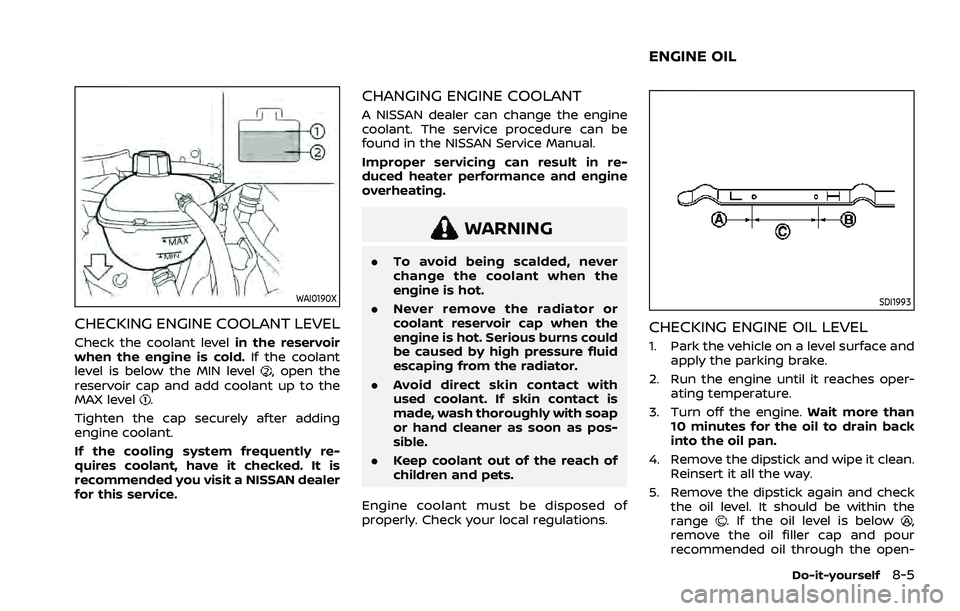
CHECKING ENGINE COOLANT LEVEL
Check the coolant levelin the reservoir
when the engine is cold. If the coolant
level is below the MIN level
, open the
reservoir cap and add coolant up to the
MAX level
.
Tighten the cap securely after adding
engine coolant.
If the cooling system frequently re-
quires coolant, have it checked. It is
recommended you visit a NISSAN dealer
for this service.
CHANGING ENGINE COOLANT
A NISSAN dealer can change the engine
coolant. The service procedure can be
found in the NISSAN Service Manual.
Improper servicing can result in re-
duced heater performance and engine
overheating.
WARNING
. To avoid being scalded, never
change the coolant when the
engine is hot.
. Never remove the radiator or
coolant reservoir cap when the
engine is hot. Serious burns could
be caused by high pressure fluid
escaping from the radiator.
. Avoid direct skin contact with
used coolant. If skin contact is
made, wash thoroughly with soap
or hand cleaner as soon as pos-
sible.
. Keep coolant out of the reach of
children and pets.
Engine coolant must be disposed of
properly. Check your local regulations.
SDI1993
CHECKING ENGINE OIL LEVEL
1. Park the vehicle on a level surface and apply the parking brake.
2. Run the engine until it reaches oper- ating temperature.
3. Turn off the engine. Wait more than
10 minutes for the oil to drain back
into the oil pan.
4. Remove the dipstick and wipe it clean. Reinsert it all the way.
5. Remove the dipstick again and check the oil level. It should be within the
range
. If the oil level is below,
remove the oil filler cap and pour
recommended oil through the open-
Do-it-yourself8-5
ENGINE OIL
Page 517 of 556
.If a methanol blend is used, it should
contain no more than 5% methanol
(methyl alcohol, wood alcohol). It
should also contain a suitable
amount of appropriate cosolvents
and corrosion inhibitors. If not prop-
erly formulated with appropriate
cosolvents and corrosion inhibitors,
such methanol blends may cause
fuel system damage and/or vehicle
performance problems. At this time,
sufficient data is not available to
ensure that all methanol blends are
suitable for use in NISSAN vehicles.
If any driveability problems such as en-
gine stalling and difficult hot-starting are
experienced after using oxygenate-blend
fuels, immediately change to a non-oxy-
genate fuel or a fuel with a low blend of
MTBE.
Take care not to spill gasoline during
refueling. Gasoline containing oxyge-
nates can cause paint damage.
E-15 fuel
E-15 fuel is a mixture of approximately
15% fuel ethanol and 85% unleaded gaso-
line. E-15 can only be used in vehicles
designed to run on E- 15 fuel. U.S. govern-
ment regulations require fuel ethanol
dispensing pumps to be identified with
small, square, orange and black label with
the common abbreviation or the appro- priate percentage for that region.
E-85 fuel
E-85 fuel is a mixture of approximately
85% fuel ethanol and 15% unleaded gaso-
line. E-85 can only be used in a Flexible
Fuel Vehicle (FFV). Do not use E-85 fuel in
your vehicle. U.S. government regulations
require fuel ethanol dispensing pumps to
be identified by a small, square, orange
and black label with the common abbre-
viation or the appropriate percentage for
that region.
Fuel containing MMT
MMT, or methylcyclopentadienyl manga-
nese tricarbonyl, is an octane boosting
additive. NISSAN does not recommend
the use of fuel containing MMT. Such fuel
may adversely affect vehicle perfor-
mance, including the emissions control
system. Note that while some fuel pumps
label MMT content, not all do, so you may
have to consult your gasoline retailer for
more details.
Aftermarket fuel additives
NISSAN does not recommend the use of
any aftermarket fuel additives (for exam-
ple, fuel injector cleaner, octane booster,
intake valve deposit removers, etc.) which
are sold commercially. Many of these
additives intended for gum, varnish or
deposit removal may contain active sol-
vent or similar ingredients that can be
harmful to the fuel system and engine.
Octane rating tips
Using unleaded gasoline with an octane
rating lower than recommended can
cause persistent, heavy “spark knock”.
(Spark knock is a metallic rapping
noise.) If severe, this can lead to engine
damage. If you detect a persistent
heavy spark knock even when using
gasoline of the stated octane rating, or
if you hear steady spark knock while
holding a steady speed on level roads, it
is recommended you have a NISSAN
dealer correct the condition. Failure to
correct the condition is misuse of the
vehicle, for which NISSAN is not respon-
sible.
Incorrect ignition timing will result in
spark knock, after-run and/or overheat-
ing, which may cause excessive fuel
consumption or engine damage. If any
of the above symptoms are encountered,
have your vehicle checked. It is recom-
mended you visit a NISSAN dealer for
servicing.
However, now and then you may notice
light spark knock for a short time while
accelerating or driving up hills. This is
not a cause for concern, because you
Technical and consumer information10-5
Page 529 of 556
available on the website at
www.nissanusa.com. This guide includes
information on trailer towing capability
and the special equipment required for
proper towing.
MAXIMUM LOAD LIMITS
Maximum trailer loads
Never allow the total trailer load to
exceed the value specified in the “Towing
load/specification” (P.10-20) chart found
in this section. The total trailer load
equals trailer weight plus its cargo
weight.
The maximum Gross Combined Weight
Rating (GCWR) should not exceed the
value specified in the following “Towing
Load/Specification” chart.
STI0541
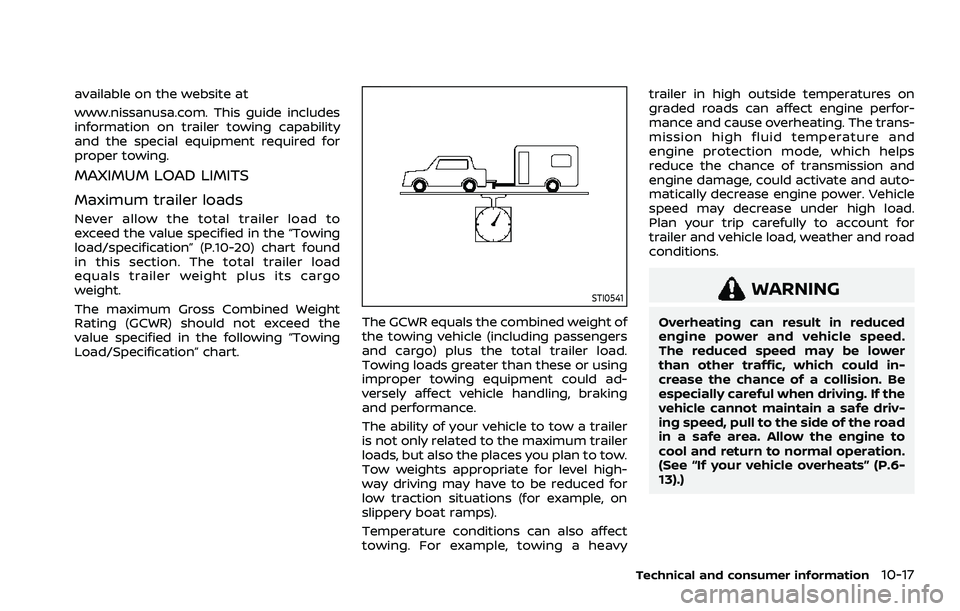
The GCWR equals the combined weight of
the towing vehicle (including passengers
and cargo) plus the total trailer load.
Towing loads greater than these or using
improper towing equipment could ad-
versely affect vehicle handling, braking
and performance.
The ability of your vehicle to tow a trailer
is not only related to the maximum trailer
loads, but also the places you plan to tow.
Tow weights appropriate for level high-
way driving may have to be reduced for
low traction situations (for example, on
slippery boat ramps).
Temperature conditions can also affect
towing. For example, towing a heavytrailer in high outside temperatures on
graded roads can affect engine perfor-
mance and cause overheating. The trans-
mission high fluid temperature and
engine protection mode, which helps
reduce the chance of transmission and
engine damage, could activate and auto-
matically decrease engine power. Vehicle
speed may decrease under high load.
Plan your trip carefully to account for
trailer and vehicle load, weather and road
conditions.
WARNING
Overheating can result in reduced
engine power and vehicle speed.
The reduced speed may be lower
than other traffic, which could in-
crease the chance of a collision. Be
especially careful when driving. If the
vehicle cannot maintain a safe driv-
ing speed, pull to the side of the road
in a safe area. Allow the engine to
cool and return to normal operation.
(See “If your vehicle overheats” (P.6-
13).)
Technical and consumer information10-17
Page 536 of 556
10-24Technical and consumer information
vehicle.
. Determine the overall height of the
vehicle and trailer so the required
clearance is known.
Trailer towing tips
In order to gain skill and an understand-
ing of the vehicle’s behavior, you should
practice turning, stopping and backing up
in an area which is free from traffic.
Steering stability, and braking perfor-
mance will be somewhat different than
under normal driving conditions.
.Always secure items in the trailer to
prevent load shift while driving.
. Lock the trailer hitch coupler with a
pin or lock to prevent the coupler from
inadvertently becoming unlatched.
. Avoid abrupt starts, acceleration or
stops.
. Avoid sharp turns or lane changes.
. Always drive your vehicle at a moder-
ate speed. Some states or provinces
have specific speed limits for vehicles
that are towing trailers. Obey the local
speed limits.
. When backing up, hold the bottom of
the steering wheel with one hand.
Move your hand in the direction in
which you want the trailer to go. Make
small corrections and back up slowly.
If possible, have someone guide you when you are backing up.
Always block the wheels on both vehicle
and trailer when parking. Parking on a
slope is not recommended; however, if
you must do so:CAUTION
If you push the park button to
engage the P (Park) position before
blocking the wheels and applying
the parking brake, transmission da-
mage could occur.
1. Apply and hold the brake pedal.
2. Have someone place blocks on the downhill side of the vehicle and trailer
wheels.
3. After the wheel blocks are in place, slowly release the brake pedal until
the blocks absorb the vehicle load.
4. Apply the parking brake.
5. Push the park button to engage the P (Park) position.
6. Turn off the engine.
To drive away:
1. Apply and hold the brake pedal.
2. Start the engine. 3. Shift the transmission into gear.
4. Release the parking brake.
5. Drive slowly until the vehicle and
trailer are clear from the blocks.
6. Apply and hold the brake pedal.
7. Have someone retrieve and store the blocks.
. While going downhill, the weight of the
trailer pushing on the tow vehicle may
decrease overall stability. Therefore, to
maintain adequate control, reduce
your speed and shift to a lower gear.
Avoid long or repeated use of the
brakes when descending a hill, as this
reduces their effectiveness and could
cause overheating. Shifting to a lower
gear instead provides “engine braking”
and reduces the need to brake as
frequently.
. If the engine coolant temperature
rises to a high temperature, see “If
your vehicle overheats” (P.6-13).
. Trailer towing requires more fuel than
normal circumstances.
. Avoid towing a trailer for your vehicle’s
first 500 miles (800 km).
. For the first 500 miles (800 km) that
you do tow, do not drive over 50 MPH
(80 km/h).
Page 537 of 556

.Have your vehicle serviced more often
than at intervals specified in the
recommended maintenance schedule
shown in the "9. Maintenance and
schedules" section.
. When making a turn, your trailer
wheels will be closer to the inside of
the turn than your vehicle wheels. To
compensate for this, make a larger
than normal turning radius during the
turn.
. Crosswinds and rough roads will ad-
versely affect vehicle/trailer handling,
possibly causing vehicle sway. When
being passed by larger vehicles, be
prepared for possible changes in
crosswinds that could affect vehicle
handling.
Do the following if the trailer begins to
sway:
1. Take your foot off the accelerator pedal to allow the vehicle to coast
and steer as straight ahead as the
road conditions allow. This combina-
tion will help stabilize the vehicle.
.Do not correct trailer sway bysteering or applying the brakes.
2. When the trailer sway stops, gently apply the brakes and pull to the side
of the road in a safe area. 3. Try to rearrange the trailer load so it is
balanced as described earlier in this
section.
. Be careful when passing other vehi-
cles. Passing while towing a trailer
requires considerably more distance
than normal passing. Remember the
length of the trailer must also pass the
other vehicle before you can safely
change lanes.
. Downshift the transmission to a lower
gear for engine braking when driving
down steep or long hills. This will help
slow the vehicle without applying the
brakes.
. Avoid holding the brake pedal down
too long or too frequently. This could
cause the brakes to overheat, result-
ing in reduced braking efficiency.
. Increase your following distance to
allow for greater stopping distances
while towing a trailer. Anticipate stops
and brake gradually.
. NISSAN recommends that the cruise
control not be used while towing a
trailer.
. While towing a trailer, do not use the
following systems (if so equipped):
— Lane Departure Warning (LDW) sys-
tem — Intelligent Lane Intervention (I-LI)
system
— Blind Spot Warning (BSW) system
— Intelligent Blind Spot Intervention (I-BSI) system
— Rear Cross Traffic Alert (RCTA) sys- tem
— ProPILOT Assist system (Intelligent Cruise Control (ICC), ProPILOT As-
sist with Navi-link and Steering
Assist)
— Automatic Emergency Braking (AEB) with pedestrian detection
system
— Intelligent Forward Collision Warn- ing (I-FCW) system
— Rear Automatic Braking (RAB) sys- tem
. Some states or provinces have speci-
fic regulations and speed limits for
vehicles that are towing trailers. Obey
the local speed limits.
. Check your hitch, trailer wiring har-
ness connections, and trailer wheel
lug nuts after 50 miles (80 km) of
travel and at every break.
. When launching a boat, do not allow
the water level to go over the exhaust
tail pipe or rear bumper.
. Make sure you disconnect the trailer
lights before backing the trailer into
Technical and consumer information10-25
Page 548 of 556

11-2
ChimesSeat belt warning light
and chime.................................................... 1-15, 2-16
Chimes, Audible reminders.................................. 2-22
Circuit breaker, Fusible link ................................. 8-18
Cleaning exterior and interior ................... 7-2, 7-4
Clock ........................................................................\
.............. 2-46
Coat hook........................................................................\
.. 2-77
Cockpit ........................................................................\
............. 2-3
Cold weather driving ............................................. 5-172
Connection to Roadside Assistance ................ 6-2
Console box ..................................................................... 2-75
Continuously Variable Transmission
(CVT) fluid........................................................................\
....... 8-8
Continuously Variable Transmission (CVT)
position indicator ........................................................ 2-11
Conventional (fixed speed) cruise control
mode (with ProPILOT Assist)........................... 5-118
Coolant Capacities and
recommended fluids/lubricants............... 10-3
Changing engine coolant ................................. 8-5
Checking engine coolant level...................... 8-5
Corrosion protection .................................................... 7-7
Cover, Cargo cover..................................................... 2-77
Cruise control Conventional (fixed speed) cruise
control mode ....................................................... 5-118
Cruise control (with ProPILOT Assist)
(See Conventional (fixed speed) cruise
control mode)...................................................... 5-118
Cruise control (without
ProPILOT Assist)..................................................... 5-82
Intelligent Cruise Control (ICC) .................. 5-97
Cup holders...................................................................... 2-71 CVT, Driving with CVT (Continuously
Variable Transmission)............................................ 5-19
D
Daytime Running Lights (DRL) system....... 2-61
Defroster switch, Rear window and
outside mirror defroster switch....................... 2-55
Dimensions and weights....................................... 10-9
Display
Head Up Display (HUD) ..................................... 2-47
Vehicle information display.......................... 2-22
Drive belt ........................................................................\
.... 8-13
Drive Computer............................................................. 2-44
Drive Mode Selector .................................................. 5-30
Driver and front passenger supplemental
knee air bag..................................................................... 1-61
Driver Assistance systems.................................... 5-34 Common troubleshooting guide ............. 5-39
Driving Cold weather driving ..................................... 5-172
Drive Mode Selector ........................................... 5-30
Driving with CVT (Continuously
Variable Transmission)..................................... 5-19
Intelligent 4x4 ..................................................... 5-151
On-pavement and off-road driving ....... 5-10
Precautions when starting
and driving.................................................................... 5-5
Safety precautions .............................................. 5-12
E
Easy-Fill Tire Alert system......................................... 5-9
ECO mode ........................................................................\
. 5-32
ECO mode system
ECO Drive Report.................................................. 2-11
Economy, Fuel............................................................. 5-150 Elapsed time.................................................................... 2-44
Electric power steering........................................ 5-154
Electric power steering warning light ........ 2-17
Electric shift control system
warning light ................................................................... 2-15
Emergency Call (SOS) button ............................ 2-70
Emission control information label............ 10-11
Emission control system warranty ............ 10-28
Engine
Before starting the engine............................ 5-17
Break-in schedule ............................................ 5-149
Capacities and
recommended fluids/lubricants............... 10-3
Changing engine coolant ................................. 8-5
Changing engine oil and filter ...................... 8-6
Checking engine coolant level...................... 8-5
Checking engine oil level................................... 8-5
Coolant temperature gauge .......................... 2-9
Emergency engine shut off.............. 5-16, 6-3
Engine compartment
check locations ......................................................... 8-3
Engine cooling system ........................................ 8-4
Engine oil.....................................................................\
... 8-5
Engine oil and oil
filter recommendation ..................................... 10-6
Engine oil viscosity .............................................. 10-7
Engine serial number .................................... 10-10
Engine specifications......................................... 10-8
Engine start operation indicator.............. 2-34
If your vehicle overheats ................................ 6-13
Remote engine start.......................................... 3-19
Starting the engine............................................. 5-17
Event Data Recorders (EDR)............................. 10-30
Exhaust gas (carbon monoxide) ......................... 5-5
Explanation of scheduled
maintenance items ........................................................ 9-5
Page 551 of 556
Other lights....................................................................... 2-21
Outside air temperature ........................................ 2-47
Outside mirrors ............................................................. 3-34
Overheat, If your vehicle overheats.............. 6-13
Owner’s Manual/Service Manual
order information..................................................... 10-31
P
Panic alarm....................................................................... 3-17
ParkingBrake break-in .................................................... 5-155
Parking brake .......................................................... 5-25
Parking on hills................................................... 5-153
Parking Aids ..................................................................... 5-34
Parking brake Electronic parking brake warning
light........................................................................\
.......... 2-15
Power Electric power steering................................ 5-154
Power door lock ....................................................... 3-5
Power outlet............................................................. 2-66
Power windows ..................................................... 2-79
PR25DD engine model................................................ 8-3
Precautions Braking precautions....................................... 5-155
Child restraints ....................................................... 1-23
Driving safety ........................................................... 5-12
Maintenance................................................................ 8-2
On-pavement and off-road driving ....... 5-10
Seat belt usage ...................................................... 1-13
SRS ........................................................................\
........... 1-46
When starting and driving................................ 5-5
ProPILOT Assist ............................................................. 5-84
ProPILOT Assist with Navi-link .......................... 5-84 Speed Adjust by Route ................................ 5-105
Speed Limit Assist............................................ 5-102 Push starting................................................................\
... 6-13
Push-button ignition switch............................... 5-14
R
RAB system ................................................................... 5-143
Rapid air pressure loss............................................ 5-11
Readiness for inspection/maintenance
(I/M) test........................................................................\
... 10-29
Rear Automatic Braking (RAB) ....................... 5-143
Rear Automatic Braking (RAB) system
OFF warning light........................................................ 2-20
Rear Cross Traffic Alert (RCTA)......................... 5-76
Rear Door Alert.............................................................. 2-65
Rear door lock, Child safety rear
door lock ........................................................................\
........ 3-7
Rear Driving Aids.......................................................... 5-34
Rear personal lights .................................................. 2-86
Rear seats........................................................................\
...... 1-7
Rear Sonar System (RSS).................................... 5-168
Rear sunshade............................................................... 3-32
Rear window and outside mirror
defroster switch ........................................................... 2-55
Rear window wiper and washer switch .... 2-53
RearView Monitor............................................................ 4-2
Recorders, Event data .......................................... 10-30
Registering in another country........................ 10-9
Remote engine start................................................. 3-19
Remote keyless entry function, For
Intelligent Key system ............................................. 3-15
Reporting safety defects .................................... 10-28
Road Assistance ............................................................... 6-2
Rollover ........................................................................\
........ 5-10
Roof rack ........................................................................\
.... 2-78
Room lights ...................................................................... 2-86
S
Safety
Child seat belts....................................................... 1-20
Reporting safety defects ............................ 10-28
Towing safety...................................................... 10-21
Seat adjustment Front manual seat adjustment .................... 1-4
Front power seat adjustment ....................... 1-5
Front seats.................................................................... 1-4
Seat belt(s) Child safety................................................................ 1-20
Infants.................................................................\
........... 1-21
Injured persons ...................................................... 1-16
Larger children ....................................................... 1-21
Precautions on seat belt usage................ 1-13
Pregnant women.................................................. 1-16
Seat belt cleaning ................................................... 7-7
Seat belt extenders............................................. 1-19
Seat belt hook......................................................... 1-19
Seat belt maintenance..................................... 1-20
Seat belt warning light and
chime............................................................... 1-15, 2-16
Seat belts .................................................................... 1-13
Seat belts with pretensioners .................... 1-65
Shoulder belt height adjustment ............ 1-18
Small children .......................................................... 1-21
Three-point type with retractor ............... 1-16
Seat(s) Heated seats ............................................................ 2-63
Memory seat ............................................................ 3-36
Seats ........................................................................\
.......... 1-3
Security system (NISSAN Vehicle
Immobilizer System), Engine start ................. 2-51
Security system, Vehicle
security system ............................................................. 2-50
Servicing air conditioner........................................ 4-38
11-5