parking brake NISSAN TEANA 2014 Repair Manual
[x] Cancel search | Manufacturer: NISSAN, Model Year: 2014, Model line: TEANA, Model: NISSAN TEANA 2014Pages: 4801, PDF Size: 51.2 MB
Page 3741 of 4801
SB-6
< BASIC INSPECTION >
COMPONENT INSPECTION
SEAT BELT RETRACTOR ON-VEHICLE CHECK
Emergency Locking Retractors (ELR) and Automatic Locking Retractors (ALR)
NOTE:
All seat belt retractors are Emergency Locking Retr actors (ELR) type. In an emergency (sudden stop) the
retractor will lock and prevent the webbing from extendi ng any further. All 3-point type seat belt retractors
except the driver seat belt also have an Automati c Locking Retractors (ALR) mode. The ALR mode (also
called child restraint mode) is used when installing child seats. The ALR mode is activated when the seat belt
is fully extended. When the webbing is then retracted part ially, the ALR mode automatically locks the seat belt
in a specific position so the webbing cannot be extended any further. To cancel the ALR mode, allow the seat
belt to fully wind back into the retractor.
Check the seat belt retractors with the following test(s ) to determine if a retractor assembly is operating prop-
erly.
ELR Function Stationary Check
Grasp the shoulder webbing and pull forward quickly. T he retractor should lock and prevent the belt from
extending further.
ALR Function Stationary Check
1. Pull out the entire length of seat belt from retractor until a click is heard.
2. Retract the webbing partially. A clicking noise shoul d be heard as the webbing retracts, indicating that the
retractor is in the Automatic Locking Retractors (ALR) mode.
3. Grasp the seat belt and try to pull out the retractor. The webbing must lock and not extend any further. If it
does not operate normally, replace the retractor assembly.
4. Allow the entire length of the webbing to re tract to cancel the automatic locking mode.
ELR Function Moving Check
WARNING:
Perform the following test in a saf e, open area clear of other vehicles and obstructions (for example, a
large, empty parking lot). Road surface must be p aved and dry. Never perform the following test on
wet or gravel roads or on public streets and highw ays. This could result in an accident and serious
personal injury. The driver and passenger must be prepared to brace themselves in the event that the
retractor does not lock.
1. Fasten driver seat belt. Buckle a passenger in to the seat for the belt that is to be tested.
2. Proceed to the designated safe area.
3. Drive the vehicle at approximately 16 km/h ( 10 MPH). Notify any passengers of a pending sudden stop
and the driver and passenger must be prepared to brace themselves in the event that the retractor does
not lock. Apply brakes firmly and make a very hard stop.
During stopping, seat belts should lock and not be extended. If the seat belt retractor assembly does not lock,
perform the retractor off-vehicle check.
SEAT BELT RETRACTOR O FF-VEHICLE CHECK (PILLAR)
1. Remove the seat belt retractor.
• Remove the front seat belt assembly, refer to SB-8, "Removal and Installation"
.
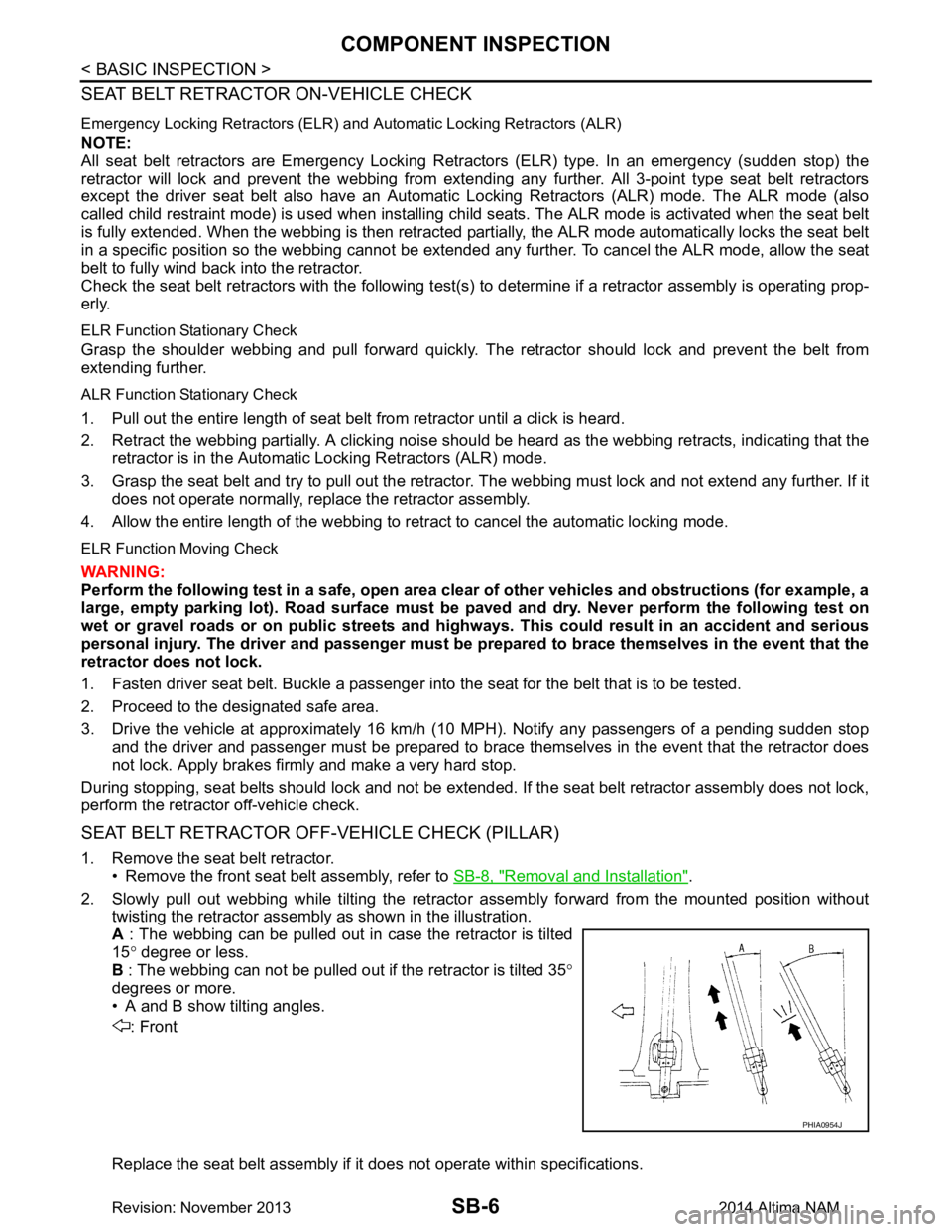
2. Slowly pull out webbing while tilting the retracto r assembly forward from the mounted position without
twisting the retractor assembly as shown in the illustration.
A : The webbing can be pulled out in case the retractor is tilted
15 ° degree or less.
B : The webbing can not be pulled out if the retractor is tilted 35 °
degrees or more.
• A and B show tilting angles.
: Front
Replace the seat belt assembly if it does not operate within specifications.
PHIA0954J
Revision: November 20132014 Altima NAM
Page 4119 of 4801
ST-16
< BASIC INSPECTION >
STEERING WHEEL
STEERING WHEEL
InspectionINFOID:0000000009461252
CONDITION OF INSTALLATION
• Check installation condition of power steering gear assembly, front suspension, front drive shaft and steering
column.
• Check if movement exists when steering wheel is mo ved up and down, to the left and right and to the axial
direction.
• Verify that the power steering gear nuts are tightened to specification. Refer to ST-36, "Exploded View"
.
STEERING WHEEL PLAY
1. Turn tires straight ahead, start engine, then turn steer ing wheel to the left and right lightly. Measure steer-
ing wheel movement on the outer circumference of the steering wheel when it is turned to the point where
tires start moving.
NEUTRAL POSITION ON STEERING WHEEL
• Check neutral position on steering wheel after confirming that front wheel alignment is correct. Refer to FSU-
25, "Wheel Alignment (Unladen*1)".
1. Turn tires straight ahead, check if st eering wheel is in the neutral position.
2. If it is not in the neutral position, remo ve steering wheel and reinstall it correctly.
3. If the neutral position cannot be attained by repositi oning the steering wheel two teeth or less on steering
stem, loosen tie-rod lock nuts of power steering gear outer sockets, then adjust tie-rods by the same
amount in the opposite direction.
STEERING WHEEL TURNING FORCE
1. Park vehicle on a level, dry surface and set parking brake.
2. Start engine.
3. Bring power steering fluid up to operating temperature.
4. Verify that the tires are inflated to the specified pressure. Refer to WT-60, "Tire"
.
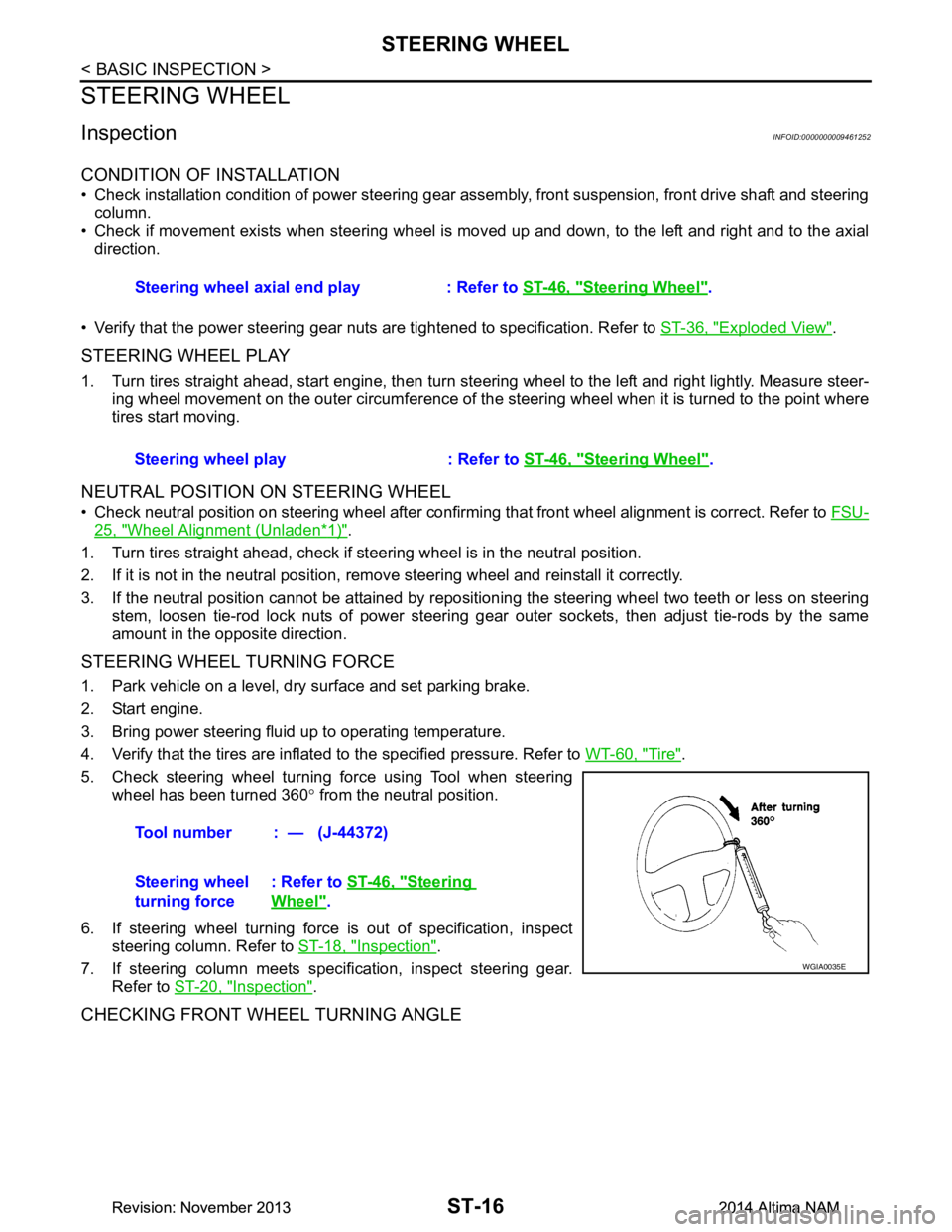
5. Check steering wheel turning force using Tool when steering wheel has been turned 360 ° from the neutral position.
6. If steering wheel turning force is out of specification, inspect steering column. Refer to ST-18, "Inspection"
.
7. If steering column meets specification, inspect steering gear. Refer to ST-20, "Inspection"
.
CHECKING FRONT WHEEL TURNING ANGLE
Steering wheel axial end play : Refer to ST-46, "Steering Wheel".
Steering wheel play : Refer to ST-46, "Steering Wheel"
.
Tool number : — (J-44372)
Steering wheel
turning force : Refer to
ST-46, "Steering
Wheel".
WGIA0035E
Revision: November 20132014 Altima NAMRevision: November 20132014 Altima NAM
Page 4238 of 4801
![NISSAN TEANA 2014 Repair Manual
STRUCTURE AND OPERATIONTM-23
< SYSTEM DESCRIPTION > [CVT: RE0F10D]
C
EF
G H
I
J
K L
M A
B
TM
N
O P
TRANSAXLE : Operation StatusINFOID:0000000009463981
× : Engaged or applied.
TRANSAXLE : Transaxle](/img/5/57390/w960_57390-4237.png "NISSAN TEANA 2014 Repair Manual
STRUCTURE AND OPERATIONTM-23
< SYSTEM DESCRIPTION > [CVT: RE0F10D]
C
EF
G H
I
J
K L
M A
B
TM
N
O P
TRANSAXLE : Operation StatusINFOID:0000000009463981
× : Engaged or applied.
TRANSAXLE : Transaxle")
STRUCTURE AND OPERATIONTM-23
< SYSTEM DESCRIPTION > [CVT: RE0F10D]
C
EF
G H
I
J
K L
M A
B
TM
N
O P
TRANSAXLE : Operation StatusINFOID:0000000009463981
× : Engaged or applied.
TRANSAXLE : Transaxle MechanismINFOID:0000000009463982
TORQUE CONVERTER (WITH LOCK-UP FUNCTION)
In the same way as a conventional A/T, the torque c onverter is a system that increases the engine torque and
transmits the torque to the transaxle. A symmetr ical 3-element, 1-stage, 2-phase type is used here.
OIL PUMP
Utilizes a vane-type oil pump that is driven by the engi ne through the oil pump drive chain in order to increase
efficiency of pump discharge volume in low-speed zone and optimize pump discharge volume in high-speed
zone. Discharged oil from oil pump is transmitted to contro l valve. It is used as the oil of primary and second-
ary pulley operation, the oil of clutch operation, and the lubricant for each part.
PLANETARY GEAR
• A planetary gear type of forward/reverse selector me chanism is installed between the torque converter and
primary pulley.
• The power from the torque converter is input via the i nput shaft, operating a wet multi-plate clutch by means
of hydraulic pressure to switch between forward and reverse driving.
Operation of Planetary gear
BELT & PULLEY
It is composed of a pair of pulleys (the groove width is changed freely in the axial direction) and the steel belt
(the steel plates are placed conti nuously and the belt is guided with the multilayer steel rings on both sides).
Selector lever
position Parking mech-
anism Forward
clutch Reverse brake Primary pulley Secondary
pulley Steel belt Final drive
P ×
R ×××××
N
D × ××××
DS × ××××
JSDIA2426GB
Revision: November 20132014 Altima NAMRevision: November 20132014 Altima NAM
Page 4242 of 4801
![NISSAN TEANA 2014 Repair Manual
STRUCTURE AND OPERATIONTM-27
< SYSTEM DESCRIPTION > [CVT: RE0F10D]
C
EF
G H
I
J
K L
M A
B
TM
N
O P
TRANSAXLE : Component DescriptionINFOID:0000000009463984
FLUID COOLER & FLUID WARMER SYSTEM
Part na](/img/5/57390/w960_57390-4241.png "NISSAN TEANA 2014 Repair Manual
STRUCTURE AND OPERATIONTM-27
< SYSTEM DESCRIPTION > [CVT: RE0F10D]
C
EF
G H
I
J
K L
M A
B
TM
N
O P
TRANSAXLE : Component DescriptionINFOID:0000000009463984
FLUID COOLER & FLUID WARMER SYSTEM
Part na")
STRUCTURE AND OPERATIONTM-27
< SYSTEM DESCRIPTION > [CVT: RE0F10D]
C
EF
G H
I
J
K L
M A
B
TM
N
O P
TRANSAXLE : Component DescriptionINFOID:0000000009463984
FLUID COOLER & FLUID WARMER SYSTEM
Part name Function
Torque converter Increases engine torque and transmits it to the transaxle.
Oil pump Utilizes a vane-type oil pump that is driven by the engine through the oil pump drive chain in order to
increase efficiency of pump discharge volume in low-speed zone and optimize pump discharge volume
in high-speed zone. Discharged oil from oil pump is tr ansmitted to control valve. It is used as the oil of
primary and secondary pulley operation, the oil of clutch operation, and the lubricant for each part.
Forward clutch The forward clutch is wet and multiple plate type clutch that consists of clutch drum, piston, drive plate,
and driven plate. It is a clutch to move the vehicle forward by activating piston hydraulically, engaging
plates, and directly connecting sun gear and input shaft.
Reverse brake The reverse brake is a wet multiple-plate type brake that consists of transaxle case, piston, drive plate,
and driven plate. It is a brake to move the vehicle in reverse by activating piston hydraulically, engaging
plates, and fixing planetary gear.
Internal gear The internal gear is directly connected to forward clutch drum. It is a gear that moves the outer edge of
pinion planet of planet carrier. It transmits power to move the vehicle in reverse when the planet carrier
is fixed.
Planet carrier Composed of a carrier, pinion planet, and pinion shaft. This gear fixes and releases the planet carrier in
order to switch between forward and reverse driving.
Sun gear Sun gear is a set part with planet carrier and internal gear. It transmits transmitted force to primary fixed
sheave. It rotates in forward or reverse direction according to activation of either forward clutch or re-
verse brake.
Input shaft The input shaft is directly connected to forward clutch drum and transmits traction force from torque con-
verter. In shaft center, there are holes for hydraulic distribution to primary pulley and hydraulic distribution
for lockup ON/OFF.
Primary pulley It is composed of a pair of pulleys (the groove width is changed freely in the axial direction) and the steel belt. The groove width changes according to wrapping radius of steel belt and pulley from low status to
overdrive status continuously with non-step. It is controlled with the oil pressures of primary pulley and
secondary pulley.
Secondary pulley
Steel belt
Manual shaft When the manual shaft is in the P position, the parking rod that is linked to the manual shaft rotates the
parking pole. When the parking pole rotates, it engages with the parking gear, fixing the parking gear. As
a result, the secondary pulley that is integrated with the parking gear is fixed.
Parking rod
Parking pawl
Parking gear
Output gear
The deceleration gears are composed of 2 stages: primary deceleration (output gear, idler gear pair) and
secondary deceleration (reduction gear, final gear pair). All of these gears are helical gears.
Idler gear
Reduction gear
Differential
Torque converter regulator
valve Adjusts the feed pressure to the torque converter to the optimum pressure corresponding to the driving
condition.
Pressure regulator valve Adjusts the discharge pressure from the oil pump to the optimum pressure (line pressure) corresponding
to the driving condition.
Torque converter clutch
control valve Adjusts the torque converter engage and disengage pressures.
Manual valve Distributes the clutch operation pressure to each circuit according to the selector lever position.
Secondary reducing valve Reduces line pressure and adjusts secondary pressure.
Primary reducing valve Reduces line pressure and adjusts primary pressure.
Pilot valve A Reduces line pressure and adjusts pilot pressure to the solenoid valves listed below.
• Primary pressure solenoid valve
• Secondary pressure solenoid valve
• Select solenoid valve
• Line pressure solenoid valve
Pilot valve B Reduces pilot pressure and adjusts pilot pressure to the torque converter clutch solenoid valve.
Revision: November 20132014 Altima NAMRevision: November 20132014 Altima NAM
Page 4296 of 4801
![NISSAN TEANA 2014 Repair Manual
ADDITIONAL SERVICE WHEN REPLACING TRANSAXLE ASSEMBLY
TM-81
< BASIC INSPECTION > [CVT: RE0F10D]
C
EF
G H
I
J
K L
M A
B
TM
N
O P
ADDITIONAL SERVICE WHEN RE PLACING TRANSAXLE ASSEMBLY
DescriptionINFOID](/img/5/57390/w960_57390-4295.png "NISSAN TEANA 2014 Repair Manual
ADDITIONAL SERVICE WHEN REPLACING TRANSAXLE ASSEMBLY
TM-81
< BASIC INSPECTION > [CVT: RE0F10D]
C
EF
G H
I
J
K L
M A
B
TM
N
O P
ADDITIONAL SERVICE WHEN RE PLACING TRANSAXLE ASSEMBLY
DescriptionINFOID")
ADDITIONAL SERVICE WHEN REPLACING TRANSAXLE ASSEMBLY
TM-81
< BASIC INSPECTION > [CVT: RE0F10D]
C
EF
G H
I
J
K L
M A
B
TM
N
O P
ADDITIONAL SERVICE WHEN RE PLACING TRANSAXLE ASSEMBLY
DescriptionINFOID:0000000009464012
Perform the following work after the transaxle assembly is replaced.
ERASING AND WRITING TCM DATA• TCM performs accurate control by retrieving data (inher ent characteristic value) of each solenoid. For this
reason, after replacing transaxle assembly, it is nec essary to erase data stored in TCM and write new data.
ERASING OF CVT FLUID DEGRADATION LEVEL DATA • TCM records the degradation level of the CVT fluid calc ulated from the vehicle driving status. Therefore, if
the transaxle assembly is replaced, it is necessary to erase the CVT fluid degradation level data recorded by
TCM.
Work ProcedureINFOID:0000000009464013
1.CHECK THE SERIAL NUMBER (PART 1)
Write down the serial number of new transaxle assembly.
>> GO TO 2.
2.CHECK THE SERIAL NUMBER (PART 2)
1. Turn ignition switch ON.
2. Insert the attached CD into CONSULT.
3. Select “Work Support” in “TRANSMISSION”.
4. Select “WRITE IP CHARA - REPLACEMENT AT/CVT”.
5. Check that the serial number displayed on CO NSULT screen and those written in the memo agree.
CAUTION:
Never perform writing procedure.
6. Go back to MENU of “Work Support”.
>> GO TO 3.
3.INITIALIZE TCM
1. Set parking brake.
2. Select “ERASE MEMORY DATA”.
3. Touch “Start” according to the instructions on the CONSULT screen.
Is
“COMPLETED” displayed?
YES >> GO TO 4.
NO >> Turn ignition switch OFF and wait for a mi nimum of 10 seconds then perform the work again.
JSDIA4208GB
Revision: November 20132014 Altima NAMRevision: November 20132014 Altima NAM
Page 4298 of 4801
![NISSAN TEANA 2014 Repair Manual
CVT FLUIDTM-83
< BASIC INSPECTION > [CVT: RE0F10D]
C
EF
G H
I
J
K L
M A
B
TM
N
O P
CVT FLUID
ReplacementINFOID:0000000009464014
CAUTION:
• Always use shop paper. Never use shop cloth.
• Replac](/img/5/57390/w960_57390-4297.png "NISSAN TEANA 2014 Repair Manual
CVT FLUIDTM-83
< BASIC INSPECTION > [CVT: RE0F10D]
C
EF
G H
I
J
K L
M A
B
TM
N
O P
CVT FLUID
ReplacementINFOID:0000000009464014
CAUTION:
• Always use shop paper. Never use shop cloth.
• Replac")
CVT FLUIDTM-83
< BASIC INSPECTION > [CVT: RE0F10D]
C
EF
G H
I
J
K L
M A
B
TM
N
O P
CVT FLUID
ReplacementINFOID:0000000009464014
CAUTION:
• Always use shop paper. Never use shop cloth.
• Replace a drain plug gasket with new ones at the fi nal stage of the operation when installing.
• Use caution when looking into the drain hole as there is a risk of dripping fluid entering the eye.
• After replacement, always pe rform CVT fluid leakage check.
1. Select “Data Monitor” in “TRANSMISSION” using CONSULT.
2. Select “FLUID TEMP” and confirm t hat the CVT fluid temperature is 40°C (104 °F) or less.
3. Check that the selector lever is in the “P ” position, then completely engage the parking brake.
4. Lift up the vehicle.
5. Remove the drain plug and drain the CVT fluid from the oil pan. Refer to TM-186, "Exploded View"
.
6. Install the drain plug to oil pan. CAUTION:
Drain plug gasket use the old one.
7. Remove the overflow plug from converter housing.
8. Install the charging pipe set (KV311039S0) (A) into the overflow plug hole.
CAUTION:
Tighten the charging pipe by hand.
9. Install the ATF changer hose (B) to the charging pipe. CAUTION:
Press the ATF changer hose all the way onto the charging
pipe until it stops.
10. Fill approximately 3 liter (2-5 /8 lmp qt) of the CVT fluid.
11. Remove the ATF changer hose and charging pipe, then install the overflow plug.
NOTE:
Perform this work quickly because CVT fluid leaks.
12. Lift down the vehicle.
13. Start the engine.
14. While depressing the brake pedal, shift the selector leve r to the entire position from “P” to “DS”, and shift it
to the “P” position.
NOTE:
Hold the lever at each position for 5 seconds.
15. Check that the CONSULT “Data Monitor” in “FLUID TEMP” is 35°C (95 °F) to 45 °C (113 °F).
16. Stop the engine.
17. Lift up the vehicle.
18. Remove the drain plug, and then drain CVT fluid from oil pan. CVT fluid : Refer to
TM-212, "General Specification"
.
Fluid capacity : Refer to TM-212, "General Specification"
.
JSDIA3714ZZ
JSDIA3713ZZ
Revision: November 20132014 Altima NAMRevision: November 20132014 Altima NAM
Page 4299 of 4801
![NISSAN TEANA 2014 Repair Manual
TM-84
< BASIC INSPECTION >[CVT: RE0F10D]
CVT FLUID
19. Repeat steps 8 to 18 (one time).
20. Tighten the drain plug to the specified torque. Refer to TM-186, "Exploded View"
.
21. Remove the overflo](/img/5/57390/w960_57390-4298.png "NISSAN TEANA 2014 Repair Manual
TM-84
< BASIC INSPECTION >[CVT: RE0F10D]
CVT FLUID
19. Repeat steps 8 to 18 (one time).
20. Tighten the drain plug to the specified torque. Refer to TM-186, \"Exploded View\"
.
21. Remove the overflo")
TM-84
< BASIC INSPECTION >[CVT: RE0F10D]
CVT FLUID
19. Repeat steps 8 to 18 (one time).
20. Tighten the drain plug to the specified torque. Refer to TM-186, "Exploded View"
.
21. Remove the overflow plug.
22. Install the charging pipe set (KV311039S0) into the overflow plug hole. CAUTION:
Tighten the charging pipe by hand.
23. Install the ATF changer hose to the charging pipe. CAUTION:
Press the ATF changer hose all the way onto the charging pipe until it stops.
24. Fill approximately 3 liter (2-5/8 lmp qt) of the CVT fluid.
25. Remove the ATF changer hose and charging pipe, then install the overflow plug. NOTE:
Perform this work quickly because CVT fluid leaks.
26. Lift down the vehicle.
27. Start the engine.
28. While depressing the brake pedal, shift the selector lever to the entire position from “P” to “DS”, and shift it to the “P” position.
NOTE:
Hold the lever at each position for 5 seconds.
29. Check that the CONSULT “Data Monitor” in “FLUID TEMP” is 35 °C (95 °F) to 45 °C (113 °F).
30. Lift up the vehicle.
31. Remove the overflow plug and confirm that the CV T fluid is drained from the overflow plug hole.
CAUTION:
Perform this work with the vehicle idling.
NOTE:
If the CVT fluid is not drained, refer to “Adjustment” and refill with the CVT fluid.
32. When the flow of CVT fluid slows to a drip, tighten the overflow plug to the specified torque. Refer to TM-
186, "Exploded View".
CAUTION:
Never reuse O-ring.
33. Lift down the vehicle.
34. Select “Data Monitor” in “T RANSMISSION” using CONSULT.
35. Select “CONFORM CVTF DETERIORTN”.
36. Select “Erase”.
37. Stop the engine.
AdjustmentINFOID:0000000009464015
CAUTION:
• During adjustment of the CVT fluid level, check CO NSULT so that the oil temperature may be main-
tained from 35 to 45 °C (95 to 113 °F).
• During adjustment of the CVT fluid level, check that the engine speed is maintaining 500 rpm.
• Use caution when looking into the drain hole as th ere is a risk of dripping fluid entering the eye.
1. Check that the selector lever is in the “P ” position, then completely engage the parking brake.
2. Start the engine.
3. Adjust the CVT fluid temperature to be approximately 40 °C (104 °F).
NOTE:
The CVT fluid is largely affected by temperature. Therefore be sure to use CONSULT and check the
“FLUID TEMP” under “TRANSMISSION” in “Data Monitor” while adjusting.
4. While depressing the brake pedal, shift the selector lever to the entire position from “P” to “DS”, and shift it to the “P” position.
NOTE: CVT fluid : Refer to
TM-212, "General Specification"
.
Fluid capacity : Refer to TM-212, "General Specification"
.
Revision: November 20132014 Altima NAMRevision: November 20132014 Altima NAM
Page 4301 of 4801
![NISSAN TEANA 2014 Repair Manual
TM-86
< BASIC INSPECTION >[CVT: RE0F10D]
STALL TEST
STALL TEST
Work ProcedureINFOID:0000000009464016
INSPECTION
1. Check the engine oil level. Replenish if necessary. Refer to
LU-9, "Inspection".
2.](/img/5/57390/w960_57390-4300.png "NISSAN TEANA 2014 Repair Manual
TM-86
< BASIC INSPECTION >[CVT: RE0F10D]
STALL TEST
STALL TEST
Work ProcedureINFOID:0000000009464016
INSPECTION
1. Check the engine oil level. Replenish if necessary. Refer to
LU-9, \"Inspection\".
2.")
TM-86
< BASIC INSPECTION >[CVT: RE0F10D]
STALL TEST
STALL TEST
Work ProcedureINFOID:0000000009464016
INSPECTION
1. Check the engine oil level. Replenish if necessary. Refer to
LU-9, "Inspection".
2. Check for leak of the CVT fluid. Refer to TM-178, "Inspection"
.
3. Drive for about 10 minutes to warm up the vehicle so that the CVT fluid temperature is 50 to 80°C (122 to
176 °F).
4. Be sure to apply the parking brake and block the tires.
5. Start the engine, depress the brake pedal and put the selector lever to the D position.
6. While depressing the brake pedal, depress the accelerator pedal gradually.
7. Read the stall speed quickly. Then, release your foot from the accelerator pedal quickly. CAUTION:
Do not depress the accelerator pedal for 5 seconds or more during the test.
8. Place the selector lever in the N position.
9. Cool the CVT fluid. CAUTION:
Run the engine with the idle speed for at least 1 minute.
10. Put the selector lever to the R position and perform Step 6 to Step 9 again.
NARROWING-DOWN MALFUNCTIONING PARTS
O: Within the stall speed standard value.
H: Stall speed is higher than the standard value.
L: Stall speed is lower than the standard value.
Stall speed : Refer to TM-212, "Stall Speed".
Selector lever position
Possible cause
DR
Stal l s pe ed HO•Forward clutch
O H • Reverse brake
LL •Engine
• Torque converter one way clutch
HH • Line pressure is low.
• Primary pulley
• Secondary pulley
• Steel belt
Revision: November 20132014 Altima NAMRevision: November 20132014 Altima NAM
Page 4390 of 4801
![NISSAN TEANA 2014 Repair Manual
CVT CONTROL SYSTEMTM-175
< SYMPTOM DIAGNOSIS > [CVT: RE0F10D]
C
EF
G H
I
J
K L
M A
B
TM
N
O P
Other No creep at all. 243789101112 5613141
Vehicle cannot run in any position. 8 256791011 3412131
Wit](/img/5/57390/w960_57390-4389.png "NISSAN TEANA 2014 Repair Manual
CVT CONTROL SYSTEMTM-175
< SYMPTOM DIAGNOSIS > [CVT: RE0F10D]
C
EF
G H
I
J
K L
M A
B
TM
N
O P
Other No creep at all. 243789101112 5613141
Vehicle cannot run in any position. 8 256791011 3412131
Wit")
CVT CONTROL SYSTEMTM-175
< SYMPTOM DIAGNOSIS > [CVT: RE0F10D]
C
EF
G H
I
J
K L
M A
B
TM
N
O P
Other No creep at all. 243789101112 5613141
Vehicle cannot run in any position. 8 256791011 3412131
With selector lever in D position,
driving is not possible. 8 256791011 3412131
With selector lever in R position,
driving is not possible. 8 256791011 3412131
Judder occurs during lock-up. 2 6 3 4 5 7 8 1
Strange noise in D position. 2 3 4 1
Strange noise in R position. 2 3 4 1
Strange noise in N position. 2 3 4 1
Vehicle does not decelerate by en-
gine brake. 73 456 2 81
Maximum speed low. 2 3 5 6 7 8 9 11 4 10 1
With selector lever in P position, ve-
hicle does not enter parking condi-
tion or, with selector lever in another
position, parking condition is not
cancelled. 12
Vehicle runs with CVT in P position. 1 3 4 2
Vehicle runs with CVT in N position. 1 3 4 2
Engine stall. 26 34 8957 101
Engine stalls when selector lever
shifted N → D or R. 26 34 5 71
Engine speed does not return to
idle. 24 3 51
Engine does not start in N or P posi-
tion. 321
Engine starts in positions other than
N or P. 321
Symptom
Engine system
CAN communication line (U1000)
Transmission range switch (P0705, P0706)
Input speed sensor (P0717)
Primary speed sensor (P0715)
Output speed sensor (P2765)
CVT fluid temperature sensor (P0711, P0712, P0713)
Primary pressure sensor (P084C, P084D)
Secondary pressure sensor (P0841, P0847, P0848)
Torque converter clutch solenoid valve (P0740, P0743, P0744)
Stall te st
CVT position
Power supply
Control valve
CVT fluid level and state
Ignition switch and starter
EC-105
TM-60TM-86TM-180TM-164TM-186TM-84
PG-19
,
STR-6
Revision: November 20132014 Altima NAMRevision: November 20132014 Altima NAM
Page 4391 of 4801
![NISSAN TEANA 2014 Repair Manual
TM-176
< SYMPTOM DIAGNOSIS >[CVT: RE0F10D]
CVT CONTROL SYSTEM
Symptom Table 2
Symptom
Torque converter
Transmission range switch
Oil pump
Forward clutch
Reverse brake
Planetary gear
Bearings
Pa](/img/5/57390/w960_57390-4390.png "NISSAN TEANA 2014 Repair Manual
TM-176
< SYMPTOM DIAGNOSIS >[CVT: RE0F10D]
CVT CONTROL SYSTEM
Symptom Table 2
Symptom
Torque converter
Transmission range switch
Oil pump
Forward clutch
Reverse brake
Planetary gear
Bearings
Pa")
TM-176
< SYMPTOM DIAGNOSIS >[CVT: RE0F10D]
CVT CONTROL SYSTEM
Symptom Table 2
Symptom
Torque converter
Transmission range switch
Oil pump
Forward clutch
Reverse brake
Planetary gear
Bearings
Parking mechanism
Stop lamp switch
Shift lock solenoid
CVT shift selector
TM-209
TM-206BR-13TM-170TM-179
Shift Shock
Large shock (N
→ D position) 2 1
Large shock (N → R position) 2 1
Shock is too large for lock-up. 1
Slips/Will
Not Engage Vehicle cannot be started from D
position. 312
Vehicle cannot be started from R
position. 41 2 3
Does not lock-up. 1 3 2
Does not hold lock-up condition. 1 3 2
Lock-up is not released. 1 2
With selector lever in D position,
acceleration is extremely poor. 13 2
With selector lever in R position,
acceleration is extremely poor. 142 3
Slips at lock-up. 1 2
Revision: November 20132014 Altima NAMRevision: November 20132014 Altima NAM