air conditioner NISSAN TIIDA 2010 Service Repair Manual
[x] Cancel search | Manufacturer: NISSAN, Model Year: 2010, Model line: TIIDA, Model: NISSAN TIIDA 2010Pages: 3745, PDF Size: 73.67 MB
Page 1 of 3745
-1
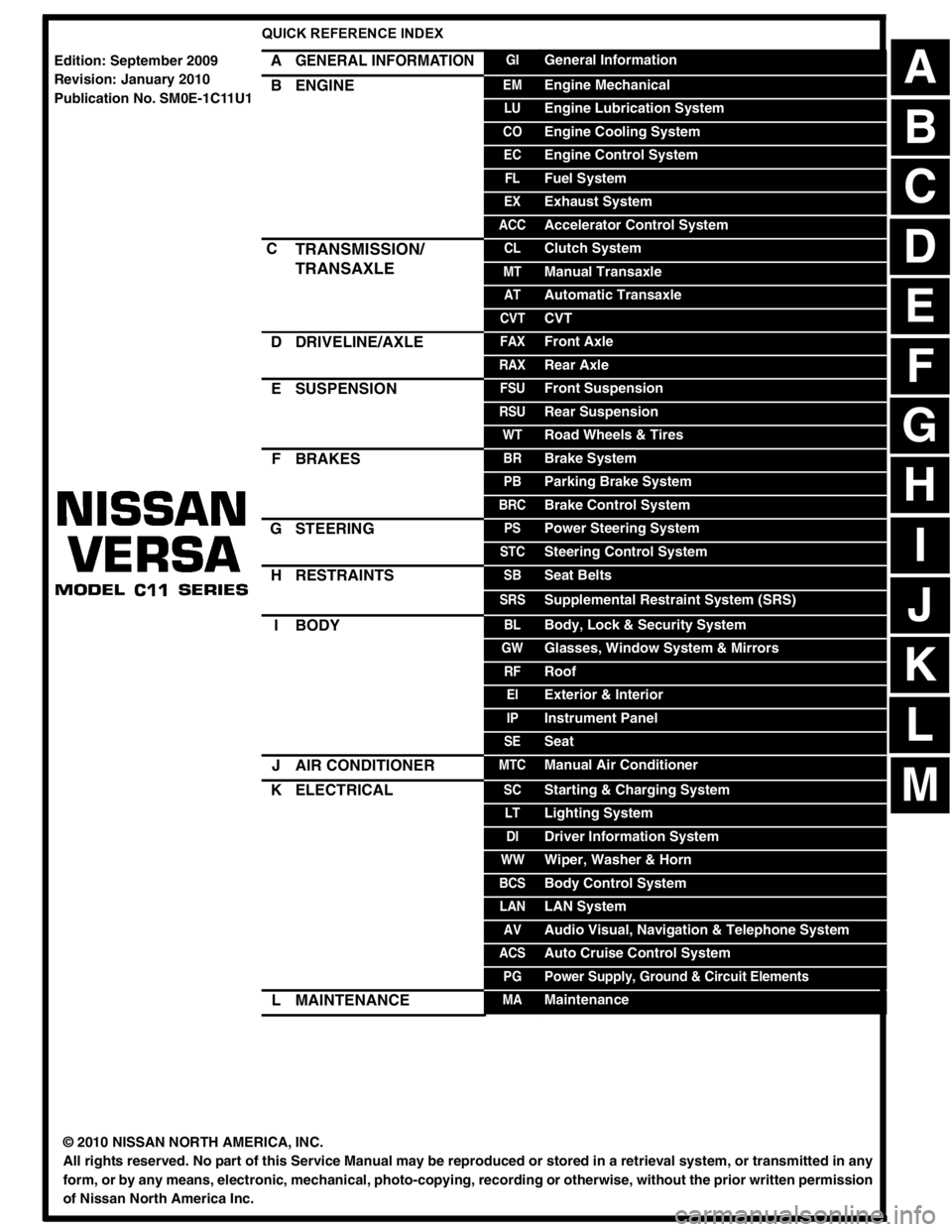
QUICK REFERENCE INDEX
AGENERAL INFORMATIONGIGeneral Information
BENGINEEMEngine Mechanical
LUEngine Lubrication System
COEngine Cooling System
ECEngine Control System
FLFuel System
EXExhaust System
ACCAccelerator Control System
CTRANSMISSION/
TRANSAXLECLClutch System
MTManual Transaxle
ATAutomatic Transaxle
CVTCVT
DDRIVELINE/AXLEFAXFront Axle
RAXRear Axle
ESUSPENSIONFSUFront Suspension
RSURear Suspension
WTRoad Wheels & Tires
FBRAKESBRBrake System
PBParking Brake System
BRCBrake Control System
GSTEERINGPSPower Steering System
STCSteering Control System
HRESTRAINTSSBSeat Belts
SRSSupplemental Restraint System (SRS)
IBODYBLBody, Lock & Security System
GWGlasses, Window System & Mirrors
RFRoof
EIExterior & Interior
IPInstrument Panel
SESeat
JAIR CONDITIONERMTCManual Air Conditioner
KELECTRICALSCStarting & Charging System
LTLighting System
DIDriver Information System
WWWiper, Washer & Horn
BCSBody Control System
LANLAN System
AVAudio Visual, Navigation & Telephone System
ACSAuto Cruise Control System
PGPower Supply, Ground & Circuit Elements
LMAINTENANCEMAMaintenance
Edition: September 2009
Revision: January 2010
Publication No. SM0E-1C11U1
B
D
© 2010 NISSAN NORTH AMERICA, INC.
All rights reserved. No part of this Service Manual may be reproduced or stored in a retrieval system, or transmitted in any
form, or by any means, electronic, mechanical, photo-copying, recording or otherwise, without the prior written permission
of Nissan North America Inc.
A
C
E
F
G
H
I
J
K
L
M
Page 507 of 3745

BCS-18
< SERVICE INFORMATION >
BCM (BODY CONTROL MODULE)
WORK SUPPORT
Display Item List
CAN Communication Inspection Using CONSULT-III (Self-Diagnosis)INFOID:0000000005395110
1.SELF-DIAGNOSTIC RESULT CHECK
1. Connect CONSULT–III and select “BCM” on “SELECT SYSTEM” screen.
2. Select “BCM” on “SELECT TEST ITEM” screen, and select “SELF-DIAG RESULTS”.
3. Check display content in self-diagnostic results.
Warning chime BUZZER ××
Room lamp timer INT LAMP ×× ×
Remote keyless entry
system MULTI REMOTE
ENT
××
×
Headlamp HEAD LAMP×× ×
Wiper WIPER×× ×
Turn signal lamp
Hazard lamp FLASHER
××
Blower fan switch sig-
nal
Air conditioner switch
signal AIR CONDITION-
ER
××
Intelligent Key INTELLIGENT
KEY
×
Combination switch COMB SW ×
NVIS (NATS) IMMU ××
Interior lamp battery
saver BATTERY SAV-
ER
××
×
Back door/Trunk TRUNK ××
Theft alarm THEFT ALARM×× ×
Retained accessory
power control RETAINED PWR
×× ×
Oil pressure swit ch SIGNAL BUFFER ××
Low tire pressure moni-
tor AIR PRESSURE
MONITOR
××
× ×
Panic alarm PANIC ALARM ×
System and item
CONSULT-III dis-
play Diagnostic test mode (Inspection by part)
WORK
SUPPORT SELF
−
DIAG RE-
SULTS CAN DIAG
SUPPORT
MNTR DATA
MONITOR ECU
PA R T
NUMBER AC-
TIVE
TEST CON-
FIGU-
RATION
Item Description
RESET SETTING VALUE Return a value set with WORK SUPPORT of each system to a default value in factory shipment.
CONSULT-III display code Diagnosis item
U1000 INITIAL DIAG
TRANSMIT DIAG ECM
IPDM E/R
METER/M&A I-KEY
Revision: January 20102010 Versa
Page 1285 of 3745
![NISSAN TIIDA 2010 Service Repair Manual EC-20
< BASIC INSPECTION >[HR16DE]
INSPECTION AND ADJUSTMENT
INSPECTION AND ADJUSTMENT
BASIC INSPECTION
BASIC INSPECTION : Special Repair RequirementINFOID:0000000005398231
1.INSPECTION START
1. Check](/img/5/57397/w960_57397-1284.png "NISSAN TIIDA 2010 Service Repair Manual EC-20
< BASIC INSPECTION >[HR16DE]
INSPECTION AND ADJUSTMENT
INSPECTION AND ADJUSTMENT
BASIC INSPECTION
BASIC INSPECTION : Special Repair RequirementINFOID:0000000005398231
1.INSPECTION START
1. Check")
EC-20
< BASIC INSPECTION >[HR16DE]
INSPECTION AND ADJUSTMENT
INSPECTION AND ADJUSTMENT
BASIC INSPECTION
BASIC INSPECTION : Special Repair RequirementINFOID:0000000005398231
1.INSPECTION START
1. Check service records for any recent repairs that ma y indicate a related malfunction, or a current need for
scheduled maintenance.
2. Open engine hood and check the following:
- Harness connectors for improper connections
- Wiring harness for improper connections, pinches and cut
- Vacuum hoses for splits, kinks and improper connections
- Hoses and ducts for leaks
- Air cleaner clogging
- Gasket
3. Confirm that electrical or mechanical loads are not applied.
- Headlamp switch is OFF.
- Air conditioner switch is OFF.
- Rear window defogger switch is OFF.
- Steering wheel is in the straight-ahead position, etc.
4. Start engine and warm it up until engine coolant temperature
indicator points the middle of gauge.
Ensure engine stays below 1,000 rpm.
5. Run engine at about 2,000 rpm for about 2 minutes under no load.
6. Make sure that no DTC is displayed with CONSULT-III or GST.
Is any DTC detected?
YES >> GO TO 2.
NO >> GO TO 3.
2.REPAIR OR REPLACE
Repair or replace components as necessary according to corresponding Diagnostic Procedure.
>> GO TO 3
3.CHECK IDLE SPEED
1. Run engine at about 2,000 rpm for about 2 minutes under no load.
SEF983U
SEF976U
SEF977U
Revision: January 20102010 Versa
Page 1291 of 3745
![NISSAN TIIDA 2010 Service Repair Manual EC-26
< BASIC INSPECTION >[HR16DE]
INSPECTION AND ADJUSTMENT
• Each time electric throttle control actuator or ECM is replaced.
• Idle speed or ignition timing is out of specification.
IDLE AIR VO](/img/5/57397/w960_57397-1290.png "NISSAN TIIDA 2010 Service Repair Manual EC-26
< BASIC INSPECTION >[HR16DE]
INSPECTION AND ADJUSTMENT
• Each time electric throttle control actuator or ECM is replaced.
• Idle speed or ignition timing is out of specification.
IDLE AIR VO")
EC-26
< BASIC INSPECTION >[HR16DE]
INSPECTION AND ADJUSTMENT
• Each time electric throttle control actuator or ECM is replaced.
• Idle speed or ignition timing is out of specification.
IDLE AIR VOLUME LEARNING
: Special Repair RequirementINFOID:0000000005398245
1.PRECONDITIONING
Make sure that all of the following conditions are satisfied.
Learning will be cancelled if any of the follo wing conditions are missed for even a moment.
• Battery voltage: More than 12.9 V (At idle)
• Engine coolant temperature: 70 - 100 °C (158 - 212° F)
• Selector lever: P or N (A/T), Neutral (M/T)
• Electric load switch: OFF (Air conditioner, headlamp, rear window defogger)
On vehicles equipped with daytime light systems, if the parking brake is applied before the engine is
started the headlamp will not be illuminated.
• Steering wheel: Neutral (Straight-ahead position)
• Vehicle speed: Stopped
• Transmission: Warmed-up
- A/T models
• With CONSULT-III: Drive vehicle until “FLUID TEMP SE” in “DATA MONITOR” mode of “TRANSMISSION”
system indicates less than 0.9 V.
• Without CONSULT-III: Drive vehicle for 10 minutes.
- M/T models
• Drive vehicle for 10 minutes.
Do you have CONSULT-III?
YES >> GO TO 2.
NO >> GO TO 3.
2.IDLE AIR VOLUME LEARNING
With CONSULT-III
1. Perform Accelerator Pedal Released Position Learning. Refer to EC-25, "
ACCELERATOR PEDAL
RELEASED POSITION LEARNING : Special Repair Requirement".
2. Perform Throttle Valve Closed Position Learning. Refer to EC-25, "
THROTTLE VALVE CLOSED POSI-
TION LEARNING : Special Repair Requirement".
3. Start engine and warm it up to normal operating temperature.
4. Select “IDLE AIR VOL LEARN” in “WORK SUPPORT” mode.
5. Touch “START” and wait 20 seconds.
Is
“CMPLT” displayed on CONSULT-III screen?
YES >> GO TO 4.
NO >> GO TO 5.
3.IDLE AIR VOLUME LEARNING
Without CONSULT-III
NOTE:
• It is better to count the ti me accurately with a clock.
• It is impossible to switch the di agnostic mode when an accelerator pedal position sensor circuit has
a malfunction.
1. Perform Accelerator Pedal Released Position Learning. Refer to EC-25, "
ACCELERATOR PEDAL
RELEASED POSITION LEARNING : Special Repair Requirement".
2. Perform Throttle Valve Closed Position Learning. Refer to EC-25, "
THROTTLE VALVE CLOSED POSI-
TION LEARNING : Special Repair Requirement".
3. Start engine and warm it up to normal operating temperature.
4. Turn ignition switch OFF and wait at least 10 seconds.
5. Confirm that accelerator pedal is fully releas ed, turn ignition switch ON and wait 3 seconds.
6. Repeat the following procedure quickly five times within 5 seconds.
- Fully depress the accelerator pedal.
- Fully release the accelerator pedal.
7. Wait 7 seconds, fully depress the accelerator pedal and keep it for approx. 20 seconds until the MIL stops
blinking and turned ON.
8. Fully release the accelerator pedal within 3 seconds after the MIL turned ON.
Revision: January 20102010 Versa
Page 1301 of 3745
![NISSAN TIIDA 2010 Service Repair Manual EC-36
< FUNCTION DIAGNOSIS >[HR16DE]
MULTIPORT FUEL INJECTION SYSTEM
MULTIPORT FUEL INJECTION SYSTEM
System DiagramINFOID:0000000005398252
System DescriptionINFOID:0000000005398253
INPUT/OUTPUT SIGNAL](/img/5/57397/w960_57397-1300.png "NISSAN TIIDA 2010 Service Repair Manual EC-36
< FUNCTION DIAGNOSIS >[HR16DE]
MULTIPORT FUEL INJECTION SYSTEM
MULTIPORT FUEL INJECTION SYSTEM
System DiagramINFOID:0000000005398252
System DescriptionINFOID:0000000005398253
INPUT/OUTPUT SIGNAL")
EC-36
< FUNCTION DIAGNOSIS >[HR16DE]
MULTIPORT FUEL INJECTION SYSTEM
MULTIPORT FUEL INJECTION SYSTEM
System DiagramINFOID:0000000005398252
System DescriptionINFOID:0000000005398253
INPUT/OUTPUT SIGNAL CHART
*1: This sensor is not used to control the engine system under normal conditions.
JMBIA2193GB
Sensor
Input signal to ECMECM functionActuator
Crankshaft position sensor (POS) Engine speed*
3
Piston position
Fuel injection
& mixture ratio
controlFuel injector
Camshaft position sensor (PHASE)
Mass air flow sensor
Amount of intake air
Intake air temperature sensor Intake air temperature
Engine coolant temperature sensor Engine coolant temperature
Air fuel ratio (A/F) sensor 1 Density of oxygen in exhaust gas
Throttle position sensor Throttle position
Accelerator pedal position sensor Accelerator pedal position
Park/neutral position (PNP) switch (M/T)
Transmission range switch (A/T) Gear position
Battery Battery voltage*
3
Knock sensorEngine knocking condition
Heated oxygen sensor 2*
1Density of oxygen in exhaust gas
EPS control unit Power steering operation*
2
ABS actuator and electric unit (control unit)
Vehicle speed*2
Combination meter
BCMAir conditioner ON signal*
2
Revision: January 20102010 Versa
Page 1317 of 3745
![NISSAN TIIDA 2010 Service Repair Manual EC-52
< FUNCTION DIAGNOSIS >[HR16DE]
AIR CONDITIONING CUT CONTROL
AIR CONDITIONING CUT CONTROL
System DiagramINFOID:0000000005398260
System DescriptionINFOID:0000000005398261
INPUT/OUTPUT SIGNAL CHART](/img/5/57397/w960_57397-1316.png "NISSAN TIIDA 2010 Service Repair Manual EC-52
< FUNCTION DIAGNOSIS >[HR16DE]
AIR CONDITIONING CUT CONTROL
AIR CONDITIONING CUT CONTROL
System DiagramINFOID:0000000005398260
System DescriptionINFOID:0000000005398261
INPUT/OUTPUT SIGNAL CHART")
EC-52
< FUNCTION DIAGNOSIS >[HR16DE]
AIR CONDITIONING CUT CONTROL
AIR CONDITIONING CUT CONTROL
System DiagramINFOID:0000000005398260
System DescriptionINFOID:0000000005398261
INPUT/OUTPUT SIGNAL CHART
*1: This signal is sent to the ECM via the CAN communication line.
*2: ECM determines the start signal status by the signals of engine speed and battery voltage.
SYSTEM DESCRIPTION
This system improves engine operati
on when the air conditioner is used.
Under the following conditions, the air conditioner is turned off.
• When the accelerator pedal is fully depressed.
• When cranking the engine.
• At high engine speeds.
• When the engine coolant temperat ure becomes excessively high.
JMBIA2195GB
Sensor Input Signal to ECMECM functionActuator
Air conditioner switch*
1Air conditioner ON signal
Air conditioner
cut controlIPDM E/R
↓
Air conditio
ner relay
↓
Compressor
Accelerator pedal position sensor
Accelerator pedal position
Crankshaft position sensor (POS)
Camshaft position sensor (PHASE) Engine speed*
2
Engine coolant temperature sensor
Engine coolant temperature
Battery Battery voltage*
2
Refrigerant pressure sensorRefrigerant pressure
EPS control unit Power steering operation
ABS actuator and electric unit (control unit)
Vehicle speed*
1
Combination meter
BCM Air conditioner ON signal*
1
Revision: January 20102010 Versa
Page 1325 of 3745
![NISSAN TIIDA 2010 Service Repair Manual EC-60
< FUNCTION DIAGNOSIS >[HR16DE]
COOLING FAN CONTROL
COOLING FAN CONTROL
System DiagramINFOID:0000000005398265
System DescriptionINFOID:0000000005398266
INPUT/OUTPUT SIGNAL CHART
*1: The ECM deter](/img/5/57397/w960_57397-1324.png "NISSAN TIIDA 2010 Service Repair Manual EC-60
< FUNCTION DIAGNOSIS >[HR16DE]
COOLING FAN CONTROL
COOLING FAN CONTROL
System DiagramINFOID:0000000005398265
System DescriptionINFOID:0000000005398266
INPUT/OUTPUT SIGNAL CHART
*1: The ECM deter")
EC-60
< FUNCTION DIAGNOSIS >[HR16DE]
COOLING FAN CONTROL
COOLING FAN CONTROL
System DiagramINFOID:0000000005398265
System DescriptionINFOID:0000000005398266
INPUT/OUTPUT SIGNAL CHART
*1: The ECM determines the start signal status by the signals of engine speed and battery voltage.
*2: This signal is sent to ECM via the CAN communication line.
SYSTEM DESCRIPTION
ECM controls cooling fan speed corresponding to vehicle
speed, engine coolant temperature, refrigerant pres-
sure, air conditioner ON signal. Then contro l system has 3-step control [HIGH/LOW/OFF].
Cooling Fan Operation
JMBIA2196GB
SensorInput signal to ECM ECM function Actuator
Crankshaft position sensor (POS)
Camshaft position sensor (PHASE) Engine speed*
1
Cooling fan
controlIPDM E/R
↓
Cooling fan relay
↓
Cooling fan motor
Battery
Battery voltage*
1
ABS actuator and electric unit (control unit)
Vehicle speed*2Combination meter
Engine coolant temperature sensorEngine coolant temperature
BCM Air conditioner ON signal*
2
Refrigerant pressure sensorRefrigerant pressure
Revision: January 20102010 Versa
Page 1366 of 3745
![NISSAN TIIDA 2010 Service Repair Manual ON BOARD DIAGNOSTIC (OBD) SYSTEMEC-101
< FUNCTION DIAGNOSIS > [HR16DE]
C
D
E
F
G H
I
J
K L
M A
EC
NP
O
HO2S2 MNTR(B1)
RICH/
LEAN • Display of heated oxygen sensor 2 signal:
RICH: means the amount of](/img/5/57397/w960_57397-1365.png "NISSAN TIIDA 2010 Service Repair Manual ON BOARD DIAGNOSTIC (OBD) SYSTEMEC-101
< FUNCTION DIAGNOSIS > [HR16DE]
C
D
E
F
G H
I
J
K L
M A
EC
NP
O
HO2S2 MNTR(B1)
RICH/
LEAN • Display of heated oxygen sensor 2 signal:
RICH: means the amount of")
ON BOARD DIAGNOSTIC (OBD) SYSTEMEC-101
< FUNCTION DIAGNOSIS > [HR16DE]
C
D
E
F
G H
I
J
K L
M A
EC
NP
O
HO2S2 MNTR(B1)
RICH/
LEAN • Display of heated oxygen sensor 2 signal:
RICH: means the amount of oxygen after three way
catalyst is relatively small.
LEAN: means the amount of oxygen after three way
catalyst is relatively large. • When the engine is stopped, a certain
value is indicated.
VHCL SPEED SE km/h or
mph • The vehicle speed computed from the vehicle speed
signal sent from combination meter is displayed.
BATTERY VOLT V • The power supply voltage of ECM is displayed.
ACCEL SEN 1 V• The accelerator pedal position sensor signal voltage is
displayed. • ACCEL SEN 2 signal is converted by
ECM internally. Thus, it differs from
ECM terminal voltage signal.
ACCEL SEN 2
TP SEN 1-B1
V• The throttle position sensor signal voltage is dis-
played. • TP SEN 2-B1 signal is converted by
ECM internally. Thus, it differs from
ECM terminal voltage signal.
TP SEN 2-B1
FUEL T/TMP SE
°C or °F • The fuel temperature (determined by the signal volt-
age of the fuel tank temperature sensor) is displayed.
INT/A TEMP SE °C or °F • The intake air temperature (determined by the signal
voltage of the intake air temperature sensor) is indicat-
ed.
EVAP SYS PRES V • The signal voltage of EVAP control system pressure
sensor is displayed.
FUEL LEVEL SE V • The signal voltage of the fuel level sensor is displayed.
START SIGNAL ON/OFF • Indicates start signal status [ON/OFF] computed by
the ECM according to the signals of engine speed and
battery voltage. • After starting the engine, [OFF] is dis-
played regardless of the starter sig-
nal.
CLSD THL POS ON/OFF • Indicates idle position [ON/OFF] computed by ECM
according to the accelerator pedal position sensor sig-
nal.
AIR COND SIG ON/OFF • Indicates [ON/OFF] condition of the air conditioner
switch determined by the air conditioner ON signal.
P/N POSI SW ON/OFF • Indicates [ON/OFF] condit
ion from the park/neutral
position (PNP) signal.
PW/ST SIGNAL ON/OFF • [ON/OFF] condition of the power steering system (de-
termined by the signal sent from EPS control unit) is
indicated.
LOAD SIGNAL ON/OFF • Indicates [ON/OFF] condition from the electrical load
signal.
ON: Rear window defogger switch is ON and/or light-
ing switch is in 2nd position.
OFF: Both rear window defogger switch and lighting
switch are OFF.
IGNITION SW ON/OFF • Indicates [ON/OFF] condition from ignition switch sig-
nal.
HEATER FAN SW ON/OFF • Indicates [ON/OFF] condition from the heater fan
switch signal.
BRAKE SW ON/OFF• Indicates [ON/OFF] condition from the stop lamp
switch signal.
INJ PULSE-B1 msec • Indicates the actual fuel injection pulse width compen-
sated by ECM according to the input signals. • When the engine is stopped, a certain
computed value is indicated.
IGN TIMING BTDC• Indicates the ignition timing computed by ECM ac-
cording to the input signals. • When the engine is stopped, a certain
value is indicated.
CAL/LD VALUE %• “Calculated load value” indicates the value of the cur-
rent air flow divided by peak air flow.
MASS AIRFLOW g·m/s • Indicates the mass air flow computed by ECM accord-
ing to the signal voltage of the mass air flow sensor.
Monitored item Unit
DescriptionRemarks
Revision: January 20102010 Versa
Page 1367 of 3745
![NISSAN TIIDA 2010 Service Repair Manual EC-102
< FUNCTION DIAGNOSIS >[HR16DE]
ON BOARD DIAGNOSTIC (OBD) SYSTEM
*: The item is indicated, but not used.
NOTE:
Any monitored item that does not match the vehicle being diagnosed is deleted from](/img/5/57397/w960_57397-1366.png "NISSAN TIIDA 2010 Service Repair Manual EC-102
< FUNCTION DIAGNOSIS >[HR16DE]
ON BOARD DIAGNOSTIC (OBD) SYSTEM
*: The item is indicated, but not used.
NOTE:
Any monitored item that does not match the vehicle being diagnosed is deleted from")
EC-102
< FUNCTION DIAGNOSIS >[HR16DE]
ON BOARD DIAGNOSTIC (OBD) SYSTEM
*: The item is indicated, but not used.
NOTE:
Any monitored item that does not match the vehicle being diagnosed is deleted from the display automatically.PURG VOL C/V %
• Indicates the EVAP canister purge volume control so-
lenoid valve control value computed by the ECM ac-
cording to the input signals.
• The opening becomes larger as the value increases.
INT/V TIM(B1) °CA • Indicates [ °CA] of intake camshaft advance angle.
INT/V SOL(B1) %• The control value of the intake valve timing control so-
lenoid valve (determined by ECM according to the in-
put signals) is indicated.
• The advance angle becomes larger as the value in- creases.
AIR COND RLY ON/OFF • The air conditioner relay control condition (determined
by ECM according to the input signals) is indicated.
FUEL PUMP RLY ON/OFF • Indicates the fuel pump relay control condition deter-
mined by ECM according to the input signals.
VENT CONT/V ON/OFF • The control condition of the EVAP canister vent control
valve (determined by ECM according to the input sig-
nals) is indicated.
ON: Closed
OFF: Open
THRTL RELAY ON/OFF • Indicates the throttle contro
l motor relay control condi-
tion determined by the ECM according to the input sig-
nals.
COOLING FAN HI/LOW/
OFF• Indicates the condition of the cooling fan (determined
by ECM according to the input signals).
HI: High speed operation
LOW: Low speed operation
OFF: Stop
HO2S2 HTR (B1) ON/OFF • Indicates [ON/OFF] condition of heated oxygen sen-
sor 2 heater determined by ECM according to the in-
put signals.
I/P PULLY SPD rpm • Indicates the engine speed computed from the prima-
ry sped sensor signal.
VEHICLE SPEED km/h or
mph • The vehicle speed computed from the vehicle speed
signal sent from TCM is displayed.
IDL A/V LEARN YET/CM-
PLT • Display the condition of Idle Air Volume Learning
YET: Idle air volume learning has not been performed
yet.
CMPLT: Idle air volume learning has already been per-
formed successfully.
TRVL AFTER MIL km or
mile • Distance traveled while MIL is activated.
A/F S1 HTR(B1) % • Air fuel ratio (A/F) sensor 1 heater control value com-
puted by ECM according to the input signals.
• The current flow to the heater becomes larger as the value increases.
AC PRESS SEN V • The signal voltage from the refrigerant pressure sen-
sor is displayed.
A/F ADJ-B1 —• Indicates the correction of factor stored in ECM. The
factor is calculated from the difference between the
target air-fuel ratio stored in ECM and the air-fuel ratio
calculated from A/F sensor 1 signal.
HO2 S2 DIAG2 (B1)
*
[INCMP/CMPLT] —• Indicates DTC P0139 self-diagnosis (slow responce)
INCMP: Self-diagnosis is incomplete.
CMPLT: Self-diagnosis is complete.
Monitored item Unit
DescriptionRemarks
Revision: January 20102010 Versa
Page 1371 of 3745
![NISSAN TIIDA 2010 Service Repair Manual EC-106
< COMPONENT DIAGNOSIS >[HR16DE]
TROUBLE DIAGNOSIS - SPECIFICATION VALUE
COMPONENT DIAGNOSIS
TROUBLE DIAGNOSIS - SPECIFICATION VALUE
DescriptionINFOID:0000000005398280
The specification (SP) val](/img/5/57397/w960_57397-1370.png "NISSAN TIIDA 2010 Service Repair Manual EC-106
< COMPONENT DIAGNOSIS >[HR16DE]
TROUBLE DIAGNOSIS - SPECIFICATION VALUE
COMPONENT DIAGNOSIS
TROUBLE DIAGNOSIS - SPECIFICATION VALUE
DescriptionINFOID:0000000005398280
The specification (SP) val")
EC-106
< COMPONENT DIAGNOSIS >[HR16DE]
TROUBLE DIAGNOSIS - SPECIFICATION VALUE
COMPONENT DIAGNOSIS
TROUBLE DIAGNOSIS - SPECIFICATION VALUE
DescriptionINFOID:0000000005398280
The specification (SP) value indicates the tolerance of
the value that is displayed in “SPEC” of “DATA MONI-
TOR” mode of CONSULT-III during normal operation of the Engine Control System. When the value in “SPEC”
of “DATA MONITOR” mode is within the SP value, the Engine Control System is confirmed OK. When the
value in “SPEC” of “DATA MONITOR” mode is NOT withi n the SP value, the Engine Control System may have
one or more malfunctions.
The SP value is used to detect malfunctions that may af fect the Engine Control System, but will not light the
MIL.
The SP value will be displayed for the following three items:
• B/FUEL SCHDL (The fuel injection pulse width progr ammed into ECM prior to any learned on board correc-
tion)
• A/F ALPHA-B1 (The mean value of air-fuel ratio feedback correction factor per cycle)
• MAS A/F SE-B1 (The signal voltage of the mass air flow sensor)
Component Function CheckINFOID:0000000005398281
1.START
Make sure that all of the following conditions are satisfied.
• Vehicle driven distance: More than 5,000 km (3,107 miles)
• Barometric pressure: 98.3 - 104.3 kPa (1.003 - 1.064 kg/cm
2, 14.25 - 15.12 psi)
• Atmospheric temperature: 20 - 30 °C (68 - 86° F)
• Engine coolant temperature: 75 - 95 °C (167 - 203° F)
• Transmission: Warmed-up
- A/T models: After the engine is warmed up to norma l operating temperature, drive vehicle until “FLUID
TEMP SE” (A/T fluid te mperature sensor signal) indicates more than 60 °C (140 °F).
- M/T models: After the engine is warmed up to normal operating temperature, drive vehicle for 5 minutes.
• Electrical load: Not applied
- Rear window defogger switch, air conditioner switch, lighting switch are OFF. Steering wheel is straight
ahead.
• Engine speed: Idle
>> GO TO 2.
2.PERFORM “SPEC” OF “DATA MONITOR” MODE
With CONSULT-III
NOTE:
Perform “SPEC” in “DATA MONITOR” mode in maximum scale display.
1. Perform EC-20, "
BASIC INSPECTION : Special Repair Requirement".
2. Select “B/FUEL SCHDL”, “A/F ALPHA-B1” and “MAS A/F SE-B1” in “SPEC” of “DATA MONITOR” mode
with CONSULT-III.
3. Make sure that monitor items are within the SP value.
Is the inspection result normal?
YES >> END
NO >> Go to EC-107, "
Diagnosis Procedure".
Revision: January 20102010 Versa