turn NISSAN TIIDA 2011 Service Repair Manual
[x] Cancel search | Manufacturer: NISSAN, Model Year: 2011, Model line: TIIDA, Model: NISSAN TIIDA 2011Pages: 3787, PDF Size: 78.35 MB
Page 13 of 3787

ACC-2
< SERVICE INFORMATION >
PRECAUTIONS
SERVICE INFORMATION
PRECAUTIONS
Precaution for Supplemental Restraint System (SRS) "AIR BAG" and "SEAT BELT
PRE-TENSIONER"
INFOID:0000000006405207
The Supplemental Restraint System such as “A IR BAG” and “SEAT BELT PRE-TENSIONER”, used along
with a front seat belt, helps to reduce the risk or severity of injury to the driver and front passenger for certain
types of collision. This system includes seat belt switch inputs and dual stage front air bag modules. The SRS
system uses the seat belt switches to determine the front air bag deployment, and may only deploy one front
air bag, depending on the severity of a collision and w hether the front occupants are belted or unbelted.
Information necessary to service the system safely is included in the SRS and SB section of this Service Man-
ual.
WARNING:
• To avoid rendering the SRS inopera tive, which could increase the risk of personal injury or death in
the event of a collision which would result in air bag inflation, all maintenance must be performed by
an authorized NISSAN/INFINITI dealer.
• Improper maintenance, including incorrect removal and installation of the SRS can lead to personal
injury caused by unintent ional activation of the system. For re moval of Spiral Cable and Air Bag
Module, see the SRS section.
• Do not use electrical test equipmen t on any circuit related to the SRS unless instructed to in this
Service Manual. SRS wiring harn esses can be identified by yellow and/or orange harnesses or har-
ness connectors.
PRECAUTIONS WHEN USING POWER TOOLS (AIR OR ELECTRIC) AND HAMMERS
WARNING:
• When working near the Airbag Diagnosis Sensor Unit or other Airbag System sensors with the Igni-
tion ON or engine running, DO NOT use air or electri c power tools or strike near the sensor(s) with a
hammer. Heavy vibration could activate the sensor( s) and deploy the air bag(s), possibly causing
serious injury.
• When using air or electric power tools or hammers , always switch the Ignition OFF, disconnect the
battery, and wait at least 3 minu tes before performing any service.
Precaution Necessary for Steering W heel Rotation After Battery Disconnect
INFOID:0000000005928708
NOTE:
• This Procedure is applied only to models with Intelligent Key system and NATS (NISSAN ANTI-THEFT SYS-
TEM).
• Remove and install all control units after disconnecting both battery cables with the ignition knob in the
″LOCK ″ position.
• Always use CONSULT-III to perform self-diagnosis as a part of each function inspection after finishing work.
If DTC is detected, perform trouble diagnosis according to self-diagnostic results.
For models equipped with the Intelligent Key system and NATS, an electrically controlled steering lock mech-
anism is adopted on the key cylinder.
For this reason, if the battery is disconnected or if the battery is discharged, the steering wheel will lock and
steering wheel rotation will become impossible.
If steering wheel rotation is required when battery pow er is interrupted, follow the procedure below before
starting the repair operation.
OPERATION PROCEDURE
1. Connect both battery cables. NOTE:
Supply power using jumper cables if battery is discharged.
2. Use the Intelligent Key or mechanical key to turn the ignition switch to the ″ACC ″ position. At this time, the
steering lock will be released.
3. Disconnect both battery cables. The steering lock will remain released and the steering wheel can be rotated.
4. Perform the necessary repair operation.
Revision: May 2010 2011 Versa
Page 14 of 3787

PRECAUTIONSACC-3
< SERVICE INFORMATION >
C
DE
F
G H
I
J
K L
M A
ACC
NP
O
5. When the repair work is completed, return the ignition switch to the
″LOCK ″ position before connecting
the battery cables. (At this time, the steering lock mechanism will engage.)
6. Perform a self-diagnosis check of al l control units using CONSULT-III.
Revision: May 2010 2011 Versa
Page 15 of 3787
ACC-4
< SERVICE INFORMATION >
ACCELERATOR CONTROL SYSTEM
ACCELERATOR CONTROL SYSTEM
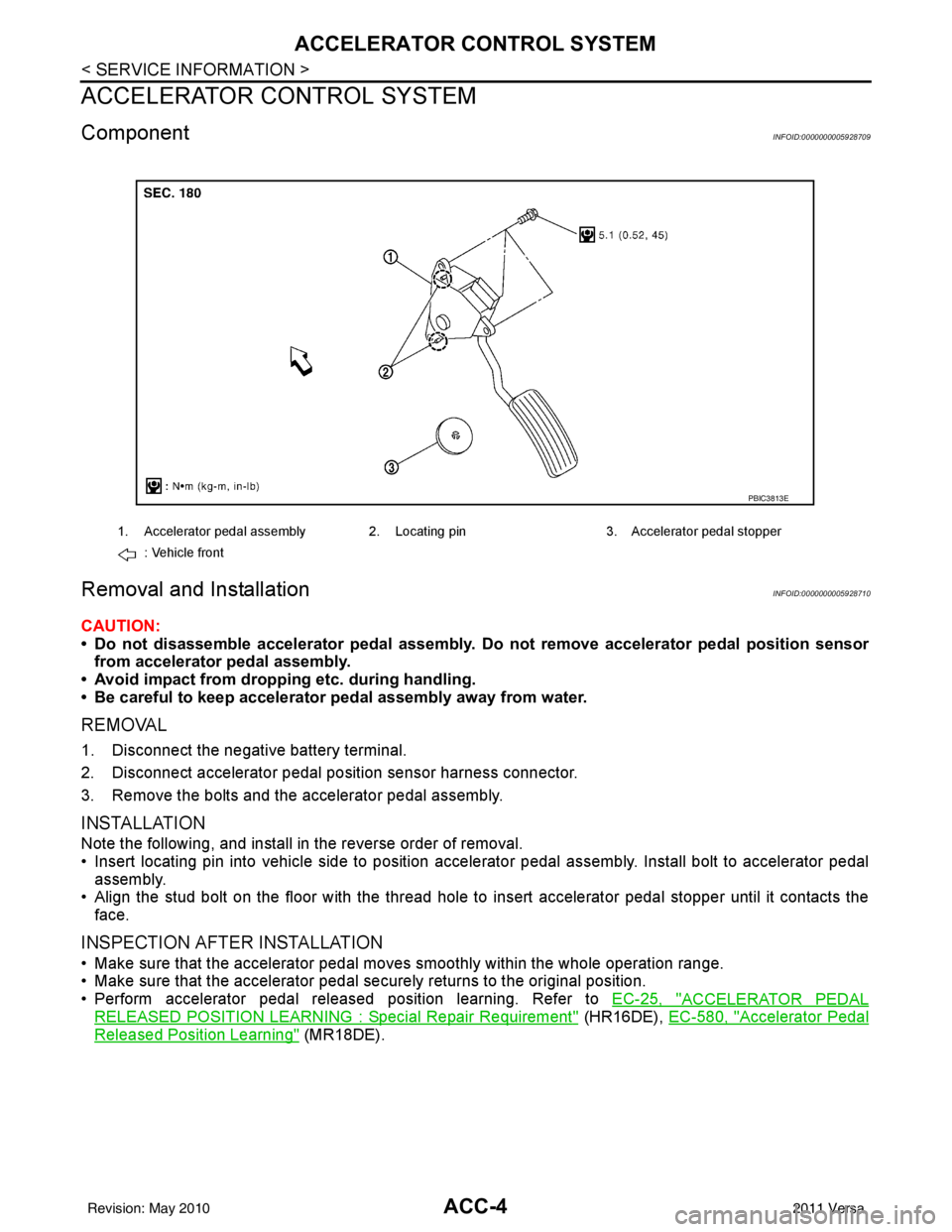
ComponentINFOID:0000000005928709
Removal and InstallationINFOID:0000000005928710
CAUTION:
• Do not disassemble accelerator pedal assembly. Do not remove accelerator pedal position sensor
from accelerator pedal assembly.
• Avoid impact from dropping etc. during handling.
• Be careful to keep accelerator pedal assembly away from water.
REMOVAL
1. Disconnect the negative battery terminal.
2. Disconnect accelerator pedal position sensor harness connector.
3. Remove the bolts and the accelerator pedal assembly.
INSTALLATION
Note the following, and install in the reverse order of removal.
• Insert locating pin into vehicle side to position accelerator pedal assembly. Install bolt to accelerator pedal assembly.
• Align the stud bolt on the floor with the thread hole to insert accelerator pedal stopper until it contacts the
face.
INSPECTION AFTER INSTALLATION
• Make sure that the accelerator pedal moves smoothly within the whole operation range.
• Make sure that the accelerator pedal securely returns to the original position.
• Perform accelerator pedal released position learning. Refer to EC-25, "
ACCELERATOR PEDAL
RELEASED POSITION LEARNING : Special Repair Requirement" (HR16DE), EC-580, "Accelerator Pedal
Released Position Learning" (MR18DE).
1. Accelerator pedal assembly 2. Locating pin 3. Accelerator pedal stopper
: Vehicle front
PBIC3813E
Revision: May 2010 2011 Versa
Page 20 of 3787

AT-3
DE
F
G H
I
J
K L
M A
B
AT
N
O
P
N
P1760 OVERRUN CLUTCH
SOLENOID .........148
Description .......................................................... ..148
CONSULT-III Reference Value in Data Monitor
Mode ................................................................... ..
148
On Board Diagnosis Logic ....................................148
Possible Cause .....................................................148
DTC Confirmation Procedure ................................148
Wiring Diagram - AT - OVRCSV ...........................149
Diagnosis Procedure .............................................150
Component Inspection ..........................................151
VEHICLE SPEED SIGNAL ...............................153
Description .......................................................... ..153
CONSULT-III Reference Value in Data Monitor
Mode ................................................................... ..
153
On Board Diagnosis Logic ....................................153
Possible Cause .....................................................153
DTC Confirmation Procedure ................................153
Wiring Diagram - AT - VSSMTR ...........................154
Diagnosis Procedure ........................................... ..155
BATT/FLUID TEMP SEN .................................156
Description .......................................................... ..156
CONSULT-III Reference Value in Data Monitor
Mode ................................................................... ..
156
On Board Diagnosis Logic ....................................156
Possible Cause .....................................................156
DTC Confirmation Procedure ................................156
Wiring Diagram - AT - BA/FTS ..............................157
Diagnosis Procedure .............................................158
Component Inspection ..........................................160
INPUT SPEED SENSOR A ..............................162
Description .......................................................... ..162
CONSULT-III Reference Value in Data Monitor
Mode ................................................................... ..
162
On Board Diagnosis Logic ....................................162
Possible Cause .....................................................162
DTC Confirmation Procedure ................................162
Wiring Diagram - AT - PT/SEN .............................163
Diagnosis Procedure .............................................164
CONTROL UNIT (RAM), CONTROL UNIT
(ROM) ...............................................................
167
Description .......................................................... ..167
On Board Diagnosis Logic ....................................167
Possible Cause .....................................................167
DTC Confirmation Procedure ................................167
Diagnosis Procedure .............................................167
MAIN POWER SUPPLY AND GROUND CIR-
CUIT ..................................................................
168
Wiring Diagram - AT - MAIN ............................... ..168
Diagnosis Procedure .............................................169
TR SW, OD SW AND CLOSED THROTTLE,
WIDE OPEN THROTTLE POSITION SIGNAL
CIRCUIT ......................................................... ..
171
CONSULT-III Reference Value in Data Monitor
Mode ................................................................... ..
171
TCM Terminal and Reference Value .....................171
Diagnosis Procedure ........................................... ..171
Component Inspection ...........................................175
SHIFT POSITION INDICATOR CIRCUIT ........176
Description .............................................................176
CONSULT-III Reference Value in Data Monitor
Mode .................................................................... ..
176
Diagnosis Procedure .............................................176
TROUBLE DIAGNOSIS FOR SYMPTOMS ....177
Wiring Diagram - AT - NONDTC ...........................177
OD OFF Indicator Lamp Does Not Come On ........180
Engine Cannot Be Started in "P" and "N" Position ..182
In "P" Position, Vehicle Moves Forward or Back-
ward When Pushed ...............................................
183
In "N" Position, Vehicle Moves ..............................183
Large Shock "N" → "R" Position .......................... ..184
Vehicle Does Not Creep Backward in "R" Position ..185
Vehicle Does Not Creep Forward in "D", "2" or "1"
Position ................................................................ ..
186
Vehicle Cannot Be Started from D1 .......................187
A/T Does Not Shift: D1→ D2or Does Not Kick-
down: D
4→ D2 ..................................................... ..189
A/T Does Not Shift: D2→ D3 ................................ ..190
A/T Does Not Shift: D3→ D4 ................................ ..192
A/T Does Not Perform Lock-up ........................... ..193
A/T Does Not Hold Lock-up Condition ...................194
Lock-up Is Not Released .......................................195
Engine Speed Does Not Return to Idle (Light
Braking D
4→ D3) ................................................. ..196
A/T Does Not Shift: D4→ D3, When OD OFF ...... ..197
A/T Does Not Shift: D3→ 22, When Selector Lever
"D" → "2" Position ............................................... ..
198
A/T Does Not Shift: 22→ 11, When Selector Lever
"2" → "1" Position ................................................ ..
199
Vehicle Does Not Decelerate by Engine Brake ... ..201
TCM Self-Diagnosis Does Not Activate .................204
A/T SHIFT LOCK SYSTEM .............................206
Description .............................................................206
Shift Lock System Parts Location ..........................207
Wiring Diagram - AT - SHIFT ................................208
Diagnosis Procedure .............................................208
TRANSMISSION CONTROL MODULE ..........212
Removal and Installation .......................................212
SHIFT CONTROL SYSTEM ............................213
A/T Shift Selector Removal and Installation ........ ..213
A/T Shift Selector Disassembly and Assembly ......216
Shift Selector Handle Removal and Installation ....216
Adjustment of A/T Position ....................................217
Checking of A/T Position .......................................217
KEY INTERLOCK CABLE ..............................219
Removal and Installation .......................................219
ON-VEHICLE SERVICE ..................................222
Control Valve Assembly and Accumulators ...........222
Revision: May 2010 2011 Versa
Page 24 of 3787

PRECAUTIONSAT-7
< SERVICE INFORMATION >
DE
F
G H
I
J
K L
M A
B
AT
N
O P
PRECAUTIONS
Precaution for Supplemental Restraint System (SRS) "AIR BAG" and "SEAT BELT
PRE-TENSIONER"
INFOID:0000000006413332
The Supplemental Restraint System such as “AIR BAG” and “SEAT BELT PRE-TENSIONER”, used along
with a front seat belt, helps to reduce the risk or severi ty of injury to the driver and front passenger for certain
types of collision. This system includes seat belt switch inputs and dual stage front air bag modules. The SRS
system uses the seat belt switches to determine the front air bag deployment, and may only deploy one front
air bag, depending on the severity of a collision and w hether the front occupants are belted or unbelted.
Information necessary to service the system safely is included in the SRS and SB section of this Service Man-
ual.
WARNING:
• To avoid rendering the SRS inoper ative, which could increase the risk of personal injury or death in
the event of a collision which would result in air bag inflation, all maintenance must be performed by
an authorized NISSAN/INFINITI dealer.
• Improper maintenance, including in correct removal and installation of the SRS can lead to personal
injury caused by unintentional act ivation of the system. For removal of Spiral Cable and Air Bag
Module, see the SRS section.
• Do not use electrical test equipm ent on any circuit related to the SRS unless instructed to in this
Service Manual. SRS wiring harnesses can be identi fied by yellow and/or orange harnesses or har-
ness connectors.
PRECAUTIONS WHEN USING POWER TOOLS (AIR OR ELECTRIC) AND HAMMERS
WARNING:
• When working near the Airbag Diagnosis Sensor Un it or other Airbag System sensors with the Igni-
tion ON or engine running, DO NOT use air or el ectric power tools or strike near the sensor(s) with a
hammer. Heavy vibration could activate the sensor( s) and deploy the air bag(s), possibly causing
serious injury.
• When using air or electric power tools or hammers, always switch the Ignition OFF, disconnect the battery, and wait at least 3 minutes before performing any service.
Precaution Necessary for Steering Wheel Rotation After Battery Disconnect
INFOID:0000000005928064
NOTE:
• This Procedure is applied only to models with Intelligent Key system and NVIS /IVIS (NISSAN/INFINITI
VEHICLE IMMOBILIZER SYSTEM - NATS).
• Remove and install all control units after disconnecti ng both battery cables with the ignition knob in the
″ LOCK ″ position.
• Always use CONSULT-III to perform self-diagnosis as a part of each function inspection after finishing work.
If DTC is detected, perform trouble diagnosis according to self-diagnostic results.
For models equipped with the Intelligent Key system and NVIS/IVIS, an electrically controlled steering lock
mechanism is adopted on the key cylinder.
For this reason, if the battery is disconnected or if the battery is discharged, the steering wheel will lock and
steering wheel rotation will become impossible.
If steering wheel rotation is required when battery power is interrupted, follow the procedure below before
starting the repair operation.
OPERATION PROCEDURE
1. Connect both battery cables. NOTE:
Supply power using jumper cables if battery is discharged.
2. Use the Intelligent Key or mechanical key to turn the ignition switch to the ″ACC ″ position. At this time, the
steering lock will be released.
3. Disconnect both battery cables. The steering lock will remain released and the steering wheel can be
rotated.
4. Perform the necessary repair operation.
5. When the repair work is completed, return the ignition switch to the ″LOCK ″ position before connecting
the battery cables. (At this time, the steering lock mechanism will engage.)
Revision: May 2010 2011 Versa
Page 25 of 3787
AT-8
< SERVICE INFORMATION >
PRECAUTIONS
6. Perform a self-diagnosis check of all control units using CONSULT-III.
Precaution for On Board Diagnosis (OBD) System of A/T and EngineINFOID:0000000005928065
The ECM has an on board diagnostic system. It will light up the malfunction indicator lamp (MIL) to warn the
driver of a malfunction causing emission deterioration.
CAUTION:
• Be sure to turn the ignition switch OFF and disconnect battery negative cable from battery negative
terminal before any repair or inspection work. The open/short circuit of related switches, sensors,
solenoid valves, etc. will cause the MIL to light up.
• Be sure to connect and lock the connectors secure ly after work. A loose (unlocked) connector will
cause the MIL to light up due to an open circuit. (Be sure the connectors are free from water, grease,
dirt, bent terminals, etc.)
• Be sure to route and secure th e harnesses properly after work. Interference of the harness with a
bracket, etc. may cause the MIL to light up due to a short circuit.
• Be sure to erase the unnecessary malfunction informa tion (repairs completed) from the TCM and
ECM before returning the vehicle to the customer.
PrecautionINFOID:0000000005928066
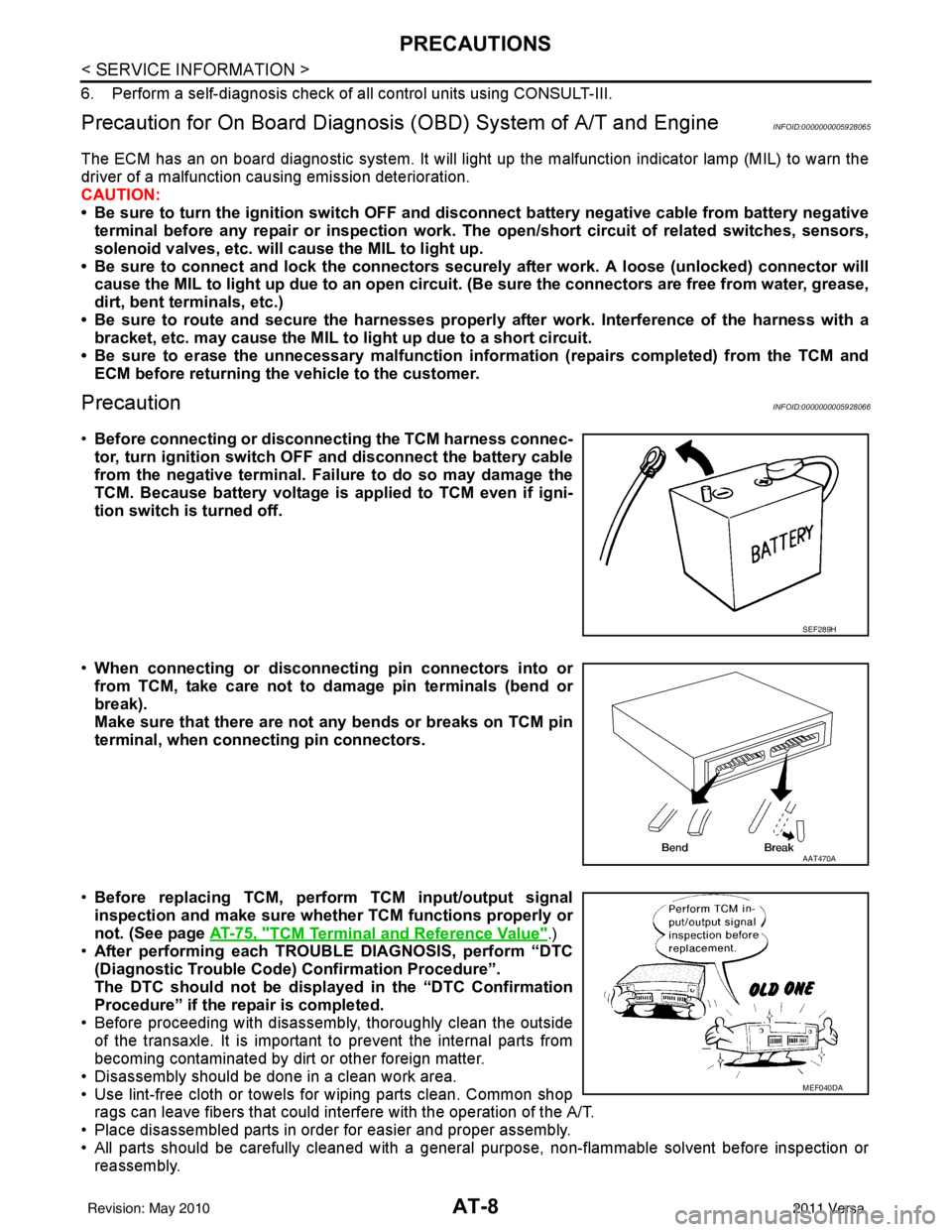
•Before connecting or disconn ecting the TCM harness connec-
tor, turn ignition switch OF F and disconnect the battery cable
from the negative terminal. Failure to do so may damage the
TCM. Because battery voltage is applied to TCM even if igni-
tion switch is turned off.
• When connecting or disconnect ing pin connectors into or
from TCM, take care not to damage pin terminals (bend or
break).
Make sure that there are not any bends or breaks on TCM pin
terminal, when connecting pin connectors.
• Before replacing TCM, perform TCM input/output signal
inspection and make sure whether TCM functions properly or
not. (See page AT-75, "
TCM Terminal and Reference Value".)
• After performing each TROUBLE DIAGNOSIS, perform “DTC
(Diagnostic Trouble Code) Confirmation Procedure”.
The DTC should not be displ ayed in the “DTC Confirmation
Procedure” if the repair is completed.
• Before proceeding with disassembly, thoroughly clean the outside of the transaxle. It is important to prevent the internal parts from
becoming contaminated by dirt or other foreign matter.
• Disassembly should be done in a clean work area.
• Use lint-free cloth or towels for wiping parts clean. Common shop rags can leave fibers that could in terfere with the operation of the A/T.
• Place disassembled parts in order for easier and proper assembly.
• All parts should be carefully cleaned with a general purpose, non-flammable solvent before inspection or reassembly.
SEF289H
AAT470A
MEF040DA
Revision: May 2010 2011 Versa
Page 30 of 3787
PREPARATIONAT-13
< SERVICE INFORMATION >
DE
F
G H
I
J
K L
M A
B
AT
N
O P
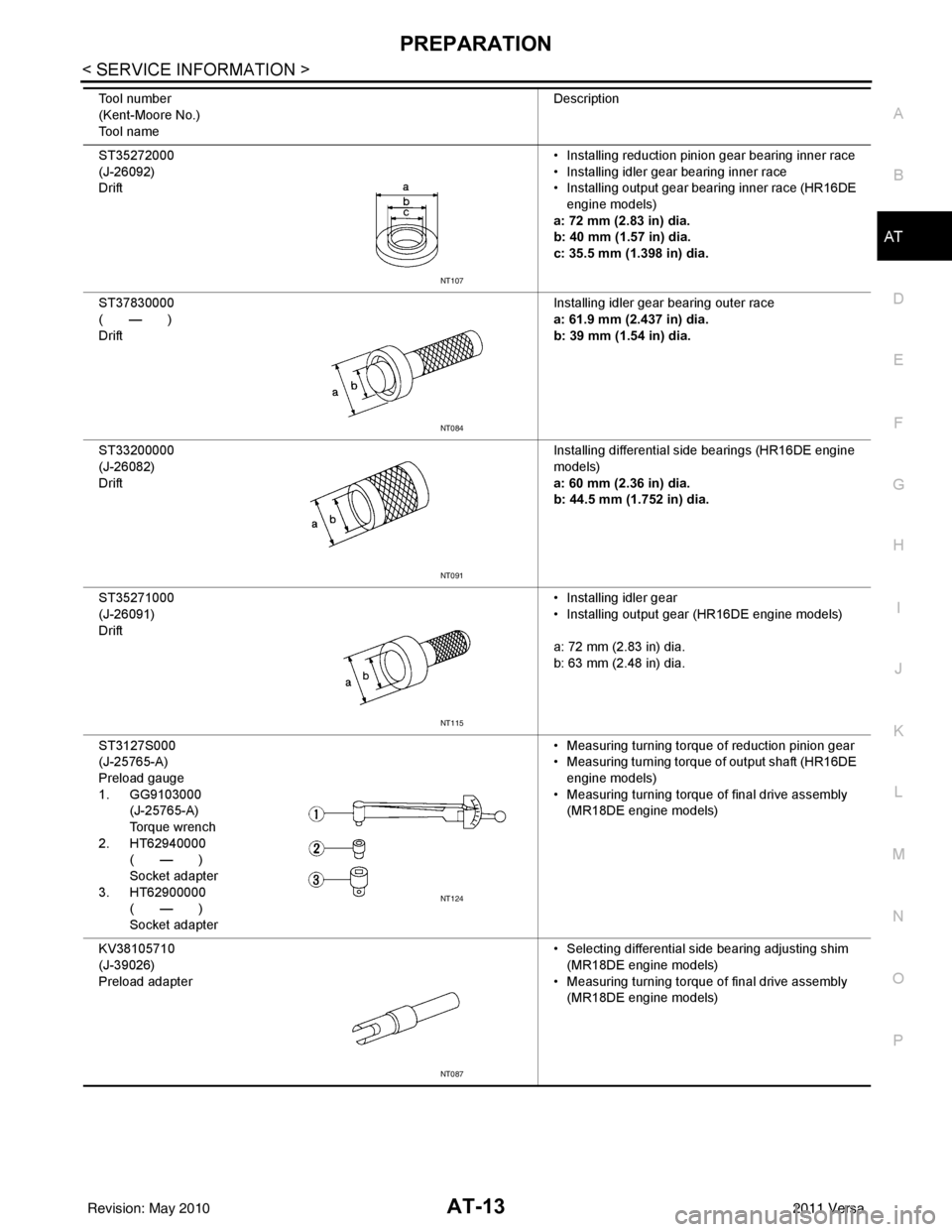
ST35272000
(J-26092)
Drift • Installing reduction pinion gear bearing inner race
• Installing idler gear bearing inner race
• Installing output gear bearing inner race (HR16DE
engine models)
a: 72 mm (2.83 in) dia.
b: 40 mm (1.57 in) dia.
c: 35.5 mm (1.398 in) dia.
ST37830000
( — )
Drift Installing idler gear bearing outer race
a: 61.9 mm (2.437 in) dia.
b: 39 mm (1.54 in) dia.
ST33200000
(J-26082)
Drift Installing differential side bearings (HR16DE engine
models)
a: 60 mm (2.36 in) dia.
b: 44.5 mm (1.752 in) dia.
ST35271000
(J-26091)
Drift • Installing idler gear
• Installing output gear (HR16DE engine models)
a: 72 mm (2.83 in) dia.
b: 63 mm (2.48 in) dia.
ST3127S000
(J-25765-A)
Preload gauge
1. GG9103000 (J-25765-A)
Torque wrench
2. HT62940000 ( — )
Socket adapter
3. HT62900000 ( — )
Socket adapter • Measuring turning torque of reduction pinion gear
• Measuring turning torque of output shaft (HR16DE
engine models)
• Measuring turning torque of final drive assembly (MR18DE engine models)
KV38105710
(J-39026)
Preload adapter • Selecting differential side bearing adjusting shim
(MR18DE engine models)
• Measuring turning torque of final drive assembly
(MR18DE engine models)
Tool number
(Kent-Moore No.)
Tool name
Description
NT107
NT084
NT091
NT115
NT124
NT087
Revision: May 2010
2011 Versa
Page 42 of 3787
A/T CONTROL SYSTEMAT-25
< SERVICE INFORMATION >
DE
F
G H
I
J
K L
M A
B
AT
N
O P
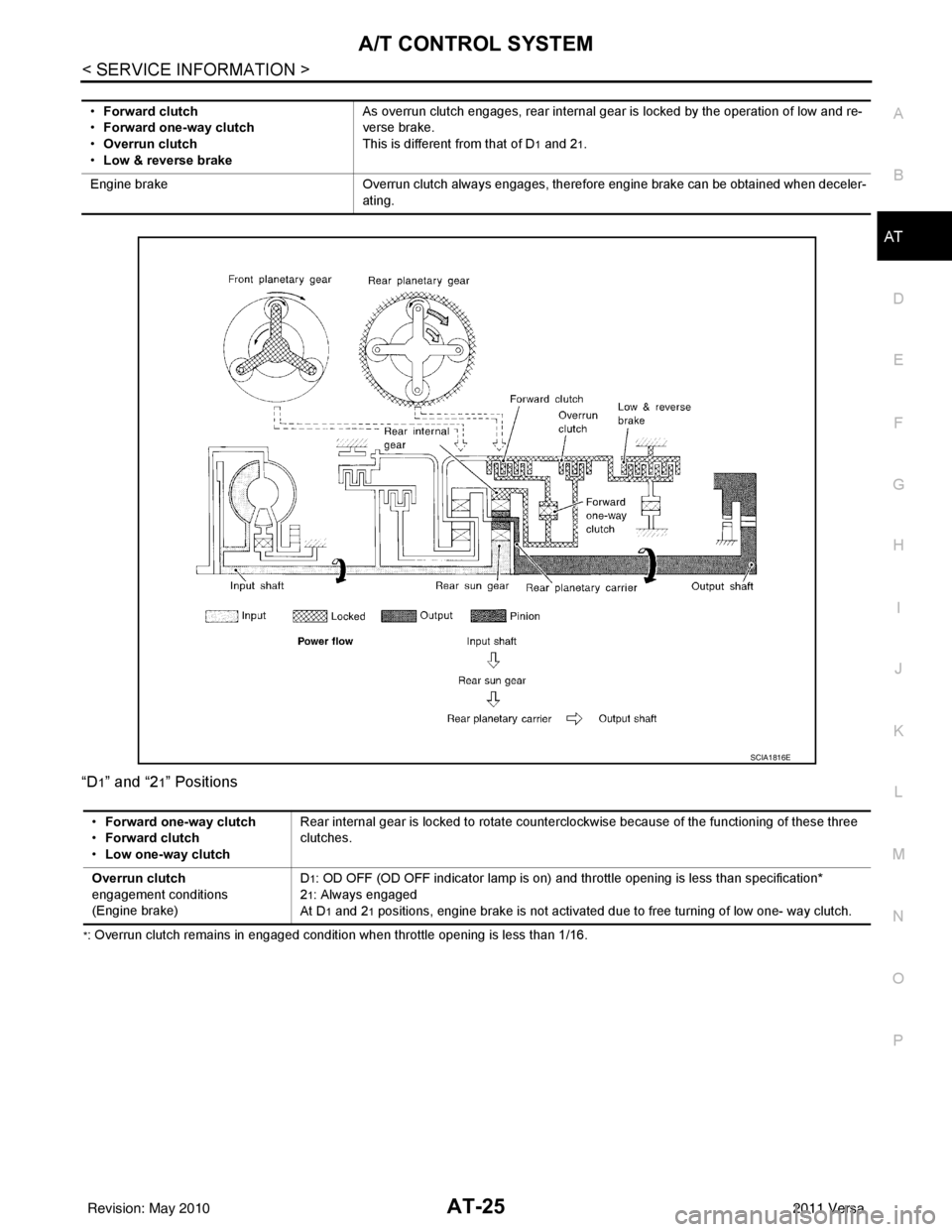
“D
1” and “21” Positions
*: Overrun clutch remains in engaged condition when throttle opening is less than 1/16. •
Forward clutch
• Forward one-way clutch
• Overrun clutch
• Low & reverse brake As overrun clutch engages, rear internal gear is locked by the operation of low and re-
verse brake.
This is different from that of D
1 and 21.
Engine brake Overrun clutch always engages, therefore engine brake can be obtained when deceler-
ating.
SCIA1816E
• Forward one-way clutch
• Forward clutch
• Low one-way clutch Rear internal gear is locked to rotate counterclockwise because of the functioning of these three
clutches.
Overrun clutch
engagement conditions
(Engine brake) D
1: OD OFF (OD OFF indicator lamp is on) and th
rottle opening is less than specification*
2
1: Always engaged
At D
1 and 21 positions, engine brake is not activated due to free turning of low one- way clutch.
Revision: May 2010 2011 Versa
Page 44 of 3787
A/T CONTROL SYSTEMAT-27
< SERVICE INFORMATION >
DE
F
G H
I
J
K L
M A
B
AT
N
O P
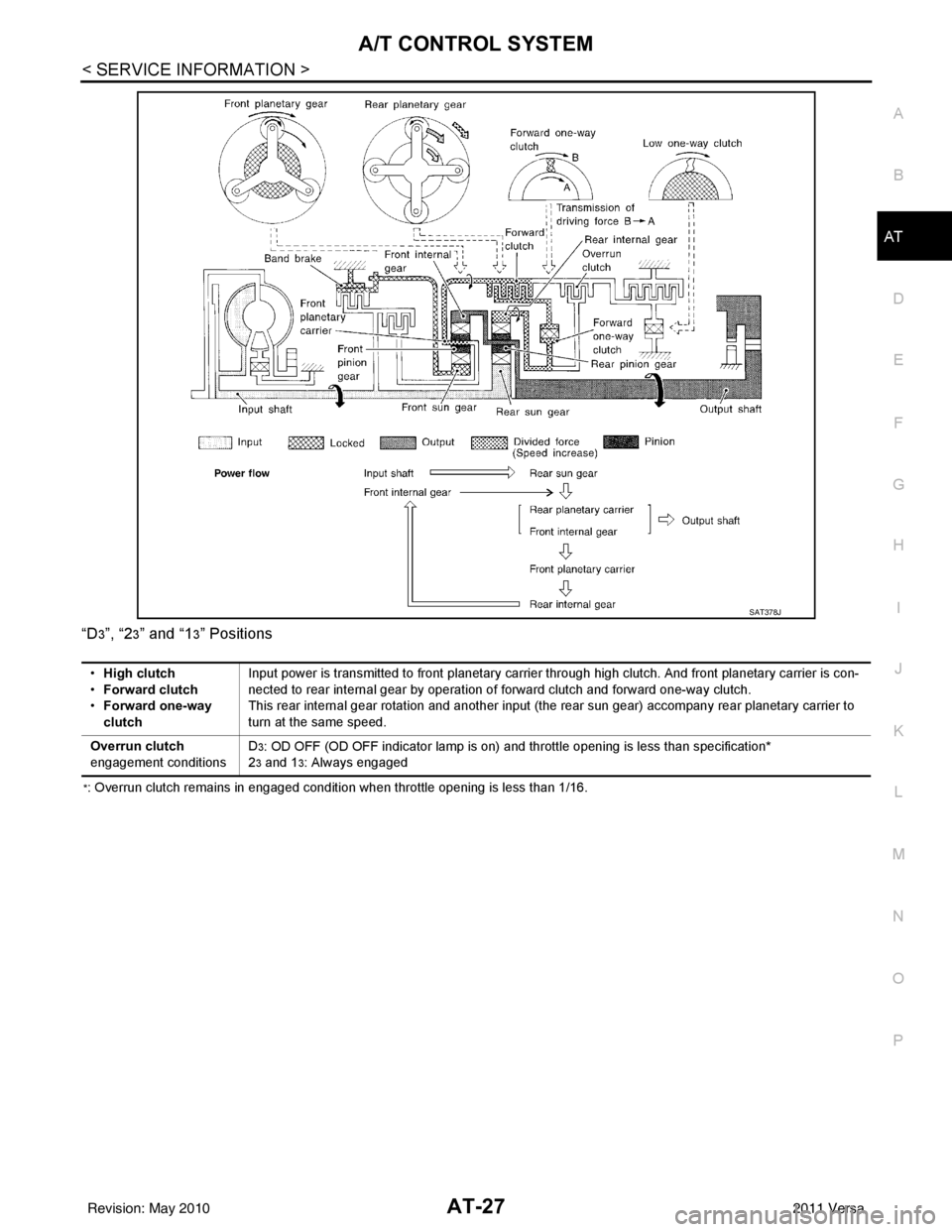
“D
3”, “23” and “13” Positions
*: Overrun clutch remains in engaged condition when throttle opening is less than 1/16.
SAT378J
•
High clutch
• Forward clutch
• Forward one-way
clutch Input power is transmitted to front planetary carrier through high clutch. And front planetary carrier is con-
nected to rear internal gear by operation of forward clutch and forward one-way clutch.
This rear internal gear rotation and another input (the rear sun gear) accompany rear planetary carrier to
turn at the same speed.
Overrun clutch
engagement conditions D
3: OD OFF (OD OFF indicator lamp is on) and throttle opening is less than specification*
2
3 and 13: Always engaged
Revision: May 2010 2011 Versa
Page 45 of 3787
AT-28
< SERVICE INFORMATION >
A/T CONTROL SYSTEM
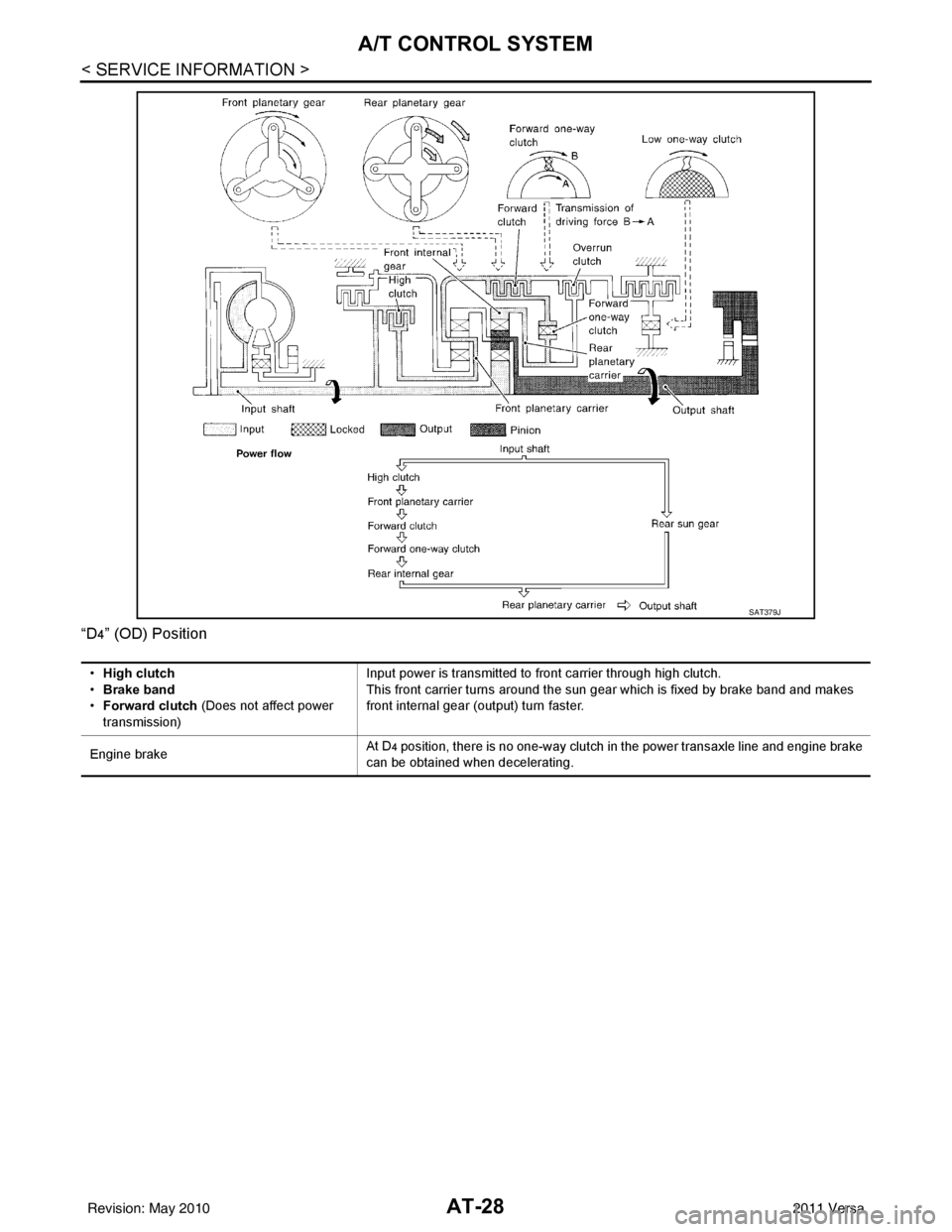
“D4” (OD) Position
SAT379J
•High clutch
• Brake band
• Forward clutch (Does not affect power
transmission) Input power is transmitted to front carrier through high clutch.
This front carrier turns around the sun gear which is fixed by brake band and makes
front internal gear (output) turn faster.
Engine brake At D
4 position, there is no one-way clutch in the power transaxle line and engine brake
can be obtained when decelerating.
Revision: May 2010 2011 Versa