trailer OLDSMOBILE BRAVADA 1994 User Guide
[x] Cancel search | Manufacturer: OLDSMOBILE, Model Year: 1994, Model line: BRAVADA, Model: OLDSMOBILE BRAVADA 1994Pages: 248, PDF Size: 14.54 MB
Page 143 of 248
and the Index will help you find them
quickly. If you’re trailering, it’s a good
idea to review these sections before
you
start your trip.
Check periodically to see that all hitch
nuts and bolts are tight.
See the next section,
Trailer Wiring
Harness.
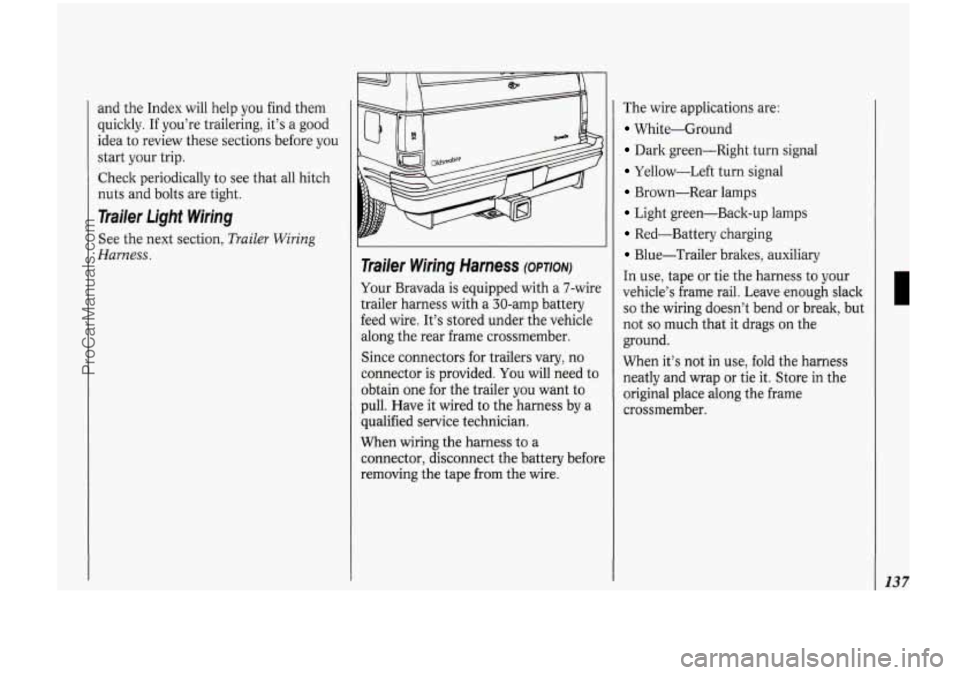
Trailer Wiring Harness (OPTION)
Your Bravada is equipped with a 7-wire
trailer harness with a 30-amp battery
feed wire. It’s stored under the vehicle
along the rear frame crossmember.
Since connectors for trailers vary, no
connector is provided.
You will need to
obtain one for the trailer
you want to
pull. Have it wired to the harness by a
qualified service technician.
When wiring the harness to a
connector, disconnect the battery before
removing the tape from the wire. The
wire applications are:
White-Ground
Dark green-Right turn signal
Yellow-Left turn signal
Brown-Rear lamps
Light green-Back-up lamps
Red-Battery charging
Blue-Trailer brakes, auxiliary
In use, tape or tie the harness to your
vehicle’s frame rail. Leave enough slack
so the wiring doesn’t bend or break, but
not
so much that it drags on the
ground.
When it’s not in use, fold the harness
neatly and wrap or tie it. Store in the
original place along the frame
crossmember.
137
ProCarManuals.com
Page 152 of 248

Problems on the Road
146
NOTICE:
If your engine catches fire because
you keep driving with no coolant,
your vehicle can be badly damaged.
The costly repairs would not be
covered by your warranty.
If No Steam Is Coming From Your
Engine
If you get the overheat warning but see
or hear no steam, the problem may not
be too serious. Sometimes the engine
can get a little too hot when you:
Climb a long hill on a hot day.
Stop after high speed driving.
Idle for long periods in traffic.
Tow a trailer.
If you get the overheat warning with no
sign of steam, try this for a minute or
so:
1. Turn off your air conditioner.
2. Turn on your heater to full hot at the
highest fan speed and open the
window as necessary.
3. If you’re in a traffic jam, shift to
N (Neutral). If
you no longer have the overheat
warning, you can drive. Just to be safe,
drive slower for about ten minutes.
If
the warning doesn’t come back on, you
can drive normally.
If the warning continues, pull over,
stop, and park your vehicle right away.
If there’s still no sign of steam, push the
accelerator until the engine speed is
about twice as fast as normal idle speed.
Bring the engine speed back to normal
idle speed after two or three minutes.
Now see
if the warning stops. But then,
if you still have the warning, TURN
OFF THE ENGINE AND GET
EVERYONE OUT
OF THE VEHICLE
until it cools down.
You may decide not to lift the hood but
to get service help right away.
Cooling System
When you decide it’s safe to lift the
hood, here’s what you’ll see:
(A) Coolant recovery tank
(B) Radiator pressure cap
If the coolant inside the coolant
recovery tank is boiling, don’t do
anything else until it cools down.
ProCarManuals.com
Page 157 of 248

Engine Fan Noise
This vehicle has a clutched engine
cooling fan. When the clutch is engaged,
the fan spins faster to provide more air
to cool the engine. In most everyday
driving conditions the clutch is not
engaged. This improves fuel economy
and reduces fan noise. Under heavy
vehicle loading, trailer towing and/or
high outside temperatures, the fan speed
increases when the clutch engages.
So
you may hear an increase in fan noise.
This is normal and should not be
mistaken as the transmission slipping or
making extra shifts. It is merely the
cooling system functioning properly.
The fan will slow down when additional
cooling is not required and the clutch
disengages. You may also hear this fan
noise when you start the engine. It will
go away
as the fan clutch disengages.
I Ifa Tire Goes Flat
It’s unusual for a tire to “blow out”
while you’re driving, especially if you
maintain your tires properly. If air goes
out of a tire, it’s much more likely to
leak out slowly. But if you should ever
have a “blowout,” here are a few tips
about what to expect and what to do:
If a front tire fails, the flat tire
will
create a drag that pulls the vehicle
toward that side. Take your foot
off the
accelerator pedal and grip the steering
wheel firmly. Steer to maintain lane
position, then gently brake to a stop
well out of the traffic lane.
A rear blowout, particularly on a curve,
acts much like a skid and may require
the same correction you’d use in a skid.
In any rear blowout, remove your foot
from the accelerator pedal. Get the
vehicle under control by steering the
way you want the vehicle to go. It may
be very bumpy and noisy, but you can
still steer. Gently brake to a stop, well
off the road if possible.
If a tire goes
flat, the next section shows
how to use your jacking equipment to
change a flat tire safely.
I Changing a Flat Tire
If a tire goes flat, avoid further tire and
wheel damage by driving slowly to a
level place. Turn
on your hazard
warning flashers.
151
ProCarManuals.com
Page 169 of 248

Fuel
Use regular unleaded gasoline rated at
87 octane or higher. Use premium
unleaded gasoline rated at 91 octane or
higher for high power performance,
when towing a trailer or with a high
payload requirement. But when
operating with a light load as
a normal
condition, you may use middle grade or
regular unleaded gasolines.
The gasoline you use should meet
specifications ASTM D4814 in the U.S.
and CGSB
3.5-92 in Canada. These
fuels should have the proper additives,
so you should not have to add anything
to the fuel.
In the
U.S. and Canada, it’s easy to be
sure you get the right kind of gasoline
(unleaded). You’ll see “UNLEADED” right
on the pump. And only unleaded
nozzles will fit into your vehicle’s filler
neck.
Be sure the posted octane is at least 91
for premium, 89 for middle grade and
87 for regular.
If the octane is less than
87, you may get a heavy knocking noise
when you drive. If it’s bad enough, it
can damage your engine.
If you’re using fuel rated at 91 octane or
higher and you still hear heavy
knocking, your engine needs service.
But don’t worry
if you hear a little
pinging noise when you’re accelerating
or driving up a hill. That’s normal, and
you don’t have to buy a higher octane
fuel to get rid of it. It’s the heavy,
constant knock that means you have a
problem.
What about gasoline with blending
materials that contain oxygen
(oxygenates), such as MTBE or
alcohol?
MTBE is “methyl tertiary-butyl ether.”
Fuel that
is no more than 15% MTBE is
fine for your vehicle.
Ethanol is ethyl or grain alcohol.
Properly-blended fuel that is no more than
10% ethanol is
fine for your
vehicle.
Methanol is methyl or wood alcohol.
NOTICE:
Fuel that is more than 5%
methanol is bad for your vehicle.
Don’t use it. It can corrode metal
parts in your fuel system and also
damage plastic and rubber parts.
That damage wouldn’t be covered
under your warranty. And even at
5% or less, there must be
“cosolvents” and corrosion
preventers in this fuel to help avoid
these problems.
GasoUnes for Cleaner Air
Your use of gasoline with deposit
control additives will help prevent
deposits from forming in your engine
and fuel system. That helps keep your
engine in tune and your emission
control system working properly. It’s
good for your vehicle, and you’ll be
doing your part for cleaner air.
Many gasolines are now blended with
oxygenates. General Motors
163
ProCarManuals.com
Page 176 of 248

Service & Appearance Care
1 70
NOTICE:
If you use oils that do not have
either the “starburst” symbol or an
API SH or SG designation, you can
cause engine damage not covered
by your warranty.
GM Goodwrench@ oil (in Canada, GM
Engine Oil) meets all the requirements
for your vehicle.
Engine Oil Additives
Don’t add anything to your oil. Your
Oldsmobile dealer is ready to advise
if
you think something should be added.
When to Change Engine Oil
See if any one of these is true for you:
Most trips are less than 4 miles (6
It’s below freezing outside and most
trips are less than
10 miles (16 km) .
The engine is at low speed most of the
time (as in door-to-door delivery, or in
stop-and-go traffic).
You tow a trailer often.
Most trips are through dusty places.
The vehicle is frequently operated off-
If any one of these is true for your
vehicle, then you need to change your
oil and filter every 3,000 miles (5 000
ltm) or 3 months - whichever comes
first.
lm) .
road.
Engine Coolant Heater (Engine Block Heater)
An engine coolant heater can be a big
help if you have to park outside in very
cold weather,
0°F (-18°C) or colder. If
your vehicle has this option, see Engine
Coolant Heater
in the Index.
What to Do with Used Oil
Did you laow that used engine oil
contains certain elements that may be
unhealthy for your skin and could even
cause cancer? Don’t let used oil stay on
your skin for very long. Clean your skin
and nails with soap and water, or a
good hand cleaner. Wash or properly
throw away clothing or rags containing
used engine oil. (See the manufacturer’s
warnings about the use and disposal of
oil products.)
Used oil can be a real threat to the
environment.
If you change your own
oil, be sure to drain all free-flowing oil
from the filter before disposal. Don’t
ever dispose of oil by putting it in the
trash, pouring it on the ground, into
sewers, or into streams or bodies
of
water. Instead, recycle it by taking it to a
place that collects used oil.
If you have a
problem properly disposing of your used
oil, ask your dealer, a service station or a
local recycling center for help.
ProCarManuals.com
Page 178 of 248

Service &Appearance Care
4. Remove the air cleaner filter from the
5. Install a new air cleaner filter and
housing.
reverse steps
1-3.
Automatic Transmission Fluid
When to Check and Change
4 good time to check your automatic
transmission fluid level is when the
:ngine oil is changed. Refer to the
Maintenance Schedule to determine
when to change your fluid. See
Scheduled Maintenance Services in
the
Index.
How to Check
Because this operation can be a little
difficult, you may choose to have this
done at an Oldsmobile dealership
Service Department.
If you do it yourself, be sure to follow
all the instructions here, or you could
get a false reading on the dipstick.
NOTICE:
Too much or too little fluid can
damage your transmission.
Too
much can mean that some of the
fluid could come out and fall on hot
engine parts or exhaust system,
starting a fire. Be sure to get an
accurate reading if you check your
transmission fluid.
Wait at least
30 minutes before
checking the transmission fluid level if
you have been driving:
When outside temperatures are abovc
At high speed for quite a while.
90°F (32°C).
In
heavy traffic - especially in hot
weather.
While pulling a trailer.
To get the right reading, the fluid
should be at normal operating
temperature, which is
180°F to 200°F
(82°C to 93°C).
To Check Transmission Fluid Hot:
Get the vehicle warmed up by driving
about
15 miles (24 km) when outside
temperatures are above
50°F (10°C). If
it's colder than
50°F ( 10°C), drive the
vehicle in
D (3rd Gear) until the engine
temperature gage moves and then
remains steady for ten minutes. Then
follow the hot check procedures.
To Check Transmission Fluid Cold:
A cold check is made after the vehicle
has been sitting for eight hours or more
with the engine off and is used only as a
reference. Let the engine run at idle for
five minutes if outside temperatures are
50°F (10°C) or more. If it's colder than
50°F (lO"C), you may have to idle the
engine longer. Should the fluid level be
low during a cold check, you
must
perform a hot check before adding fluid.
This will give you a more accurate
reading of the fluid level.
ProCarManuals.com
Page 190 of 248

Sewice & Appearance Care
Payload
The Payload Capacity is shown on the
Certificationflire label. This is the
maximum load capacity that your
vehicle can carry. Be sure to include the
weight of the people inside as part of
your load. If you added any accessories
or equipment after your vehicle left the
factory, remember to subtract the weight
of these things from the payload.
Your dealer can help you with this.
Trailering Package
If your vehicle comes with the trailering
package, there is also a load rating
which includes the weight of the vehicle
and the trailer it tows. This rating is
called the Gross Combination Weight
Rating (GCWR)
.
When you weigh your trailer, be sure to
include the weight of everything you put
in it. And, remember to figure the weight
of the people inside as part
of your load.
Your dealer can help you determine
your GCWR.
Add-on Equipment
When you carry removable items, you
may need to put a limit on how many
people you carry inside your vehicle. Be
sure to weigh your vehicle before you
buy and install the new equipment.
NOTICE:
Your warranty doesn’t cover parts
or components that fail because of
overloading.
I Single Belt Accessory Drive
Your new vehicle uses a serpentine belt
that is lighter, more durable and fuel
efficient than systems with several belts.
The belt runs over or around the pulleys
on the engine.
A tensioner is used to
keep the belt tight at all times. The
tensioner also makes replacing the belt
easier.
If you need to replace the belt, be
sure to get the correct replacement belt.
Your dealership or parts supplier can
help you with this. The Accessory Drive
Belt Routing label on your vehicle will
show you how to route the belt your
vehicle uses.
I Air Conditioning
Every now and then have your
dealership check your air conditioning
system to be sure it has not lost any
cooling ability. If you think the system
is not working properly, have your
dealership check it out as soon as
possible.
The air conditioning will not work when
the temperature is below
40°F (4°C).
ProCarManuals.com
Page 203 of 248

INST LPS PWR ACC
HORNIDM IGNIGAU BRAKE STOPIHAZ
h TAIL LPS TURNIBU HTR A/C RADIO
%se Usage
Position
INST LPS
PWR ACC
HORN/DM
IGN/GAU BRAKE
STOP/HAZ
TAIL LPS
TURNDU HTR A/C RADIO
ECM B
ECM I
PWR WDO
WIPER
CRANK
TRAILER*
Rating
(AMP.)
5
30
20
20
15
15
20
15
25
15
15
10
30
25
3
30
UNDERHOOD':' 4
CD PLAYER 10
"In-line fuse.
Circuitry
Instrument Panel Lights, Headlight Warning Buzzer, Heater
Light, Ashtray Light, Radio Illumination Light, Rear Wiper
Switch Light
Power Door Locks, Rear Defogger, Console Accessory
Receptacles, CD Player
Horn, Dome Lights, Glove
Box Light, Clock, Lighter, Lighted
Vanity Mirror, Outside Rearview Mirror, Courtesy Lights
Indicator Lights and Gages, Rear Defogger Relay, Cruise
Control, Rear Defogger Switch, Seat Belt Timer
Four Wheel Anti-lock Brake Module, Digital Ratio Adapter
Module (Speedometer)
Stop Lights, Hazard Warning Lights, Chime Module, Center
High Mounted Stop Light (CHMSL)
Light Switch, TaiVPark Lights, Electronic Cluster, License Light
Turn Signals
& Back-up Lights
Heating and Air Conditioning
Radio, Inside Rearview Mirror Map Lights, Rear Wiper, Rear
Washer, Compass
Electronic Control Module, Fuel Pump
Electronic Control Module
Power Windows
Windshield Wipers and Washer
Electronic Control Module
Trailer Wiring Harness
Underhood Light
CD Player (attached to fuse block)
197
ProCarManuals.com
Page 204 of 248

Service & Appearance Care
198
Headlight Wiring
The headlight wiring is protected by a
circuit breaker in the light switch. An
electrical overload will cause the lights
to go on and off, or in some cases to
remain off. If this happens, have your
headlight system checked right away.
Trailer Wiring Harness
The seven-wire trailer wiring harness is
protected by an in-line fuse in the
battery feed wire. This fuse is near the
junction block. See the
Index under
Trailer Wiring Harness.
Windshield Wipers
The windshield wiper motor is
protected by a circuit breaker and a
fuse.
If the motor overheats due to
heavy snow, etc., the wiper will stop
until the motor cools.
If the overload is
caused by some electrical problem, have
it fixed.
Power Windows and Other Power
Accessories
Circuit breakers in the fuse panel
protect the power windows and other
power accessories. When the current
load is too heavy, the circuit breaker
opens and closes, protecting the circuit
until the problem is fixed or goes away.
Before you wire any other electrical
accessories into your fuse block, please
check with your Oldsmobile dealer.
ProCarManuals.com
Page 211 of 248

“Section C: Periodic Maintenance
Inspections” explains important
inspections that your Oldsmobile
dealer’s service department or another
qualified service center should perform.
“Section
D: Recommended Fluids &
Lubricants” lists some products GM
recommends to help keep your vehicle
properly maintained. These products, or
their equivalents, should be used
whether you do the work yourself or
have it done.
“Section
E: Maintenance Record”
provides a place for you to record the
maintenance performed on your vehicle.
Whenever any maintenance is
performed, be sure to write it down in
this section.
This will help you
determine when your next maintenance
should be done. In addition, it is a good
idea to keep your maintenance receipts.
They may be needed to qualify your
vehicle for warranty repairs.
Section A: Scheduled
Maintenance Services
Using Your Maintenance
Schedules
This section tells you the maintenance
services you should have done and
when you should schedule them. Your
Oldsmobile dealer knows your vehicle
best and wants you to be happy with it.
If you go to your dealer for your service
needs, you’ll know that GM-trained and
supported service people will perform
the work using genuine GM parts.
These schedules are for vehicles that:
carry passengers and cargo within
recommended limits.
You will find
these limits
on your vehicle’s
Certificatioflire label. See the
Index
under Loading Your Vehicle.
are driven on reasonable road
surfaces within legal driving limits.
use the recommended unleaded fuel.
See the
Index under Fuel.
Selecting the Right Schedule
First you’ll need to decide which of the
two schedules is right for your vehicle.
Here’s how to decide which schedule to
follow:
Schedule I
Is any one of these true for your
vehicle?
Most trips are less than 4 miles (6
km) .
Most trips are less than 10 miles (16
km) when outside temperatures are
below freezing.
The engine is at low speed most of the
time (as in door-to-door delivery, or
in
stop-and-go traffic).
areas or off-road frequently.
You operate your vehicle in dusty
You tow a trailer.
If any one (or more) of these is true for
your driving, follow Schedule
I.
Schedule I1
Follow Schedule I1 only if none 01 me
above conditions is true.
L
205
ProCarManuals.com