seats Oldsmobile Bravada 2003 Owner's Manuals
[x] Cancel search | Manufacturer: OLDSMOBILE, Model Year: 2003, Model line: Bravada, Model: Oldsmobile Bravada 2003Pages: 410, PDF Size: 20.1 MB
Page 5 of 410
Vehicle Damage Warnings
Also, in this book you will find these notices:
Notice: These mean there is something that could
damage your vehicle.
A notice will tell you about something that can damage
your vehicle. Many times, this damage would not be
covered by your warranty, and it could be costly. But the
notice will tell you what to do
to help avoid the
damage.
When you read other manuals, you might see CAUTION
and NOTICE warnings in different colors or in different
words.
You’ll also see warning labels on your vehicle. They use
the same words, CAUTION or NOTICE.
Vehicle Symbols
Your vehicle has components and labels that use
symbols instead of text. Symbols, used on your vehicle,
are shown along with the text describing the operation
or information relating
to a specific component, control,
message, gage or indicator.
If you need help figuring out a specific name of a
component, gage or indicator reference the following
topics:
Seats and Restraint Systems in Section
1
Features and Controls in Section 2
Instrument Panel Overview in Section 3
Climate Controls in Section 3
Warning Lights, Gages and Indicators in Section 3
Audio System(s) in Section 3
Engine Compartment Overview in Section 5
iv
Page 8 of 410
Section 1 Seats and Restraint Systems
Front Seats ...................................................... 1-2
Power Seats
.............................................. 1.2
Power Lumbar
........................................... 1-2
Heated Seats
................................................. 1-3
Power Reclining Seatbacks
.............................. 1-4
Head Restraints
............................................. 1-5
Rear Seats ....................................................... 1-6
Rear Seat Operation
....................................... 1-6
Safety Belts ..................................................... 1-8
Safety Belts: They Are for Everyone
................. 1-8
Questions and Answers About Safety Belts
...... 1-12
How to Wear Safety Belts Properly
................. 1-13
Driver Position
.............................................. 1-1 3
Safety Belt Use During Pregnancy
............... 1-20
Right Front Passenger Position
.................... 1-21
Rear Seat Passengers
.................................. 1-21
Rear Safety Belt Comfort Guides
for
Children and Small Adults .......................... 1-24
Safety Belt Extender
..................................... 1-26
Child Restraints ............................................. 1-27
Older Children
.............................................. 1-27
Infants and Young Children
............................ 1-29
Child Restraint Systems
................................. 1-32 Where
to Put the Restraint
............................. 1.35
Top Strap
.................................................... 1-36
Top Strap Anchor Location
............................. 1-37
Lower Anchorages and Top Tethers for
Children (LATCH System)
....................... 1-38
Securing a Child Restraint Designed
for the LATCH System
............................... 1-40
Securing a Child Restraint in a Rear
Outside Seat Position
................................ 1-40
Securing a Child Restraint in the Right
Front Seat Position
.................................... 1-42
Center Seat Position
..................................... 1-45
Air Bag Systems ............................................ 1-46
Where Are the Air Bags?
............................ 1-49
When Should an Air Bag Inflate?
... ...... 1-51
What Makes an Air Bag Inflate?
..................... 1-52
How Does an Air Bag Restrain?
..................... 1-52
What Will
You See After an Air Bag Inflates? ... 1-53
Servicing Your Air Bag-Equipped Vehicle
......... 1-55
Restraint System Check .................................. 1-56
Checking Your Restraint Systems
................... 1-56
Replacing Restraint System Parts
After a Crash
............................................ 1-56
1-1
Page 9 of 410

Front Seats
Power Seats
Your vehicle may have this
feature. The power seat
controls are located on the
outboard side of the
front seat cushions. The
horizontal control adjusts
the seat cushion and
the vertical control adjusts
the seatback.
Move the front of the seat control up or down to
adjust the front portion of the cushion.
Lift up or push down on the center of the seat
control to move the entire seat up or down.
To move the seat forward or rearward, slide the
To recline the seatback, press the vertical control
rearward.
To raise the seatback, press the vertical
control forward. seat control forward or rearward.
Power Lumbar
Your vehicle may have this feature. The driver’s and
passenger’s seatback lumbar support can be adjusted
by moving a control located on the outboard side of
the seat cushions.
To increase or decrease support, hold the control
forward or rearward. Keep
in mind that as your seating
position changes, as it may during long trips,
so
should the position of your lumbar support. Adjust the
seat as needed.
Move the rear of the seat control up or down to
adjust the rear portion of the cushion.
1 -2
Page 10 of 410
Heated Seats
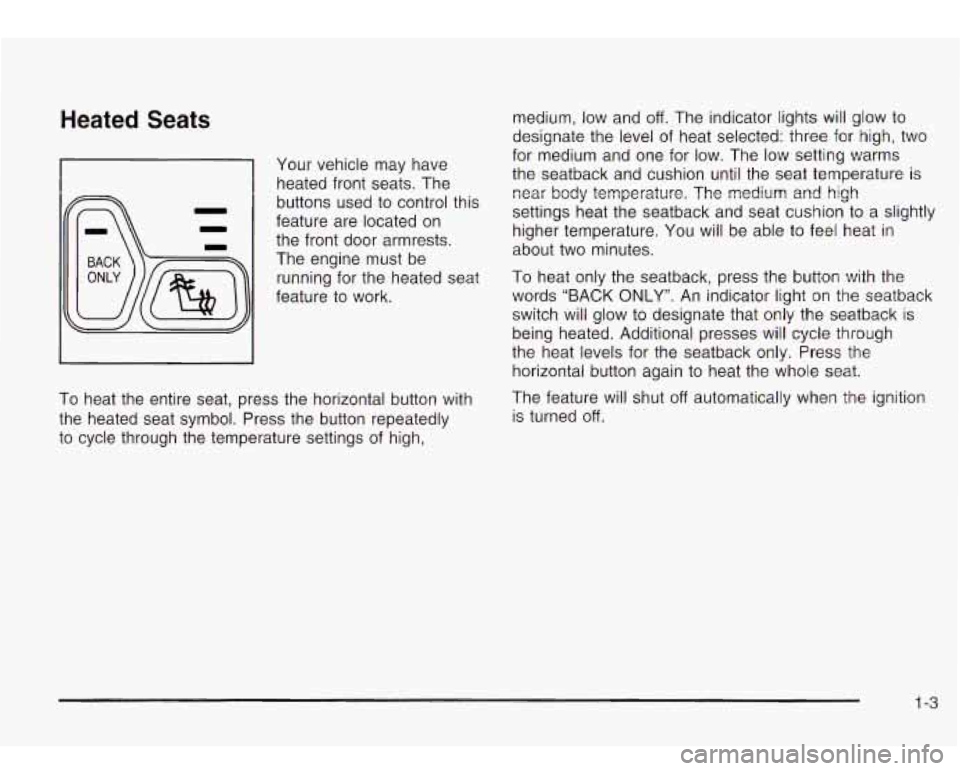
Your vehicle may have
heated front seats. The
buttons used to control this
feature are located on
the front door armrests.
The engine must be
running for the heated seat
feature to work.
To heat the entire seat, press the horizontal button with
the heated seat symbol. Press the button repeatedly
to cycle through the temperature settings of high, medium,
low and
off. The indicator lights will glow to
designate the level
of heat selected: three for high, two
for medium and one for low. The low setting warms
the seatback and cushion until the seat temperature is
near body temperature. The medium and high
settings heat the seatback and seat cushion to a slightly
higher temperature. You will be able
to feel heat in
about two minutes.
To heat only the seatback, press the button with the
words “BACK
ONLY”. An indicator light on the seatback
switch will glow to designate that only the seatback is
being heated. Additional presses will cycle through
the heat levels for the seatback only. Press the
horizontal button again to heat the whole seat.
The feature will shut
off automatically when the ignition
is turned
off.
1 -3
Page 13 of 410
Rear Seats
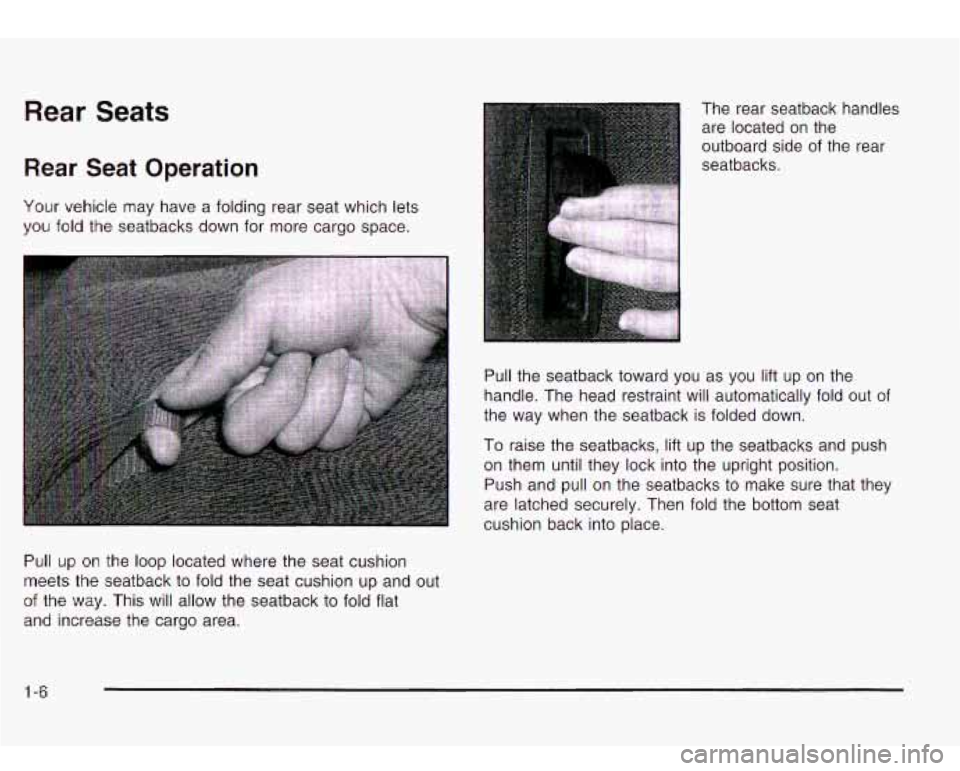
Pull up on the loop located where the seat cushion
meets the seatback to fold the seat cushion up and out
of the way. This will allow the seatback to fold flat
and increase the cargo area.
. .... ...
1-6
Page 15 of 410
Safety Belts
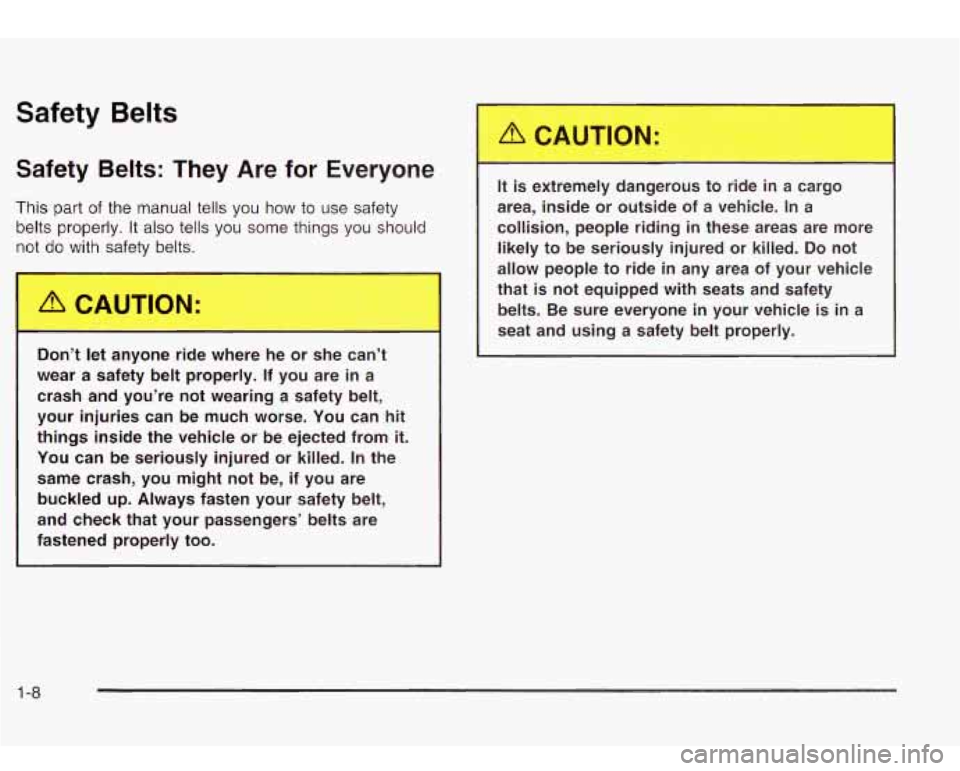
Safety Belts: They Are for Everyone
This part of the manual tells you how to use safety
belts
properly. It also tells you some things you should
not do with safety belts.
Don’t let anyone ride where he or she can’t
wear a safety belt properly.
If you are in a
crash and you’re not wearing a safety belt,
your injuries can be much worse.
You can hit
things inside the vehicle or be ejected from it.
You can be seriously injured or killed. In the same crash, you might not be, if you are
buckled up. Always fasten your safety belt,
and check that your passengers’ belts are
fastened properly too.
It is ext ly dangerous to rid n a cargo
area, inside or outside of a vehicle. In
a
collision, people riding in these areas are more
likely to be seriously injured or killed.
Do not
allow people to ride
in any area of your vehicle
that is not equipped with seats and safety belts. Be sure everyone in your vehicle is in a
seat and using
a safety belt properly.
1 -8
Page 21 of 410
Lap-Shoulder Belt
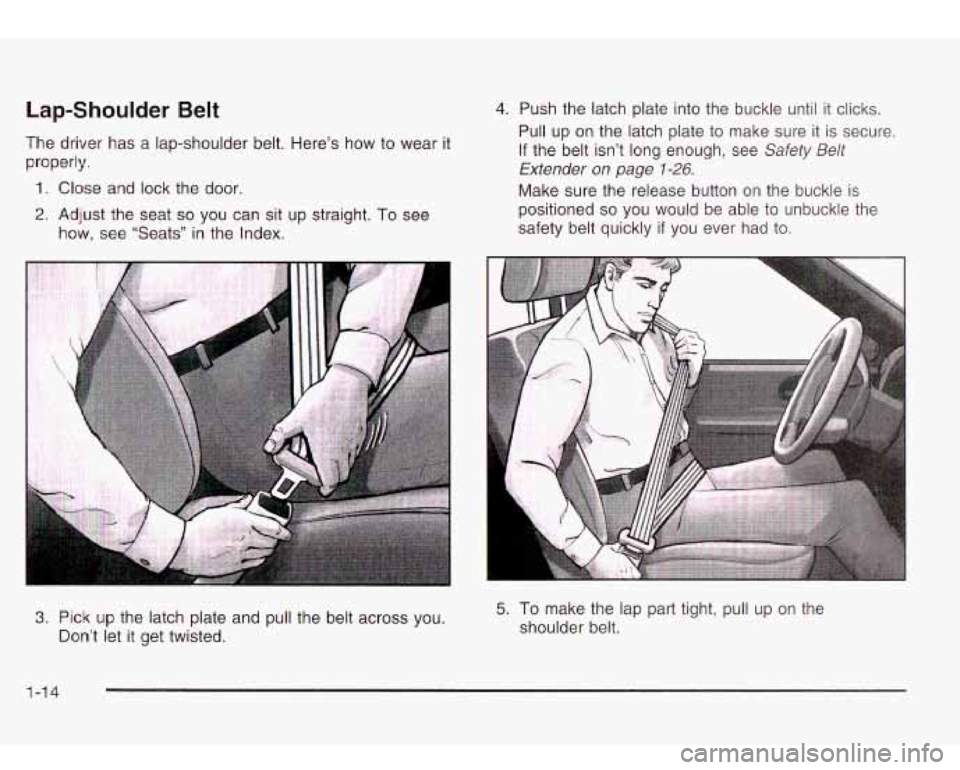
The driver has a lap-shoulder belt. Here’s how to wear it
properly.
1. Close and lock the door.
2. Adjust the seat so you can sit up straight. To see
how, see “Seats” in the Index.
4. Push the latch plate into the buckle until it clicks.
Pull up on the latch plate to make sure it is secure.
If the belt isn’t long enough, see Safety Belt
Extender on page 1-26.
Make sure the release button on the buckle is
positioned
so you would be able to unbuckle the
safety belt quickly
if you ever had to.
3. Pick up the latch plate and pull the belt across you.
Don’t let it get twisted.
5. To make the lap part tight, pull up on the
shoulder belt.
1-14
Page 31 of 410
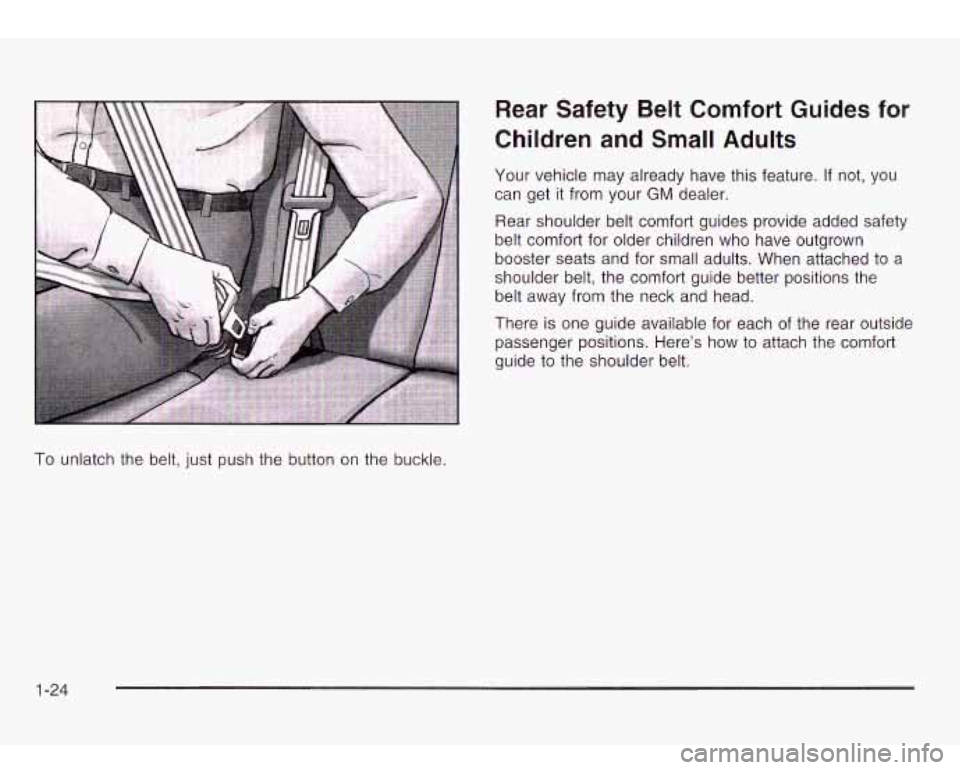
To unlatch the belt, just push the button on the buckle.
Rear Safety Belt Comfort Guides for
Children and Small Adults
Your vehicle may already have this feature. If not, you
can get it from your
GM dealer.
Rear shoulder belt comfort guides provide added safety
belt comfort for older children who have outgrown
booster seats and for small adults. When attached to a
shoulder belt, the comfort guide better positions the
belt away from the neck and head.
There is one guide available for each of the rear outside
passenger positions. Here’s how to attach the comfort
guide to the shoulder belt.
1-24
Page 34 of 410
Child Restraints
Older Children
Q: What is the proper way to wear safety belts?
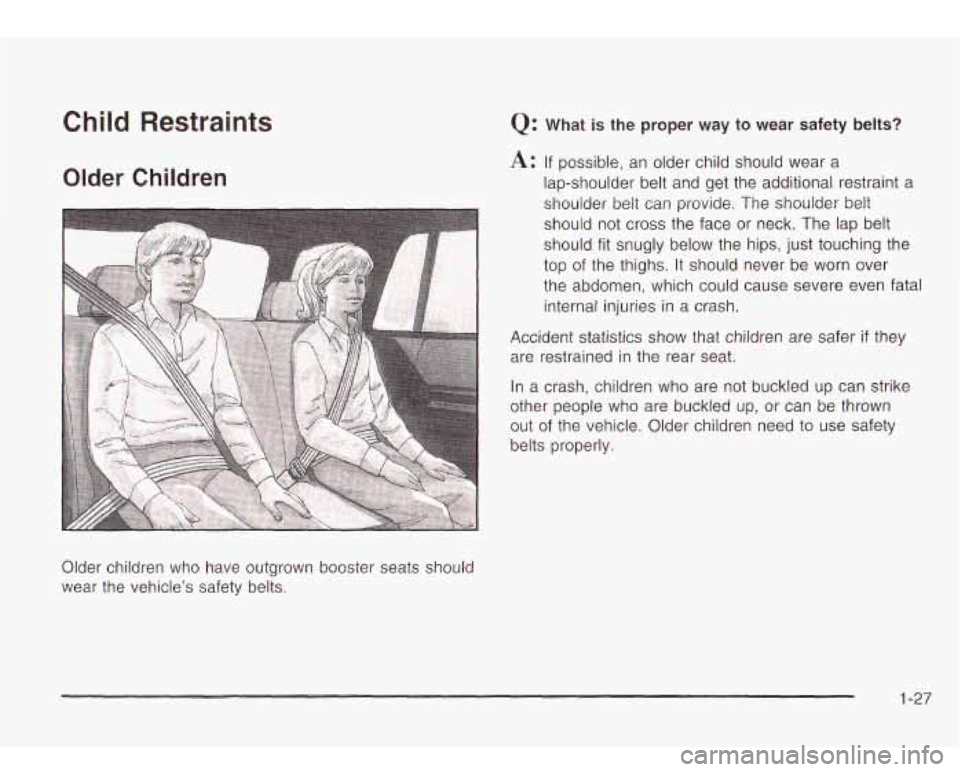
A: If possible, an older child should wear a
lap-shoulder belt and get the additional restraint
a
shoulder belt can provide. The shoulder belt
should not cross the face or neck. The lap belt
should fit snugly below the hips, just touching the
top of the thighs.
It should never be worn over
the abdomen, which could cause severe even fatal
internal injuries in
a crash.
Accident statistics show that children are safer
if they
are restrained in the rear seat.
In a crash, children who are not buckled up can strike
other people who are buckled up, or can be thrown
out of the vehicle. Older children need
to use safety
belts properly.
Older children who have outgrown booster seats should
wear the vehicle's safety belts.
1-27
Page 41 of 410
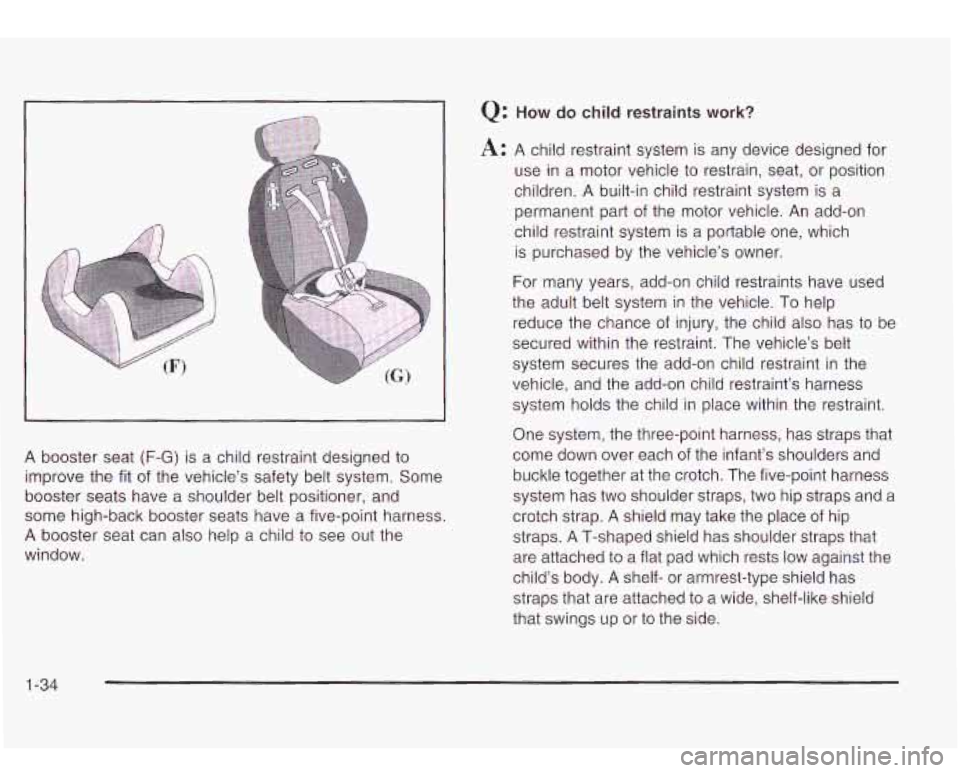
A booster seat (F-G) is a child restraint designed to
improve the fit of the vehicle’s safety belt system. Some
booster seats have a shoulder belt positioner, and
some high-back booster seats have a five-point harness.
A booster seat can also help a child to see out the window.
Q: How do child restraints work?
A: A child restraint system is any device designed for
use in a motor vehicle to restrain, seat, or position
children. A built-in child restraint system is a
permanent part of the motor vehicle. An add-on
child restraint system is a portable one, which
is purchased by the vehicle’s owner.
For many years, add-on child restraints have used
the adult belt system in the vehicle. To help
reduce the chance of injury, the child also has
to be
secured within the restraint. The vehicle’s belt
system secures the add-on child restraint in the
vehicle, and the add-on child restraint’s harness
system holds the child in place within the restraint.
One system, the three-point harness, has straps that
come down over each of the infant’s shoulders and
buckle together at the crotch. The five-point harness
system has two shoulder straps, two hip straps and a
crotch strap. A shield may take the place of hip
straps. A T-shaped shield has shoulder straps that
are attached
to a flat pad which rests low against the
child’s body. A shelf- or armrest-type shield has
straps that are attached
to a wide, shelf-like shield
that swings up or
to the side.
1 -34