differential OPEL FRONTERA 1998 Owners Manual
[x] Cancel search | Manufacturer: OPEL, Model Year: 1998, Model line: FRONTERA, Model: OPEL FRONTERA 1998Pages: 6000, PDF Size: 97 MB
Page 527 of 6000

4A2B–24DIFFERENTIAL (REAR 244mm)
4. Remove Differential shaft (2) using hammer and
punch.
Place shop towel behind case to prevent differential
shaft from dropping out of case.
425RW005
5. Assemble clutch pack unloading tool
5–8840–2586–0 .
a. Install cap (1) to the bottom differential side gear.
b. Install threaded screw cap (2) to top differential
side gear. Thread forcing screws (3) into threaded
screw cap until it becomes centered into the
bottom cap.
425RW064
c. Tighten forcing screw until tight enough to collapse
dished spacers and allow looseness between side
and pinion mate gears.6. Both pinion mate gear thrust washers using a shim
stock (1) of 0.51 mm (0.020 in.) or equivalent tool to
push out washers.
425RW007
7. Relieve tension of dished spacers by loosening
forcing screw.
NOTE:
You may have to adjust the forcing screw slightly to
allow the case to rotate.
8. Insert differential shaft into its hole of case. Pull on
shaft and rotate case until pinion mate gears can be
removed.
9. Remove pinion mate gears.
10. Hold side gear top clutch pack (1) with one hand and
remove positraction unloading tools.
425RW008
Page 528 of 6000

DIFFERENTIAL (REAR 244mm)
4A2B–25
11. Remove top side gear and clutch pack.
NOTE:
Keep the stack of plates and discs intact and in
exactly the same position while they are being
removed.
12. Remove case from holder. Turn case with flange or
ring gear side up to allow side gear and clutch pack to
be removed from case.
13. Remove differential plate retainer from both clutch
packs to allow separation of the plates and discs.
NOTE:
Keep the discs and plates in the same order as they
were removed.
425RW009
Legend
(1) Differential Plate
(2) Differential Disc
(3) Dished Spacer
(4) Side Gear
Inspection and Repair
Cleaning
All parts with solvent.
Visual Inspection
Clean all parts with solvent.
Plates and Discs. If any one disc or plate in either
stack shows evidence of excessive wear or scoring,
the complete stack is to be replaced on both sides.
Side Gears and Pinion Mate Gears. The gear teeth of
these parts should be checked for extreme wear and
possible cracks. The external teeth of the side gear,
which retain the concentric groove discs, should also
be checked for wear or cracks.
If replacement of one gear is required due to wear,
etc., then both side gears, pinion mate gears, and
thrust washers are to be replaced.
Differential Shaft. If excessive wear is evident, the
differential shaft should be replaced.
Differential Plate Retainers. If wear is evident on any
one of the differential plate retainers, all four retainers
must be replaced.
Differential Case. If scoring, wear or metal pickup is
evident on the machined surfaces, replacement of
the case is necessary.
Reassembly
1. Lubricate thrust face of side gears, plates and discs
with the proper limited slip rear axle lubricant.
2. Assemble plates and discs in exactly in the same
position as they were removed, regardless of whether
they are new or original.
3. Install differential plate retainer to ears of plates.
NOTE:
Make sure both retainers are completely seated on
ears of plates.
4. Install clutch pack and side gear into bottom side gear
bore. Make sure clutch pack stays assembled to side
gear splines, and that retainers are completely seated
into pockets of case.
NOTE:
To prevent clutch pack from falling out of case, hold
clutch pack in place by hand while repositioning case
on bench.
5. Install other side gear and clutch pack. Make sure
clutch pack stays assembled to side gear splines, and
retainers are completely seated into pockets of case.
6. Hold clutch pack in position and assemble special tool
5–8840–2586–0, screw cap (2), cap (1) and forcing
screw (3). Tighten forcing screw into bottom cap to
hold both clutch packs in position.
7. With tools assembled to case, position case on shaft
by aligning splines of side gear with those of shaft.
Tighten forcing screw to compress clutch packs in
order to provide clearance for pinion mate gears.
425RW064
Page 529 of 6000
4A2B–26DIFFERENTIAL (REAR 244mm)
8. Install pinion mate gears.
Place the pinion mate gears into the differential 180
degrees apart.
9. While holding gears in place, insert differential shaft in
its hole of case. Pull on shaft and rotate case, allowing
gears to turn. Make sure that holes in pinion mate
gears align with holes in case.
It may be necessary to adjust tension on forcing
screw to rotate case.
10. Tighten forcing screw to compress the clutch packs,
to allow installation of tapered washers.
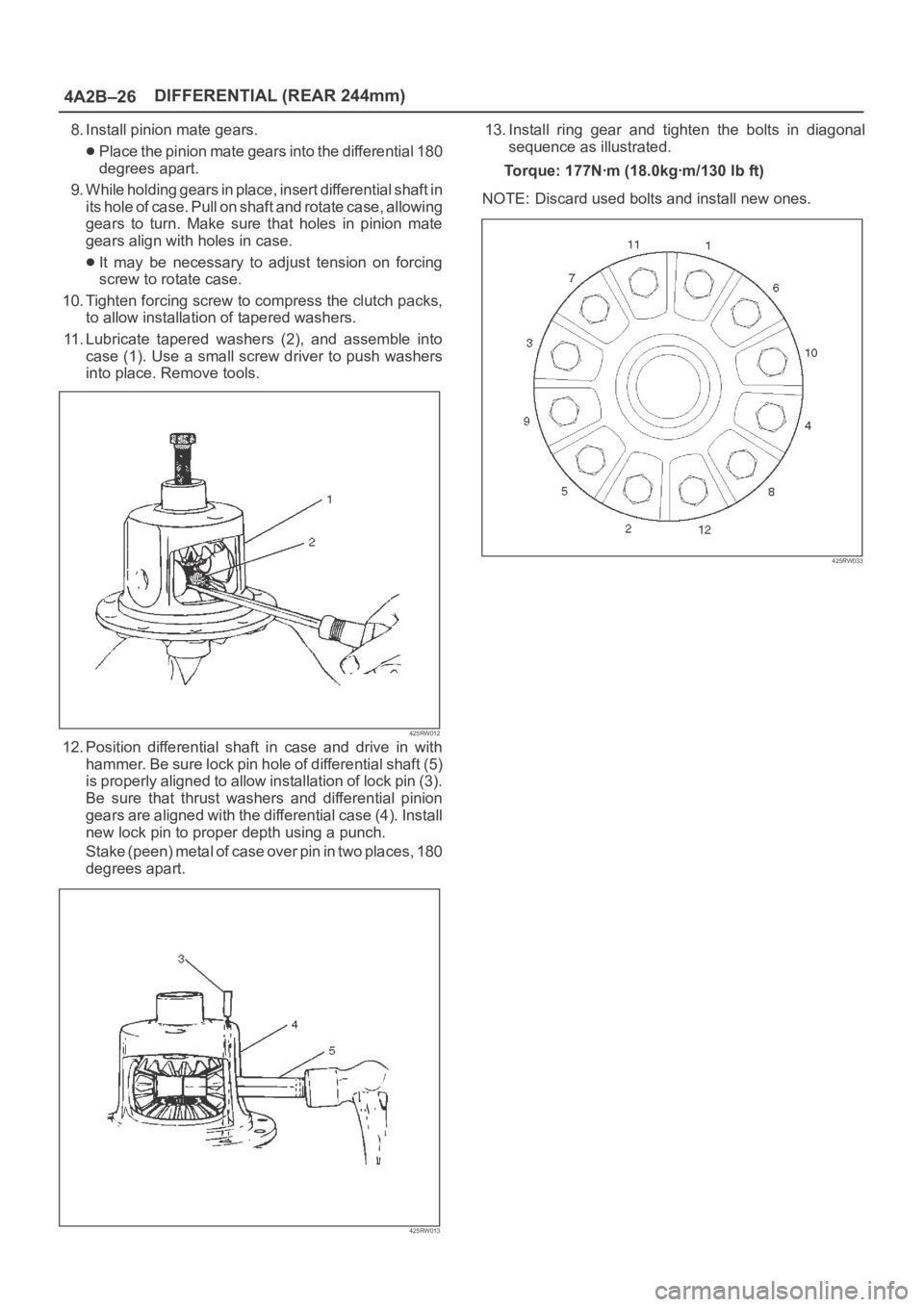
11. Lubricate tapered washers (2), and assemble into
case (1). Use a small screw driver to push washers
into place. Remove tools.
425RW012
12. Position differential shaft in case and drive in with
hammer. Be sure lock pin hole of differential shaft (5)
is properly aligned to allow installation of lock pin (3).
Be sure that thrust washers and differential pinion
gears are aligned with the differential case (4). Install
new lock pin to proper depth using a punch.
S t a k e ( p e e n ) m e t a l o f c a s e o v e r p i n i n t w o p l a c e s , 1 8 0
degrees apart.
425RW013
13. Install ring gear and tighten the bolts in diagonal
sequence as illustrated.
Torque: 177Nꞏm (18.0kgꞏm/130 lb ft)
NOTE: Discard used bolts and install new ones.
425RW033
Page 530 of 6000

DIFFERENTIAL (REAR 244mm)
4A2B–27
Main Data and Specifications
General Specifications
Rear axle
Ty p eBanjo, Semi–floating
Rear axle Size244 mm (9.61 in)
Gear typeHypoid
Gear ratio (to 1)4.100(6VE1 with A/T)
4.300(6VE1 with M/T,4JX1)
Differential typeTwo pinion
Lubricant GradeGL–5: (Standard differential)
GL–5, LSD: (Limited slip differential)
Locking Differential Lubricant80W90 GL–5
(USE Limited Slip Differential Gear Lubricant or Friction
Modifier Organic Additive)
Capacity3.0 liter (2.6 Imp qt/3.2 US qt)
Page 531 of 6000
4A2B–28DIFFERENTIAL (REAR 244mm)
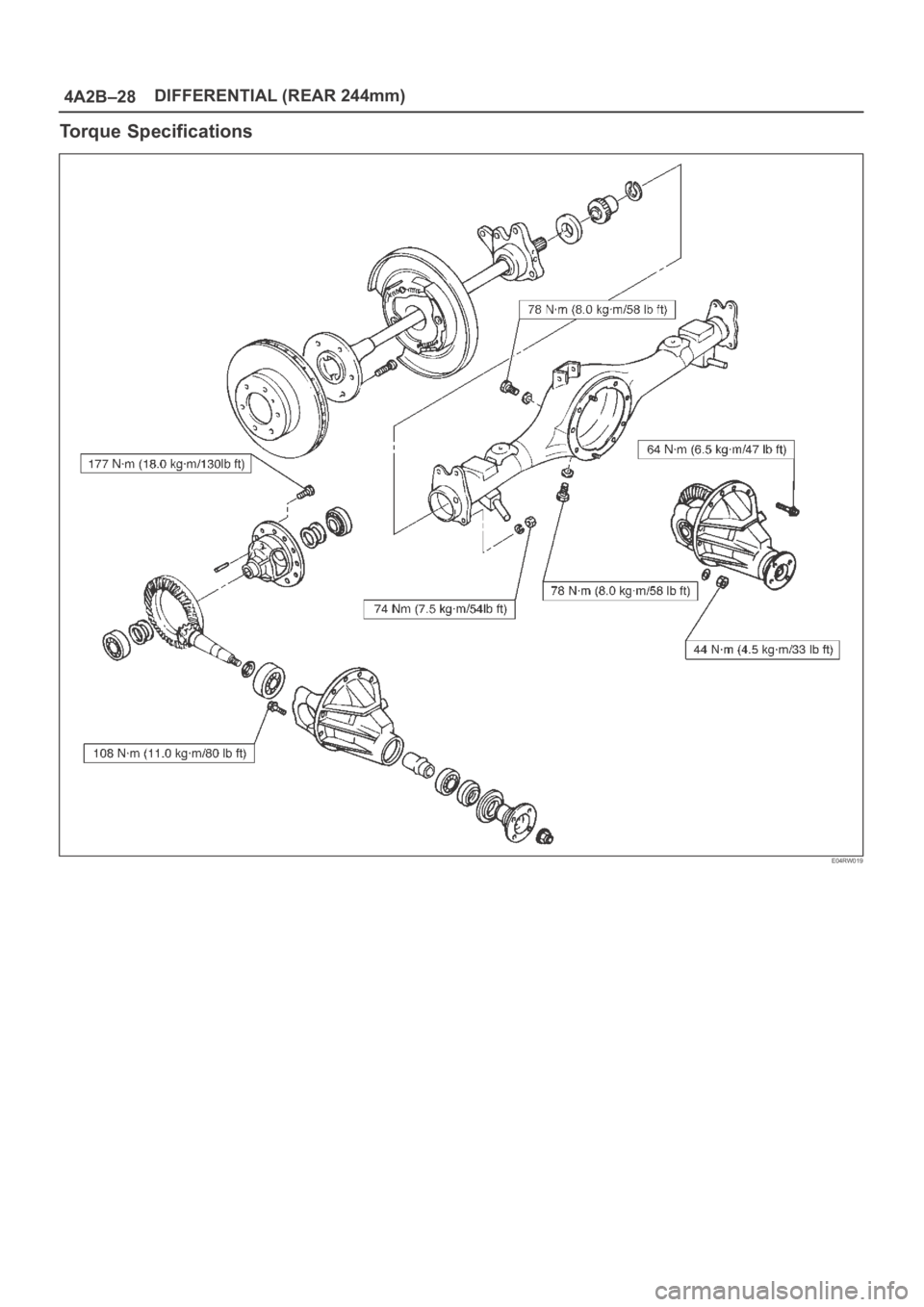
Torque Specifications
E04RW019
Page 532 of 6000

DIFFERENTIAL (REAR 244mm)
4A2B–29
Special Tools
ILLUSTRATIONTOOL NO.
TOOL NAME
5–8840–2294–0
(J–39210)
Installer; Axle shaft inner
seal
5–8840–0133–0
(J–8614–01)
Pinion flange holder
5–8840–2165–0
(J–37263)
Installer; Pinion oil seal
5–8840–2029–0
(J–42832)
Holding fixture
5–8840–0003–0
(J–3289–20)
Holding fixture base
5–8840–2587–0
(J–42379)
Remover; Bearing
ILLUSTRATIONTOOL NO.
TOOL NAME
5–8840–2576–0
(J–8107–3)
Adapter; Side bearing
plug
5–8840–0008–0
(J–8611–01)
Installer; Outer bearing
outer race
5–8840–0007–0
(J–8092)
Grip
5–8840–2571–0
(J–42831)
Installer; Inner bearing
outer race
5–8840–2575–0
(J–42824)
Pilot;Outer
5–8840–0127–0
(J–21777–43)
Nut & Stud
Page 533 of 6000

4A2B–30DIFFERENTIAL (REAR 244mm)
ILLUSTRATIONTOOL NO.
TOOL NAME
5–8840–2573–0
(J–42827)
Pilot;Inner
5–8840–2572–0
(J–42826)
Gage plate
5–8840–0126–0
(J–8001)
Dial indicator
5–8840–2577–0
(J–42825)
Disc (2 required)
5–8840–0128–0
(J–23597–1)
Arbor
5–8840–2574–0
(J–42828)
Installer; Pinion bearing
ILLUSTRATIONTOOL NO.
TOOL NAME
5–8840–2293–0
(J–39209)
Punch; End nut lock
5–8840–2570–0
(J–42829)
Installer; Side bearing
5–8840–2323–0
(J–39602)
Remover; Outer bearing
5–8840–2586–0
(J–39858)
Clutch pack unloading
tool kit Includes
Screw cap, Cap and
Forcing screw
Page 657 of 6000
DRIVE LINE CONTROL SYSTEM (TOD) 4B2–86
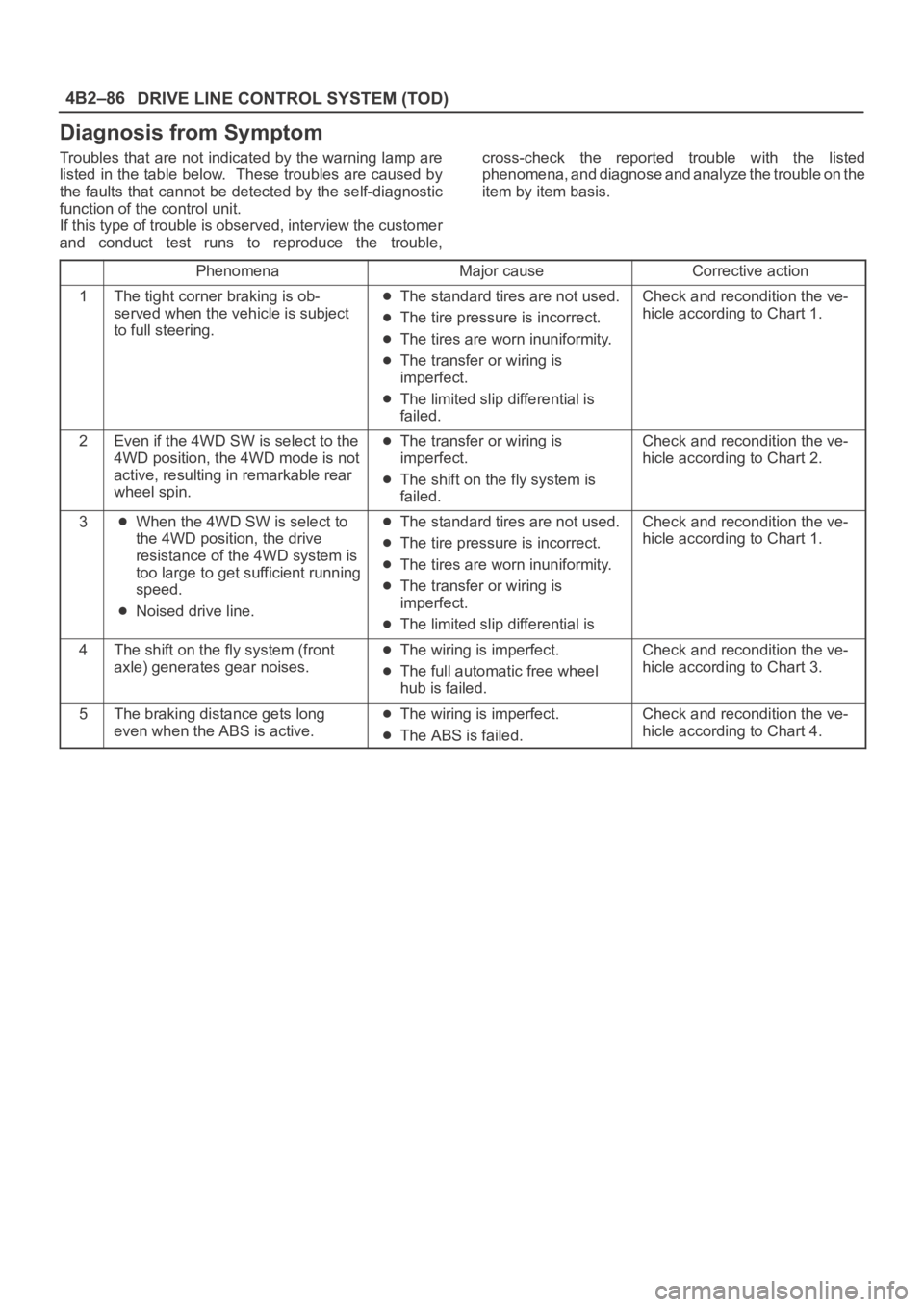
Diagnosis from Symptom
Troubles that are not indicated by the warning lamp are
listed in the table below. These troubles are caused by
the faults that cannot be detected by the self-diagnostic
function of the control unit.
If this type of trouble is observed, interview the customer
and conduct test runs to reproduce the trouble,cross-check the reported trouble with the listed
phenomena, and diagnose and analyze the trouble on the
item by item basis.
PhenomenaMajor causeCorrective action
1The tight corner braking is ob-
served when the vehicle is subject
to full steering.The standard tires are not used.
The tire pressure is incorrect.
The tires are worn inuniformity.
The transfer or wiring is
imperfect.
The limited slip differential is
failed.
Check and recondition the ve-
hicle according to Chart 1.
2Even if the 4WD SW is select to the
4WD position, the 4WD mode is not
active, resulting in remarkable rear
wheel spin.The transfer or wiring is
imperfect.
The shift on the fly system is
failed.
Check and recondition the ve-
hicle according to Chart 2.
3When the 4WD SW is select to
the 4WD position, the drive
resistance of the 4WD system is
too large to get sufficient running
speed.
Noised drive line.
The standard tires are not used.
The tire pressure is incorrect.
The tires are worn inuniformity.
The transfer or wiring is
imperfect.
The limited slip differential is
Check and recondition the ve-
hicle according to Chart 1.
4The shift on the fly system (front
axle) generates gear noises.The wiring is imperfect.
The full automatic free wheel
hub is failed.
Check and recondition the ve-
hicle according to Chart 3.
5The braking distance gets long
even when the ABS is active.The wiring is imperfect.
The ABS is failed.
Check and recondition the ve-
hicle according to Chart 4.
Page 659 of 6000
DRIVE LINE CONTROL SYSTEM (TOD) 4B2–88
StepActionYe sNo
1Are the front and rear tires in specified size?
Go to Step 2
Replace the tires
with specified
ones, and service
the new tires.
Go to Step 16
2Is the tire pressure correct?
Go to Step 3
Replace the tires
with specified
ones, and service
the new tires.
Go to Step 16
3Are the tires free from abnormal wear?
Go to Step 4
Replace the tires
with specified
ones, and service
the new tires.
Go to Step 16
4Are different types of tires used?
Go to Step 5
Replace the tires
with specified
ones, and service
the new tires.
Go to Step 16
51. Start the engine.
2. Shift the transfer lever to the high (TOD) position.
3. Fully turn the steering to the left (or right) end, and select the D
range and start the creep run.
Does the tight corner braking occur? Is the judder with chug-chug
sound observed? * Use caution on the operation.
Go to Step 6 Go to Step 11
61. Shift the transfer lever to the 2H position.
2. Fully turn the steering to the left (or right) end, and select the D
range and start the creep run.
Does the tight corner braking occur? Is the judder with chug-chug
sound observed? * Use caution on the operation.
Go to Step 7 Go to Step 14
7Is an LSD mounted to the rear differential? Go to Step 8 Go to Step 9
8Is the genuine LSD oil used in the rear differential?
Go to Step 9
Replace the
differential oil.
Go to Step 16
9Does the engine output the power correctly?
Go to Step 10
Check the
engine.
Go to Step 16
10Do the speed sensors work correctly? (Check trouble codes.)The ECU has
failed. Replace
the ECU.
Go to Step 16
Replace the
speed sensors.
Go to Step 16
11Is the tight corner braking observed only when the brake is
applied?
Go to Step 12
Conduct full
steering under
WOT.
Go to Step 5
121. Turn off the starter switch.
2. Disconnect the ECU connector.
Is the battery voltage observed between terminals (B–68)6 and
(B–67)11?
Go to Step 13
Repair the circuit
of terminal 6
(ABS IN).
Go to Step 16
Page 669 of 6000
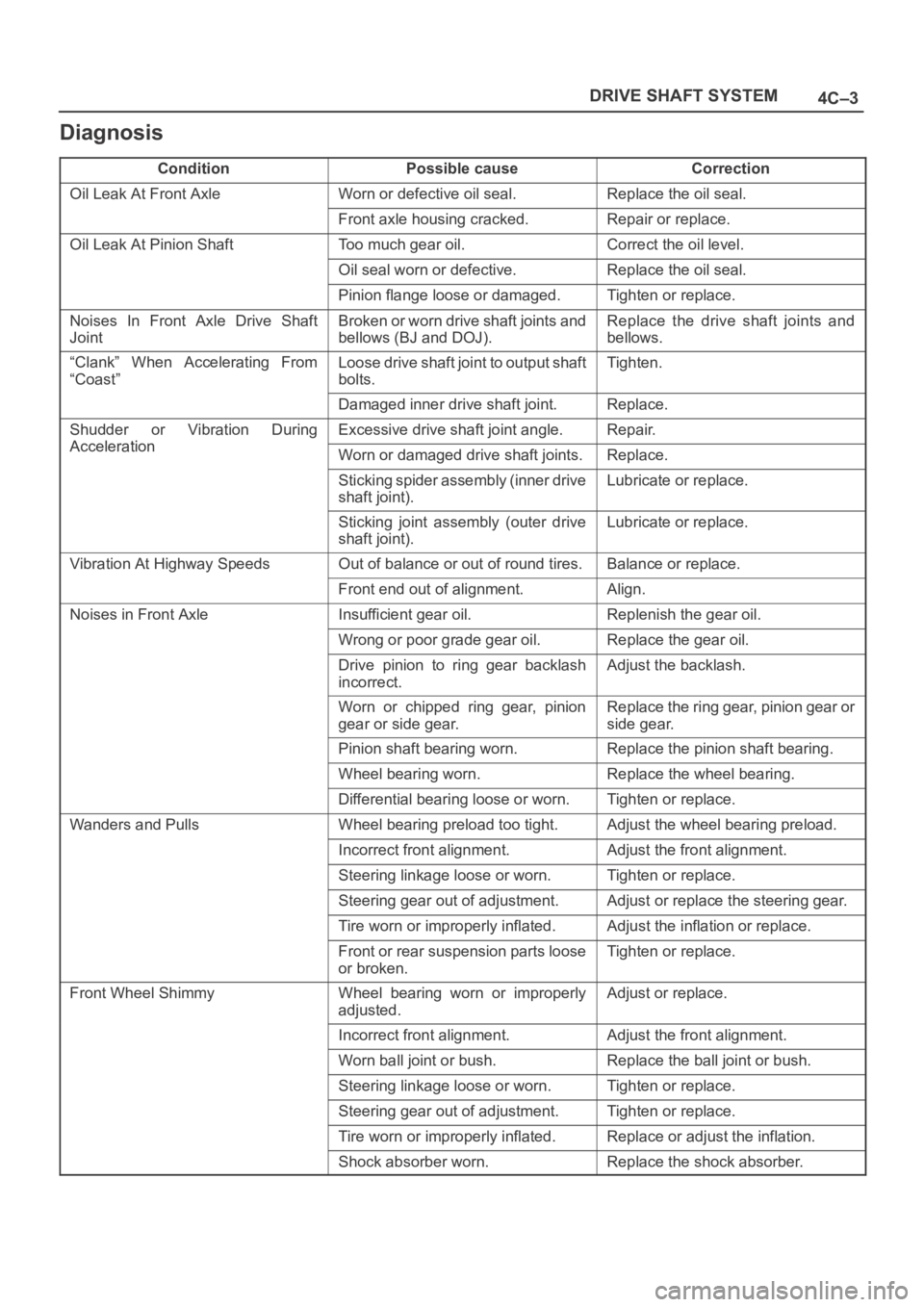
4C–3 DRIVE SHAFT SYSTEM
Diagnosis
ConditionPossible causeCorrection
Oil Leak At Front AxleWorn or defective oil seal.Replace the oil seal.
Front axle housing cracked.Repair or replace.
Oil Leak At Pinion ShaftToo much gear oil.Correct the oil level.
Oil seal worn or defective.Replace the oil seal.
Pinion flange loose or damaged.Tighten or replace.
Noises In Front Axle Drive Shaft
JointBroken or worn drive shaft joints and
bellows (BJ and DOJ).Replace the drive shaft joints and
bellows.
“Clank” When Accelerating From
“Coast”Loose drive shaft joint to output shaft
bolts.Tighten.
Damaged inner drive shaft joint.Replace.
Shudder or Vibration During
Acceleration
Excessive drive shaft joint angle.Repair.
AccelerationWorn or damaged drive shaft joints.Replace.
Sticking spider assembly (inner drive
shaft joint).Lubricate or replace.
Sticking joint assembly (outer drive
shaft joint).Lubricate or replace.
Vibration At Highway SpeedsOut of balance or out of round tires.Balance or replace.
Front end out of alignment.Align.
Noises in Front AxleInsufficient gear oil.Replenish the gear oil.
Wrong or poor grade gear oil.Replace the gear oil.
Drive pinion to ring gear backlash
incorrect.Adjust the backlash.
Worn or chipped ring gear, pinion
gear or side gear.Replace the ring gear, pinion gear or
side gear.
Pinion shaft bearing worn.Replace the pinion shaft bearing.
Wheel bearing worn.Replace the wheel bearing.
Differential bearing loose or worn.Tighten or replace.
Wanders and PullsWheel bearing preload too tight.Adjust the wheel bearing preload.
Incorrect front alignment.Adjust the front alignment.
Steering linkage loose or worn.Tighten or replace.
Steering gear out of adjustment.Adjust or replace the steering gear.
Tire worn or improperly inflated.Adjust the inflation or replace.
Front or rear suspension parts loose
or broken.Tighten or replace.
Front Wheel ShimmyWheel bearing worn or improperly
adjusted.Adjust or replace.
Incorrect front alignment.Adjust the front alignment.
Worn ball joint or bush.Replace the ball joint or bush.
Steering linkage loose or worn.Tighten or replace.
Steering gear out of adjustment.Tighten or replace.
Tire worn or improperly inflated.Replace or adjust the inflation.
Shock absorber worn.Replace the shock absorber.