brake light OPEL GRANDLAND X 2018.75 Manual user
[x] Cancel search | Manufacturer: OPEL, Model Year: 2018.75, Model line: GRANDLAND X, Model: OPEL GRANDLAND X 2018.75Pages: 273, PDF Size: 7.7 MB
Page 204 of 273
202Vehicle careVehicle careGeneral Information...................202
Accessories and vehicle modifications .......................... 202
Vehicle storage ........................203
End-of-life vehicle recovery .....204
Vehicle checks ........................... 204
Performing work ......................204
Bonnet ..................................... 204
Engine oil ................................. 205
Engine coolant ......................... 206
Washer fluid ............................ 207
Brakes ..................................... 207
Brake fluid ............................... 207
Vehicle battery ......................... 207
Diesel fuel system bleeding .....209
Wiper blade replacement ........209
Bulb replacement .......................210
Halogen headlights ..................210
LED headlights ........................ 211
Front fog lights ......................... 211
Tail lights ................................. 212
Side turn lights ......................... 215
Number plate light ...................215
Interior lights ............................ 215Electrical system........................216
Fuses ....................................... 216
Engine compartment fuse box . 217
Instrument panel fuse box .......218
Vehicle tools .............................. 220
Tools ........................................ 220
Wheels and tyres .......................221
Winter tyres ............................. 221
Tyre designations ....................221
Tyre pressure .......................... 222
Tyre deflation detection system .................................... 223
Tread depth ............................. 224
Changing tyre and wheel size . 224
Wheel covers ........................... 225
Tyre chains .............................. 225
Tyre repair kit .......................... 225
Wheel changing .......................228
Spare wheel ............................ 229
Jump starting ............................. 233
Towing ....................................... 234
Towing the vehicle ...................234
Towing another vehicle ...........235
Appearance care .......................236
Exterior care ............................ 236
Interior care ............................. 238General Information
Accessories and vehiclemodifications
We recommend the use of genuine
parts and accessories and factory approved parts specific for your
vehicle type. We cannot assess or guarantee reliability of other products
- even if they have a regulatory or
otherwise granted approval.
Any modification, conversion or other changes made to standard vehicle
specifications (including, without
limitation, software modifications,
modifications of the electronic control
units) may invalidate the warranty
offered by Opel. Furthermore, such
changes may affect driver assistance
systems, may impact fuel
consumption, CO 2 emissions and
other emissions of the vehicle and
cause the vehicle to no longer
conform to the operating permit,
impacting the validity of your vehicle
registration.
Page 214 of 273
212Vehicle careTail lightsTail lights, daytime running lights and
centre high-mounted brake light are
designed as LEDs. In case of failure, have LEDs replaced by a workshop.
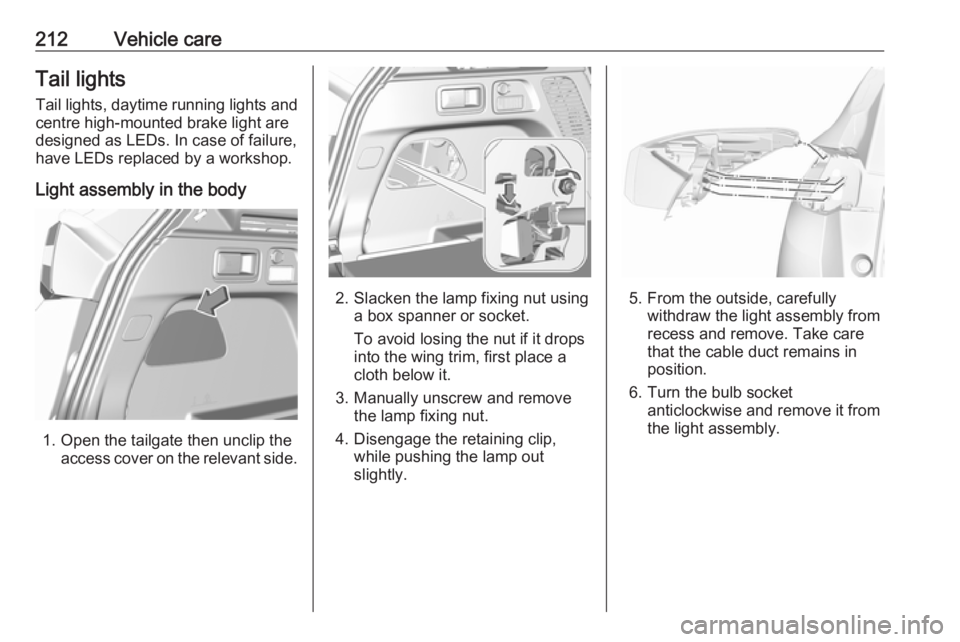
Light assembly in the body
1. Open the tailgate then unclip the access cover on the relevant side.
2. Slacken the lamp fixing nut usinga box spanner or socket.
To avoid losing the nut if it drops
into the wing trim, first place a
cloth below it.
3. Manually unscrew and remove the lamp fixing nut.
4. Disengage the retaining clip, while pushing the lamp out
slightly.5. From the outside, carefully withdraw the light assembly from
recess and remove. Take care
that the cable duct remains in
position.
6. Turn the bulb socket anticlockwise and remove it from
the light assembly.
Page 215 of 273
Vehicle care213
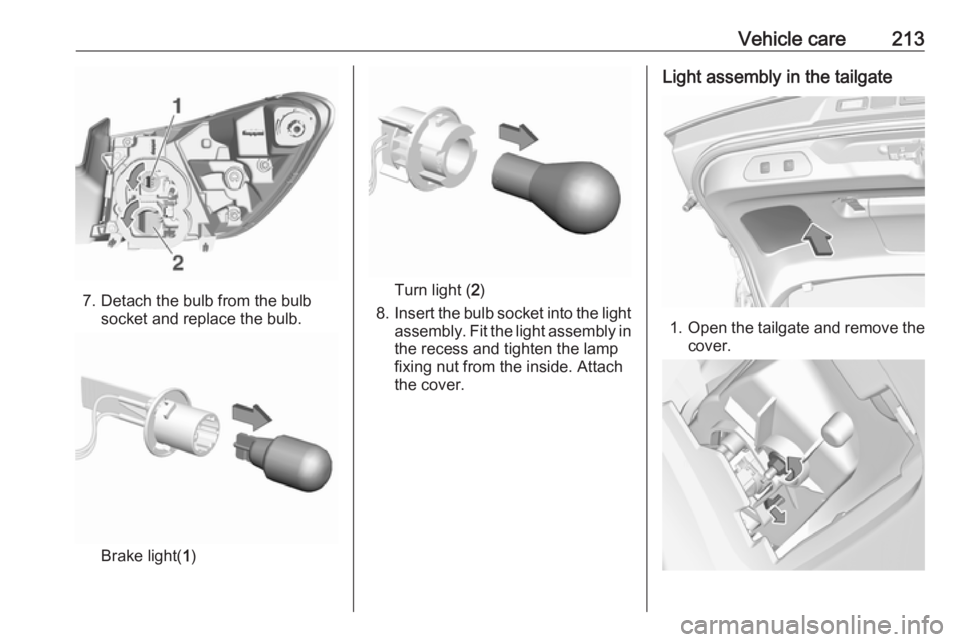
7. Detach the bulb from the bulbsocket and replace the bulb.
Brake light( 1)
Turn light ( 2)
8. Insert the bulb socket into the light
assembly. Fit the light assembly in the recess and tighten the lamp
fixing nut from the inside. Attach the cover.
Light assembly in the tailgate
1. Open the tailgate and remove the
cover.
Page 216 of 273
214Vehicle care2. Slacken the lamp fixing nut usinga box spanner or socket.
3. Manually unscrew and remove the lamp fixing nut.
4. Disengage the retaining clip, while pushing the light assembly
out slightly.
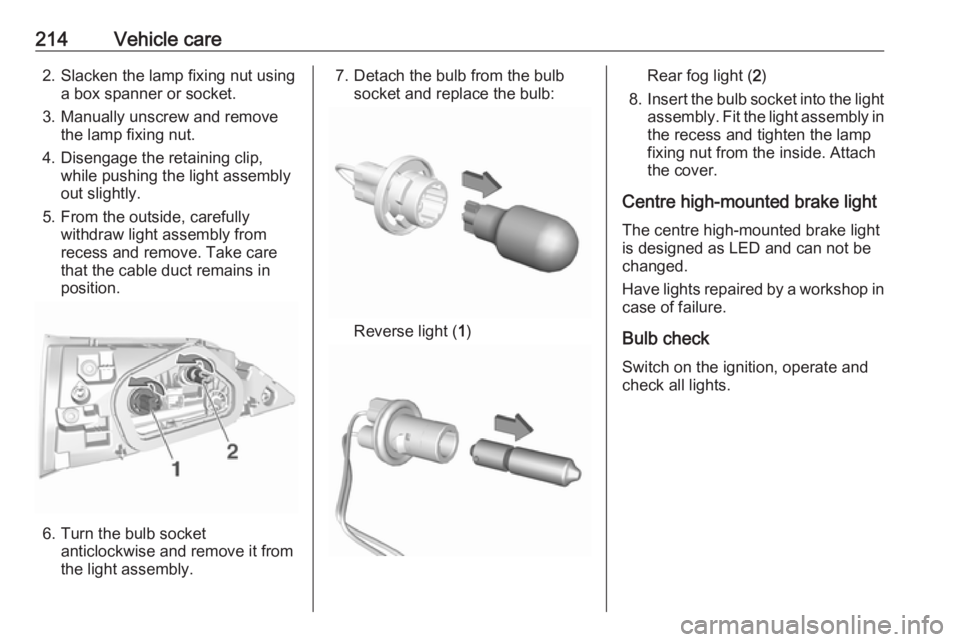
5. From the outside, carefully withdraw light assembly from
recess and remove. Take care
that the cable duct remains in
position.
6. Turn the bulb socket anticlockwise and remove it from
the light assembly.
7. Detach the bulb from the bulb socket and replace the bulb:
Reverse light ( 1)
Rear fog light ( 2)
8. Insert the bulb socket into the light
assembly. Fit the light assembly in the recess and tighten the lamp
fixing nut from the inside. Attach
the cover.
Centre high-mounted brake light The centre high-mounted brake light
is designed as LED and can not be
changed.
Have lights repaired by a workshop in
case of failure.
Bulb check
Switch on the ignition, operate and
check all lights.
Page 219 of 273
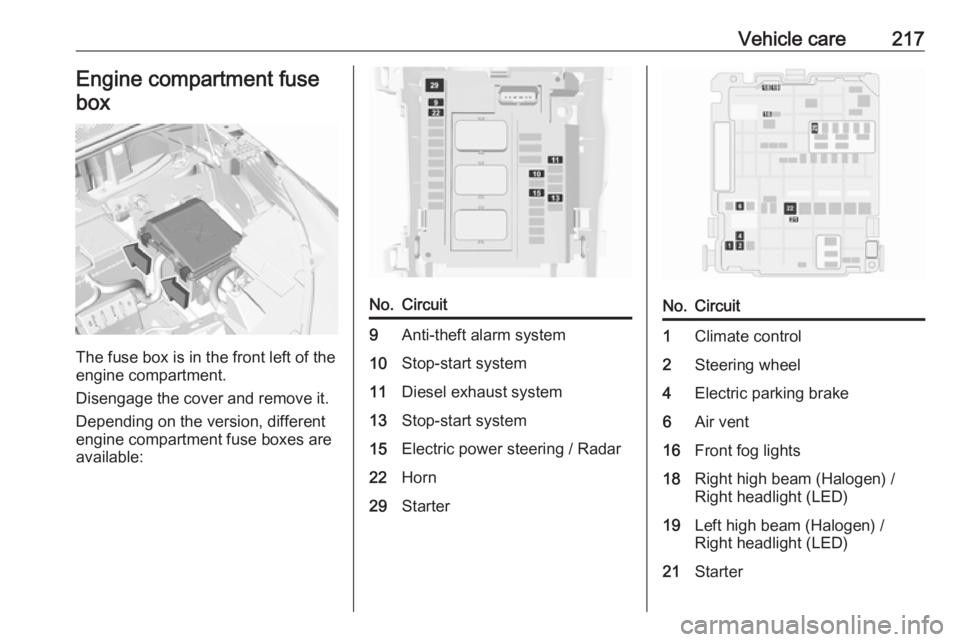
Vehicle care217Engine compartment fusebox
The fuse box is in the front left of the
engine compartment.
Disengage the cover and remove it. Depending on the version, different
engine compartment fuse boxes are
available:
No.Circuit9Anti-theft alarm system10Stop-start system11Diesel exhaust system13Stop-start system15Electric power steering / Radar22Horn29StarterNo.Circuit1Climate control2Steering wheel4Electric parking brake6Air vent16Front fog lights18Right high beam (Halogen) /
Right headlight (LED)19Left high beam (Halogen) /
Right headlight (LED)21Starter
Page 221 of 273
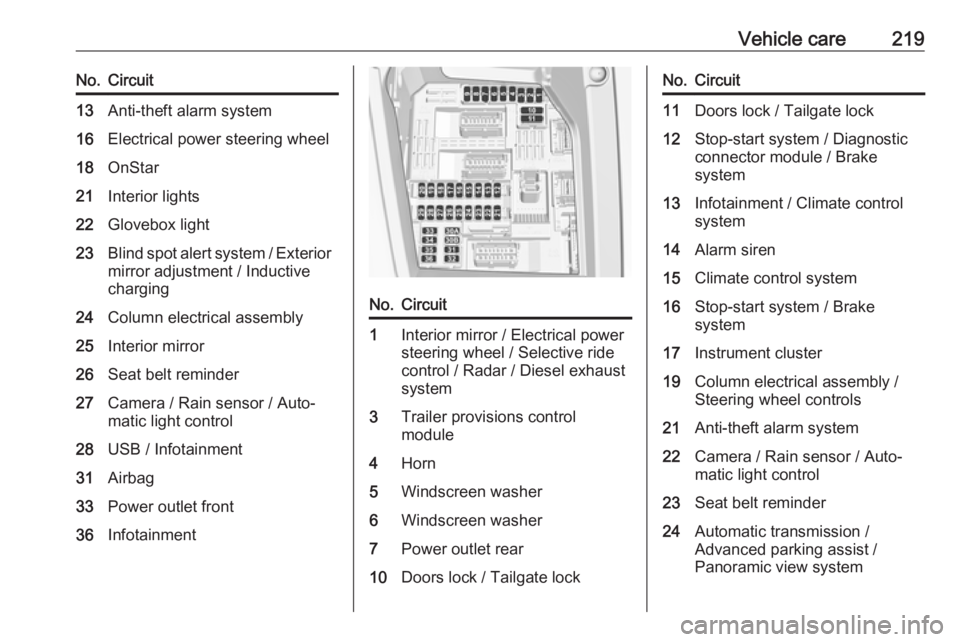
Vehicle care219No.Circuit13Anti-theft alarm system16Electrical power steering wheel18OnStar21Interior lights22Glovebox light23Blind spot alert system / Exterior
mirror adjustment / Inductive
charging24Column electrical assembly25Interior mirror26Seat belt reminder27Camera / Rain sensor / Auto‐
matic light control28USB / Infotainment31Airbag33Power outlet front36InfotainmentNo.Circuit1Interior mirror / Electrical power
steering wheel / Selective ride
control / Radar / Diesel exhaust
system3Trailer provisions control
module4Horn5Windscreen washer6Windscreen washer7Power outlet rear10Doors lock / Tailgate lockNo.Circuit11Doors lock / Tailgate lock12Stop-start system / Diagnostic
connector module / Brake
system13Infotainment / Climate control
system14Alarm siren15Climate control system16Stop-start system / Brake
system17Instrument cluster19Column electrical assembly /
Steering wheel controls21Anti-theft alarm system22Camera / Rain sensor / Auto‐
matic light control23Seat belt reminder24Automatic transmission /
Advanced parking assist /
Panoramic view system
Page 236 of 273
234Vehicle care● The vehicles must not come intocontact with each other during
the jump starting process.
● Apply the parking brake, transmission in neutral,
automatic transmission in P.
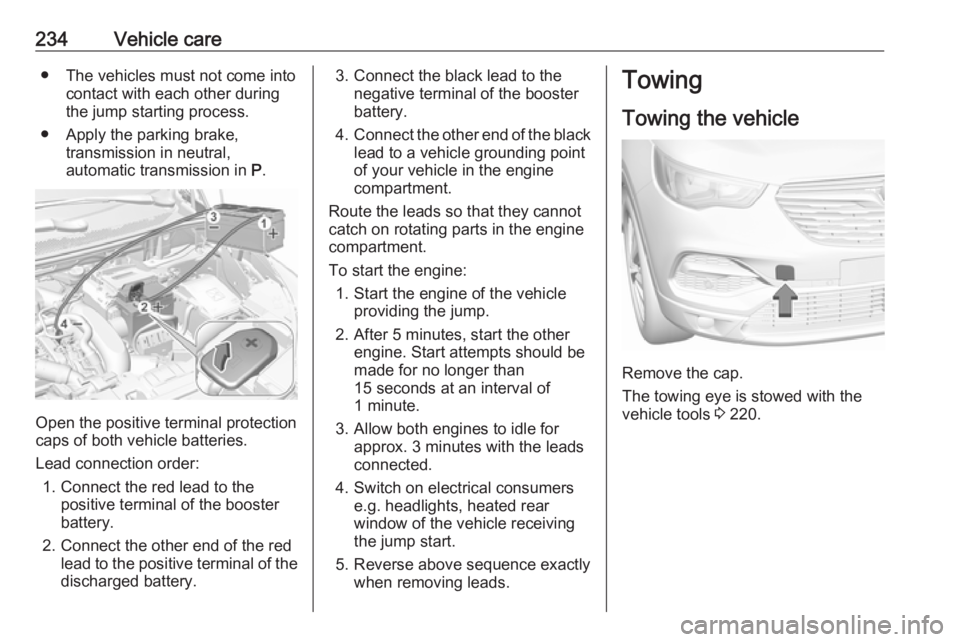
Open the positive terminal protection
caps of both vehicle batteries.
Lead connection order: 1. Connect the red lead to the positive terminal of the booster
battery.
2. Connect the other end of the red lead to the positive terminal of the
discharged battery.
3. Connect the black lead to the negative terminal of the boosterbattery.
4. Connect the other end of the black
lead to a vehicle grounding point
of your vehicle in the engine
compartment.
Route the leads so that they cannot
catch on rotating parts in the engine
compartment.
To start the engine: 1. Start the engine of the vehicle providing the jump.
2. After 5 minutes, start the other engine. Start attempts should be
made for no longer than
15 seconds at an interval of
1 minute.
3. Allow both engines to idle for approx. 3 minutes with the leads
connected.
4. Switch on electrical consumers e.g. headlights, heated rear
window of the vehicle receiving
the jump start.
5. Reverse above sequence exactly when removing leads.Towing
Towing the vehicle
Remove the cap.
The towing eye is stowed with the
vehicle tools 3 220.
Page 237 of 273
Vehicle care235
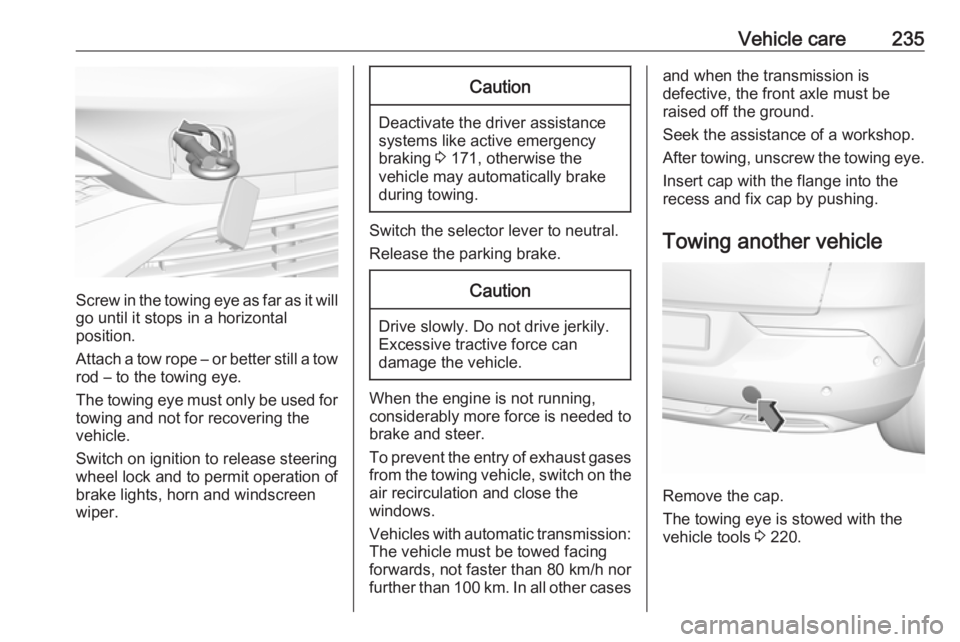
Screw in the towing eye as far as it will
go until it stops in a horizontal
position.
Attach a tow rope – or better still a tow
rod – to the towing eye.
The towing eye must only be used for towing and not for recovering the
vehicle.
Switch on ignition to release steering
wheel lock and to permit operation of
brake lights, horn and windscreen
wiper.
Caution
Deactivate the driver assistance
systems like active emergency
braking 3 171, otherwise the
vehicle may automatically brake during towing.
Switch the selector lever to neutral.
Release the parking brake.
Caution
Drive slowly. Do not drive jerkily.
Excessive tractive force can
damage the vehicle.
When the engine is not running,
considerably more force is needed to
brake and steer.
To prevent the entry of exhaust gases from the towing vehicle, switch on the
air recirculation and close the
windows.
Vehicles with automatic transmission: The vehicle must be towed facing
forwards, not faster than 80 km/h nor further than 100 km. In all other cases
and when the transmission is
defective, the front axle must be
raised off the ground.
Seek the assistance of a workshop.
After towing, unscrew the towing eye.
Insert cap with the flange into the
recess and fix cap by pushing.
Towing another vehicle
Remove the cap.
The towing eye is stowed with the
vehicle tools 3 220.
Page 265 of 273
Customer information263● Faults and defects in importantsystem components (e.g. lights,
brakes),
● System reactions in special driving situations (e.g. triggeringof an airbag, actuation of the
stability control systems),
● Information on events damaging the vehicle.
In special cases (e.g. if the vehicle
has detected a malfunction), it may be
necessary to save data that would
otherwise just be volatile.
When you use services, the operating
data saved can be read together with the vehicle identification number andused if necessary. Staff working for
the service net-work (e.g. garages,
manufacturers) or third parties (e.g.
breakdown services) can read the
data from the vehicle. Services
include repair services, maintenance
processes, warranty cases and
quality assurance measures.
Data is generally read via the OBD
(On-Board Diagnostics) port
prescribed by law in the vehicle. The operating data which has been read
out documents the technical conditionof the vehicle or individual
components and assists with fault
diagnosis, compliance with warranty
obligations and quality improvement.
This data, in particular information on
component stress, technical events,
operator errors and other faults, is
transmitted to the manufacturer
where appropriate, together with the vehicle identification number. The
manufacturer is also subject to
product liability. The manufacturer
potentially also needs operating data
from vehicles for product recalls.
Fault memories in the vehicle can be
reset by a service company when
carrying out servicing or repairs.
Comfort and infotainment
functions
Comfort settings and custom settings can be stored in the vehicle and
changed at any time.Depending on the equipment level in
question, these include
● Seat and steering wheel position settings,
● Chassis and air conditioning settings,
● Custom settings such as interior lighting.
You can input your own data in the
infotainment functions for your
vehicle as part of the selected
features.
Depending on the equipment level in
question, these include
● Multimedia data such as music, videos or photos for playback in
an integrated multimedia system,
● Address book data for use with an integrated hands-free system
or an integrated navigation
system,
● Input destinations,
● Data on the use of online services.
This data for comfort and
infotainment functions can be stored
locally in the vehicle or be kept on a
Page 268 of 273
266IndexAAccessories and vehicle modifications .......................... 202
Active emergency braking ..100, 171
Adaptive cruise control .......100, 163
AdBlue .................................. 98, 145
Adjustable air vents ...................132
Advanced parking assist ............179
Airbag and belt tensioners ...........94
Airbag deactivation ................60, 95
Airbag label................................... 55 Airbag system .............................. 55
Air conditioning regular operation ................................ 134
Air conditioning system .............. 125
Air intake .................................... 133
Air vents...................................... 132
Antilock brake system ................ 152
Antilock brake system (ABS) .......97
Anti-theft alarm system ................35
Anti-theft locking system .............. 35
Appearance care ........................236
Armrest ................................... 51, 52
Ashtrays ....................................... 88 Automatic anti-dazzle ..................39
Automatic light control ...............115
Automatic locking ........................28
Automatic transmission .............148
Autostop ............................... 99, 140
Auxiliary heater ........................... 132B
Battery discharge protection ......123
Battery voltage ........................... 105
BlueInjection ............................... 145
Bonnet ....................................... 204
Brake and clutch fluid .................242
Brake and clutch system .............96
Brake assist ............................... 154
Brake fluid .................................. 207
Brakes ............................... 152, 207
Breakdown.................................. 234
Bulb replacement ....................... 210
C Capacities .................................. 253
Catalytic converter .....................144
Central locking system ................24
Centre console lighting ..............122
Centre console storage ...............70
Changing tyre and wheel size ...224
Charging system .......................... 95
Child locks ................................... 29
Child restraint installation locations ................................... 65
Child restraints.............................. 62
Child restraint systems ................62
Cigarette lighter ........................... 87
Climate control ............................. 16
Climate control systems .............124
Clock............................................. 84