light Peugeot 3008 Hybrid 4 2012 - RHD (UK. Australia) Owner's Guide
[x] Cancel search | Manufacturer: PEUGEOT, Model Year: 2012, Model line: 3008 Hybrid 4, Model: Peugeot 3008 Hybrid 4 2012Pages: 284, PDF Size: 14.08 MB
Page 136 of 284
SA
F
134
ELECTRONIC STABILITY PROGRAMME (ESC)
Definitions
Anti-skid regulation (ASR)
The ASR system (also known as Trac-
tion Control) optimises traction in order
to avoid wheel slip by acting on the
brakes of the driving wheels and on the
engine. It also improves the directional
stability of the vehicle on acceleration.
Dynamic stability control (DSC)
If there is a difference between the path
followed by the vehicle and that re-
quired by the driver, the DSC monitors
each wheel and automatically acts on
the brake of one or more wheels and
on the engine to return the vehicle to
the required path, within the limits of the
laws of physics.
Emergency braking assistance
In an emergency, this system enables
you to reach the optimum braking pres-
sure more quickly and therefore reduce
the stopping distance.
It is triggered in relation to the speed at
which the brake pedal is pressed. This
is felt by a reduction in the resistance of
the pedal and an increase in the effec-
tiveness of the braking.
Anti-lock braking system (ABS) and
electronic brake force distribution
(EBFD)
This system improves the stability and
manoeuvrability of your vehicle when
braking and provides improved control
in corners, in particular on poor or slip-
pery road surfaces.
The ABS prevents wheel lock in the
event of emergency braking.
The electronic brake force distribution
system manages the braking pressure
wheel by wheel.
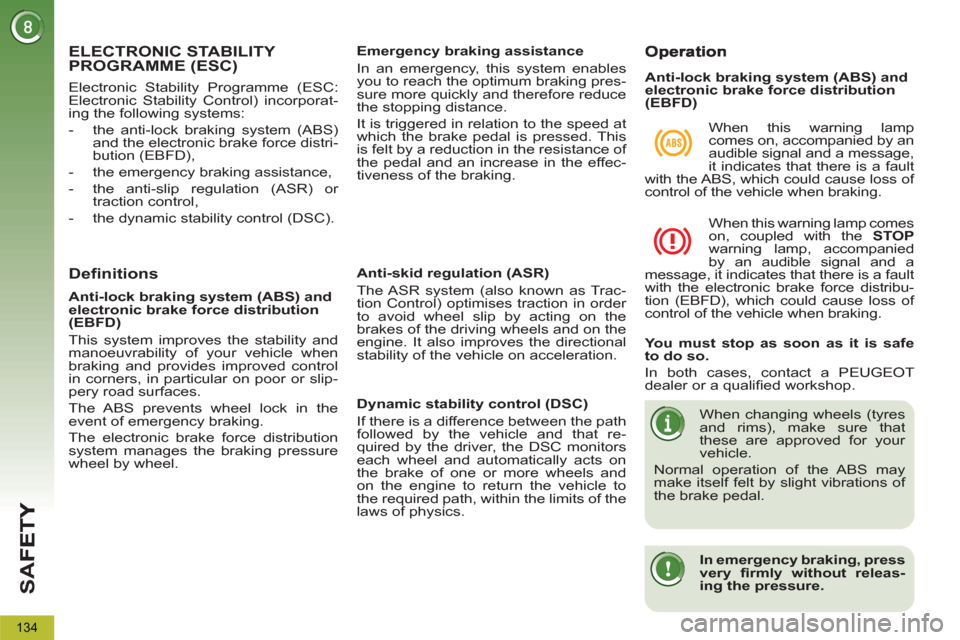
When this warning lamp
comes on, accompanied by an
audible signal and a message,
it indicates that there is a fault
with the ABS, which could cause loss of
control of the vehicle when braking.
When this warning lamp comes
on, coupled with the STOP
warning lamp, accompanied
by an audible signal and a
message, it indicates that there is a fault
with the electronic brake force distribu-
tion (EBFD), which could cause loss of
control of the vehicle when braking.
You must stop as soon as it is safe
to do so.
In both cases, contact a PEUGEOT
dealer or a qualifi ed workshop.
When changing wheels (tyres
and rims), make sure that
these are approved for your
vehicle.
Normal operation of the ABS may
make itself felt by slight vibrations of
the brake pedal.
In emergency braking, press
very fi rmly without releas-
ing the pressure.
Anti-lock braking system (ABS) and
electronic brake force distribution
(EBFD)
Electronic Stability Programme (ESC:
Electronic Stability Control) incorporat-
ing the following systems:
- the anti-lock braking system (ABS)
and the electronic brake force distri-
bution (EBFD),
- the emergency braking assistance,
- the anti-slip regulation (ASR) or
traction control,
- the dynamic stability control (DSC).
Page 140 of 284
SA
F
138
The driver must ensure that
passengers use the seat belts
correctly and that they are all
restrained securely before setting off.
Wherever you are seated in the ve-
hicle, always fasten your seat belt,
even for short journeys.
Do not interchange the seat belt
buckles as they will not fulfi l their role
fully.
The seat belts are fi tted with an inertia
reel permitting automatic adjustment
of the length of the strap to your size.
The seat belt is stowed automatically
when not in use.
Before and after use, ensure that the
seat belt is reeled in correctly.
The lower part of the strap must be
positioned as low as possible on the
pelvis.
The upper part must be positioned in
the hollow of the shoulder.
The inertia reels are fi tted with an au-
tomatic locking device which comes
into operation in the event of a col-
lision, emergency braking or if the
vehicle rolls over. You can release
the device by pulling fi rmly on the
strap and releasing it so that it reels
in slightly. In order to be effective, a seat belt
must:
- be tightened as close to the body
as possible,
- be pulled in front of you with a
smooth movement, checking that
it does not twist,
- be used to restrain only one person,
- not bear any trace of cuts or fraying,
- not be converted or modifi ed to
avoid affecting its performance.
In accordance with current safety
regulations, for all repairs on your
vehicle, go to a qualifi ed workshop
with the skills and equipment need-
ed, which a PEUGEOT dealer is able
to provide.
Have your seat belts checked regu-
larly by a PEUGEOT dealer or a
qualifi ed workshop, particularly if the
straps show signs of damage.
Clean the seat belt straps with soapy
water or a textile cleaning product,
sold by PEUGEOT dealers.
After folding or moving a seat or rear
bench seat, ensure that the seat belt
is positioned and reeled in correctly.
Recommendations for children
Use a suitable child seat if the pas-
senger is less than 12 years old or
shorter than one and a half metres.
Never use the same seat belt to se-
cure more than one person.
Never allow a child to travel on your lap.
In the event of an impact
Depending on the nature and se-
riousness of the impact
, the pre-
tensioning device may be deployed
before and independently of the
airbags. Deployment of the preten-
sioners is accompanied by a slight
discharge of harmless smoke and
a noise, due to the activation of the
pyrotechnic cartridge incorporated in
the system.
In all cases, the airbag warning lamp
comes on.
Following an impact, have the seat
belts system checked, and if neces-
sary replaced, by a PEUGEOT deal-
er or a qualifi ed workshop.
In the event of an accident, the high
voltage is disconnected automatically.
Page 141 of 284
SA
F
139
AIRBAGS
Deployment of the airbag(s) is
accompanied by a slight emis-
sion of harmless smoke and
a noise, due to the activation of the
pyrotechnic cartridge incorporated in
the system.
This smoke is not harmful, but sensi-
tive individuals may experience slight
irritation.
The noise of the detonation may re-
sult in a slight loss of hearing for a
short time.
Front airbags
Deployment
The airbags are deployed simultane-
ously, unless the passenger's front
airbag is deactivated, in the event of a
serious front impact to all or part of the
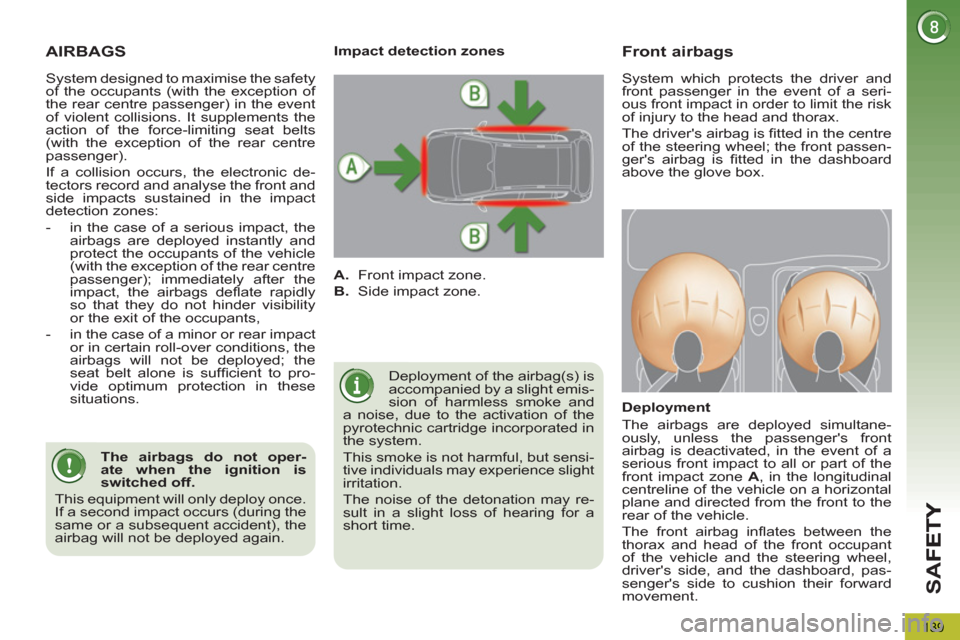
front impact zone A
, in the longitudinal
centreline of the vehicle on a horizontal
plane and directed from the front to the
rear of the vehicle.
The front airbag infl ates between the
thorax and head of the front occupant
of the vehicle and the steering wheel,
driver's side, and the dashboard, pas-
senger's side to cushion their forward
movement.
Impact detection zones
A.
Front impact zone.
B.
Side impact zone.
The airbags do not oper-
ate when the ignition is
switched off.
This equipment will only deploy once.
If a second impact occurs (during the
same or a subsequent accident), the
airbag will not be deployed again.
System designed to maximise the safety
of the occupants (with the exception of
the rear centre passenger) in the event
of violent collisions. It supplements the
action of the force-limiting seat belts
(with the exception of the rear centre
passenger).
If a collision occurs, the electronic de-
tectors record and analyse the front and
side impacts sustained in the impact
detection zones:
- in the case of a serious impact, the
airbags are deployed instantly and
protect the occupants of the vehicle
(with the exception of the rear centre
passenger); immediately after the
impact, the airbags defl ate rapidly
so that they do not hinder visibility
or the exit of the occupants,
- in the case of a minor or rear impact
or in certain roll-over conditions, the
airbags will not be deployed; the
seat belt alone is suffi cient to pro-
vide optimum protection in these
situations.
System which protects the driver and
front passenger in the event of a seri-
ous front impact in order to limit the risk
of injury to the head and thorax.
The driver's airbag is fi tted in the centre
of the steering wheel; the front passen-
ger's airbag is fi tted in the dashboard
above the glove box.
Page 146 of 284
D
R
I
144
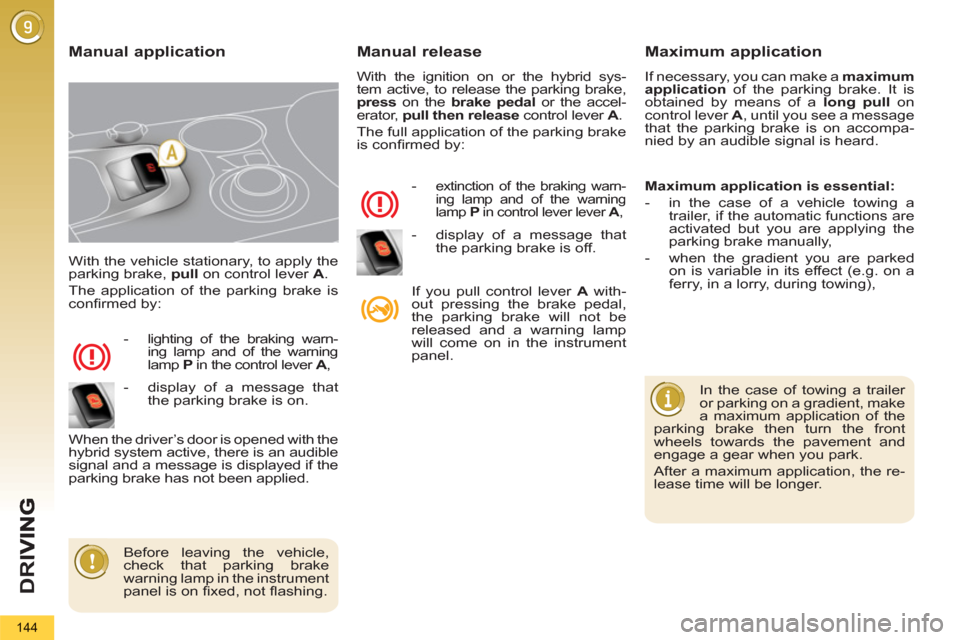
With the vehicle stationary, to apply the
parking brake, pull
on control lever A
.
The application of the parking brake is
confi rmed by:
- lighting of the braking warn-
ing lamp and of the warning
lamp P
in the control lever A
,
When the driver’s door is opened with the
hybrid system active, there is an audible
signal and a message is displayed if the
parking brake has not been applied.
Manual release
With the ignition on or the hybrid sys-
tem active, to release the parking brake,
press
on the brake
pedal
or the accel-
erator, pull then release
control lever A
.
The full application of the parking brake
is confi rmed by:
-
extinction of the braking warn-
ing lamp and of the warning
lamp P
in control lever lever A
,
If you pull control lever A
with-
out pressing the brake pedal,
the parking brake will not be
released and a warning lamp
will come on in the instrument
panel.
Manual application Maximum application
If necessary, you can make a maximum
application
of the parking brake. It is
obtained by means of a long pull
on
control lever A
, until you see a message
that the parking brake is on accompa-
nied by an audible signal is heard.
In the case of towing a trailer
or parking on a gradient, make
a maximum application of the
parking brake then turn the front
wheels towards the pavement and
engage a gear when you park.
After a maximum application, the re-
lease time will be longer.
Before leaving the vehicle,
check that parking brake
warning lamp in the instrument
panel is on fi xed, not fl ashing.
Maximum application is essential:
- in the case of a vehicle towing a
trailer, if the automatic functions are
activated but you are applying the
parking brake manually,
- when the gradient you are parked
on is variable in its effect (e.g. on a
ferry, in a lorry, during towing),
- display of a message that
the parking brake is on.
- display of a message that
the parking brake is off.
Page 181 of 284
PRACTICAL INFORMATION
179
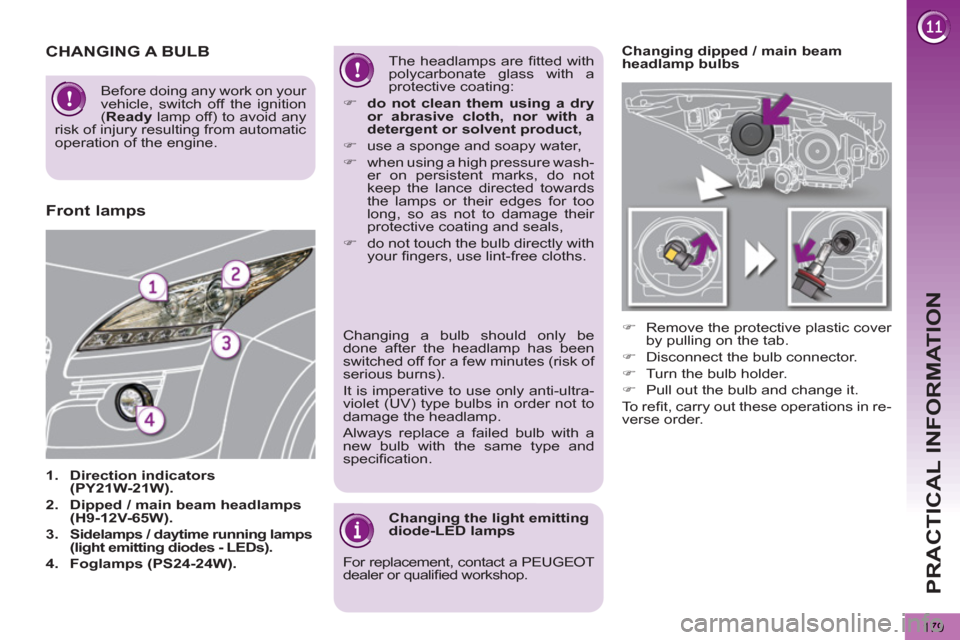
Changing dipped / main beam
headlamp bulbs
)
Remove the protective plastic cover
by pulling on the tab.
)
Disconnect the bulb connector.
)
Turn the bulb holder.
)
Pull out the bulb and change it.
To r efi t, carry out these operations in re-
verse order.
CHANGING A BULB
1.
Direction indicators
(PY21W-21W).
2.
Dipped / main beam headlamps
(H9-12V-65W).
3.
Sidelamps / daytime running lamps
(light emitting diodes - LEDs).
4.
Foglamps (PS24-24W).
The headlamps are fi tted with
polycarbonate glass with a
protective coating:
)
do not clean them using a dry
or abrasive cloth, nor with a
detergent or solvent product,
)
use a sponge and soapy water,
)
when using a high pressure wash-
er on persistent marks, do not
keep the lance directed towards
the lamps or their edges for too
long, so as not to damage their
protective coating and seals,
)
do not touch the bulb directly with
your fi ngers, use lint-free cloths.
Front lamps
Changing a bulb should only be
done after the headlamp has been
switched off for a few minutes (risk of
serious burns).
It is imperative to use only anti-ultra-
violet (UV) type bulbs in order not to
damage the headlamp.
Always replace a failed bulb with a
new bulb with the same type and
specifi cation.
Changing the light emitting
diode-LED lamps
For replacement, contact a PEUGEOT
dealer or qualifi ed workshop.
Before doing any work on your
vehicle, switch off the ignition
( Ready
lamp off) to avoid any
risk of injury resulting from automatic
operation of the engine.
Page 186 of 284
PRACTICAL INFORMATION
184
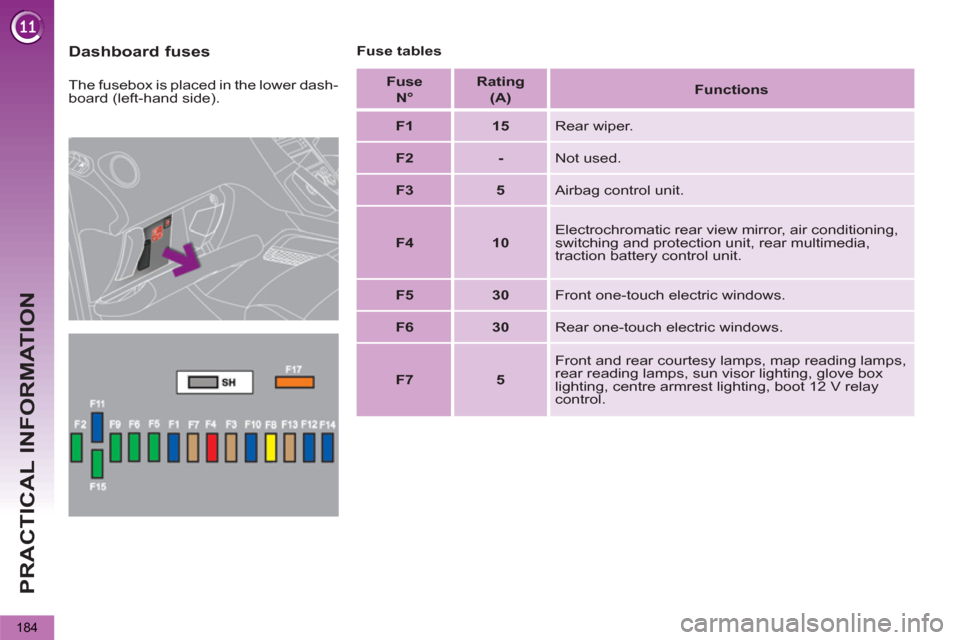
Dashboard fuses
Fuse tables
The fusebox is placed in the lower dash-
board (left-hand side).
Fuse
N°
Rating
(A)
Functions
F1
15
Rear wiper.
F2
-
Not used.
F3
5
Airbag control unit.
F4
10
Electrochromatic rear view mirror, air conditioning,
switching and protection unit, rear multimedia,
traction battery control unit.
F5
30
Front one-touch electric windows.
F6
30
Rear one-touch electric windows.
F7
5
Front and rear courtesy lamps, map reading lamps,
rear reading lamps, sun visor lighting, glove box
lighting, centre armrest lighting, boot 12 V relay
control.
Page 187 of 284
PRACTICAL INFORMATION
185
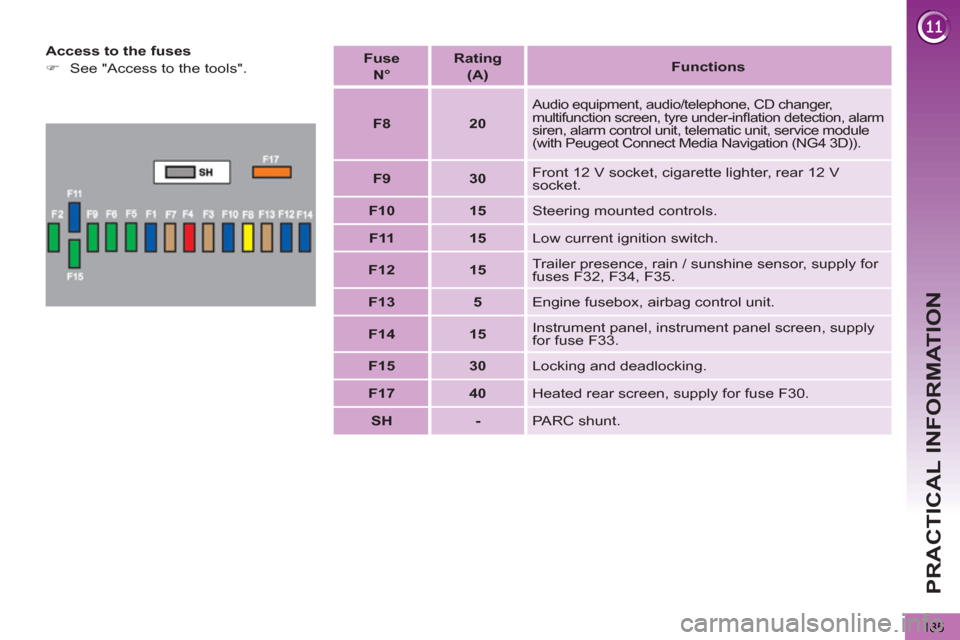
Access to the fuses
)
See "Access to the tools".
Fuse
N°
Rating
(A)
Functions
F8
20
Audio equipment, audio/telephone, CD changer,
multifunction screen, tyre under-infl ation detection, alarm
siren, alarm control unit, telematic unit, service module
(with Peugeot Connect Media Navigation (NG4 3D)).
F9
30
Front 12 V socket, cigarette lighter, rear 12 V
socket.
F10
15
Steering mounted controls.
F11
15
Low current ignition switch.
F12
15
Trailer presence, rain / sunshine sensor, supply for
fuses F32, F34, F35.
F13
5
Engine fusebox, airbag control unit.
F14
15
Instrument panel, instrument panel screen, supply
for fuse F33.
F15
30
Locking and deadlocking.
F17
40
Heated rear screen, supply for fuse F30.
SH
-
PARC shunt.
Page 198 of 284
PRACTICAL INFORMATION
196
TOWING A TRAILER, ...
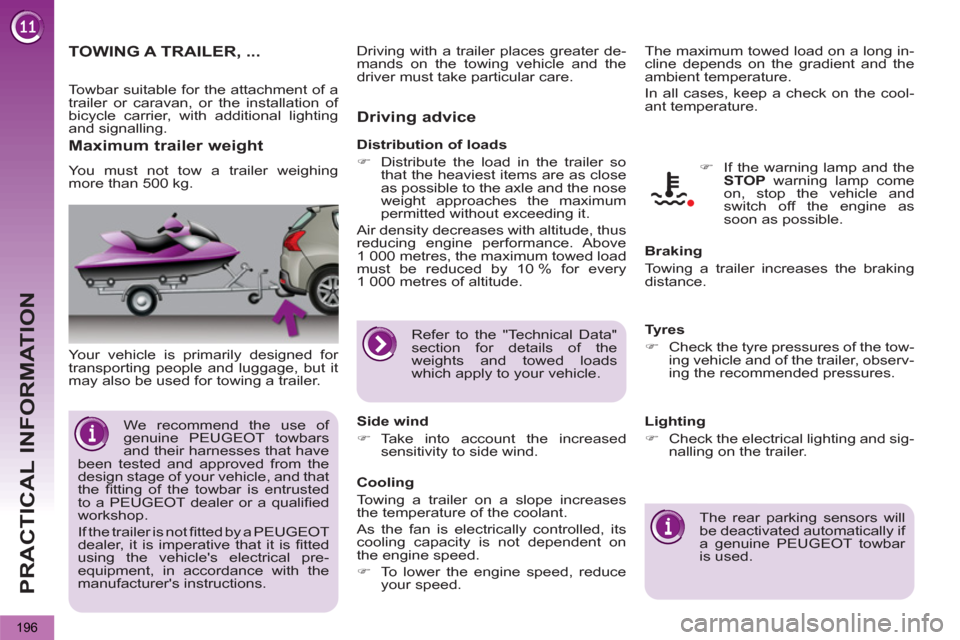
Your vehicle is primarily designed for
transporting people and luggage, but it
may also be used for towing a trailer.
Driving advice
The maximum towed load on a long in-
cline depends on the gradient and the
ambient temperature.
In all cases, keep a check on the cool-
ant temperature.
Cooling
Towing a trailer on a slope increases
the temperature of the coolant.
As the fan is electrically controlled, its
cooling capacity is not dependent on
the engine speed.
)
To lower the engine speed, reduce
your speed.
Side wind
)
Take into account the increased
sensitivity to side wind.
Tyres
)
Check the tyre pressures of the tow-
ing vehicle and of the trailer, observ-
ing the recommended pressures.
Braking
Towing a trailer increases the braking
distance.
)
If the warning lamp and the
STOP
warning lamp come
on, stop the vehicle and
switch off the engine as
soon as possible.
Maximum trailer weight
You must not tow a trailer weighing
more than 500 kg.
Distribution of loads
)
Distribute the load in the trailer so
that the heaviest items are as close
as possible to the axle and the nose
weight approaches the maximum
permitted without exceeding it.
Air density decreases with altitude, thus
reducing engine performance. Above
1 000 metres, the maximum towed load
must be reduced by 10 % for every
1 000 metres of altitude.
Driving with a trailer places greater de-
mands on the towing vehicle and the
driver must take particular care.
We recommend the use of
genuine PEUGEOT towbars
and their harnesses that have
been tested and approved from the
design stage of your vehicle, and that
the fi tting of the towbar is entrusted
to a PEUGEOT dealer or a qualifi ed
workshop.
If the trailer is not fi tted by a PEUGEOT
dealer, it is imperative that it is fi tted
using the vehicle's electrical pre-
equipment, in accordance with the
manufacturer's instructions.
Refer to the "Technical Data"
section for details of the
weights and towed loads
which apply to your vehicle.
Lighting
)
Check the electrical lighting and sig-
nalling on the trailer.
The rear parking sensors will
be deactivated automatically if
a genuine PEUGEOT towbar
is used.
Towbar suitable for the attachment of a
trailer or caravan, or the installation of
bicycle carrier, with additional lighting
and signalling.
Page 204 of 284
TECHNICAL DATA
202
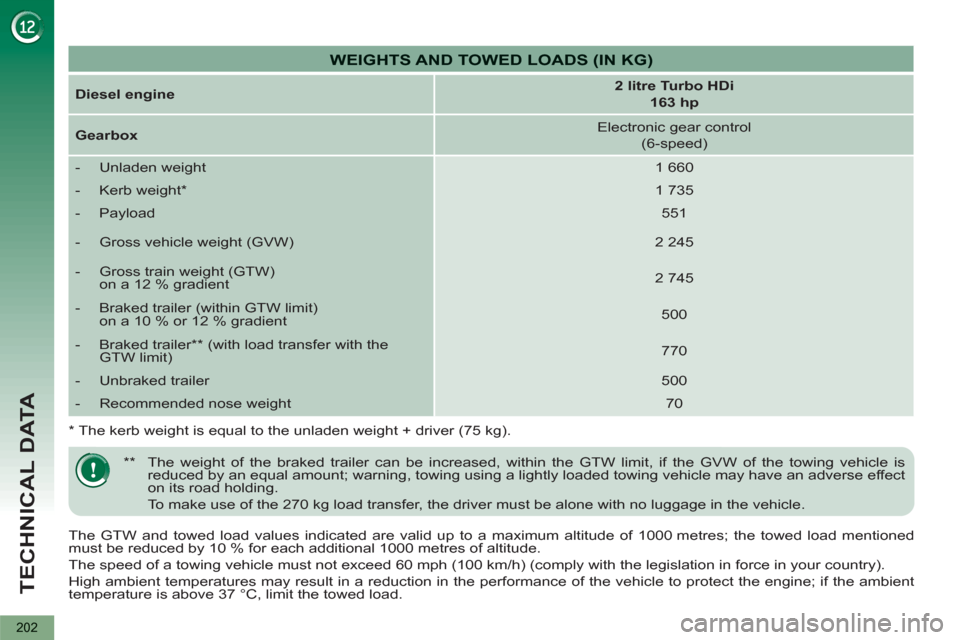
The GTW and towed load values indicated are valid up to a maximum altitude of 1000 metres; the towed load mentioned
must be reduced by 10 % for each additional 1000 metres of altitude.
The speed of a towing vehicle must not exceed 60 mph (100 km/h) (comply with the legislation in force in your country).
High ambient temperatures may result in a reduction in the performance of the vehicle to protect the engine; if the ambient
temperature is above 37 °C, limit the towed load.
WEIGHTS AND TOWED LOADS (IN KG)
* The kerb weight is equal to the unladen weight + driver (75 kg).
**
The weight of the braked trailer can be increased, within the GTW limit, if the GVW of the towing vehicle is
reduced by an equal amount; warning, towing using a lightly loaded towing vehicle may have an adverse effect
on its road holding.
To make use of the 270 kg load transfer, the driver must be alone with no luggage in the vehicle.
Diesel engine
2 litre Turbo HDi
163 hp
Gearbox
Electronic gear control
(6-speed)
- Unladen weight
1 660
- Kerb weight *
1 735
- Payload
551
- Gross vehicle weight (GVW)
2 245
- Gross train weight (GTW)
on a 12 % gradient
2 745
- Braked trailer (within GTW limit)
on a 10 % or 12 % gradient
500
- Braked trailer ** (with load transfer with the
GTW limit)
770
- Unbraked trailer
500
- Recommended nose weight
70
Page 213 of 284
211
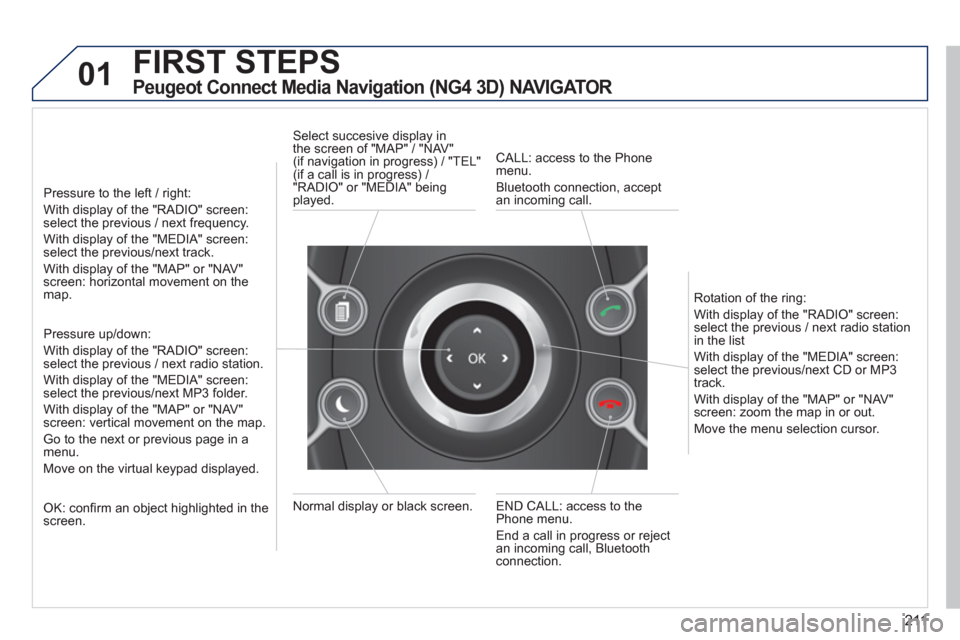
01FIRST STEPS
Peugeot Connect Media Navigation (NG4 3D) NAVIGATOR
Pressure to the left / right:
With display of the "RADIO" screen: select the previous / next frequency.
With display of the "MEDIA" screen: select the previous/next track.
With display of the "MAP" or "NAV"screen: horizontal movement on themap.
Pressure up/down:
With display of the "RADIO" screen: select the previous / next radio station.
With display of the "MEDIA" screen: select the previous/next MP3 folder.
With display of the "MAP" or "NAV"screen: vertical movement on the map.
Go to the next or previous pa
ge in a menu.
Move on the virtual keypad displayed.
OK: confi rm an object highlighted in thescreen.
END CALL: access to the Phone menu.
End a call in pro
gress or reject
an incoming call, Bluetooth connection. Normal displa
y or black screen. Select succesive displa
y in
the screen of "MAP" / "NAV"(if navigation in progress) / "TEL"(if a call is in progress) /
"RADIO" or "MEDIA" being
played.
CALL: access to the Phonemenu.
Bluetooth connection, accept
an incomin
g call.
Rotation o
f the ring:
With displa
y of the "RADIO" screen: select the previous / next radio station
in the list
With displa
y of the "MEDIA" screen: select the previous/next CD or MP3
track.
With displa
y of the "MAP" or "NAV"screen: zoom the map in or out.
M
ove the menu selection cursor.