bonnet Peugeot 308 2016 Owner's Manual
[x] Cancel search | Manufacturer: PEUGEOT, Model Year: 2016, Model line: 308, Model: Peugeot 308 2016Pages: 398, PDF Size: 9.38 MB
Page 5 of 398
308_en_Chap00a_sommaire_ed02-2015
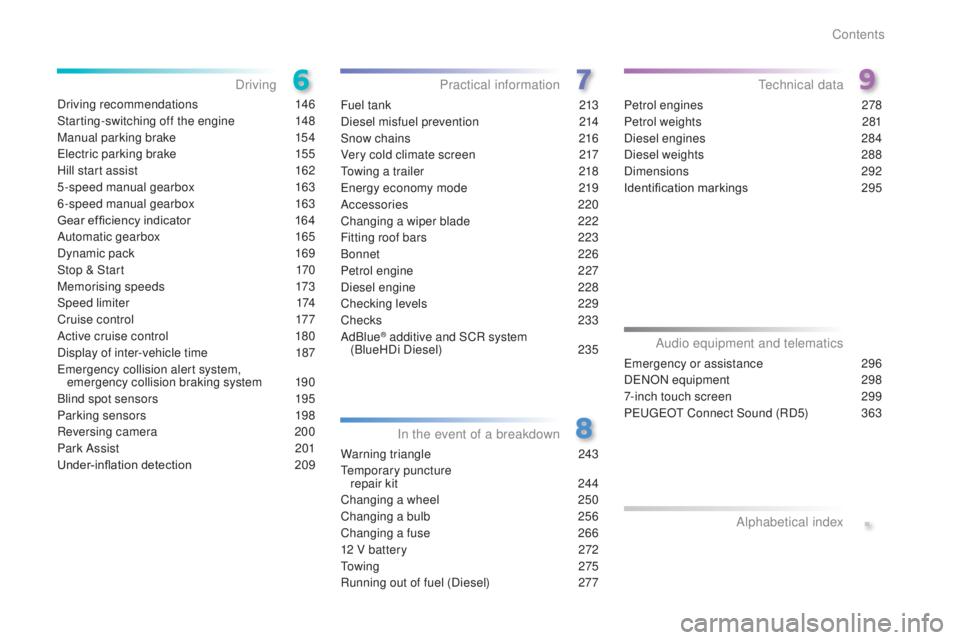
Driving recommendations 146
Starting-switching off the engine
14
8
Manual parking brake
15
4
ele
ctric parking brake
15
5
Hill start assist
16
2
5-speed manual gearbox
16
3
6-speed manual gearbox
16
3
Gear ef ficiency indicator
16
4
Automatic gearbox
16
5
Dynamic pack
16
9
Stop & Start
17
0
Memorising speeds
17
3
Speed limiter
17
4
Cruise control
17
7
Active cruise control
18
0
Display of inter-vehicle time
187
emer
gency collision alert system,
emergency collision braking system
19
0
Blind spot sensors
19
5
Parking sensors
19
8
Reversing camera
20
0
Park Assist
20
1
Under-inflation detection
209 F
uel tank 21 3
Diesel misfuel prevention
21
4
Snow chains
21
6
Very cold climate screen
21
7
tow
ing a trailer
21
8
ene
rgy economy mode
21
9
Accessories
22
0
Changing a wiper blade
22
2
Fitting roof bars
22
3
Bonnet
2
26
Petrol engine
22
7
Diesel engine
22
8
Checking levels
22
9
Checks
23
3
AdBlue
® additive and SCR system
(BlueHDi Diesel) 235
W
arning triangle
24
3
temp
orary puncture
repair kit
24
4
Changing a wheel
25
0
Changing a bulb
25
6
Changing a fuse
26
6
12 V battery
27
2
to w
i n g
2
7 5
Running out of fuel (Diesel)
27
7Petrol engines
27
8
Petrol weights
28
1
Diesel engines
28
4
Diesel weights
28
8
Dimensions
29
2
Identification markings
29
5
Driving
Practical information
In the event of a breakdowntec hnical data
.
emergency or assistance 296
D
eNO
N equipment
29
8
7-inch touch screen
29
9
P
eu
ge
Ot C
onnect Sound (RD5)
36
3
Audio equipment and telematics
Alphabetical index
Contents
Page 9 of 398
7
308_en_Chap00b_vue-ensemble_ed02-2015
Instruments and controls
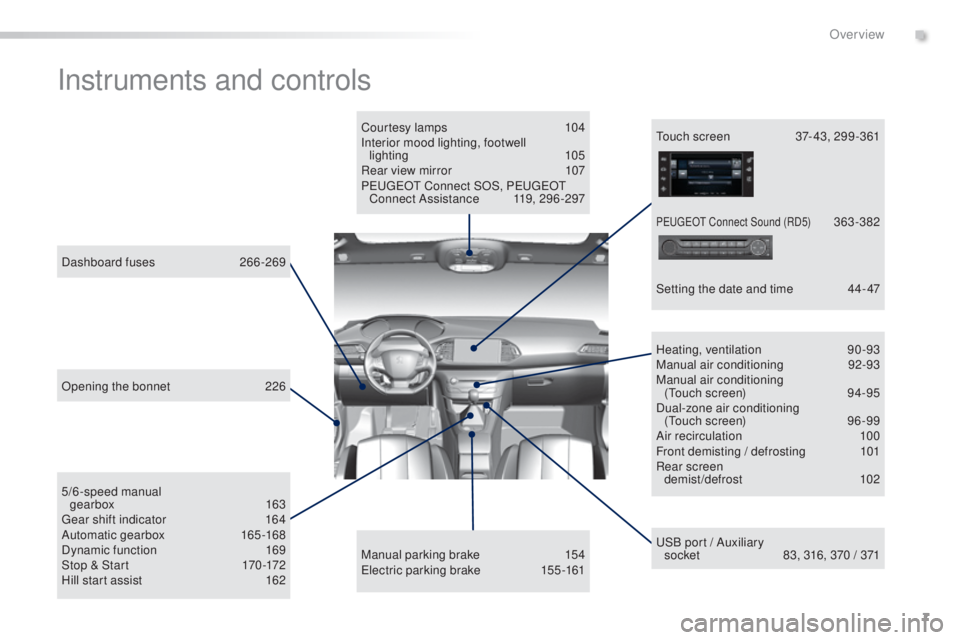
Courtesy lamps 104
Interior mood lighting, footwell lighting
1
05
Rear view mirror
10
7
Peuge
Ot C
onnect SOS, Peuge
Ot
C
onnect Assistance
11
9, 296 -297
uSB p
ort / Auxiliary
socket
83
, 316, 370 / 371
5/6-speed manual
gearbox
16
3
gea
r shift indicator
16
4
Automatic gearbox
165
-168
Dynamic function
16
9
Stop & Start
17
0 -172
Hill start assist
16
2
Dashboard fuses
26
6-269 Heating, ventilation
90
-93
Manual air conditioning
92
-93
Manual air conditioning (
tou
ch screen)
94
-95
Dual-zone air conditioning (
tou
ch screen)
96
-99
Air recirculation
10
0
Front demisting / defrosting
10
1
Rear screen demist/defrost
10
2
Manual parking brake
15
4
ele
ctric parking brake
15
5 -161tou ch screen 37 - 43, 299 -361
Setting the date and time
44
- 47
Opening the bonnet
22
6
PeugeOt C onnect Sound (RD5) 363-382
.
Over view
Page 11 of 398
9
308_en_Chap00b_vue-ensemble_ed02-2015
Maintenance - technical data
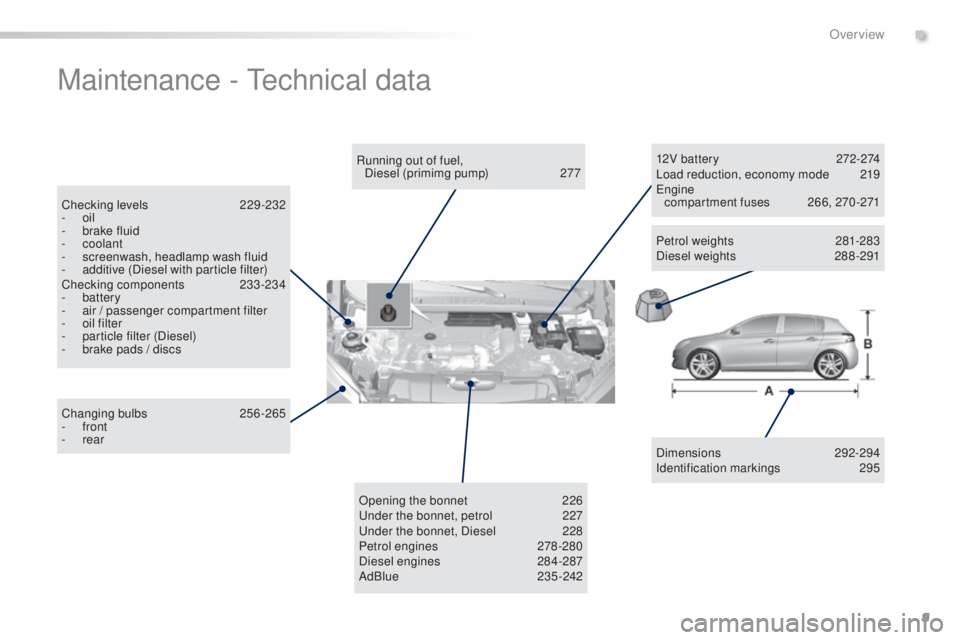
Dimensions 2 92-294
Identification markings 29 5
Running out of fuel,
Diesel (primimg pump)
27
7
Checking levels
22
9-232
-
o
il
-
br
ake fluid
-
c
oolant
-
sc
reenwash, headlamp wash fluid
-
ad
ditive (Diesel with particle filter)
Checking components
233
-234
-
b
attery
-
ai
r / passenger compartment filter
-
oi
l filter
-
pa
rticle filter (Diesel)
-
br
ake pads / discs
Changing bulbs
25
6-265
-
f
ront
- r
ear 12V battery
27
2-274
Load reduction, economy
mo
de
21
9
engin
e
compartment fuses
26
6, 270 -271
Opening the bonnet
22
6
und
er the bonnet, petrol
22
7
und
er the bonnet, Diesel
22
8
Petrol engines
27
8 -280
Diesel engines
28
4-287
AdBlue
2
35-242 Petrol weights
28
1-283
Diesel weights
28
8 -291
.
Over view
Page 67 of 398
65
308_en_Chap02_ouvertures_ed02-2015
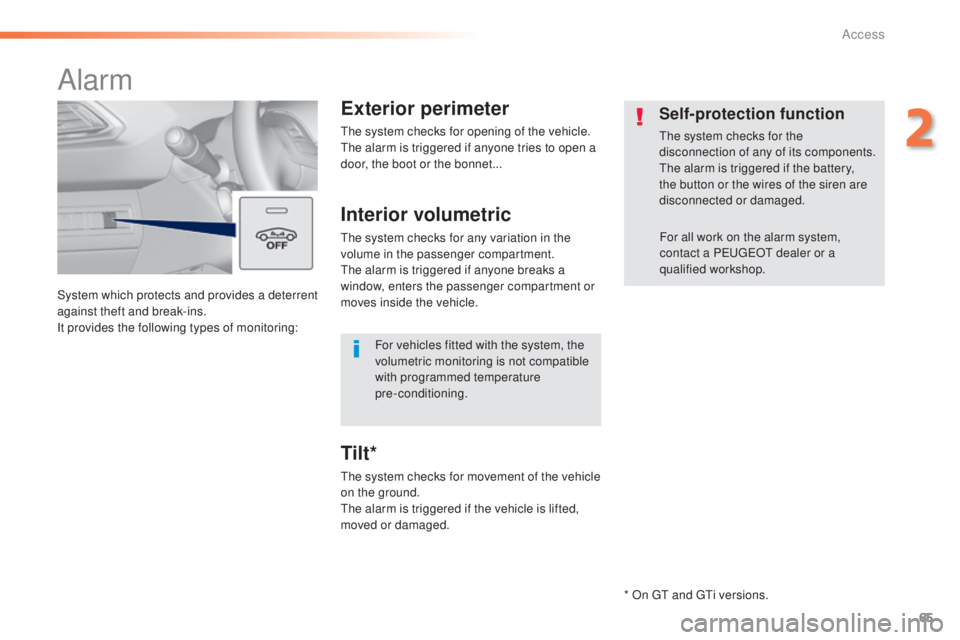
System which protects and provides a deterrent
against theft and break-ins.
It provides the following types of monitoring:
Alarm
Exterior perimeter
the system checks for opening of the vehicle.the alarm is triggered if anyone tries to open a
door, the boot or the bonnet...
Self-protection function
the system checks for the
d isconnection of any of its components.
the a
larm is triggered if the battery,
the button or the wires of the siren are
disconnected or damaged.
For all work on the alarm system,
contact a P
eu
ge
Ot d
ealer or a
qualified workshop.
Interior volumetric
the system checks for any variation in the
v olume in the passenger compartment.
the a
larm is triggered if anyone breaks a
window, enters the passenger compartment or
moves inside the vehicle.
the s
ystem checks for movement of the vehicle
on the ground.
the a
larm is triggered if the vehicle is lifted,
moved or damaged.
Tilt*
For vehicles fitted with the system, the
volumetric monitoring is not compatible
with programmed temperature
pre-conditioning.
* On
g
t
a
nd
g
t
i ve
rsions.
2
Access
Page 68 of 398
66
308_en_Chap02_ouvertures_ed02-2015
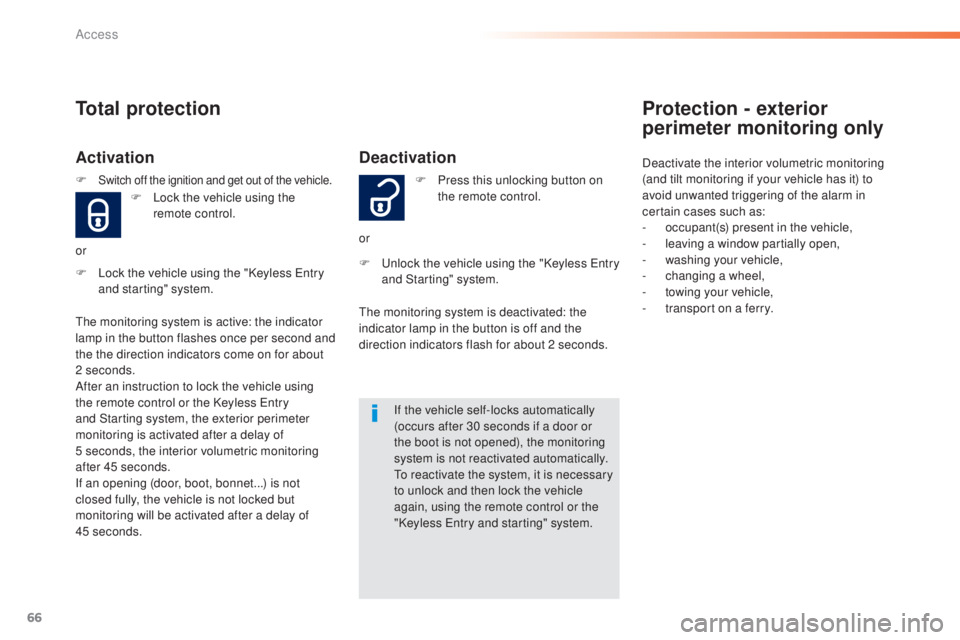
Deactivation
F Lock the vehicle using the "Keyless entry
and starting" system. F
Pr
ess this unlocking button on
the remote control.
or
F unl ock the vehicle using the "Keyless ent ry
and Starting" system.
If the vehicle self-locks automatically
(occurs after 30 seconds if a door or
the boot is not opened), the monitoring
system is not reactivated automatically.
to re
activate the system, it is necessary
to unlock and then lock the vehicle
again, using the remote control or the
"Keyless
ent
ry and starting" system.
the m
onitoring system is deactivated: the
indicator lamp in the button is off and the
direction indicators flash for about 2 seconds.
Total protection
Activation
F Lock the vehicle using the
r emote control.
or
the m
onitoring system is active: the indicator
lamp in the button flashes once per second and
the the direction indicators come on for about
2 seconds.
After an instruction to lock the vehicle using
the remote control or the Keyless
ent
ry
and Starting system, the exterior perimeter
monitoring is activated after a delay of
5
s
econds, the interior volumetric monitoring
after 45 seconds.
If an opening (door, boot, bonnet...) is not
closed fully, the vehicle is not locked but
monitoring will be activated after a delay of
45
se
conds.
F
Switch off the ignition and get out of the vehicle.
Protection - exterior
perimeter monitoring only
Deactivate the interior volumetric monitoring
(and tilt monitoring if your vehicle has it) to
avoid unwanted triggering of the alarm in
certain cases such as:
-
oc
cupant(s) present in the vehicle,
-
le
aving a window partially open,
-
was
hing your vehicle,
-
chan
ging a wheel,
-
to
wing your vehicle,
-
tr
ansport on a ferry.
Access
Page 174 of 398
172
308_en_Chap06_conduite_ed02-2015
Operating fault
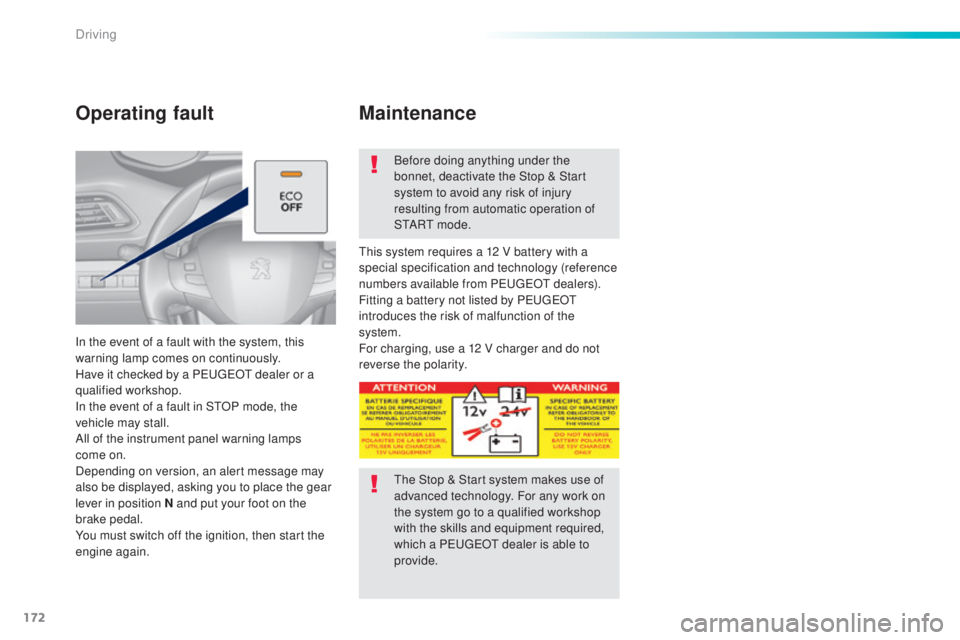
In the event of a fault with the system, this
warning lamp comes on continuously.
Have it checked by a P
eu
ge
Ot d
ealer or a
qualified workshop.
In the event of a fault in S
tOP m
ode, the
vehicle may stall.
All of the instrument panel warning lamps
come on.
Depending on version, an alert message may
also be displayed, asking you to place the gear
lever in position N and put your foot on the
brake pedal.
You must switch off the ignition, then start the
engine again. Before doing anything under the
bonnet, deactivate the Stop & Start
system to avoid any risk of injury
resulting from automatic operation of
S
tA
R
t m o
d e .
thi
s system requires a 12 V battery with a
special specification and technology (reference
numbers available from P
eug
e
Ot de
alers).
Fitting a battery not listed by P
eu
ge
Ot
i
ntroduces the risk of malfunction of the
system.
For charging, use a 12 V charger and do not
reverse the polarity.
Maintenance
the Stop & Start system makes use of
a dvanced technology. For any work on
the system go to a qualified workshop
with the skills and equipment required,
which a P
eu
ge
Ot d
ealer is able to
provide.
Driving
Page 228 of 398
226
308_en_Chap07_info-pratiques_ed02-2015
Bonnet
Before doing anything under the
bonnet, switch off the Stop & Start
system to avoid any risk of injury
resulting from an automatic change to
S
tA
R
t m o
d e .
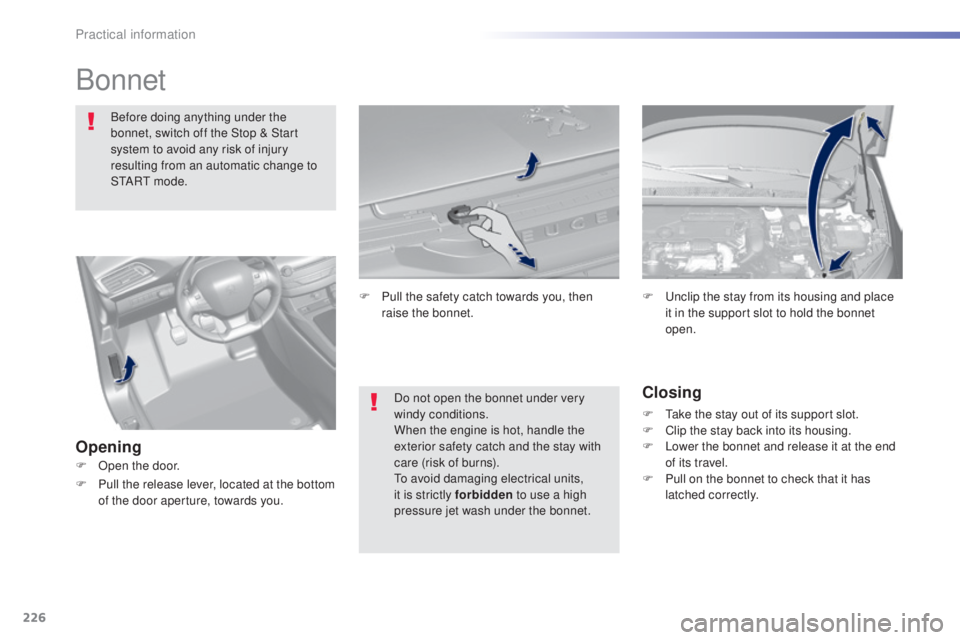
Opening Closing
F take the stay out of its support slot.
F Cl ip the stay back into its housing.
F
Lo
wer the bonnet and release it at the end
of its travel.
F
Pu
ll on the bonnet to check that it has
latched correctly.
F
u
nc
lip the stay from its housing and place
it in the support slot to hold the bonnet
open.
Do not open the bonnet under very
windy conditions.
When the engine is hot, handle the
exterior safety catch and the stay with
care (risk of burns).
to a
void damaging electrical units,
it is strictly forbidden to use a high
pressure jet wash under the bonnet.
F
Pu
ll the safety catch towards you, then
raise the bonnet.
F
Op
en the door.
F
Pu
ll the release lever, located at the bottom
of the door aperture, towards you.
Practical information
Page 231 of 398
229
308_en_Chap07_info-pratiques_ed02-2015
Checking levels
take care when working under the bonnet, as certain areas of the engine may be extremely hot (risk of burns) and the cooling fan could start at
a ny time (even with the ignition off).
Engine oil level
the check is carried out either when
t he ignition is switched on using the
oil level indicator in the instrument
panel for vehicles so equipped, or
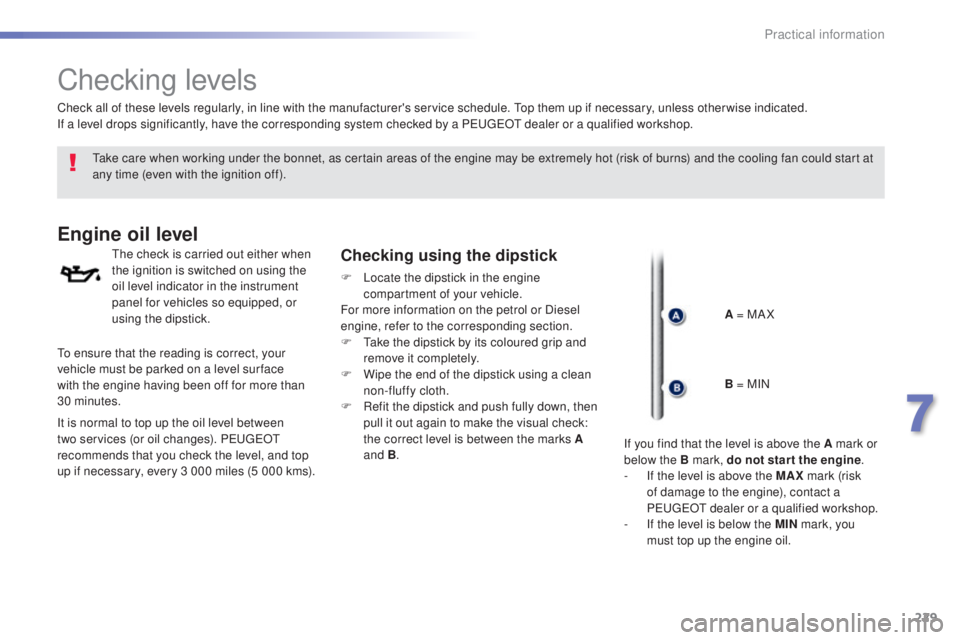
using the dipstick.Checking using the dipstick
F Locate the dipstick in the engine
c ompartment of your vehicle.
For more information on the petrol or Diesel
engine, refer to the corresponding section.
F
t
ak
e the dipstick by its coloured grip and
remove it completely.
F
Wi
pe the end of the dipstick using a clean
non-fluffy cloth.
F
Re
fit the dipstick and push fully down, then
pull it out again to make the visual check:
the correct level is between the marks A
and B .
Check all of these levels regularly, in line with the manufacturer's service schedule.
top t
hem up if necessary, unless other wise indicated.
If a level drops significantly, have the corresponding system checked by a P
eu
ge
Ot d
ealer or a qualified workshop.
A = MA X
to en
sure that the reading is correct, your
vehicle must be parked on a level sur face
with the engine having been off for more than
30
m
inutes.
It is normal to top up the oil level between
two services (or oil changes). P
eu
ge
Ot
r
ecommends that you check the level, and top
up if necessary, every 3 000 miles (5 000 kms). B = MIN
If you find that the level is above the A mark or
below the B mark, do not star t the engine .
-
If t
he level is above the MAX mark (risk
of damage to the engine), contact a
P
eu
ge
Ot d
ealer or a qualified workshop.
-
If t
he level is below the MIN mark, you
must top up the engine oil.
7
Practical information
Page 274 of 398
272
308_en_Chap08_en-cas-de-panne_ed02-2015
12 V battery
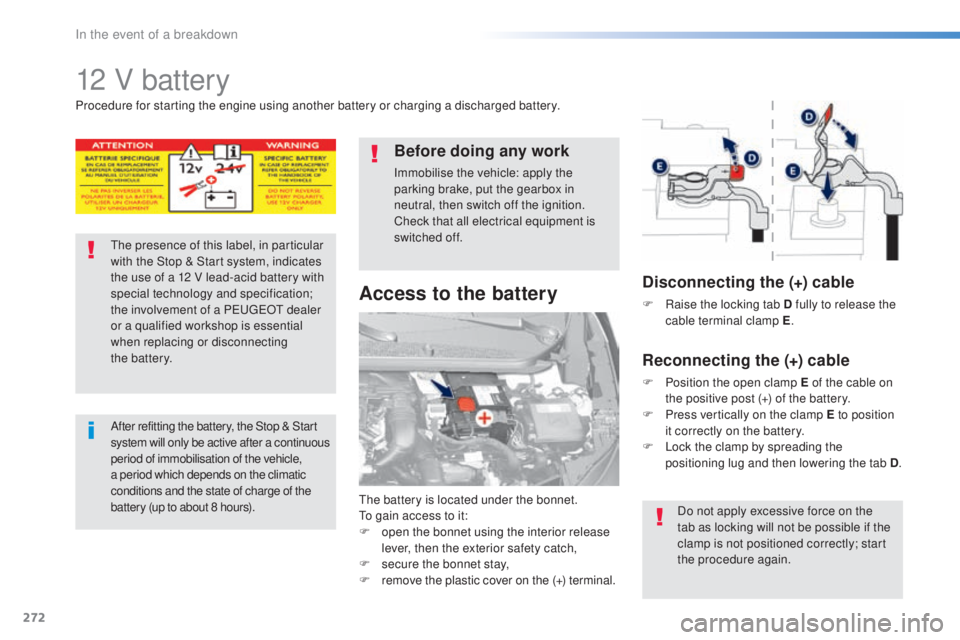
the battery is located under the bonnet.to ga
in access to it:
F
op
en the bonnet using the interior release
lever, then the exterior safety catch,
F
se
cure the bonnet stay,
F
re
move the plastic cover on the (+)
t
erminal.
Access to the battery
Procedure for starting the engine using another battery or charging a discharged battery.
the
presence of this label, in particular
with the Stop & Start system, indicates
the use of a 12 V lead-acid battery with
special technology and specification;
the involvement of a P
eu
ge
Ot d
ealer
or a qualified workshop is essential
when replacing or disconnecting
the
b
attery.
After refitting the battery, the Stop & Start
sy stem will only be active after a continuous
period of immobilisation of the vehicle,
a period which depends on the climatic
conditions and the state of charge of the
battery (up to about 8 hours).
Before doing any work
Immobilise the vehicle: apply the
parking brake, put the gearbox in
neutral, then switch off the ignition.
Check that all electrical equipment is
switched off.
Disconnecting the (+) cable
F Raise the locking tab D fully to release the
c able terminal clamp E .
Reconnecting the (+) cable
F Position the open clamp E of the cable on
t
he positive post (+) of the battery.
F
Pr
ess vertically on the clamp E to position
it correctly on the battery.
F
Lo
ck the clamp by spreading the
positioning lug and then lowering the tab D .
Do not apply excessive force on the
tab as locking will not be possible if the
clamp is not positioned correctly; start
the procedure again.
In the event of a breakdown
Page 279 of 398
277
308_en_Chap08_en-cas-de-panne_ed02-2015
On vehicles fitted with Diesel engines, the fuel
system must be primed if you run out of fuel.
For all versions other than BlueHDi, refer to the
corresponding engine compartment view.
Running out of fuel (Diesel)
For more information on the Diesel
misfuel prevention device, refer to the
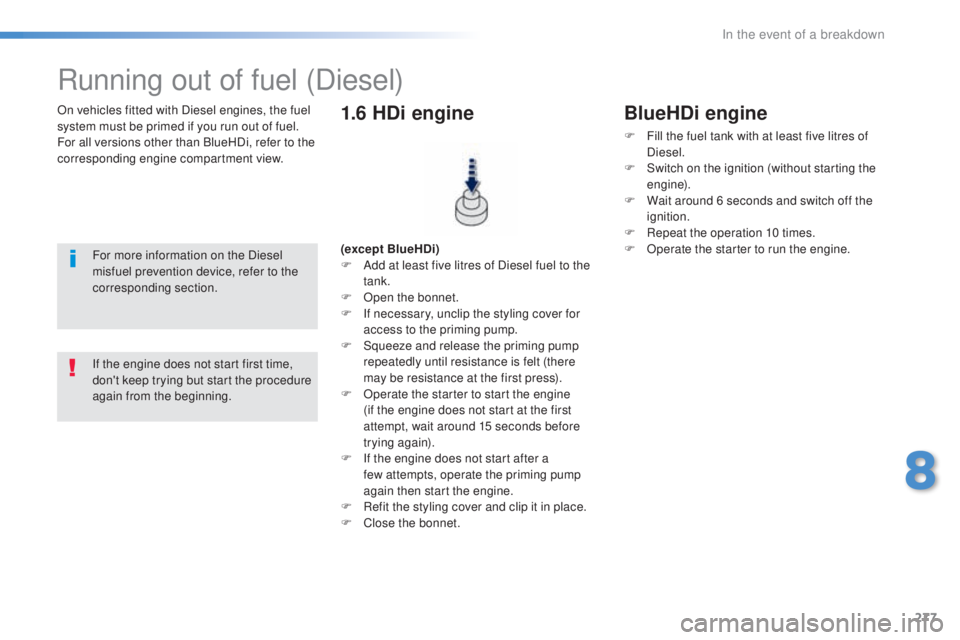
corresponding section. (except BlueHDi)
F Ad
d at least five litres of Diesel fuel to the
tank.
F
Op
en the bonnet.
F
If n
ecessary, unclip the styling cover for
access to the priming pump.
F
Sq
ueeze and release the priming pump
repeatedly until resistance is felt (there
may be resistance at the first press).
F
Op
erate the starter to start the engine
(if the engine does not start at the first
attempt, wait around 15 seconds before
trying again).
F
If t
he engine does not start after a
few
a
ttempts, operate the priming pump
again then start the engine.
F
Re
fit the styling cover and clip it in place.
F
Clos
e the bonnet.
1.6 HDi engine
If the engine does not start first time,
don't keep trying but start the procedure
again from the beginning.
BlueHDi engine
F Fill the fuel tank with at least five litres of
Diesel.
F
Sw
itch on the ignition (without starting the
engine).
F
Wa
it around 6 seconds and switch off the
ignition.
F
Re
peat the operation 10 times.
F
Op
erate the starter to run the engine.
8
In the event of a breakdown