tow PEUGEOT 308 2017 Workshop Manual
[x] Cancel search | Manufacturer: PEUGEOT, Model Year: 2017, Model line: 308, Model: Peugeot 308 2017Pages: 566, PDF Size: 16.05 MB
Page 286 of 566
284
3008-2_en_Chap07_infos-pratiques_ed01-2016
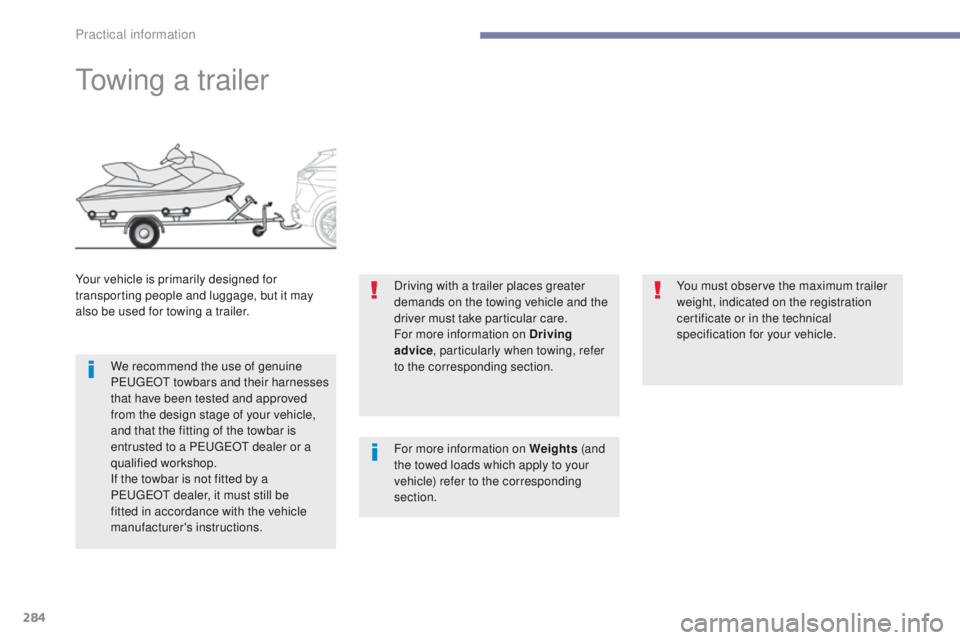
Towing a trailer
Your vehicle is primarily designed for
transporting people and luggage, but it may
also be used for towing a trailer.We recommend the use of genuine
PEUGEOT towbars and their harnesses
that have been tested and approved
from the design stage of your vehicle,
and that the fitting of the towbar is
entrusted to a PEUGEOT dealer or a
qualified workshop.
If the towbar is not fitted by a
PEUGEOT dealer, it must still be
fitted in accordance with the vehicle
manufacturer's instructions. Driving with a trailer places greater
demands on the towing vehicle and the
driver must take particular care.
For more information on Driving
advice
, particularly when towing, refer
to the corresponding section.
For more information on Weights (and
the towed loads which apply to your
vehicle) refer to the corresponding
section. You must observe the maximum trailer
weight, indicated on the registration
certificate or in the technical
specification for your vehicle.
Practical information
Page 287 of 566
285
3008-2_en_Chap07_infos-pratiques_ed01-2016
Towbar with quickly detachable towball
Presentation
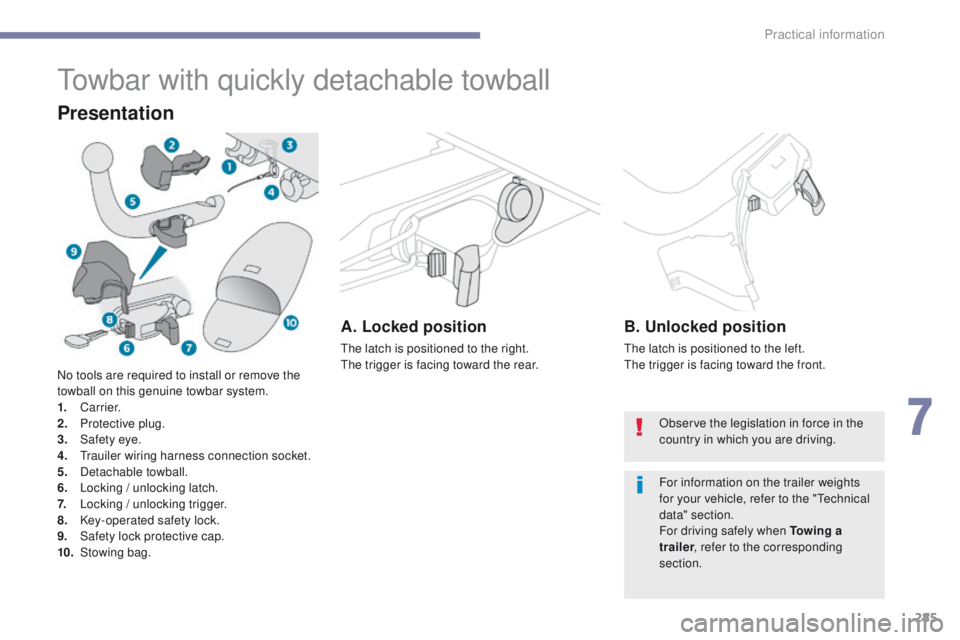
A. Locked position
The latch is positioned to the right.
The trigger is facing toward the rear.
B. Unlocked position
The latch is positioned to the left.
The trigger is facing toward the front.Observe the legislation in force in the
country in which you are driving.
For information on the trailer weights
for your vehicle, refer to the "Technical
data" section.
For driving safely when Towing a
trailer, refer to the corresponding
section.
No tools are required to install or remove the
towball on this genuine towbar system.
1.
Carrier.
2.
P
rotective plug.
3.
S
afety eye.
4.
T
rauiler wiring harness connection socket.
5.
D
etachable towball.
6.
L
ocking / unlocking latch.
7.
L
ocking / unlocking trigger.
8.
K
ey-operated safety lock.
9.
S
afety lock protective cap.
10.
S
towing bag.
7
Practical information
Page 288 of 566
286
3008-2_en_Chap07_infos-pratiques_ed01-2016
Before each use
Check that the towball is correctly fitted, verifying the follow points:
- t he towball is correctly engaged (position A ),
-
t
he safety lock is on and the key removed; the trigger can no longer be operated,
-
t
he towball must not be able to move in its carrier; test by shaking it with your hand.
If the towball is not locked, the trailer could separate - Risk of an accident!
During use
Never release the locking system with a trailer or load carrier on the towball.
Never exceed the maximum authorised weight for the vehicle plus trailer - the Gross Train
Weight or GTW.
You must not exceed the maximum nose weight on the towbar: if exceeded, this could result
in detachment from the vehicle - Risk of an accident!
Check that the trailer lighting and signalling work correctly.
Before setting off, check the adjustment of the headlamp beam height.
For more information on Adjusting the headlamp beam height , refer to the corresponding
section.
Following use
When travelling without a trailer or load on a towbar-mounted carrier, the towball must be
removed and the protective plug inserted in the carrier. This measure applies particularly
where the towball might obscure visibility of the number plate or its lighting.
Maintenance
Correct operation is only possible if the towball
and its carrier are kept clean.
Before cleaning the vehicle with a high-
pressure jet wash, the towball must be removed
and the protective plug fitted to the carrier.
Go to a PEUGEOT dealer or a qualified
workshop for any work on the towbar system.
Practical information
Page 289 of 566
287
3008-2_en_Chap07_infos-pratiques_ed01-2016
Fitting the towball
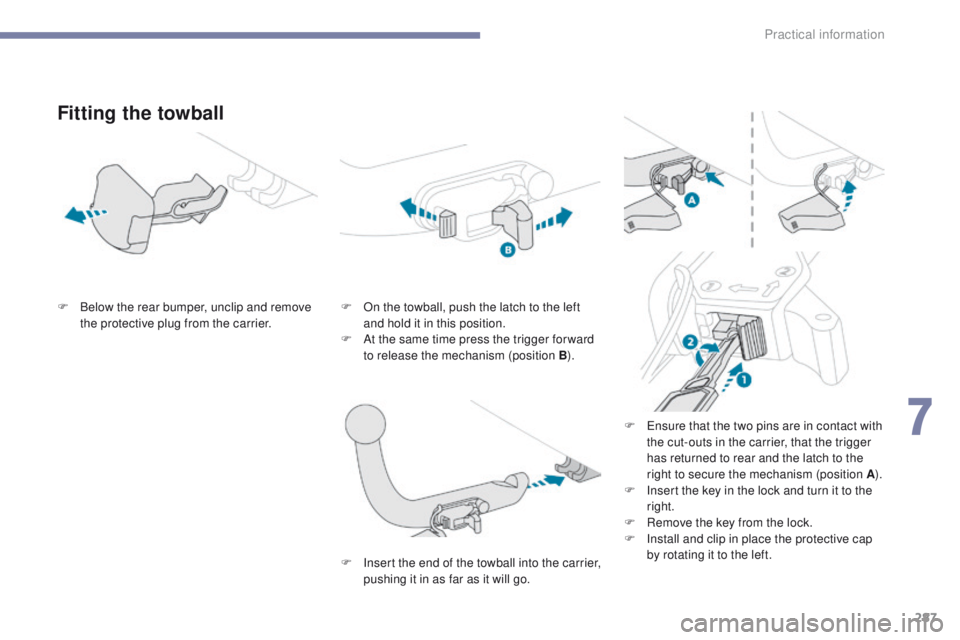
F Below the rear bumper, unclip and remove the protective plug from the carrier. F
O n the towball, push the latch to the left
and hold it in this position.
F
A
t the same time press the trigger for ward
to release the mechanism (position B ).
F
I
nsert the end of the towball into the carrier,
pushing it in as far as it will go. F
E
nsure that the two pins are in contact with
the cut-outs in the carrier, that the trigger
has returned to rear and the latch to the
right to secure the mechanism (position A ).
F
I
nsert the key in the lock and turn it to the
right.
F
R
emove the key from the lock.
F
I
nstall and clip in place the protective cap
by rotating it to the left.
7
Practical information
Page 290 of 566
288
3008-2_en_Chap07_infos-pratiques_ed01-2016
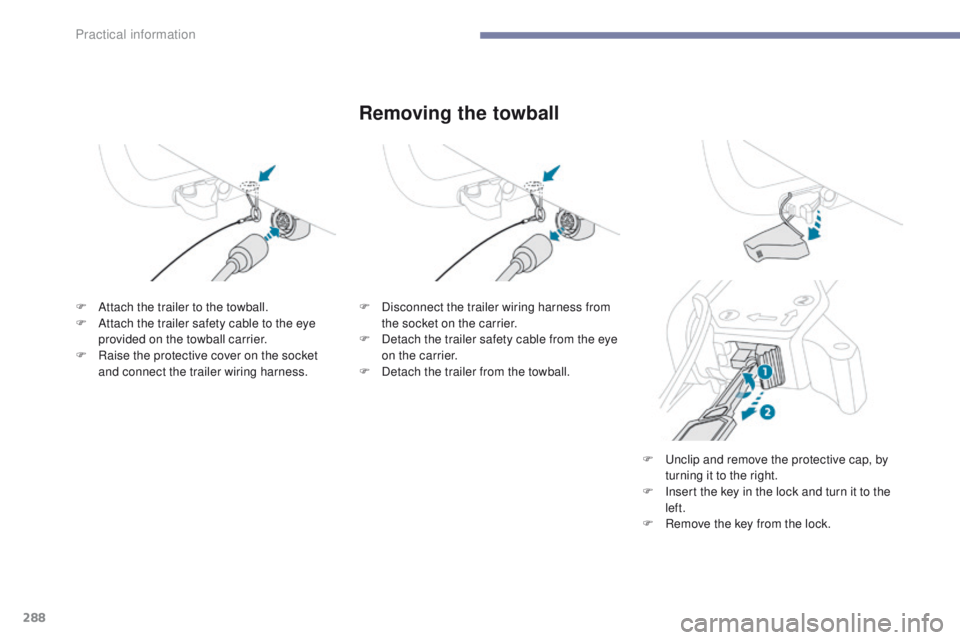
Removing the towball
F Attach the trailer to the towball.
F A ttach the trailer safety cable to the eye
provided on the towball carrier.
F
R
aise the protective cover on the socket
and connect the trailer wiring harness. F
D isconnect the trailer wiring harness from
the socket on the carrier.
F
D
etach the trailer safety cable from the eye
on the carrier.
F
D
etach the trailer from the towball.
F
U
nclip and remove the protective cap, by
turning it to the right.
F
I
nsert the key in the lock and turn it to the
left.
F
R
emove the key from the lock.
Practical information
Page 291 of 566
289
3008-2_en_Chap07_infos-pratiques_ed01-2016
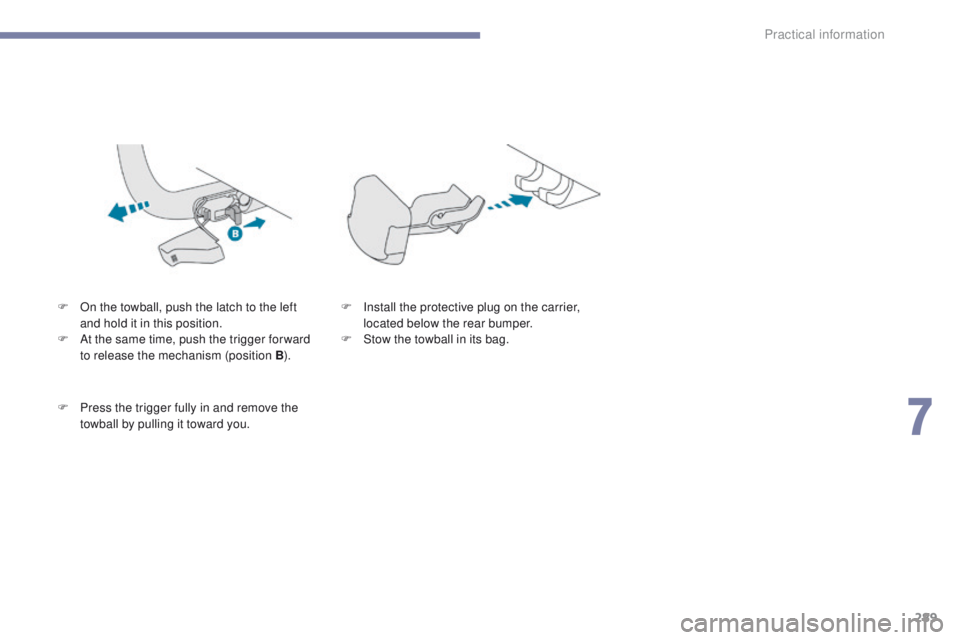
F On the towball, push the latch to the left and hold it in this position.
F
A
t the same time, push the trigger for ward
to release the mechanism (position B ).
F
P
ress the trigger fully in and remove the
towball by pulling it toward you. F
I nstall the protective plug on the carrier,
located below the rear bumper.
F
S
tow the towball in its bag.
7
Practical information
Page 293 of 566
291
3008-2_en_Chap07_infos-pratiques_ed01-2016
Very cold climate screens*
Removable protective screens which prevent
the accumulation of snow at the radiator
cooling fan.Before fitting or removing a screen,
ensure that the engine is off and the
cooling fan has stopped.
* Depending on the country of sale.It is recommended that the screens
be fitted and removed by a PEUGEOT
dealer or a qualified workshop.
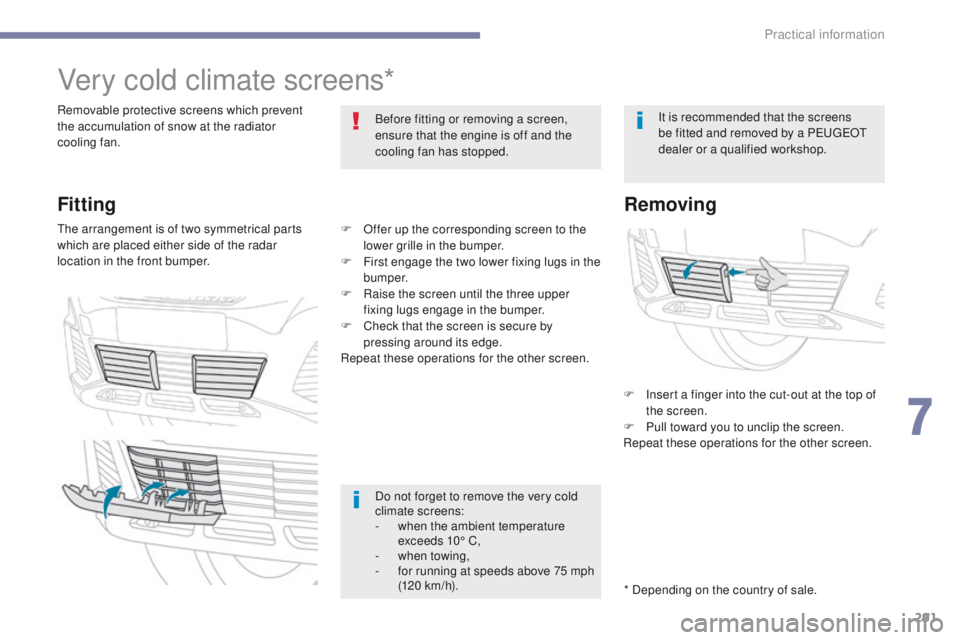
Fitting
The arrangement is of two symmetrical parts
which are placed either side of the radar
location in the front bumper.
Removing
F Insert a finger into the cut-out at the top of
the screen.
F
P
ull toward you to unclip the screen.
Repeat these operations for the other screen.
Do not forget to remove the very cold
climate screens:
-
w
hen the ambient temperature
exceeds 10° C,
-
w
hen towing,
-
f
or running at speeds above 75 mph
(120 km/h).
F
O
ffer up the corresponding screen to the
lower grille in the bumper.
F
F
irst engage the two lower fixing lugs in the
b u m p e r.
F
R
aise the screen until the three upper
fixing lugs engage in the bumper.
F
C
heck that the screen is secure by
pressing around its edge.
Repeat these operations for the other screen.
7
Practical information
Page 296 of 566
294
3008-2_en_Chap07_infos-pratiques_ed01-2016
Bonnet
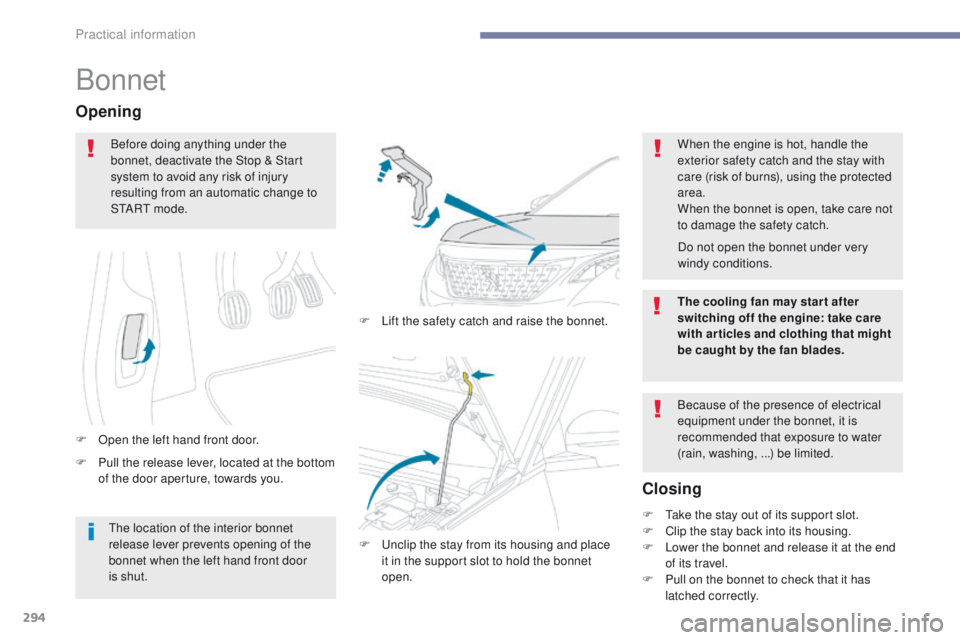
F Pull the release lever, located at the bottom of the door aperture, towards you.
Opening
F Open the left hand front door. F
L
ift the safety catch and raise the bonnet.
Closing
Before doing anything under the
bonnet, deactivate the Stop & Start
system to avoid any risk of injury
resulting from an automatic change to
S TA R T m o d e .
When the engine is hot, handle the
exterior safety catch and the stay with
care (risk of burns), using the protected
area.
When the bonnet is open, take care not
to damage the safety catch.
Because of the presence of electrical
equipment under the bonnet, it is
recommended that exposure to water
(rain, washing, ...) be limited.
F
U
nclip the stay from its housing and place
it in the support slot to hold the bonnet
open. F
T
ake the stay out of its support slot.
F
C
lip the stay back into its housing.
F
L
ower the bonnet and release it at the end
of its travel.
F
P
ull on the bonnet to check that it has
latched correctly.
The location of the interior bonnet
release lever prevents opening of the
bonnet when the left hand front door
is shut. Do not open the bonnet under very
windy conditions.
The cooling fan may star t after
switching off the engine: take care
with articles and clothing that might
be caught by the fan blades.
Practical information
Page 304 of 566
302
3008-2_en_Chap07_infos-pratiques_ed01-2016
Automatic gearbox
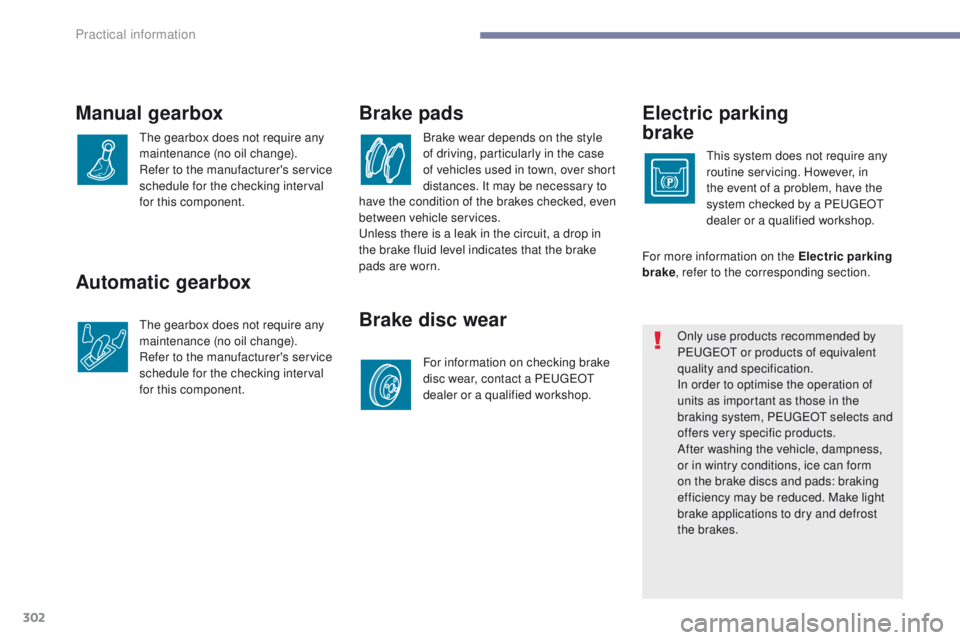
The gearbox does not require any
maintenance (no oil change).
Refer to the manufacturer's service
schedule for the checking interval
for this component.
Electric parking
brake
This system does not require any
routine servicing. However, in
the event of a problem, have the
system checked by a PEUGEOT
dealer or a qualified workshop.
Brake pads
Brake wear depends on the style
of driving, particularly in the case
of vehicles used in town, over short
distances. It may be necessary to
Brake disc wear
For information on checking brake
disc wear, contact a PEUGEOT
dealer or a qualified workshop.For more information on the Electric parking
brake
, refer to the corresponding section.
Manual gearbox
The gearbox does not require any
maintenance (no oil change).
Refer to the manufacturer's service
schedule for the checking interval
for this component.
Only use products recommended by
PEUGEOT or products of equivalent
quality and specification.
In order to optimise the operation of
units as important as those in the
braking system, PEUGEOT selects and
offers very specific products.
After washing the vehicle, dampness,
or in wintry conditions, ice can form
on the brake discs and pads: braking
efficiency may be reduced. Make light
brake applications to dry and defrost
the brakes.
have the condition of the brakes checked, even
between vehicle services.
Unless there is a leak in the circuit, a drop in
the brake fluid level indicates that the brake
pads are worn.
Practical information
Page 309 of 566
307
3008-2_en_Chap08_en cas-de-panne_ed01-2016
Warning triangle
As a safety precaution, before leaving your vehicle to set up and install the triangle, switch on the hazard warning lamps and put on your high visibility
vest.
Storage compartment
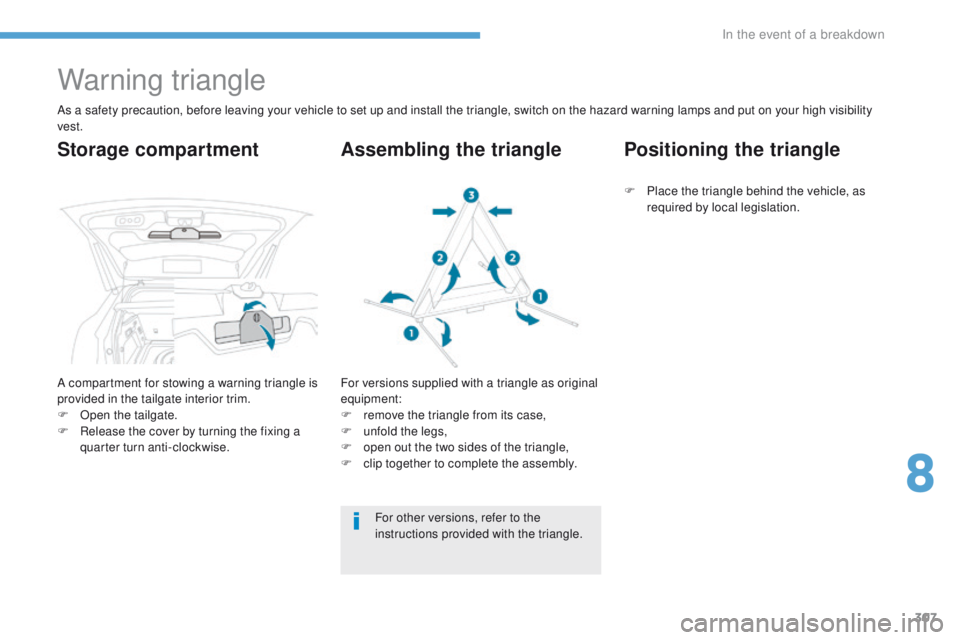
A compartment for stowing a warning triangle is
provided in the tailgate interior trim.
F
O
pen the tailgate.
F
R
elease the cover by turning the fixing a
quarter turn anti-clockwise.
For other versions, refer to the
instructions provided with the triangle.
Assembling the triangle
For versions supplied with a triangle as original
equipment:
F
r
emove the triangle from its case,
F
u
nfold the legs,
F
o
pen out the two sides of the triangle,
F
c
lip together to complete the assembly.
Positioning the triangle
F Place the triangle behind the vehicle, as required by local legislation.
8
In the event of a breakdown