engine PEUGEOT LANDTREK 2022 Workshop Manual
[x] Cancel search | Manufacturer: PEUGEOT, Model Year: 2022, Model line: LANDTREK, Model: PEUGEOT LANDTREK 2022Pages: 164, PDF Size: 5.87 MB
Page 101 of 164
99
Practical information
7computer - risk of damage to the electronic
system components.
Fuel system
All work on the fuel system must be
carried out only by a PEUGEOT dealer or a
qualified workshop.
Electrical system
Never:
–
disconnect the battery cables or the
electrical wiring harness connectors when the
engine is running.
–
reverse the polarities when reconnecting
the battery (risk of damage to electronic
components).
–
pierce the insulation of the electrical wires
during an electrical check or diagnosis.
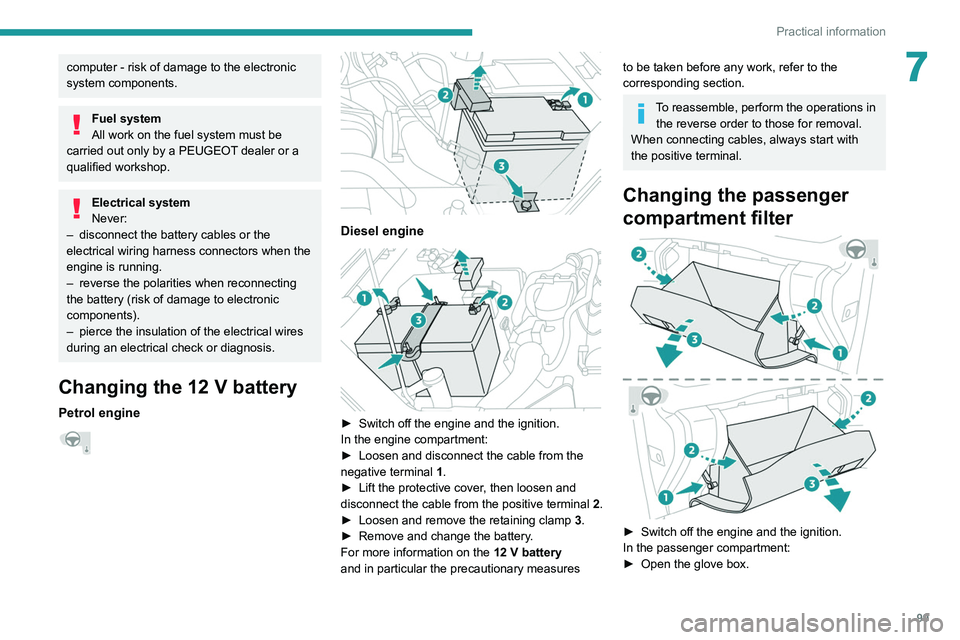
Changing the 12 V battery
Petrol engine
Diesel engine
► Switch off the engine and the ignition.
In the engine compartment:
►
Loosen and disconnect the cable from the
negative terminal
1.
►
Lift the protective cover
, then loosen and
disconnect the cable from the positive terminal
2.
►
Loosen and remove the retaining clamp 3
.
►
Remove and change the battery
.
For more information on the 12 V battery
and in particular the precautionary measures
to be taken before any work, refer to the
corresponding section.
To reassemble, perform the operations in the reverse order to those for removal.
When connecting cables, always start with
the positive terminal.
Changing the passenger
compartment filter
► Switch off the engine and the ignition.
In the passenger compartment:
►
Open the glove box.
Page 102 of 164
100
Practical information
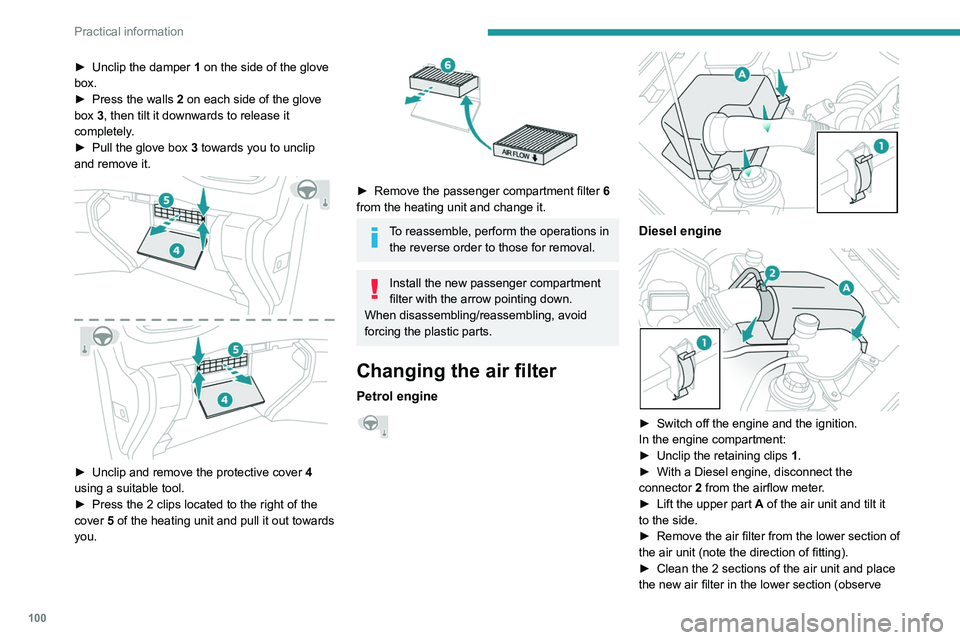
► Unclip the damper 1 on the side of the glove
box.
►
Press the walls
2 on each side of the glove
box 3, then tilt it downwards to release it
completely.
►
Pull the glove box 3
towards you to unclip
and remove it.
► Unclip and remove the protective cover 4
using a suitable tool.
►
Press the 2 clips located to the right of the
cover
5 of the heating unit and pull it out towards
you.
► Remove the passenger compartment filter 6
from the heating unit and change it.
To reassemble, perform the operations in the reverse order to those for removal.
Install the new passenger compartment
filter with the arrow pointing down.
When disassembling/reassembling, avoid
forcing the plastic parts.
Changing the air filter
Petrol engine
Diesel engine
► Switch off the engine and the ignition.
In the engine compartment:
►
Unclip the retaining clips 1
.
►
With a Diesel engine, disconnect the
connector
2 from the airflow meter.
►
Lift the upper part
A of the air unit and tilt it
to the side.
►
Remove the air filter from the lower section of
the air unit (note the direction of fitting).
►
Clean the 2 sections
of the air unit and place
the new air filter in the lower section (observe
the direction of fitting of the air filter to guarantee
sealing).
► Refit the upper section A on the filter, taking
care not to pinch the seal.
► Clip the retaining clips 1.
► With a Diesel engine, reconnect the
connector 2 to the airflow meter.
Never remove the air filter when the
engine is running - risk of injury and
damage!
When the upper section of the air unit is
removed, always make sure that no debris or
dust enters the engine air intake pipe - risk of
serious damage to the engine!
Always use an original air filter or one suitable
for the vehicle - risk of damage to the engine.
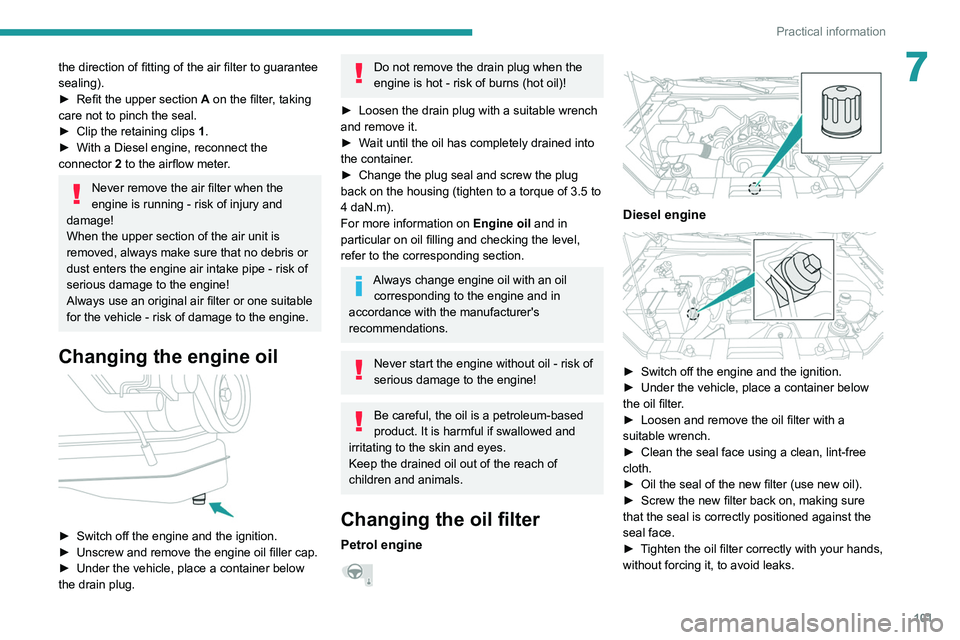
Changing the engine oil
► Switch off the engine and the ignition.
► Unscrew and remove the engine oil filler cap.
► Under the vehicle, place a container below
the drain plug.
Page 103 of 164
101
Practical information
7the direction of fitting of the air filter to guarantee
sealing).
►
Refit the upper section
A
on the filter, taking
care not to pinch the seal.
►
Clip the retaining clips 1
.
►
With a Diesel engine, reconnect the
connector
2 to the airflow meter.
Never remove the air filter when the
engine is running - risk of injury and
damage!
When the upper section of the air unit is
removed, always make sure that no debris or
dust enters the engine air intake pipe - risk of
serious damage to the engine!
Always use an original air filter or one suitable
for the vehicle - risk of damage to the engine.
Changing the engine oil
► Switch off the engine and the ignition.
► Unscrew and remove the engine oil filler cap.
►
Under the vehicle, place a container below
the drain plug.
Do not remove the drain plug when the
engine is hot - risk of burns (hot oil)!
►
Loosen the drain plug with a suitable wrench
and remove it.
►
W
ait until the oil has completely drained into
the container.
►
Change the plug seal and screw the plug
back on the housing (tighten to a torque of 3.5 to
4 daN.m).
For more information on Engine oil and in
particular on oil filling and checking the level,
refer to the corresponding section.
Always change engine oil with an oil corresponding to the engine and in
accordance with the manufacturer's
recommendations.
Never start the engine without oil - risk of
serious damage to the engine!
Be careful, the oil is a petroleum-based
product. It is harmful if swallowed and
irritating to the skin and eyes.
Keep the drained oil out of the reach of
children and animals.
Changing the oil filter
Petrol engine
Diesel engine
► Switch off the engine and the ignition.
► Under the vehicle, place a container below
the oil filter
.
►
Loosen and remove the oil filter with a
suitable wrench.
►
Clean the seal face using a clean, lint-free
cloth.
►
Oil the seal of the new filter (use new oil).
►
Screw the new filter back on, making sure
that the seal is correctly positioned against the
seal face.
►
T
ighten the oil filter correctly with your hands,
without forcing it, to avoid leaks.
Page 104 of 164
102
Practical information
After the operation, check the engine oil level with the dipstick and top up if
necessary.
For more information on Engine oil and in
particular on checking the level, refer to the
corresponding section.
Never start the engine without the oil
filter - risk of splashing and serious
damage to the engine!
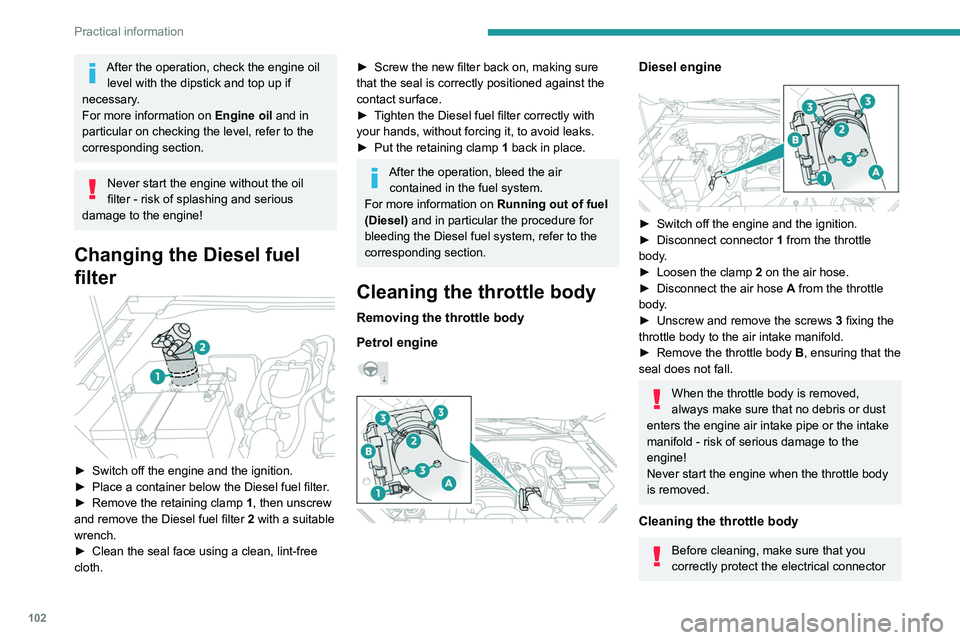
Changing the Diesel fuel
filter
► Switch off the engine and the ignition.
► Place a container below the Diesel fuel filter .
►
Remove the retaining clamp 1
, then unscrew
and remove the Diesel fuel filter 2 with a suitable
wrench.
►
Clean the seal face using a clean, lint-free
cloth.
► Screw the new filter back on, making sure
that the seal is correctly positioned against the
contact surface.
►
T
ighten the Diesel fuel filter correctly with
your hands, without forcing it, to avoid leaks.
►
Put the retaining clamp 1
back in place.
After the operation, bleed the air contained in the fuel system.
For more information on Running out of fuel
(Diesel) and in particular the procedure for
bleeding the Diesel
fuel system, refer to the
corresponding section.
Cleaning the throttle body
Removing the throttle body
Petrol engine
Diesel engine
► Switch off the engine and the ignition.
► Disconnect connector 1
from the throttle
body.
►
Loosen the clamp 2
on the air hose.
►
Disconnect the air hose A
from the throttle
body.
►
Unscrew and remove the screws 3
fixing the
throttle body to the air intake manifold.
►
Remove the throttle body B
, ensuring that the
seal does not fall.
When the throttle body is removed,
always make sure that no debris or dust
enters the engine air intake pipe or the intake
manifold - risk of serious damage to the
engine!
Never start the engine when the throttle body
is removed.
Cleaning the throttle body
Before cleaning, make sure that you
correctly protect the electrical connector
Page 105 of 164
103
Practical information
7of the throttle body against any projection of
liquid (oil, water, detergent or solvent).
►
Remove grease and carbon deposits from
the surface of the main duct with a specific
"carburettor" type cleaner
.
►
Rotate the throttle valve inside the duct to
clean the seats on each side.
►
Wipe and dry the throttle body with a soft,
lint-free cloth.
If no cleaning has been done for a long
time, deposits may be difficult to remove.
Clean and wipe the throttle body
several
times with a soft, lint-free cloth.
Never immerse the throttle body in a
cleaning liquid or in an ultrasonic tank.
Never use:
–
detergents containing methyl ketone or
other highly corrosive substances as well as
household cleaning detergent;
–
cleaning products directly on the throttle
bearings as well as on the body's connector;
–
hard, sharp or abrasive tools to remove
difficult deposits. Use a soft cloth with a
suitable detergent.
Refitting the throttle body
Before refitting the throttle body, check
the condition of the seal. If it is damaged,
replace it with a new one. ►
Install the seal on the intake manifold and fit
the throttle body
B, making sure that the seal
does not fall.
For reassembly, carry out the operations in the
reverse order to those for removal. Tighten the
screws to the correct tightening torque.
Free-wheeling
In certain situations, you must allow the vehicle
to free-wheel (while being towed, on a rolling
road, in an automatic car wash, or being
transported by rail or sea freight, etc.).
The procedure differs depending on the type of
gearbox and transmission.
/
To release them
► With the vehicle stationary and the engine
running, depress the brake pedal and release
the parking brake.
►
With a manual gearbox, move the gear lever
into neutral.
►
With an automatic gearbox, select position N
.
►
For 4-wheel drive vehicles (4x4), put the
transmission selector in 2H
mode.
►
Switch the ignition off.
Advice on care and maintenance
General recommendations
Observe the following recommendations to avoid
damaging the vehicle.
Exterior
Never use a high-pressure jet wash in
the engine compartment - risk of
damaging the electrical components!
Do not wash the vehicle in bright sunshine or
extremely cold conditions.
When washing the vehicle in an
automatic roller-brush car wash, be sure
to lock the doors and, depending on version,
move the electronic key away.
When using a high-pressure washer, keep
the jet nozzle at a minimum distance of 30
cm from the vehicle (particularly on any stone
chip impacts, sensors or seals).
Promptly clean up any stains containing
chemicals liable to damage the vehicle's
paintwork (including tree resin, bird
droppings, insect secretions, pollen and tar).
Depending on the environment, clean the
vehicle frequently to remove salty deposits
(in coastal areas), soot (in industrial areas)
and mud/salts (in wet or cold areas). These
substances can be highly corrosive.
Page 108 of 164
106
In the event of a breakdown
Warning triangle
This reflective and dismantlable device is to be
installed on the side of the road when a vehicle
is broken down or damaged.
Before getting out of the vehicle
Turn on the hazard warning lamps, then
put on the safety vest to assemble and install
the triangle.
Storage
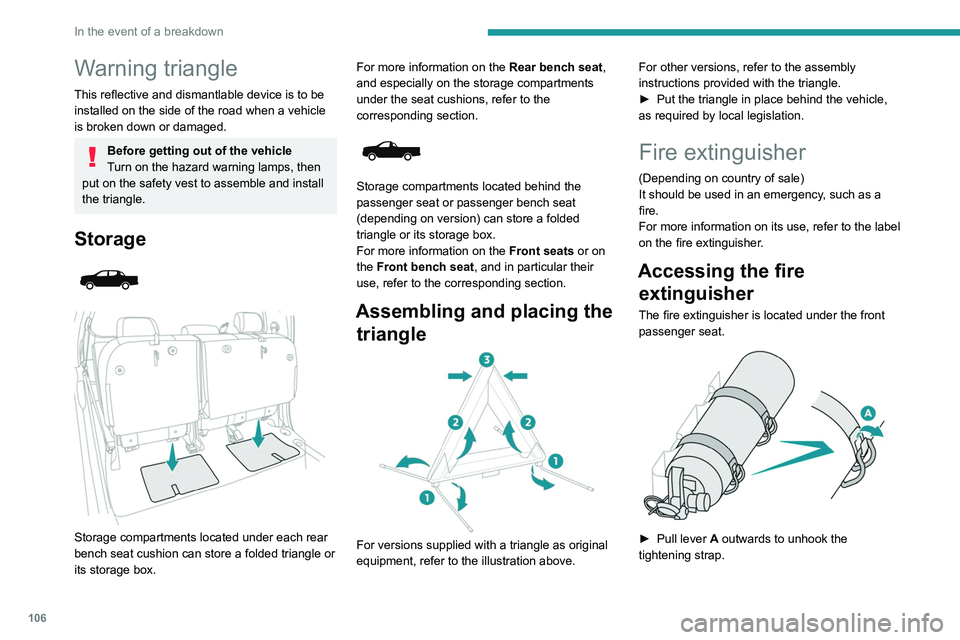
Storage compartments located under each rear
bench seat cushion can store a folded triangle or
its storage box. For more information on the
Rear bench seat,
and especially on the storage compartments
under the seat cushions, refer to the
corresponding section.
Storage compartments located behind the
passenger seat or passenger bench seat
(depending on version) can store a folded
triangle or its storage box.
For more information on the Front seats or on
the Front bench seat, and in particular their
use, refer to the corresponding section.
Assembling and placing the triangle
For versions supplied with a triangle as original
equipment, refer to the illustration above. For other versions, refer to the assembly
instructions provided with the triangle.
►
Put the triangle in place behind the vehicle,
as required by local legislation.
Fire extinguisher
(Depending on country of sale)
It should be used in an emergency, such as a
fire.
For more information on its use, refer to the label
on the fire extinguisher.
Accessing the fire extinguisher
The fire extinguisher is located under the front
passenger seat.
► Pull lever A outwards to unhook the
tightening strap.
After using the fire extinguisher, store it in a safe
place, then replace it with a new extinguisher as
soon as possible.
Never keep a fire extinguisher that has
already been used or that does not bear
its seal.
When the fire extinguisher is not used, attach
it to its support. There is a risk of movement
in the event of sudden braking or an accident.
The fire extinguisher must be replaced
approximately every 5 years; the expiry date
is written on its label.
Contact a PEUGEOT dealer or a
qualified workshop to replace the fire
extinguisher with one that has the same
specifications as the original.
Running out of fuel
(Diesel)
With Diesel engines, the fuel system must be
primed if you run out of fuel.
Before starting to prime the system, it is
essential to put at least 5 litres of Diesel into the
fuel tank.
For more information on Refuelling and
on the Engine compartment (in
particular the location of the priming pump),
refer to the corresponding section.
Page 109 of 164
107
In the event of a breakdown
8After using the fire extinguisher, store it in a safe
place, then replace it with a new extinguisher as
soon as possible.
Never keep a fire extinguisher that has
already been used or that does not bear
its seal.
When the fire extinguisher is not used, attach
it to its support. There is a risk of movement
in the event of sudden braking or an accident.
The fire extinguisher must be replaced
approximately every 5 years; the expiry date
is written on its label.
Contact a PEUGEOT dealer or a
qualified workshop to replace the fire
extinguisher with one that has the same
specifications as the original.
Running out of fuel
(Diesel)
With Diesel engines, the fuel system must be
primed if you run out of fuel.
Before starting to prime the system, it is
essential to put at least 5 litres of Diesel into the
fuel tank.
For more information on Refuelling and
on the Engine compartment (in
particular the location of the priming pump),
refer to the corresponding section. ►
Open the bonnet.
►
Loosen the degassing bolt about 2 to 3 turns.
► Activate the priming pump until fuel
(without air) appears through the
degassing bolt.
►
Retighten the degassing bolt.
►
Operate the starter motor until the engine
starts (if the engine does not start at the first
attempt, wait around 15 seconds before trying
again).
►
If the engine does not start after a few
attempts, operate the priming pump again, then
start the engine.
►
Close the bonnet.
Tool kit
Set of tools supplied with the vehicle.
Accessing the tools
Depending on version, the tools are stored under
the rear passenger seat cushion or behind the
front passenger seat or bench seat.
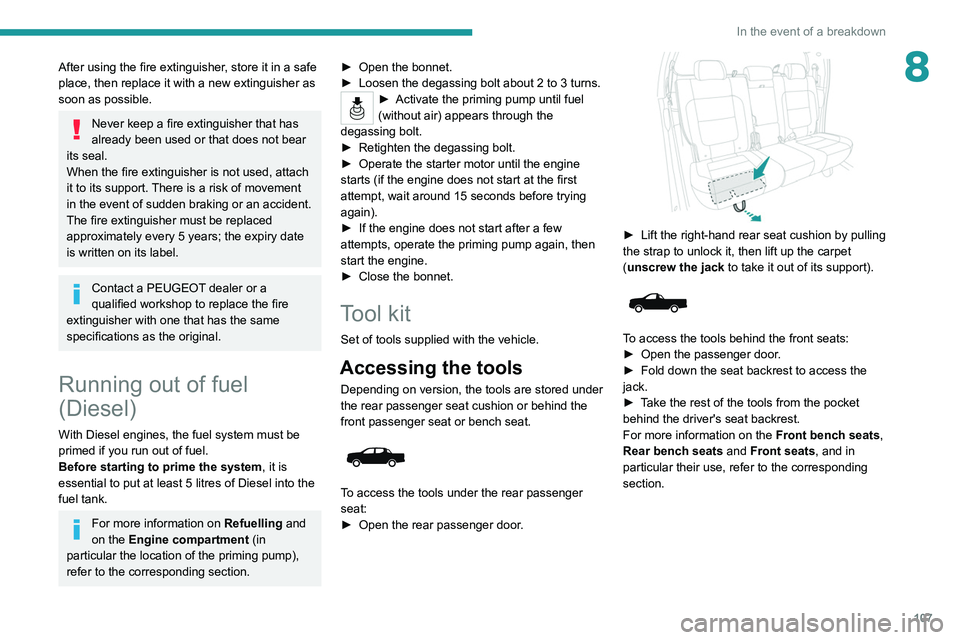
To access the tools under the rear passenger
seat:
►
Open the rear passenger door
.
► Lift the right-hand rear seat cushion by pulling
the strap to unlock it, then lift up the carpet
(
unscrew the jack to take it out of its support).
To access the tools behind the front seats:
► Open the passenger door .
►
Fold down the seat backrest to access the
jack.
►
T
ake the rest of the tools from the pocket
behind the driver's seat backrest.
For more information on the Front bench seats,
Rear bench seats and Front seats, and in
particular their use, refer to the corresponding
section.
Page 111 of 164
109
In the event of a breakdown
8
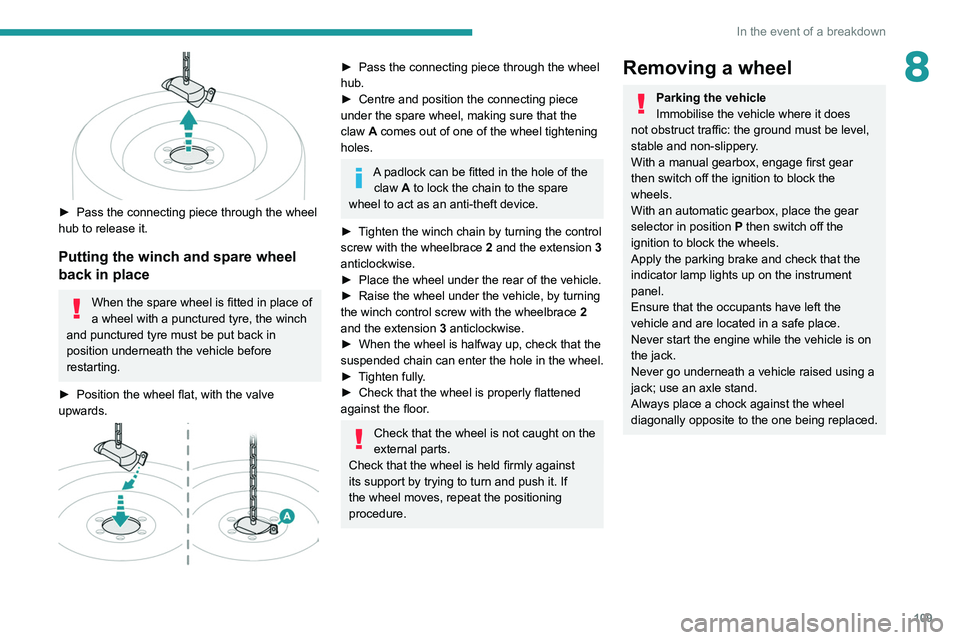
► Pass the connecting piece through the wheel
hub to release it.
Putting the winch and spare wheel
back in place
When the spare wheel is fitted in place of
a wheel with a punctured tyre, the winch
and punctured tyre must be put back in
position underneath the vehicle before
restarting.
►
Position the wheel flat, with the valve
upwards.
► Pass the connecting piece through the wheel
hub.
►
Centre and position the connecting piece
under the spare wheel, making sure that the
claw
A comes out of one of the wheel tightening
holes.
A padlock can be fitted in the hole of the claw A to lock the chain to the spare
wheel to act as an anti-theft device.
►
T
ighten the winch chain by turning the control
screw with the wheelbrace 2 and the extension 3
anticlockwise.
►
Place the wheel under the rear of the vehicle.
►
Raise the wheel under the vehicle, by turning
the winch control screw with the wheelbrace 2
and the extension 3 anticlockwise.
►
When the wheel is halfway up, check that the
suspended
chain can enter the hole in the wheel.
►
T
ighten fully.
►
Check that the wheel is properly flattened
against the floor
.
Check that the wheel is not caught on the
external parts.
Check that the wheel is held firmly against
its support by trying to turn and push it. If
the wheel moves, repeat the positioning
procedure.
Removing a wheel
Parking the vehicle
Immobilise the vehicle where it does
not obstruct traffic: the ground must be level,
stable and non-slippery.
With a manual gearbox, engage first gear
then switch off the ignition to block the
wheels.
With an automatic gearbox, place the gear
selector in position P then switch off the
ignition to block the wheels.
Apply the parking brake and check that the
indicator lamp lights up on the instrument
panel.
Ensure that the occupants have left the
vehicle and are located in a safe place.
Never start the engine while the vehicle is on
the jack.
Never go underneath a vehicle raised using a
jack; use an axle stand.
Always place a chock against the wheel
diagonally opposite to the one being replaced.
Page 114 of 164
11 2
In the event of a breakdown
Changing a bulb
In some weather conditions (e.g. low
temperature or humidity), misting on the
internal surface of the glass of the headlamps
and rear lamps is normal, and will disappear
after the lamps have been on for a few
minutes.
The headlamps have polycarbonate lenses with a protective coating:
–
Do not clean them with a dry or abrasive
cloth, nor with detergent or solvent
products.
–
Use a sponge and soapy water or a pH
neutral product.
–
When using a high-pressure washer on
persistent marks, do not keep the lance
directed towards the headlamps, lamps or
their edges for too long, so as not to damage
their protective coating and seals.
Changing a bulb must only be done with
the ignition off and after the headlamp /
lamp has been switched off for several
minutes - risk of serious burns!
Do not touch the bulb directly with your
fingers; use a lint-free cloth.
It is essential only to use anti-ultraviolet
(UV) type bulbs, so as not to damage the
headlamp.
Always replace a failed bulb with a new bulb
of the same type and specification. To avoid
lighting imbalance, replace the bulbs in pairs.
After changing a bulb
To refit, carry out the operations in
reverse order to removal.
Close the protective cover very carefully to
guarantee the sealing of the lamps.
Light-emitting diode (LED)
headlamps and lamps
Depending on version, the affected types of
headlamps/lamps are:
–
Offset daytime running lamps.
–
Direction indicator side repeaters.
–
Rear sidelamps.
–
Third brake lamp and loading bay lighting.
If you need to replace this type of bulb,
you must contact a PEUGEOT dealer or
a qualified workshop.
Front lamps
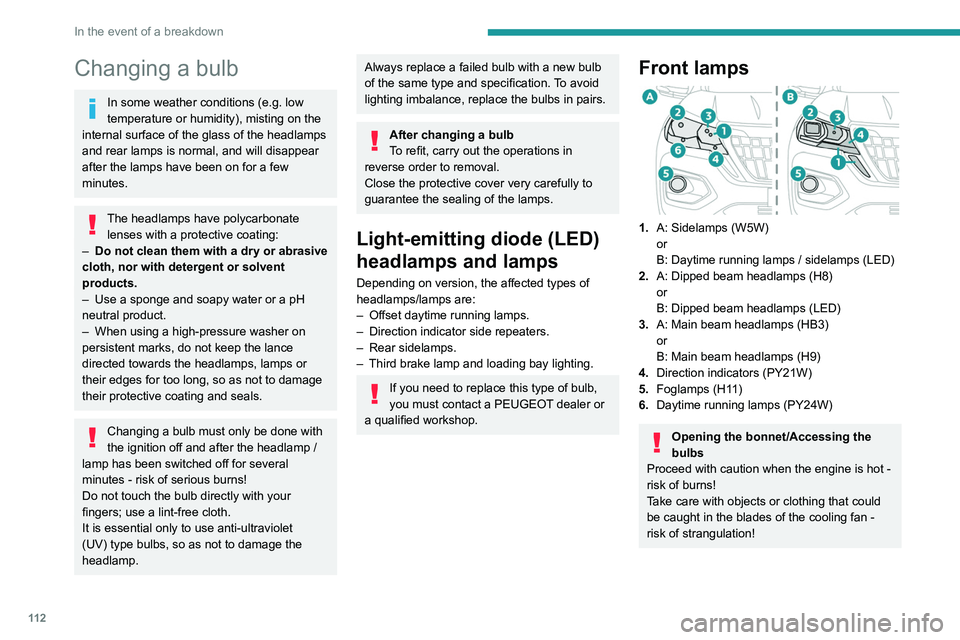
1. A: Sidelamps (W5W)
or
B: Daytime running lamps / sidelamps (LED)
2. A: Dipped beam headlamps (H8)
or
B: Dipped beam headlamps (LED)
3. A: Main beam headlamps (HB3)
or
B: Main beam headlamps (H9)
4. Direction indicators (PY21W)
5. Foglamps (H11)
6. Daytime running lamps (PY24W)
Opening the bonnet/Accessing the
bulbs
Proceed with caution when the engine is hot -
risk of burns!
Take care with objects or clothing that could
be caught in the blades of the cooling fan -
risk of strangulation!
Halogen bulbs (Hx)
To ensure good quality lighting, check
that the bulb is correctly positioned in its
housing.
Accessing the front lamps
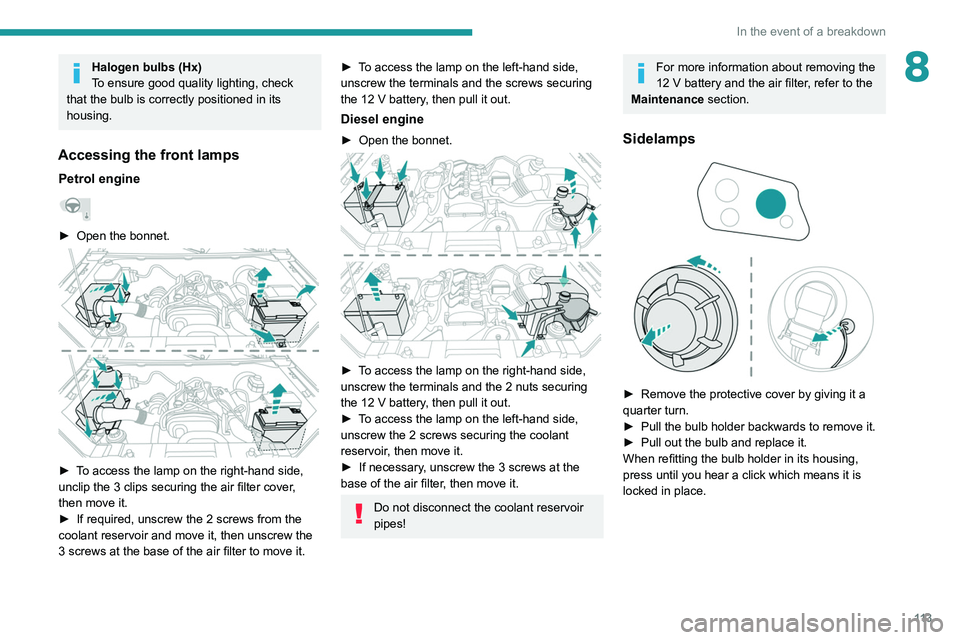
Petrol engine
► Open the bonnet.
► To access the lamp on the right-hand side,
unclip the 3 clips securing the air filter cover,
then move it.
► If required, unscrew the 2 screws from the
coolant reservoir and move it, then unscrew the
3 screws at the base of the air filter to move it.
Page 115 of 164
11 3
In the event of a breakdown
8Halogen bulbs (Hx)
To ensure good quality lighting, check
that the bulb is correctly positioned in its
housing.
Accessing the front lamps
Petrol engine
► Open the bonnet.
► To access the lamp on the right-hand side,
unclip the 3 clips securing the air filter cover,
then move it.
►
If required, unscrew the 2 screws from the
coolant reservoir and move it, then unscrew the
3 screws at the base of the air filter to move it.
► To access the lamp on the left-hand side,
unscrew the terminals and the screws securing
the 12
V battery, then pull it out.
Diesel engine
► Open the bonnet.
► To access the lamp on the right-hand side,
unscrew the terminals and the 2 nuts securing
the 12 V battery, then pull it out.
►
T
o access the lamp on the left-hand side,
unscrew the 2 screws securing the coolant
reservoir, then move it.
►
If necessary
, unscrew the 3 screws at the
base of the air filter, then move it.
Do not disconnect the coolant reservoir
pipes!
For more information about removing the
12 V battery and the air filter, refer to the
Maintenance section.
Sidelamps
► Remove the protective cover by giving it a
quarter turn.
►
Pull the bulb holder backwards to remove it.
►
Pull out the bulb and replace it.
When refitting the bulb holder in its housing,
press until you hear a click which means it is
locked in place.