coolant temperature PONTIAC BONNEVILLE 1998 Owners Manual
[x] Cancel search | Manufacturer: PONTIAC, Model Year: 1998, Model line: BONNEVILLE, Model: PONTIAC BONNEVILLE 1998Pages: 395, PDF Size: 17.6 MB
Page 80 of 395
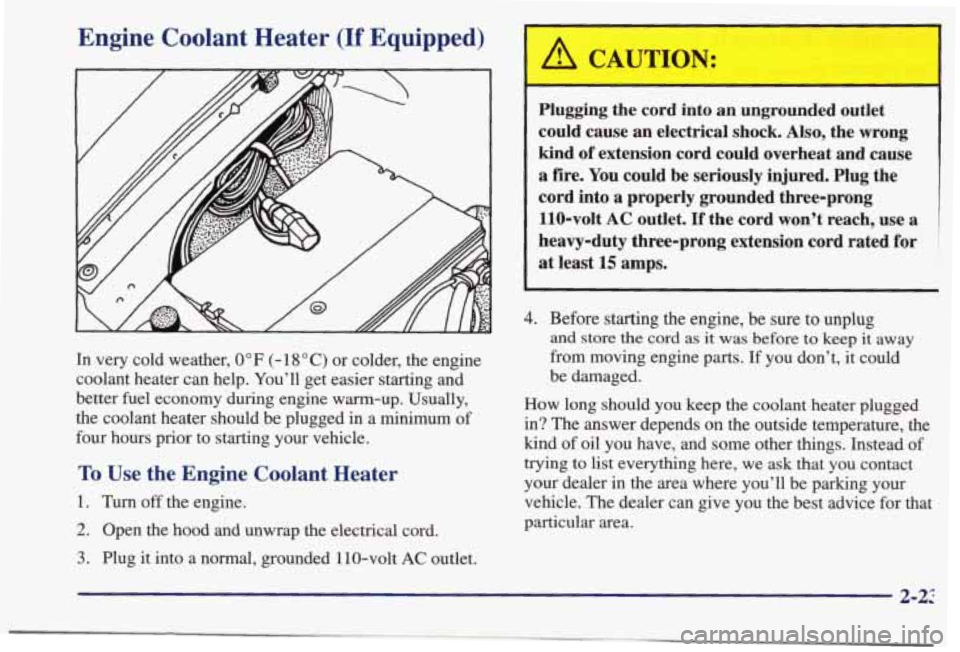
Engine Coolant Heater (If Equipped)
In very cold weather, 0” F (- 18 O C) or colder, the engine
coolant heater can help. You’ll get easier starting and
better fuel economy during engine warm-up. Usually,
the coolant heater should be plugged in a minimum of
four hours prior to starting your vehicle.
To Use the Engine Coolant Heater
1. Turn off the engine.
2. Open the hood and unwrap the electrical cord.
3. Plug it into a normal, grounded 1 10-volt AC outlet.
/1 CAUTION:
Plugging the cord into an ungrounded outlet
could cause
an electrical shock. Also, the wrong
kind of extension cord could overheat and cause
a fire. You could be seriously injured. Plug the
cord into a properly grounded three-prong
110-volt AC outlet.
If the cord won’t reach, use a
heavy-duty three-prong extension cord rated for at least
15 amps.
4. Before starting the engine, be sure to unplug
and store the cord as it was before to keep it away
from moving engine parts.
If you don’t, it could
be damaged.
How long should you keep the coolant heater plugged in? The answer depends
on the outside temperature, the
kind of oil you have, and some other things. Instead of
trying to list everything here, we ask that you contact
your dealer in the area where you’ll be parking your
vehicle. The dealer can give you the best advice for that
particular area.
2-22
Page 125 of 395
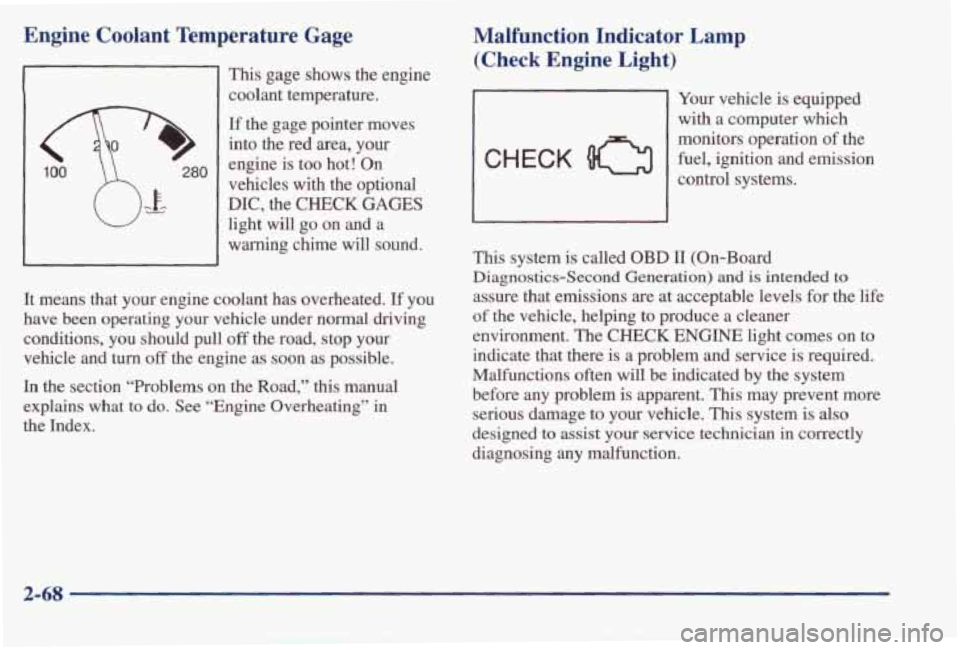
Engine Coolant Temperature Gage
280
This gage shows the engine
coolant temperature.
If the gage pointer moves
into
the red area, your
engine is too hot! On
vehicles
with the optional
DIC, the CHECK GAGES
light will go on and a
warning chime will sound.
It means that your engine coolant has overheated.
If you
have been operating your vehicle under normal driving
conditions, you should pull
off the road, stop your
vehicle and
turn off the engine as soon as possible.
In the section “Problems
on the Road,” this manual
explains what to
do. See “Engine Overheating” in
the Index.
Malfunction Indicator Lamp (Check Engine Light)
CHECK 0
Your vehicle is equipped
with a computer which
monitors operation of the
fuel, ignition and emission
control systems.
This system is called OBD II (On-Board
Diagnostics-Second Generation)
and is intended to
assure that emissions are at acceptable levels for the life
of the vehicle, helping to produce a cleaner
environment. The
CHECK ENGINE light comes on to
indicate that there is a problem and service is required.
Malfunctions often will be indicated by the system
before any problem is apparent. This may prevent more
serious damage to your vehicle. This system is also
designed to assist your service technician in correctly
diagnosing any malfunction.
2-68
Page 129 of 395
Check Oil Level Warning Light
The CHECK OIL LEVEL
light turns on for three
each time the ignition key is turned to the
RUN position.
If the light doesn’t turn on,
- have your vehicle serviced.
C H EC K 0 I L seconds as a bulb check
LEVEL
If the engine oil is more than one quart (0.95 L) low and
the engine has been shut off for at least eight minutes,
the CHECK OIL LEVEL light will turn on for about
one minute and will then remain off until the next time
you start the vehicle.
If the CHECK OIL LEVEL light turns on, the engine oil
level should be checked at the dipstick then brought up
to the proper level, if necessary. See “Engine Oil” in
the Index.
Low Washer Fluid Warning Light
- This light will come on
when your windshield
washers are working
and the
one-third full.
WASH E R FLU I D fluid container is less than
Check Gages Warning Light (Option)
CHECK GAGES
This light will come on
briefly when you are
starting
the engine.
If
the light comes on and stays on while you are driving,
check your gages for fuel, coolant temperature, oil
pressure
or voltage. This light will stay on if your engine
is not running with the ignition
on.
2-72
Page 131 of 395
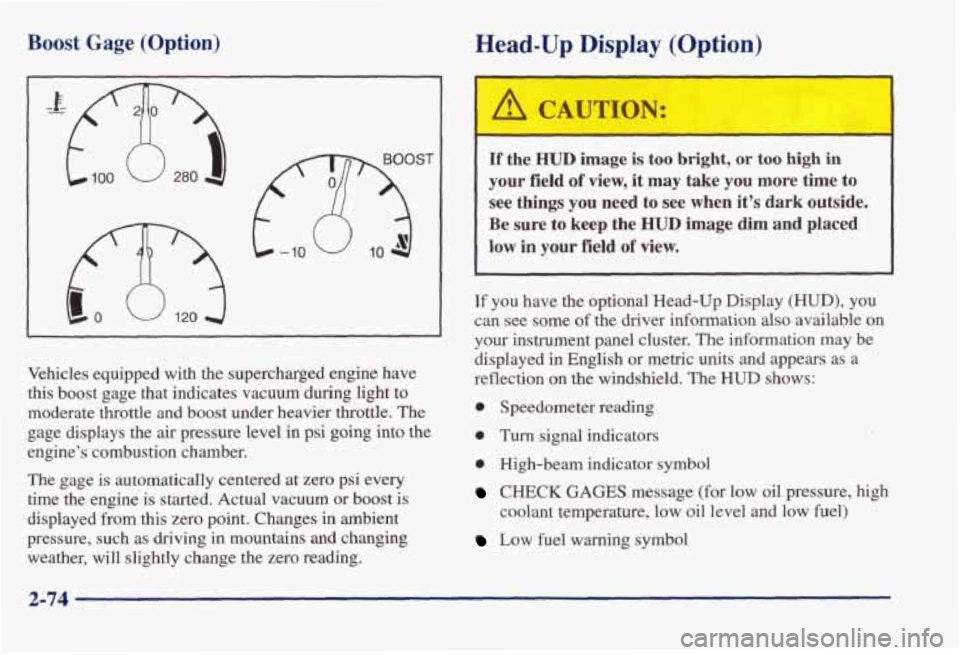
Boost Gage (Option) Head-Up Display (Option)
fXjST
Vehicles equipped with the supercharged engine have
this boost gage that indicates vacuum during light
to
moderate throttle and boost under heavier throttle. The
gage displays the air pressure level in psi going into the
engine’s combustion chamber.
The gage is automatically centered at zero psi every
time the engine is started. Actual vacuum or boost
is
displayed from this zero point. Changes in ambient
pressure, such as driving in mountains
and changing
weather, will slightly change the zero reading.
If the HUD image is too bright, or too high in
your field of view, it may take you more time to
see things you need to see when it’s dark outside.
Be sure to keep the HUD image dim and placed
low in your field of view.
If you have the optional Head-Up Display (HUD), you
can see some
of the driver information also available on
your instrument panel cluster. The information
may be
displayed in English or metric units and appears as a
reflection on the windshield. The
HUD shows:
0 Speedometer reading
0 Turn signal indicators
0 High-beam indicator symbol
CHECK GAGES message (for low oil pressure, high
coolant temperature, low oil level and low fuel)
Low fuel warning symbol
2-74
Page 135 of 395
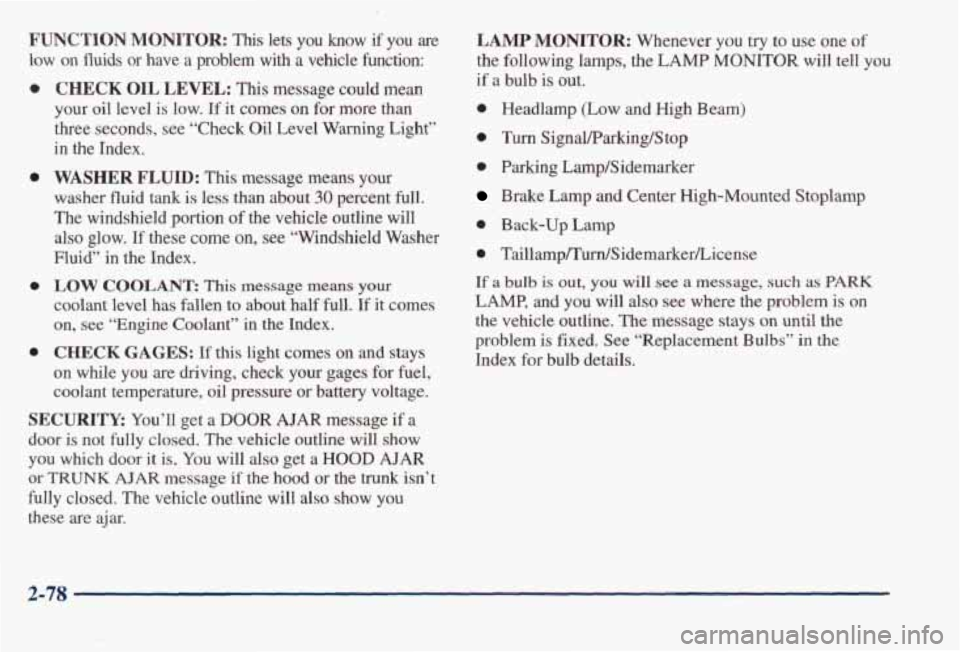
FUNCTION MONITOR: This lets you know if you are
low on fluids or have a problem with a vehicle function:
0
0
0
0
CHECK OIL LEVEL: This message could mean
your oil level
is low. If it comes on for more than
three seconds, see “Check Oil
Level Warning Light”
in the Index.
WASHER FLUID: This message means your
washer fluid
tank is less than about 30 percent full.
The windshield portion
of the vehicle outline will
also glow,
If these come on, see “Windshield Washer
Fluid” in the Index.
LOW COOLANT: This message means your
coolant level has fallen to about half full. If it comes
on,
see “Engine Coolant” in the Index.
CHECK GAGES: If this light comes on and stays
on while you are driving, check your gages for fuel,
coolant temperature, oil pressure or battery voltage.
SECURITY: You’ll get a DOOR AJAR message if a
door is not fully closed. The vehicle outline will show
you which door
it is. You will also get a HOOD AJAR
or TRUNK AJAR message if the hood or the trunk isn’t
fully closed. The vehicle outline will
also show you
these are ajar.
LAMP MONITOR: Whenever you try to use one of
the following lamps, the LAMP MONITOR will tell you
if a bulb is out.
0 Headlamp (Low and High Beam)
0 Turn Signal/Parking/Stop
0 Parking Lamp/Sidemarker
Brake Lamp and Center High-Mounted Stoplamp
0 Back-up Lamp
0 Taillamp~rn/Sidemarker/License
If a bulb is out, you will see a message, such as PARK
LAMP, and you will also see where the problem is on
the vehicle outline.
The message stays on until the
problem
is fixed. See “Replacement Bulbs” in the
Index for bulb details.
2-78
Page 145 of 395
To find your comfort zone, start with 75" F (24" C)
temperature setting and allow about 20 minutes for the
system to regulate. Press the
TEMP button up or down
to adjust the temperature setting if necessary, If you
choose the temperature setting of
60°F (15 "C), the
system will remain
at that maximum cooling setting and
will not regulate the
fan speed. If you choose the
temperature setting
of 90°F (33"c), the system will
remain at that maximum heating setting and will not
regulate the fan speed. Choosing either maximum
setting will not cause the system to heat
or cool
any faster.
Pressing
the AUTO button will display the requested
temperature, fan speed and air delivery mode for five
seconds, then change
to display the outside air
temperature. Be careful not to put
anythmg over the
sensor located
in the middle of the instrument panel near
the windshield,
or over the sensor in the grille above the
radio. These sensors are used by the automatic system to
regulate temperature.
The exterior temperature display sensor is in front of the
vehicle, near the radiator. The displayed temperature is
most accurate when the vehicle is moving. During stops,
or while idling, the display shows the previous driving
temperature for best system control.
To avoid blowing cold air in cold weather, the system
will delay
turning on the fan until warm air is available.
The length of delay depends on outside
air temperature,
engine coolant temperature, and time since
the engine
was last started. Pushing the fan button will override this
delay and change the fan to a selected single speed.
If you leave your vehicle, the system will remember the
control setting
the next time you start your engine.
Manual Operation
You may also manually adjust the air delivery mode or
fan speed.
'/J HEAR Manually selecting HEAT by cycling
through
the MODE settings will deliver air to the
floor outlets.
3 DEFOG: Manually selecting DEFOG by cycling
through the
MODE settings will deliver air to the floor
and windshield outlets.
a
Lo
BIDLEVEL: Manually selecting BI-LEVEL by
cycling through the MODE setting will deliver warm air
to the floor and cooler air to the middle instrument
panel outlets.
3-4
Page 228 of 395
Engine Overheating
You will find a coolant temperature gage or the warning
light about a hot engine on your vehicle’s instrument
panel. See “Coolant Temperature Gage” and “Coolant Temperature Warning
Light” in the Index.
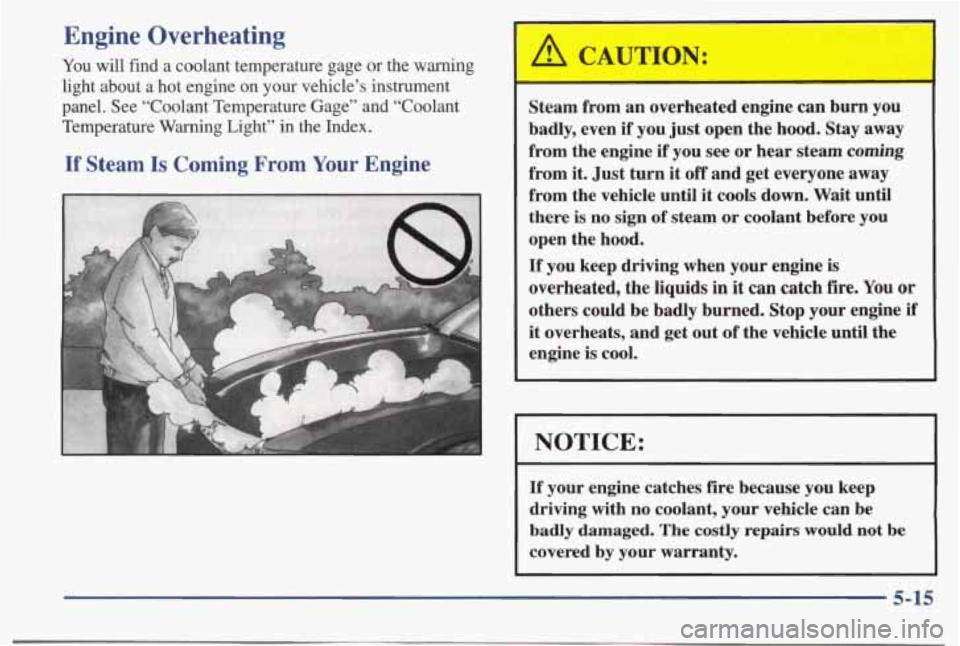
If Steam Is Coming From Your Engine
1
A CAUTION:
Steam from an overheated engine can burn you
badly, even if you just open the hood. Stay away
from the engine if you see or hear steam
coming
from it. Just turn it off and get everyone away
from the vehicle until it cools down. Wait until
there is no sign
of steam or coolant before you
open the hood.
If you keep driving when your engine is
overheated, the liquids in it
can catch fire. You or
others could be badly burned. Stop your engine if
it overheats, and get out of the vehicle until the
engine is cool.
I
NOTICE:
If your engine catches fire because you keep
driving with no coolant, your vehicle can be
badly damaged. The costly repairs would not be
covered by your warranty.
5-15
Page 274 of 395
Engine Coolant
The cooling s stem in your vehicle is filled with
DEX-COOL
8 engine coolant. This coolant is designed
to remain in your vehicle for
5 years or 150,000 miles
(240 000 km) whichever occurs first, if you add only
DEX-COOL’ extended life coolant.
The following explains your cooling system and
how to add coolant when it is low. If you have a
problem with engine overheating,
see “Engine
Overheating”
in the Index.
A 50/50 mixture of water and DEX-COOL@
coolant will:
Give freezing protection down to -34°F (-37°C).
0 Give boiling protection up to 265 “F (129°C).
0 Protect against rust and corrosion.
Help keep the proper engine temperature.
Let the warning lights and gages work as
they should.
NOTICE:
When adding coolant, it is important that you
use only DEX-COOL@ (silicate-free) coolant.
If coolant other than DEX-COOL is added to
the system, premature engine, heater core or
radiator corrosion may result. In addition, the
engine coolant
will require change sooner -- at
30,000 miles (50 000 km) or 24 months,
whichever occurs first. Damage caused by the
use of coolant other than DEX-COOL@
is not
covered by your new vehicle warranty.
6-23
Page 277 of 395
Thermostat
Engine coolant temperature is controlled by a thermostat
in the engine coolant system. The thermostat stops the
You can be burned if you spill coolant on hot
engine parts. Coolant contains ethylene glycol, and it will burn if the engine parts
are hot
enough. Don’t spill coolant on a
hot engine.
Radiator Pressure Cap
ICE:
~~~
Your radiator cap is a 15 psi (105 Wa)
pressure-type cap and must be tightly installed to
prevent coolant loss and possible engine damage
from overheating. Be sure the arrows on the cap
line up with the overflow tube on the radiator
filler neck.
flow of coolant through the radiator until the coolant
reaches a preset temperature.
Power Steering Fluid
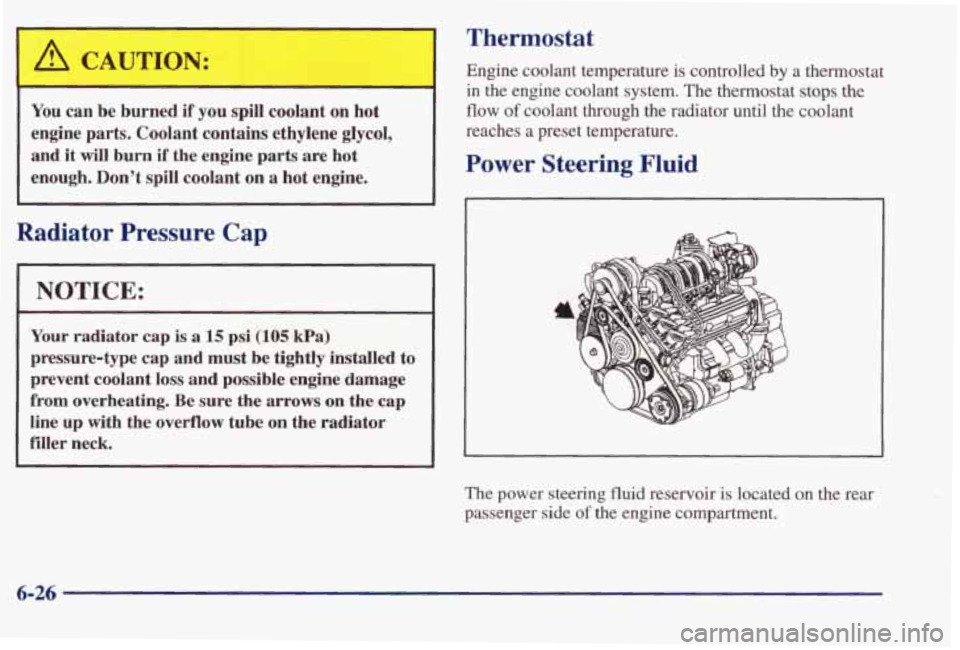
The power steering fluid reservoir is located on the rear
passenger side
of the engine compartment.
6-26
Page 349 of 395
Long Trip/Highway Maintenance Schedule
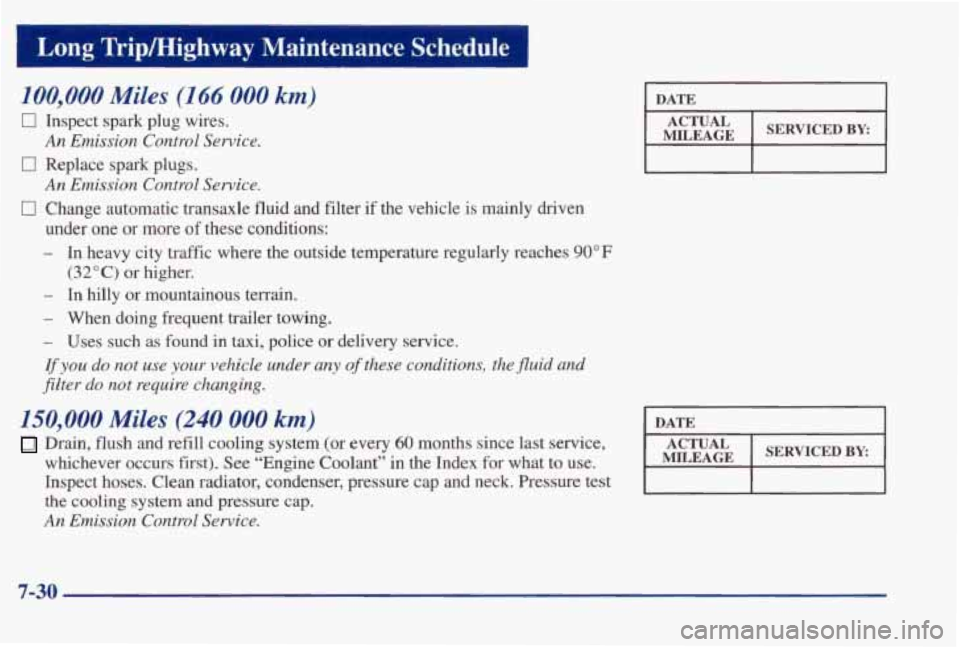
100,000 Miles (I 66 000 km)
Inspect spark plug wires.
An Emission Control Service.
Replace spark plugs.
An Emission Control Service.
Change automatic transaxle fluid and filter if the vehicle is mainly driven
under one
or more of these conditions:
- In heavy city traffic where the outside temperature regularly r\
eaches 90°F
- In hilly or mountainous terrain.
- When doing frequent trailer towing.
- Uses such as found in taxi, police or delivery service.
Ifyou do not use your vehicle under any of these conditions, the fluid and
filter do not require changing.
(32°C) or higher.
DATE I
MILEAGE
150,000 Miles (240 000 km)
Drain, flush and refill cooling system (or every 60 months since last service,
whichever occurs first). See “Engine Coolant” in the Index for what to use.
Inspect hoses. Clean radiator, condenser, pressure cap
and neck. Pressure test
the cooling system
and pressure cap.
An Emission Control Service.
7-30