gas type PONTIAC BONNEVILLE 1999 Owners Manual
[x] Cancel search | Manufacturer: PONTIAC, Model Year: 1999, Model line: BONNEVILLE, Model: PONTIAC BONNEVILLE 1999Pages: 392, PDF Size: 2.96 MB
Page 30 of 392
First Edition for Pontiac Bonneville Owner's Manual ± 1999
yellowblue
1-24
What makes an air bag inflate?
In an impact of sufficient severity, the air bag sensing
system detects that the vehicle is in a crash. The sensing
system triggers a release of gas from the inflator, which
inflates the air bag. The inflator, air bag and related
hardware are all part of the air bag modules inside the
steering wheel and in the instrument panel in front of the
right front passenger.
How does an air bag restrain?
In moderate to severe frontal or near
-frontal collisions,
even belted occupants can contact the steering wheel or
the instrument panel. Air bags supplement the protection
provided by safety belts. Air bags distribute the force of
the impact more evenly over the occupant's upper body,
stopping the occupant more gradually. But air bags
would not help you in many types of collisions,
including rollovers, rear impacts and side impacts,
primarily because an occupant's motion is not toward
those air bags. Air bags should never be regarded as
anything more than a supplement to safety belts,
and then only in moderate to severe frontal or
near
-frontal collisions.What will you see after an air bag inflates?
After an air bag inflates, it quickly deflates, so quickly
that some people may not even realize the air bag
inflated. Some components of the air bag module
-- the
steering wheel hub for the driver's air bag, or the
instrument panel for the right front passenger's
bag
-- will be hot for a short time. The parts of the
bag that come into contact with you may be warm, but
not too hot to touch. There will be some smoke and dust
coming from vents in the deflated air bags. Air bag
inflation doesn't prevent the driver from seeing or from
being able to steer the vehicle, nor does it stop people
from leaving the vehicle.
CAUTION:
When an air bag inflates, there is dust in the air.
This dust could cause breathing problems for
people with a history of asthma or other
breathing trouble. To avoid this, everyone in the
vehicle should get out as soon as it is safe to do so.
If you have breathing problems but can't get out
of the vehicle after an air bag inflates, then get
fresh air by opening a window or door.
Page 254 of 392

yellowblue
6-4
It is recommended that the gasoline meet specifications
which have been developed by the American
Automobile Manufacturers Association (AAMA) and
endorsed by the Canadian Motor Vehicle Manufacturers
Association for better vehicle performance and engine
protection. Gasolines meeting the AAMA specification
could provide improved driveability and emission
control system performance compared to other
gasolines. For more information, write to: American
Automobile Manufacturer's Association, 7430 Second
Ave, Suite 300, Detroit MI 48202.
Be sure the posted octane for premium is at least 91 (at
least 89 for middle grade and 87 for regular). If the
octane is less than 87, you may get a heavy knocking
noise when you drive. If it's bad enough, it can damage
your engine.
If your vehicle is certified to meet California Emission
Standards (indicated on the underhood emission control
label), it is designed to operate on fuels that meet
California specifications. If such fuels are not available
in states adopting California emissions standards, your
vehicle will operate satisfactorily on fuels meeting federal specifications, but emission control system
performance may be affected. The malfunction indicator
lamp on your instrument panel may turn on and/or your
vehicle may fail a smog
-check test. (See ªMalfunction
Indicator Lampº in the Index.) If this occurs, return to
your authorized Pontiac dealer for diagnosis to
determine the cause of failure. In the event it is
determined that the cause of the condition is the type of
fuels used, repairs may not be covered by your warranty.
Some gasolines that are not reformulated for low
emissions may contain an octane
-enhancing additive
called methylcyclopentadienyl manganese tricarbonyl
(MMT); ask your service station operator whether or not
the fuel contains MMT. General Motors does not
recommend the use of such gasolines. If fuels containing
MMT are used, spark plug life may be reduced and your
emission control system performance may be affected.
The malfunction indicator lamp on your instrument
panel may turn on. If this occurs, return to your
authorized Pontiac dealer for service.
Page 257 of 392
yellowblue
6-7
While refueling, hang the tethered cap on the hook on
the inside of the fuel door.
To remove the cap, turn it slowly to the left
(counterclockwise). The cap has a spring in it; if you let
go of the cap too soon, it will spring back to the right.
CAUTION:
If you get gasoline on yourself and then
something ignites it, you could be badly burned.
Gasoline can spray out on you if you open the
fuel filler cap too quickly. This spray can happen
if your tank is nearly full, and is more likely in
hot weather. Open the fuel filler cap slowly and
wait for any ªhissº noise to stop. Then unscrew
the cap all the way.
Be careful not to spill gasoline. Clean gasoline from
painted surfaces as soon as possible. See ªCleaning the
Outside of Your Vehicleº in the Index.When you put the cap back on, turn it to the right
(clockwise) until you hear a clicking sound. Make sure
you fully install the cap. The diagnostic system can
determine if the fuel cap has been left off or improperly
installed. This would allow fuel to evaporate into the
atmosphere. See ªMalfunction Indicator Lampº in
the Index.
NOTICE:
If you need a new cap, be sure to get the right
type. Your dealer can get one for you. If you get
the wrong type, it may not fit properly. This may
cause your malfunction indicator lamp to light
and your fuel tank and emissions system may be
damaged. See ªMalfunction Indicator Lampº in
the Index.
Page 283 of 392
yellowblue
6-33
Bulb Replacement
For any bulb changing procedure not listed in this
section, contact your dealer's service department.
Halogen Bulbs
CAUTION:
Halogen bulbs have pressurized gas inside and
can burst if you drop or scratch the bulb. You or
others could be injured. Be sure to read and
follow the instructions on the bulb package.
If you go through a high pressure car wash, or it is very
humid, your headlamps may ªfog up.º This is normal.
The lenses should clear by themselves in time.
Headlamps
For the proper bulb type, see ªReplacement Bulbsº in
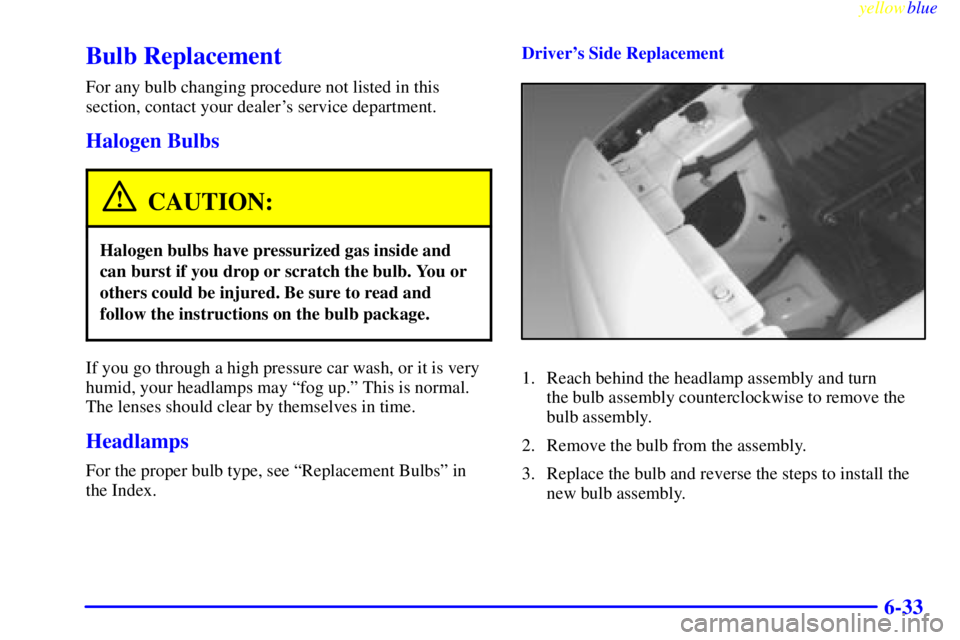
the Index.Driver's Side Replacement
1. Reach behind the headlamp assembly and turn
the bulb assembly counterclockwise to remove the
bulb assembly.
2. Remove the bulb from the assembly.
3. Replace the bulb and reverse the steps to install the
new bulb assembly.