wiper fluid PONTIAC BONNEVILLE 2003 Owners Manual
[x] Cancel search | Manufacturer: PONTIAC, Model Year: 2003, Model line: BONNEVILLE, Model: PONTIAC BONNEVILLE 2003Pages: 418, PDF Size: 20.24 MB
Page 125 of 418
Windshield Washer
At the end of the wiper lever, there’s a button. To spray
washer fluid on the windshield, push the button until
you have enough fluid to clean the windshield. The
wipers will clear the window and either stop or return to
yot set
speed.
~ -
In freezing weather, don’t use your washer
until the windshield is warmed. Otherwise the
washer fluid can form ice on the windshield,
blocking your vision.
Cruise Control
With cruise control, you can maintain a speed of about
25 mph (40 km/h) or more without keeping your foot
on the accelerator. This can really help
on long trips.
A WASHER FLUID warning light will indicate if the fluid
level in the windshield washer reservoir is low. See
Low Washer Fluid Warning Light on page 3-51.
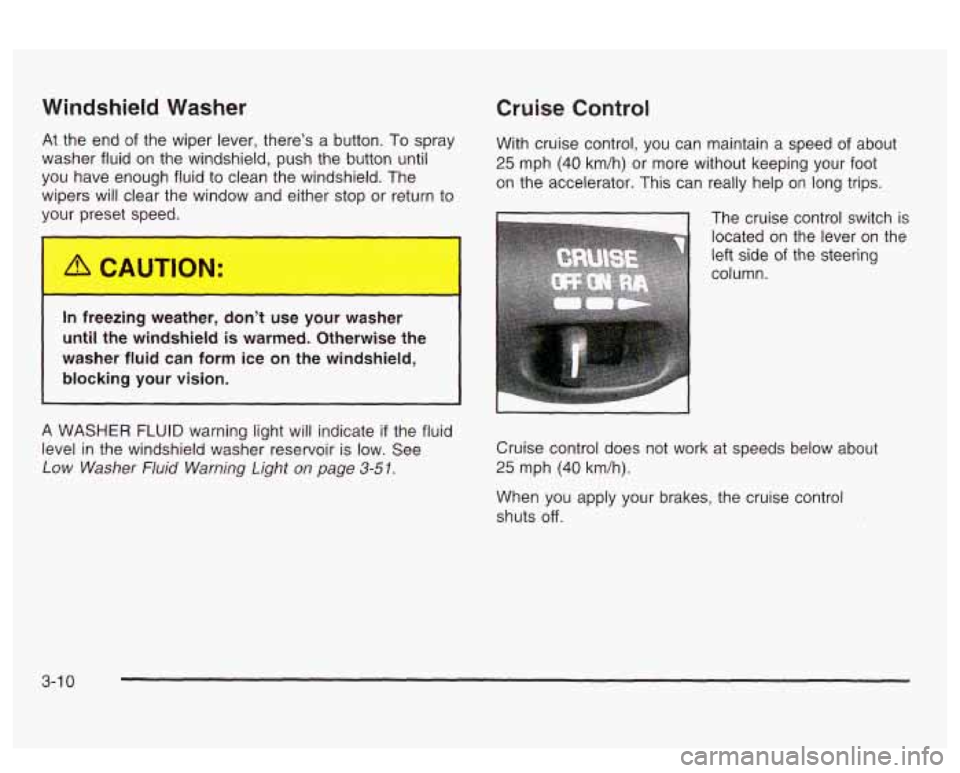
The cruise control switch is
located on the lever
on the
left side
of the steering
column.
Cruise control does not work at speeds below about
25 mph (40 km/h).
When you apply your brakes, the cruise control
shuts
off.
3-1 0
Page 235 of 418
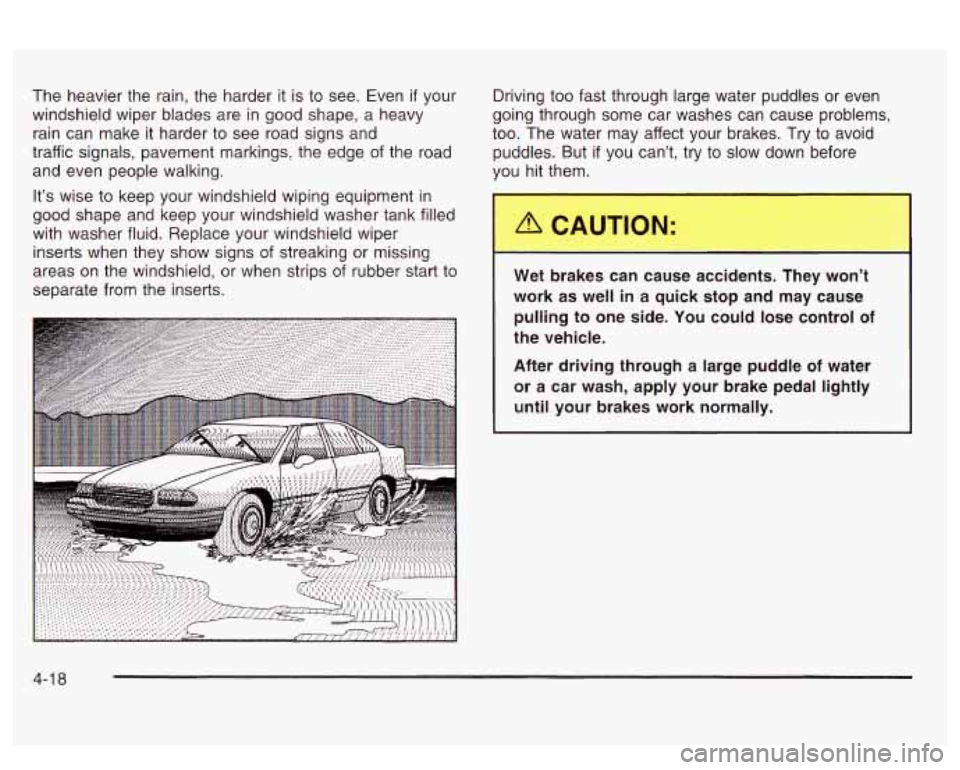
The heavier the rain, the harder it is to see. Even if your
windshield wiper blades are in good shape, a heavy
rain can make it harder to see road signs and
traffic signals, pavement markings, the edge
of the roaa
and even people walking.
It’s wise to keep your windshield wiping equipment in
good shape and keep your windshield washer tank filled
with washer fluid. Replace your windshield wiper
inserts when they show signs of streaking or missing
areas on the windshield, or when strips of rubber start to
separate from the inserts. Driving too fast through large
water puddles or even
going through some car washes can cause problems,
too. The water may affect your brakes. Try to avoid
puddles. But if you can’t, try to slow down before
you hit them.
Wet brakes can cause accidents. They won’t
work as well in a quick stop and may cause
pulling to one side. You could lose control of
the vehicle.
After driving through a large puddle
of water
or a car wash, apply your brake pedal lightly
until your brakes work normally.
4-1 8
Page 239 of 418
Once you are moving on the freeway, make certain you
allow a reasonable following distance.
Expect to move slightly slower at night.
When you want to leave the freeway, move to the
proper lane well in advance.
If you miss your exit, do
not, under any circumstances, stop and back up. Drive
on to the next exit.
The exit ramp can be curved, sometimes quite sharply.
The exit speed is usually posted. Reduce your speed
according to your speedometer, not to your sense
of motion. After driving for any distance at higher
speeds, you may tend to think you are going slower
than you actually are. Of
course, you’ll find experienced and able service
experts in dealerships all across North America. They’ll
be ready and willing to help
if you need it.
Here are some things you can check before a trip:
a
Before Leaving on a Long Trip
Make sure you’re ready. Try to be well rested. If you
must start when you’re not fresh
- such as after a day’s
work
- don’t plan to make too many miles that first
part of the journey. Wear comfortable clothing and shoes
you can easily drive in.
Is your vehicle ready for a long trip? If you keep
it serviced and maintained, it’s ready to go. If it
needs service, have it done before starting out.
Windshield Washer Fluid: Is the reservior full? Are
all windows clean inside and outside?
Wiper Blades: Are they in good shape?
Fuel, Engine Oil, Other Fluids: Have you checked
all levels?
Lamps: Are they all working? Are the lenses clean?
Tires: They are vitally important to a safe,
trouble-free trip.
Is the tread good enough for
long-distance driving? Are the tires all inflated
to the
recommended pressure?
Weather Forecasts: What’s the weather outlook
along your route? Should you delay your trip a
short time to avoid a major storm system?
Maps: Do you have up-to-date maps?
4-22
Page 380 of 418
At Least Twice a Year
Restraint System Check
Make sure the safety belt reminder light and all your
belts, buckles, latch plates, retractors and anchorages
are working properly. Look for any other loose or
damaged safety belt system parts. If you see anything
that might keep a safety belt system from doing its
job, have it repaired. Have any torn or frayed safety belts
replaced.
Also look for any opened or broken air bag coverings,
and have them repaired or replaced. (The air bag
system does not need regular maintenance.)
Wiper Blade Check
Inspect wiper blades for wear or cracking. Replace
blade inserts that appear worn or damaged or that
streak or miss areas of the windshield.
Also see
“Windshield Wiper and Wiper Blades” under Cleaning
the Outside
of Your Vehicle on page 5-85.
Weatherstrip Lubrication
Silicone grease on weatherstrips will make them last
longer, seal better, and not stick or squeak. Apply
silicone grease with a clean cloth, During very cold,
damp weather more frequent application may be
required. See
Part D: Recommended Fluids and
Lubricants on page
6-24.
Automatic Transaxle Check
Check the transaxle fluid level; add if needed. See
Automatic Transaxle Fluid on page 5-23. A fluid loss
may indicate a problem. Check the system and repair if
needed.
At Least Once a Year
Key Lock Cylinders Service
Lubricate the key lock cylinders with the lubricant
specified in Part
D.
Lubricate all hinges and latches, including those for the
hood, rear compartment, glove box door, console
door and any folding seat hardware. Part D tells you
what to use. More frequent lubrication may be required
when exposed to a corrosive environment.
6-1 9
Page 414 of 418
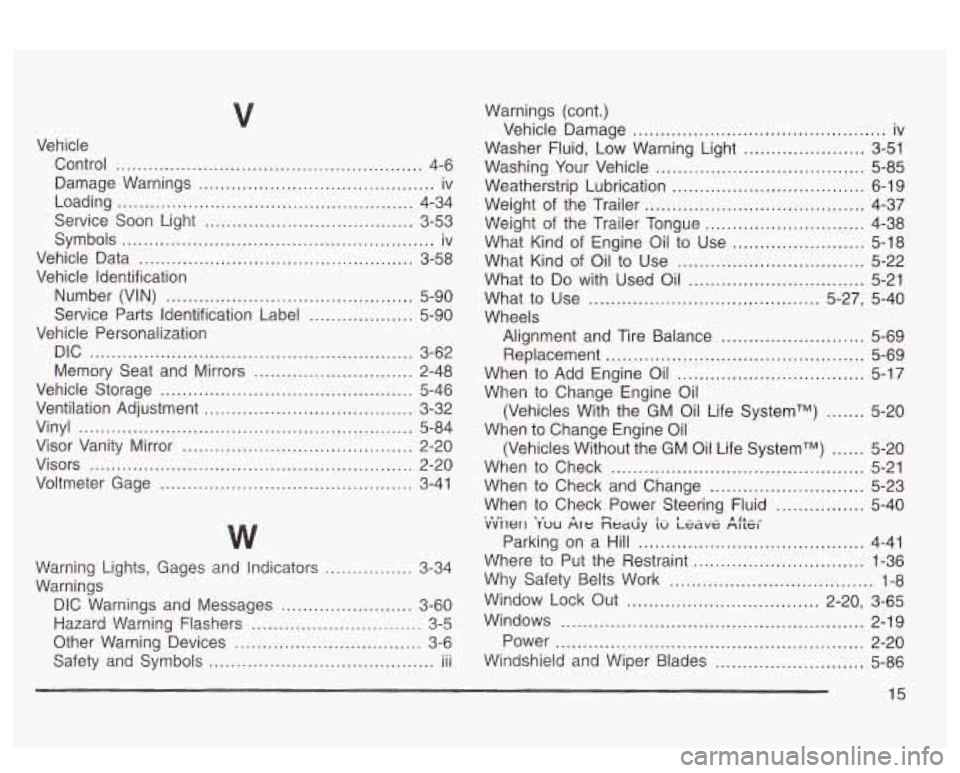
v
Vehicle Control
........................................................ 4-6
Damage Warnings
........................................... iv
Loading
...................................................... 4-34
Service
Soon Light ...................................... 3-53
Symbols
......................................................... iv
Vehicle Data
.................................................. 3-58
Vehicle Identification
Number (VIN)
............................................. 5-90
Service Parts Identification Label
................... 5-90
DIC
........................................................... 3-62
Memory Seat and Mirrors
......................... 2-48
Vehicle Storage
.......................................... 5-46
Ventilation Adjustment
...................................... 3-32
Vinyl
............................................................. 5-84
Vehicle
Personalization
Visor Vanity Mirror
.......................................... 2-20
Visors 2-20
Voltmeter Gage
.............................................. 3-41
...........................................................
Warning Lights. Gages and Indicators ...... ~ .... 3-34
DIC Warnings and Messages
........................ 3-60
Hazard ?n.larning Flashers ............................... 3-5
Warnings
Other Warning Devices
.................................. 3-6
Safety and Symbols
......................................... III ...
Warnings (cont.) Vehicle Damage
.............................................. iv
Washer Fluid. Low Warning Light
...................... 3-51
Washing Your Vehicle
...................................... 5-85
Weight of the Trailer
........................................ 4-37
What Kind of Engine Oil
to Use ........................ 5-18
What to Do with Used
Oil ................................ 5-21
What
to Use .......................................... 5-27, 5-40
Wheels
Alignment and Tire Balance
.......................... 5-69
Weatherstrip Lubrication
................................... 6-19
Weight of the Trailer Tongue
............................. 4-38
What Kind of Oil to Use
.................................. 5-22
Replacement
............................................... 5-69
When to Add Engine Oil
.................................. 5-17
When to Change Engine Oil
(Vehicles With the GM Oil Life SystemTM)
....... 5-20
When to Change Engine Oil
(Vehicles Without the GM Oil Life SystemTM)
...... 5-20
When to Check
.............................................. 5-21
When to Check Power Steering Fluid
................ 5-40
vvrwrt ‘r’ou Are Fieauy LU ~eavc MILW
Parking on a Hill ......................................... 4-41
When
to Check and Change
............................ 5-23
.... -I ~ 1- I - _. ._ Afr- ..
Where to Put the Restraint ............................... 1-36
Why Safety Belts Work
..................................... 1-8
Window Lock Out
................................... 2-20, 3-65
Windows
....................................................... 2-19
Power
........................................................ 2-20
Windshield and Wiper Blades
........................... 5-86
15
Page 415 of 418
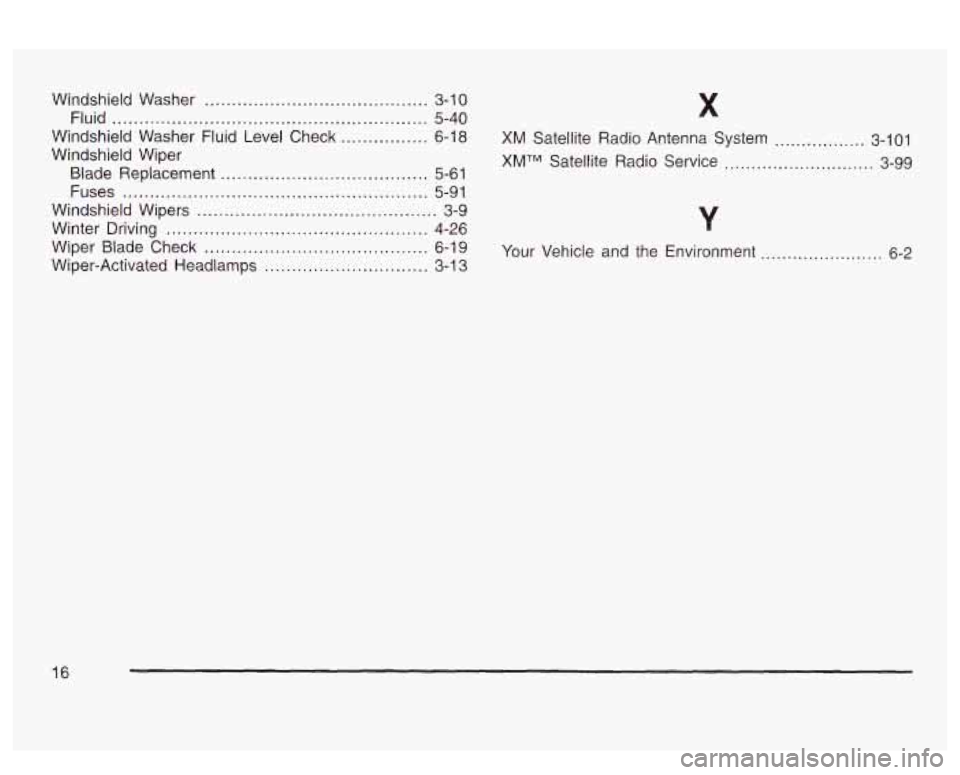
Windshield Washer ......................................... 3-10
Fluid
.......................................................... 5-40
Windshield Washer Fluid Level Check ................ 6-18 XM Satellite Radio Antenna System ................. 3-101
Windshield Wiper XMTM Satellite Radio Service ............................ 3-99
Blade Replacement ................................... 5-61
Windshield Wipers
............................................ 3-9
Wiper Blade Check
......................................... 6-19 Your Vehicle and the Environment ........... Wiper-Activated Headlamps .............................. 3-13
Fuses
........................................................ 5-91
Winter Driving 4-26 Y ................................................
.... 6-2