tire pressure PONTIAC G5 2009 Owner's Guide
[x] Cancel search | Manufacturer: PONTIAC, Model Year: 2009, Model line: G5, Model: PONTIAC G5 2009Pages: 402, PDF Size: 2.22 MB
Page 306 of 402
GM recommends replacing tires in sets of four.
This is because uniform tread depth on all tires
will help keep your vehicle performing most like
it did when the tires were new. Replacing less
than a full set of tires can affect the braking
and handling performance of your vehicle.
SeeTire Inspection and Rotation on page 5-63for
information on proper tire rotation.
{CAUTION:
Mixing tires could cause you to lose control
while driving. If you mix tires of different
sizes, brands, or types (radial and bias-belted
tires), the vehicle may not handle properly,
and you could have a crash. Using tires of
different sizes, brands, or types may also
cause damage to your vehicle. Be sure to
use the correct size, brand, and type of tires
on all wheels. It is all right to drive with
your compact spare temporarily, as it
was developed for use on your vehicle.
SeeCompact Spare Tire on page 5-93.
{CAUTION:
If you use bias-ply tires on the vehicle, the
wheel rim anges could develop cracks after
many miles of driving. A tire and/or wheel
could fail suddenly, causing a crash. Use only
radial-ply tires with the wheels on the vehicle.
If you must replace your vehicle’s tires with those
that do not have a TPC Spec number, make sure
they are the same size, load range, speed rating,
and construction type (radial and bias-belted tires)
as your vehicle’s original tires.
Vehicles that have a tire pressure monitoring
system could give an inaccurate low-pressure
warning if non-TPC Spec rated tires are installed on
your vehicle. Non-TPC Spec rated tires may give a
low-pressure warning that is higher or lower than
the proper warning level you would get with TPC
Spec rated tires. SeeTire Pressure Monitor System
on page 5-56.
Your vehicle’s original equipment tires are listed
on the Tire and Loading Information Label.
SeeLoading the Vehicle on page 4-22, for more
information about the Tire and Loading Information
Label and its location on your vehicle.
5-66
Page 309 of 402

Wheel Replacement
Replace any wheel that is bent, cracked, or badly rusted
or corroded. If wheel nuts keep coming loose, the wheel,
wheel bolts, and wheel nuts should be replaced. If the
wheel leaks air, replace it (except some aluminum
wheels, which can sometimes be repaired). See your
dealer/retailer if any of these conditions exist.
Your dealer/retailer will know the kind of wheel you need.
Each new wheel should have the same load-carrying
capacity, diameter, width, offset, and be mounted
the same way as the one it replaces.
If you need to replace any of your wheels, wheel bolts,
wheel nuts, or Tire Pressure Monitor System (TPMS)
sensors, replace them only with new GM original
equipment parts. This way, you will be sure to have
the right wheel, wheel bolts, wheel nuts, and TPMS
sensors for your vehicle.
{CAUTION:
Using the wrong replacement wheels, wheel bolts,
or wheel nuts on your vehicle can be dangerous.
It could affect the braking and handling of your
vehicle, make your tires lose air and make you lose
CAUTION: (Continued)
CAUTION: (Continued)
control. You could have a collision in which you or
others could be injured. Always use the correct
wheel, wheel bolts, and wheel nuts for
replacement.
Notice:The wrong wheel can also cause problems
with bearing life, brake cooling, speedometer or
odometer calibration, headlamp aim, bumper height,
vehicle ground clearance, and tire or tire chain
clearance to the body and chassis.
SeeChanging a Flat Tire on page 5-80for more
information.
Used Replacement Wheels
{CAUTION:
Putting a used wheel on the vehicle is dangerous.
You cannot know how it has been used or how
far it has been driven. It could fail suddenly and
cause a crash. If you have to replace a wheel,
use a new GM original equipment wheel.
5-69
Page 312 of 402
Tire Sealant and Compressor Kit
{CAUTION:
Idling a vehicle in an enclosed area with poor
ventilation is dangerous. Engine exhaust may
enter the vehicle. Engine exhaust contains Carbon
Monoxide (CO) which cannot be seen or smelled.
It can cause unconsciousness and even death.
Never run the engine in an enclosed area that has
no fresh air ventilation. For more information, see
Engine Exhaust on page 2-34.
{CAUTION:
Over-inating a tire could cause the tire to rupture
and you or others could be injured. Be sure to
read and follow the tire sealant and compressor kit
instructions and inate the tire to its recommended
pressure. Do not exceed the recommended
pressure.
{CAUTION:
Storing the tire sealant and compressor kit or
other equipment in the passenger compartment of
the vehicle could cause injury. In a sudden stop or
collision, loose equipment could strike someone.
Store the tire sealant and compressor kit in its
original location.
If this vehicle has a tire sealant and compressor kit,
there may not be a spare tire, tire changing equipment,
and on some vehicles there may not be a place to
store a tire.
The tire sealant and compressor can be used to
temporarily seal punctures up to
14inch (6 mm) in the
tread area of the tire. It can also be used to inate
an under inated tire.
If the tire has been separated from the wheel, has
damaged sidewalls, or has a large puncture, the tire is too
severely damaged for the tire sealant and compressor kit
to be effective. SeeRoadside Assistance Program on
page 7-7.
5-72
Page 313 of 402
Read and follow all of the tire sealant and compressor
kit instructions.
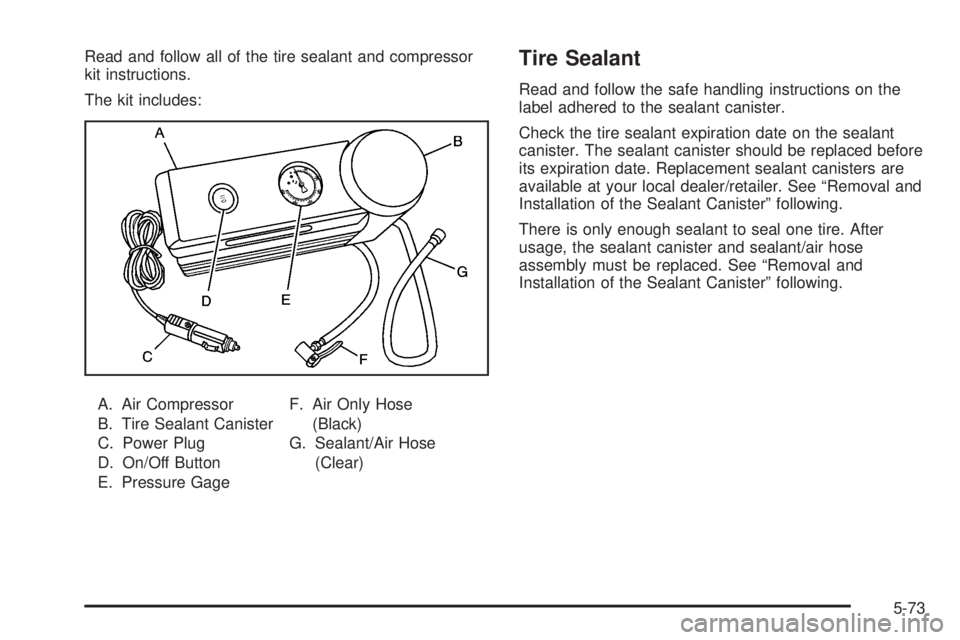
The kit includes:
A. Air Compressor
B. Tire Sealant Canister
C. Power Plug
D. On/Off Button
E. Pressure GageF. Air Only Hose
(Black)
G. Sealant/Air Hose
(Clear)Tire Sealant
Read and follow the safe handling instructions on the
label adhered to the sealant canister.
Check the tire sealant expiration date on the sealant
canister. The sealant canister should be replaced before
its expiration date. Replacement sealant canisters are
available at your local dealer/retailer. See “Removal and
Installation of the Sealant Canister” following.
There is only enough sealant to seal one tire. After
usage, the sealant canister and sealant/air hose
assembly must be replaced. See “Removal and
Installation of the Sealant Canister” following.
5-73
Page 315 of 402
7. Start the vehicle. The vehicle must be running while
using the air compressor.
8. Press the on/off (D) button to turn the tire sealant
and compressor kit on.
The compressor will inject sealant and air into
the tire.
The pressure gage (E) will initially show a
high pressure while the compressor pushes the
sealant into the tire. Once the sealant is completely
dispersed into the tire, the pressure will quickly drop
and start to rise again as the tire inates with air only.
9. Inate the tire to the recommended ination pressure
using the pressure gage (E). The recommended
ination pressure can be found on the Tire and
Loading Information label. SeeInflation - Tire
Pressure on page 5-55.
The pressure gage (E) may read higher than the
actual tire pressure while the compressor is on.
Turn the compressor off to get an accurate pressure
reading. The compressor may be turned on/off until
the correct pressure is reached.Notice:If the recommended pressure cannot be
reached after approximately 25 minutes, the vehicle
should not be driven farther. The tire is too severely
damaged and the tire sealant and compressor kit
cannot inate the tire. Remove the power plug from
the accessory power outlet and unscrew the inating
hose from the tire valve. SeeRoadside Assistance
Program on page 7-7.
10. Press the on/off button (D) to turn the tire sealant
and compressor kit off.
The tire is not sealed and will continue to leak air until
the vehicle is driven and the sealant is distributed in
the tire, therefore, Steps 11 through 17 must be done
immediately after Step 10.
Be careful while handling the tire sealant and
compressor kit as it could be warm after usage.
11. Unplug the power plug (C) from the accessory
power outlet in the vehicle.
12. Turn the sealant/air hose (F) counterclockwise to
remove it from the tire valve stem.
5-75
Page 316 of 402
13. Replace the tire valve stem cap.
14. Replace the sealant/air hose (F), and the power
plug (C) back in their original location.
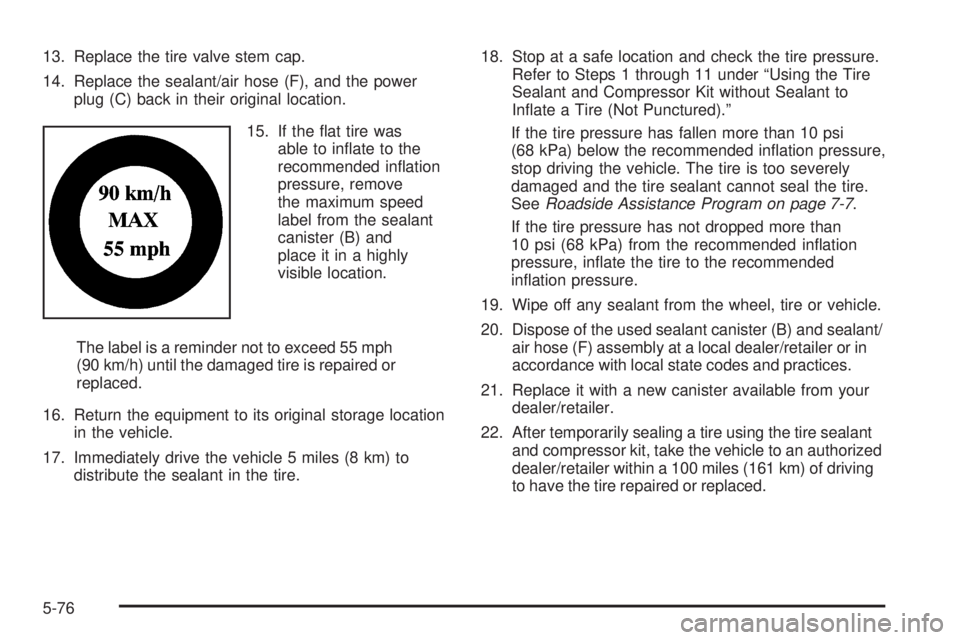
15. If the at tire was
able to inate to the
recommended ination
pressure, remove
the maximum speed
label from the sealant
canister (B) and
place it in a highly
visible location.
The label is a reminder not to exceed 55 mph
(90 km/h) until the damaged tire is repaired or
replaced.
16. Return the equipment to its original storage location
in the vehicle.
17. Immediately drive the vehicle 5 miles (8 km) to
distribute the sealant in the tire.18. Stop at a safe location and check the tire pressure.
Refer to Steps 1 through 11 under “Using the Tire
Sealant and Compressor Kit without Sealant to
Inate a Tire (Not Punctured).”
If the tire pressure has fallen more than 10 psi
(68 kPa) below the recommended ination pressure,
stop driving the vehicle. The tire is too severely
damaged and the tire sealant cannot seal the tire.
SeeRoadside Assistance Program on page 7-7.
If the tire pressure has not dropped more than
10 psi (68 kPa) from the recommended ination
pressure, inate the tire to the recommended
ination pressure.
19. Wipe off any sealant from the wheel, tire or vehicle.
20. Dispose of the used sealant canister (B) and sealant/
air hose (F) assembly at a local dealer/retailer or in
accordance with local state codes and practices.
21. Replace it with a new canister available from your
dealer/retailer.
22. After temporarily sealing a tire using the tire sealant
and compressor kit, take the vehicle to an authorized
dealer/retailer within a 100 miles (161 km) of driving
to have the tire repaired or replaced.
5-76
Page 318 of 402
10. Press the on/off (D) button to turn the
compressor on.
The compressor will inate the tire with air only.
11. Inate the tire to the recommended ination pressure
using the pressure gage (E). The recommended
ination pressure can be found on the Tire and
Loading Information label. SeeInflation - Tire
Pressure on page 5-55.
The pressure gage (E) may read higher than the
actual tire pressure while the compressor is on.
Turn the compressor off to get an accurate reading.
The compressor may be turned on/off until the
correct pressure is reached.
12. Press the on/off button (D) to turn the tire sealant
and compressor kit off.
Be careful while handling the tire sealant and
compressor kit as it could be warm after usage.
13. Unplug the power plug (C) from the accessory
power outlet in the vehicle.
14. Disconnect the air only hose (F) from the tire valve
stem, by turning it counterclockwise, and replace
the tire valve stem cap.
15. Replace the air only hose (F) and the power plug (C)
back in its original location.
16. Place the equipment in the original storage location
in the vehicle.Removal and Installation of the Sealant
Canister
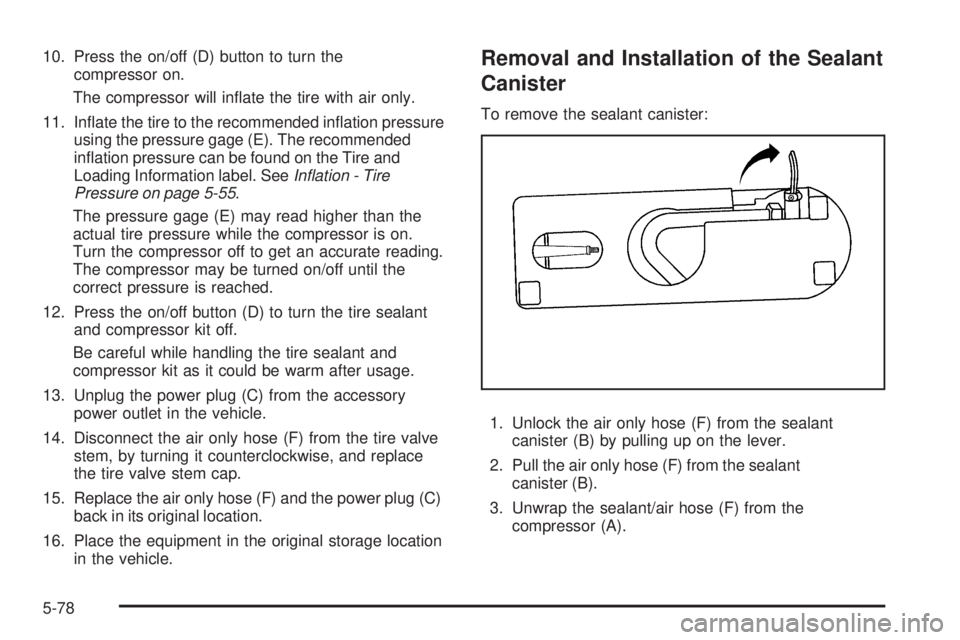
To remove the sealant canister:
1. Unlock the air only hose (F) from the sealant
canister (B) by pulling up on the lever.
2. Pull the air only hose (F) from the sealant
canister (B).
3. Unwrap the sealant/air hose (F) from the
compressor (A).
5-78
Page 333 of 402
To store the compact spare tire and tools, follow the
previous procedure without using the stow bolt extension
rod and seeRemoving the Spare Tire and Tools on
page 5-82and follow the removal procedure, in reverse,
for the proper jack storage instructions for this vehicle.
The compact spare tire is for temporary use only.
Replace the compact spare with a full-size tire as soon
as possible.
Compact Spare Tire
{CAUTION:
Driving with more than one compact spare tire at a
time could result in loss of braking and handling.
This could lead to a crash and you or others could
be injured. Use only one compact spare tire at
a time.
This vehicle may have a compact spare tire. Although the
compact spare tire was fully inated when the vehicle
was new, it can lose air after a time. Check the ination
pressure regularly. It should be 60 psi (420 kPa).After installing the compact spare on the vehicle, if the
vehicle has one, stop as soon as possible and make sure
the spare tire is correctly inated. The compact spare is
made to perform well at speeds up to 65 mph (105 km/h)
for distances up to 3,000 miles (5 000 km), so you can
nish your trip and have the full-size tire repaired or
replaced at your convenience. Of course, it is best to
replace the spare with a full-size tire as soon as possible.
The spare tire will last longer and be in good shape in
case it is needed again.
Notice:When the compact spare is installed, do not
take the vehicle through an automatic car wash with
guide rails. The compact spare can get caught on the
rails which can damage the tire, wheel and other
parts of the vehicle.
Do not use the compact spare on other vehicles.
And do not mix the compact spare tire or wheel with other
wheels or tires. They will not t. Keep the spare tire and
its wheel together.
Notice:Tire chains will not t the compact spare.
Using them can damage the vehicle and can damage
the chains too. Do not use tire chains on the compact
spare.
5-93
Page 355 of 402

Scheduled Maintenance
Service MaintenanceIMaintenanceII
Change engine oil and lter. SeeEngine Oil on page 5-13. Reset oil life
system. SeeEngine Oil Life System on page 5-16.An Emission Control
Service.••
Visually check for any leaks or damage.See footnote (j).••
Inspect engine air cleaner lter. If necessary, replace lter. SeeEngine Air
Cleaner/Filter on page 5-18.See footnote (k).•
Rotate tires and check ination pressures and wear. SeeTire Inspection and
Rotation on page 5-63and “Tire Wear Inspection” inAt Least Once a Month
on page 6-9.••
Inspect brake system.See footnote (a).••
Check engine coolant and windshield washer uid levels and add uid as
needed.••
Perform any needed additional services. See “Additional Required Services”
in this section.••
Inspect suspension and steering components.See footnote (b).•
Inspect engine cooling system.See footnote (c).•
Inspect wiper blades.See footnote (d).•
Inspect restraint system components.See footnote (e).•
Lubricate body components.See footnote (f).•
Replace passenger compartment air lter.See footnote (l).•
Inspect throttle system.See footnote (g).•
6-5
Page 359 of 402

Engine Coolant Level Check
Check the engine coolant level and add DEX-COOL®
coolant mixture if necessary. SeeEngine Coolant
on page 5-24.
Windshield Washer Fluid Level Check
Check the windshield washer uid level in the
windshield washer uid reservoir and add the proper
uid if necessary.
At Least Once a Month
Tire Ination Check
Inspect the vehicle’s tires and make sure they are
inated to the correct pressures. Do not forget to check
the spare tire, if the vehicle has one. SeeInflation - Tire
Pressure on page 5-55. If the vehicle has a spare tire,
check to make sure it is stored securely. SeeChanging
a Flat Tire on page 5-80.
Tire Wear Inspection
Tire rotation may be required for high mileage highway
drivers prior to the Engine Oil Life System service
notication. Check the tires for wear and, if necessary,
rotate the tires. SeeTire Inspection and Rotation on
page 5-63.
At Least Once a Year
Starter Switch Check
{CAUTION:
When you are doing this inspection, the vehicle
could move suddenly. If the vehicle moves, you or
others could be injured.
1. Before starting this check, be sure there is enough
room around the vehicle.
2. Firmly apply both the parking brake and the regular
brake. SeeParking Brake on page 2-30.
Do not use the accelerator pedal, and be ready to
turn off the engine immediately if it starts.
3. For automatic transmission vehicles, try to start the
engine in each gear. The vehicle should start only
in P (Park) or N (Neutral). If the vehicle starts in any
other position, contact your dealer/retailer for service.
For manual transmission vehicles, put the shift lever
in Neutral, push the clutch pedal down halfway, and
try to start the engine. The vehicle should start only
when the clutch pedal is pushed down all the way to
the oor. If the vehicle starts when the clutch pedal is
not pushed all the way down, contact your dealer/
retailer for service.
6-9