change time PONTIAC G6 2010 Owner's Manual
[x] Cancel search | Manufacturer: PONTIAC, Model Year: 2010, Model line: G6, Model: PONTIAC G6 2010Pages: 448, PDF Size: 2.5 MB
Page 296 of 448

Automatic Transmission Fluid
(3.9L V6 Engine)
When to Check and Change Automatic
Transmission Fluid
A good time to check the automatic transmission fluid
level is when the engine oil is changed.
Change the fluid and filter at the intervals listed in
Scheduled Maintenance on page 7-3and be sure to
use the transmission fluid listed inRecommended
Fluids and Lubricants on page 7-10.
How to Check Automatic Transmission
Fluid
Because this operation can be a little difficult, you may
choose to have this done at the dealer/retailer service
department.
If you do it yourself, be sure to follow all the instructions
here or you could get a false reading on the dipstick.Notice:Too much or too little uid can damage your
transmission. Too much can mean that some of the
uid could come out and fall on hot engine parts or
exhaust system parts, starting a re. Too little uid
could cause the transmission to overheat. Be sure
to get an accurate reading if you check your
transmission uid.
Wait at least 30 minutes before checking the
transmission fluid level if you have been driving:
•When outside temperatures are above 32°C (90°F).
•At high speed for quite a while.
•In heavy traffic — especially in hot weather.
•While pulling a trailer.
To get the right reading, the fluid should be at
normal operating temperature, which is 82°C to 93°C
(180°F to 200°F).
Get the vehicle warmed up by driving about
24 km (15 miles) when outside temperatures are
above 10°C (50°F). If it is colder than 10°C (50°F),
you may have to drive longer.
6-28
Page 309 of 448

Brake Wear
This vehicle has disc brakes. Disc brake pads have
built-in wear indicators that make a high-pitched warning
sound when the brake pads are worn and new pads
are needed. The sound can come and go or be heard
all the time the vehicle is moving, except when applying
the brake pedal firmly.
{WARNING:
The brake wear warning sound means that soon
the brakes will not work well. That could lead to an
accident. When the brake wear warning sound is
heard, have the vehicle serviced.
Notice:Continuing to drive with worn-out brake
pads could result in costly brake repair.
Some driving conditions or climates can cause a brake
squeal when the brakes are first applied or lightly applied.
This does not mean something is wrong with the brakes.
Properly torqued wheel nuts are necessary to help
prevent brake pulsation. When tires are rotated, inspect
brake pads for wear and evenly tighten wheel nuts in the
proper sequence to torque specifications inCapacities
and Specications on page 6-125.Brake linings should always be replaced as complete
axle sets.
Brake Pedal Travel
See your dealer/retailer if the brake pedal does not
return to normal height, or if there is a rapid increase
in pedal travel. This could be a sign that brake service
might be required.
Brake Adjustment
Every time the brakes are applied, with or without the
vehicle moving, the brakes adjust for wear.
Replacing Brake System Parts
The braking system on a vehicle is complex. Its many
parts have to be of top quality and work well together if
the vehicle is to have really good braking. The vehicle
was designed and tested with top-quality brake parts.
When parts of the braking system are replaced — for
example, when the brake linings wear down and new
ones are installed — be sure to get new approved
replacement parts. If this is not done, the brakes might
not work properly. For example, if someone puts in
brake linings that are wrong for the vehicle, the balance
between the front and rear brakes can change — for the
worse. The braking performance expected can change in
many other ways if the wrong replacement brake parts
are installed.
6-41
Page 342 of 448
Reset the Tire Pressure Monitor System. SeeTire
Pressure Monitor Operation on page 6-67.
Make certain that all wheel nuts are properly
tightened. See “Wheel Nut Torque” under
Capacities and Specications on page 6-125.
{WARNING:
Rust or dirt on a wheel, or on the parts to
which it is fastened, can make wheel nuts
become loose after time. The wheel could
come off and cause an accident. When you
change a wheel, remove any rust or dirt from
places where the wheel attaches to the
vehicle. In an emergency, you can use a cloth
or a paper towel to do this; but be sure to use a
scraper or wire brush later, if needed, to get all
the rust or dirt off. SeeChanging a Flat Tire on
page 6-90.
When It Is Time for New Tires
Various factors, such as maintenance, temperatures,
driving speeds, vehicle loading, and road conditions
influence when you need new tires.
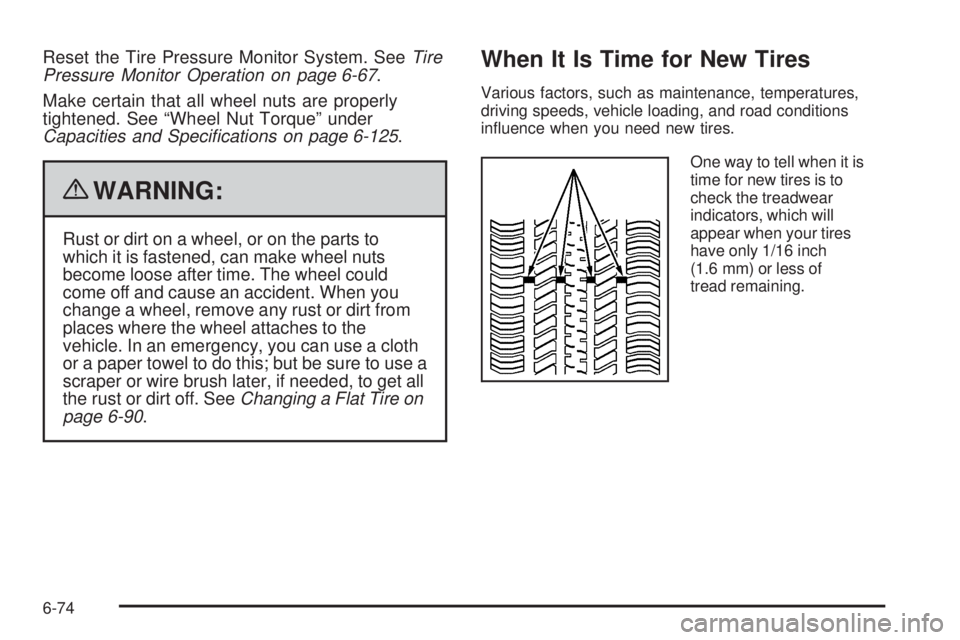
One way to tell when it is
time for new tires is to
check the treadwear
indicators, which will
appear when your tires
have only 1/16 inch
(1.6 mm) or less of
tread remaining.
6-74
Page 399 of 448
Rotation of New Tires
To maintain ride, handling, and performance of the
vehicle, it is important that the first rotation service
for new tires be performed when they have
8 000 to 13 000 km (5,000 to 8,000 miles).
SeeTire Inspection and Rotation on page 6-73.
Scheduled Maintenance
When the Change Oil Soon Message
Displays
Change engine oil and filter. SeeEngine Oil on
page 6-21.An Emission Control Service.
When the Change Oil Soon message displays, service
is required for the vehicle as soon as possible, within
the next 1 000 km/600 miles. If driving under the
best conditions, the engine oil life system might not
indicate the need for vehicle service for more than a
year. The engine oil and filter must be changed at
least once a year and the oil life system must be reset.
Your dealer/retailer has trained service technicians
who will perform this work and reset the system. If the
engine oil life system is reset accidentally, service
the vehicle within 5 000 km/3,000 miles since the last
service. Reset the oil life system whenever the oil
is changed. SeeEngine Oil Life System on page 6-24.When the Change Oil Soon message displays, certain
services, checks, and inspections are required. The
services described for MaintenanceIshould be
performed at every engine oil change. The services
described for MaintenanceIIshould be performed when:
•MaintenanceIwas performed the last time the
engine oil was changed.
•It has been 10 months or more since the Change
Oil Soon message has displayed or since the last
service.
MaintenanceI
•Change engine oil and filter. SeeEngine Oil on
page 6-21.An Emission Control Service.
•Engine coolant level check. SeeEngine Coolant on
page 6-31.
•Windshield washer fluid level check. SeeWindshield
Washer Fluid on page 6-38.
•Tire inflation check. SeeInation - Tire Pressure on
page 6-64.
•Tire wear inspection. SeeTire Inspection and
Rotation on page 6-73.
•Rotate tires. SeeTire Inspection and Rotation on
page 6-73.
7-3
Page 420 of 448

Coverage
Services are provided up to 5 years/100,000 miles
(160 000 km), whichever comes first.
In the U.S., anyone driving the vehicle is covered. In
Canada, a person driving the vehicle without permission
from the owner is not covered.
Roadside Assistance is not a part of the New Vehicle
Limited Warranty. Pontiac and General Motors of
Canada Limited reserve the right to make any changes
or discontinue the Roadside Assistance program at
any time without notification.
Pontiac and General Motors of Canada Limited reserve
the right to limit services or payment to an owner or
driver if they decide the claims are made too often, or
the same type of claim is made many times.
Services Provided
•Emergency Fuel Delivery:Delivery of enough fuel
for the vehicle to get to the nearest service station.
•Lock-Out Service:Service is provided to unlock the
vehicle if you are locked out. A remote unlock may
be available if you have OnStar
®. For security
reasons, the driver must present identification
before this service is given.
•Emergency Tow From a Public Road or
Highway:Tow to the nearest Pontiac dealer for
warranty service, or if the vehicle was in a crash and
cannot be driven. Assistance is also given when the
vehicle is stuck in sand, mud, or snow.
•Flat Tire Change:Service is provided to change a
flat tire with the spare tire. The spare tire, if equipped,
must be in good condition and properly inflated. It is
the owner’s responsibility for the repair or
replacement of the tire if it is not covered by the
warranty.
•Battery Jump Start:Service is provided to jump
start a dead battery.
•Trip Interruption Benets and Assistance:If your
trip is interrupted due to a warranty failure, incidental
expenses may be reimbursed during the 5 years/
100,000 miles (160 000 km) Powertrain warranty
period. Items considered are hotel, meals, and
rental car.
8-8
Page 423 of 448

In addition, for U.S. customers, should you arrange
transportation through a friend or relative, limited
reimbursement for reasonable fuel expenses may be
available. Claim amounts should reflect actual costs and
be supported by original receipts. See your dealer for
information regarding the allowance amounts for
reimbursement of fuel or other transportation costs.
Courtesy Rental Vehicle
Your dealer may arrange to provide you with a courtesy
rental vehicle or reimburse you for a rental vehicle that
you obtain if your vehicle is kept for an overnight warranty
repair. Rental reimbursement will be limited and must be
supported by original receipts. This requires that you
sign and complete a rental agreement and meet state/
provincial, local, and rental vehicle provider requirements.
Requirements vary and may include minimum age
requirements, insurance coverage, credit card, etc. You
are responsible for fuel usage charges and may also be
responsible for taxes, levies, usage fees, excessive
mileage, or rental usage beyond the completion of the
repair.
It may not be possible to provide a like-vehicle as a
courtesy rental.
Additional Program Information
All program options, such as shuttle service, may not be
available at every dealer. Please contact your dealer
for specific information about availability. All Courtesy
Transportation arrangements will be administered
by appropriate dealer personnel.
General Motors reserves the right to unilaterally modify,
change or discontinue Courtesy Transportation at
any time and to resolve all questions of claim eligibility
pursuant to the terms and conditions described
herein at its sole discretion.
Collision Damage Repair
If your vehicle is involved in a collision and it is
damaged, have the damage repaired by a qualified
technician using the proper equipment and quality
replacement parts. Poorly performed collision repairs
diminish your vehicle’s resale value, and safety
performance can be compromised in subsequent
collisions.
8-11
Page 428 of 448

Current and Past Model Order Forms
Technical Service Bulletins and Manuals are available
for current and past model GM vehicles. To request
an order form, specify year and model name of
the vehicle.
ORDER TOLL FREE: 1-800-551-4123
Monday-Friday 8:00 AM - 6:00 PM
Eastern Time
For Credit Card Orders Only
(VISA-MasterCard-Discover), visit Helm, Inc. on the
World Wide Web at: helminc.com
Or you can write to:
Helm, Incorporated
P.O. Box 07130
Detroit, MI 48207
Prices are subject to change without notice and without
incurring obligation. Allow ample time for delivery.
Note to Canadian Customers: All listed prices are
quoted in U.S. funds. Canadian residents are to make
checks payable in U.S. funds.
Vehicle Data Recording and
Privacy
Your GM vehicle has a number of sophisticated
computers that record information about the vehicle’s
performance and how it is driven. For example, your
vehicle uses computer modules to monitor and control
engine and transmission performance, to monitor the
conditions for airbag deployment and deploy airbags in a
crash and, if so equipped, to provide antilock braking to
help the driver control the vehicle. These modules may
store data to help your dealer/retailer technician service
your vehicle. Some modules may also store data about
how you operate the vehicle, such as rate of fuel
consumption or average speed. These modules may also
retain the owner’s personal preferences, such as radio
pre-sets, seat positions, and temperature settings.
8-16
Page 438 of 448

H
Halogen Bulbs................................................6-47
Hazard Warning Flashers................................... 4-3
Head Restraints............................................... 2-2
Headlamps....................................................4-10
Aiming .......................................................6-47
Bulb Replacement.......................................6-47
Daytime Running Lamps (DRL).....................4-11
Delayed.....................................................4-11
Flash-to-Pass............................................... 4-5
Headlamps, Front Turn Signal, Sidemarker,
and Parking Lamps..................................6-48
High/Low Beam Changer................................ 4-5
On Reminder..............................................4-10
Headlamps Off in Park....................................4-11
Heated Seats................................................... 2-6
Heater...........................................................4-16
Engine Coolant...........................................3-23
Highbeam On Light.........................................4-38
High-Speed Operation, Tires.............................6-66
Highway Hypnosis...........................................5-13
Hill and Mountain Roads..................................5-14
Hitches..........................................................5-30
Hood
Checking Things Under................................6-14
Release.....................................................6-15Horn ............................................................... 4-3
How OnStar Service Works..............................1-22
How the System Alarm is Activated...................3-17
How to Add Automatic Transmission Fluid..........6-30
How to Add Coolant to the Coolant
Surge Tank.................................................6-33
How to Check................................................6-65
How to Check Automatic Transmission Fluid.......6-28
How to Check Power Steering Fluid..................6-38
How to Detect a Tamper Condition....................3-18
How to Inspect the Engine Air Cleaner/Filter.......6-26
How to Reset the Engine Oil Life System...........6-25
How to Turn Off the System Alarm....................3-17
How to Wear Safety Belts Properly
...................2-20
Hydraulic Power Steering................................... 5-8
Hydroplaning..................................................5-12
I
If a Crash Occurs...........................................8-13
If No Steam Is Coming From The Engine
Compartment..............................................6-36
If Steam Is Coming From The Engine
Compartment..............................................6-35
If the Off Indicator is Lit for an Adult-Size
Occupant...................................................2-70
8
Page 448 of 448

W
Warning Lights, Gages, and Indicators...............4-24
Warnings
DIC Warnings and Messages........................4-42
Hazard Flashers............................................ 4-3
Safety and Symbols......................................... iv
Weight of the Trailer........................................5-28
Weight of the Trailer Tongue.............................5-29
What Kind of Engine Oil to Use........................6-23
What to Do with Used Oil ................................6-25
What to Use ..........................................6-32, 6-38
Wheels
Alignment and Tire Balance..........................6-79
Different Size..............................................6-77
Replacement...............................................6-79
When It Is Time for New Tires..........................6-74
When the Change Oil Soon Message Displays..... 7-3
When to Add Engine Oil..................................6-22
When to Change Engine Oil.............................6-24
When to Check..............................................6-65
When to Check and Change Automatic
Transmission Fluid.......................................6-28
When to Check Power Steering Fluid................6-37
When to Inspect the Engine Air Cleaner/Filter.....6-26
Where to Put the Child Restraint.......................2-44
Why Safety Belts Work....................................2-16Window Indexing (Coupe and Retractable
Hardtop).....................................................3-15
Window Lockout (Sedan Only)..........................3-16
Windows.......................................................3-13
Power ........................................................3-14
Windshield
Washer........................................................ 4-6
Washer Fluid..............................................6-38
Wiper Blade Replacement.............................6-55
Wiper Blades, Cleaning..............................6-112
Wiper Fuses.............................................6-115
Wipers......................................................... 4-5
Winter Driving................................................5-15
Winter Tires...................................................6-57
X
XM Radio Messages.......................................4-70
XM Satellite Radio Service...............................4-59
XM™ Satellite Radio
Antenna.....................................................4-84
XM™ Satellite Radio Service............................4-83
Y
Your Responsibility..........................................1-24
18