brake light PONTIAC GRAND-AM 1994 Owners Manual
[x] Cancel search | Manufacturer: PONTIAC, Model Year: 1994, Model line: GRAND-AM, Model: PONTIAC GRAND-AM 1994Pages: 274, PDF Size: 15.01 MB
Page 6 of 274
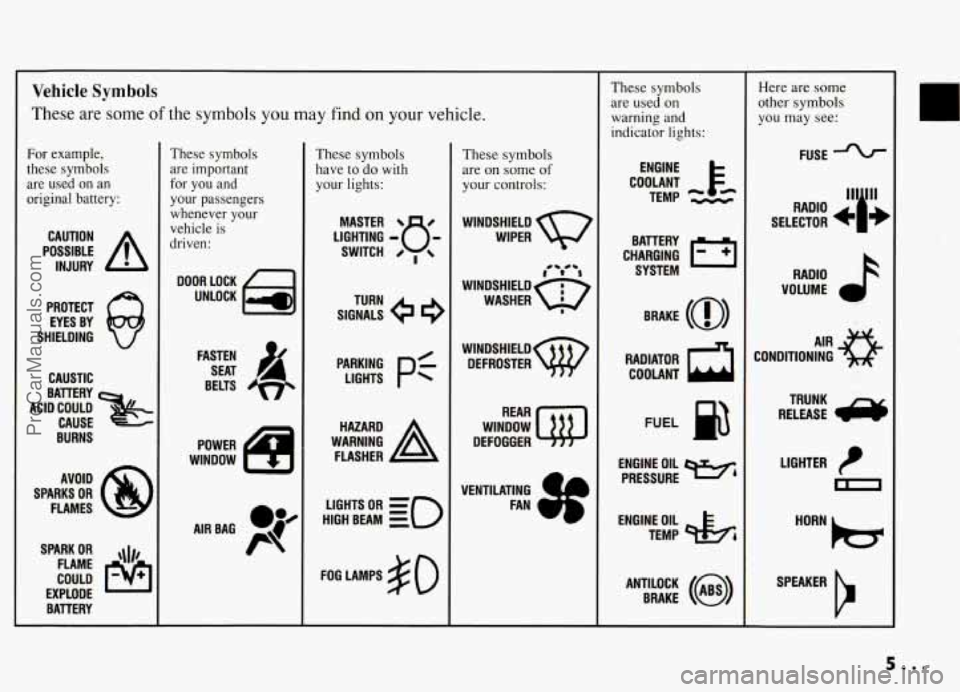
Vehicle Symbols
These are some of the symbols you may find on your vehicle.
For example,
these symbols
are used on an
original battery:
PROTECT
EYES BY
SHIELDING
CAUSTIC
BURNS
AVOID
SPARKS
OR
FLAMES
SPARK OR ,\I/,
COULD FLAME
EXPLODE BATTERY
These symbols
are important
for you and
your passengers
whenever your
vehicle is
driven:
DOOR LOCK
UNLOCK
FASTEN SEAT 4
BELTS
POWER
WINDOW
These symbols
have
to do with
your lights:
SIGNALS e
TURN
HIGH BEAM OR = =o
FOG LAMPS $0
These symbols
are
on some of
your controls:
WIPER Q
WINDSHIELD
WASHER
wlNDSHIELDw DEFROSTER
WINDOW REAR
DEFOGGER.
VENTILATING ca
FAN c.
These symbols
are used
on
warning and
indicator lights:
COOLANT F-
TEMP --
ENGINE
CHARGING BATTERY
SYSTEM
BRAKE (0)
RADIATOR a
COOLANT
FUEL
ENGINE OIL
PRESSURE
-4
TEMP OIL &
ANTILOCK (e)
BRAKE
Here are some
other symbols
you may
see:
FUSE *
RADIO
VOLUME
AIR
CONDITIONING
RELEASE TRUNK
LIGHTER
SPEAKER
b
ProCarManuals.com
Page 46 of 274
...
dele you can learn about the many
tandard and optional features on our Pontiac. and information on
tarting. shifting and braking
. Also
!xplained are the instrument panel
nd the warning systems that tell you
’ everything is working properly ..
ind what to do if you have a problem .
Part 2
Features & Controls
Keys ..... ....................................................... 46
DoorLocks ........................................................ 47
Keyless Entry System
............................................... 50
GloveBox ........................................................ 54
Ignitionswitch
..................................................... 55
StartingYourEngine ................................................ 56
Engine Coolant Heater (Engine Block Heater) ............................ 58
Shifting the Automatic Transaxle ...................................... 59
Shifting the Five-Speed Manual Transaxle ............................... 64
Shifting Into Park (Automatic Transaxle) ................................ 67
Windows
......................................................... 72
Turn Signal/Multifunction Lever ....................................... 73
CruiseControl
..................................................... 74
Lightcontrols
..................................................... 77
Battery Rundown Protection
.......................................... 80
Windshield Wipers .................................................. 81
Windshield Washer ................................................. 82
Mirrors ........................................................... 82
SunVisors ........................................................ 84
Instrumentpanel ................................................... 88
Warning Lights, Gages and Indicators ................................... 93
ParkingBrake ...................................................... 66
45.0.
ProCarManuals.com
Page 66 of 274
1 3 5
2 4 R
C
E
il
F
4
h
II
t'
C
4
I1
C
F
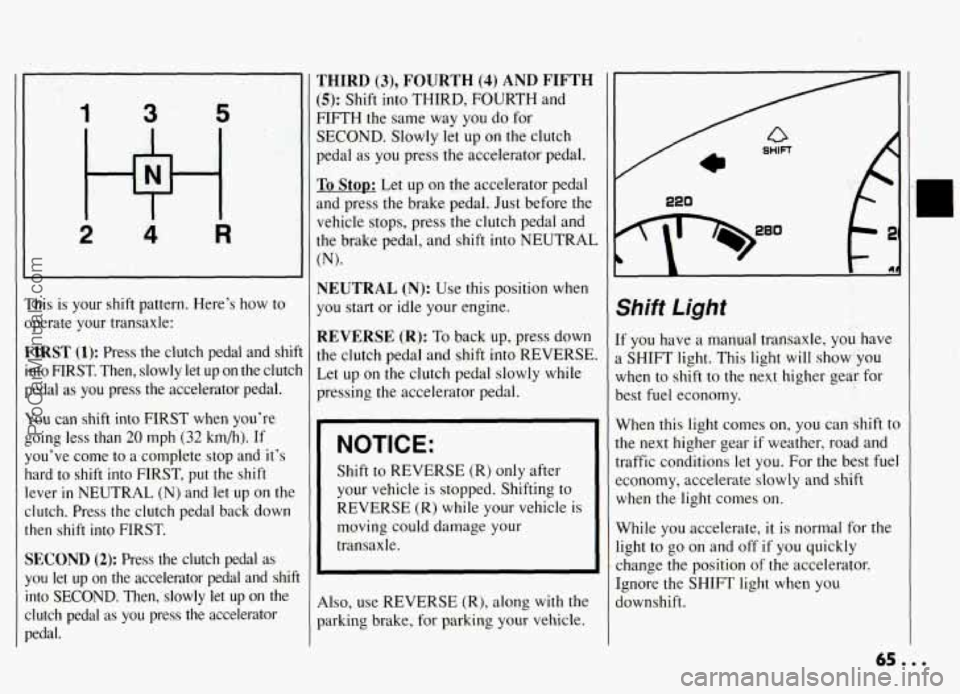
'his is your shift pattern. Here's how to
bperate your transaxle:
rIRST (1): Press the clutch pedal and shi
nto FIRST. Then, slowly let up on the clutc
kedal as you press the accelerator pedal.
lou can shift into FIRST when you're
;oing less than
20 mph (32 km/h). If
fou've come to a complete stop and it's
lard to
shift into FIRST, put the shift
ever
in NEUTRAL (N) and let up on the
Iutch. Press the clutch pedal back down
hen shift into FIRST.
iECOND (2): Press the clutch pedal as
'ou let up on the accelerator pedal and shij
nto
SECOND. Then, slowly let up on the
:lutch pedal as
you press the accelerator
Iedal.
HIRD (3), FOURTH (4) AND FIFTH
;): Shift into THIRD, FOURTH and
IFTH the same way you do for
ECOND. Slowly let up on the clutch
:dal as you press the accelerator pedal.
o Stop: Let up on the accelerator pedal
Id press the brake pedal. Just before the
:hicle stops, press
the clutch pedal and
le brake pedal, and shift into NEUTRAL
9.
'EUTRAL (N): Use this position when
3u start or idle your engine.
.EVERSE (R): To back up, press down
Le clutch pedal and shift into REVERSE.
et
up on the clutch pedal slowly while
ressing the accelerator pedal. ~
NOTICE:
Shift
to REVERSE (R) only after
your vehicle is stopped. Shifting to
REVERSE (R) while your vehicle is
moving could damage your
transaxle.
ho, use REVERSE (R), along with the
arking brake, for parking your vehicle.
Shift Light
If you have a manual transaxle, you have
a SHIFT light. This light will show you
when to shift to the next higher gear for
best fuel economy.
When this light comes on, you can shift to
the next higher gear if weather, road and
traffic conditions let you. For the best fuel
economy, accelerate slowly and shift
when the light comes on.
While you accelerate, it is normal for the
light to go on and off if you quickly
change the position of the accelerator.
Ignore the SHIFT light when you
downshift.
ProCarManuals.com
Page 67 of 274
Features & Controls
Shift Speeds
(Manual Transaxle)
This chart shows when to shift to the next
higher gear for best fuel economy.
Acceleration Shift Speeds for 2.3L
OHC and 2.3L High Output Quad 4
Engines (Codes 3 and A):
FIRST to SECOND 15 mph (24 km/h)
SECOND to THIRD
25 mph (40 km/h)
THIRD to FOURTH 40 mph
(64 km/h)
FOURTH to FIFTH 45 mph (72 km/h)
If your speed drops below 20 mph
(32 km/h), or if the engine is not running
smoothly, you should downshift to the
next lower gear.
You may have to
downshift two or more gears to keep the
engine running smoothly or for good
performance.
NOTICE:
If you skip more than one gear
when you downshift, or if you race
the engine when you downshift, you
can damage the clutch or transaxle.
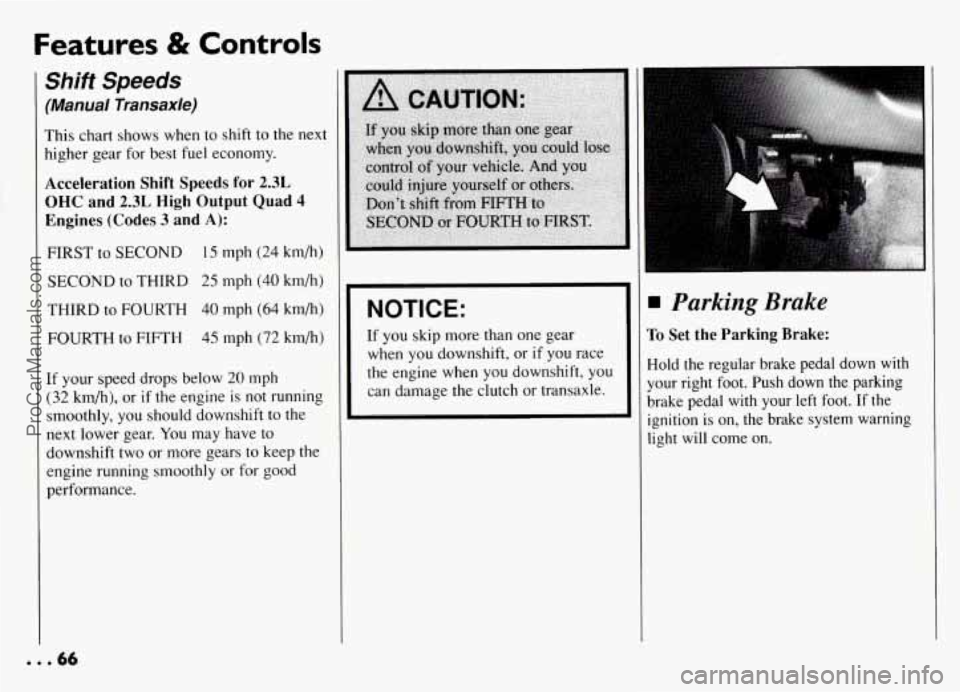
Parking Brake
To Set the Parking Brake:
Hold the regular brake pedal down with
your right foot. Push down the parking
brake pedal with your left foot. If the
ignition is on, the brake system warning
light will come on.
... 66
ProCarManuals.com
Page 77 of 274
Features & Controls
To Reduce Speed While
Using Cruise Control
There are two ways to reduce your speed
while using cruise control:
0 Push in the button at the end of the
lever until you reach the lower speed
you want, then release
it.
0 To slow down in very small amounts,
push the button for less than half a
second. Each
time you do this, you’ll
go
1 mph (1.6 km/h) slower.
Passing Another Vehicle
While Using Cruise
Control
Use the accelerator pedal to increase your
speed. When you take your foot off the
pedal, your vehicle
will slow down to the
Cruise Control speed you set earlier.
Using Cruise Control on
Hills
How well your Cruise Control will work
on hills depends upon your speed, load,
and the steepness of the hills. When going
up steep hills, you may have to step on
the accelerator pedal to maintain your
speed. When going downhill, you may
have to brake or shift to
a lower gear to
keep your speed down. Of course,
applying the brake takes you out of
Cruise Control. Many drivers find this
to
be too much trouble and don’t use Cruise
Control on steep hills.
To Get Out of Cruise
Control
There are two ways to turn off the Cruise
Control:
0 Step lightly on the brake pedal or push
the clutch pedal,
if you have a manual
transaxle;
OR
Move the Cruise switch to OFF.
To Erase Cruise Speed
Memory
When you turn off the Cruise Control or
the ignition, your Cruise Control set speed
memory
is erased.
ProCarManuals.com
Page 78 of 274
rn Light Controls
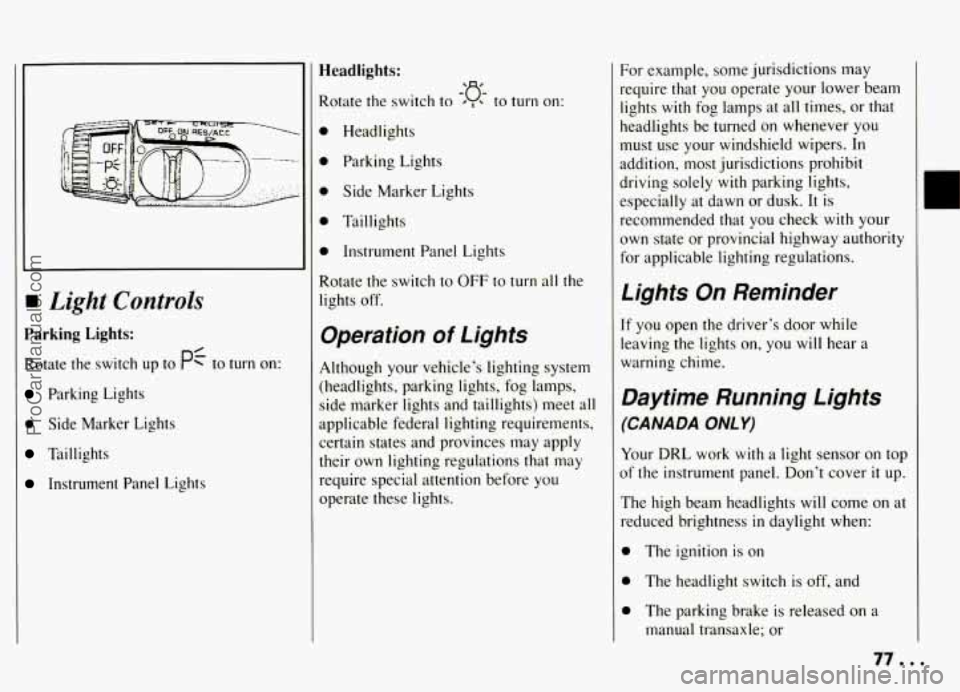
Parking Lights:
Rotate the switch up to PC to turn on:
Parking Lights
0 Side Marker Lights
Taillights
Instrument Panel Lights
Headlights:
Rotate the switch to ’ , to turn on:
0 Headlights
0 Parking Lights
0 Side Marker Lights
0 Taillights
0 Instrument Panel Lights
Rotate the switch
to OFF to turn all the
lights off.
-‘a-
Operation of Lights
Although your vehicle’s lighting system
(headlights, parking lights, fog lamps,
side marker lights and taillights)
meet all
applicable federal lighting requirements,
certain states and provinces may apply
their own lighting regulations that may
require special attention before you
operate these lights.
For example, some jurisdictions may
require that you operate your lower beam
lights with fog lamps at all times, or that
headlights be turned
on whenever you
must use your windshield wipers.
In
addition, most jurisdictions prohibit
driving solely with parking lights,
especially at dawn or dusk.
It is
recommended that you check with your
own state or provincial highway authority
for applicable lighting regulations.
Lights On Reminder
If you open the driver’s door while
leaving the lights
on, you will hear a
warning chime.
Daytime Running Lights
(CANADA ONLY)
Your DRL work with a light sensor on top
of the instrument panel. Don’t cover
it up.
The high beam headlights will come
on at
reduced brightness in daylight when:
0 The ignition is on
0 The headlight switch is off, and
0 The parking brake is released on a
manual transaxle; or
77 a I
ProCarManuals.com
Page 79 of 274
Features & Controls
Daytime Running Lights
(CANADA ONLY) (CONT.)
The shift lever is shifted out of PARK
(P) or NEUTRAL (N) on an automatic
transaxle.
At dusk, the exterior lights and headlights
will come on automatically. At dawn, the
exterior lights will go out and the high
beams will change to the reduced
brightness of DRL again (if the headlight
switch is off).
Of course, you may still turn on the
headlights any time you need to.
To idle your vehicle with the DRL off, set
the parking brake
on a manual transaxle
or put the vehicle
in PARK (P) or
NEUTRAL
(N) on an automatic
transaxle, while the ignition is in the OFF
or LOCK position. Then start the vehicle.
The DRL will stay off until
you release
the parking brake on a manual transaxle
or shift out of PARK (P) or NEUTRAL
(N) on an automatic transaxle.
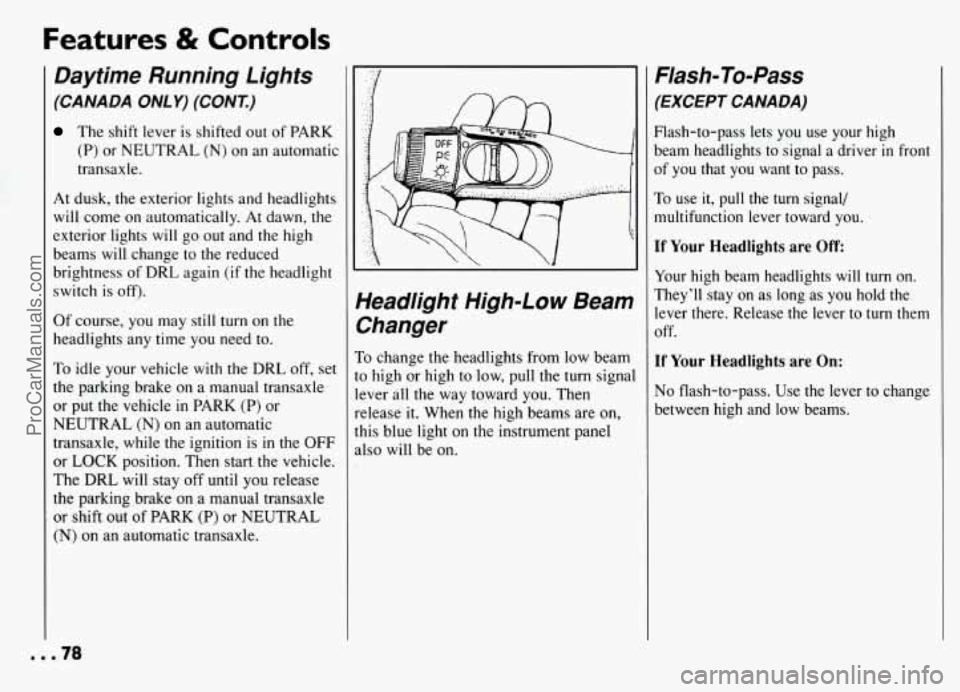
Yeadlight High-Low Beam
%anger
To change the headlights from low beam
o high or high to low, pull the turn signal
ever all the way toward you. Then
elease it. When the high beams are on,
his blue light on the instrument panel
dso will be on.
Flash-To-Pass
(EXCEPT CANADA)
Flash-to-pass lets you use your high
beam headlights to signal a driver
in front
of you that you want to pass.
To use it, pull the turn signal/
multifunction lever toward you.
If Your Headlights are Off
Your high beam headlights will turn on.
They’ll stay on as long as you hold the
lever there. Release the lever to turn them
off.
If Your Headlights are On:
No flash-to-pass. Use the lever to change
between high and low beams.
mm.78
ProCarManuals.com
Page 90 of 274
The Instrument
Panel-Your Information System
Your instrument panel is designed to let
you know at a glance how
your vehicle is
running. You’ll know how fast you’re
going, how much fuel you’re using, and
many other things you’ll need to drive
safely and economically.
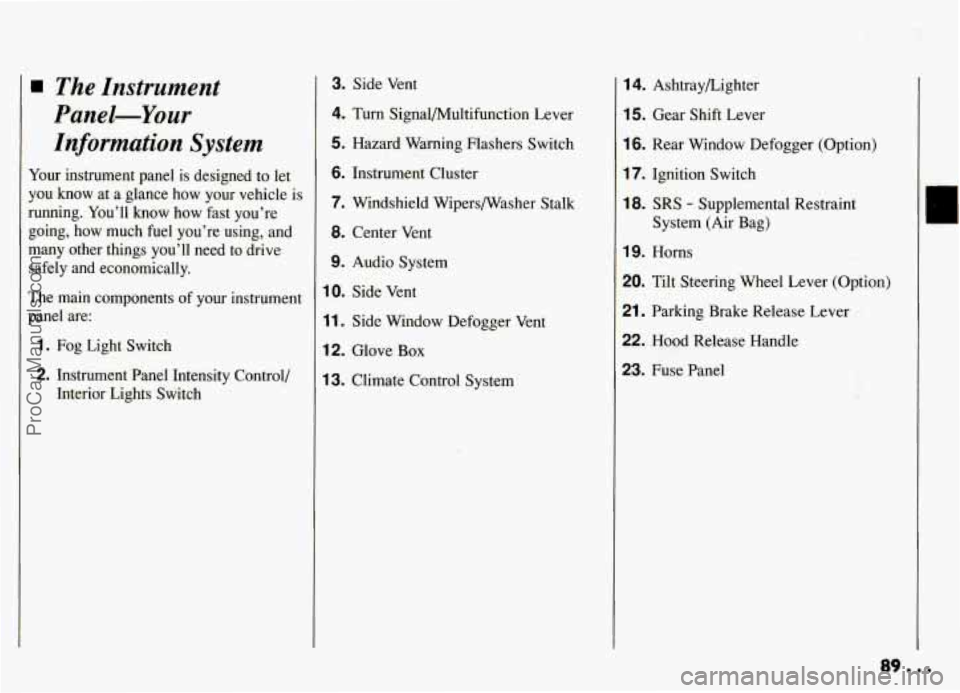
The main components of your instrument
panel are:
1. Fog Light Switch
2. Instrument Panel Intensity Control,’
Interior Lights Switch
3. Side Vent
4. Turn Signal/Multifunction Lever
5. Hazard Warning Flashers Switch
6. Instrument Cluster
7. Windshield Wipersmasher Stalk
8. Center Vent
9. Audio System
10. Side Vent
11. Side Window Defogger Vent
12. Glove Box
13. Climate Control System
14. Ashtraybighter
15. Gear Shift Lever
16. Rear Window Defogger (Option)
17. Ignition Switch
18. SRS - Supplemental Restraint
System (Air Bag)
19. Horns
20. Tilt Steering Wheel Lever (Option)
21. Parking Brake Release Lever
22. Hood Release Handle
23. Fuse Panel
ProCarManuals.com
Page 99 of 274
Features & Controls
BRAKE
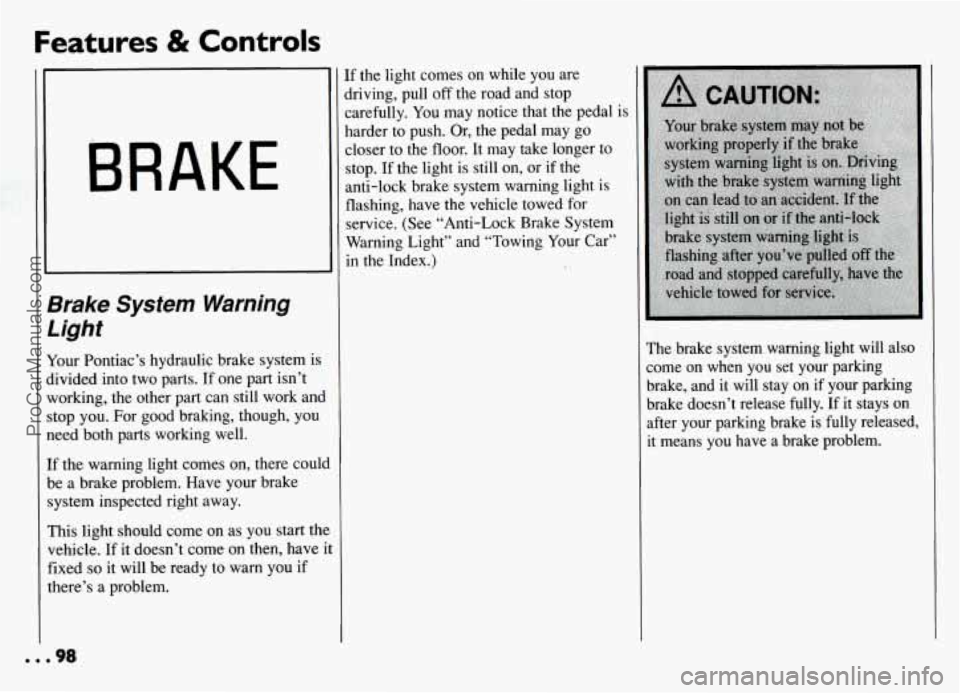
Brake System Warning
light
four Pontiac’s hydraulic brake system is
!ivided into two parts. If one part isn’t
qorking, the other part can still work and
top you. For good braking, though, you
leed both parts working well.
f the warning light comes on, there coulc
le a brake problem. Have your brake
ystem inspected right away.
ihis light should come on as you start tht
lehicle. If it doesn’t come
on then, have i
ixed so it will be ready to warn you if
here’s a problem.
[f the light comes on while you are
hiving, pull
off the road and stop
zarefully. You may notice that the pedal is
harder to push. Or, the pedal may go
;loser to the floor. It may take longer to
stop. If the light is still on, or if the
anti-lock brake system warning light is
flashing, have the vehicle towed for
service. (See “Anti-Lock Brake System
Warning Light” and “Towing Your Car”
in the Index.)
The brake system warning light will also
come on when you set your parking
brake, and it will stay on if your parking
brake doesn’t release fully. If it stays on
after your parking brake is fully released,
it means you have a brake problem.
... 98
ProCarManuals.com
Page 100 of 274
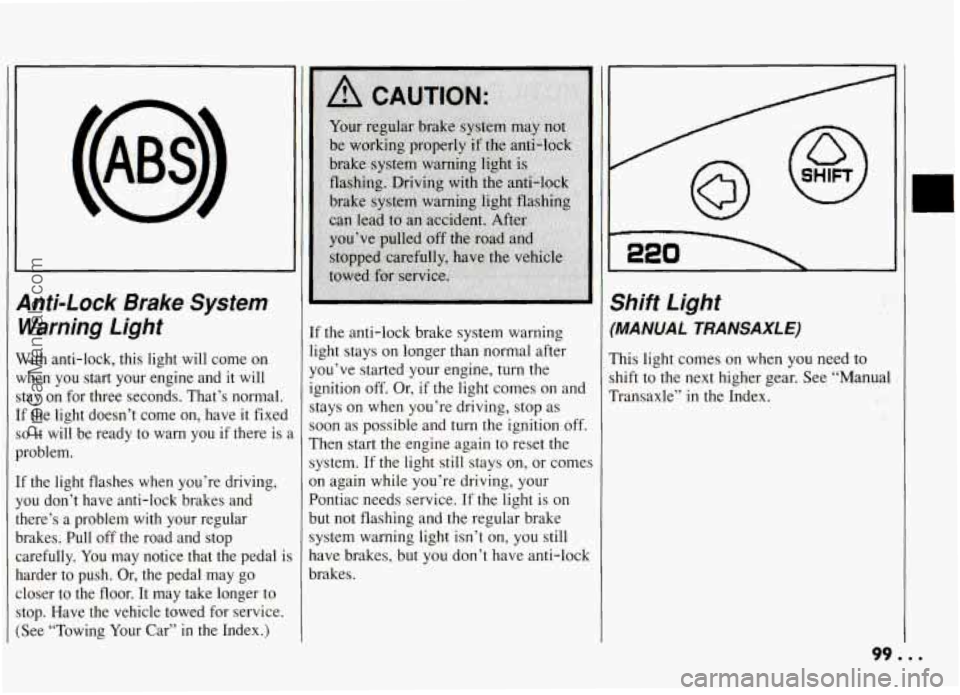
anti-Lock Brake System
Naming Light
Vith anti-lock, this light will come on
{hen you start your engine and it will
tay on for three seconds. That’s normal.
F the light doesn’t come on, have it fixed
D it will be ready to warn you if there is 2
roblem.
1 the light flashes when you’re driving,
ou don’t have anti-lock brakes and
lere’s a problem with your regular
rakes. Pull off the road and stop arefully. You may notice that the pedal
is
arder to push. Or, the pedal may go
loser to the floor. It may take longer to
:op. Have the vehicle towed for service.
See “Towing Your Car”
in the Index.)
If the anti-lock brake system warning
light stays on longer than normal after
you’ve started your engine, turn the
ignition
off. Or, if the light comes on and
stays on when you’re driving, stop as
soon as possible and turn the ignition off.
Then start the engine again to reset the
system.
If the light still stays on, or comes
3n again while you’re driving, your
Pontiac needs service.
If the light is on
but not flashing and the regular brake
system warning light isn’t on, you still
nave brakes, but you don’t have anti-lock
xakes.
Shift Light
(MANUAL TRA NSAXL E)
This light comes on when you need to
shift to the next higher gear. See “Manual
Transaxle”
in the Index.
99. ..
ProCarManuals.com