steering wheel PONTIAC GRAND-AM 1994 Owners Manual
[x] Cancel search | Manufacturer: PONTIAC, Model Year: 1994, Model line: GRAND-AM, Model: PONTIAC GRAND-AM 1994Pages: 274, PDF Size: 15.01 MB
Page 24 of 274
-.
How The Air Bag System
Works
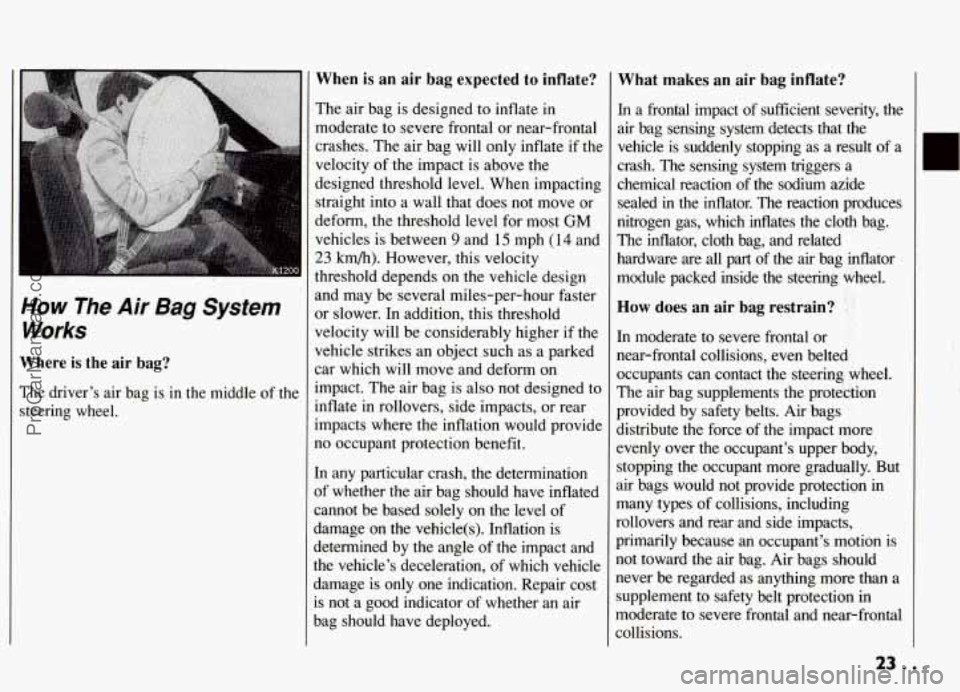
Where is the air bag?
The driver’s air bag is in the middle of the
steering wheel.
When is an air bag expected to inflate?
The air bag is designed to inflate in
moderate to severe frontal or near-frontal
crashes. The air bag will only inflate
if the
velocity of the impact is above the
designed threshold level. When impacting
straight into a wall that does not move or
deform, the threshold level for most
GM
vehicles is between 9 and 15 mph (14 and
23 km/h). However, this velocity
threshold depends on the vehicle design
and may be several miles-per-hour faster
or slower. In addition, this threshold
velocity will be considerably higher
if the
vehicle strikes an object such as a parked
car which will move and deform on
impact. The air bag is also not designed to
inflate in rollovers, side impacts, or rear
impacts where the inflation would provide
no occupant protection benefit.
In any particular crash, the determination
of whether ‘the air bag should have inflated
cannot be based solely on the level of
damage on the vehicle(s), Inflation is
determined by the angle of the impact and
the vehicle’s deceleration, of which vehicle
damage
is only one indication. Repair cost
is not a good indicator of whether an air
bag should have deployed.
What makes an air bag inflate?
In a frontal impact of sufficient severity, the
air bag sensing system detects that the
vehicle is suddenly stopping as a result of a
crash. The sensing system triggers a
chemical reaction
of the sodium azide
sealed in the inflator. The reaction produces
nitrogen gas, which inflates the cloth bag.
The inflator, cloth bag, and related
hardware are all part of the
air bag inklator
module packed inside the steering wheel.
How does an air bag restrain? ~
In moderate to severe frontal or
near-frontal collisions, even belted
occupants can contact the steering wheel.
The air bag supplements the protektion
provided by safety belts. Air.bags
distribute the force of the impact more
evenly over the occupant’s upper body,
stopping the occupant more gradually. But
air bags would not provide protection in
many types of collisions, including
rollovers and rear and side impacts,
primarily because an occupant’s motion is
not toward the air bag. Air bags should
never be regarded as anything more than a
supplement to safety belt protection in
moderate to severe frontal and near-frontal
:ollisions.
II
ProCarManuals.com
Page 25 of 274
Seats & Restraint Systems
How The Air Bag System
Works (CONT)
What will you see after an air bag
inflation?
After the air bag has inflated, it will then
quickly deflate, This occurs
so quickly
that some people may not even realize
that the air bag inflated. Some
components of the air bag module
in the
steering wheel hub may be hot for a short
time, but the portion of the bag that comes
into contact with you will not be hot to
the touch. There will be small amounts of
smoke and dust coming from vents in the
deflated air bag. The air bag will
not
impede the driver’s vision or ability to
steer the vehicle, nor will it hinder the
occupants from exiting the vehicle.
0 The air bag is designed to inflate only
once. After it inflates, you’ll need
some new parts for your air bag
system. If you don’t get them, the air
bag system won’t be there to help
protect you in another crash.
A new
system will include the air bag module
and possibly other parts. The service
manual has information about the
need to replace other parts.
Your vehicle is equipped with a
diagnostic module, which records
information about the air bag system
if the air bag deploys during a crash.
The module records information about
the readiness .of the system, which
sensors activated the deployment, and
whether the driver’s safety belt was in
use.
Let only qualified technicians work on
your air bag system. Improper service
can mean that your air bag system
won’t work properly. See your dealer
for service.
NOTICE:
If you damage the cover for the
driver’s air bag, it may not work
properly. You may have to replace
the air bag on the steering wheel.
Do not open or break the air bag
cover.
Is the smoke from an air bag inflation
harmful?
The particles emitted during air bag
inflation are not harmful to most people.
Some people with respiratory ailments
may experience difficulty breathing if
they’stay in the vehicle with the windows
closed’after air bag inflation.
So, if your
air bag inflates, you and any passengers
should exit the vehicle if and when it is
safe’to do
so. If you or your passengers
can’t get out of the vehicle, try to get
fresh air by opening a window, turning on
the fan, or opening
a door.
... 24
ProCarManuals.com
Page 53 of 274
Features & Controls
Battery Replacement
(CONK)
To Replace Batteries in the Remote
Keyless Entry:
1. Remove the screw from back cover.
2. Lift the front cover off, bottom half
first.
3. Remove and replace the two batteries
(2016).
4. Reassemble the transmitter.
5. Check the transmitter operation.
Tailgate Caution
. . 52
Theft
Vehicle theft is big business, especially in
some cities. Although your Pontiac has a
number of theft deterrent features, we
know that nothing we put on
it can make
it impossible to steal. However, there are
ways you can help.
Key in the Ignition
If you walk away from your vehicle with
the keys inside, it’s an easy target for joy
riders or professional thieves
-- so don’t
do
it.
When you park your Pontiac and open the
driver’s door, you’ll hear a chime
reminding you to remove your key from
the ignition and take
it with you. Always
do this. Your steering wheel will be
locked, and
so will your ignition. If you
have an automatic transaxle, taking your
key out also locks your transaxle. And
remember to lock the doors.
Parking at Night
Park in a lighted spot, close all windows
and lock your vehicle. Remember to keep
your valuables out of sight. Put them
in a
storage area, or take them with you.
ProCarManuals.com
Page 56 of 274
LOCK
ACCESSORY
I Ignition Switch-
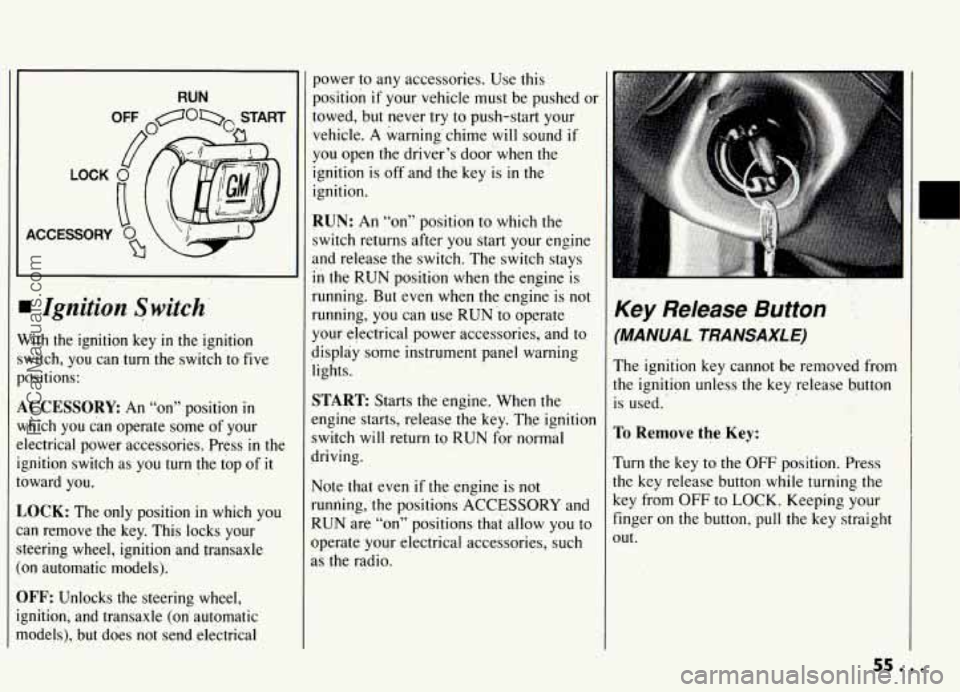
Vith the ignition key in the ignition
witch, you can
turn the switch ‘to five
ositions:
,CCESSORE An “on” position in
lhich you can operate some of your
lectrical power accessories. Press
in the
;nition switch as you turn the top of
it
)ward you.
,OCK: The only position in which you
!n remove the key. This locks your
:cering wheel, ignition and transaxle
~n automatic models).
IFF: Unlocks the steering wheel,
;nition, and transaxle (on’ automatic
todels), but.does not send electrical
power to any accessories. Use this
position if your vehicle must be pushed or
towed, but never try
to push-start your
vehicle.
A warning’chime will sound if
you open the driver’s door when the
ignition is off and the key is in the
ignition.
RUN: An “on” position to which the
switch returns after you start your engine
and release the switch. The switch stays
in the RUN position when the engine is
running. But ‘even when the engine is not
running, you can use RUN io operate
your electrical power accessories,
and to
display
some instrument panel warning
lights.
START: Starts the engine. When the
engine starts, release the key. The ignition
switch
will return to RUN for normal
driving.
Note that even if the engine is not
running, ‘the positions
ACCESSORY and
RUN are “on” positions that allow you to
operate your electrical accessories, such
as the radio.
,.
Key Release Button
‘MANUAL TRANSAXLE)
The ignition key cannot be removed from
he ignition unless.the key release button
s used.
ro Remwe the Key:
rum the key to the OFF position. Press
he key release button while turning
the
Ley from OFF to LOCK. Keeping your
inger on
the button, pull the key straight
)Ut.
sa...
ProCarManuals.com
Page 57 of 274
Features & Controls
Key Release Button
(MANUAL TRANSAXLE) (CONT.)
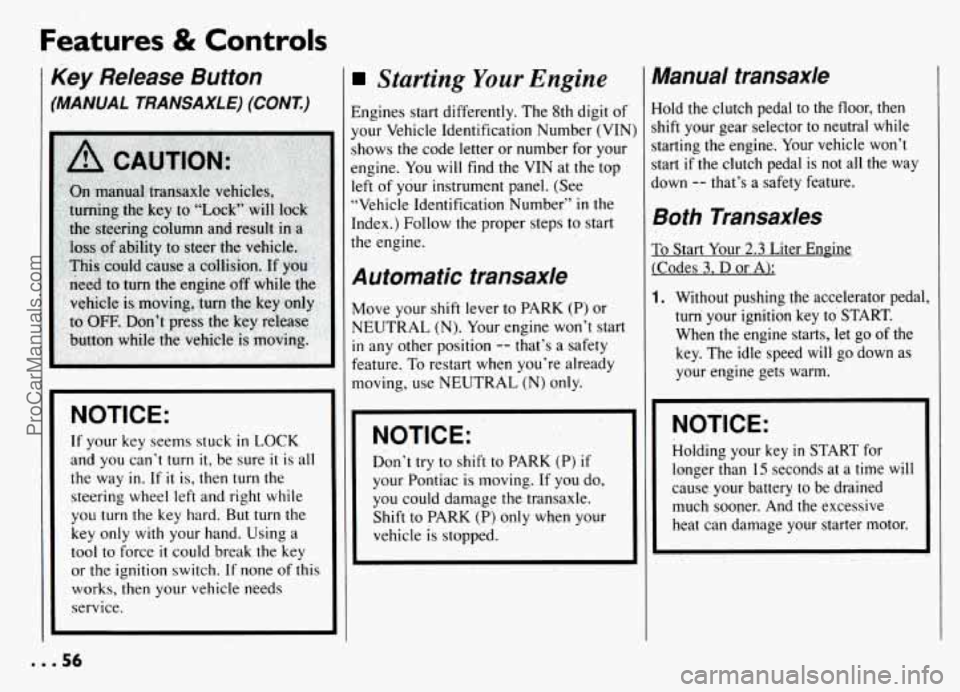
NOTICE:
If your key seems stuck in LOCK
and you can’t turn it, be sure it is all
the.way in. If
it is, then turn the
steering wheel left and right while
you
turn the key hard. But turn the
key only
with your hand. Using a
tool to force
it could break the key
or the ignition switch.
If none of this
works, then your vehicle needs
service.
Starting Your Engine
Engines start differently. The 8th digit of
your Vehicle Identification Number (VIN)
shows
the code letter or number for your
engine. You
will find the VIN at the top
left
of your instrument panel. (See
”Vehicle Identification Number”
in the
Index.) Follow the proper steps to start
the engine.
Automatic transaxle
Move your shift lever to PARK (P) or
NEUTRAL (N). Your engine won’t start
in any other position -- that’s a safety
feature. To restart when you’re already
.EUTRAL (N) only.
Don’t try to shift to PARK (P) if
your Pontiac is moving. If you do,
you could damage the transaxle.
Shift to PARK (P) only when your
vehicle
is stopped.
Manual transaxle
Hold the clutch pedal to the floor, then
shift your gear selector to neutral while
starting the engine. Your vehicle won’t
start
if the clutch pedal is not all the way
down
-- that’s a safety feature.
Both Transaxles
To Start Your 2.3 Liter EnEine
(Codes
3. D or A):
1. Without pushing the accelerator pedal,
turn your ignition key to START.
When the engine starts, let
go of the
key. The idle speed
will go down as
your engine gets warm.
NOTICE:
Holding your key in START for
longer than
15 seconds at a time will
cause your battery to be drained
much sooner. And the excessive
heat can damage your starter motor.
ProCarManuals.com
Page 72 of 274
Follow the proper steps to be sure your
vehicle won’t move. See “Shifting Into
PARK (P)” in the Index.
If you’re pulling a trailer, see “Towing a
Trailer”
in the Index.
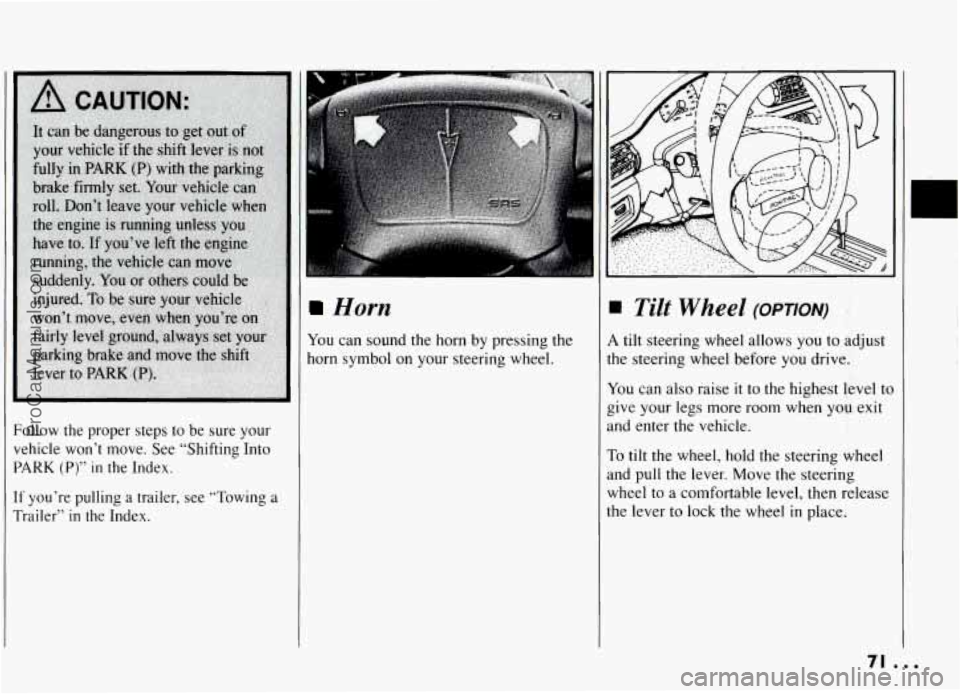
Horn
You can sound the horn by pressing the
horn symbol
on your steering wheel.
A tilt steering wheel allows you to adjust
the steering wheel before you drive.
You can also raise it to the highest level tc
give your legs more room when you exit
and enter the vehicle.
To tilt the wheel, hold the steering wheel
and pull the lever. Move the steering
wheel to a comfortable level, then release
the lever
to lock the wheel in place,
71 ...
ProCarManuals.com
Page 90 of 274
The Instrument
Panel-Your Information System
Your instrument panel is designed to let
you know at a glance how
your vehicle is
running. You’ll know how fast you’re
going, how much fuel you’re using, and
many other things you’ll need to drive
safely and economically.
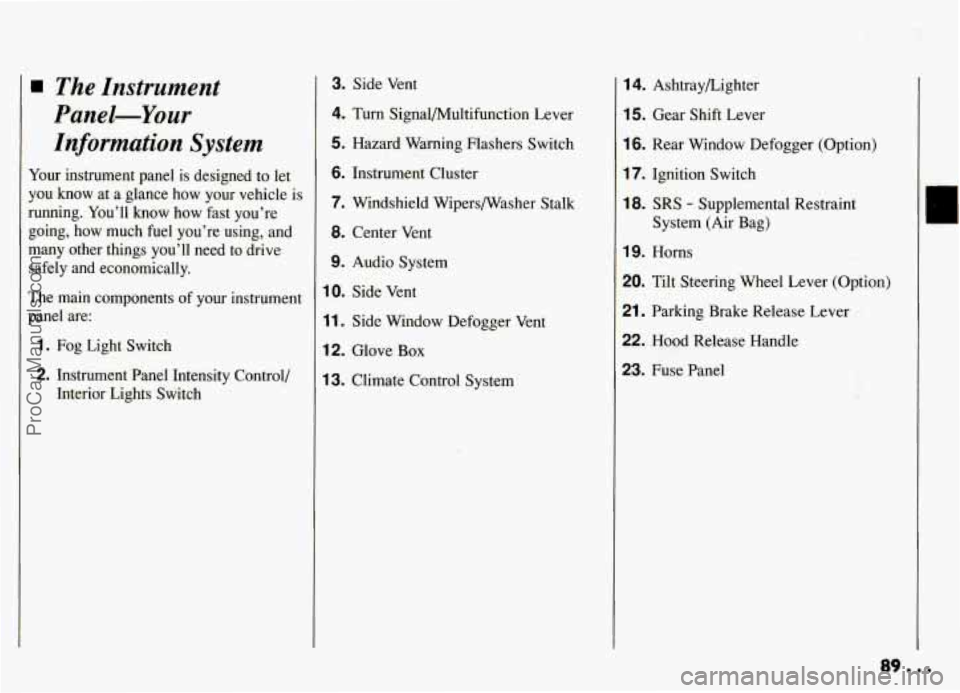
The main components of your instrument
panel are:
1. Fog Light Switch
2. Instrument Panel Intensity Control,’
Interior Lights Switch
3. Side Vent
4. Turn Signal/Multifunction Lever
5. Hazard Warning Flashers Switch
6. Instrument Cluster
7. Windshield Wipersmasher Stalk
8. Center Vent
9. Audio System
10. Side Vent
11. Side Window Defogger Vent
12. Glove Box
13. Climate Control System
14. Ashtraybighter
15. Gear Shift Lever
16. Rear Window Defogger (Option)
17. Ignition Switch
18. SRS - Supplemental Restraint
System (Air Bag)
19. Horns
20. Tilt Steering Wheel Lever (Option)
21. Parking Brake Release Lever
22. Hood Release Handle
23. Fuse Panel
ProCarManuals.com
Page 126 of 274
To Use Anti-Lock:
Don’t pump the brakes. Just hold the
brake pedal down and let anti-lock work
.for you. You may feel the system
working, or you may notice some noise,
but this is normal.
Braking in Emergencies
Use your anti-lock braking system when
you need to. With anti-lock, you can steer
and brake at the same time. In many
emergencies, steering can help you more
than even the very best braking.
Steering
Power Steering
If you lose power steering assist because
the engine stops or the system is not
functioning, you can steer but it will take
much more effort.
Variable Effort Steering
(OPTION)
This steering system provides lighter
steering effort for parking and at low
vehicle speeds. Steering effort will
increase at higher speeds for improved
road feel.
Steering Tips
Driving on Curves
It’s important to take curves at a
reasonable speed.
A lot of the “driver lost control” accidents
mentioned on the news happen on curves.
Here’s why:
Experienced driver or beginner, each of
us is subject to the same laws of physics
when driving on curves. The traction of
the tires against the road surface makes it
possible
for the vehicle to change its path
when you
turn the front wheels. If there’s
no traction, inertia will keep the vehicle
going in the same direction. If you’ve
ever tried to steer a vehicle on wet ice,
you’ll understand this.
The traction you can get in a curve
depends on the condition of your tires and
the road ,surface, the angle at which the
curve is banked, and your speed. While
you’re in a curve, speed isthe one factor
you can control.
Suppose you’re steering through a sharp
curve. Then you suddenly accelerate.
Both control systems
-- steering and
acceleration
-- have to do their work
where the tires meet the road. Adding the
sudden acceleration can demand too
much of those places. You can lose
control.
What should you do if this ever happens?
Ease up on the accelerator pedal, steer the
vehicle the way you want it to go, and
slow down.
Speed limit signs near curves warn that
you should adjust your speed. Of course,
the posted speeds are based on good
weather and road conditions. Under less
favorable conditions you’ll want
to go
slower.
I
125...
ProCarManuals.com
Page 127 of 274
Your Driving and the Road
Steering Tips (CONT.)
If you need to reduce your speed as you
approach a curve, do it before you enter
the curve, while your front wheels are
straight ahead.
Try to adjust your speed so you can
“drive” through the curve. Maintain a
reasonable, steady speed. Wait to
accelerate until you are out of the curve,
and then accelerate gently into the
straightaway.
I .. ..
I
Steering in Emergencies
There are times when steering can be
more effective than braking. For example,
you come over a
hill and find a truck
stopped in your lane, or a car suddenly
pulls out from nowhere, or a child darts
out from between parked cars and stops
right in front of you. You can avoid these
problems by braking
-- if you can stop in
time. But sometimes you can’t; there isn’t
room. That’s the time for evasive action
-- steering around the problem.
Your Pontiac can perform very well in
=mergencies like these. First apply your
brakes. It is better to remove as much
speed as you can from a possible
Zollision. Then steer around the problem,
to the left or right depending on the space
mailable.
An emergency like this requires close
attention and a quick decision. If you are
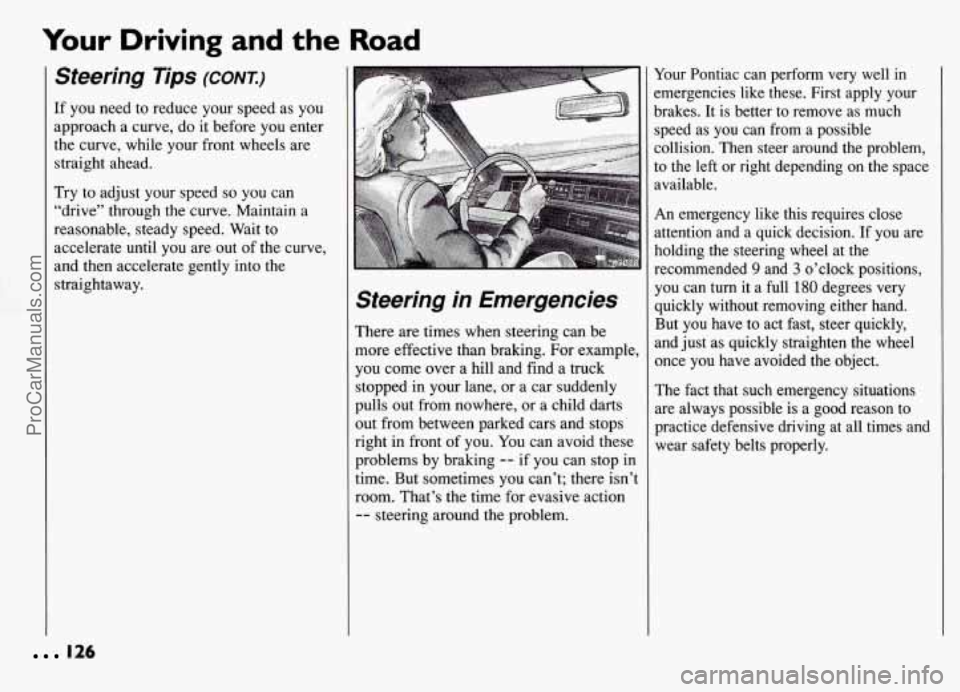
holding the steering wheel at the
recommended
9 and 3 o’clock positions,
you can turn it a full
180 degrees very
quickly without removing either hand.
But you have to act fast, steer quickly,
and just as quickly straighten the wheel
once you have avoided the object.
The fact that such emergency situations
are always possible is a
good reason to
practice defensive driving at all times and
wear safety belts properly.
126
ProCarManuals.com
Page 128 of 274
Off-Road Recovery
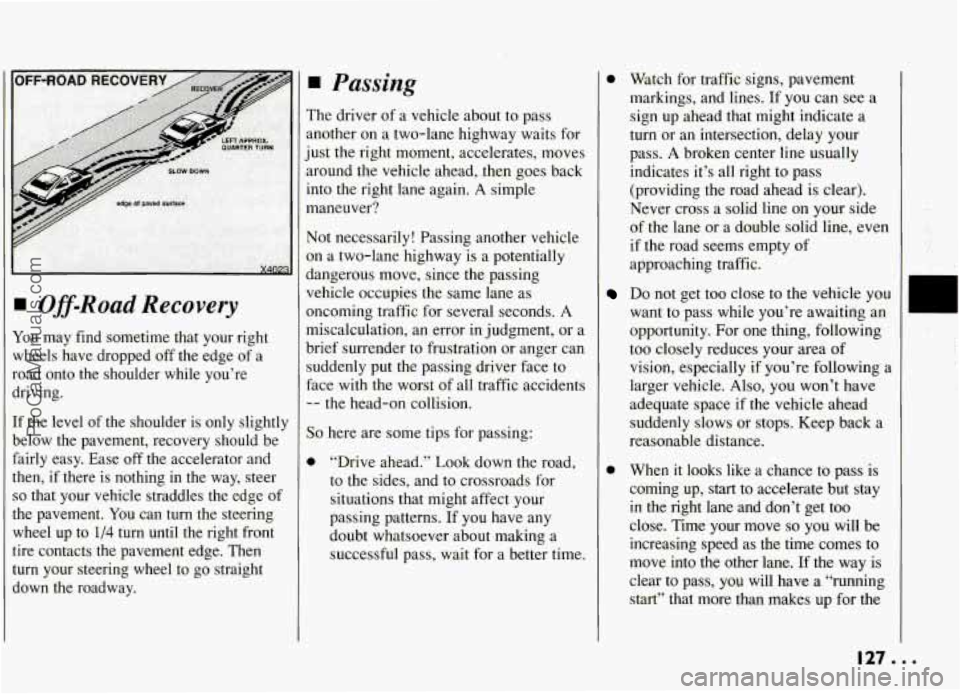
You may find sometime that your right
wheels have dropped’off the edge of a
road onto the shoulder while you’re
driving.
If the level of the shoulder is only slightlJ
below the pavement, recovery should be fairly easy. Ease off the accelerator and
then, if there is nothing in the way, steer
so that your vehicle straddles the edge of
the pavement.
You can turn the steering
wheel up to
1/4 turn until the right front
tire contacts the pavement edge. Then
turn your steering wheel to go straight
down the roadway.
<
1
(
I
I
1
7
4 Passing
The driver of a vehicle about to pass
another on
a two-lane highway waits for
just the right moment, accelerates, moves
around the vehicle ahead, dhen goes back
into the right lane again.
A simple
maneuver?
Not necessarily! Passing another vehicle
on a two-lane highway is a potentially
dangerous move, since the passing
vehicle occupies the same lane as
oncoming traffic for several seconds.
A
miscalculation, an error in judgment, or a
brief surrender
to frustration or anger can
suddenly put the passing driver face to
face with the worst of all traffic accidents
-- the head-on collision.
So here are some tips for passing:
0 “Drive ahead.” Look down the road,
to the sides, and to crossroads for
situations that might affect your
passing patterns. If you have any
doubt whatsoever about making a
successful pass, wait for
a better time.
0
0
Watch for traffic signs, pavement
markings, and lines. If you can see a
sign up ahead that might indicate a
turn or an intersection, delay your
pass.
A broken center line usually
indicates it’s all right to pass
(providing the road ahead is clear).
Never cross a solid line on your side
of the lane or a double solid line, even
if the road seems empty
of
approaching traffic.
Do not get too close to the vehicle you
want to pass while you’re awaiting an
opportunity. For one thing, following
too closely reduces your area of
vision, especially if you’re following a
larger vehicle. Also, you won’t have
adequate space if the vehicle ahead
suddenly slows or stops. Keep back a
reasonable distance.
When it looks like a chance to pass is
coming up, start to accelerate but stay
in the right lane and don’t get too
close. Time your move
so you will be
increasing speed as the time comes to
move into the other lane. If the way is
clear to pass, you will have a “running
start” that more than makes up for the
127...
ProCarManuals.com