ECO mode PONTIAC SOLSTICE 2007 User Guide
[x] Cancel search | Manufacturer: PONTIAC, Model Year: 2007, Model line: SOLSTICE, Model: PONTIAC SOLSTICE 2007Pages: 396, PDF Size: 2.27 MB
Page 200 of 396

Notice:When traction control is turned off,
or Competitive Driving Mode is active, it is
possible to lose traction. If you attempt to shift
with the rear wheels spinning with a loss of
traction, it is possible to cause damage to the
transmission. Do not attempt to shift when the
rear wheels do not have traction. Damage
caused by misuse of the vehicle is not covered.
See your warranty book for additional
information.
The traction control system may activate on dry or
rough roads or under conditions such as heavy
acceleration while turning or abrupt upshifts/
downshifts of the transmission. When this
happens, you may notice a reduction in
acceleration, or may hear a noise or vibration.
This is normal.
If your vehicle is in cruise control when the system
activates, the ESC/TCS light will ash and the
cruise control will automatically disengage. When
road conditions allow you to use cruise control
again, you may re-engage the cruise control. See
Cruise Control on page 115.
Adding non-GM accessories can affect your
vehicle’s performance. SeeAccessories and
Modications on page 235for more information.Limited-Slip Rear Axle
Your vehicle may have a limited-slip rear
differential which provides maximum power and
performance. It is designed to give you additional
traction on snow, mud, ice, sand or gravel. It
works like a standard axle most of the time, but
when one of the rear wheels has no traction
and the other does, this feature will allow
the wheel with traction to move the vehicle.
During a sudden shift, such as shifting from
FIRST (1) to SECOND (2) gear at low engine
speeds or suddenly applying the clutch, you may
feel or hear a clunking or rattling noise. This is
normal.
Electronic Stability Control
Your vehicle may be equipped with an Electronic
Stability Control (ESC) system which combines
antilock brake, traction and stability control
systems and helps the driver maintain directional
control of the vehicle in most driving conditions.
When you rst start your vehicle and begin to drive
away, the system performs several diagnostic
checks to ensure there are no problems. You may
hear or feel the system working.
200
Page 202 of 396
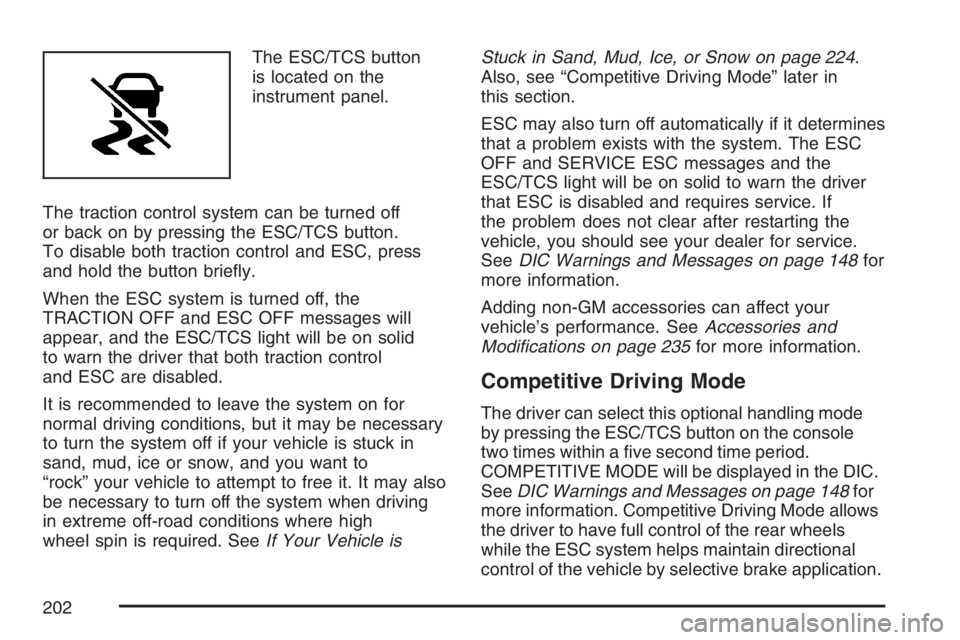
The ESC/TCS button
is located on the
instrument panel.
The traction control system can be turned off
or back on by pressing the ESC/TCS button.
To disable both traction control and ESC, press
and hold the button briey.
When the ESC system is turned off, the
TRACTION OFF and ESC OFF messages will
appear, and the ESC/TCS light will be on solid
to warn the driver that both traction control
and ESC are disabled.
It is recommended to leave the system on for
normal driving conditions, but it may be necessary
to turn the system off if your vehicle is stuck in
sand, mud, ice or snow, and you want to
“rock” your vehicle to attempt to free it. It may also
be necessary to turn off the system when driving
in extreme off-road conditions where high
wheel spin is required. SeeIf Your Vehicle isStuck in Sand, Mud, Ice, or Snow on page 224.
Also, see “Competitive Driving Mode” later in
this section.
ESC may also turn off automatically if it determines
that a problem exists with the system. The ESC
OFF and SERVICE ESC messages and the
ESC/TCS light will be on solid to warn the driver
that ESC is disabled and requires service. If
the problem does not clear after restarting the
vehicle, you should see your dealer for service.
SeeDIC Warnings and Messages on page 148for
more information.
Adding non-GM accessories can affect your
vehicle’s performance. SeeAccessories and
Modications on page 235for more information.
Competitive Driving Mode
The driver can select this optional handling mode
by pressing the ESC/TCS button on the console
two times within a ve second time period.
COMPETITIVE MODE will be displayed in the DIC.
SeeDIC Warnings and Messages on page 148for
more information. Competitive Driving Mode allows
the driver to have full control of the rear wheels
while the ESC system helps maintain directional
control of the vehicle by selective brake application.
202
Page 203 of 396

The ESC/TCS light will be on and the traction
control system will not be operating. Adjust your
driving accordingly. This electronic stability control
mode is recommended only for use during closed
track events and competitive driving venues.
When you press the ESC button again, or restart
the vehicle, the ESC and TCS will be turned
back on.
Notice:When traction control is turned off,
or Competitive Driving Mode is active, it
is possible to lose traction. If you attempt to
shift with the rear wheels spinning with a loss
of traction, it is possible to cause damage
to the transmission. Do not attempt to shift
when the rear wheels do not have traction.
Damage caused by misuse of the vehicle is
not covered. See your warranty book for
additional information.Steering
Power Steering
If you lose power steering assist because the
engine stops or the system is not functioning,
you can steer but it will take much more effort.
Steering Tips
It is important to take curves at a reasonable speed.
A lot of the “driver lost control” accidents
mentioned on the news happen on curves.
Here is why:
Experienced driver or beginner, each of us is
subject to the same laws of physics when driving on
curves. The traction of the tires against the road
surface makes it possible for the vehicle to change
its path when you turn the front wheels. If there is
no traction, inertia will keep the vehicle going in the
same direction. If you have ever tried to steer a
vehicle on wet ice, you will understand this.
203
Page 290 of 396
GAWR RR:Gross Axle Weight Rating for the rear
axle. SeeLoading Your Vehicle on page 226.
Intended Outboard Sidewall:The side of
an asymmetrical tire, that must always face
outward when mounted on a vehicle.
Kilopascal (kPa):The metric unit for air pressure.
Light Truck (LT-Metric) Tire:A tire used on
light duty trucks and some multipurpose passenger
vehicles.
Load Index:An assigned number ranging from
1 to 279 that corresponds to the load carrying
capacity of a tire.
Maximum Ination Pressure:The maximum
air pressure to which a cold tire may be inated.
The maximum air pressure is molded onto the
sidewall.
Maximum Load Rating:The load rating for a tire
at the maximum permissible ination pressure
for that tire.
Maximum Loaded Vehicle Weight:The sum of
curb weight, accessory weight, vehicle capacity
weight, and production options weight.Normal Occupant Weight:The number of
occupants a vehicle is designed to seat multiplied
by 150 lbs (68 kg). SeeLoading Your Vehicle
on page 226.
Occupant Distribution:Designated seating
positions.
Outward Facing Sidewall:The side of an
asymmetrical tire that has a particular side that
faces outward when mounted on a vehicle.
The side of the tire that contains a whitewall,
bears white lettering, or bears manufacturer,
brand, and/or model name molding that is higher
or deeper than the same moldings on the
other sidewall of the tire.
Passenger (P-Metric) Tire:A tire used on
passenger cars and some light duty trucks and
multipurpose vehicles.
Recommended Ination Pressure:Vehicle
manufacturer’s recommended tire ination
pressure as shown on the tire placard. See
Ination - Tire Pressure on page 292and
Loading Your Vehicle on page 226.
290
Page 370 of 396
Alternative Service:There may be times,
when Roadside Assistance cannot provide
timely assistance, your advisor may authorize
you to secure local emergency road service,
and you will be reimbursed up to $100
upon submission of the original receipt to
Roadside Assistance.
In many instances, mechanical failures are
covered under Pontiac’s Bumper-to-Bumper
warranty, and the duration of the Base Warranty
Coverage for Canadian customers of the new
Vehicle Limited Warranty. However, any cost for
parts and labor for non-warranty repairs are
the responsibility of the driver.
For prompt and efficient assistance when calling,
please provide the following to the Roadside
Assistance Representative:
Your name, home address, and home
telephone number.
Telephone number of your location.
Location of the vehicle.
Model, year, color, and license plate number
of the vehicle.
Odometer reading, Vehicle Identication
Number (VIN), and delivery date of the vehicle.
Description of the problem.
While we hope you never have the occasion to
use our service, it is added security while traveling
for you and your family. Remember, we are
only a phone call away. Pontiac Roadside
Assistance:1-800-ROADSIDE (762-3743), text
telephone (TTY) users, call1-888-889-2438,
Canadian customers call1-800-268-6800.
Pontiac and General Motors of Canada Limited
reserve the right to limit services or reimbursement
to an owner or driver when, in their sole
discretion, the claims become excessive in
frequency or type of occurrence.
Roadside Assistance is not part of or included in
the coverage provided by the New Vehicle Limited
Warranty. Pontiac and General Motors of
Canada Limited reserve the right to make any
changes or discontinue the Roadside Assistance
program at any time without notication.
370
Page 373 of 396
Additional Program Information
All program options, such as shuttle service, may
not be available at every dealer. Please contact
your dealer for specic information about
availability. All Courtesy Transportation
arrangements will be administered by appropriate
dealer personnel.
General Motors reserves the right to unilaterally
modify, change or discontinue Courtesy
Transportation at any time and to resolve all
questions of claim eligibility pursuant to the terms
and conditions described herein at its sole
discretion.
Vehicle Data Collection and Event
Data Recorders
Your vehicle, like other modern motor vehicles,
has a number of sophisticated computer systems
that monitor and control several aspects of the
vehicle’s performance. Your vehicle uses on-board
vehicle computers to monitor emission control
components to optimize fuel economy, to monitor
conditions for airbag deployment and, if the
vehicle has the Anti-lock Brake System (ABS), to
provide anti-lock braking and to help the driver
control the vehicle in difficult driving situations.
Some information may be stored during regular
operations to facilitate repair of detected
malfunctions; other information is stored only
in a crash event by computer systems,
such as those commonly called Event Data
Recorders (EDR).
373