parking brake PORSCHE CAYNNE 2010 1.G User Guide
[x] Cancel search | Manufacturer: PORSCHE, Model Year: 2010, Model line: CAYENNE, Model: PORSCHE CAYENNE 2010 1.GPages: 379, PDF Size: 13.91 MB
Page 163 of 379

Driving and Driving Safety
163
The warning lights will go out after the parking
brake is fully released.
The warning lights are not an indicator that the
parking brake is fully applied; it is only intended to
be a warning to release the parking brake before
driving the car.
Caution!
A partially engaged brake will overheat the
rear brakes, reduce their effectiveness and
cause excessive wear.
fRelease the parking brake fully.
fWhen parking your car, press down firmly on
the foot pedal.
fMove the Tiptronic selector lever to “P”
(Tiptronic) or move the gearshift lever to
reverse or first gear (Manual transmission).
fOn hills also turn the front wheels towards the
curb.
BrakesfMake it a habit to check the operation of your
brakes before driving.
Keep in mind that the braking distance increases
very rapidly as the speed increases. At 60 mph
(100 km/h), for example, it is not twice but four
times longer than 30 mph (50 km/h). Tire traction
is also less effective when the roads are wet or
slippery.
fTherefore, always maintain a safe distance
from the car in front of you.Vehicles without Porsche Ceramic
Composite Brake (PCCB)Even though the brake discs consist of alloyed
grey cast iron, they will unavoidably start to cor-
rode if your car is parked for an extended period.
The brakes will tend to “rub” as a result.
The nature, extent and effects of corrosion
depend on the amount of time the vehicle was
parked, whether road salt or grit was spread and
whether grease-dissolving agents were used in
car washes.
If the braking comfort is noticeably impaired, we
recommend having the brake system checked by
experts at an authorized Porsche dealer.
Brake system functionYour Porsche is equipped with a power assisted
hydraulic dual circuit brake system with disc
brakes at the front and rear.
Both circuits function independently. One brake
circuit operates the front left and rear right wheel
and the other operates the front right and rear left
wheel.
If one brake circuit has failed, the other will still
operate. However, you will notice an increased
pedal travel when you apply the brakes.Failure of
one brake circuit will cause the stopping distance
to increase.
Warning!
Risk of an accident, resulting in serious per-
sonal injury or death.
In the unlikely event of hydraulic failure of
one brake circuit:
fPush the brake pedal down firmly and hold it in
that position. A mechanical linkage activates
the second circuit, and you will be able to bring
the vehicle to a stop.
fAfter bringing your vehicle to a complete stop,
avoid driving the vehicle and instead have it
towed to the nearest authorized Porsche dealer for repair.
Parking Brake warning
light USA
Parking Brake warning
light Canada
10_Cayenne_21_KW17.book Seite 163 Donnerstag, 9. April 2009 3:33 15
Page 166 of 379

166
Driving and Driving Safety New brake pads or linings
New brake pads have to be “broken in”, and there-
fore only attain optimal friction when the car has
covered several hundred miles or km.
The slightly reduced braking ability must be com-
pensated for by pressing the brake pedal harder.
This also applies whenever the brake pads and
brake discs are replaced.
Warning!
fDo not obstruct the pedal travel with floor mats
or other objects.
The brake booster is ready for operation only
while the engine is running.
If the engine is switched off or there is a defect in
the brake booster, much greater force has to be
applied to the pedal when braking.
fPlease see the chapter “TOWING” on
Page 342.
In heavy rain, while driving through water or after
leaving a car wash, the braking action may be
delayed and increased pressure may be required.
fFor this reason, keep further back from the ve-
hicle in front and “dry” the brakes by applying
them at intervals. Make sure that following traf-
fic is not affected.
After a long drive over salted or sanded roads, a
coating may form on the brake discs and pads
that significantly reduces friction and thus braking
action.fEven though the brake discs consist of alloyed
grey cast iron, they will unavoidably start to
corrode if your car is parked for an extended
period. The brakes will tend to “rub” as a
result.
The nature, extent and effects of corrosion
depend on the amount of time the vehicle was
parked, whether road salt or grit was spread
and whether grease-dissolving agents were
used in car washes (not on vehicles with
Porsche Ceramic Composite Brake).
To prevent corrosion of the brake discs, “brake
them dry” before parking the car (not on
vehicles with Porsche Ceramic Composite
Brake).
If the braking comfort is noticeably impaired,
we recommend having the brake system
checked by experts at an authorized Porsche
dealer.
fTo relieve the braking system on downhill
stretches, change down to a lower gear in
enough time to obtain engine braking.
If engine braking is insufficient on steep
stretches, operate the footbrake at intervals.
Continuous braking overheats the brakes and
reduces the braking effect.
fPlease see the chapter “BRAKE-FLUID LEVEL”
on Page 257.
10_Cayenne_21_KW17.book Seite 166 Donnerstag, 9. April 2009 3:33 15
Page 171 of 379
Driving and Driving Safety
171
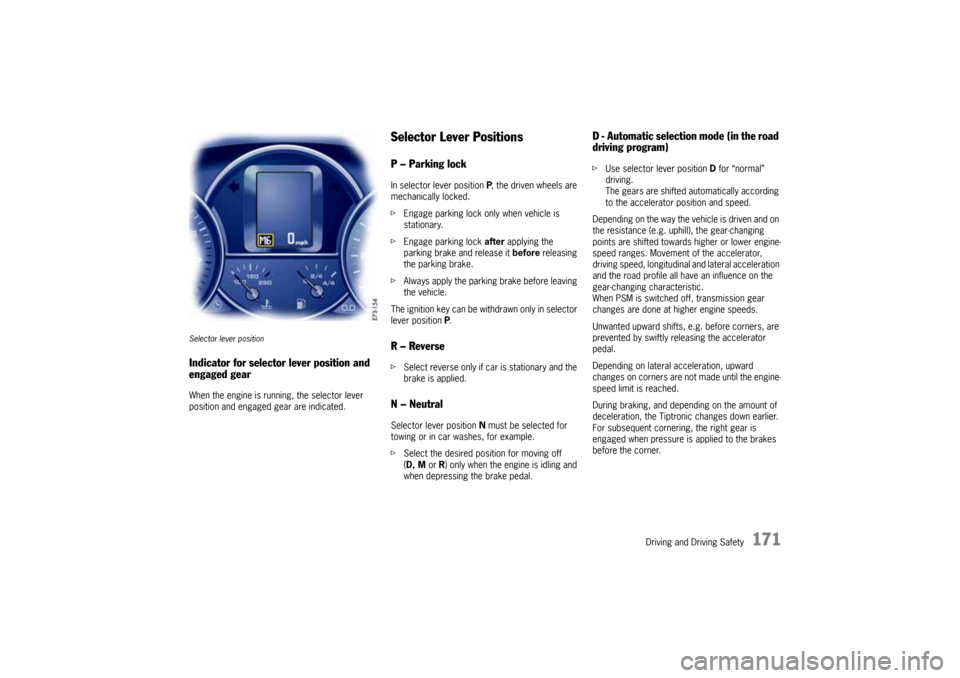
Selector lever positionIndicator for selector lever position and
engaged gearWhen the engine is running, the selector lever
position and engaged gear are indicated.
Selector Lever PositionsP – Parking lockIn selector lever position P, the driven wheels are
mechanically locked.
fEngage parking lock only when vehicle is
stationary.
fEngage parking lock after applying the
parking brake and release it before releasing
the parking brake.
fAlways apply the parking brake before leaving
the vehicle.
The ignition key can be withdrawn only in selector
lever position P.R – ReversefSelect reverse only if car is stationary and the
brake is applied.N – NeutralSelector lever position N must be selected for
towing or in car washes, for example.
fSelect the desired position for moving off
(D, M or R) only when the engine is idling and
when depressing the brake pedal.
D - Automatic selection mode (in the road
driving program)fUse selector lever position D for “normal”
driving.
The gears are shifted automatically according
to the accelerator position and speed.
Depending on the way the vehicle is driven and on
the resistance (e.g. uphill), the gear-changing
points are shifted towards higher or lower engine-
speed ranges. Movement of the accelerator,
driving speed, longitudinal and lateral acceleration
and the road profile all have an influence on the
gear-changing characteristic.
When PSM is switched off, transmission gear
changes are done at higher engine speeds.
Unwanted upward shifts, e.g. before corners, are
prevented by swiftly releasing the accelerator
pedal.
Depending on lateral acceleration, upward
changes on corners are not made until the engine-
speed limit is reached.
During braking, and depending on the amount of
deceleration, the Tiptronic changes down earlier.
For subsequent cornering, the right gear is
engaged when pressure is applied to the brakes
before the corner.
10_Cayenne_21_KW17.book Seite 171 Donnerstag, 9. April 2009 3:33 15
Page 174 of 379

174
Driving and Driving Safety
M - Manual selection mode (in the off-
road driving program)
Warning!
The kickdown function is not active in manual
selection mode “M”.
The kickdown function cannot be used to
downshift in manual selection mode “M”.
fTherefore shift down manually when accelera-ting (e.g. to overtake).
Tip on driving
The kickdown function is not active in selector
lever position M.
Unlike in the road driving program, an automatic
upshift is not performed when the engine-speed
limit is reached.Shifting up
fPress upper part (+) of a rocker switch A or
fPush selector lever B forward in the M gate.
Shifting down
fPress lower part (–) of a rocker switch A or
fPush selector lever B back in the M gate.
Depending on driving speed and engine speed,
you can shift up or down at any time. Gear
changes which would exceed the upper or lower
engine-speed limit are not executed by the control
unit.
You can change down two gears by quickly pres-
sing rocker switches A or selector lever B twice.
The gear is changed down automatically just
before idle speed is reached.
fSelect an appropriately low gear on upward
and downward slopes.
This will ensure optimum use of engine power
and engine braking.
If manual mode fails, the control electronics
switch to automatic mode. In this event, the instru-
ment panel will display selector lever position D.
fTo remedy the fault, please consult an
authorized Porsche dealer.
StoppingfFor a brief stop (e.g. at a traffic light), leave the
selector lever in drive position and hold the
vehicle with the brake pedal.
fDo not hold the car on a slope using the acce-
lerator. Use the brake pedal or the parking
brake instead.
fBefore leaving the vehicle, always apply the
handbrake and move the selector lever to
position P.
Tip on driving
In selector lever positions D and M, the hillholder
function makes it easier to move off from a stand-
still on an upward slope when the engine is run-
ning. The driver does not have to apply the brake.
fPlease see the chapter “HILLHOLDER -
MOVING-OFF ASSISTANT ON VEHICLES WITH
TIPTRONIC S” on Page 187.
10_Cayenne_21_KW17.book Seite 174 Donnerstag, 9. April 2009 3:33 15
Page 175 of 379
Driving and Driving Safety
175
ParkingfGo easy on the accelerator.
fWhen parking or maneuvring in a small space,
control the speed by careful use of the foot-
brake.Driving in winterIn wintry road conditions it is advisable to take
steep inclines in manual mode M. This prevents
the occurrence of gear changes that could cause
wheelspin.
Limp-home modeIf there is a fault in the transmission:
–An X appears instead of the current gear
indicator on the multi-purpose display of the
instrument panel.
The transmission no longer shifts.
fTo remedy the fault, immediately consult an
authorized Porsche dealer.
Warning!
Reverse gear lock monitoring is disabled in
the emergency running program.
Damage to the vehicle may result as well as
loss of control, if the vehicle is moving for-
ward fast enough to cause rear wheel lockup.
fDo not shift into R while the vehicle is moving forward.
Tip on driving
3rd or 5th gear in selector position D and reverse
gear R are now available and will allow you to
reach the nearest authorized Porsche dealer.
fPlease go to your authorized Porsche dealer
as soon as possible.
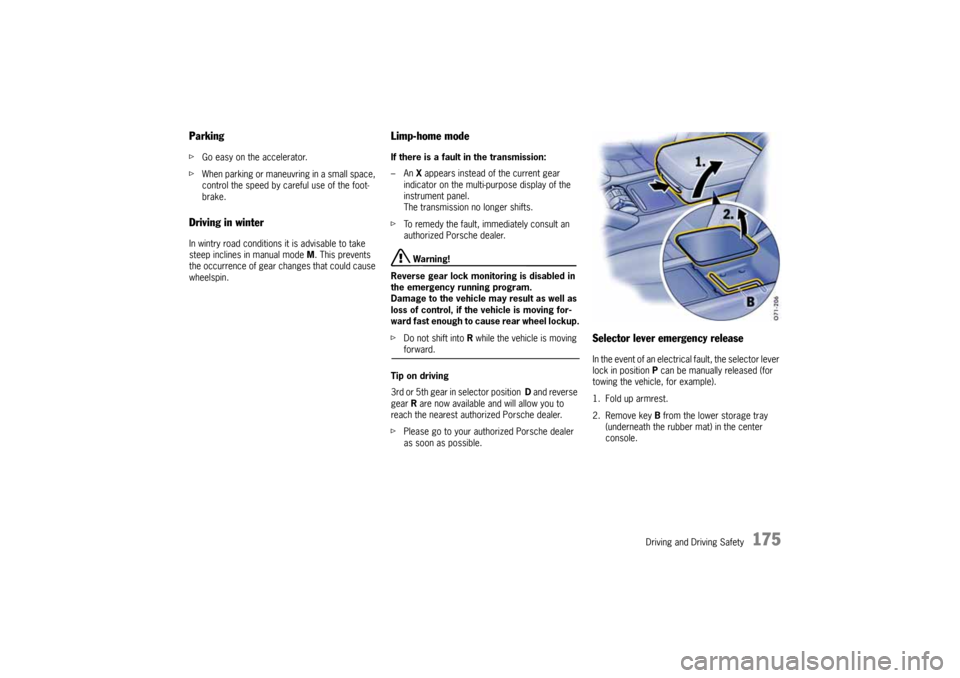
Selector lever emergency releaseIn the event of an electrical fault, the selector lever
lock in position P can be manually released (for
towing the vehicle, for example).
1. Fold up armrest.
2. Remove key B from the lower storage tray
(underneath the rubber mat) in the center
console.
10_Cayenne_21_KW17.book Seite 175 Donnerstag, 9. April 2009 3:33 15
Page 176 of 379
176
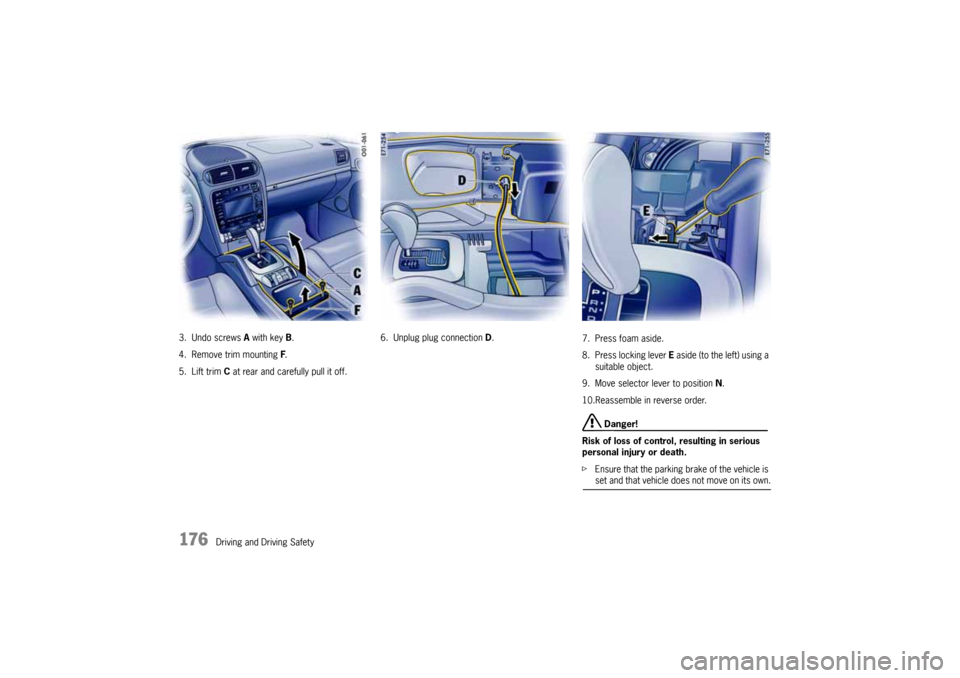
Driving and Driving Safety 3. Undo screws A with key B.
4. Remove trim mounting F.
5. Lift trim C at rear and carefully pull it off.6. Unplug plug connection D.
7. Press foam aside.
8. Press locking lever E aside (to the left) using a
suitable object.
9. Move selector lever to position N.
10.Reassemble in reverse order.
Danger!
Risk of loss of control, resulting in serious
personal injury or death.
fEnsure that the parking brake of the vehicle is set and that vehicle does not move on its own.
10_Cayenne_21_KW17.book Seite 176 Donnerstag, 9. April 2009 3:33 15
Page 188 of 379

188
Driving and Driving Safety
Porsche Drive-Off Assistant –
Moving-off assistant on vehicles with
manual transmissionThe Porsche Drive-Off Assistant enables the driver
to move off on upward slopes. The vehicle must
have sufficient road contact to use this feature.
The Porsche Drive-Off Assistant is available for
slopes starting at approximately 5%.
fPlease see the chapter “TRAILER COUPLING”
on Page 230.
Danger!
Risk of accident, resulting in serious perso-
nal injury or death.
When moving off on a slippery surface (e.g.,
on icy or loose surfaces), assistance by the
Porsche Drive-Off Assistant is no longer
assured. In this case, the vehicle could slip.
The limits set by the physics of driving cannot
be overcome, even with the Porsche Drive-
Off Assistant. The responsibility for moving
off on upward slopes is still the driver's,
despite the Porsche Drive-Off Assistant.
fAlways adjust your driving style to the driving
conditions and vehicle load, use the footbrake if necessary.Moving off with Porsche Drive-Off Assistant
1. Hold the vehicle securely with footbrake or
parking brake on the slope.
The engine must be running.
2. Fully depress the clutch pedal.
3. Engage one of the gears used to ascend in the
direction of travel (1st gear or reverse).
4. While keeping the clutch pedal depressed,
release the footbrake or foot-operated parking
brake.
The vehicle is held on the slope.
5. Move off as usual.Note on operation
The Porsche Drive-Off Assistant ceases to func-
tion:
– By shifting to neutral.
– When changing gears.
– If the engine is not running.
Danger!
Risk of accident, resulting in serious perso-
nal injury or death.
If the Porsche Drive-Off Assistant ceases to
function, the vehicle will no longer be held on
a slope.
fHold the vehicle with the footbrake.
10_Cayenne_21_KW17.book Seite 188 Donnerstag, 9. April 2009 3:33 15
Page 189 of 379

Driving and Driving Safety
189
Engine Braking Support
(Assistance when heading downhill)The Porsche Down-Hill Assistant is an assistance
system which helps the driver at slower downhill
driving up to approx. 12 mph (20 km/h), e.g., on
steep slopes or on wintry mountain roads.
As long as the gas pedal is not used when
traveling downhill, the Porsche Down-Hill Assistant
is active and brakes the vehicle.
If road grip is lost on one or more wheels, the
system brakes the wheels which have good road
contact.
The braking ability of the Engine Braking Support
is affected by slippery surfaces (e.g., on icy or
loose surfaces), like all brakes.
Warning!
Risk of accident, resulting in serious perso-
nal injury or death. Reduced braking ability
on a slippery surface.
fAlways adjust your driving style to the driving situation.
Conditions:
– The gas pedal must not be used when
travelling downhill.
– The speed must not exceed 12 mph
(20 km/h).–Vehicles with Tiptronic S:
The Tiptronic selector lever position D, M or R
must be engaged.
–Vehicles with manual transmission:
The reverse gear or any other gear (1. - 6. )
must be engaged. The clutch pedal must not
be used when travelling downhill.
Tip on driving
The Porsche Down-Hill Assistant is active when
driving downhill either forwards or backwards.
Checks on test standsBrake tests
Brake tests must be carried out only in High Range
and on plate-type test stands or roller test stands.
The following limit values must not be exceeded
on roller test stands:
– Testing speed 4.7 mph (7.5 km/h)
– Test duration 20 seconds
Parking brake test
Parking brake tests on the brake tester must be
performed only with the ignition switched off and
the Tiptronic selector lever in position N or the
gearshift lever in neutral.Balancing wheels on the vehicle
During finish balancing of the wheels, the entire
vehicle must be lifted and the wheels must be free
to turn.
Dynamometer testing procedure Some U.S. states and Canadian provinces con-
duct emissions inspection/maintenance testing
involving the use of two-wheel dynamometer.
A two-wheeled dynamometer is a treadmill type
device upon which a single axle of the car, the dri-
ving axle of the vehicle, rotates to simulate vehicle
operation on the road while the vehicle remains
stationary.
Your Porsche Cayenne has a full-time four-wheel
drive system which cannot be disabled. Severe
d a m a g e t o t h e p o w e r t r a i n c a n re s u l t i f t e s t e d o n a
two-wheel dynamometer.
Warning!
To avoid severe powertrain damage and a
possible unexpected movement of the vehic-
le.
fYour Porsche Cayenne vehicle must never be
tested on a two-wheel dynamometer.
fAdvise the emission station of this warning before testing the vehicle.
10_Cayenne_21_KW17.book Seite 189 Donnerstag, 9. April 2009 3:33 15
Page 235 of 379

Trailer Hitch
235
Driving with a trailer
When towing a trailer you must under all circum-
stances adapt your speed to prevailing road and
driving conditions. Towing at excessive speed can
result in loss of control. Observe country-specific
laws for driving with trailers.
fCarefully and gradually familiarize yourself with
the handling and braking behavior of the car-
trailer combination.
fDo not drive with the towing vehicle empty and
the trailer loaded.
If this unfavorable combination is unavoidable,
please drive especially slowly.
fBear in mind the different vehicle handling and
size in situations such as braking, parking,
cornering and overtaking, etc.
fThe driving stability of the car-trailer combina-
tion worsens as the speed increases. There-
fore, drive especially slowly on downhill
stretches and in the case of unfavorable road
and weather conditions (such as wind).
fDrive in an appropriately low gear on downhill
stretches in order to make use of the engine
braking effect.fSlow down immediately if the trailer starts to
sway. Do not countersteer; brake if necessary.
Never attempt to straighten out the car-trailer
combination by accelerating.
fActivate Low Range when moving off on steep
slopes.
fUnder no circumstances may people, animals
or objects be in the space between the trailer
and the towing vehicle when the vehicle is
moving.
fWhen reversing, bear in mind that ParkAssist is
not active.
fAlways see the permissible towing capacity,
vertical coupling load and rear-axle load.
Please see the chapter “WEIGHTS” on
Page 356.
Maintenance Note
fPlease take into consideration that driving with
a trailer places markedly greater stress on all
vehicle components. Expert inspection and
maintenance after every use are indispensable
prerequisites for proper functioning and safety.
10_Cayenne_21_KW17.book Seite 235 Donnerstag, 9. April 2009 3:33 15
Page 240 of 379

240
Parking Limits of ultrasonic measurement
– ParkAssist cannot detect sound-absorbing
obstacles (e.g. winter operation, powder
snow),
– Sound-reflecting obstacles (e.g. glass sur-
faces, flat painted surfaces),
– And very thin obstacles.
Other ultrasound sources (e.g. pneumatic brakes
of other vehicles, jackhammers) can interfere with
detection of obstacles.
Fault indication without warning tone
All red light segments of the active warning indica-
tors light up when there is a temporary fault in
ParkAssist.
Note
Correct operation is no longer ensured if there is
a temporary fault (e.g. caused by ice formation or
heavy soiling on the sensors).
The system detects the temporary fault.
All light segments light up until a speed of
9mph (14km/h) is reached.
ParkAssist is ready for operation again when the
interference has been eliminated.Fault indication with warning tone
In the event of a long-lasting fault in ParkAssist,
the red light segments of the active warning indi-
cators light up and a continuous tone sounds for
three seconds after a transmission range has
been selected.
Possible causes
– Defect or system fault.
fSwitch ParkAssist off.
When ParkAssist is switched off, the indicator
light in the button lights up.
Please see the chapter “SWITCHING
PARKASSIST ON AND OFF” on Page 237.
fPlease have the fault remedied at an
authorized Porsche dealer.Driving with a trailer
The ParkAssist rear monitoring area is switched
off when the trailer’s power supply is plugged in.
10_Cayenne_21_KW17.book Seite 240 Donnerstag, 9. April 2009 3:33 15