traction control RAM 1500 2022 User Guide
[x] Cancel search | Manufacturer: RAM, Model Year: 2022, Model line: 1500, Model: RAM 1500 2022Pages: 496, PDF Size: 18.03 MB
Page 316 of 496

314SAFETY
(Continued)
Electronic Roll Mitigation (ERM)
The ERM system anticipates the potential for
wheel lift by monitoring the driver’s steering wheel
input and the speed of the vehicle. When ERM
determines that the rate of change of the steering
wheel angle and vehicle’s speed are sufficient to
potentially cause wheel lift, it then applies the
appropriate brake and may also reduce engine
power to lessen the chance that wheel lift will
occur. ERM can only reduce the chance of wheel
lift occurring during severe or evasive driving
maneuvers; it cannot prevent wheel lift due to
other factors, such as road conditions, leaving the
roadway, striking objects or other vehicles.
Electronic Stability Control (ESC)
ESC enhances directional control and stability of
the vehicle under various driving conditions. ESC
corrects for oversteering or understeering of the
vehicle by applying the brake of the appropriate
wheel(s) to counteract the above conditions.
Engine power may also be reduced to help the
vehicle maintain the desired path.
Oversteer — when the vehicle is turning more
than appropriate for the steering wheel position.
Understeer — when the vehicle is turning less
than appropriate for the steering wheel position.
ESC uses sensors in the vehicle to determine the
vehicle path intended by the driver and compares
it to the actual path of the vehicle. When the actual
path does not match the intended path, ESC
applies the brake of the appropriate wheel to
assist in counteracting the oversteer or understeer
condition. The ESC Activation/Malfunction Indicator Light
located in the instrument cluster will start to flash
as soon as the ESC system becomes active. The
ESC Activation/Malfunction Indicator Light also
flashes when the TCS is active. If the ESC
Activation/Malfunction Indicator Light begins to
flash during acceleration, ease up on the
accelerator and apply as little throttle as possible.
Be sure to adapt your speed and driving to the
prevailing road conditions.
WARNING!
Many factors, such as vehicle loading, road
conditions and driving conditions, influence the
chance that wheel lift or rollover may occur. ERM
cannot prevent all wheel lift or rollovers,
especially those that involve leaving the roadway
or striking objects or other vehicles. The
capabilities of an ERM-equipped vehicle must
never be exploited in a reckless or dangerous
manner which could jeopardize the user's safety
or the safety of others.
WARNING!
Electronic Stability Control (ESC) cannot
prevent the natural laws of physics from
acting on the vehicle, nor can it increase the
traction afforded by prevailing road condi
-
tions. ESC cannot prevent accidents, including
those resulting from excessive speed in turns,
driving on very slippery surfaces, or hydro -
planing. ESC also cannot prevent accidents
resulting from loss of vehicle control due to
inappropriate driver input for the conditions.
Only a safe, attentive, and skillful driver can
prevent accidents. The capabilities of an ESC
equipped vehicle must never be exploited in a
reckless or dangerous manner which could
jeopardize the user’s safety or the safety of
others.
22_DT_OM_EN_USC_t.book Page 314
Page 318 of 496

316SAFETY
ESC Activation/Malfunction Indicator Light
And ESC OFF Indicator Light
The ESC Activation/Malfunction Indicator
Light in the instrument cluster will come
on when the ignition is placed in the ON/
RUN mode. It should go out with the
engine running. If the ESC Activation/Malfunction
Indicator Light comes on continuously with the
engine running, a malfunction has been detected
in the ESC system. If this light remains on after several ignition cycles, and the vehicle has been
driven several miles (kilometers) at speeds greater
than 30 mph (48 km/h), see an authorized dealer
as soon as possible to have the problem
diagnosed and corrected.
The ESC Activation/Malfunction Indicator Light
starts to flash as soon as the tires lose traction and
the ESC system becomes active. The ESC
Activation/Malfunction Indicator Light also flashes
when TCS is active. If the ESC Activation/
Malfunction Indicator Light begins to flash during
acceleration, ease up on the accelerator and apply
as little throttle as possible. Be sure to adapt your
speed and driving to the prevailing road conditions.
The ESC OFF Indicator Light indicates
that the Electronic Stability Control (ESC)
is in a reduced mode.
NOTE:
The ESC Activation/Malfunction Indicator Light
and the ESC OFF Indicator Light come on
momentarily each time the ignition is placed in
the ON/RUN mode.
Each time the ignition is placed in the ON/RUN
mode, the ESC system will be on even if it was
turned off previously.
The ESC system will make buzzing or clicking
sounds when it is active. This is normal; the
sounds will stop when ESC becomes inactive
following the maneuver that caused the ESC
activation.
Hill Descent Control (HDC) — If Equipped
HDC is intended for low speed off-road driving
while in 4WD Low. HDC maintains vehicle speed
while descending hills during various driving
situations. HDC controls vehicle speed by actively
controlling the brakes.
HDC Has Three States:
1. Off (feature is not enabled and will not activate).
2. Enabled (feature is enabled and ready but activation conditions are not met, or driver is
actively overriding with brake or throttle
application).
3. Active (feature is enabled and actively controlling vehicle speed).
WARNING!
In the ESC “Full Off” mode, the engine torque
reduction and stability features are disabled.
Therefore, enhanced vehicle stability offered
by the ESC system is unavailable. In an emer -
gency evasive maneuver, the ESC system will
not engage to assist in maintaining stability.
ESC “Full Off” mode is intended for
off-highway or off-road use only.
The Electronic Stability Control (ESC) cannot
prevent the natural laws of physics from
acting on the vehicle, nor can it increase the
traction afforded by prevailing road condi -
tions. ESC cannot prevent all accidents,
including those resulting from excessive
speed in turns, driving on very slippery
surfaces, or hydroplaning. ESC also cannot
prevent collisions.
22_DT_OM_EN_USC_t.book Page 316
Page 321 of 496

SAFETY319
Rain Brake Support (RBS)
RBS may improve braking performance in wet
conditions. It will periodically apply a small amount
of brake pressure to remove any water buildup on
the front brake rotors. It functions when the
windshield wipers are in LO or HI speed. When Rain
Brake Support is active, there is no notification to
the driver and no driver interaction is required.
Ready Alert Braking (RAB)
RAB may reduce the time required to reach full
braking during emergency braking situations. It
anticipates when an emergency braking situation
may occur by monitoring how fast the throttle is
released by the driver. The Electronic Brake
Control system will prepare the brake system for a
panic stop.
Traction Control System (TCS)
The TCS monitors the amount of wheel spin of
each of the driven wheels. If wheel spin is
detected, the TCS may apply brake pressure to the
spinning wheel(s) and/or reduce engine power to
provide enhanced acceleration and stability. A
feature of the TCS, Brake Limited Differential (BLD)
functions similarly to a limited slip differential and
controls the wheel spin across a driven axle. If one
wheel on a driven axle is spinning faster than the
other, the system will apply the brake of the spinning wheel. This will allow more engine torque
to be applied to the wheel that is not spinning. BLD
may remain enabled even if TCS and Electronic
Stability Control (ESC) are in reduced modes.
Trailer Sway Control (TSC)
TSC uses sensors in the vehicle to recognize an
excessively swaying trailer and will take the
appropriate actions to attempt to stop the sway.
NOTE:TSC cannot stop all trailers from swaying. Always
use caution when towing a trailer and follow the
trailer tongue weight recommendations
Ú
page 212.
When TSC is functioning, the ESC Activation/
Malfunction Indicator Light will flash, the engine
power may be reduced and you may feel the
brakes being applied to individual wheels to
attempt to stop the trailer from swaying. TSC is
disabled when the ESC system is in the “Partial
Off” or “Full Off” modes.
AUXILIARY DRIVING SYSTEMS
BLIND SPOT MONITORING (BSM) —
I
F EQUIPPED
BSM uses two radar sensors, located inside the
taillights, to detect highway licensable vehicles
(automobiles, trucks, motorcycles, etc.) that enter
the blind spot zones from the rear/front/side of
the vehicle.
Rear Detection Zones
When the vehicle is started, the BSM Warning Light
will momentarily illuminate in both outside
rearview mirrors to let the driver know that the
system is operational. The BSM system sensors
operate when the vehicle is in any forward gear
and enters standby mode when the vehicle is in
PARK.
WARNING!
If TSC activates while driving, slow the vehicle
down, stop at the nearest safe location, and
adjust the trailer load to eliminate trailer sway.
6
22_DT_OM_EN_USC_t.book Page 319
Page 457 of 496

SERVICING AND MAINTENANCE455
TIRE TYPES
All Season Tires — If Equipped
All Season tires provide traction for all seasons
(Spring, Summer, Autumn, and Winter). Traction
levels may vary between different all season tires.
All season tires can be identified by the M+S, M&S,
M/S or MS designation on the tire sidewall. Use all
season tires only in sets of four; failure to do so
may adversely affect the safety and handling of
your vehicle.
Summer Or Three Season Tires — If
Equipped
Summer tires provide traction in both wet and dry
conditions, and are not intended to be driven in
snow or on ice. If your vehicle is equipped with
Summer tires, be aware these tires are not
designed for Winter or cold driving conditions.
Install Winter tires on your vehicle when ambient
temperatures are less than 40°F (5°C) or if roads
are covered with ice or snow. For more
information, contact an authorized dealer. Summer tires do not contain the all season
designation or mountain/snowflake symbol on the
tire sidewall. Use Summer tires only in sets of four;
failure to do so may adversely affect the safety and
handling of your vehicle.
Snow Tires
Some areas of the country require the use of snow
tires during the Winter. Snow tires can be identified
by a “mountain/snowflake” symbol on the tire
sidewall.
If you need snow tires, select tires
equivalent in size and type to the
original equipment tires. Use snow tires
only in sets of four; failure to do so may
adversely affect the safety and handling of your
vehicle.
Snow tires generally have lower speed ratings than
what was originally equipped with your vehicle and
should not be operated at sustained speeds over
75 mph (120 km/h). For speeds above 75 mph
(120 km/h) refer to original equipment or an authorized tire dealer for recommended safe
operating speeds, loading and cold tire inflation
pressures.
While studded tires improve performance on ice,
skid and traction capability on wet or dry surfaces
may be poorer than that of non-studded tires.
Some states prohibit studded tires; therefore, local
laws should be checked before using these tire
types.
SPARE TIRES — IF EQUIPPED
NOTE:For vehicles equipped with Tire Service Kit instead
of a spare tire, please refer to “Tire Service Kit” in
“In Case Of Emergency” for further information.
For restrictions when towing with a spare tire
designated for temporary emergency use
Ú
page 220.
CAUTION!
Replacing original tires with tires of a different
size may result in false speedometer and
odometer readings.
WARNING!
Do not use Summer tires in snow/ice conditions.
You could lose vehicle control, resulting in
severe injury or death. Driving too fast for
conditions also creates the possibility of loss of
vehicle control.
CAUTION!
Because of the reduced ground clearance, do
not take your vehicle through an automatic car
wash with a compact or limited use temporary
spare installed. Damage to the vehicle may
result.
8
22_DT_OM_EN_USC_t.book Page 455
Page 461 of 496
SERVICING AND MAINTENANCE459
(Continued)
(Continued)
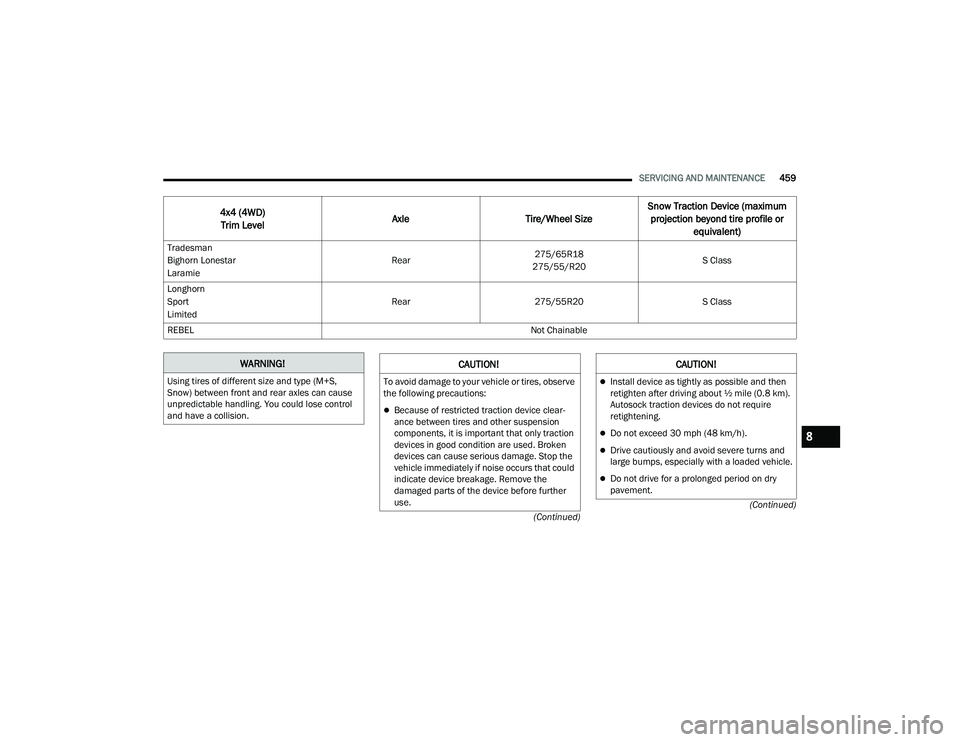
4x4 (4WD) Trim Level Axle
Tire/Wheel SizeSnow Traction Device (maximum
projection beyond tire profile or equivalent)
Tradesman
Bighorn Lonestar
Laramie Rear
275/65R18
275/55/R20 S Class
Longhorn
Sport
Limited Rear
275/55R20 S Class
REBEL Not Chainable
WARNING!
Using tires of different size and type (M+S,
Snow) between front and rear axles can cause
unpredictable handling. You could lose control
and have a collision.
CAUTION!
To avoid damage to your vehicle or tires, observe
the following precautions:
Because of restricted traction device clear-
ance between tires and other suspension
components, it is important that only traction
devices in good condition are used. Broken
devices can cause serious damage. Stop the
vehicle immediately if noise occurs that could
indicate device breakage. Remove the
damaged parts of the device before further
use.
Install device as tightly as possible and then
retighten after driving about ½ mile (0.8 km).
Autosock traction devices do not require
retightening.
Do not exceed 30 mph (48 km/h).
Drive cautiously and avoid severe turns and
large bumps, especially with a loaded vehicle.
Do not drive for a prolonged period on dry
pavement.
CAUTION!
8
22_DT_OM_EN_USC_t.book Page 459
Page 462 of 496
460SERVICING AND MAINTENANCE
TIRE ROTATION RECOMMENDATIONS
Tires on the front and rear axles of vehicles
operate at different loads and perform different
steering, driving, and braking functions. For these
reasons, they wear at unequal rates.
These effects can be reduced by timely rotation of
tires. The benefits of rotation are especially
worthwhile with aggressive tread designs such as
those on all season type tires. Rotation will
increase tread life, help to maintain mud, snow
and wet traction levels and contribute to a smooth,
quiet ride.
For the proper maintenance intervals Úpage 394.
More frequent rotation is permissible if desired.
The reasons for any rapid or unusual wear should
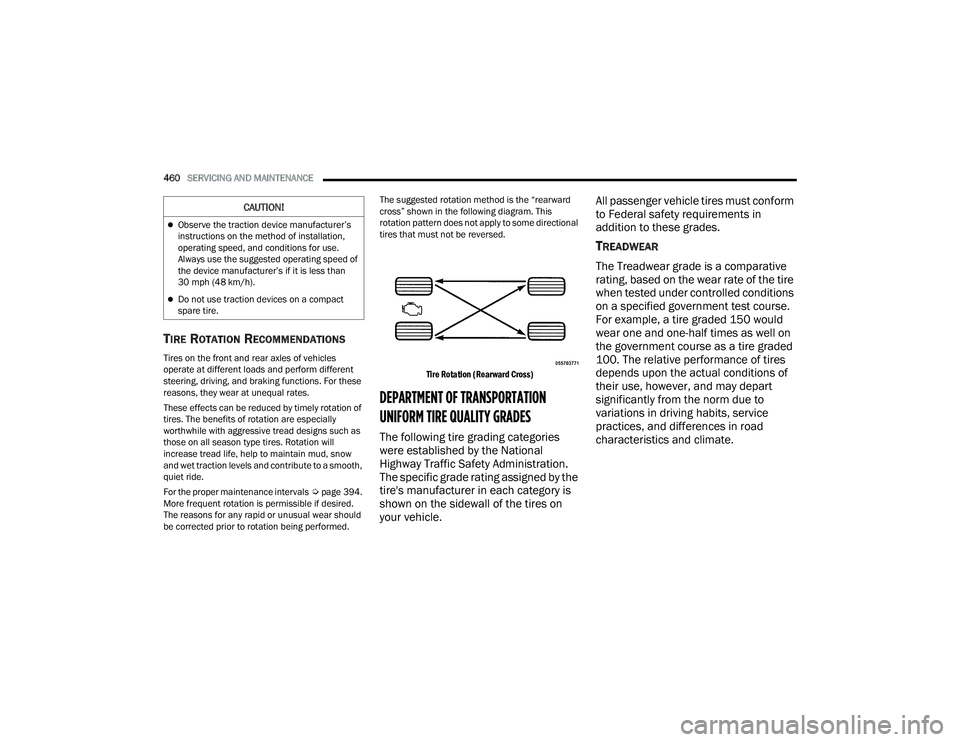
be corrected prior to rotation being performed. The suggested rotation method is the “rearward
cross” shown in the following diagram. This
rotation pattern does not apply to some directional
tires that must not be reversed.
Tire Rotation (Rearward Cross)
DEPARTMENT OF TRANSPORTATION
UNIFORM TIRE QUALITY GRADES
The following tire grading categories
were established by the National
Highway Traffic Safety Administration.
The specific grade rating assigned by the
tire's manufacturer in each category is
shown on the sidewall of the tires on
your vehicle. All passenger vehicle tires must conform
to Federal safety requirements in
addition to these grades.
TREADWEAR
The Treadwear grade is a comparative
rating, based on the wear rate of the tire
when tested under controlled conditions
on a specified government test course.
For example, a tire graded 150 would
wear one and one-half times as well on
the government course as a tire graded
100. The relative performance of tires
depends upon the actual conditions of
their use, however, and may depart
significantly from the norm due to
variations in driving habits, service
practices, and differences in road
characteristics and climate.
Observe the traction device manufacturer’s
instructions on the method of installation,
operating speed, and conditions for use.
Always use the suggested operating speed of
the device manufacturer’s if it is less than
30 mph (48 km/h).
Do not use traction devices on a compact
spare tire.
CAUTION!
22_DT_OM_EN_USC_t.book Page 460
Page 463 of 496

SERVICING AND MAINTENANCE461
TRACTION GRADES
The Traction grades, from highest to
lowest, are AA, A, B, and C. These grades
represent the tire's ability to stop on wet
pavement, as measured under
controlled conditions on specified
government test surfaces of asphalt and
concrete. A tire marked C may have poor
traction performance.
TEMPERATURE GRADES
The Temperature grades are A (the
highest), B, and C, representing the tire's
resistance to the generation of heat and
its ability to dissipate heat, when tested
under controlled conditions on a
specified indoor laboratory test wheel. Sustained high temperature can cause
the material of the tire to degenerate
and reduce tire life, and excessive
temperature can lead to sudden tire
failure. The grade C corresponds to a
level of performance, which all
passenger vehicle tires must meet
under the Federal Motor Vehicle Safety
Standard No. 109. Grades B and A
represent higher levels of performance
on the laboratory test wheel, than the
minimum required by law.
STORING THE VEHICLE
If you are storing your vehicle for more than three
weeks, we recommend that you take the following
steps to minimize the drain on your vehicle's
battery:
Disconnect the negative cable from battery.
Any time you store your vehicle or keep it out of
service (i.e., vacation) for two weeks or more,
run the air conditioning system at idle for about
five minutes in the fresh air and high blower
setting. This will ensure adequate system lubri-
cation to minimize the possibility of compressor
damage when the system is started again.
BODYWORK
PROTECTION FROM ATMOSPHERIC
A
GENTS
Vehicle body care requirements vary according to
geographic locations and usage. Chemicals that
make roads passable in snow and ice and those
that are sprayed on trees and road surfaces during
other seasons are highly corrosive to the metal in
your vehicle. Outside parking, which exposes your
vehicle to airborne contaminants, road surfaces on
which the vehicle is operated, extreme hot or cold
weather and other extreme conditions will have an
adverse effect on paint, metal trim, and underbody
protection.
WARNING!
The traction grade assigned to this tire is based
on straight-ahead braking traction tests, and
does not include acceleration, cornering,
hydroplaning, or peak traction characteristics.
WARNING!
The temperature grade for this tire is
established for a tire that is properly inflated and
not overloaded. Excessive speed, underinflation,
or excessive loading, either separately or in
combination, can cause heat buildup and
possible tire failure.
8
22_DT_OM_EN_USC_t.book Page 461
Page 488 of 496

486 Air Suspension Payload Protection
............ 134Air Suspension Ride Height Lowering........ 135Air Suspension Ride Height Raising..........134Anti-Lock Brake System............................. 131Brake Assist Warning................................ 316Brake Warning.......................................... 128Bulb Replacement..................................... 438Cargo.................................................. 57, 135Center Mounted Stop................................ 443Courtesy/Reading....................................... 59Cruise.............................................. 136, 137Daytime Running......................................... 55ECO Mode................................................. 136Electric Power Steering............................. 130Electronic Park Brake................................ 131Electronic Stability Control........................ 131Electronic Throttle Control......................... 129Engine Coolant Temperature..................... 130Exterior............................................... 54, 370Fog.................................................. 136, 442Forward Collision Warning......................... 135Hazard Warning Flasher............................ 371Headlights............................................ 54, 56High Beam......................................... 55, 137High Beam/Low Beam Select..................... 55Hill Descent Control Indicator.......... 137, 316Hood Open................................................ 130Illuminated Entry......................................... 60Interior........................................................ 59LaneSense...................................... 136, 137
Lights On Reminder..................................... 56Low Diesel Exhaust Fluid.......................... 135Low Fuel................................................... 136Malfunction Indicator (Check Engine)....... 132NEUTRAL.................................................. 135Oil Temperature........................................ 130Passing........................................................ 55Rear Axle Lock.......................................... 135Rear Axle Lock Fault................................. 133Rear Tail Lamps....................................... 442Seat Belt Reminder.................................. 130Security Alarm.......................................... 131Service..................................................... 438Service Stop Start..................................... 133Stop Start Active....................................... 136TOW HAUL................................................ 135Traction Control........................................ 316Transmission Temperature....................... 131Turn Signals.................................... 137, 440Wait To Start............................................. 135Warning Instrument ClusterDescriptions......................................... 137Limited-Slip Differential....................... 173, 427Load Shed Battery Saver Mode.................... 127Load Shed Battery Saver On......................... 127Load Shed Electrical Load Reduction........... 127Load Shed Intelligent Battery Sensor............ 127Loading Vehicle............................................ 211Tires......................................................... 448
LocksAutomatic Door............................................32Child Protection...........................................32Power Door..................................................29Low Tire Pressure System............................. 328Lubrication, Body.......................................... 418Lug Nuts........................................................ 466Lug Nuts/Bolts.............................................. 466
M
Maintenance.............................................83, 85Maintenance Free Battery............................ 408Maintenance Schedule............... 393, 398, 399Malfunction Indicator Light
(Check Engine).............................................. 132ManualService...................................................... 480Media Hub.......................................................75Media Mode.................................................. 270Memory Seat....................................................34Memory Settings..............................................34Methanol....................................................... 468Mirrors.............................................................45Automatic Dimming.....................................45Digital..........................................................46Electric Powered..........................................48Heated.........................................................49Manual Dimming.........................................45Memory.......................................................34Outside........................................................47
22_DT_OM_EN_USC_t.book Page 486
Page 492 of 496

490 Storage, Vehicle
...................................... 68, 461Store Radio Presets....................................... 268Storing Your Vehicle...................................... 461Sun Roof............................................ 82, 83, 85Sunglasses Storage......................................... 72Sunshade Operation................................. 83, 84Surround View Camera.................................. 200Suspension Air.................................................... 165, 169Sway Control, Trailer...................................... 319Symbol Glossary.............................................. 13Synthetic Engine Oil....................................... 409
T
Tailgate............................................................ 86Tailgate Removal............................................. 88Tailgate, Electronic Lowering........................... 86Tailgate, Multifunction..................................... 87Telescoping Steering Column.......................... 33Temperature Control, Automatic (ATC)............ 67TiltDown........................................................... 38Up................................................................ 38Tilt Steering Column........................................ 33Tip Start......................................................... 141Tire And Loading Information Placard........... 448Tire Identification Number (TIN).................... 446Tire Markings................................................. 444
Tire Safety Information................................. 444Tire Terminology And Definitions.................. 447Tires......................... 369, 451, 455, 456, 460Aging (Life Of Tires).................................. 454Air Pressure.............................................. 451Chains...................................................... 458Compact Spare......................................... 456Dual.......................................................... 466General Information............... 451, 455, 456High Speed............................................... 452Inflation Pressure..................................... 452Life Of Tires.............................................. 454Load Capacity........................................... 448Pressure Monitoring System(TPMS)........................................ 133, 328Quality Grading......................................... 460Radial....................................................... 452Replacement............................................ 454Rotation.................................................... 460Run Flat.................................................... 453Safety.............................................. 444, 451Sizes......................................................... 445Snow Tires................................................ 455Spare Tires............................. 455, 456, 457Spinning................................................... 453Trailer Towing........................................... 220Tread Wear Indicators.............................. 453Types........................................................ 455Wheel Nut Torque..................................... 466
To Open Hood..................................................85Tongue Weight/Trailer Weight............. 213, 217Tonneau Cover....................................... 98, 462Tonneau Cover Cleaning............................... 462Tow/Haul Mode............................................ 160Towing.........................................135, 212, 390Disabled Vehicle....................................... 390Guide........................................................ 217Recreational............................................. 227Weight...................................................... 217Towing Behind A Motorhome........................ 227Traction......................................................... 230Traction Control............................................ 319Trailer Reverse Steering Control................... 217Trailer Sway Control (TSC).................... 213, 319Trailer Tire Pressure...................................... 332Trailer Towing....................................... 131, 212Frontal Area.............................................. 213Hitches..................................................... 216Minimum Requirements........................... 219Mirrors.........................................................49Tips........................................................... 225Trailer And Tongue Weight........................ 217Weight Carrying Hitch............................... 213Weight Distributing Hitch.......................... 214Wiring....................................................... 223Trailer Towing Guide..................................... 217Trailer Weight................................................ 217
22_DT_OM_EN_USC_t.book Page 490