weight Ram 3500 Chassis Cab 2019 Owner's Manual
[x] Cancel search | Manufacturer: RAM, Model Year: 2019, Model line: 3500 Chassis Cab, Model: Ram 3500 Chassis Cab 2019Pages: 607, PDF Size: 10.72 MB
Page 9 of 607

7
PARKSENSE REAR PARK ASSIST —
IF EQUIPPED ................................................................... 309
ParkSense Sensors ....................................................... 310
ParkSense Warning Display ...................................... 310
ParkSense Display ....................................................... 310
Enabling And Disabling ParkSense .......................... 315
Service The ParkSense Rear Park Assist System..... 315
Cleaning The ParkSense System ............................... 316
ParkSense System Usage Precautions ...................... 316
PARKSENSE FRONT AND REAR PARK ASSIST ..... 317
ParkSense Sensors ....................................................... 318
ParkSense Warning Display ...................................... 318
ParkSense Display ....................................................... 318
Enabling And Disabling Front And/Or Rear
ParkSense ...................................................................... 323
Service The ParkSense Front/Rear Park Assist
System ........................................................................... 324
Cleaning The ParkSense System ............................... 324
ParkSense System Usage Precautions ...................... 324
PARKVIEW REAR BACK UP CAMERA ................. 326
SURROUND VIEW CAMERA SYSTEM —
IF EQUIPPED ................................................................... 330
REFUELING THE VEHICLE — GAS ........................... 336
Loose Fuel Filler Cap Message ................................. 337
VEHICLE LOADING .....................................................337
Gross Vehicle Weight Rating (GVWR) ....................337
Payload..........................................................................338
Gross Axle Weight Rating (GAWR)..........................338
Tire Size .........................................................................338
Rim Size.........................................................................338
Inflation Pressure .........................................................338
Curb Weight .................................................................338
Loading .........................................................................338
TRAILER TOWING ........................................................339
Common Towing Definitions ....................................339
Trailer Hitch Type and Maximum Trailer Weight ...... 344
Trailer Towing Weights (Maximum Trailer Weight
Ratings) ......................................................................345
Trailer And Tongue Weight ......................................345
Towing Requirements ................................................346
Towing Tips .................................................................353
SNOWPLOW .................................................................... 355
2500/3500 Models Only..............................................355
RECREATIONAL TOWING (BEHIND MOTORHOME,
ETC.) ...................................................................................358
Towing This Vehicle Behind Another Vehicle ........358
Recreational Towing — Two-Wheel Drive Models .... 359
Recreational Towing — Four-Wheel Drive
Models ...........................................................................359
Page 108 of 607
106 GETTING TO KNOW YOUR VEHICLE
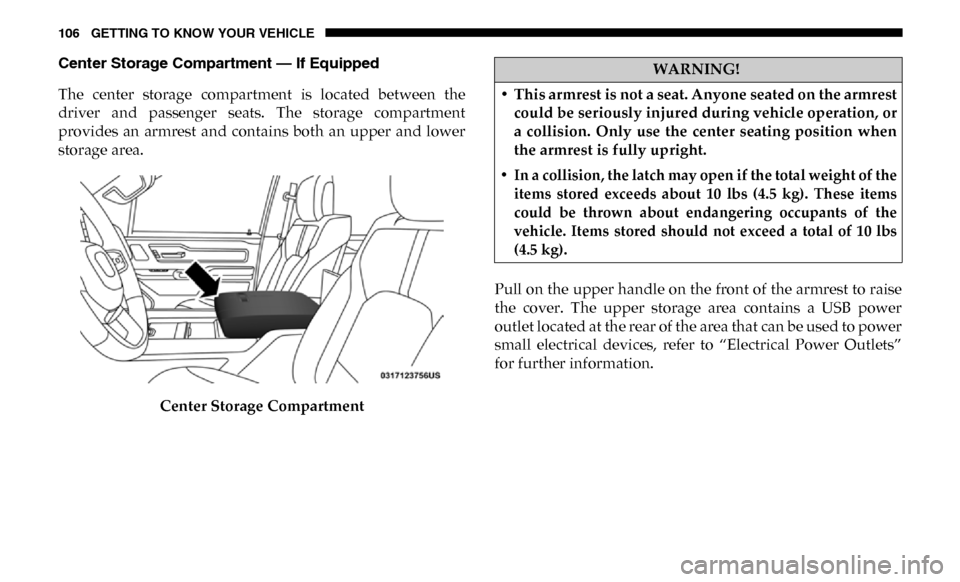
Center Storage Compartment — If Equipped
The center storage compartment is located between the
driver and passenger seats. The storage compartment
provides an armrest and contains both an upper and lower
storage area.Center Storage Compartment Pull on the upper handle on the front of the armrest to raise
the cover. The upper storage area contains a USB power
outlet located at the rear of the area that can be used to power
small electrical devices, refer to “Electrical Power Outlets”
for further information.WARNING!
• This armrest is not a seat. Anyone seated on the armrest could be seriously injured during vehicle operation, or
a collision. Only use the center seating position when
the armrest is fully upright.
• In a collision, the latch may open if the total weight of the items stored exceeds about 10 lbs (4.5 kg). These items
could be thrown about endangering occupants of the
vehicle. Items stored should not exceed a total of 10 lbs
(4.5 kg).
Page 172 of 607

170 SAFETY
The “ESC OFF Indicator Light” indicates the
customer has elected to have the Electronic Stability
Control (ESC) in a reduced mode.
Electronic Roll Mitigation (ERM)
This system anticipates the potential for wheel lift by moni -
toring the driver’s steering wheel input and the speed of the
vehicle. When ERM determines that the rate of change of the
steering wheel angle and vehicle’s speed are sufficient to
potentially cause wheel lift, it then applies the appropriate
brake and may also reduce engine power to lessen the chance
that wheel lift will occur. ERM can only reduce the chance of
wheel lift occurring during severe or evasive driving maneu-
vers; it cannot prevent wheel lift due to other factors, such as
road conditions, leaving the roadway, or striking objects or
other vehicles.
NOTE:
ERM is disabled anytime the ESC is in “Full Off” mode (if
equipped). Refer to “Electronic Stability Control (ESC)” in
this section for a complete explanation of the available ESC
modes. Trailer Sway Control (TSC)
TSC uses sensors in the vehicle to recognize an excessively
swaying trailer and will take the appropriate actions to
attempt to stop the sway. TSC will become active automati
-
cally once an excessively swaying trailer is recognized.
NOTE:
TSC cannot stop all trailers from swaying. Always use
caution when towing a trailer and follow the trailer tongue
weight recommendations. Refer to “Trailer Towing” in
“Starting And Operating” for further information.WARNING!
Many factors, such as vehicle loading, road conditions
and driving conditions, influence the chance that wheel
lift or rollover may occur. ERM cannot prevent all wheel
lift or roll overs, especially those that involve leaving the
roadway or striking objects or other vehicles. The
capabilities of an ERM-equipped vehicle must never be
exploited in a reckless or dangerous manner which could
jeopardize the user's safety or the safety of others.
Page 217 of 607
SAFETY 215
Carefully read and follow all the instructions and warnings
in the child restraint Owner’s Manual and on all the labels
attached to the child restraint.
Before buying any restraint system, make sure that it has a
label certifying that it meets all applicable Safety Standards.
You should also make sure that you can install it in the
vehicle where you will use it.NOTE:
• For additional information, refer to
http://www.nhtsa.gov/
parents-and-caregivers or call: 1–888–327–4236
• Canadian residents should refer to Transport Canada’s website for additional information: http://www.tc.gc.ca/eng/motorve -
hiclesafety/safedrivers-childsafety-index-53.htm
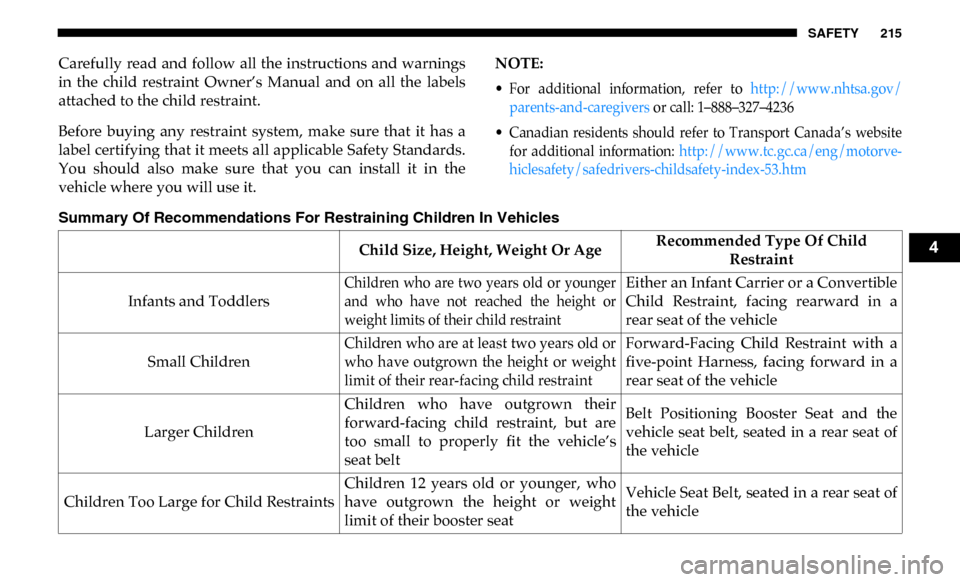
Summary Of Recommendations For Restraining Children In Vehicles Child Size, Height, Weight Or AgeRecommended Type Of Child
Restraint
Infants and Toddlers
Children who are two years old or younger
and who have not reached the height or
weight limits of their child restraint
Either an Infant Carrier or a Convertible
Child Restraint, facing rearward in a
rear seat of the vehicle
Small Children
Children who are at least two years old or
who have outgrown the height or weight
limit of their rear-facing child restraint
Forward-Facing Child Restraint with a
five-point Harness, facing forward in a
rear seat of the vehicle
Larger Children Children who have outgrown their
forward-facing child restraint, but are
too small to properly fit the vehicle’s
seat belt Belt Positioning Booster Seat and the
vehicle seat belt, seated in a rear seat of
the vehicle
Children Too Large for Child Restraints Children 12 years old or younger, who
have outgrown the height or weight
limit of their booster seat Vehicle Seat Belt, seated in a rear seat of
the vehicle
4
Page 218 of 607
216 SAFETY
Infant And Child Restraints
Safety experts recommend that children ride rear-facing in
the vehicle until they are two years old or until they reach
either the height or weight limit of their rear-facing child
restraint. Two types of child restraints can be used
rear-facing: infant carriers and convertible child seats.
The infant carrier is only used rear-facing in the vehicle. It is
recommended for children from birth until they reach the
weight or height limit of the infant carrier. Convertible child
seats can be used either rear-facing or forward-facing in the
vehicle. Convertible child seats often have a higher weight
limit in the rear-facing direction than infant carriers do, so
they can be used rear-facing by children who have outgrown
their infant carrier but are still less than at least two years old.
Children should remain rear-facing until they reach the
highest weight or height allowed by their convertible child
seat.WARNING!
• Never place a rear-facing child restraint in front of an air bag. A deploying passenger front air bag can cause
death or serious injury to a child 12 years or younger,
including a child in a rear-facing child restraint.
• Never install a rear-facing child restraint in the front seat of a vehicle. Only use a rear-facing child restraint
in the rear seat. If the vehicle does not have a rear seat,
do not transport a rear-facing child restraint in that
vehicle.
WARNING!
Do not install a rear-facing car seat using a rear support
leg in this vehicle. The floor of this vehicle is not
designed to manage the crash forces of this type of car
seat. In a crash, the support leg may not function as it
was designed by the car seat manufacturer, and your
child may be more severely injured as a result.
Page 219 of 607

SAFETY 217
Older Children And Child Restraints
Children who are two years old or who have outgrown their
rear-facing convertible child seat can ride forward-facing in
the vehicle. Forward-facing child seats and convertible child
seats used in the forward-facing direction are for children
who are over two years old or who have outgrown the
rear-facing weight or height limit of their rear-facing
convertible child seat. Children should remain in a
forward-facing child seat with a harness for as long as
possible, up to the highest weight or height allowed by the
child seat.
All children whose weight or height is above the
forward-facing limit for the child seat should use a belt-posi-
tioning booster seat until the vehicle’s seat belts fit properly.
If the child cannot sit with knees bent over the vehicle’s seat
cushion while the child’s back is against the seatback, they
should use a belt-positioning booster seat. The child and
belt-positioning booster seat are held in the vehicle by the
seat belt.WARNING!
• Improper installation can lead to failure of an infant or child restraint. It could come loose in a collision. The
child could be badly injured or killed. Follow the child
restraint manufacturer’s directions exactly when
installing an infant or child restraint.
• After a child restraint is installed in the vehicle, do not move the vehicle seat forward or rearward because it
can loosen the child restraint attachments. Remove the
child restraint before adjusting the vehicle seat posi -
tion. When the vehicle seat has been adjusted, reinstall
the child restraint.
• When your child restraint is not in use, secure it in the vehicle with the seat belt or LATCH anchorages, or
remove it from the vehicle. Do not leave it loose in the
vehicle. In a sudden stop or accident, it could strike the
occupants or seatbacks and cause serious personal
injury.
4
Page 221 of 607

SAFETY 219
Recommendations For Attaching Child Restraints Restraint Type Combined Weight
of the Child +
Child Restraint Use Any Attachment Method Shown With An “X” Below
LATCH – Lower Anchors Only Seat Belt OnlyLATCH – Lower
Anchors + Top Tether Anchor Seat Belt + Top
Tether Anchor
Rear-Facing Child Restraint Up to 65 lbs
(29.5 kg) X
X
Rear-Facing Child Restraint More than 65 lbs
(29.5 kg) X
Forward-Facing Child Restraint Up to 65 lbs
(29.5 kg) X
X
Forward-Facing Child Restraint More than 65 lbs
(29.5 kg) X
4
Page 224 of 607

222 SAFETY
Frequently Asked Questions About Installing Child Restraints With LATCH
What is the weight limit (child’s weight
+ weight of the child restraint) for using
the LATCH anchorage system to attach
the child restraint? 65 lbs (29.5 kg)Use the LATCH anchorage system until the combined
weight of the child and the child restraint is 65 lbs (29.5
kg). Use the seat belt and tether anchor instead of the
LATCH system once the combined weight is more than
65 lbs (29.5 kg).
Can the LATCH anchorages and the
seat belt be used together to attach a
rear-facing or forward-facing child
restraint? NoDo not use the seat belt when you use the LATCH
anchorage system to attach a rear-facing or
forward-facing child restraint.
Booster seats may be attached to the LATCH anchorages
if allowed by the booster seat manufacturer. See your
booster seat owner’s manual for more information.
Can a child seat be installed in the
center position using the inner LATCH
lower anchorages from the outboard
seating positions? No – Regular / Crew
Full Rear Bench
N/A – Crew Split Rear
BenchRegular Cab Front/Full Bench Rear Seat: Use the seat belt
and tether anchor to install a child seat in the center
seating position.
Split Bench Rear Seat: Use the supplied center lower
anchorages to install a child restraint in the center
position.
Page 232 of 607

230 SAFETY
Frequently Asked Questions About Installing Child Restraints With Seat Belts
What is the weight limit (child’s weight
+ weight of the child restraint) for using
the Tether Anchor with the seat belt to
attach a forward facing child restraint? Weight limit of the Child Restraint Always use the tether anchor when
using the seat belt to install a forward
facing child restraint, up to the
recommended weight limit of the child
restraint.
Can the rear-facing child restraint
touch the back of the front passenger
seat? Yes Contact between the front passenger
seat and the child restraint is allowed, if
the child restraint manufacturer also
allows contact.
Can the rear head restraints be
removed? Yes The head restraints can be removed in
every rear seating position if they
interfere with the installation of the
child restraint.
Refer to “Head Restraints” in “Getting
To Know Your Vehicle” for further
information.
Can the buckle stalk be twisted to
tighten the seat belt against the belt
path of the child restraint? Yes – Cinching Latch Plate
No – ALR In positions with cinching latch plates
(CINCH), the buckle stalk may be
twisted up to 3 full turns. Do not twist
the buckle stalk in a seating position
with an ALR retractor.
Page 339 of 607
STARTING AND OPERATING 337
NOTE:
Tighten the gas cap ¼ turn until you hear one click. This is an
indication that the cap is properly tightened.
If the gas cap is not tightened properly, the Malfunction Indi-
cator Light will come on. Be sure the gas cap is tightened
every time the vehicle is refueled.
Loose Fuel Filler Cap Message
If the vehicle diagnostic system determines that the
fuel filler cap is loose, improperly installed, or
damaged, a loose gascap indicator will display in the
instrument cluster telltale display area. Refer to “Instrument
Cluster Display” in “Getting To Know Your Instrument
Panel” for further information. Tighten the fuel filler cap
properly and push the RIGHT button to turn off the message.
If the problem continues, the message will appear the next
time the vehicle is started.
VEHICLE LOADING
Gross Vehicle Weight Rating (GVWR)
The GVWR is the total permissible weight of your vehicle
including driver, passengers, vehicle, options and cargo. The
label also specifies maximum capacities of front and rear axle
systems (GAWR). Total load must be limited so GVWR and
front and rear GAWR are not exceeded.
• Never add fuel to the vehicle when the engine is
running. This is in violation of most state and federal
fire regulations and may cause the MIL to turn on.
WARNING!
A fire may result if gasoline is pumped into a portable
container that is inside of a vehicle. You could be
burned. Always place gas containers on the ground
while filling.
WARNING! (Continued)
5