fuel RAM CHASSIS CAB 2007 Owner's Guide
[x] Cancel search | Manufacturer: RAM, Model Year: 2007, Model line: CHASSIS CAB, Model: RAM CHASSIS CAB 2007Pages: 532, PDF Size: 2.69 MB
Page 278 of 532

WARNING!Do not use the Tow/Haul feature when driving in icy
or slippery conditions as the increased engine brak-
ing can cause the rear wheels to slide and the vehicle
to swing around with the possible loss of vehicle
control, which may cause an accident possibly result-
ing in personal injury or death.
When To Lock Out Overdrive
When driving in hilly areas, towing a trailer, carrying a
heavy load, etc., and frequent 6–5–6 or 5–4–5 transmis-
sion shifting occurs, press the “TOW/HAUL” button.
This will improve performance and reduce the potential
for transmission overheating or failure due to excessive
shifting. Torque Converter Clutch
A feature, designed to improve fuel economy, has been
included in the automatic transmission on your vehicle.
A clutch within the torque converter engages automati-
cally at calibrated speeds. This may result in a slightly
different feeling or response during normal operation in
high gear. When the vehicle speed drops or during
acceleration when the transmission downshifts to 1st
gear, the clutch automatically disengages.
NOTE: The torque converter clutch will not engage
until the transmission fluid and engine coolant are warm
[usually after 1-3 miles (1.6 - 4.8 km) of driving]. Because
the engine speed is higher when the torque converter
clutch is not engaged, it may seem as if the transmission
is not shifting into Overdrive when cold. This is normal.
Pressing the “TOW/HAUL” button, when the transmis-
sion is sufficiently warm, will demonstrate that the
transmission is able to shift into and out of overdrive.278 STARTING AND OPERATING
Page 280 of 532

Manual Transmission — 6 Speed (G56)
Your vehicle may be equipped with the G56 manual
transmission. This transmission has a “creeper” 1st gear
which should be used to start from a standing position
when carrying a payload or towing a trailer. Damage to
the clutch can result from starting in 2nd or 3rd gear with
a loaded vehicle. An unloaded vehicle may be launched
in 2nd gear. Use each gear in numerical order – do not
skip a gear.
For most city driving you may find it easier to use only
1st through 5th gear ranges. For steady highway driving
with light accelerations, 6th gear is recommended. To
shift into 5th gear, move the shift lever to the right
beyond the spring pressure point and push it forward.
When shifting from 5th to 4th gear, pull the lever down
toward you in one motion. Do not pull the lever sharply left as you may shift accidentally into 2nd gear and
damage the transmission.
To shift into Reverse, come to a complete stop. Depress
the clutch and pause briefly to allow the gear train to
stop. Reverse has a “crash-through” lockout feature.
Move the shift lever from the Neutral position straight
across, in one swift motion, and down into Reverse.
Recommended Vehicle Shift Speeds
To utilize your manual transmission efficiently for both
fuel economy and performance, it should be upshifted as
listed in recommended shift speed chart. Shift at the
vehicle speeds listed for acceleration. Earlier upshifts
during cruise conditions (steady speeds) will result in
increased fuel economy, and may be used as indicated.280 STARTING AND OPERATING
Page 315 of 532
2. Economy—
Improper inflation pressures can cause uneven wear
patterns to develop across the tire tread. These abnormal
wear patterns will reduce tread life resulting in a need for
earlier tire replacement. Under inflation, also increases
tire rolling resistance and results in higher fuel consump-
tion.
3. Ride Comfort and Vehicle Stability—
Proper tire inflation contributes to a comfortable ride.
Over inflation produces a jarring and uncomfortable ride.
Tire Inflation Pressures
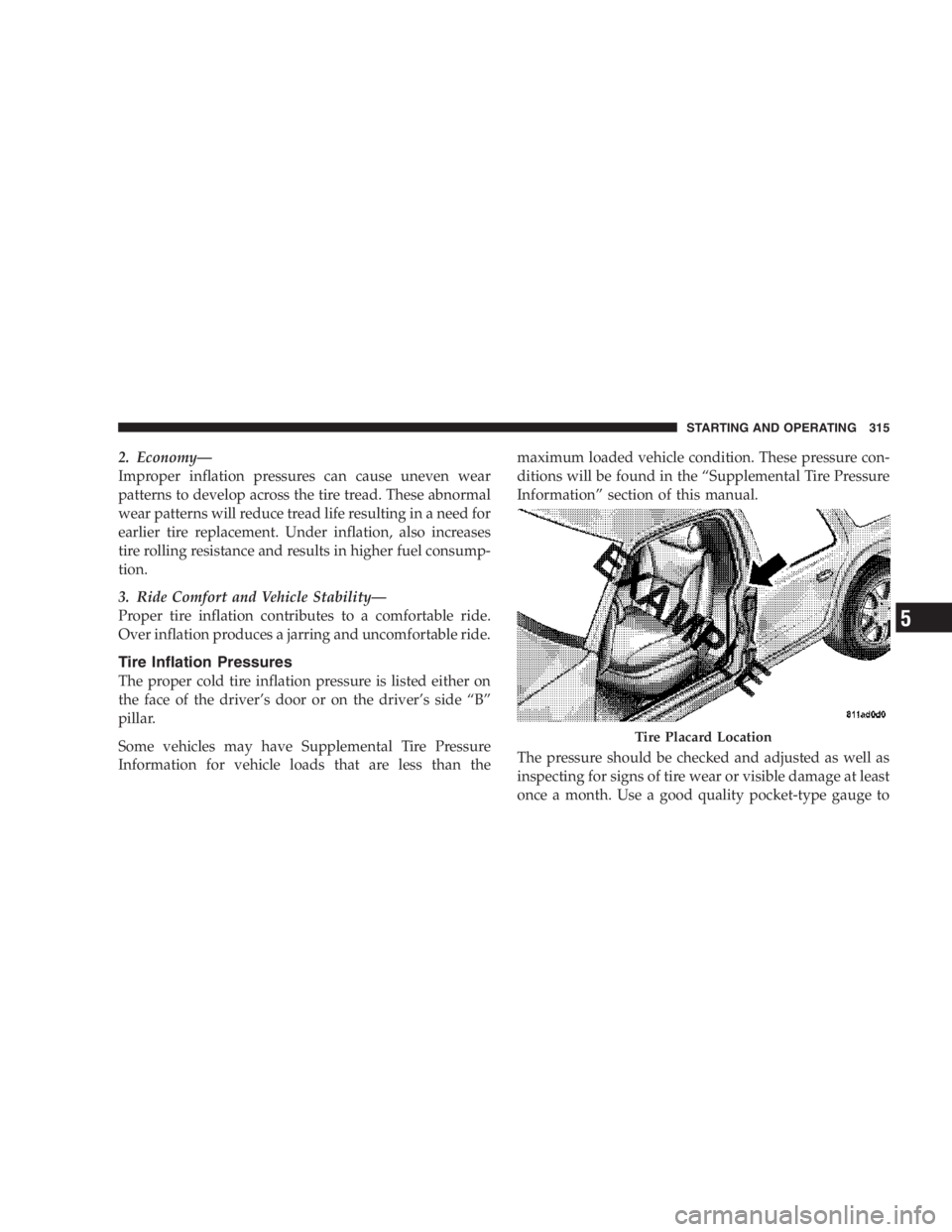
The proper cold tire inflation pressure is listed either on
the face of the driver’s door or on the driver’s side “B”
pillar.
Some vehicles may have Supplemental Tire Pressure
Information for vehicle loads that are less than the maximum loaded vehicle condition. These pressure con-
ditions will be found in the “Supplemental Tire Pressure
Information” section of this manual.
The pressure should be checked and adjusted as well as
inspecting for signs of tire wear or visible damage at least
once a month. Use a good quality pocket-type gauge to Tire Placard Location STARTING AND OPERATING 315
5
Page 327 of 532

ENGINE RUNAWAY
WARNING!In case of engine runaway due to flammable fumes
from gasoline spills or turbocharger oil leaks being
sucked into the engine do the following to help
avoid personal injury and/or vehicle damage:
1. Shut off engine ignition switch.
2. Using a CO 2
or dry chemical type fire extin-
guisher, direct the spray from the fire extinguisher
into the grille on the passenger side so that the spray
enters the engine air intake.
The inlet for the engine air intake is located behind the
passenger side headlamp and receives air through the
grille FUEL REQUIREMENTS
Fuel Requirements (Gas Engines)
The 5.7L engine is designed to meet all
emissions regulations and provide satisfac-
tory fuel economy and performance when
using high quality unleaded gasoline hav-
ing an octane range of 87 to 89. The manu-
facturer recommends the use of 89 octane
for optimum performance. The routine use of premium
gasoline is not recommended. The use of premium
gasoline will provide no benefit over high quality regular
and mid-grade gasolines, and in some circumstances
may result in poorer performance.
Light spark knock at low engine speeds is not harmful to
your engine. However, continued heavy spark knock at
high speeds can cause damage and immediate service is
required. STARTING AND OPERATING 327
5
Page 328 of 532

Poor quality gasoline can cause problems such as hard
starting, stalling and hesitations. If you experience these
symptoms, try another brand of “regular” gasoline be-
fore considering service for the vehicle.
Over 40 auto manufacturers world-wide have issued and
endorsed consistent gasoline specifications (the World-
wide Fuel Charter, WWFC) to define fuel properties
necessary to deliver enhanced emissions, performance
and durability for your vehicle. We recommend the use
of gasolines that meet the WWFC specifications if they
are available.
Reformulated Gasoline
Many areas of the country require the use of cleaner
burning gasoline referred to as “Reformulated Gasoline.”
Reformulated gasolines contain oxygenates, and are spe-
cifically blended to reduce vehicle emissions and im-
prove air quality. We strongly support the use of reformulated gasolines.
Properly blended reformulated gasolines will provide
excellent performance and durability for the engine and
fuel system components.
Gasoline/Oxygenate Blends
Some fuel suppliers blend unleaded gasoline with oxy-
genates such as 10% ethanol, MTBE and ETBE. Oxygen-
ates are required in some areas of the country during the
winter months to reduce carbon monoxide emissions.
Fuels blended with these oxygenates may be used in
your vehicle.
CAUTION!DO NOT use gasolines containing Methanol or E85
Ethanol. Use of these blends may result in starting
and driveability problems and may damage critical
fuel system components.328 STARTING AND OPERATING
Page 329 of 532

Problems that result from using methanol/gasoline or
E85 Ethanol blends are not the responsibility of the
manufacturer. While MTBE is an oxygenate made from
Methanol, it does not have the negative effects of Metha-
nol.
MMT In Gasoline
MMT is a manganese-containing metallic additive that is
blended into some gasoline to increase octane. Gasolines
blended with MMT provide no performance advantage
beyond gasolines of the same octane number without
MMT. Gasolines blended with MMT reduce spark plug
life and reduce emission system performance. We recom-
mend that gasolines free of MMT be used in your vehicle.
The MMT content of gasoline may not be indicated on
the gasoline pump; therefore, you should ask your gaso-
line retailer whether or not his/her gasoline contains
MMT. It is even more important to look for gasolines without
MMT in Canada because MMT can be used at levels
higher than allowed in the United States. MMT is pro-
hibited in Federal and California reformulated gasolines.
Materials Added To Fuel
All gasolines sold in the United States are required to
contain effective detergent additives. Use of additional
detergents or other additives is not needed under normal
conditions and would result in unnecessary cost. There-
fore, you should not have to add anything to the fuel.
Fuel System Cautions
CAUTION!Follow these guidelines to maintain your vehicle’s
performance: STARTING AND OPERATING 329
5
Page 330 of 532

• The use of leaded gas is prohibited by Federal law.
Using leaded gasoline can impair engine performance,
damage the emission control system.
• An out-of-tune engine, or certain fuel or ignition
malfunctions, can cause the catalytic converter to
overheat. If you notice a pungent burning odor or
some light smoke, your engine may be out of tune or
malfunctioning and may require immediate service.
Contact your dealer for service assistance.
• When pulling a heavy load or driving a fully loaded
vehicle when the humidity is low and the temperature
is high, use a premium unleaded fuel to help prevent
spark knock. If spark knock persists, lighten the load,
or engine piston damage may result.
• The use of fuel additives which are now being sold as
octane enhancers is not recommended. Many of these
products contain high concentrations of methanol. Fuel system damage or vehicle performance problems
resulting from the use of such fuels or additives is not
the responsibility of the manufacturer.
NOTE: Intentional tampering with emissions control
systems can result in civil penalties being assessed
against you.
Carbon Monoxide Warnings
WARNING!Carbon monoxide (CO) in exhaust gases is deadly.
Follow the precautions below to prevent carbon
monoxide poisoning:
• Do not inhale exhaust gases. They contain carbon
monoxide, a colorless and odorless gas which can kill.
Never run the engine in a closed area, such as a
garage, and never sit in a parked vehicle with the330 STARTING AND OPERATING
Page 331 of 532

engine running for an extended period. If the vehicle is
stopped in an open area with the engine running for
more than a short period, adjust the ventilation system
to force fresh, outside air into the vehicle.
• Guard against carbon monoxide with proper mainte-
nance. Have the exhaust system inspected every time
the vehicle is raised. Have any abnormal conditions
repaired promptly. Until repaired, drive with all side
windows fully open.
• Keep the liftgate closed when driving your vehicle to
prevent carbon monoxide and other poisonous ex-
haust gases from entering the vehicle.
Fuel Requirements (6.7L Diesel Engines)
Use good quality diesel fuel from a reputable supplier in
your vehicle. Federal law requires that you must fuel this
vehicle with Ultra Low Sulfur Highway Diesel fuel (15
ppm Sulfur maximum) and prohibits the use of Low
Sulfur Highway Diesel fuel (500 ppm Sulfur maximum) to avoid damage to the emissions control system. For
most year-round service, No. 2 diesel fuel meeting ASTM
specification D-975 Grade S15 will provide good perfor-
mance. If the vehicle is exposed to extreme cold (below
20°F or -7°C), or is required to operate at colder-than-
normal conditions for prolonged periods, use climatized
No. 2 diesel fuel or dilute the No. 2 diesel fuel with 50%
No. 1 diesel fuel. This will provide better protection from
fuel gelling or wax-plugging of the fuel filters.
WARNING!Do not use alcohol or gasoline as a fuel blending
agent. They can be unstable under certain conditions
and hazardous or explosive when mixed with diesel
fuel. STARTING AND OPERATING 331
5
Page 332 of 532

Diesel fuel is seldom completely free of water. To prevent
fuel system trouble, drain the accumulated water from
the fuel/water separator using the fuel/water separator
drain provided. If you buy good quality fuel and follow
the cold weather advice above, fuel conditioners should
not be required in your vehicle. If available in your area,
a high cetane “premium” diesel fuel may offer improved
cold-starting and warm-up performance.
Fuel Specifications
The Cummins Turbocharged, Charge Air Cooled, Diesel
engine has been developed to take advantage of the high
energy content and generally lower cost No. 2 Ultra Low
Sulfur diesel fuel or No. 2 Ultra Low Sulfur climatized diesel fuels. Experience has shown that it also operates
on No. 1 Ultra Low Sulfur diesel fuels or other fuels
within specification.
NOTE: A maximum blend of 5% biodiesel meeting
ASTM specification D-6751 may be used with your
Cummins Diesel equipped vehicle.
NOTE: In addition, commercially available fuel addi-
tives are not necessary for the proper operation of your
Cummins Diesel equipped vehicle.
NOTE: No. 1 Ultra Low Sulfur diesel fuel should only
be used where extended arctic conditions (-10°F or -23°C)
exist.332 STARTING AND OPERATING
Page 333 of 532

ADDING FUEL
Adding Fuel (Gas Engines)
CAUTION!Damage to the fuel system or emission control
system could result from using an improper fuel
tank filler tube cap (gas cap). A poorly fitting cap
could let impurities into the fuel system. Also a
poorly fitted after-market cap can cause the MIL
(Malfunction Indicator Light) to illuminate, due to
fuel vapors escaping from the system. CAUTION!A poorly fitting gas cap may cause the Malfunction
Indicator Light to turn on.
CAUTION!To avoid fuel spillage and overfilling, do not “top
off” the fuel tank after filling.
NOTE: When the fuel nozzle “clicks” or shuts off, the
fuel tank is full. STARTING AND OPERATING 333
5