lock RAM CHASSIS CAB 2009 Owner's Manual
[x] Cancel search | Manufacturer: RAM, Model Year: 2009, Model line: CHASSIS CAB, Model: RAM CHASSIS CAB 2009Pages: 429, PDF Size: 3.51 MB
Page 36 of 429

Power Sliding Rear Window – If Equipped
The power sliding rear window switch is located on the
instrument panel below the climate controls. Press the
right side of the switch to open the glass and the left side
of the switch to close the glass.
Sliding Rear Window – If Equipped
A locking device in the center of the window helps to
prevent entry from the rear of the vehicle. Squeeze the
lock to release the window.
Wind Buffeting
Wind buffeting can be described as the perception of
pressure on the ears or a helicopter type sound in the
ears. Your vehicle may exhibit wind buffeting with the
windows down or in partially open positions. This is a
normal occurrence and can be minimized. If the buffeting
occurs with the rear windows open, open the front and
rear windows together to minimize the buffeting.
Power Sliding Rear Window Switch
34 THINGS TO KNOW BEFORE STARTING YOUR VEHICLE
Page 38 of 429

of ejection and the risk of injury caused by striking the
inside of the vehicle.Everyonein a motor vehicle should
be belted at all times.
Lap/Shoulder Belts
All seating positions except the Quad Cab\3 front center
seating position have combination lap/shoulder belts.
The belt webbing retractor is designed to lock during
very sudden stops or collisions. This feature allows the
shoulder part of the belt to move freely with you under
normal conditions. But in a collision, the belt will lock
and reduce the risk of your striking the inside of the
vehicle or being thrown out.
WARNING!
It is extremely dangerous to ride in a cargo area,
inside or outside of a vehicle. In a collision, people
riding in these areas are more likely to be seriously
injured or killed.
Do not allow people to ride in any area of your
vehicle that is not equipped with seats and seat belts.
Be sure everyone in your vehicle is in a seat and
using a seat belt properly.
36 THINGS TO KNOW BEFORE STARTING YOUR VEHICLE
Page 46 of 429
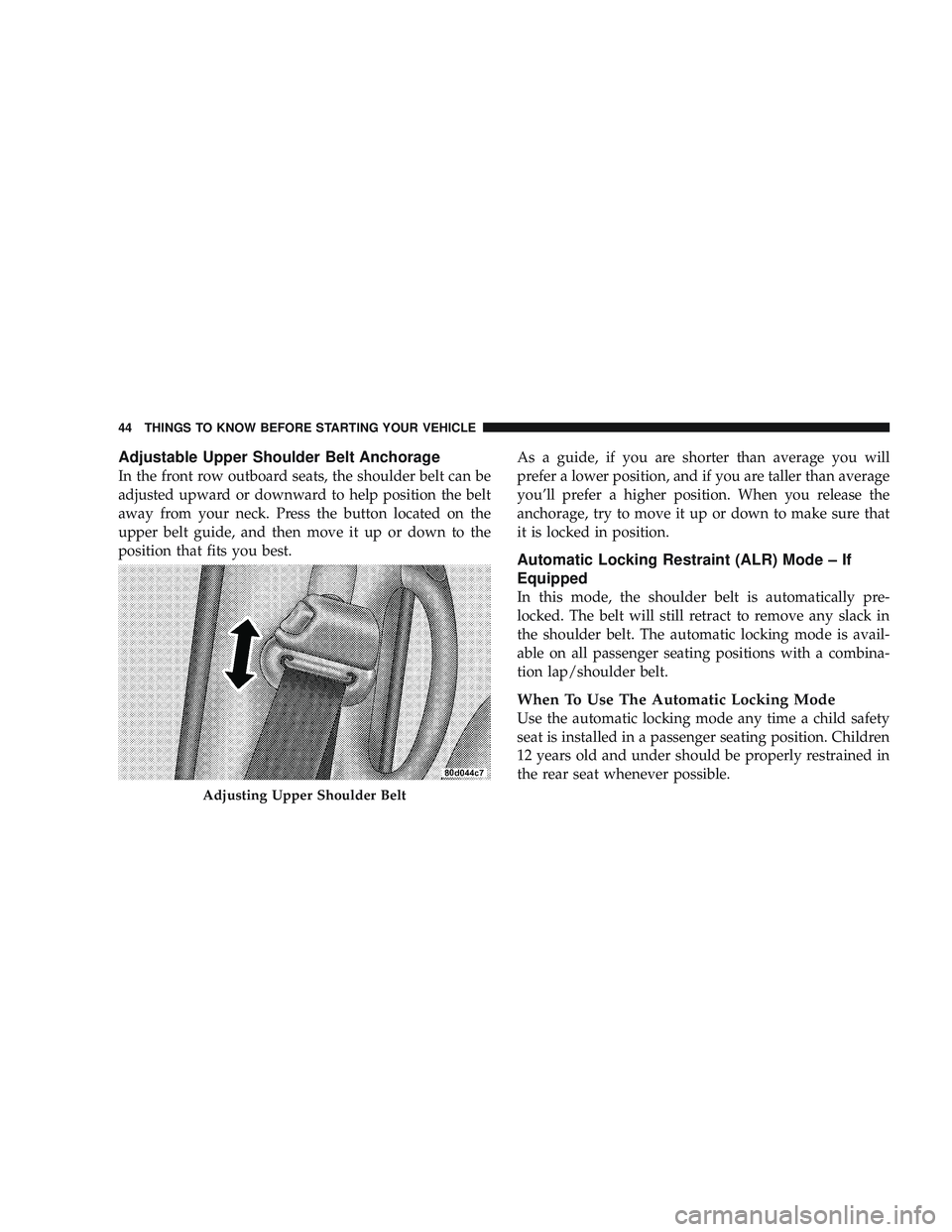
Adjustable Upper Shoulder Belt Anchorage
In the front row outboard seats, the shoulder belt can be
adjusted upward or downward to help position the belt
away from your neck. Press the button located on the
upper belt guide, and then move it up or down to the
position that fits you best.As a guide, if you are shorter than average you will
prefer a lower position, and if you are taller than average
you’ll prefer a higher position. When you release the
anchorage, try to move it up or down to make sure that
it is locked in position.
Automatic Locking Restraint (ALR) Mode – If
Equipped
In this mode, the shoulder belt is automatically pre-
locked. The belt will still retract to remove any slack in
the shoulder belt. The automatic locking mode is avail-
able on all passenger seating positions with a combina-
tion lap/shoulder belt.
When To Use The Automatic Locking Mode
Use the automatic locking mode any time a child safety
seat is installed in a passenger seating position. Children
12 years old and under should be properly restrained in
the rear seat whenever possible.
Adjusting Upper Shoulder Belt
44 THINGS TO KNOW BEFORE STARTING YOUR VEHICLE
Page 47 of 429
How To Use The Automatic Locking Mode
1. Buckle the combination lap/shoulder belt.
2. Grasp the shoulder portion and pull downward until
the entire belt is extracted.
3. Allow the belt to retract. As the belt retracts, you will
hear a clicking sound. This indicates the safety belt is
now in the automatic locking mode.
How To Disengage The Automatic Locking Mode
Disconnect the combination lap/shoulder belt and allow
it to retract completely to disengage the automatic lock-
ing mode and activate the vehicle sensitive (emergency)
locking mode.
Center Lap Belts
The center seating position for the Quad Cab\3front seat
has a lap belt only. To fasten the lap belt, slide the latch
plate into the buckle until you hear a \6click.\6To lengthen
the lap belt, tilt the latch plate and pull. To remove slack,
pull the loose end of the webbing. Wear the lap belt snug
against the hips. Sit back and erect in the seat, then adjust
the belt as tightly as is comfortable.
WARNING!
•A lap belt worn too loose or too high is dangerous.
•A belt worn too loose can allow you to slip down
and under the belt in a collision.
•A belt that is too loose or too high will apply crash
forces to the abdomen, not to the stronger hip
bones. In either case, the risk of internal injuries is
greater. Wear a lap belt low and snug.
THINGS TO KNOW BEFORE STARTING YOUR VEHICLE 45
2
Page 56 of 429

WARNING!
Whenever an airbag is turned off, even a lap/
shoulder belted passenger may hit their head, neck,
or chest on the dashboard (instrument panel) or
windshield in a crash. This may result in serious
injury or death.
To Shut Off the Passenger Airbag (Regular Cab Ve-
hicles Only) – If Equipped
Place the ignition key in the Passenger Airbag On/Off
Switch (if equipped), push the key in and turn clockwise,
and remove the key from the switch. This will shut off the
passenger airbag (if equipped). The OFF light near the
switch will illuminate when the ignition switch is turned
to the ON position. To Turn On the Passenger Airbag (Regular Cab Vehicles
Only) – If Equipped
Place the ignition key in the Passenger Airbag On/Off
Switch (If Equipped), push the key in and turn counter-
clockwise, and remove the key from the switch. This will
turn on the passenger airbag (if equipped). The OFF light
near the switch will be off when the ignition switch is
turned to the ON position.
If A Deployment Occurs
The airbag system is designed to deploy when the ORC
detects a moderate-to-severe frontal collision, and then
immediately to deflate.
NOTE:
A frontal collision that is not severe enough to
need airbag protection will not activate the system. This
does not mean something is wrong with the airbag
system.
54 THINGS TO KNOW BEFORE STARTING YOUR VEHICLE
Page 58 of 429

Enhanced Accident Response System
If the airbags deploy after an impact and the electrical
system remains functional, vehicles equipped with
power door locks will unlock automatically. In addition,
approximately 10 seconds after the vehicle has stopped
moving, the interior lights will light until the ignition
switch is turned off.
Maintaining Your Airbag Systems
WARNING!
•Modifications to any part of the airbag system
could cause it to fail when you need it. You could
be injured because the airbags are not there to
protect you. Do not modify the components or
wiring, including adding any kind of badges or
stickers to the steering wheel hub trim cover or the
upper right side of the instrument panel. Do not
modify the front bumper, vehicle body structure,
or frame.
•You need proper knee impact protection in a
collision. Do not mount or locate any aftermarket
equipment on or behind the knee bolster.
•It is dangerous to try to repair any part of the
airbag system yourself. Be sure to tell anyone who
works on your vehicle that it has airbags.
56 THINGS TO KNOW BEFORE STARTING YOUR VEHICLE
Page 59 of 429

NOTE:Perchlorate Material – special handling may apply:
Refer to www.dtsc.ca.gov/hazardouswaste/perchlorate.
Airbag Warning Light
You will want to have the airbags ready to
inflate for your protection in an impact. While
the airbag system is designed to be mainte-
nance free, if any of the following occurs, have
an authorized dealer service the system promptly:
•The Airbag Warning Light does not come on or flickers
during the six to eight seconds when the ignition
switch is first turned ON.
•The light remains on or flickers after the six to eight
second interval.
•The light flickers or comes on and remains on while
driving. NOTE:
If the speedometer, tachometer or any engine
related gauges are not working, the ORC may also be
disabled. The airbags may not be ready to inflate for your
protection. Promptly check the fuse block for blown
fuses. For proper location of airbag fuses, refer to “Fuses
(Integrated Power Module)” in Section 7. See your au-
thorized dealer if the fuse is good.
Event Data Recorder (EDR)
In the event of an accident, your vehicle is designed to
record up to approximately five seconds of specific
vehicle data parameters (see the following list) in an
event data recorder prior to the moment of airbag de-
ployment, or near deployment, and up to a quarter-
second of high-speed deceleration data during and/or
after airbag deployment. EDR data are ONLY recorded if
an airbag deploys, or nearly deploys, and are otherwise
unavailable.
THINGS TO KNOW BEFORE STARTING YOUR VEHICLE 57
2
Page 64 of 429
WARNING!
•Improper installation can lead to failure of an
infant or child restraint. It could come loose in a
collision. The child could be badly injured or
killed. Follow the manufacturer’s directions ex-
actly when installing an infant or child restraint.
•A rearward-facing child restraint should only be
used in a rear seat, or in the front seat if the
passenger’s front airbag is Off (if equipped). If the
airbag is left On, a rearward-facing child restraint
in the front seat may be struck by a deploying
passenger airbag (if equipped) which may cause
severe or fatal injury to the infant.
Here are some tips for getting the most out of your child
restraint:
•Before buying any restraint system, make sure that it
has a label certifying that it meets all applicable Safety Standards. We also recommend that you make sure
that you can install the child restraint in the vehicle
where you will use it before you buy it.
•The restraint must be appropriate for your child’s
weight and height. Check the label on the restraint for
weight and height limits.
•Carefully follow the instructions that come with the
restraint. If you install the restraint improperly, it may
not work when you need it.
•The passenger seat belts are equipped with Automatic
Locking Retractors (ALR), which are designed to keep
the lap portion tight around the child restraint so that
it is not necessary to use a locking clip.
Pull the belt from the retractor until there is enough to
allow you to pass through the child restraint and slide
the latch plate into the buckle. Then pull on the belt
until it is completely extended from the retractor.
62 THINGS TO KNOW BEFORE STARTING YOUR VEHICLE
Page 65 of 429

Allow the belt to return to the retractor, pulling on the
excess webbing to tighten the lap portion about the
child restraint. Refer to\6Automatic Locking Retractors
(ALR) Mode\6 in this section.
•In the rear seat, you may have trouble tightening the
lap/shoulder belt on the child restraint because the
buckle or latch plate is too close to the belt path
opening on the restraint. Disconnect the latch plate
from the buckle and twist the short buckle-end belt
several times to shorten it. Insert the latch plate into
the buckle with the release button facing out.
•If the belt still can’t be tightened, or if pulling and
pushing on the restraint loosens the belt, disconnect
the latch plate from the buckle, turn the latch plate
around, and insert the latch plate into the buckle
again. If you still can’t make the child restraint secure,
try a different seating position.
•Buckle the child into the seat according to the child
restraint manufacturer’s directions.
•When your child restraint is not in use, secure it in the
vehicle with the seat belt or remove it from the vehicle.
Do not leave it loose in the vehicle. In a sudden stop or
collision, it could strike the occupants or seat backs
and cause serious personal injury.
WARNING!
Improper installation can lead to failure of an infant
or child restraint. It could come loose in a collision.
The child could be badly injured or killed. Follow
the manufacturer’s directions exactly when installing
an infant or child restraint.
THINGS TO KNOW BEFORE STARTING YOUR VEHICLE 63
2
Page 77 of 429
Airbag Warning Light
The airbag warning light should come on, and remain on,
for six to eight seconds as a bulb check when the ignition
switch is first turned ON. If the light is not lit during
starting, see your authorized dealer. If the light stays on,
flickers or comes on while driving, have the system
checked by an authorized dealer. If there is a problem
with the airbag warning light, the seat belt light will
flash.
Safety Checks You Should Make Outside The
Vehicle
Tires
Examine tires for tread wear or uneven wear patterns.
Check for stones, nails, glass or other objects lodged in
the tread.
Inspect for tread cuts or sidewall cracks. Check wheel
nuts for tightness and tires for proper pressure.
Lights
Check the operation of all exterior lights. Check turn
signal and high beam indicator lights on the instrument
panel.
Door Latches
Check for positive closing, latching and locking.
Fluid Leaks
Check area under vehicle after overnight parking for fuel,
water, oil, or other fluid leaks. Also, if fuel fumes are
detected the cause should be located and corrected.
THINGS TO KNOW BEFORE STARTING YOUR VEHICLE 75
2