transmission RAM CHASSIS CAB 2019 Manual Online
[x] Cancel search | Manufacturer: RAM, Model Year: 2019, Model line: CHASSIS CAB, Model: RAM CHASSIS CAB 2019Pages: 607, PDF Size: 12.68 MB
Page 407 of 607

IN CASE OF EMERGENCY 405
(Continued)FREEING A STUCK VEHICLE
If your vehicle becomes stuck in mud, sand, or snow, it can
often be moved using a rocking motion. Turn the steering
wheel right and left to clear the area around the front wheels.
Then shift back and forth between DRIVE and REVERSE,
while gently pressing the accelerator. Use the least amount of
accelerator pedal pressure that will maintain the rocking
motion, without spinning the wheels or racing the engine.
NOTE:
• For trucks equipped with an 8–speed transmission, shifts
between DRIVE and REVERSE can only be achieved at
wheel speeds of 5 mph (8 km/h) or less. Whenever the
transmission remains in NEUTRAL for more than two
seconds, you must press the brake pedal to engage DRIVE
or REVERSE.
• Push the "ESC Off" switch, to place the Electronic Stability
Control (ESC) system in "Partial Off" mode, before rocking
the vehicle. Refer to “Electronic Brake Control” in “Safety”
for further information. Once the vehicle has been freed,
push the "ESC Off" switch again to restore "ESC On" mode. WARNING!
Fast spinning tires can be dangerous. Forces generated
by excessive wheel speeds may cause damage, or even
failure, of the axle and tires. A tire could explode and
injure someone. Do not spin your vehicle's wheels faster
than 30 mph (48 km/h) or for longer than 30 seconds
continuously without stopping when you are stuck and
do not let anyone near a spinning wheel, no matter what
the speed.
CAUTION!
• Racing the engine or spinning the wheels may lead to
transmission overheating and failure. Allow the engine
to idle with the transmission in NEUTRAL for at least
one minute after every five rocking-motion cycles. This
will minimize overheating and reduce the risk of trans -
mission failure during prolonged efforts to free a stuck
vehicle.
• When “rocking” a stuck vehicle by shifting between
DRIVE and REVERSE, do not spin the wheels faster
than 15 mph (24 km/h), or drivetrain damage may
result. 6
Page 408 of 607

406 IN CASE OF EMERGENCY
TOWING A DISABLED VEHICLE
This section describes procedures for towing a disabled
vehicle using a commercial towing service. If the transmis -
sion and drivetrain are operable, disabled vehicles may also
be towed as described under “Recreational Towing” in the
“Starting And Operating” section.• Revving the engine or spinning the wheels too fast may lead
to transmission overheating and failure. It can also damage
the tires. Do not spin the wheels above 30 mph (48 km/h)
while in gear (no transmission shifting occurring). CAUTION! (Continued)
Towing
Condition Wheels OFF
The Ground 2WD Models 4WD Models
Flat Tow NONE If transmission is operable:
• Transmission in NEUTRAL
• 30 mph (48 km/h) max speed
• 15 miles (24 km) max distance (6–speed
transmission)
• 30 miles (48 km) max distance (8–speed
transmission) See instructions in “Recreational Towing”
under “Starting And Operating”
• Auto Transmission in PARK
• Transfer Case in NEUTRAL
• Tow in forward direction
Wheel Lift Or
Dolly Tow Front NOT ALLOWED
Rear OK NOT ALLOWED
Flatbed ALL BEST METHOD BEST METHOD
Page 409 of 607

IN CASE OF EMERGENCY 407
Proper towing or lifting equipment is required to prevent
damage to your vehicle. Use only tow bars and other equip -
ment designed for this purpose, following equipment manu -
facturer’s instructions. Use of safety chains is mandatory.
Attach a tow bar or other towing device to main structural
members of the vehicle, not to bumpers or associated
brackets. State and local laws regarding vehicles under tow
must be observed.
If you must use the accessories (wipers, defrosters, etc.)
while being towed, the ignition must be in the ON/RUN
mode, not the ACC mode.
If the key fob is unavailable or the vehicle's battery is
discharged, refer to “Manual Park Release” or “Gear Selector
Override” in this section for instructions on shifting the auto -
matic transmission out of PARK for towing. Two-Wheel Drive Models
The manufacturer recommends towing your vehicle with all
four wheels OFF the ground using a flatbed.
If flatbed equipment is not available, and the transmission is
operable, the vehicle may be towed (with the rear wheels on
the ground) under the following conditions:
• The transmission must be in NEUTRAL. Refer to “Manual
Park Release” in this section for instructions on shifting the
8–speed transmission to NEUTRAL when the engine is off.
• The towing speed must not exceed 30 mph (48 km/h).
• The towing distance must not exceed 15 miles (24 km) for
6–speed transmission, or 30 miles (48 km) for 8–speed
transmission.
If the transmission is not operable, or the vehicle must be
towed faster than 30 mph (48 km/h) or farther than 15 miles
(24 km) for 6–speed transmission, or 30 miles (48 km) for
8–speed transmission, tow with the rear wheels OFF the
ground. Acceptable methods are to tow the vehicle on a
flatbed, or with the front wheels raised and the rear wheels
on a towing dolly, or (when using a suitable steering wheel
stabilizer to hold the front wheels in the straight position)
with rear wheels raised and the front wheels on the ground.CAUTION!
• Do not use sling type equipment when towing. Vehicle
damage may occur.
• When securing the vehicle to a flat bed truck, do not
attach to front or rear suspension components. Damage
to your vehicle may result from improper towing. 6
Page 410 of 607

408 IN CASE OF EMERGENCY
Four-Wheel Drive Models
The manufacturer recommends towing with all wheels OFF
the ground. Acceptable methods are to tow the vehicle on a
flatbed or with one end of vehicle raised and the opposite
end on a towing dolly.
If flatbed equipment is not available, and the transfer case is
operable, the vehicle may be towed (in the forward direction,
with ALL wheels on the ground), IF the transfer case is in
NEUTRAL and the transmission is in PARK (P). Refer to
“Recreational Towing” in “Starting And Operating” for
further information and detailed instructions. Emergency Tow Hooks — If Equipped
Your vehicle may be equipped with emergency tow hooks.
NOTE:
For off-road recovery, it is recommended to use both of the
front tow hooks to minimize the risk of damage to the
vehicle.CAUTION!
Towing this vehicle in violation of the above
requirements can cause severe engine and/or
transmission damage. Damage from improper towing is
not covered under the New Vehicle Limited Warranty. CAUTION!
• Front or rear wheel lifts must not be used (if the
remaining wheels are on the ground). Internal damage
to the transmission or transfer case will occur if a front
or rear wheel lift is used when towing.
• Towing this vehicle in violation of the above require -
ments can cause severe transmission and/or transfer
case damage. Damage from improper towing is not
covered under the New Vehicle Limited Warranty.
Page 413 of 607

SERVICING AND MAINTENANCE 411
Once A Month Or Before A Long Trip:
• Check engine oil level.
• Check windshield washer fluid level.
• Check the tire inflation pressures and look for unusual
wear or damage. Rotate at the first sign of irregular wear.
• Check the fluid levels of the coolant reservoir, brake
master cylinder, power steering and automatic transmis -
sion (six-speed only), and fill as needed.
• Check function of all interior and exterior lights. Maintenance Plan
Required Maintenance
Refer to the maintenance plan on the following pages for
required maintenance.
At Every Oil Change Interval As Indicated By Oil Change Indicator System:
• Change oil and filter.
• Rotate the tires. Rotate at the first sign of irregular wear, even if it occurs before the oil indicator system turns on.
• Inspect engine cooling system protection and hoses.
• Inspect exhaust system.
• Inspect engine air cleaner if using in dusty or off-road conditions.
• Inspect battery and clean and tighten terminals as required.
• Inspect automatic transmission fluid if equipped with dipstick.
• Inspect brake pads, shoes, rotors, drums, hoses and park brake.
• Inspect front end, and lubricate — If equipped with serviceable fittings. 7
Page 415 of 607
SERVICING AND MAINTENANCE 413
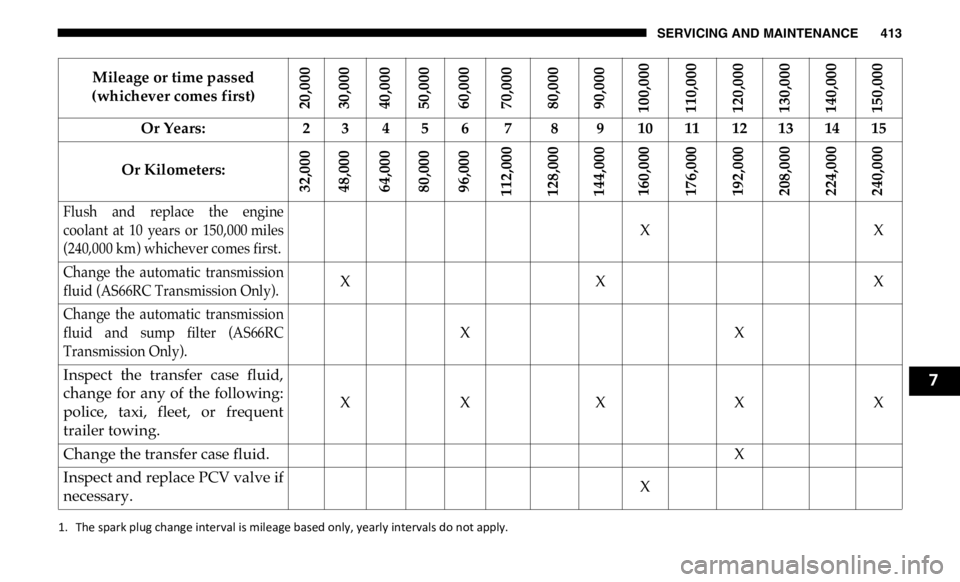
Flush and replace the engine
coolant at 10 years or 150,000 miles
(240,000 km) whichever comes first. X X
Change the automatic transmission
fluid (AS66RC Transmission Only). X X X
Change the automatic transmission
fluid and sump filter (AS66RC
Transmission Only). X X
Inspect the transfer case fluid,
change for any of the following:
police, taxi, fleet, or frequent
trailer towing. X X X X X
Change the transfer case fluid. X
Inspect and replace PCV valve if
necessary. X
1. The spark plug change interval is mileage based only, yearly intervals do not apply. Mileage or time passed
(whichever comes first)
20,000
30,000
40,000
50,000
60,000
70,000
80,000
90,000
100,000
110,000
120,000
130,000
140,000
150,000Or Years: 2 3 4 5 6 7 8 9 10 11 12 13 14 15
Or Kilometers:
32,000
48,000
64,000
80,000
96,000
112,000
128,000
144,000
160,000
176,000
192,000
208,000
224,000
240,000 7
Page 435 of 607
SERVICING AND MAINTENANCE 433
In unusual situations involving grossly malfunctioning
engine operation, a scorching odor may suggest severe and
abnormal catalyst overheating. If this occurs, stop the
vehicle, turn off the engine and allow it to cool. Service,
including a tune-up to manufacturer's specifications, should
be obtained immediately.
To minimize the possibility of catalytic converter damage:
• Do not interrupt the ignition when the transmission is in
gear and the vehicle is in motion.
• Do not try to start the vehicle by pushing or towing the
vehicle.
• Do not idle the engine with any ignition components
disconnected or removed, such as when diagnostic testing,
or for prolonged periods during very rough idle or
malfunctioning operating conditions. Cooling System
WARNING!
• You or others can be badly burned by hot engine
coolant (antifreeze) or steam from your radiator. If you
see or hear steam coming from under the hood, do not
open the hood until the radiator has had time to cool.
Never open a cooling system pressure cap when the
radiator or coolant bottle is hot.
• Keep hands, tools, clothing, and jewelry away from the
radiator cooling fan when the hood is raised. The fan
starts automatically and may start at any time, whether
the engine is running or not.
• When working near the radiator cooling fan, discon -
nect the fan motor lead or turn the ignition to the OFF
mode. The fan is temperature controlled and can start at
any time the ignition is in the ON mode.
7
Page 441 of 607
SERVICING AND MAINTENANCE 439
Automatic Transmission
Selection Of Lubricant
It is important to use the proper transmission fluid to ensure
optimum transmission performance and life. Use only the
manufacturer’s specified transmission fluid. Refer to “Fluids
And Lubricants” in “Technical Specifications”. It is
important to maintain the transmission fluid at the correct
level using the recommended fluid. No chemical flushes
should be used in any transmission; only the approved lubri -
cant should be used. Special Additives
The manufacturer strongly recommends against using any
special additives in the transmission. Automatic Transmis -
sion Fluid (ATF) is an engineered product and its perfor -
mance may be impaired by supplemental additives.
Therefore, do not add any fluid additives to the transmis -
sion. The only exception to this policy is the use of special
dyes for diagnosing fluid leaks in six-speed transmissions.
Avoid using transmission sealers as they may adversely
affect seals.• Overfilling the brake fluid reservoir can result in
spilling brake fluid on hot engine parts, causing the
brake fluid to catch fire. Brake fluid can also damage
painted and vinyl surfaces, care should be taken to
avoid its contact with these surfaces.
• Do not allow petroleum based fluid to contaminate the
brake fluid. Brake seal components could be damaged,
causing partial or complete brake failure. This could
result in a collision. WARNING! (Continued) CAUTION!
Using a transmission fluid other than the manufacturer’s
recommended fluid may cause deterioration in
transmission shift quality and/or torque converter
shudder, and (for six-speed transmissions) will require
more frequent fluid and filter changes. Refer to “Fluids
And Lubricants” in “Technical Specifications” for fluid
specifications.
7
Page 442 of 607

440 SERVICING AND MAINTENANCE
Fluid Level Check — Eight-Speed Transmission
The fluid level is preset at the factory and does not require
adjustment under normal operating conditions. Routine
fluid level checks are not required, therefore the transmis -
sion has no dipstick. An authorized dealer can check your
transmission fluid level using special service tools.
If you notice fluid leakage or transmission malfunction, visit
an authorized dealer immediately to have the transmission
fluid level checked. Operating the vehicle with an improper
fluid level can cause severe transmission damage. Fluid Level Check — Six-Speed Transmission
It is best to check the fluid level when the transmission is at
normal operating temperature (158-176°F / 70-80°C). This
normally occurs after at least 15 miles (25 km) of driving. At
normal operating temperature the fluid cannot be held
comfortably between the fingertips. You can read the trans -
mission sump temperature in the instrument cluster screen
(refer to “Instrument Cluster Display” for further informa -
tion).
Use the following procedure to check the transmission fluid
level properly:
1. Monitor the transmission temperature using the instru -
ment cluster display, and operate the vehicle as required
to reach the normal operating temperature. If the trans -
mission is not functioning properly, or the vehicle cannot
be driven, see the NOTE and CAUTION below about
checking the fluid level at colder temperatures.
2. Park the vehicle on level ground.
3. Run the engine at normal idle speed for at least 60
seconds, and leave the engine running for the rest of this
procedure.
4. Fully apply the parking brake, and press the brake pedal.CAUTION!
Do not use chemical flushes in your transmission as the
chemicals can damage your transmission components.
Such damage is not covered by the New Vehicle Limited
Warranty.
CAUTION!
If a transmission fluid leak occurs, visit an authorized
dealer immediately. Severe transmission damage may
occur. An authorized dealer has the proper tools to adjust
the fluid level accurately.
Page 443 of 607

SERVICING AND MAINTENANCE 441
5. Place the gear selector momentarily into each gear posi -
tion (allowing time for the transmission to fully engage in
each position), ending with the transmission in PARK.
6. Remove the dipstick, wipe it clean and reinsert it until
seated.
7. Remove the dipstick again and note the fluid level on
both sides. The fluid level reading is only valid if there is
a solid coating of oil on both sides of the dipstick. Note
that the holes in the dipstick will be full of fluid if the
actual level is at or above the hole. The fluid level should
be between the “HOT” (upper) reference holes on the
dipstick at normal operating temperature. If the fluid
level is low, add fluid through the dipstick tube to bring
it to the proper level. Do not overfill. Use ONLY the spec -
ified fluid (see "Fluids And Lubricants" for fluid specifica -
tions). After adding any quantity of oil through the
dipstick tube, wait a minimum of two minutes for the oil
to fully drain into the transmission before rechecking the
fluid level.
NOTE:
If it is necessary to check the transmission below the oper -
ating temperature, the fluid level should be between the two
“COLD” (lower) holes on the dipstick with the fluid at
60-70°F / 16-21°C. Only use the COLD region of the dipstick as a rough reference when setting the fluid level after a trans -
mission service or fluid change. Re-check the fluid level, and
adjust as required, once the transmission reaches normal
operating temperature.
8. Reinsert the dipstick. Check for leaks. Release the parking
brake.
NOTE:
If it is necessary to check the transmission below the oper -
ating temperature, the fluid level should be between the two
COLD (lower) holes on the dipstick with the fluid at 68-86°F
/ 20-30°C. Only use the COLD region of the dipstick as a
rough reference when setting the fluid level after a transmis -
sion service or fluid change. Re-check the fluid level, and
adjust as required, once the transmission reaches normal
operating temperature. CAUTION!
If the fluid temperature is below 50 °F (10 °C) it may not
register on the dipstick. Do not add fluid until the
temperature is elevated enough to produce an accurate
reading. Run the engine at idle, in PARK, to warm the
fluid.
7