door lock RENAULT MEGANE ESTATE 2016 X95 / 3.G User Guide
[x] Cancel search | Manufacturer: RENAULT, Model Year: 2016, Model line: MEGANE ESTATE, Model: RENAULT MEGANE ESTATE 2016 X95 / 3.GPages: 274, PDF Size: 2.62 MB
Page 17 of 274
1.11
OPENING AND CLOSING THE DOORS (2/2)
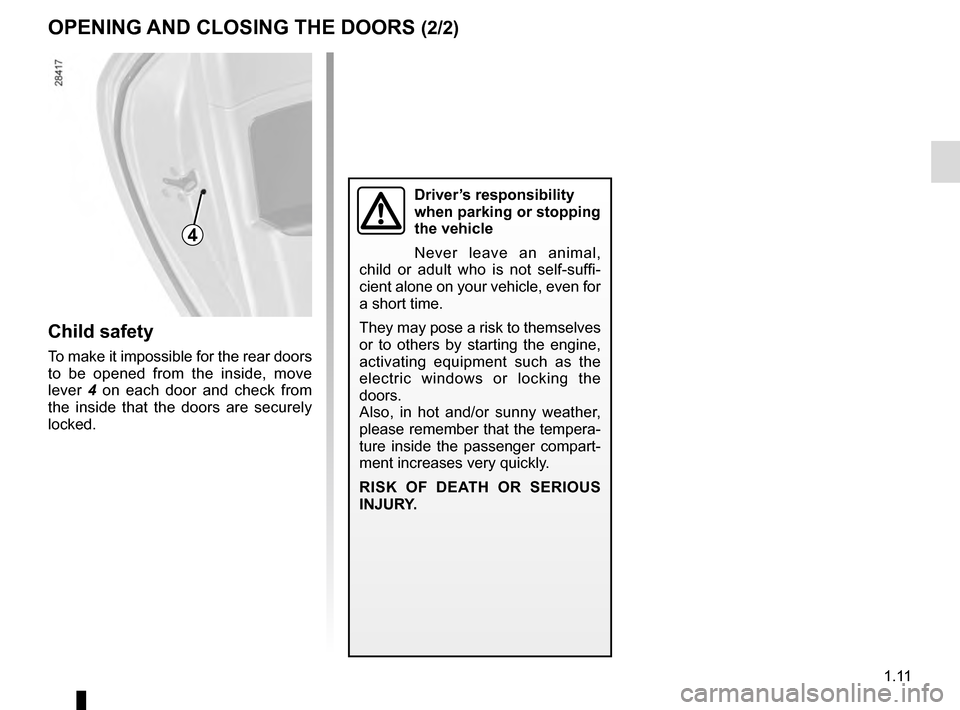
Child safety
To make it impossible for the rear doors
to be opened from the inside, move
lever 4 on each door and check from
the inside that the doors are securely
locked.
4
Driver’s responsibility
when parking or stopping
the vehicle
Never leave an animal,
child or adult who is not self-suffi-
cient alone on your vehicle, even for
a short time.
They may pose a risk to themselves
or to others by starting the engine,
activating equipment such as the
electric windows or locking the
doors.
Also, in hot and/or sunny weather,
please remember that the tempera-
ture inside the passenger compart-
ment increases very quickly.
RISK OF DEATH OR SERIOUS
INJURY.
Page 18 of 274
1.12
LOCKING/UNLOCKING THE DOORS (1/2)
Locking/Unlocking the doors
from the outside
This is done using the RENAULT Card;
see the “RENAULT Card” information in
Section 1.
In certain cases, the RENAULT card
may not work:
– if the RENAULT card battery is weak, flat, etc.
– if equipment operating on the same frequency as the card (mobile
phones, etc.) is used;
– vehicle located in a high electromag- netic radiation zone.
It is then possible:
– to use the key integrated into the card to unlock the front left-hand
door;
– to lock each of the doors manually;
– to use the interior door locking/un- locking control (refer to the following
pages).
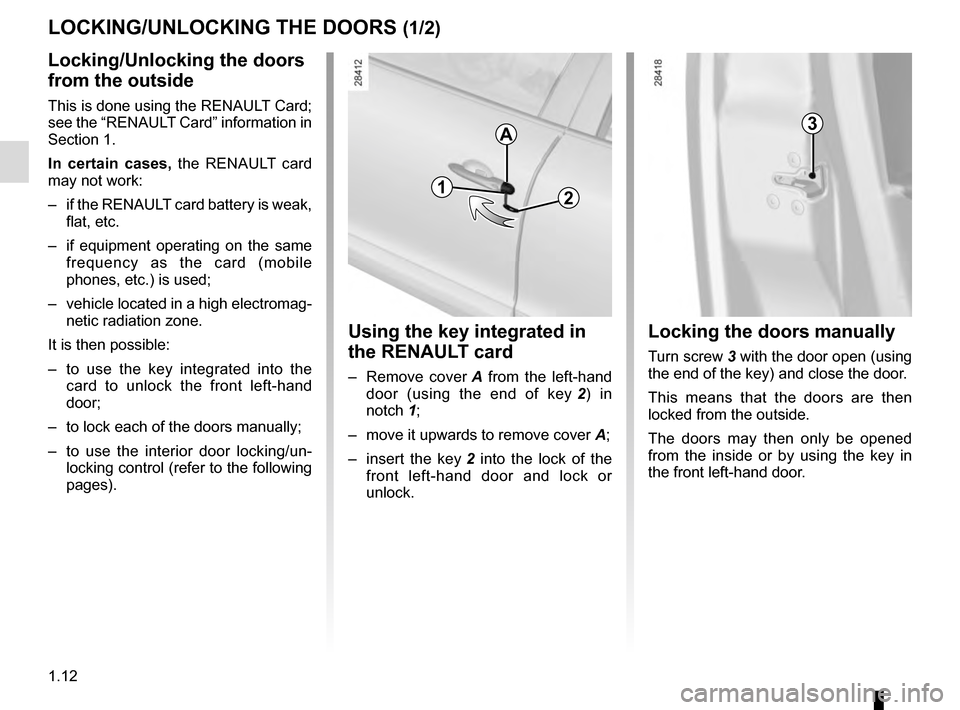
Using the key integrated in
the RENAULT card
– Remove cover A from the left-hand
door (using the end of key 2) in
notch 1;
– move it upwards to remove cover A;
– insert the key 2 into the lock of the
front left-hand door and lock or
unlock.
Locking the doors manually
Turn screw 3 with the door open (using
the end of the key) and close the door.
This means that the doors are then
locked from the outside.
The doors may then only be opened
from the inside or by using the key in
the front left-hand door.
A
2
3
1
Page 19 of 274
1.13
LOCKING/UNLOCKING THE DOORS (2/2)
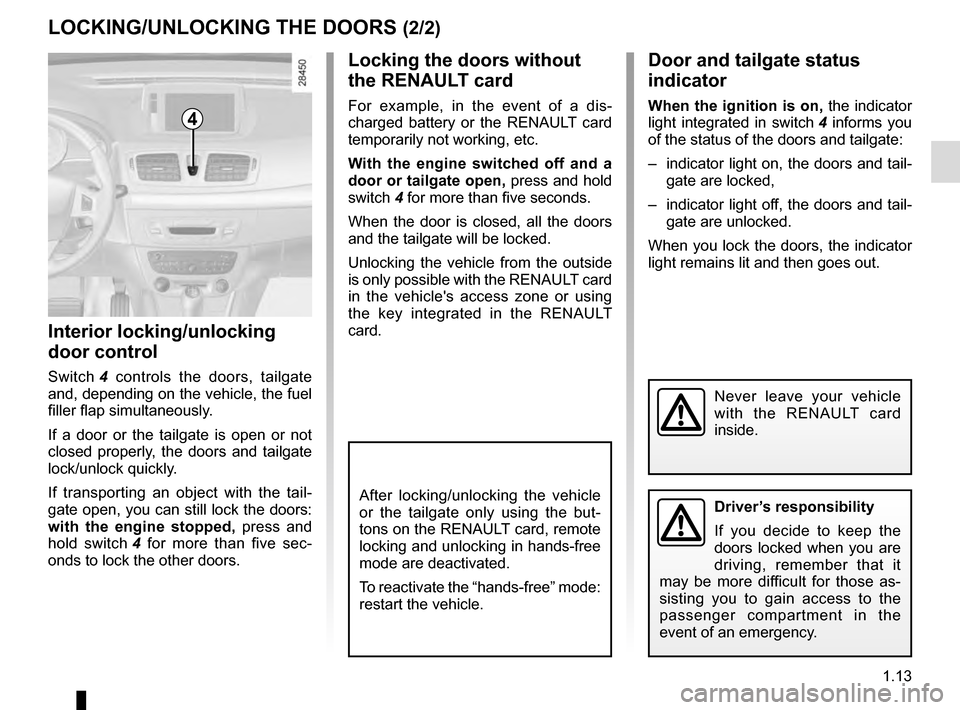
Interior locking/unlocking
door control
Switch 4 controls the doors, tailgate
and, depending on the vehicle, the fuel
filler flap simultaneously.
If a door or the tailgate is open or not
closed properly, the doors and tailgate
lock/unlock quickly.
If transporting an object with the tail-
gate open, you can still lock the doors:
with the engine stopped, press and
hold switch 4 for more than five sec-
onds to lock the other doors.
Locking the doors without
the RENAULT card
For example, in the event of a dis-
charged battery or the RENAULT card
temporarily not working, etc.
With the engine switched off and a
door or tailgate open, press and hold
switch 4 for more than five seconds.
When the door is closed, all the doors
and the tailgate will be locked.
Unlocking the vehicle from the outside
is only possible with the RENAULT card
in the vehicle's access zone or using
the key integrated in the RENAULT
card.
Door and tailgate status
indicator
When the ignition is on, the indicator
light integrated in switch 4 informs you
of the status of the doors and tailgate:
– indicator light on, the doors and tail- gate are locked,
– indicator light off, the doors and tail- gate are unlocked.
When you lock the doors, the indicator
light remains lit and then goes out.
Never leave your vehicle
with the RENAULT card
inside.
After locking/unlocking the vehicle
or the tailgate only using the but-
tons on the RENAULT card, remote
locking and unlocking in hands-free
mode are deactivated.
To reactivate the “hands-free” mode:
restart the vehicle.
4
Driver’s responsibility
If you decide to keep the
doors locked when you are
driving, remember that it
may be more difficult for those as-
sisting you to gain access to the
passenger compartment in the
event of an emergency.
Page 20 of 274
1.14
Activating/deactivating the
function
Refer to “Vehicle settings customisation
menu” in Section 1, regarding the “Auto
door locking while driving” function:
= function activated
< function deactivated.
AUTOMATIC LOCKING WHEN DRIVING
You can decide whether you want to
activate this function.
Operating principle
After the vehicle is started, the system
automatically locks the doors when
you are driving at approximately 6 mph
(10 km/h) and over.
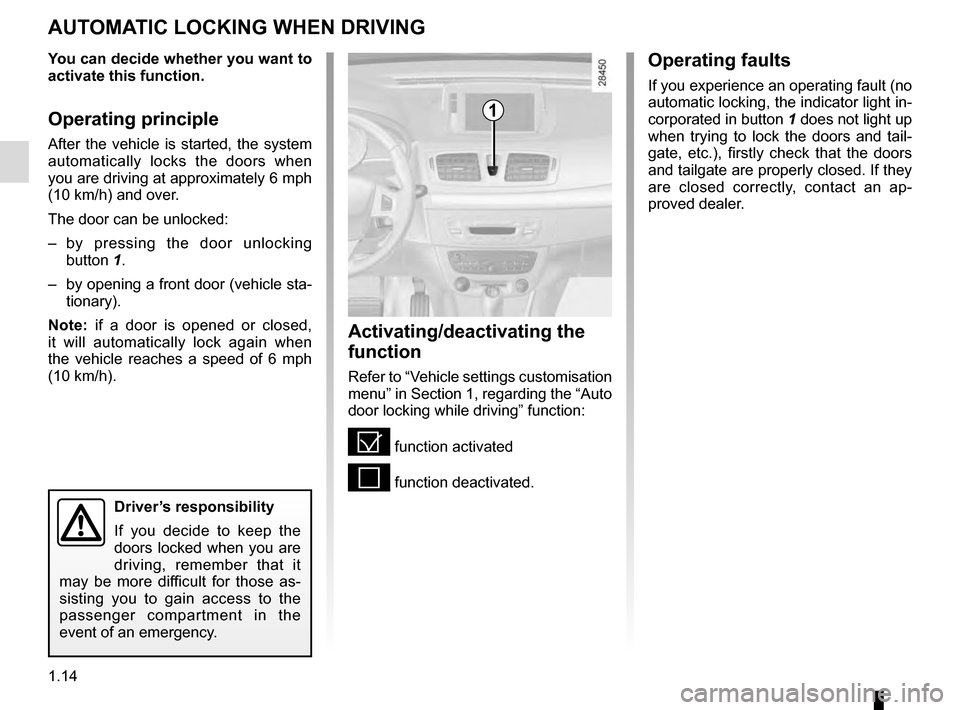
The door can be unlocked:
– by pressing the door unlocking button 1.
– by opening a front door (vehicle sta- tionary).
Note: if a door is opened or closed,
it will automatically lock again when
the vehicle reaches a speed of 6 mph
(10 km/h).
Operating faults
If you experience an operating fault (no
automatic locking, the indicator light in-
corporated in button 1 does not light up
when trying to lock the doors and tail-
gate, etc.), firstly check that the doors
and tailgate are properly closed. If they
are closed correctly, contact an ap-
proved dealer.
1
Driver’s responsibility
If you decide to keep the
doors locked when you are
driving, remember that it
may be more difficult for those as-
sisting you to gain access to the
passenger compartment in the
event of an emergency.
Page 27 of 274
1.21
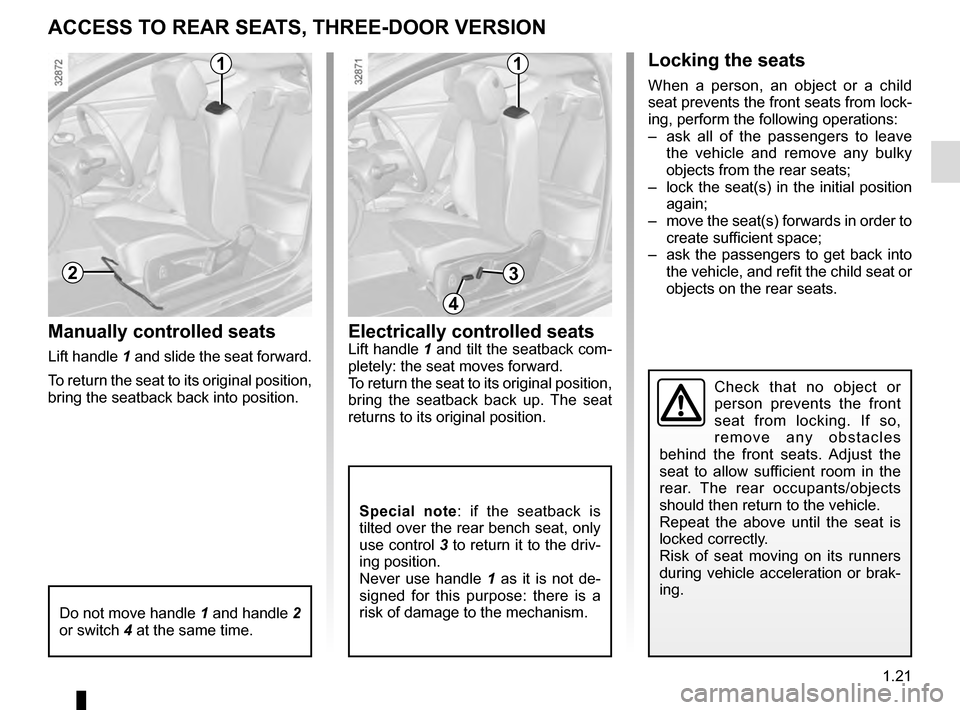
Electrically controlled seatsLift handle 1 and tilt the seatback com-
pletely: the seat moves forward.
To return the seat to its original position,
bring the seatback back up. The seat
returns to its original position.
ACCESS TO REAR SEATS, THREE-DOOR VERSION
Manually controlled seats
Lift handle 1 and slide the seat forward.
To return the seat to its original position,
bring the seatback back into position.
Check that no object or
person prevents the front
seat from locking. If so,
remove any obstacles
behind the front seats. Adjust the
seat to allow sufficient room in the
rear. The rear occupants/objects
should then return to the vehicle.
Repeat the above until the seat is
locked correctly.
Risk of seat moving on its runners
during vehicle acceleration or brak-
ing.
Do not move handle 1 and handle 2
or switch 4 at the same time.
1
2
Locking the seats
When a person, an object or a child
seat prevents the front seats from lock-
ing, perform the following operations:
– ask all of the passengers to leave the vehicle and remove any bulky
objects from the rear seats;
– lock the seat(s) in the initial position again;
– move the seat(s) forwards in order to create sufficient space;
– ask the passengers to get back into the vehicle, and refit the child seat or
objects on the rear seats.
Special note: if the seatback is
tilted over the rear bench seat, only
use control 3 to return it to the driv-
ing position.
Never use handle 1 as it is not de-
signed for this purpose: there is a
risk of damage to the mechanism.
1
4
3
Page 29 of 274
1.23
SEAT BELTS (2/3)Adjusting the front seat belt
height
(depending on vehicle)
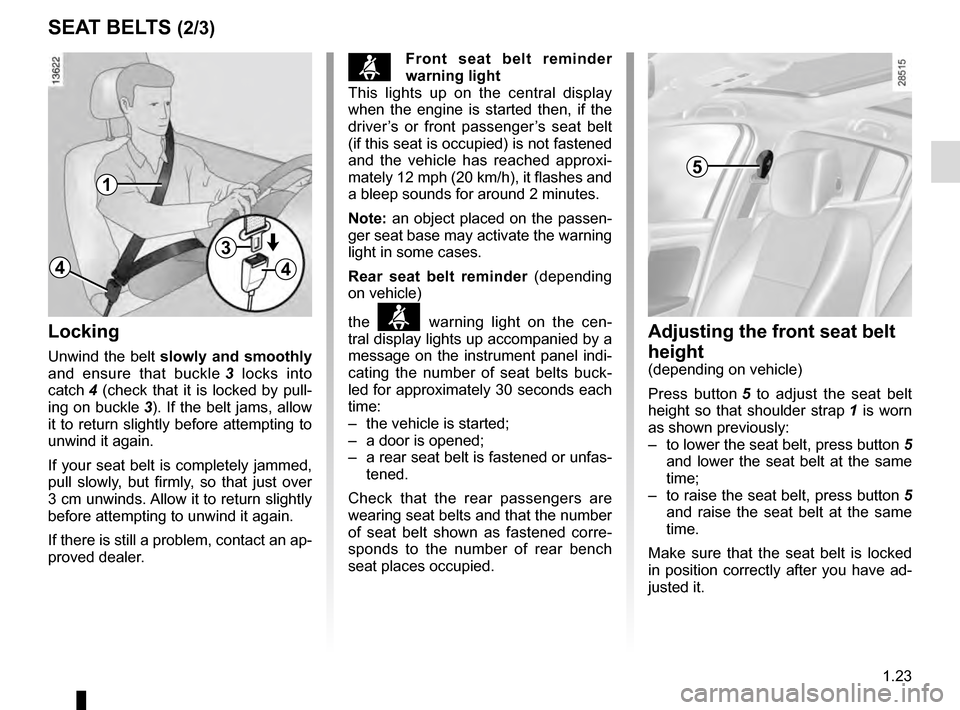
Press button 5 to adjust the seat belt
height so that shoulder strap 1 is worn
as shown previously:
– to lower the seat belt, press button 5
and lower the seat belt at the same
time;
– to raise the seat belt, press button 5
and raise the seat belt at the same
time.
Make sure that the seat belt is locked
in position correctly after you have ad-
justed it.
5
Locking
Unwind the belt slowly and smoothly
and ensure that buckle 3 locks into
catch 4 (check that it is locked by pull-
ing on buckle 3). If the belt jams, allow
it to return slightly before attempting to
unwind it again.
If your seat belt is completely jammed,
pull slowly, but firmly, so that just over
3 cm unwinds. Allow it to return slightly
before attempting to unwind it again.
If there is still a problem, contact an ap-
proved dealer.
1
4
3
4
ßFront seat belt reminder
warning light
This lights up on the central display
when the engine is started then, if the
driver’s or front passenger’s seat belt
(if this seat is occupied) is not fastened
and the vehicle has reached approxi-
mately 12 mph (20 km/h), it flashes and
a bleep sounds for around 2 minutes.
Note: an object placed on the passen-
ger seat base may activate the warning
light in some cases.
Rear seat belt reminder (depending
on vehicle)
the
ß warning light on the cen-
tral display lights up accompanied by a
message on the instrument panel indi-
cating the number of seat belts buck-
led for approximately 30 seconds each
time:
– the vehicle is started;
– a door is opened;
– a rear seat belt is fastened or unfas- tened.
Check that the rear passengers are
wearing seat belts and that the number
of seat belt shown as fastened corre-
sponds to the number of rear bench
seat places occupied.
Page 38 of 274
1.32
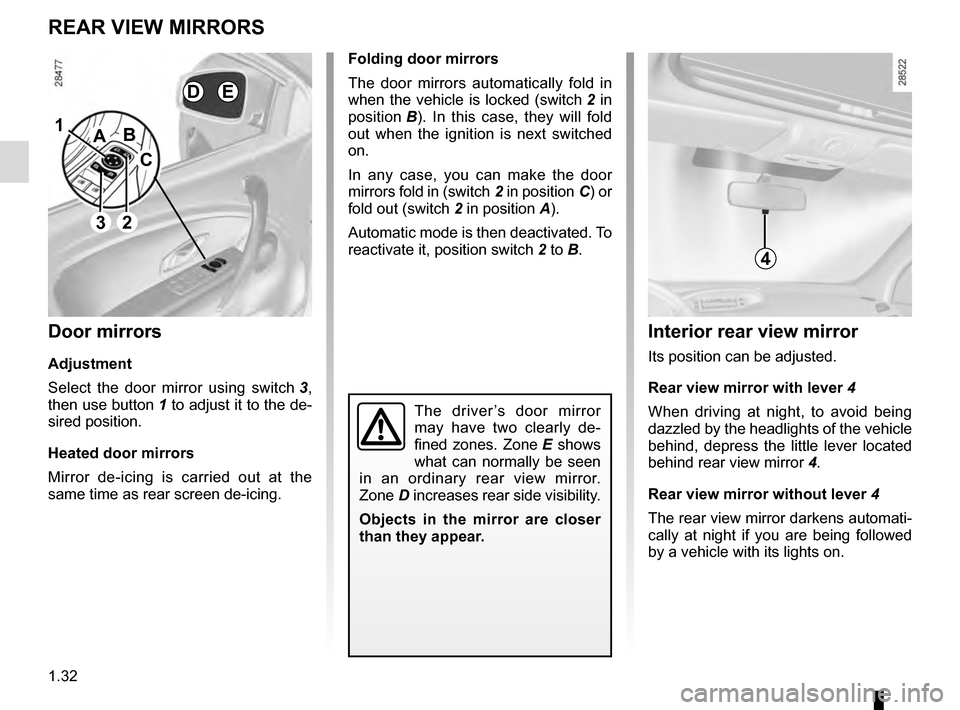
Folding door mirrors
The door mirrors automatically fold in
when the vehicle is locked (switch 2 in
position B). In this case, they will fold
out when the ignition is next switched
on.
In any case, you can make the door
mirrors fold in (switch 2 in position C) or
fold out (switch 2 in position A).
Automatic mode is then deactivated. To
reactivate it, position switch 2 to B.
REAR VIEW MIRRORS
Door mirrors
Adjustment
Select the door mirror using switch 3,
then use button 1 to adjust it to the de-
sired position.
Heated door mirrors
Mirror de-icing is carried out at the
same time as rear screen de-icing.
The driver’s door mirror
may have two clearly de-
fined zones. Zone E shows
what can normally be seen
in an ordinary rear view mirror.
Zone D increases rear side visibility.
Objects in the mirror are closer
than they appear.
Interior rear view mirror
Its position can be adjusted.
Rear view mirror with lever 4
When driving at night, to avoid being
dazzled by the headlights of the vehicle
behind, depress the little lever located
behind rear view mirror 4.
Rear view mirror without lever 4
The rear view mirror darkens automati-
cally at night if you are being followed
by a vehicle with its lights on.
1
2
A
C
B
4
DE
3
Page 39 of 274
1.33
CHILD SAFETY: General information (1/2)
Carrying children
Children, and adults, must be correctly
seated and strapped in for all journeys.
The children being carried in your vehi-
cle are your responsibility.
A child is not a miniature adult. Children
are at risk of specific injuries as their
muscles and bones have not yet fin-
ished growing. The seat belt alone
would not provide suitable protection.
Use an approved child seat and ensure
you use it correctly.
A collision at 30 mph
(50 km/h) is the same
as falling a distance of
10 metres. Transporting a
child without a restraint is the equi-
valent of allowing him or her to play
on a fourth-floor balcony without
railings.
Never travel with a child held in your
arms. In the event of an accident,
you will not be able to keep hold of
the child, even if you yourself are
wearing a seat belt.
If your vehicle has been involved in
a road accident, replace the child
seat and have the seat belts and
ISOFIX anchorage points checked.
To prevent the doors being
opened, use the “Child
safety” device (refer to the
information on “Opening
and closing the doors” in Section 1).
Driver’s responsibility
when parking or stopping
the vehicle
Never leave an animal,
child or adult who is not self-suffi-
cient alone on your vehicle, even for
a short time.
They may pose a risk to themselves
or to others by starting the engine,
activating equipment such as the
electric windows or by locking the
doors.
Also, in hot and/or sunny weather,
please remember that the tempera-
ture inside the passenger compart-
ment increases very quickly.
RISK OF DEATH OR SERIOUS
INJURY.
Page 43 of 274
1.37
CHILD SAFETY: choosing a child seat mounting (2/2)
The ISOFIX anchorage
points have been exclu-
sively designed for child
seats with the ISOFIX
system. Never fit a different type of
child seat, seat belt or other objects
to these anchorage points.
Check that nothing is obstructing
the anchorage points.
If your vehicle has been involved in
a road accident, have the ISOFIX
anchorage points checked and re-
place your child seat.
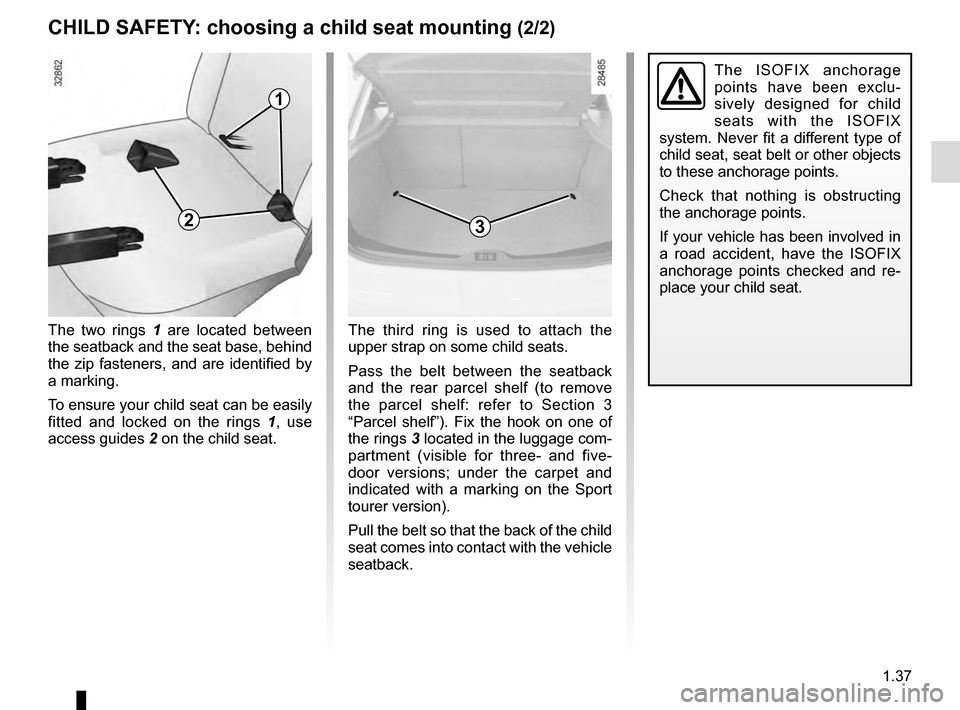
The third ring is used to attach the
upper strap on some child seats.
Pass the belt between the seatback
and the rear parcel shelf (to remove
the parcel shelf: refer to Section 3
“Parcel shelf”). Fix the hook on one of
the rings 3 located in the luggage com-
partment (visible for three- and five-
door versions; under the carpet and
indicated with a marking on the Sport
tourer version).
Pull the belt so that the back of the child
seat comes into contact with the vehicle
seatback.
The two rings 1
are located between
the seatback and the seat base, behind
the zip fasteners, and are identified by
a marking.
To ensure your child seat can be easily
fitted and locked on the rings 1 , use
access guides 2 on the child seat.
3
1
2
Page 45 of 274
1.39
Ensure that the child seat
or the child’s feet do not
prevent the front seat from
locking correctly. Refer to
the information on the “Front seat”
in Section 1.
In the rear side seat
A carrycot can be installed across the
vehicle and will take up at least two
seats.
Position the child with their feet nearest
the door.
Move the front seat as far forward as
possible to install a rear-facing child
seat, then move back the seat in front
as far as it will go, although without al-
lowing it to come into contact with the
child seat.
For the safety of the child in the for-
ward-facing seat, do not move the seat
in front back past the middle of the
runner, do not tilt the seatback too far
(maximum of 25°) and raise the seat as
much as possible.
Always remove the headrest from the
rear seat used for the child seat (see
“Rear headrests” in Section 1). This
must be done before fitting the child
seat.
Check that the forward-facing child seat
is resting against the back of the vehi-
cle seat.
CHILD SAFETY: fitting a child seat (2/12)