test 3 low RENAULT SCENIC 2012 J95 / 3.G Engine And Peripherals EDC16CP33 Workshop Manual
[x] Cancel search | Manufacturer: RENAULT, Model Year: 2012, Model line: SCENIC, Model: RENAULT SCENIC 2012 J95 / 3.GPages: 510, PDF Size: 2.98 MB
Page 3 of 510
13B-3V12 MR-372-J84-13B300$010.mif
DIESEL INJECTION
Fault finding – Introduction13B
EDC16CP33
Program No.: C4
Vdiag No.: 04, 08, 18, 1C,
20, 24, 26, 28, 34, 38, 44,
4C, 54, 58, 5C, 60, 62, 74
Faults
Faults are declared present or stored (depending on whether they appeared in a certain context and have
disappeared since, or whether they remain present but are not diagnosed within the current context).
The present or stored status of faults should be taken into consideration when the diagnostic tool is switched on
following + after ignition feed is activated (no system components active).
For a present fault, apply the procedure described in the Interpretation of faults section.
For a stored fault, note the faults displayed and apply the Notes section.
If the fault is confirmed when the instructions are applied, the fault is present. Deal with the fault.
If the fault is not confirmed, check:
– the electrical lines which correspond to the fault,
– the connectors on these lines (corrosion, bent pins, etc.),
– the resistance of the faulty component,
– the condition of the wires (melted or cut insulation, wear).
Conformity check
The purpose of the conformity check is to check data that does not produce a fault on the diagnostic tool if the data
is inconsistent. Therefore, this stage is used to:
– carry out fault finding on faults that do not have a fault display, and which may correspond to a customer complaint.
– check that the system is operating correctly and that there is no risk of a fault recurring after repair.
The conformity check is a fault finding procedure carried out using the interpretation of statuses and parameters.
If a status does not function normally or a parameter is outside the permitted tolerance values, consult the
corresponding fault finding pages (see interpretation of statuses and parameters).
Customer complaints - Fault finding chart
If the test with the diagnostic tool is correct but the customer complaint is still present, the fault should be dealt with
by customer complaints. WARNING:
Deal first with instrument panel faults (eg. "Particle filter" warning light).
Then carry out scheduled maintenance on the vehicle.
A synopsis of the general procedure to follow is provided on the following page in the form of a flow chart.
Page 16 of 510
13B-16V12 MR-372-J84-13B300$030.mif
DIESEL INJECTION
Fault finding – System operation13B
EDC16CP33
Program No.: C4
Vdiag No.: 04, 08, 18, 1C,
20, 24, 26, 28, 34, 38, 44,
4C, 54, 58, 5C, 60, 62, 74
III - Management of the damper valve
The damper valve is now responsible for two functions:
– Damping: when the engine is switched off, the flap closes in order to block the passage of air towards the cylinders.
The aim of this is to stop the engine as quickly as possible and to reduce instabilities when the engine is switched
off.
– "Valving" function depending on the engine operation: the damper valve closes by a few % to create a "venturi"
effect at the EGR valve passage section.
The aim of this is to accelerate the air flow of EGR gases and to reduce the emission of pollutants.
IV - Exhaust gas recirculation management
The EGR (Exhaust Gas Recirculation) system involves removing exhaust gases and reintroducing them into the
inlet.
This system plays a major role in reducing diesel engine emissions. The EGR system is cooled by a gas - water
exchanger, as on most Euro IV engines. This cooler has a dual position bypass valve, which allows the gas to be
cooled or not depending on the emission control requirements. The bypass circuit is inside the cooler (not visible
from the outside). The valve control rod is visible from the outside.
The exhaust gases are collected in the exhaust manifold (before the turbocharger), then directed to the EGR cooler
and the EGR valve. The EGR valve connects the air circuit between the damper valve and the inlet manifold; the
EGR valve is positioned next to the damper valve.
The EGR valve is activated every time the engine stops by performing 10opening/closing cycles. This programming
activates the EGR valve in order to prevent it from clogging. The program is no longer active if there are any system
faults.
The EGR system does not operate below 5°C (air flowmeter temperature).
– The controlled EGR cooler bypass
The EGR cooler bypass is controlled by an all-or-nothing solenoid valve, connected on one side to the vacuum
pump, and on the other side to the bypass control diaphragm. It is actuated according to the coolant temperature
and the engine operating status. Gases flow into the EGR section of the cooler unless the engine is cold, in which
case they flow through the bypass valve. There is also a regular actuation function for the bypass valve to prevent it
from clogging.
– EGR valve
The EGR valve is supplied by direct current and connected to a potentiometer copying the position of the valve.
The opening of the valve is actuated (H bridge) by a positive command 0 to 100%.
The valve is controlled using a double regulation loop.
The first loop (fastest) is a position loop. It brings the valve to the desired position by a loop connection using the
signal from the position sensor.
The second loop is slower and is an air flow loop. At a given operating point, the air flow setpoint is attained by
adjusting the quantity of exhaust gas flowing through the EGR valve and the flow of fresh air passing through the
damper valve. At a total constant flow, the more exhaust gas recirculation, the less fresh air there is and vice versa.
The air flow is measured by the flowmeter and the setpoint is attained using both the EGR valve position setpoint
and the damper valve position setpoint.
Page 24 of 510
13B-24V12 MR-372-J84-13B300$050.mif
DIESEL INJECTION
Fault finding – Replacement of components13B
EDC16CP33
Program No.: C4
Vdiag No.: 04, 08, 18, 1C,
20, 24, 26, 28, 34, 38, 44,
4C, 54, 58, 5C, 60, 62, 74
REPLACING THE EXHAUST GAS RECIRCULATION (EGR) VALVE
After the exhaust gas recirculation valve has been replaced, the computer must store the new valve offset, and the
offset measured when the ignition was last switched off (in power latch phase), which corresponds to the valve
closing.
Using this data, the computer can detect whether the valve is clogged or seized.
When the valve is replaced, clear the stored offsets so that the program uses the new valve’s offset value.
The data associated with this program is compiled in the Emission control / EOBD (European On Board
Diagnostic) sub-function.
–PR128: FIRST EGR VALVE OFFSET.
–PR129: LAST EGR VALVE OFFSET > or = PR128 if the valve is new.
Programming PR128 and PR129 must be cleared every time the exhaust gas recirculation valve is replaced.
PROCEDURE to be followed after replacing the exhaust gas recirculation valve:
- Run command SC036 Reinitialise programming.
- Select EGR valve as the operation type, then follow the instructions given by the diagnostic tool.
• When the command is finished,
–switch off the ignition,
– wait for the diagnostic tool message (maximum wait 8 minutes): Loss of dialogue with the computer: EDC16
CP33, check the tool connection and the computer supply.
The new EGR valve offset is automatically reprogrammed the next time the ignition is switched on.
– start the vehicle to enable the latest EGR valve offset to be programmed,
– switch off the ignition,
– wait for the diagnostic tool message (maximum wait 8 minutes): Loss of dialogue with the computer: EDC16
CP33, check the tool connection and the computer supply before switching the ignition back on.
The last EGR valve offset reprogrammed is stored on the computer.
– then check the system faults, and clear any stored faults,
– if there are faults, deal with the present faults,
– clear the faults from the computer memory.
Carry out a road test followed by another check with the diagnostic tool.
End of the procedure.Note:
When reinitialisation is complete, the Emission control / EOBD sub-function displays: PR128 = PR129 = 0%
Note:
When the new EGR valve offset has been reprogrammed, the Emission control / EOBD sub-function will display:
10% < PR128 < 40%
PR129 = 0%
Note:
When the last EGR valve offset has been reprogrammed, the Emission control / EOBD sub-function will display:
10% < PR128 < 40%,
10% < PR129 < 40%
Page 25 of 510
13B-25V12 MR-372-J84-13B300$050.mif
DIESEL INJECTION
Fault finding – Replacement of components13B
EDC16CP33
Program No.: C4
Vdiag No.: 04, 08, 18, 1C,
20, 24, 26, 28, 34, 38, 44,
4C, 54, 58, 5C, 60, 62, 74
REPLACING THE INJECTORS
After one or more injectors have been replaced, enter the IMA codes again and then run command SC036
Reinitialise programming.
To do this, record the IMA code(s) etched on the injector bodies, and enter the codes into the computer using
command SC002 Enter injector codes, and follow the instructions given by the diagnostic tool. Run command
SC036 Reinitialise programming and select injectors, then follow the procedure. Note:
The "IMA" code (individual injector correction) is a calibration with corrective values unique to each injector,
and is used to adjust their flow accurately (injector classification). This correction takes into account mechanical
variances and the variances of the piezo actuator. An injector's class is determined by measurements taken at
different pressures on a test bench. The IMA class identification (7-character alphanumeric code) is then
engraved on the collar of the injector.
The IMA codes must be read from left to right:
– Foolproofing for reading the IMA codes is carried out using the low pressure return connector and/or the
electrical connector on the injector.
– This reading direction is valid when these connectors are located to the left of the cotech.
The IMA codes are read from left to right (see illustration in MR 402 (Vel Satis ph2), MR 395 (Laguna II ph2),
MR 364 (Mégane II ph2), MR 370 (Scénic II ph2), MR 405 (Espace IV ph2) Mechanical, 13B Diesel injection,
Diesel injector, Removal – Refitting)
Note: When entering characters, confusion can arise between:
– Figure 1 and the letters I and L,
– Figure 2 and the letter Z,
– Figure 5 and the letter S,
– Figure 6 and the letter G,
– Figure 8 and the letter B.
After programming or reprogramming the computer, it is essential to enter the 4 injector codes before confirming
the entry.
These individual corrective values are then written to the computer EEPROM, which can then control the injectors,
taking into account their manufacturing variation.
IMPORTANT:
Engines can only operate correctly if the correct IMA* codes have been entered. If no code has been
entered, or if an invalid code has been entered, fault DF066 Injector code(s) is present and the engine will
run in defect mode (engine speed limited significantly). If another injector's code has been entered, the
system will accept it but will make the wrong correction. This could lead to engine damage, loss of
performance and excessive pollution.
Always use the correct injector codes for the engine cylinder/computer.
Note:
On the M9R engine (Renault - Nissan partnership engine), cylinder no. 1 is located at the timing end.
Page 27 of 510
13B-27V12 MR-372-J84-13B300$050.mif
DIESEL INJECTION
Fault finding – Replacement of components13B
EDC16CP33
Program No.: C4
Vdiag No.: 04, 08, 18, 1C,
20, 24, 26, 28, 34, 38, 44,
4C, 54, 58, 5C, 60, 62, 74
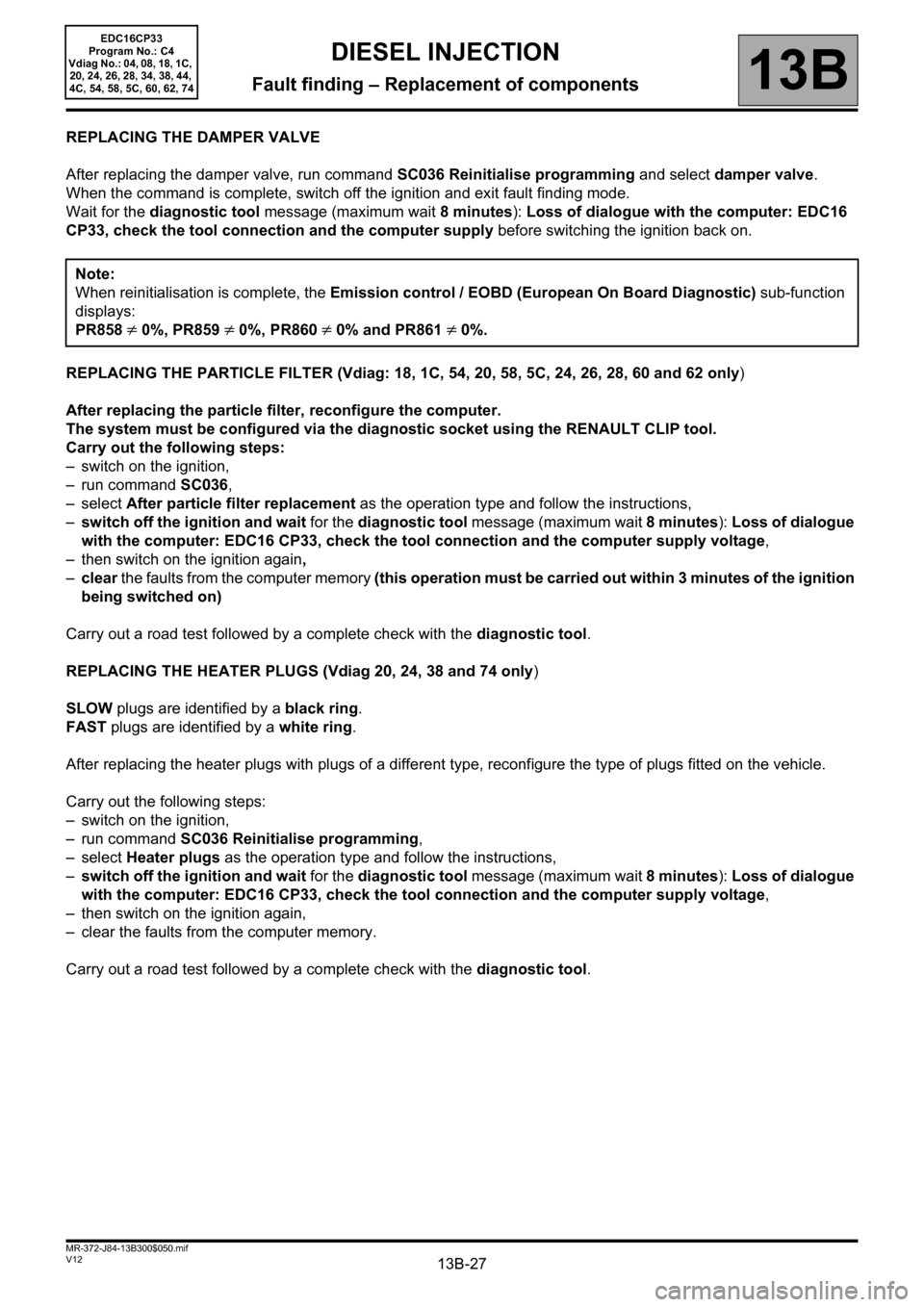
REPLACING THE DAMPER VALVE
After replacing the damper valve, run command SC036 Reinitialise programming and select damper valve.
When the command is complete, switch off the ignition and exit fault finding mode.
Wait for the diagnostic tool message (maximum wait 8 minutes): Loss of dialogue with the computer: EDC16
CP33, check the tool connection and the computer supply before switching the ignition back on.
REPLACING THE PARTICLE FILTER (Vdiag: 18, 1C, 54, 20, 58, 5C, 24, 26, 28, 60 and 62 only)
After replacing the particle filter, reconfigure the computer.
The system must be configured via the diagnostic socket using the RENAULT CLIP tool.
Carry out the following steps:
– switch on the ignition,
– run command SC036,
–select After particle filter replacement as the operation type and follow the instructions,
–switch off the ignition and wait for the diagnostic tool message (maximum wait 8 minutes): Loss of dialogue
with the computer: EDC16 CP33, check the tool connection and the computer supply voltage,
– then switch on the ignition again,
–clear the faults from the computer memory (this operation must be carried out within 3 minutes of the ignition
being switched on)
Carry out a road test followed by a complete check with the diagnostic tool.
REPLACING THE HEATER PLUGS (Vdiag 20, 24, 38 and 74 only)
SLOW plugs are identified by a black ring.
FAST plugs are identified by a white ring.
After replacing the heater plugs with plugs of a different type, reconfigure the type of plugs fitted on the vehicle.
Carry out the following steps:
– switch on the ignition,
– run command SC036 Reinitialise programming,
–select Heater plugs as the operation type and follow the instructions,
–switch off the ignition and wait for the diagnostic tool message (maximum wait 8 minutes): Loss of dialogue
with the computer: EDC16 CP33, check the tool connection and the computer supply voltage,
– then switch on the ignition again,
– clear the faults from the computer memory.
Carry out a road test followed by a complete check with the diagnostic tool. Note:
When reinitialisation is complete, the Emission control / EOBD (European On Board Diagnostic) sub-function
displays:
PR858
≠ 0%, PR859 ≠ 0%, PR860 ≠ 0% and PR861 ≠ 0%.
Page 31 of 510
13B-31
AFTER REPAIRDeal with any other faults. Clear the fault memory.
Switch off the ignition until the end of the power-latch phase, and carry out a road test
followed by a check with the diagnostic tool.
V12 MR-372-J84-13B300$071.mif
13B
EDC16CP33
Program No.: C4
Vdiag No.: 04, 08, 18, 1C,
20, 24, 26, 28, 34, 38, 44,
4C, 54, 58, 5C, 60, 62, 74
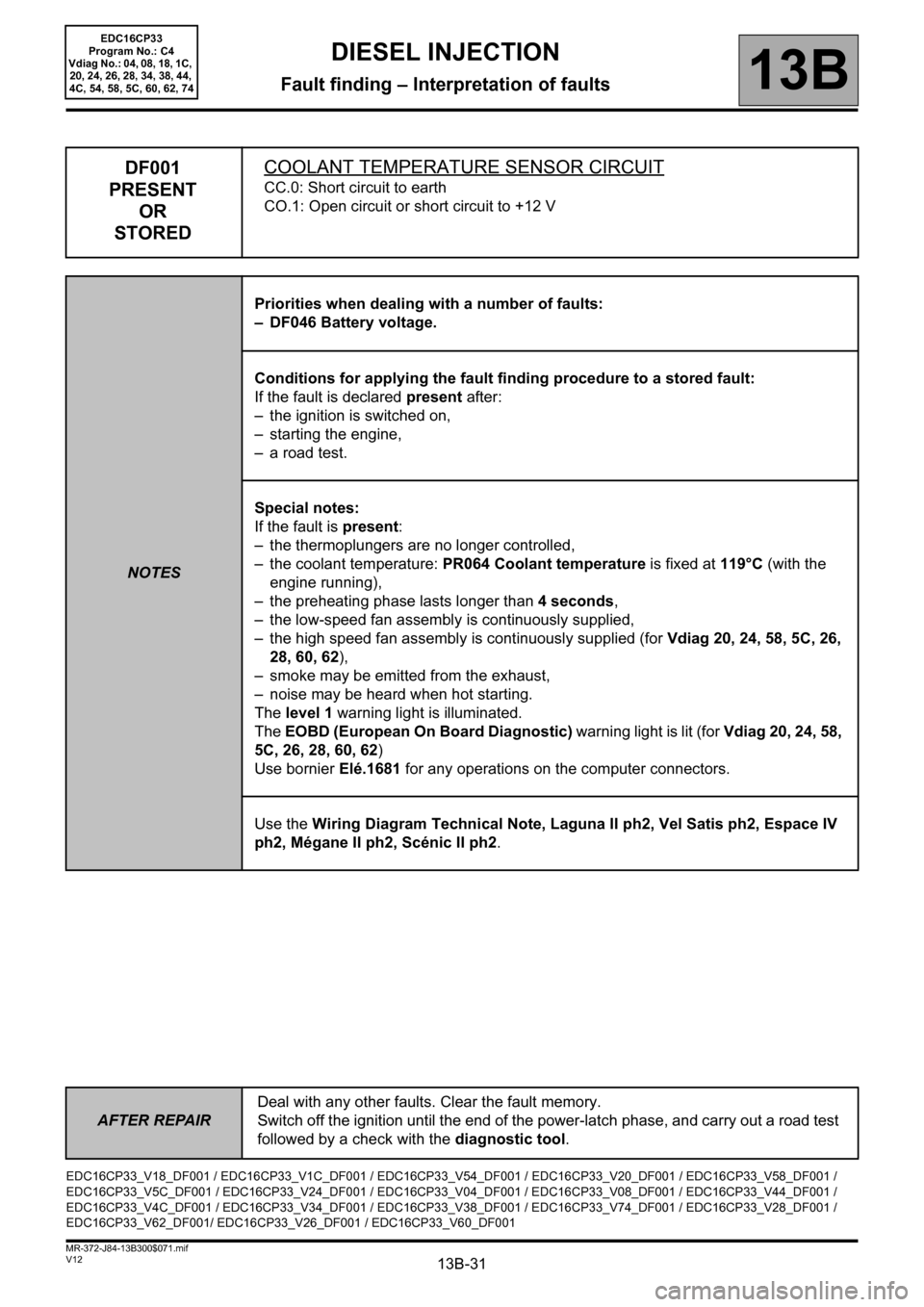
DF001
PRESENT
OR
STOREDCOOLANT TEMPERATURE SENSOR CIRCUIT
CC.0: Short circuit to earth
CO.1: Open circuit or short circuit to +12 V
NOTESPriorities when dealing with a number of faults:
– DF046 Battery voltage.
Conditions for applying the fault finding procedure to a stored fault:
If the fault is declared present after:
– the ignition is switched on,
– starting the engine,
– a road test.
Special notes:
If the fault is present:
– the thermoplungers are no longer controlled,
– the coolant temperature: PR064 Coolant temperature is fixed at 119°C (with the
engine running),
– the preheating phase lasts longer than 4 seconds,
– the low-speed fan assembly is continuously supplied,
– the high speed fan assembly is continuously supplied (for Vdiag 20, 24, 58, 5C, 26,
28, 60, 62),
– smoke may be emitted from the exhaust,
– noise may be heard when hot starting.
The level 1 warning light is illuminated.
The EOBD (European On Board Diagnostic) warning light is lit (for Vdiag 20, 24, 58,
5C, 26, 28, 60, 62)
Use bornier Elé.1681 for any operations on the computer connectors.
Use the Wiring Diagram Technical Note, Laguna II ph2, Vel Satis ph2, Espace IV
ph2, Mégane II ph2, Scénic II ph2.
EDC16CP33_V18_DF001 / EDC16CP33_V1C_DF001 / EDC16CP33_V54_DF001 / EDC16CP33_V20_DF001 / EDC16CP33_V58_DF001 /
EDC16CP33_V5C_DF001 / EDC16CP33_V24_DF001 / EDC16CP33_V04_DF001 / EDC16CP33_V08_DF001 / EDC16CP33_V44_DF001 /
EDC16CP33_V4C_DF001 / EDC16CP33_V34_DF001 / EDC16CP33_V38_DF001 / EDC16CP33_V74_DF001 / EDC16CP33_V28_DF001 /
EDC16CP33_V62_DF001/ EDC16CP33_V26_DF001 / EDC16CP33_V60_DF001
DIESEL INJECTION
Fault finding – Interpretation of faults
Page 32 of 510
13B-32
AFTER REPAIRDeal with any other faults. Clear the fault memory.
Switch off the ignition until the end of the power-latch phase, and carry out a road test
followed by a check with the diagnostic tool.
V12 MR-372-J84-13B300$071.mif
DIESEL INJECTION
Fault finding – Interpretation of faults13B
EDC16CP33
Program No.: C4
Vdiag No.: 04, 08, 18, 1C,
20, 24, 26, 28, 34, 38, 44,
4C, 54, 58, 5C, 60, 62, 74
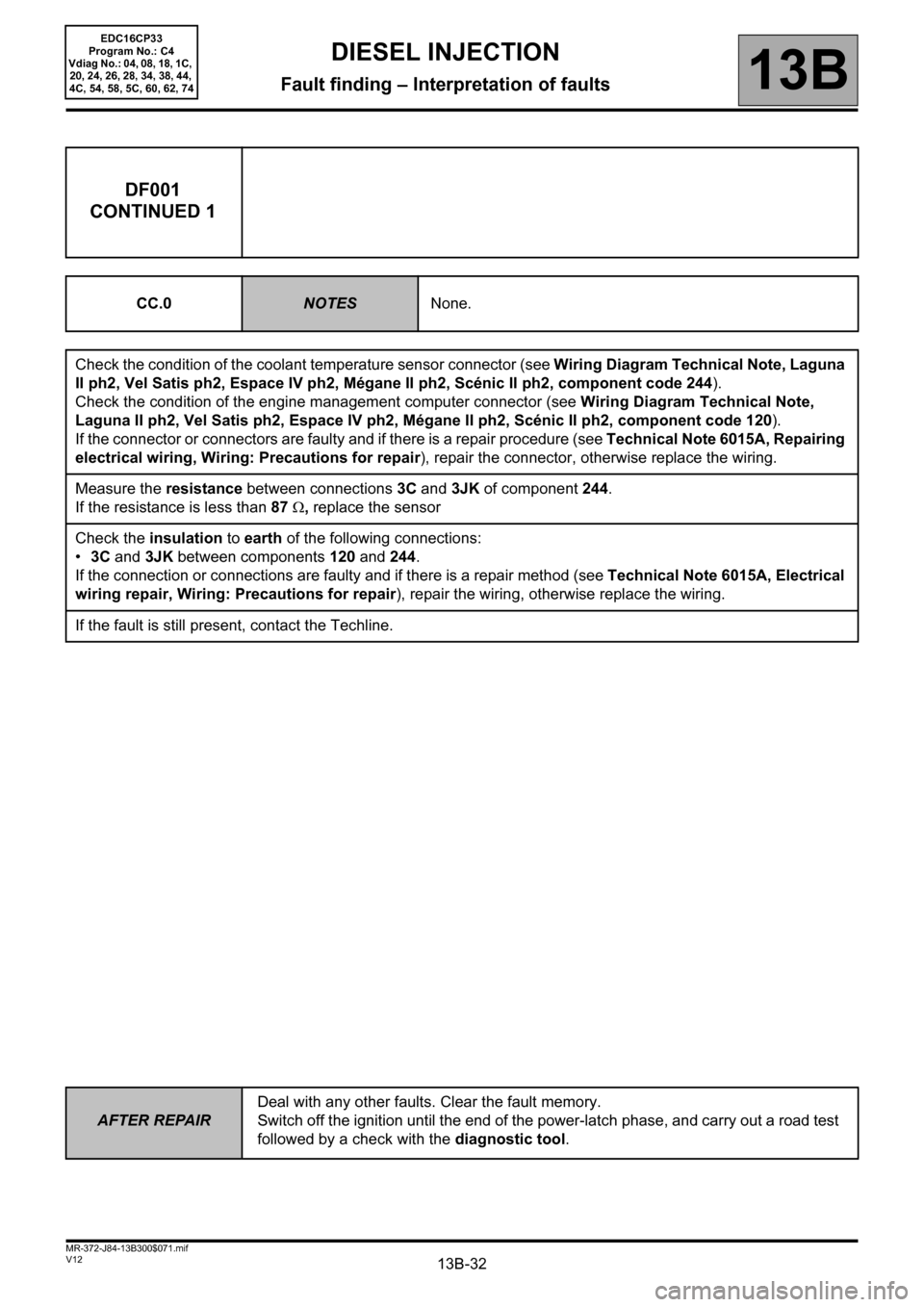
DF001
CONTINUED 1
CC.0NOTESNone.
Check the condition of the coolant temperature sensor connector (see Wiring Diagram Technical Note, Laguna
II ph2, Vel Satis ph2, Espace IV ph2, Mégane II ph2, Scénic II ph2, component code 244).
Check the condition of the engine management computer connector (see Wiring Diagram Technical Note,
Laguna II ph2, Vel Satis ph2, Espace IV ph2, Mégane II ph2, Scénic II ph2, component code 120).
If the connector or connectors are faulty and if there is a repair procedure (see Technical Note 6015A, Repairing
electrical wiring, Wiring: Precautions for repair), repair the connector, otherwise replace the wiring.
Measure the resistance between connections 3C and 3JK of component 244.
If the resistance is less than 87 Ω, replace the sensor
Check the insulation to earth of the following connections:
•3C and 3JK between components 120 and 244.
If the connection or connections are faulty and if there is a repair method (see Technical Note 6015A, Electrical
wiring repair, Wiring: Precautions for repair), repair the wiring, otherwise replace the wiring.
If the fault is still present, contact the Techline.
Page 33 of 510
13B-33
AFTER REPAIRDeal with any other faults. Clear the fault memory.
Switch off the ignition until the end of the power-latch phase, and carry out a road test
followed by a check with the diagnostic tool.
V12 MR-372-J84-13B300$071.mif
DIESEL INJECTION
Fault finding – Interpretation of faults13B
EDC16CP33
Program No.: C4
Vdiag No.: 04, 08, 18, 1C,
20, 24, 26, 28, 34, 38, 44,
4C, 54, 58, 5C, 60, 62, 74
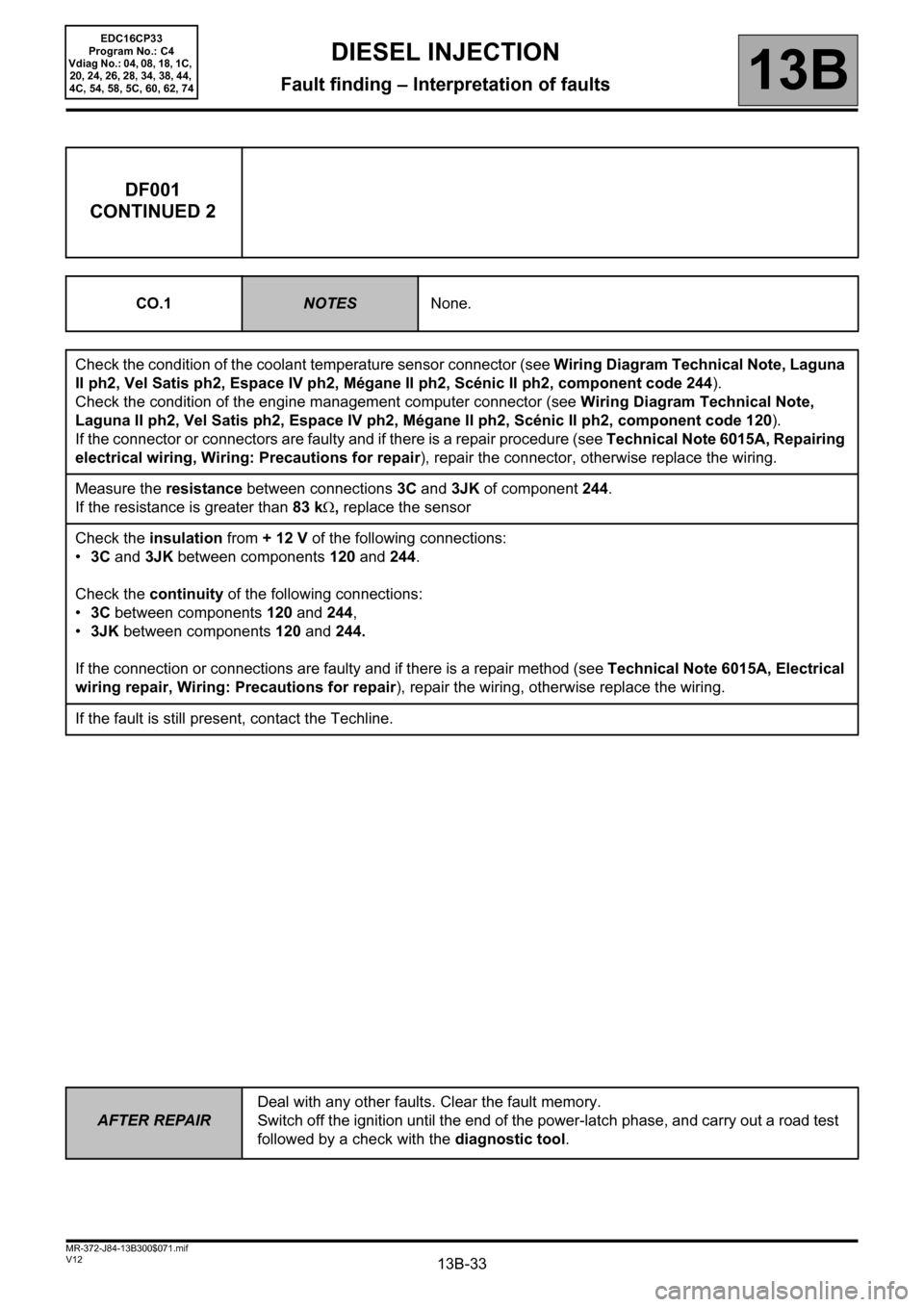
DF001
CONTINUED 2
CO.1NOTESNone.
Check the condition of the coolant temperature sensor connector (see Wiring Diagram Technical Note, Laguna
II ph2, Vel Satis ph2, Espace IV ph2, Mégane II ph2, Scénic II ph2, component code 244).
Check the condition of the engine management computer connector (see Wiring Diagram Technical Note,
Laguna II ph2, Vel Satis ph2, Espace IV ph2, Mégane II ph2, Scénic II ph2, component code 120).
If the connector or connectors are faulty and if there is a repair procedure (see Technical Note 6015A, Repairing
electrical wiring, Wiring: Precautions for repair), repair the connector, otherwise replace the wiring.
Measure the resistance between connections 3C and 3JK of component 244.
If the resistance is greater than 83 kΩ, replace the sensor
Check the insulation from + 12 V of the following connections:
•3C and 3JK between components 120 and 244.
Check the continuity of the following connections:
•3C between components 120 and 244,
•3JK between components 120 and 244.
If the connection or connections are faulty and if there is a repair method (see Technical Note 6015A, Electrical
wiring repair, Wiring: Precautions for repair), repair the wiring, otherwise replace the wiring.
If the fault is still present, contact the Techline.
Page 34 of 510
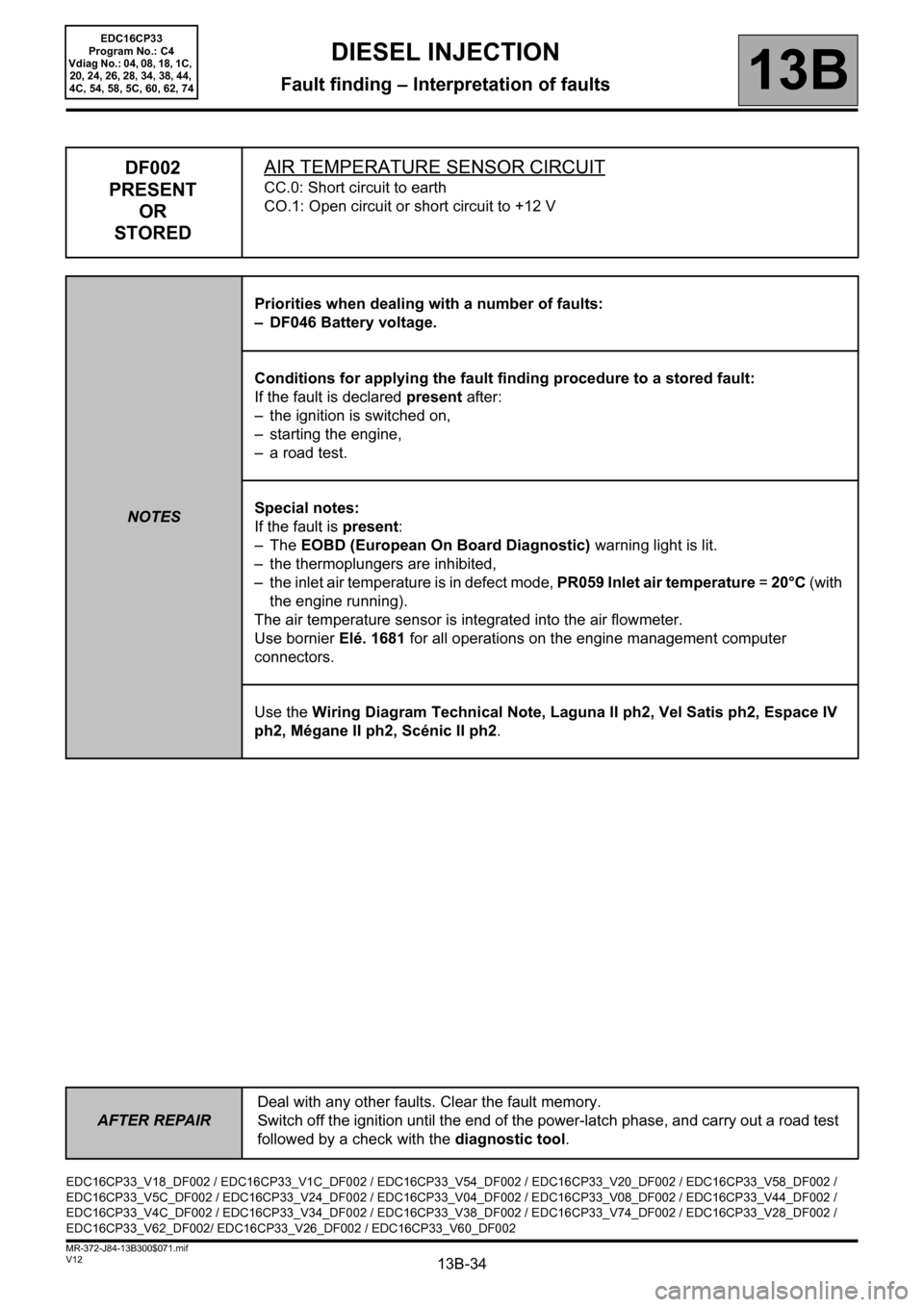
13B-34
AFTER REPAIRDeal with any other faults. Clear the fault memory.
Switch off the ignition until the end of the power-latch phase, and carry out a road test
followed by a check with the diagnostic tool.
V12 MR-372-J84-13B300$071.mif
DIESEL INJECTION
Fault finding – Interpretation of faults13B
EDC16CP33
Program No.: C4
Vdiag No.: 04, 08, 18, 1C,
20, 24, 26, 28, 34, 38, 44,
4C, 54, 58, 5C, 60, 62, 74
DF002
PRESENT
OR
STOREDAIR TEMPERATURE SENSOR CIRCUIT
CC.0: Short circuit to earth
CO.1: Open circuit or short circuit to +12 V
NOTESPriorities when dealing with a number of faults:
– DF046 Battery voltage.
Conditions for applying the fault finding procedure to a stored fault:
If the fault is declared present after:
– the ignition is switched on,
– starting the engine,
– a road test.
Special notes:
If the fault is present:
–The EOBD (European On Board Diagnostic) warning light is lit.
– the thermoplungers are inhibited,
– the inlet air temperature is in defect mode, PR059 Inlet air temperature = 20°C (with
the engine running).
The air temperature sensor is integrated into the air flowmeter.
Use bornier Elé. 1681 for all operations on the engine management computer
connectors.
Use the Wiring Diagram Technical Note, Laguna II ph2, Vel Satis ph2, Espace IV
ph2, Mégane II ph2, Scénic II ph2.
EDC16CP33_V18_DF002 / EDC16CP33_V1C_DF002 / EDC16CP33_V54_DF002 / EDC16CP33_V20_DF002 / EDC16CP33_V58_DF002 /
EDC16CP33_V5C_DF002 / EDC16CP33_V24_DF002 / EDC16CP33_V04_DF002 / EDC16CP33_V08_DF002 / EDC16CP33_V44_DF002 /
EDC16CP33_V4C_DF002 / EDC16CP33_V34_DF002 / EDC16CP33_V38_DF002 / EDC16CP33_V74_DF002 / EDC16CP33_V28_DF002 /
EDC16CP33_V62_DF002/ EDC16CP33_V26_DF002 / EDC16CP33_V60_DF002
Page 35 of 510
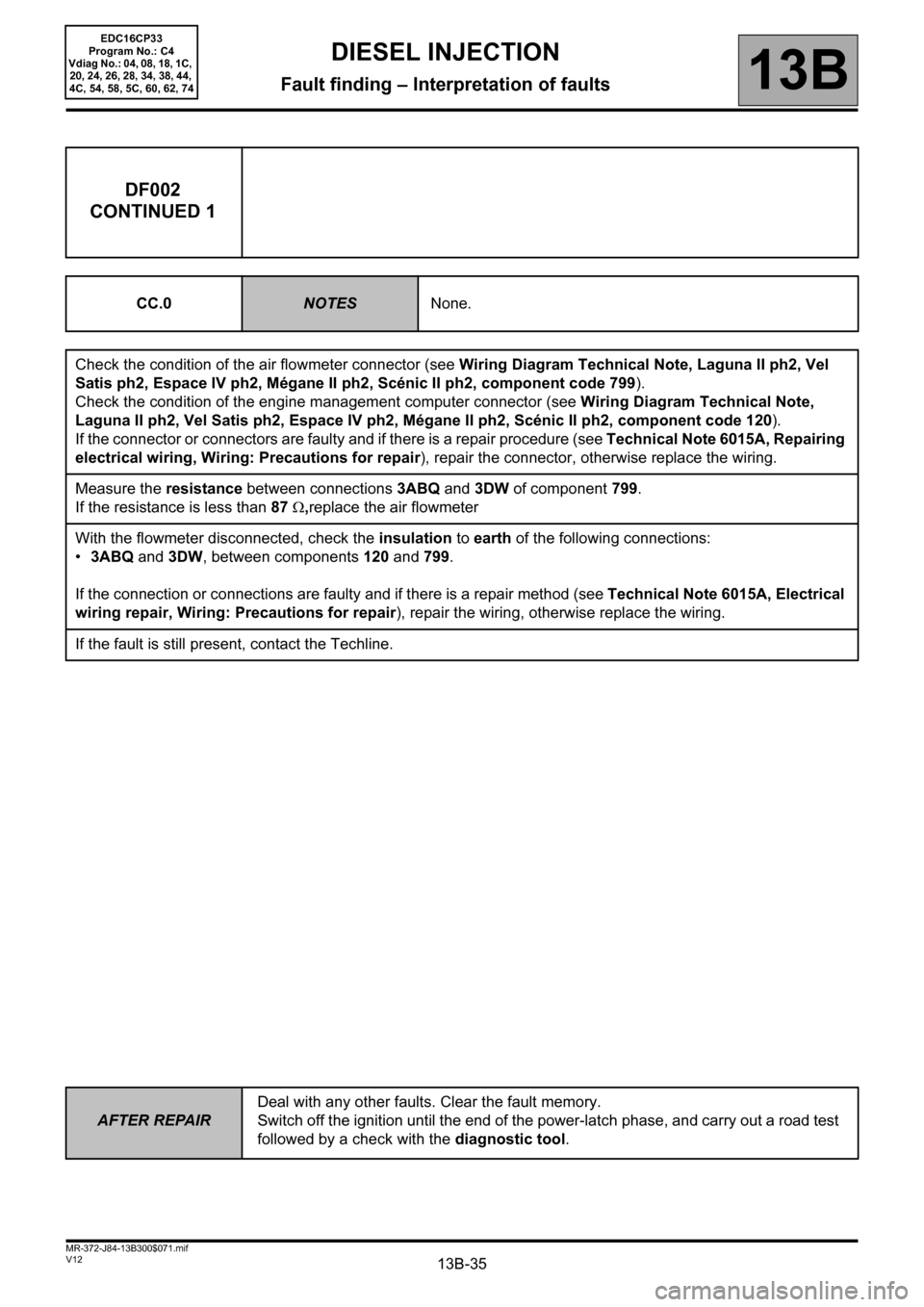
13B-35
AFTER REPAIRDeal with any other faults. Clear the fault memory.
Switch off the ignition until the end of the power-latch phase, and carry out a road test
followed by a check with the diagnostic tool.
V12 MR-372-J84-13B300$071.mif
DIESEL INJECTION
Fault finding – Interpretation of faults13B
EDC16CP33
Program No.: C4
Vdiag No.: 04, 08, 18, 1C,
20, 24, 26, 28, 34, 38, 44,
4C, 54, 58, 5C, 60, 62, 74
DF002
CONTINUED 1
CC.0NOTESNone.
Check the condition of the air flowmeter connector (see Wiring Diagram Technical Note, Laguna II ph2, Vel
Satis ph2, Espace IV ph2, Mégane II ph2, Scénic II ph2, component code 799).
Check the condition of the engine management computer connector (see Wiring Diagram Technical Note,
Laguna II ph2, Vel Satis ph2, Espace IV ph2, Mégane II ph2, Scénic II ph2, component code 120).
If the connector or connectors are faulty and if there is a repair procedure (see Technical Note 6015A, Repairing
electrical wiring, Wiring: Precautions for repair), repair the connector, otherwise replace the wiring.
Measure the resistance between connections 3ABQ and 3DW of component 799.
If the resistance is less than 87 Ω,replace the air flowmeter
With the flowmeter disconnected, check the insulation to earth of the following connections:
•3ABQ and 3DW, between components 120 and 799.
If the connection or connections are faulty and if there is a repair method (see Technical Note 6015A, Electrical
wiring repair, Wiring: Precautions for repair), repair the wiring, otherwise replace the wiring.
If the fault is still present, contact the Techline.