ESP RENAULT WIND ROADSTER 2012 Owner's Manual
[x] Cancel search | Manufacturer: RENAULT, Model Year: 2012, Model line: WIND ROADSTER, Model: RENAULT WIND ROADSTER 2012Pages: 185, PDF Size: 5.52 MB
Page 102 of 185
air conditioning ..................................... (up to the end of the DU)
heating system ..................................... (up to the end of the DU)
air conditioning ..................................... (up to the end of the DU)
temperature regulation ......................... (up to the end of the DU)
ventilation ............................................. (up to the end of the DU)
heating and air conditioning system ...................... (current page)
3.18
ENG_UD11524_2
Air conditionné : informations et conseils d’utilisation (X77 ph2\
- Renault)
ENG_NU_865-6_E33_Renault_3
aiR ConDitioning: information and advice on use
Fuel consumption
You will normally notice an increase
in fuel consumption (especially
when driving in town) when the air
conditioning is operating. For vehi -
cles fitted with manual air condition -
ing, switch off the system when it is
not required.
advice for reducing consumption
and therefore helping to preserve
the environment:
Drive with the air vents open and
the windows closed.
If the vehicle has been parked in
the sun, open the doors for a few
moments to let the hot air escape
before starting the engine.
Maintenance
Refer to the Maintenance Document
for your vehicle for the inspection
frequency.
Do not open the refriger -
ant fluid circuit. The fluid
may damage eyes or skin.
note
Presence of water under the ve -
hicle. After prolonged use of the air
conditioning system, it is normal for
water to be present under the vehi-
cle. This is caused by condensation.
operating faults
As a general rule, contact your ap-
proved Dealer in the event of an op-
erating fault.
– Reduction in de-icing, demist -
ing or air conditioning per -
formance . This may be caused
by the passenger compartment
filter cartridge becoming clogged.
– no cold air is being produced.
Check that the controls are set
correctly and that the fuses are
sound. Otherwise, switch off the
system.
Do not add anything to the
vehicle’s ventilation circuit
(for example, to remove
bad odours).
t here is a risk of damage or of
fire.
Page 103 of 185
electric windows ................................... (up to the end of the DU)
child safety ............................................................. (current page)
children (safety) ..................................................... (current page)
sunroof .................................................. (up to the end of the DU)
3.19
ENG_UD24366_2
Lève-vitres électriques (E33 - X33 - Renault)
ENG_NU_865-6_E33_Renault_3
Electric windows
eleCtRiC winDows
operation
With the ignition switched on, press the
switch for the relevant window upwards
to raise it to the desired height.
Press the switch for the window con -
cerned downwards to lower it to the de-
sired height.
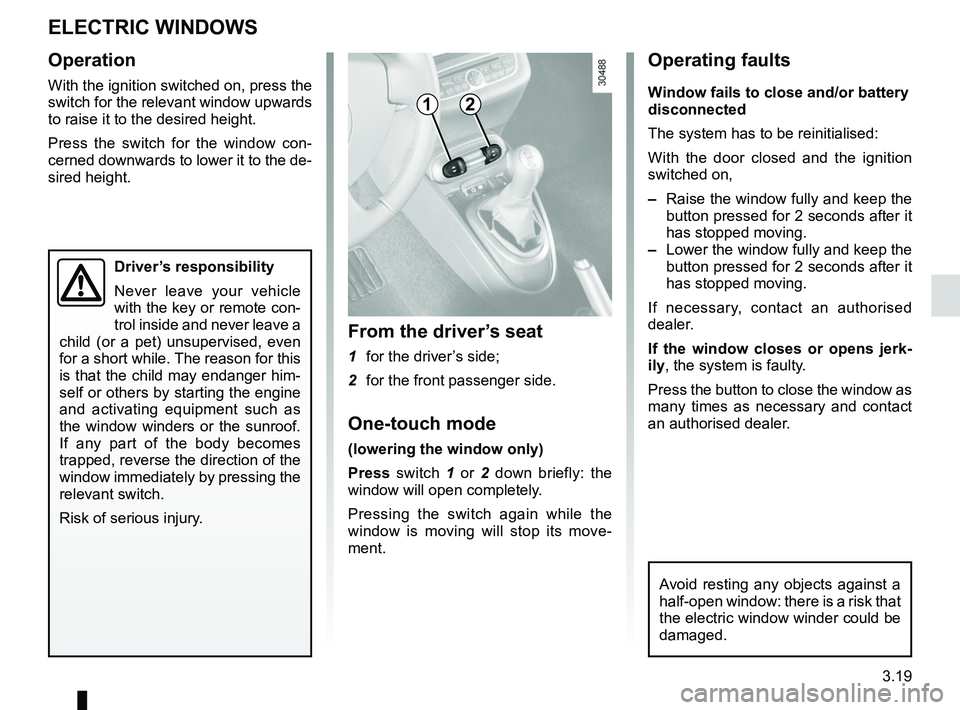
From the driver’s seat
1 for the driver’s side;
2 for the front passenger side.
one-touch mode
(lowering the window only)
Press switch 1 or 2 down briefly: the
window will open completely.
Pressing the switch again while the
window is moving will stop its move -
ment.
Avoid resting any objects against a
half-open window: there is a risk that
the electric window winder could be
damaged.
1
Driver’s responsibility
Never leave your vehicle
with the key or remote con-
trol inside and never leave a
child (or a pet) unsupervised, even
for a short while. The reason for this
is that the child may endanger him-
self or others by starting the engine
and activating equipment such as
the window winders or the sunroof.
If any part of the body becomes
trapped, reverse the direction of the
window immediately by pressing the
relevant switch.
Risk of serious injury.
2
operating faults
w indow fails to close and/or battery
disconnected
The system has to be reinitialised:
With the door closed and the ignition
switched on,
– Raise the window fully and keep the
button pressed for 2 seconds after it
has stopped moving.
– Lower the window fully and keep the
button pressed for 2 seconds after it
has stopped moving.
If necessary, contact an authorised
dealer.
i f the window closes or opens jerk -
ily, the system is faulty.
Press the button to close the window as
many times as necessary and contact
an authorised dealer.
Page 121 of 185
battery................................................... (up to the end of the DU)
4.11
ENG_UD11219_1
Batterie (E33 - X33 - Renault)
ENG_NU_865-6_E33_Renault_4
Battery
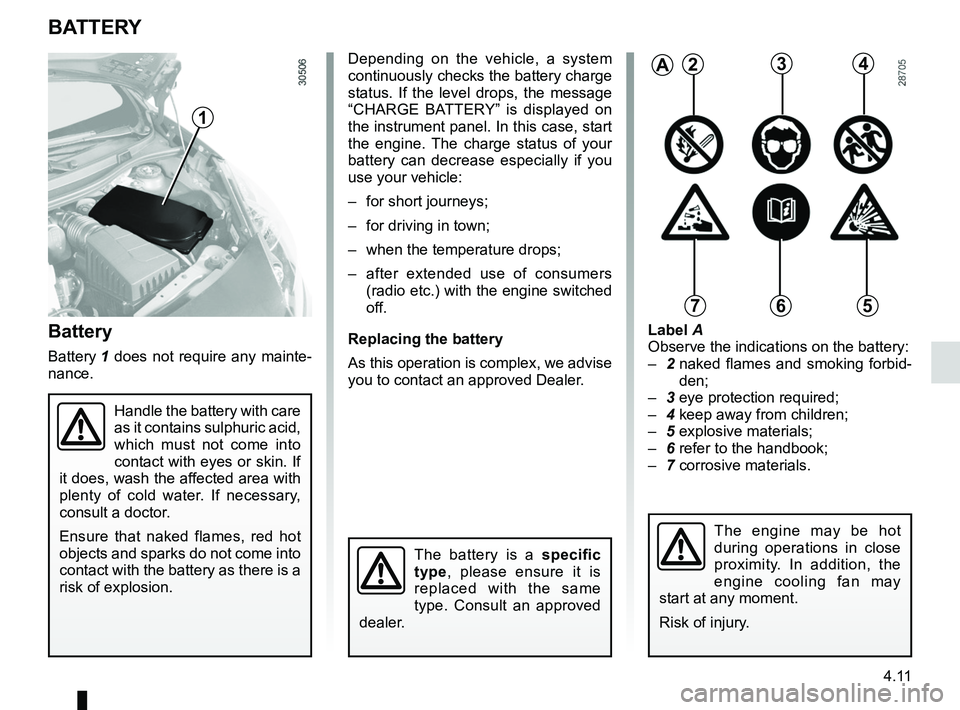
Battery 1 does not require any mainte-
nance.
Battery
Handle the battery with care
as it contains sulphuric acid,
which must not come into
contact with eyes or skin. If
it does, wash the affected area with
plenty of cold water. If necessary,
consult a doctor.
Ensure that naked flames, red hot
objects and sparks do not come into
contact with the battery as there is a
risk of explosion.
BA tteR y
Depending on the vehicle, a system
continuously checks the battery charge
status. If the level drops, the message
“CHARGE BATTERY ” is displayed on
the instrument panel. In this case, start
the engine. The charge status of your
battery can decrease especially if you
use your vehicle:
– for short journeys;
– for driving in town;
– when the temperature drops;
– after extended use of consumers
(radio etc.) with the engine switched
off.
Replacing the battery
As this operation is complex, we advise
you to contact an approved Dealer.
The engine may be hot
during operations in close
proximity. In addition, the
engine cooling fan may
start at any moment.
Risk of injury.
A234
567
The battery is a specific
type , please ensure it is
replaced with the same
type. Consult an approved
dealer.
1
label A
Observe the indications on the battery:
– 2 naked flames and smoking forbid-
den;
– 3 eye protection required;
– 4 keep away from children;
– 5 explosive materials;
– 6 refer to the handbook;
– 7 corrosive materials.
Page 123 of 185
JauneNoirNoir texte
4.13
ENG_UD30003_4
Entretien de la carrosserie (E33 - X33 - Renault)
ENG_NU_865-6_E33_Renault_4
BoDyWoRk MAintenAnCe (2/2)
y ou should
Wash your car frequently, with the
engine off, with cleaning products rec-
ommended by the manufacturer (never
use abrasive products). Rinse thor -
oughly beforehand with a jet:
– spots of tree resin and industrial
grime;
– mud in the wheel arches and under -
neath the body which forms damp
patches;
– bird droppings , which cause a
chemical reaction with the paint that
rapidly discolours paintwork and
may even cause the paint to peel
off;
wash the vehicle immediately to
remove these marks since it is im -
possible to remove them by polish -
ing;
– salt, particularly in the wheel arches
and underneath the body after driv -
ing in areas where the roads have
been gritted.
Remove any plant matter (resin, leaves,
etc.) from the vehicle regularly.
Clean the roof cover using a soft cloth. Respect local regulations about wash
-
ing vehicles (e.g. do not wash your ve-
hicle on a public highway).
Observe the vehicle stopping distances
when driving on gravelled surfaces to
prevent paint damage.
Repair, or have repaired quickly, areas
where the paint has been damaged, to
prevent corrosion spreading.
Remember to visit the body shop pe -
riodically in order to maintain your
anti-corrosion warranty. Refer to the
Maintenance Document.
If it is necessary to clean mechani -
cal components, hinges, etc., spray
them with products approved by our
Technical Department to protect them
after they have been cleaned.
We have selected special products
to care for your vehicle and you can
obtain these from the manufactur -
er’s accessory outlets.
Using a roller type car wash
Return the windscreen wiper stalk to
the Park position (refer to the informa-
tion on the “Windscreen washer, wiper”
in Section 1). Check the mounting of
external accessories, additional lights
and mirrors, and ensure that the wiper
blades are secured with adhesive tape.
Remove the radio aerial mast if your
vehicle is fitted with this equipment.
Remember to remove the tape and refit
the antenna after washing.
Cleaning the headlights
As the headlights are made of plastic
“glass”, use a soft cloth or cotton wool
to clean them. If this does not clean
them properly, moisten the cloth with
soapy water, then wipe clean with a soft
damp cloth or cotton wool.
Finally, carefully dry off with a soft dry
cloth.
Cleaning products containing alco -
hol must not be used.
Page 146 of 185
5.20
ENG_UD24358_4
Fusibles (E33 - X33 - Renault)
ENG_NU_865-6_E33_Renault_5
Jaune NoirNoir texte
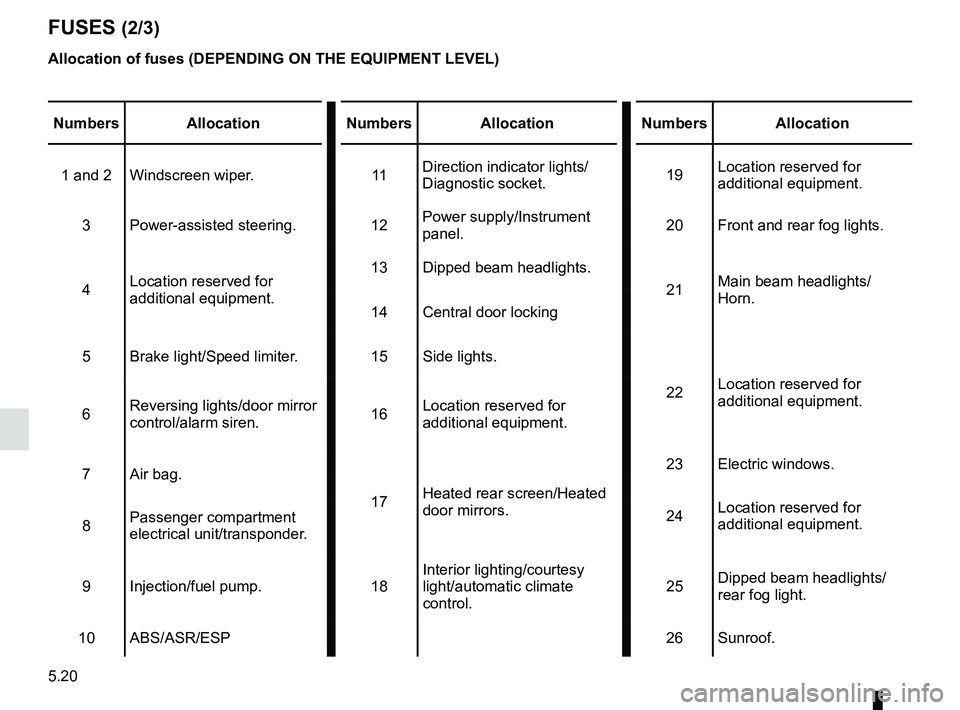
allocation of fuses (dePendIng On tHe eQuIPment LeVeL)
Fuses (2/3)
numbers allocation numbersallocation numbersallocation
1 and 2 Windscreen wiper. 11Direction indicator lights/
Diagnostic socket. 19Location reserved for
additional equipment.
3 Power-assisted steering. 12Power supply/Instrument
panel. 20
Front and rear fog lights.
4 Location reserved for
additional equipment. 13
Dipped beam headlights.
21Main beam headlights/
Horn.
14 Central door locking
5 Brake light/Speed limiter. 15Side lights.
22Location reserved for
additional equipment.
6 Reversing lights/door mirror
control/alarm siren. 16Location reserved for
additional equipment.
7 Air bag.
17Heated rear screen/Heated
door mirrors. 23
Electric windows.
24 Location reserved for
additional equipment.
8 Passenger compartment
electrical unit/transponder.
9 Injection/fuel pump. 18Interior lighting/courtesy
light/automatic climate
control. 25
Dipped beam headlights/
rear fog light.
10 ABS/ASR/ESP 26Sunroof.
Page 152 of 185
wiper blades ......................................... (up to the end of the DU)
wipers blades ............................................. (up to the end of the DU)
5.26
ENG_UD21917_3
Balais d’essuie-vitres (X95 - E95 - E33 - X33 - Renault)
ENG_NU_865-6_E33_Renault_5
Wipers (replacing blades)
WIndscreen WIPer BLades
Check the condition of the wiper
blades. You are responsible for their
service life:
– clean the blades and the wind -
screen regularly with soapy
water;
– do not use them when the wind-
screen is dry;
– free them from the windscreen
when they have not been used
for a long time.
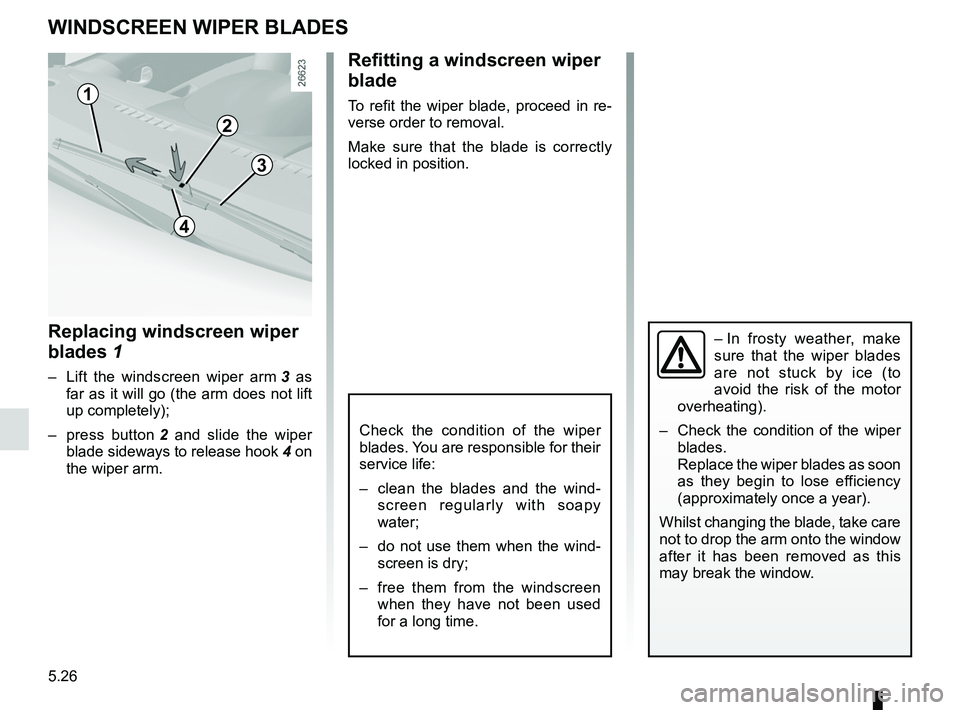
replacing windscreen wiper
blades 1
– Lift the windscreen wiper arm 3 as
far as it will go (the arm does not lift
up completely);
– press button 2 and slide the wiper
blade sideways to release hook 4 on
the wiper arm.
– In frosty weather, make
sure that the wiper blades
are not stuck by ice (to
avoid the risk of the motor
overheating).
– Check the condition of the wiper
blades.
Replace the wiper blades as soon
as they begin to lose efficiency
(approximately once a year).
Whilst changing the blade, take care
not to drop the arm onto the window
after it has been removed as this
may break the window.
3
1
2
4
refitting a windscreen wiper
blade
To refit the wiper blade, proceed in re-
verse order to removal.
Make sure that the blade is correctly
locked in position.
Page 154 of 185
operating faults ..................................... (up to the end of the DU)
practical advice ..................................... (up to the end of the DU)
faults operating faults ............................... (up to the end of the DU)
5.28
ENG_UD20505_2
Anomalie de fonctionnement (E33 - X33 - Renault)
ENG_NU_865-6_E33_Renault_5
Jaune NoirNoir texte
Operating faults
OPeratIng F auLts (1/7)
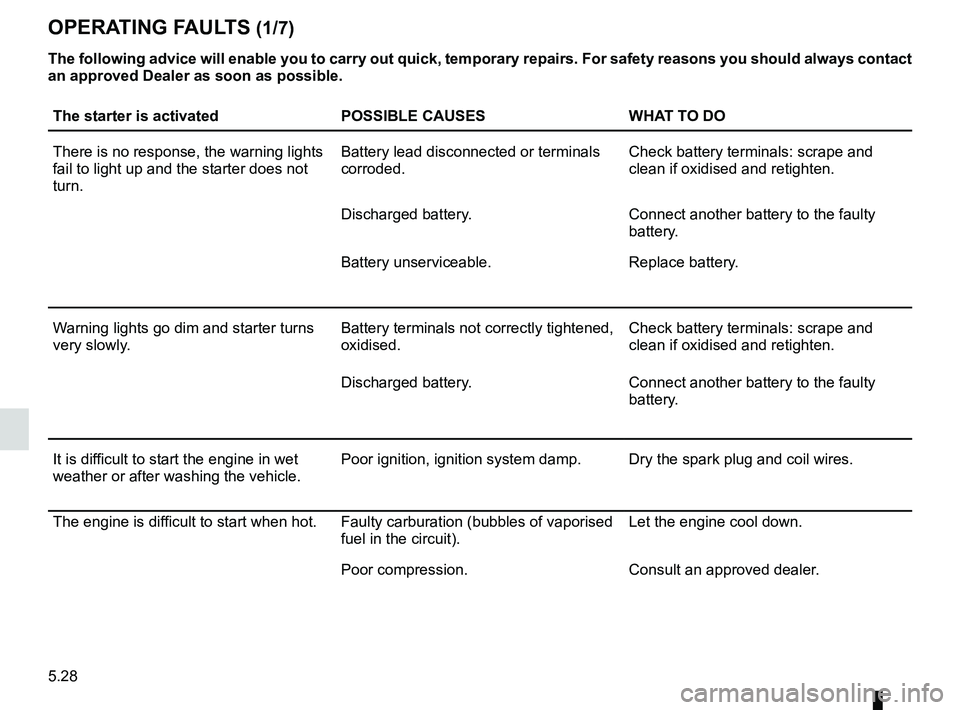
the following advice will enable you to carry out quick, temporary repairs. For safety reasons you should always contact
an approved dealer as soon as possible.
the starter is activated POssIBLe causesWHat tO dO
There is no response, the warning lights
fail to light up and the starter does not
turn. Battery lead disconnected or terminals
corroded.
Check battery terminals: scrape and
clean if oxidised and retighten.
Discharged battery. Connect another battery to the faulty
battery.
Battery unserviceable. Replace battery.
Warning lights go dim and starter turns
very slowly. Battery terminals not correctly tightened,
oxidised.Check battery terminals: scrape and
clean if oxidised and retighten.
Discharged battery. Connect another battery to the faulty
battery.
It is difficult to start the engine in wet
weather or after washing the vehicle. Poor ignition, ignition system damp.
Dry the spark plug and coil wires.
The engine is difficult to start when hot. Faulty carburation (bubbles of vaporised
fuel in the circuit).Let the engine cool down.
Poor compression. Consult an approved dealer.
Page 162 of 185
vehicle identification ............................. (up to the end of the DU)
paintwork reference .......................................................... (current page)
vehicle identification plates ................... (up to the end of the DU)
technical specifications ......................... (up to the end of the DU)
6.2
ENG_UD30002_3
Plaques d’identification véhicule (X35 - E33 - X33 - Renault)
ENG_NU_865-6_E33_Renault_6
Vehicle identification plates
Vehicle identification plates
a
B
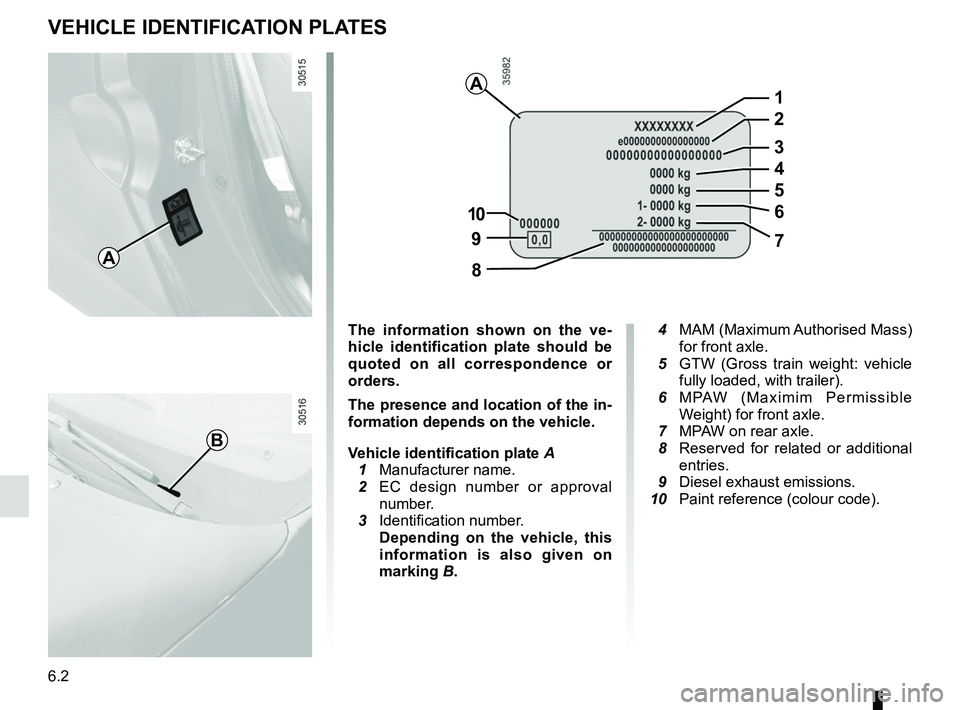
t he information shown on the ve -
hicle identification plate should be
quoted on all correspondence or
orders.
the presence and location of the in-
formation depends on the vehicle.
Vehicle identification plate A
1 Manufacturer name.
2 EC design number or approval
number.
3 Identification number.
depending on the vehicle, this
information is also given on
marking B.
4 MAM (Maximum Authorised Mass)
for front axle.
5 GTW (Gross train weight: vehicle
fully loaded, with trailer).
6 MPAW (Maximim Permissible
Weight) for front axle.
7 MPAW on rear axle.
8 Reserved for related or additional
entries.
9 Diesel exhaust emissions.
10 Paint reference (colour code).
a
97
8
10
5
1
2
3
4
6
Page 180 of 185
7.2
FRA_UD30001_7
Index (E33 - X33 - Renault)
ENG_NU_865-6_E33_Renault_7
Jaune NoirNoir texte
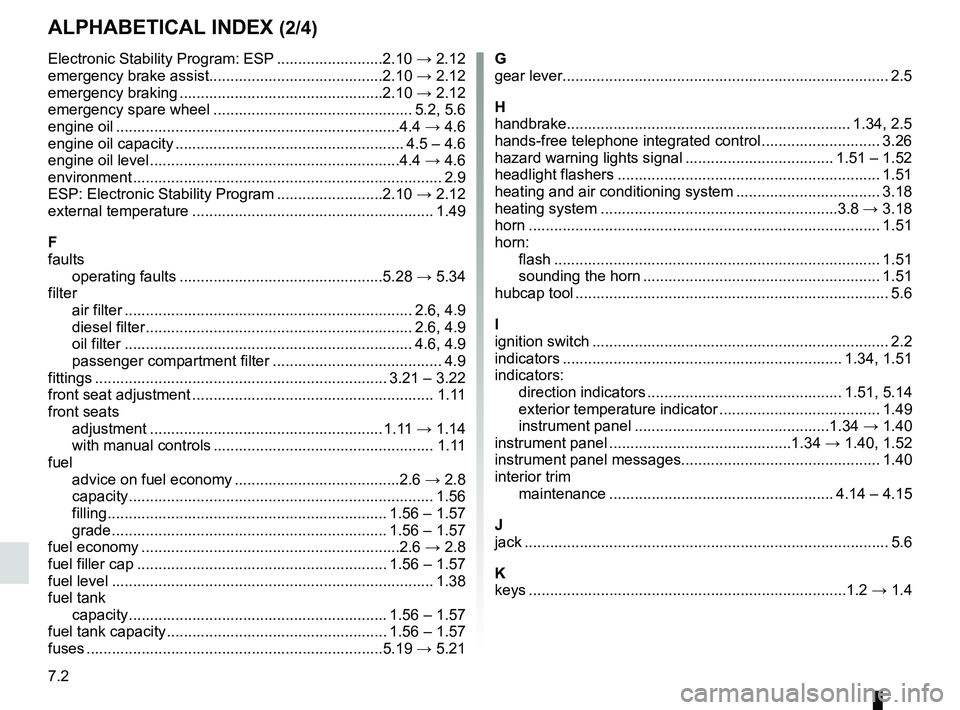
AlphAbeticAl index (2/4)
Electronic Stability Program: ESP .........................2.10 → 2.12
emergency brake assist ......................................... 2.10 → 2.12
emergency braking ................................................ 2.10 → 2.12
emergency spare wheel ............................................... 5.2, 5.6
engine oil ................................................................... 4.4 → 4.6
engine oil capacity ...................................................... 4.5 – 4.6
engine oil level ........................................................... 4.4 → 4.6
environment ......................................................................... 2.9
ESP: Electronic Stability Program .........................2.10 → 2.12
external temperature ......................................................... 1.49
F
faults operating faults ................................................ 5.28 → 5.34
filter air filter .................................................................... 2.6, 4.9
diesel filter ............................................................... 2.6, 4.9
oil filter .................................................................... 4.6, 4.9
passenger compartment filter ........................................ 4.9
fittings ..................................................................... 3.21 – 3.22
front seat adjustment ......................................................... 1.11
front seats adjustment ....................................................... 1.11 → 1.14
with manual controls .................................................... 1.11
fuel advice on fuel economy ....................................... 2.6 → 2.8
capacity ........................................................................ 1.56
filling .................................................................. 1.56 – 1.57
grade ................................................................. 1.56 – 1.57
fuel economy ............................................................. 2.6 → 2.8
fuel filler cap ........................................................... 1.56 – 1.57
fuel level ............................................................................ 1.38
fuel tank capacity ............................................................. 1.56 – 1.57
fuel tank capacity .................................................... 1.56 – 1.57
fuses ...................................................................... 5.19 → 5.21G
gear lever
............................................................................. 2.5
h
handbrake ................................................................... 1.34, 2.5
hands-free telephone integrated control ............................ 3.26
hazard warning lights signal ................................... 1.51 – 1.52
headlight flashers .............................................................. 1.51
heating and air conditioning system .................................. 3.18
heating system ........................................................ 3.8 → 3.18
horn ................................................................................... 1.51
horn: flash ............................................................................. 1.51
sounding the horn ........................................................ 1.51
hubcap tool .......................................................................... 5.6
i
ignition switch ...................................................................... 2.2
indicators .................................................................. 1.34, 1.51
indicators: direction indicators .............................................. 1.51, 5.14
exterior temperature indicator ...................................... 1.49
instrument panel .............................................. 1.34 → 1.40
instrument panel ........................................... 1.34 → 1.40, 1.52
instrument panel messages ............................................... 1.40
interior trim maintenance ..................................................... 4.14 – 4.15
J
jack ...................................................................................... 5.6
K
keys ........................................................................... 1.2 → 1.4